Showing posts with label akashic books. Show all posts

Monday, September 16, 2019

No Home In This Land - Rasaq Malik (Akashic Books)

Today's book of poetry:
No Home In This Land.  Rasaq Malik.  Akashic Books.  New Generation African Poets - Taro.  Brooklyn, New York. 2018.

Luckily for us there is some hope to be found in Rasaq Malik's No Home In This Land because there is some sad rain in Malik's world.  Today's book of poetry is almost embarrassed to address some of the issues facing Malik as a norm, they are so foreign to us here in Canada.  Foreign in anything except the news.  Our poets worry about publication and literary festivals.  Rasaq Malik's generation of Nigerians worry about war, baby soldiers, the weaponized madness of the dispossessed.

No Home In This Land starts with one breath-taking body punch, ala Sir Joe Frazier, and then before you can catch your breath, before you can inhale needed oxygen, Malik digs down from his knees and cannon shots another into your ribs, even the sturdiest reader buckles at the knees.  Malik's Nigeria is unforgiving and bleak.

At Dalori Camp
After Abubakar Adam Ibrahim's
Losing and Finding Love in the Time of Boko Haram

The women stretch their legs as their malnourished infants
suck disease-infected breasts, as another day begins with
fear lurking in their eyes, as they remember their relatives
at home, their families waiting at the doorsteps every night,
their beloveds searching for them every day, their dreams
dismantled by war, their hope the frail light in the lantern
they carry every night to search for the bodies of the dead.

The women weep as they see their children hold
the dusty photographs of their fathers, as they remember
the soldiers raping them every night, the soldiers
littering their bodies with scars nothing can erase.
They remember the corpses paving the streets,
bodies wrapped and disposed like waste
beside desolate houses. The women wake up
every day to see rooms filled with new refugees
trucks filled with few relief materials for the displaced.

The women watch their children lie on the mats,
as another night begins with people searching
for the meaning of home in the sadness of a woman washing
the blood-soaked dress of her daughter, in the silence
of a man returning home to meet the dismembered
bodies of his wife and children, in the sorrow of a widow
living with solitude. The women search for the meaning
of home whenever they wake up to see bullet holes on the walls,
whenever the pieces of their beloveds fill the streets,
whenever they receive letters from missing loved ones,
notes from relatives in prison, flowers from dying parents to their children.

💫💫💫

Rasaq Malik does find some tenderness, some reasons for hope even in the face of almost systemic chaos.  Malik does not explain the unexplainable but he does report it with wounded candor.

What poet wouldn't blanch at the spectacle of his country falling apart around them?  Malik chooses to enter the fray in order to better report the truth of it.  Federico Garcia Lorca did the same thing in Spain but didn't make it through.  We get first hand reportage in poems, some disguised as dispatches and other disguised as prayers.  But Malik abides, he stays on the ground and bears witness.

At Today's book of poetry the important thing is the poem and Rasaq Malik doesn't let us down.

Grateful

For life after the bombings, for the love that cradles us in spite of the war
that wrecks our land, for joy in the cries of infants in their mother's arms.

Grateful for little things, for my son's dream of building the world,
for people waking up every day to marvel at the birds that fill the sky.

Grateful for friends that visit us, relatives that send letters to us,
people that open their doors for us when war looms in the sky.

Grateful for the rivers that become a confluence, fields that house our
children when they gather to explore childhood moments.

Grateful for answered questions, for the walls that bear the frames
of our pictures, for the windows that usher in air.

Grateful for things that shape us into better things, things that lift our hands
when we fill the night with cries, things that unchain our passion for bliss.

Grateful for husbands that return home safely to meet their wives and children
waiting for them at doorsteps, for mothers whose children remember.

Grateful for things that survive, for children whose lives become maps
for us to trace, for God's infinite mercy over us.

Grateful for the meals taken at normal hours, for shared compassion,
for songs that soothe our troubled hearts.

Grateful for the ones who kiss our brows and say, we will be fine,
for the ones who stretch their hands filled with gifts for us to take home,

for the ones who phone at late hours to ask if we are fine,
for the ones whose names mean the world is a haven.

Grateful for my mother's stable health, for my father's strong bones,
for the assurance of kindness when we need it.

Grateful for those who, in spite of their sad
hearts, offer us every bright thing in the world.

💫💫💫

Our morning read followed the emotional ups and down of Rasaq Malik's poetic landscape.  And, once again proved that all poems improve from reading out loud to an audience.  Rasaq Malik's No Home In This Land loves being read aloud.

Today's book of poetry read Rasaq Malik's muscular and disturbing No Home In This Land several times in our desire to get inside the poems.  At least two of the those reads took place in the comfort of our big bed, the beautiful K beside us, reading her latest and resting one of her tiny feet against my leg.  Today's book of poetry read Malik in the safety of our bed, in our safe neighbourhood, in our safe city, in our safe country.  Today's book of poetry doesn't feel guilty but the same time we don't feel right about our safe lives knowing full well that in many parts of the world that assumption can't be made.  In some parts of the world feeling safe is the last thing you are allowed to do.

Rasaq Malik challenged himself and then us when he decided to see Boko Haram from the inside.  He bravely bares witness for the many who cannot.  No Home In This Land is knock-out poetry.  A big, big price was paid for each of these poems.

In This Village Where Every Dawn
Begins With A Funeral

In this village, where a child draws the image
of his dead mother on a cardboard,
where a man covers the pieces of his wife's body
with leaves, where flowers replace bodies
buried in exile, where the muezzin's voice recedes
as gunshots assemble people at the scene, where the dead
long for a mass funeral in order to escape the agony
of being devoured by crows, where a woman translates her grief
by sitting on the tomb of her child, they cook dinner with
bloodstained water. The earth widens beneath feet,
as people trace the footprints of lost beloved
with lanterns and return to their huts to meet the mangled
bodies of their children. Here, broken women seek healing,
and men are burdened with the role of burying
their dead. Here, my grandmother's graveyard decked
with a vase of writhed wreaths, my uncle's farmland is razed
to dust, and my family's house is turned into a hollow during war.
In this village there are unmarked graves, tombstones bearing
the names of ambushed soldiers, blood-draped walls of old houses,
remnants of burnt homesteads, ruins of bombed stores, fallen branches
and dry twigs. The hills house refugees, camps built in the desert,
lands converted to cemeteries. The girls here live with the scars of rape,
the boys are weaned by war, elders stagger as they walk
to where a country becomes a shadow, a memorial ground.
The portraits of the dead are taped to the walls,
with the broken slates of children who will never return home
to enjoy childhood years, to meet the streets glowing
with streetlights, to listen to the radio once again, to bathe in the river,
to climb mango trees, to adorn their necks with catapults,
to dance in the rain and listen to stories at dusk.

💫💫💫

Akashic Books' New-Generation African Poets: A Chapbook Box Set -  (Tano) is an annual project that brings much excitement to our offices upon arrival.  Today's book of poetry suspects it is because some of the very best, most exciting, vibrant poetry we've experienced is contained in these collections.  There is always a bit of a polite "dust-up" over who gets what when - but it does all get shared and adored.

As taken as Today's book of poetry has been with various other books from these excellent collections, Rasaq Malik's No Home In This Land raises the bar just that much higher.  Malik pulls no punches, his love is witness honest and abides his searching for truth.  These poems burn, bright.

Image result for rasaq malik photo

Rasaq Malik

ABOUT THE POET
Rasaq Malik is a graduate of the University of Ibadan, Nigeria. His work has appeared or is forthcoming in various journals, including Michigan Quarterly Review, Poet Love, Spillway, Rattle, Juked, Connotation Press, HEArt Online, Grey Sparrow, Jalada, and elsewhere. He is a two-time nominee for Best of the Net. He has been nominated twice for the Pushcart Prize and was shortlisted for the Brunel International African Poetry Prize in 2017.


785

DISCLAIMERS

Poems cited here are assumed to be under copyright by the poet and/or publisher.  They are shown here for publicity and review purposes.  For any other kind of re-use of these poems, please contact the listed publishers for permission.

We here at TBOP are technically deficient and rely on our bashful Milo to fix everything.  We received notice from Google that we were using "cookies"
and that for our readers in Europe there had to be notification of the use of those "cookies.  Please be aware that TBOP may employ the use of some "cookies" (whatever they are) and you should take that into consideration.


Monday, August 27, 2018

Bone Light — Yasmin Belkhyr (Akashic Books)

Today's book of poetry:
Bone Light.  Yasmin Belkhyr.  New-Generation African Poets.  Akashic Books.  Brooklyn, New York.  2017.

35484282

Yasmin Belkhyr's first poems hit you like a sequence of surrealist dreams — but in these dreams, enough is familiar to the reader that reasonable assumptions can be made.

Bone Light is where hearts get ripped out of your dreams.  Not romantic love-hearts; bloody muscles pulsing red, hot and wet.  Yasmin has seen the chicken clucking shortly before being introduced to the pot, the red meat walking by moments before hitting the grill.  These poems, in themselves, are not metaphor but fact.

Belkhyr's youthful persona is a presence in Bone Light as is a shimmering beginning to the first calls of sensuality.  But Belkhyr has a bigger purpose in mind.  These poems bridge continents and cultures; Morocco is in these poems, Yasmin is from Morocco, but so is America.

In these poems America represents both heaven and hell, escape and misfortune, Mecca and main street.  Bone Light fights against stereotypes but America is always going to be the promised land, always going to be an evil empire.

Interlude with Forgotten Myth, or,
Portrait of Ibrahim's Daughter

I have a recurring dream in which my father breaks the neck of every pigeon
in the park. I help: a good daughter. I snatch them from the air & tear out the
feathers. Bloody. In the stories, there was a king named Ibrahim & he loved
his god. No one calls me foreign but I know that's what they mean. In the
stories, girls like me sweat out the fevers, drop dirty guns in the trash chute.
We rip the rabbit's heart right out of its fucking chest. All the red-soaked
skin under our fingernails. All I do is think about stories. About history, or
his story, or her story, or my story. They're all the same story really. Someone
always ends up holding something mangled.

💫💫💫

"Someone always ends up holding something mangled."- Belkhyr

That's a line Today's book of poetry wants to remember.  Maybe even borrow.

Today's book of poetry loved how these short prose poems performed.  In concise form with a language collected from several shores Belkhyr dropped poetry bomb after poetry bomb until our score card ran out of spaces for check marks.  Yasmin Belkhyr reached blast velocity with the first poem in this splendid collection and never took her hand off of the throttle.

Yasmin Belkhyr has taken some of the titles in Bone Light from the sacred text of the Quran, others from the mouths of Moroccan women of experience.  Today's book of poetry sees no dogmatic pretense behind any of these slick poems.  Belkhyr makes her blind turns with her foot on the gas and a tight grip, fingers splayed, on the hand-brake.

Laylat Al-Qadr

I don't own any mirrors. In sleep, I scrape ticks off the windows. Once, a bird
startled itself into the apartment and I was alone. If I throw a nickel off the
bridge, I'm thinking about my niece. While the city slept, sound dripped slow
down the street. An unnatural thing. The festering mess to suddenly damped
and quiet. None of the wounded dogs moaned. None of the children woke
curled around ghosts. During the day, I wore a loose dress and bought pastries
from a bakery and thought of all the people I'd like to touch. At night, I 
imagined the ways I could sink. My little fears and aches, the stupid rust in
my chest. Define: daughter. Define: obligation. Define: heartless. I swear, I'd
be better if I could. The girl was named Rumisa and I read to her in English
and that's all you need to know.

💫💫💫

Today's morning read was a typical early Monday morning fiasco.  Thankfully Yasmin Belkhyr's taught and tender poems brought out the best in each of us.  Kathryn, our Jr. Editor, jumped to the lead and started assigning poems, which was perfect.  Someone has to light the fire.

Yasmin Belkhyr reminds Today's book of poetry how much we really do not know about Africa, Morocco, women.  Belkhyr and the other poets (Victoria Adukwei Bulley, Mary-Alice Daniel, Chekwebe O. Danladi, Len Bezawork Gronlund, Ashley Makue, Momtaza Mehri, Famia Nkansa, Ejiofor Ugwu, chimwemwe Undi) from The New Generation African Poets series are going to clear some of that up for us.

& We Have Never Owned Casablanca

It's hard to find work, a man on the train tells me. He asks if I am married,
if I have a boyfriend. I'm seeing someone, I lie. We are cramped together in
the doorway, late August, the train a bullet streaking to the airport. My
suitcases are between us, his mother sitting beside the door. Miles sweep by,
sea becoming country becoming city becoming sea again. Here, it all leads to
water. They're building a new city. Between Kenitra and Mehdia,he says. Piece
by piece, the cities reach for each other. The train jolts: he grabs my arm, steadies
me, horribly intimate. I could build, he says, but my hands are too soft. Outside
the window, a flash of children chase chickens in a grassless yard. Do you like
strong men? He has a stain on his shirt and moist palms. His mother smiles
at me, squeezes her son's arm. She offers me a warm date, a firm strawberry.
I think you are very beautiful, he says, What is your name? The train slows to a
stop: outside, the waves thrash against the rocks, beating them smooth.

💫💫💫

Yasmin Belkhyr can sound like she is treading carefully, walking softly, but that's just the invitation, the ticket in.  Once you are in Belkhyr world she will rattle your cage.  Bone Light is a delight for poetry addicts like Today's book of poetry.  We can't wait to see what she does next.

Image result for yasmin belkhyr photo

Yasmin Belkhyr

ABOUT THE AUTHOR
Yasmin writes. She was born in Salé, Morocco, grew up in NYC, and now lives and studies in Amherst, Massachusetts. You can read some of her published poems here. Her chapbook Bone Light was published in 2017 by the African Poetry Book Fund and Akashic Books. In 2013, Yasmin founded Winter Tangerine, an independent literary and arts journal. She now acts as the Editor-in-Chief. She is also the founder and EIC of Honeysuckle Press.

BLURBS
"Across dreamscapes, across landscapes of Morocco and America, across layers of memory and emotion, Belkhyr deftly writes through complicated imagery and reflections.... In the compact space of a chapbook, Bone Light demonstrates Belkhyr as a bold and necessary voice."
     — Emily Corwin, Monstering Magazine

"What is delightful is how quickly the poet establishes her sense of layered narrative in the book and the effect it exerts on her poems. Throughout the book, Belkhyr influences through this kind of manipulation, which transforms her poems into vehicles that draw readers in, as water is attracted to travel through every crevice it ultimately passes."
     — Bruce Arlen Wasserman, New York Journal of Books 


Yasmin Belkhyr
2014 National Young Arts Week
Video: Young Arts


716

DISCLAIMERS

Poems cited here are assumed to be under copyright by the poet and/or publisher.  They are shown here for publicity and review purposes.  For any other kind of re-use of these poems, please contact the listed publishers for permission.

We here at TBOP are technically deficient and rely on our bashful Milo to fix everything.  We received notice from Google that we were using "cookies"
and that for our readers in Europe there had to be notification of the use of those "cookies.  Please be aware that TBOP may employ the use of some "cookies" (whatever they are) and you should take that into consideration.

Sunday, December 3, 2017

Blood for the Blood God - Mary-Alice Daniel (Akashic Books)

Today's book of poetry:
Blood for the Blood God.  Mary-Alice Daniel.  New-Generation African Poets.  Akashic Books.  Brooklyn, N.Y.  2017.

<h3> Blood For the Blood God | Mary-Alice Daniel </h3>

Mathew Shenoda's illuminating preface to Mary-Alice Daniel's Blood for the Blood God suggests that her poems use an "internalized" voice and speak in an "ethereal" language but Today's book of poetry is convinced that Mary-Alice Daniel has an international voice, one that breaks down boundaries.  I know because it reaches all the way back to Maiduguri, Nigeria, where Daniel was born.  But that is a flash point starting place on the grid because Daniel's spent time in London, England, she spent time in Nashville, Tennessee.  This strong, strong voice went to Yale.

Mary-Alice Daniel is a rare find.  She's lived where we live and knows what we know.  But she has other knowledge that lingers, she knows things we don't know, the history of another continent as a birthright and all this globetrotting helps to create a voice that we should want to hear.

Blood for the Blood God

You can do to a body a lot of things,
A feature in Smithsonian on cannibals makes me hungry.

I'm learning so much--they use bodies as ritual snacks,
eating everything but teeth, hair, and penis.

(Toenails as pills for stomachache.)

You can view bodies with aequanimitas--that clinical practice--
emotional distancing, as of a doctor:

                          humans otherwise caught in a net of cable wires,
                          humans assimilated into the larger borg.

Or you can want them put down.
Eliminate 350,000 bodies a year to reach optimum population:

If they assume the fetal position,
they can be slaughtered in orderly fashion.

You can make pain principles out of anything: unripe papaya.
You can pickle a man in a five-foot-tall glass jar.

Take more men on field trips over battlefields
as melancholy meat: silhouettes of the national scene.

You can explain the disappearance of a people by making myth--
say that conquistadors stacked bodies,

then poured cement of top, built them into houses--
thumbed their noses at haunting and good engineering.

Now zip things in and out of a body
surgically like a Sunday purse.

Wonder how bodies came to be like this...
...Cannibals use bodies like we all must.

This is the best way, the only natural way:
in anger, in heat. One lonely cannibal,

so upset by his wife's truancy,
twice burned down his own tree house.

...

Mary-Alice Daniel talks about nightmares in these poems.  She instructs us that the five most common types of nightmares are:

Tooth falling out
Falling
Public
Naked
Chased

Today's book of poetry has had a taste of all those old standbys with the exception of the "tooth falling out."  Considering the atrocious dental care of my youth and all my missing teeth along with my propensity for nightmares you'd think it would top the list.  Nope, for Today's book of poetry it's all about the chase dream.  All night long.  I try to physically run out of our bed in my sleep, scream when the blankets restrain me.  Mary-Alice has it right from the start when she says "dream-logic won't save you."  Daniel hits the proverbial nail on the head with aplomb when she refers to us human beans as "long pigs."

Mary-Alice Daniel has a vice-grip view on the human spectacle and these poems throb with it.  On first read you might conclude that these poems are looking for new spaces for their emotional light to blossom, new places to spread out.  Today's book of poetry would argue that the only additional space needed by Mary-Alice is a bigger book.  Blood for the Blood God is ample proof that there is more to this voice that can be contained in a chapbook.  This is taut and tasty and tight poetry.

For My Uncle
Who Died Of Aids
Contracted At The Dentist's Office
(He Had A Toothache)

1.     If he dies during the Month of Brides it is a great shame.
2.     Wash the body 3 or 5 or 7 times--Never 2 or 4 or 6 times.
3.     We see Allah rearranging candlesticks in the starry hall of heavens,
                   creating spectral shapes, undoing them
                   and remixing the music of the situation,
                   in widening circles containing us in these compulsions,
                   as He wonders which fires He has left unextinguished.
4.     Who commits to us these instructions?
                   Your heavenly blameless Father,
                   His prophets and your earthly fathers:
                   superstitions and blind notions.
5.     Welcome all to the funeral: Buddhists, followers after Christ,
                   those who believe in Chang'e, that lady in the moon
                   who sweeps her vast cold place all alone.
6.     Remember the small black dogs your mother dreamt devoured
                   each other in play near the incense pit, and know:
                   if there are night visions, there are mystical visions.
                   There must be a heaven, gods' birthplace--
                   therein resides Allah.
7.     The face must point toward the House of God in Mecca:
                   the living always walk beside or in front of death.
8.     Into the grave, place no object!
9.     Avoid burial at sunrise, high noon, and sunset.
10.   Allow neither music nor emotional outburst,
                    for though we surrender our dead to the earth,
                    forward from it
                                             we shall bring them      
                                                                             once again.

The procedure described above is the only correct one.
To Him do we belong and unto Him is our return.

...

The morning read in the Today's book of poetry offices was interrupted by bacon and eggs, French toast, beans, maple sugar, toast, more bacon.  Orange juice, milk, coffee, tea and at least one Coca-Cola.  

When we got around to the reading part we took our usual turns with Mary-Alice Daniel's Blood for the Blood God.  Otis, our translator, dropped by this morning and translated one of Mary-Alice's poems to Farsi and then read that version to us.  It sounded perfect, and really, how would we know otherwise.  But music is always music.

Mary-Alice Daniel is coming from an aesthetic that most of us can only understand as an intellectual exercise.  If you are white and privileged, and everyone at Today's book of poetry is white and privileged, your narrative doesn't include having ancestors who were slaves.  Our white and privileged ancestors owned slaves.  Bridging that historical, ethical, moral divide is one of the things good poetry can do.

Feel Better

You strap them in a wheelchair crazy as hallelujah
Those amongst us with no impulse control I mean zero

Useless meat puppets                                 Carnival of bad animals
Show them a picture of eyelash mites no eyelashes seconds later

Chaya in Algeria believed the world would die when the Large Hadron Collider
                                                                                                                  rebooted
She  thought   Earth  would  crack up and everyone would get pulled like a body
                                                                                                   just getting pulled

Her father tried to divert her attention no such thing
A black hole                                    That's a bad end
The television is irresponsible saying eclipse is omen

The rabble rushes to temple ignoring scientists warning nothing to fear calm
                                                                                       yourselves calm calm
No wonder humans are called long pigs                              Not only for taste

Chaya ran from the evening news straight to the bleach you've already guessed
                                                                                                     she chugged it

That isn't cosmic that's belly pain that's human
Goodbye to your mother with chlorine on your breath

Hallelujah is the wrong word to begin with so start over
Tiny tiny crazy baby steps toward mass compulsion

...

Today's book of poetry is excited to share a second volume (of nine) from the New-Generation African Poets: A Chapbook Box Set (Nine).  Blood for the Blood God follows Today's book of poetry's report on Chekwube O. Danladi's Take Me Back.  In the coming weeks and months Today's book of poetry will be looking at another two or three of the titles from Akashic Books splendid assemblage of chapbooks.

Mary-Alice Daniel writes intimate poems that span continents and belief, and she does it with grace.  Today's book of poetry can only wait for a full-length collection from a voice this smart and true.

Image result for mary-alice daniel photo

Mary-Alice Daniel

ABOUT THE AUTHOR
“Mary-Alice Daniel was born in Maiduguri, Nigeria—birthplace of Boko Haram, the terrorist group that specializes in kidnapping the girl child. She was raised in Hausaland and in England. Since adolescence, she has called these places home: Nashville, Maryland, New Haven, Brooklyn, and Detroit. She attended Yale University and was selected by U.S. Poet Laureate Louise Glück to receive the Clapp Fellowship, an award supporting a postgraduate year of poetry composition. She received her MFA in Poetry from the University of Michigan as a Rackham Merit Fellow. Her poems have received three Pushcart Prize nominations and have appeared in American Poetry Review, New England Review, Black Warrior Review, Hayden’s Ferry Review, Callaloo, and several anthologies. Her adopted home is Los Angeles, where she is completing her first full-length poetry manuscript and earning a PhD in Creative Writing and English Literature as an Annenberg Fellow at the University of Southern California.”

BLURB
"To enter into Mary-Alice Daniel's Blood for the Blood God is to embrace a space where time can be suspended or simply conducted in the deeper regions of the imagination, where clocks have no business being. Here it is always night, the past is always present, and there is always a sense of hunger and affliction. We find in her poems a quiet and searing voice intent on reinterpreting the world to create from it a new logic, a logic that seeks, perhaps out of an ultimate desire for healing or redirection, to understand how well humanity has worked to feel the blood god."
     - Mathew Shenoda

akashicbooks.com

636

DISCLAIMERS

Poems cited here are assumed to be under copyright by the poet and/or publisher.  They are shown here for publicity and review purposes.  For any other kind of re-use of these poems, please contact the listed publishers for permission.


We here at TBOP are technically deficient and rely on our bashful Milo to fix everything.  We received notice from Google that we were using "cookies"
and that for our readers in Europe there had to be notification of the use of those "cookies.  Please be aware that TBOP may employ the use of some "cookies" (whatever they are) and you should take that into consideration


Friday, July 28, 2017

Take Me Back - Chekwube O. Danladi (New-Generation African Poets - Akashic Books)

Today's book of poetry:
Take Me Back.  Chekwube O. Danladi.  Edited by Kwame Dawes and Chris Abani.  New-Generation African Poets.  Akashic Books.  Brooklyn, New York.  2017.

“No one has a body that cannot be broken.”

New-Generation African Poets arrived at the doors of Today's book of poetry a couple of months ago with considerable fanfare.  It is a stunning boxed set of nine chapbooks.  To quote Akashic Books:

"New Generation African Poets: A Chapbooks Box Set (Nine), edited by Kwame Dawes and Chris Abani, is an annual project of the African Poetry Book Fund--established through the generosity of Laura and Robert F.X. Sillerman and published in collaboration with Akashic Books--which seeks to identify the best poetry written by African authors working today, with a special focus on those who have not yet published their first full-length book of poetry."

Today's book of poetry has chosen Chekwube O. Danladi's Take Me Back as the first chapbook from this series to grace our page.  Over the coming months Today's book of poetry will be looking at another four titles from this exceptional offering from Akaskic Books.  

Chekwube O. Danladi tries "to mask the lust/oozing from me" as she says in the poem Tomorrow, Chaka Demus Will Play, but it turns out that it isn't quite possible.  And just so you know, Chaka Demus is a Jamaican reggae musician.

Tomorrow, Chaka Demus Will Play

while I braid my hair long / thump coconut oil between
the sections / crack palm nut with my teeth / rub the
meat on my belly / I'll want to go dancing  / might
go to the Shake and Bake / I'll bless Ma with a slash /
tuck a miniskirt in my purse for later / might wear lip
-stick too / there'll still black henna on my hands from
Zaynab's wedding / they might bend around a black
man's waist / we'll dance like we're blood / we'll both
wonder / was the slave trader your ancestor or mine? /
his rum-laced tongue will coat my lobes / I'll think of
Mama / while he bonds with me / I can get home myself /
I'll say / I'll creep in / past Mama on the sofa / drink coffee
to mask the lust / oozing from me / I'll eat leftover jollof
cold from the pot / I'll heave / I might struggle / with sleep

...

These poems wrestle with a sexuality that seems to have escaped the bounds of gender.  Danladi has concerns with colonization and the dark history that frames all of the present and past but in the back and front of her libidinous mind she's working over both the notion of her sexual pleasure and the sexual politic.

Take Me Back certainly feels like a book written from a position of strength, Danladi has all the justified confidence of a seasoned and mature poet in her young voice.

When I First Encountered Kwame Nkrumah's
Crypt, I laughed

The sun-blanched effigy gleamed,    Mine was the sun-blanched body,
                       the body of a haunt hot for wanting,    skirting the pull of visibility
                                    the crypt emerging that way   in a thrust the dead enact,
                       that wants to be seen in its unseeing,   pretending to want to be forgotten,
                    if the unseen could ever be so humble.   as if we can shun character.
                   They did not even let the man die here,   Osagyefo found his own end.
                      but there was love in the return, sure,   Consider the sweetness of forgiving.
           as I too have dug graves that hold no bones.   Perhaps he is not even in there.
How many times must a man go on dying?   Perhaps he has gone on living elsewhere.
Could a father ever be that dead?   Is this the malediction of exile?
                     Would weeping be more appropriate?   I should have wept more thoroughly but
                                               Humour took hold as   I let the mirthful musing rack me.
                                     I thumbed the fringe stones.  The crypt is sanctuary for the displaced, I learn.
I left an offering of bronze.  I hoped for a Kente inlay.

...

Kwame Nkrumah (1909-1972) led Ghana to independence and was the first President following colonial rule.

In his preface to Take Me Back series editor Kwame Dawes speaks about Danladi and how her "imagination is happily wanton."  Danladi isn't afraid to draw blood, or when necessary, to let some of her own flow.  She realizes, intuitively, when to go for the jugular in a poem.

This is a strong and confident voice, the voice of an empowered woman, flexing.  These poems feel woman strong, purposeful.

At the World's End
For (and after) Kofi Awoonor

At a soft shore,
I have the salt, a
boning knife, candles
(two red, one black), a spool of
thread. Easy waves wane, coax flitting
fish. I have the cry of the wind while the moon gives birth
in the offing. Boss, this now is my own lament. History reigns as
cruelty, consumes more than it kills. I croak with the kingfisher here, thirst sated,
hunger not, but seeking, this loss a continued meditation; the ache of the
   wound keeps me
up at night. Still I ask: What may I offer you? What would be enough? May I
   weep-sing
near Keta Lagoon? To hope that when the water breaks open there, people may
   hear the
heat of your name? Sir, even the ocean quavered, even death jostled. When my
wings mend, as night labors dawn, as the graves grow green, I will
burrow by the shoreline and meet you. I will have fruit and 
sun and song for you. Here is peace, have it.

...

Kofi Awoonor (1935-2013), was a Ghanian poet "who combined poetic traditions of his native Ewe people with contemporary and religious symbolism to depict Africa during decolonization."

Take Me Back is a strong first outing and Chekwube O. Danladi is a poet we will be on the watch for. Today's book of poetry agrees with Kwame Dawes when he speculates in his introduction about Danladi's future.  Dawes insists Danladi's future is incandescent, Today's book of poetry couldn't agree more.  No whimsy here.

Image result for chekwube o danladi photo
Chekwube O. Danladi

ABOUT THE AUTHOR
Chekwube O. Danladi is a Nigerian American writer of poetry and fiction. She was born in Lagos, Nigeria and raised in Washington, D.C. and West Baltimore. Yes, she knows someone who was in The Wire. Her work has appeared or is forthcoming in Apogee, PANK, Callaloo, Poetry International, and elsewhere. Her chapbook, titled Take Me Back, is forthcoming with the APBF New Generation African Poets series (Akashic Books, 2017). She lives in Champaign, Illinois with a wacky mutt named Goldie.


591


DISCLAIMERS

Poems cited here are assumed to be under copyright by the poet and/or publisher.  They are shown here for publicity and review purposes.  For any other kind of re-use of these poems, please contact the listed publishers for permission.

We here at TBOP are technically deficient and rely on our bashful Milo to fix everything.  We received notice from Google that we were using "cookies"
and that for our readers in Europe there had to be notification of the use of those "cookies.  Please be aware that TBOP may employ the use of some "cookies" (whatever they are) and you should take that into consideration.

Saturday, April 18, 2015

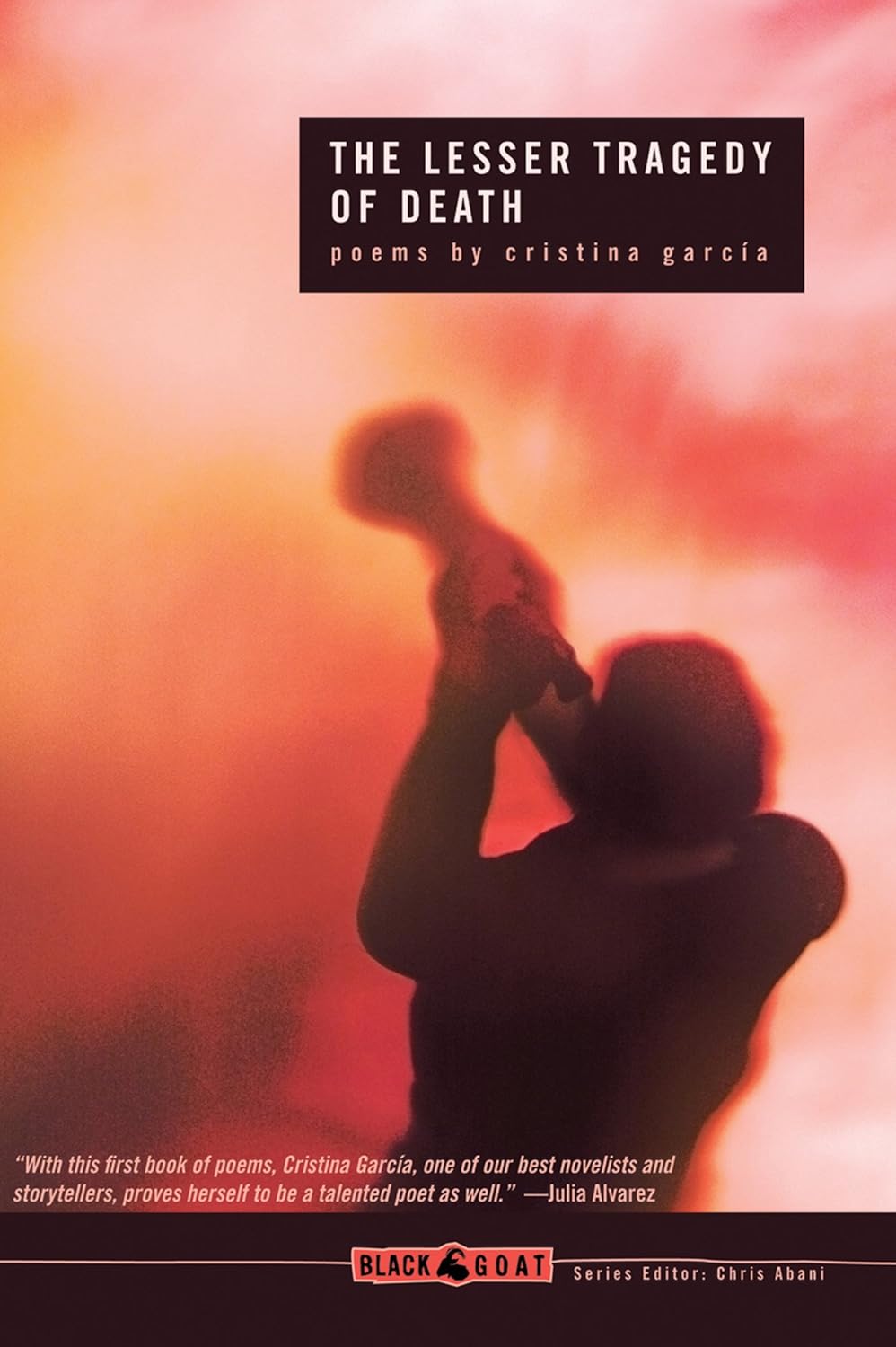
The Lesser Tragedy of Death - Cristina Garcia (Black Goat/Akashic Books)

Today's book of poetry:
The Lesser Tragedy of Death.  Cristina Garcia.  Black Goat/Akashic Books.  Brooklyn, N.Y.  2010.


This is family history writ large.  A brother - sister duet high on drama.  The Lesser Tragedy of Death is that slow motion accident unfolding in front of your ever widening eyes.

Cristina Garcia builds her brothers' character out a myriad of construction materials only to watch them cascade down around her family like sad building blocks.

Queens

We shamed you into leaving,

said you stank up the bathroom,
sprayed you with air freshener

until you choked.

You'd sneak off to E.J. Korvette's

to shit or wait till morning recess
at Catholic school where nobody

could blame just you.

Years later I learned this word
from a shrink: encopretic.

It means holding things in to bursting.
It means carrying the rage within.

...

The stacked deck of fate conspired against our handsome protagonist or the devil sought him out to dance for his own devilish amusement,  Either way his difficult journey from adored and beautiful child to outrigger, outlaw and out of family is perhaps a story we all know different versions of.

We here at Today's book of poetry like the honesty that Cristina Garcia brings to The Lesser Tragedy of Death.  This isn't journalism, there is no fact checking.  These poems feel real, true, tragic.

Forgetting

I'm not depressed like I hear you get,
wanting to blow your brains out, but a more-
of-the-same lifelessness that's getting me down.
Maybe I shouldn't be mucking through the past
like some sick archaeologist holding up
broken forks and making deductions. This
is our history we're talking about here, not
some ancient civilization we can opt out of.
Our parents are still alive and they're coming
to stay with me soon, and I want to be nice but
a part of me wants to read them these poems
and have them say, We were wrong, or
the thing they'll never say: We're sorry.
Well, I'm sorry, really sorry for hiding
out in these words instead of calling you and telling
you that I do remember and that it's much much
harder than forgetting.

...

The story arc of these poems wouldn't matter at all if the poems themselves weren't continuously compelling.  Garcia keeps it taut.  She gives us enough line to know there is something biting on the end, but she never leaves us stranded.

What You Believe

That you can speak to dogs.
That they don't listen to you.

That women are impenetrable,
except for the obvious.

That children should like you.

That it's possible to be a hero.

That the good things in life are bad for
you: mothers, malted milk balls, cocaine.

That there's a God but He's ignored you.

That a family awaits you.

That you suffer for cheapness.
(Are you listening, Dad?)

That one morning you'll wake up dead.
And that will be without pain.

...

The Lesser Tragedy of Death just resonated so true.  As the poems build from the cherubic infant Elvis to an inevitable end of dismay Cristina Garcia laments her brothers sad life, both the life they share and the life she can't share.  It is all sad terrain.

But very worthwhile poetry.

This is Garcia's first book of poetry.  Excellent start.

Cristina Garcia

ABOUT THE AUTHOR
CRISTINA GARCÍA is the author of several novels including Dreaming in Cuban and A Handbook to Luck, anthologies, and books for young readers. The Lesser Tragedy of Death is her first collection of poetry. García’s work has been nominated for a National Book Award and translated into a dozen languages. She is a Visiting Professor and Black Mountain Institute Teaching Fellow in Creative Writing at the University of Nevada, Las Vegas.

BLURBS
“The Lesser Tragedy of Death is a brave and moving tribute to a brother gone astray. With skill, unflinching honesty, and redemptive compassion, Cristina García tracks his marvelous, complex, and errant life . . . These poems are the beautiful, painful, astonishing result of a journey to hell and back in search of the brother she loves. With this first book of poems, Cristina García, one of our best novelists and storytellers, proves herself to be a talented poet as well.”
—Julia Alvarez, author of Saving the World

“Cristina García has the courage to look tragedy in the eye without flinching . . . In spare, luminous brushstrokes of language, García paints a series of portraits, from the boy who fell off a bicycle to the desperate mugger wrestling with an old woman over her purse. The cumulative effect is haunting, yet ultimately redemptive. There is power in García’s insistence that we see her brother as a human being, in all his complexity and mystery. You won’t forget these poems, or the story they tell.”
—Martin Espada, author of The Republic of Poetry

Cristina Garcia
Story Hour in The Library
video courtesy of: University of California Television (UCTV)
Cristina Garcia is the author of five novels, a collection of poetry, and three works for young readers including her newest release "Dreams of Significant Girls" about three wealthy and adventurous ninth-grade girls from different worlds who converge upon a Swiss boarding school for a summer of discovery. Series: "Story Hour in the Library" [4/2012]

(Today's book of poetry couldn't find a video of Cristina Garcia reading poetry, sorry.)


328

Poems cited here are assumed to be under copyright by the poet and/or publisher.  They are shown here for publicity and review purposes.  For any other kind of re-use of these poems, please contact the listed publishers for permission.