Showing posts with label dean rader. Show all posts

Tuesday, July 3, 2018

Ordinary Monsters — Justin Bond (Mongrel Empire Press)

Today's book of poetry:
Ordinary Monsters.  Justin Bond.  Mongrel Empire Press.  Norman, Oklahoma.  2017.
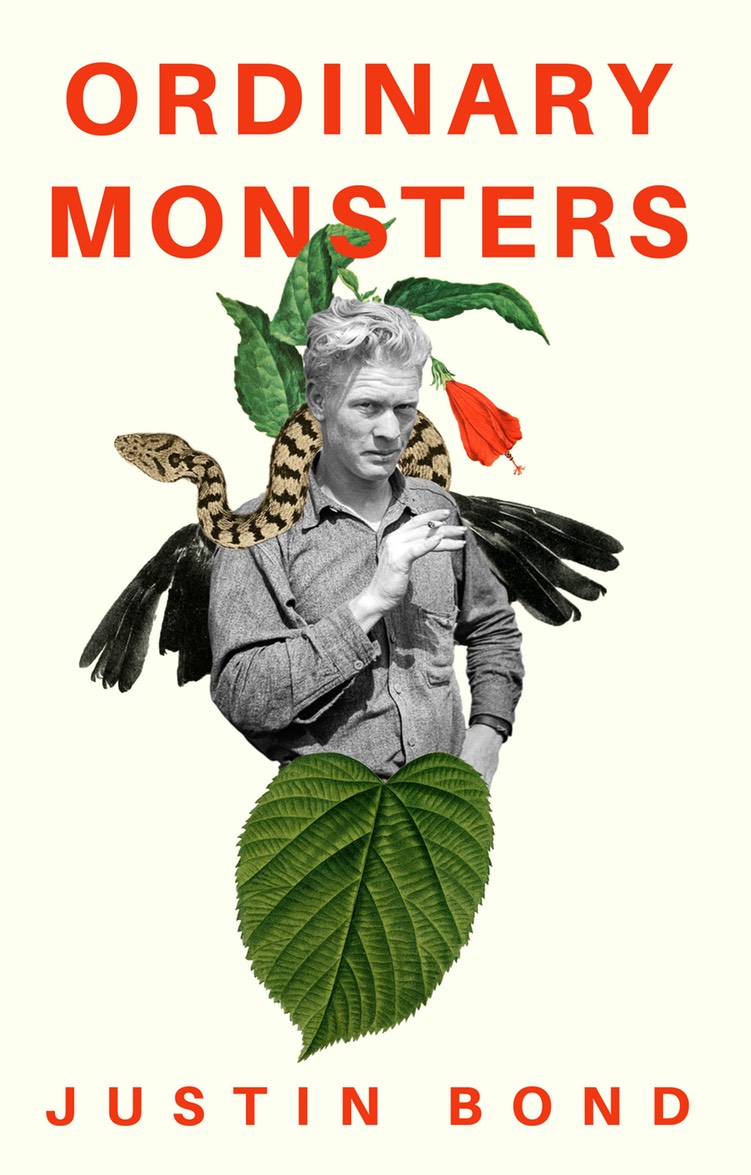
FrontCover

"And as you lie in bed
like an effigy of yourself
it is the ordinary that comes to save you."
                                                                                                         Linda Pastan
                                                                                                         The Ordinary

Justin Bond's Ordinary Monsters blooms open like some splendid bruise you have to touch just to see how much it is going to hurt.  Then you need to reassure yourself, was that pain or pleasure, and you touch the bruise once more.

Perhaps comparing poetry to a bruise is unfair and misleading but Bond can stand the heat.  These poems are plain beautiful, and wise, and witty.

Today's book of poetry can be clueless, and clueless we were, not realizing that Justin Bond was gay.  This man's lovely love poems transcend gender.  Beauty is always in the eye of the beholder, we take that as a given.  Bond takes up some of that territory between love and lust, he uses these tight poems to bridge that gap.

The Right Way to Want Me

The
way
Madonna
wants
to 
devour
Lady Gaga
probably
head
first
strand
by
strand
of 
bleached
blonde
ambition
the 
super
ego
subsuming
the
id
unless
you
would 
consider
that
reductive

...

Justin Bond just comes off so damned smart with his big heart and compassionate brain.  Ordinary Monsters made Today's book of poetry laugh, cry and even momentarily, uncomfortably horny.  That particular poem is one my lovely wife of twenty-five years will probably want to read.  (Hello Sweetie)

The clumsy point Today's book of poetry is trying to make is that these poems are universal.  By being honest with himself Bond unveils some of the deep truths we are all tethered to regardless of our preferences in plumbing.

There is a real hopeful stance to Justin Bond's poetry.  Ordinary Monsters is dense with optimism in the face of overwhelming odds, and the reader will follow Bond anywhere he cares to go.  After the first couple of poems of Ordinary Monsters there was no doubt about Today's book of poetry being a Justin Bond fan.                                                                                        

The Wolf on His Deathbed, Remorseless

Let it not be forgotten
that I was no more or less
than the sum of my instincts.

Would you blame me for hunger?
A girl moved like flame through the forest.
Even now she smolders the brush of those dead years.

Blood is untamable.
She was weak, I was not,
and this world will not let you choose.

...

And after the "wolf" poem, Today's book of poetry knew we were in deep.  Mr. Bond can burn with the best.

Last evening, Today's book of poetry was on the front porch with the fore mentioned K, we were talking about Wisława Szymborska, because it was her birthday.  Later today I will pull out some Szymborska from the stacks and add them to the reading pile on K's side of the bed.  K has a very low tolerance for bad, so-so and mediocre poetry.  I only dare leave her "the best of the best of the best" as Rip Torn would have said if Men In Black were about poetry.  I won't hesitate to add Bond to K's reading pile either.

Ordinary Monsters

Once when I was a child
walking alone to my grandma's house
I saw something scary in the woods.
I still remember the snap of the twig
like a crunching of bone
that startled me silent mid-song,
the dun-colored fur covering the leg
that stepped out from behind the trunk
of an old pecan tree,
foreign and sapling-thick.
How I ran, clumsily and blindly, fearing
the thing all children secretly fear most:
the fairytale come to life.

We grow up and the world grows
smaller. The monsters it breeds
have become a more ordinary variety,
hairy-legged and hungry,
some wearing the faces of people
I tell myself I might want to love.
But even as I feel myself opening
to receive them, I shut my eyes tight
as two fists, I can't bear to look back
at the forest behind me.

...

Ordinary Monsters made for an excellent morning read here at Today's book of poetry.  The one complication was that as we don't have air conditioning in the Today's book of poetry offices, we were forced into the basement to get out today's blog/review.  There's a big fan on the box where I've got my computer.  My computer itself sits on it's own "cooling fan" base.  But sometimes things burn up - it was 35 C in Ottawa yesterday, with the humidex it was 110 F, hotter than Baghdad.

It's going to remain very hot all week so I've given orders to cover up the windows and doors.  But it is too late; our first floor is blistering hot, the second floor has turned to liquid magma, last time I checked it was 374 C.

The staff reading itself was great, Bond speaks with such a lovely, almost gallant voice and his poems make the reader sound intelligent.  Our crew like that.

Justin Bond reminded Today's book of poetry of the wide variety of voices needed to make up a choir, and they are out there in the poetry ether, yawping Whitmanesque, brilliant voices.

Gay poet, gay poetry.  Today's book of poetry is absolutely certain this poetry transcends my ability/desire to label it.  If you are a regular Today's book of poetry reader you will probably be at the point where you just let the poems speak for themselves.  That would always be excellent advice, but dear reader, please know, please trust me, when I say that we have a poetry loving staff working hard to bring you the very best poetry we can find - regardless of gender or choice of public restroom.

Justin Bond's poems are simply beautiful beasts you'll recognize as they work their way through to your poetry heart.


Justin Bond

ABOUT THE AUTHOR
Justin Bond was born, raised and educated in Oklahoma. He is the author of the chapbook Going Native (Red Bird 2014). His work has been included as part of The Pulitzer Remix (a National Poetry Month initiative), performed in Emotive Fruition’s 2016 Pride performance, and nominated for a Pushcart Prize. He lives and works in New York City.

BLURBS
"All of the new thinking is about loss," Robert Hass once wrote. "In that, it resembles all of the old thinking." Gay poet Justin Bond's gorgeous debut collection pays beautiful, painful homage to this human tradition. These pages steep the reader in passion and grief, stark and gleaming. They nourish us with lust, lyricism and the will to go on, which is, as Bond says, "part of what elevates us above a clumsy gallop of meat and bone.”
—Ruth L. Schwartz, winner of the National Poetry Series prize,
Autumn House Press Poetry Prize, Anhinga Prize for Poetry, AWP Award Series prize.

"The story of us,” writes Justin Bond, “is the story of America.” The smart, insightful, and revelatory poems of Ordinary Monsters are themselves stories of us (both reader and writer) but also of this vast and bizarre country.
And like our country, Bond’s poems are diverse, ambitious, and explosive.
Walt Whitman would love their big, expansive, democratic heart. You will too.
—Dean Rader, winner of the 2010 T. S. Eliot Poetry Prize,
2010 Writer's League of Texas Poetry Prize, and the George H. Bogin Award from the Poetry Society of America

mongrelempire.org

701
DISCLAIMERS

Poems cited here are assumed to be under copyright by the poet and/or publisher.  They are shown here for publicity and review purposes.  For any other kind of re-use of these poems, please contact the listed publishers for permission.
We here at TBOP are technically deficient and rely on our bashful Milo to fix everything.  We received notice from Google that we were using "cookies"
and that for our readers in Europe there had to be notification of the use of those "cookies.  Please be aware that TBOP may employ the use of some "cookies" (whatever they are) and you should take that into consideration

Wednesday, November 15, 2017

This Sweet Haphazard - Gillian Wegener (Sixteen Rivers Press)

Today's book of poetry:
This Sweet Haphazard.  Gillian Wegener.  Sixteen Rivers Press. 
San Francisco, California.  2017.


These remarkable poems seem to do two things at once, they gently reassure you that all will eventually be okay, until it's not.  Gillian Wegener's This Sweet Haphazard plays both ends against the middle as though she were a rationalizing mall-mom, but dressed like a gun-slinger underneath.

Or we can approach This Sweet Haphazard this way.  How does Wegener know what she knows?  The precision of her approach, how a neighbour who doesn't want to rock the boat by telling her firework-crazy neighbour that she hates fireworks.  Only to find herself pleasurably lost in the beauty of same, the final spectacle spectacular and Wegener finds the beauty.  And then to fold that like taffy, Wegener twists to the real end of the poem where accuracy takes over and the smoke and the dust from the fireworks obscure the real beauty of the night sky, all those stars burning bright.  Wegener pulls off this sort of savvy machination repeatedly, seemingly at will.

America by Train

America passes by the window like a set of slides being shown too fast.  Here are
the desert scenes with long stretches of blank landscape, but you know that it's 
all in the details. How the gray-green cactus will open up the most beautiful pink
flower for just one day, but you'll never see that flower from this train window.
How the lizard will wait on its rock for the unfortunate cricket to land and
become a tiny meal. You won't hear the screech of the hawk welcoming sunset
or see the startle of the mouse in hearing that cry. What you can see is brown
and gray and vaguely green, with the wide, darkening sky overhead, and it's like
holding a book you know will be a good read but that you aren't allowed to open.
      But here are the passengers, their unchosen details out for display. The
man and wife who argue about every little thing in hard whispers and then
in loud voices, not quite shouts, not much softer, but not really meant for
the entire car to hear. She has something to say about how he shaves. He has
something to say about the way she cooks turkey. She is wearing a yellow hat
fifty years too late for yellow hats with small cloth daisies, and he has a cane
that he whittled himself, and they are going from Bakersfield to Kansas to see
her sister. He has something to say about that, too. Another passenger peels
an orange, and another says he was attacked by dogs in Indonesia and is going
home to get treatment, but the sores on his arms and face don't speak of dogs,
and the gloss of fever means everyone for the most part leaves him alone, and
what he wants most is a mug of tea, but because he is so tired, he decides to wait
it out. Another passenger walks ahead for a smoke. A baby sleeps on her father's
shoulder. The conductor reads a magazine and wishes he were elsewhere.
      And America passes by like that in the night, when the windows show
nothing but passenger reflections. It becomes New Mexico. It becomes
Oklahoma. It becomes a train moving through a world made up of nothing
but darkness punctuated by the little comma moon overhead. It becomes
a train standing still as the world moves past. The arguing couple grows
quiet, her head on his shoulder. The feverish boy sleeps and murmurs
with feverish dreams. The baby is awake and watching her own reflection
in the window, waving at her sweet new self as the night folds around us.

...

Well crafted almost sounds disparaging these days but Today's book of poetry still thinks that's how things should be done.  Gillian Wegener's poems are air-tight.

Frequent readers of Today's book of poetry will remember that we are suckers for a good list poem and Wegener obliges in fine form with a dandy, "The Old Mill Cafe."  Today's book of poetry would normally use it for fodder but frankly we were so smitten with Wegener's particular disposition that we were drawn to several other poems.  You meet women like Wegener every day, smart, decisive and decidedly kind and gentle (when she wants to be).  The wrong assumption that is often made is that these attributes reveal a weakness of some kind.  But the real lion doesn't always have to prove herself to be a lion.  She just is.  She can be as kind and gentle as needed.  Until she has to be that other kind of lion.

The Dyerville Giant

When a tree falls in a forest,
a tree like that, anyway,
with all those years ringing it,
having sprouted out of the soft earth
before Jesus was even a spark
in his Father's bright eye --
when a tree like that falls,
it cracks and echoes so that
even the gnats careening
in the sun near the creek
take pause. And when this tree
fell, the crash was like trains colliding.
The ground inhaled and held
its breath, waiting for impact.
The sound rolled through the forest
and made salamanders hide
in their damp burrows. It thundered
like a train wreck, and so
the townsfolk drove out
to the trestle to see the havoc,
while the fine silt of redwoods
rose and then settled
in the forest behind them.

...

Today's book of poetry's morning read was a slightly more subdued event than some of our recent escapades.  Milo, our head tech, and Kathryn, our Jr. Editor, apparently drank all of the Scotch in Vanier last night.  Their little wounded souls are being dragged around the office today like corpses with open wounds.  Neither of them appreciated this morning's Ornette Coleman concert over the office box.  His ground breaking saxophone and disharmonic reverberations were beyond their reason.  They didn't enjoy it at all.

Our reading was without musical accompaniment and Gillian Wegener's particularly humane kick at the proverbial can helped Milo and Kathryn see some light on the horizon through their caked and crusty eye-slits.  If for no other reason than they could see kindness still existed in the world at large.

This Sweet Haphazard

No one calls this town pretty.
Not with the dusty oleanders off the freeway
and the ragged fence boards of backyards
propped up with two-by-fours, and
the canals with their twin likes of slow and safe,
and the ash trees, dead branches dangling, and
the large, pale no-one's-home houses and
the foreclosed houses and the small houses
with their carefully tended geranium borders,
with the plum trees gone overripe and sticky.
No one calls this town pretty, with the heat
rippling of the parking lots and the sighs
of aunts and uncles sitting in the shade of garages
filled with cars that were once meant to go places,
and the church marquee scolding that
Jesus Did Not Read Porn, and the swarms
of mosquitoes buzzing the standing water
from the leaking sprinkler heads in the park.
And yeah, no one calls this town pretty
as the creek laps at its share of shopping carts,
and the untended grasses bleach dry by April,
and the public pools are mostly closed,
but the sky here turns indigo on summer nights,
and the hummingbird chases the sparrow
from the feeder, and the kids on the soccer field
run as fast as kids anywhere, oblivious
to the town around then, because after all,
it isn't so bad. It's an okay town.
We know where all the roads go,
and we know where to get good coffee,
and we know what time the train pulls through.
We know too we're more than soil, more than sky,
more than what you've read in the news,
and no, it isn't pretty, but we still live here, and
tonight the moon will rise, almost full,
over this sweet haphazard of home.

...

Gillian Wegener's long poem "Neighborhood" sounds a bit like every neighbourhood on earth from Minneapolis to Moscow, and from Houston to Helsinki.  Today's book of poetry felt a bit like going home when reading This Sweet Haphazard.  Not a home we've ever had but a place we'd like to be.

Gillian Wegener cooks.  Her sound reason gives us hope.

Gillian Wegener

ABOUT THE AUTHOR
Gillian Wegener is the author of three books of poetry: a chapbook, Lifting One Foot, Lifting the Other (In the Grove Press, 2001), and a full-length collection, The Opposite of Clairvoyance (Sixteen Rivers Press, 2008), and her new collection, This Sweet Haphazard (Sixteen Rivers Press, 2017). Widely published, she has won several awards for her work, including the Dorothy Sargent Rosenberg Poetry Prize in 2006 and 2007, and the Zócalo Public Square Prize for Poetry of Place in 2015. Wegener, a junior high teacher, lives with her husband and daughter in Modesto, where she coordinates and hosts the monthly Second Tuesday Reading Series. She is a cofounder of the Modesto-Stanislaus Poetry Center and has served as the poet laureate for the city of Modesto.

BLURBS
“In This Sweet Haphazard, Gillian Wegener turns her well-tuned ear, her sharp eye, and her considerable intelligence and humor to the California of lightning fires, bulldozed almond trees, and murky rivers with unpredictable currents, as well as that of clear desert night skies, foggy coastlines, and the green light that filters through the sequoias. She sees the beauty and melancholy all around her, and she approaches it with tenderness and without aesthetic pretension. This is a beautiful book of powerful poems.”
     —Jane Mead, author of World of Made and Unmade


“‘Place, to the writer at work, is seen in a frame,’ writes Eudora Welty. ‘Not an empty frame, a brimming one.’ Everything is brimming in Gillian Wegener’s fantastic new collection of poems: rivers, bees, the Old Mill Cafe, forest fires, churches, Neville Bros. Service, the ghosts of Humboldt County, the streets, shops, and citizens of Modesto, California, and most importantly, the unmapped geography of the human heart. Candid and creative, Wegener charts past and present, interior and exterior, in order to create a poetic landscape we never want to leave.”
     —Dean Rader, author of Works & Days

Gillian Wegener
Sacramento Poetry Center
Video: Tim Kahl


629


DISCLAIMERS

Poems cited here are assumed to be under copyright by the poet and/or publisher.  They are shown here for publicity and review purposes.  For any other kind of re-use of these poems, please contact the listed publishers for permission.


We here at TBOP are technically deficient and rely on our bashful Milo to fix everything.  We received notice from Google that we were using "cookies"
and that for our readers in Europe there had to be notification of the use of those "cookies.  Please be aware that TBOP may employ the use of some "cookies" (whatever they are) and you should take that into consideration