Showing posts with label indolent books. Show all posts

Saturday, August 24, 2019

The Inside Room - Lisa Andrews (Indolent Books)

Today's book of poetry:
The Inside Room.  Lisa Andrews.  Indolent Books.  Brooklyn, New York.  2018.


Back in July of 2017 Today's book of poetry had the pleasure of writing about Lisa Andrews' charming chapbook Dear Liz.  You can see that blog/review here:


Today's book of poetry certainly was impressed by Lisa Andrews' Dear Liz, so it comes as no surprise to us here that The Inside Room caught our full attention.  The Inside Room is one splendid poetry adventure.  We suggest you leave a trail of bread crumbs, just in case.

At one time or another we have all played with fire, most of us have been at least a small time burnt.  Lisa Andrews is no Phoenix but she sure has some glow.

Gretel in the Forest

From the moment we entered the unfamiliar place in the forest
we knew we were meant to be eaten.

Even the trees spoke of it. We tongued the salt
                          from each other's bodies,
knowing our parent wanted us

to starve. The father—nothing;
                           the brother—
useless with crumbs in his pockets.

The one I could have loved, the one
                           who watched me devour her home—
pane by pane—satisfaction almost

splitting my body in two—I pushed her in.
                           I did this: barred the door,
listened at the hinge for hours

as she screamed my name—
                            it sounded like regret, as if
she never meant the fire.

                            ✽

In this forest where branches fall like axes
                             I guard a single fire. Nights I pluck
a blistered lump of coal, take it

in my palm. Her embers feed on me, kiss
                             my flesh. I clasp the coal and chant the names
of all the children I have saved.

Like small towns, they talk, want to know
                             exactly what my hand is doing
tending a fire nothing can satisfy—

💫💫💫

Lisa Andrews, like many of us, has a complicated relationship to her past and her parents.  The Inside Room is frighteningly intimate, detailing sins, incanting when necessary.  The Inside Room rides over the death of a father and the ensuing grief, all of it interlaced with a very distressing mother/daughter dynamic.  But nothing is simple in Andrews world, secrets are made and kept, dark secrets.

Lisa Andrews writes poems that pulsate with a wounded energy, that spark under the skin, that warning that tells when to run.  "None of us suffer in the dark" intones Andrews but Today's book of poetry thinks she is only being brave.

Exhibit

That day my mother told me,
You don't know anything
about me, I knew I couldn't touch
her either. Slippery with gin, she'd lie
on the tweed couch, a stone
goddess: headless, winged—
her shoulders chipped, an accident.

Too much of my other is visible.
All those parts that made me have turned
inside out. Her straps hang, metal clasps
click and swivel, murmur, Undo me,
but somebody's already gone
and done it. I am extraneous.

Oh Mother, my first museum—
how you matter to me. If only
you were half as delicate
as you seem.

Doors, locks, keys,
you open and shut—a hinge
I must have lifted once, flown
out of your body, an exhibit—
a girl you couldn't take back.

Oh Mother, the lights
are out, the statues asleep,
the paintings hang.

💫💫💫

Lisa Andrews starts The Inside Room with this quote:

     "With her it was like there was two places—the inside room
       and the outside room."
                                              CARSON MCCULLERS
                                              The Heart Is a Lonely Hunter

In her chapbook Dear Liz that clever and consistent Andrews started the action off another Carson McCullers quote:

     "And how can the dead be truly dead when they still
      live in the souls of those who are left behind?
                               
                                                CARSON MCCULLERS
                                                The Heart Is a Lonely Hunter

Nothing is by mistake.  Andrews is stating her intentions.  Like our much admired Carson McCullers, Andrews glows with a considerable portion of that southern dark and Gothic gloss.  It is a sensibility familiar with the weight of loss.

Andrews' The Inside Room builds on itself like a fairy tale rich with doom.  But just like McCullers, whom Today's book of poetry considers a truly great writer, Andrews creates a rich tableau in front of every one's fall from grace.  There are ghosts in these poems singing dirges just beyond our range.

Abduction

I liked it when he took me here.
My own flower with a hundred blooms, my own
chariot to hell.

My mother's a river now. Protected from the sun,
I swim in her silver-pillared caves. The dead I rule
are happy here. None of us suffer
in the dark.

How five o'clock would come, the way you closed
black curtains and said, Thank God that's over—
Sometimes I think you made me
just for this.

💫💫💫

It took a bit of effort but we found it, Today's book of poetry found a slice of hope in Lisa Andrews' The Inside Room.  Family can weigh heavy on the shoulder and Andrews is willing to loose her demons in the hopes of touching her angels.

The Today's book of poetry gang remembered Dear Liz with some affection, Maggie, our newest intern, went and got it out of the stacks.  Our morning read clattered around the office with Saturday morning enthusiasm.  The Inside Room takes you travelling into Lisa Andrews world, back to your own family too.  Not all great rides leave you smiling, hope comes in all sorts of disguises.


Lisa Andrews

ABOUT THE POET

Lisa Andrews is the author of The Inside Room (Indolent Books, 2018) and Dear Liz (Indolent Books, 2016). Her poems have appeared in Gargoyle, Painted Bride Quarterly, and Zone 3. Andrews holds a B.A. from Hunter College, and an M.A. in English literature and M.F.A. in creative writing (poetry) from New York University, where she taught in the Expository Writing Program, and worked with poetry students at Goldwater Hospital and Bayview Correctional Facility. She lives in Brooklyn with her husband, artist Tony Geiger.


779

DISCLAIMERS

Poems cited here are assumed to be under copyright by the poet and/or publisher.  They are shown here for publicity and review purposes.  For any other kind of re-use of these poems, please contact the listed publishers for permission.

We here at TBOP are technically deficient and rely on our bashful Milo to fix everything.  We received notice from Google that we were using "cookies"
and that for our readers in Europe there had to be notification of the use of those "cookies.  Please be aware that TBOP may employ the use of some "cookies" (whatever they are) and you should take that into consideration.

Monday, August 6, 2018

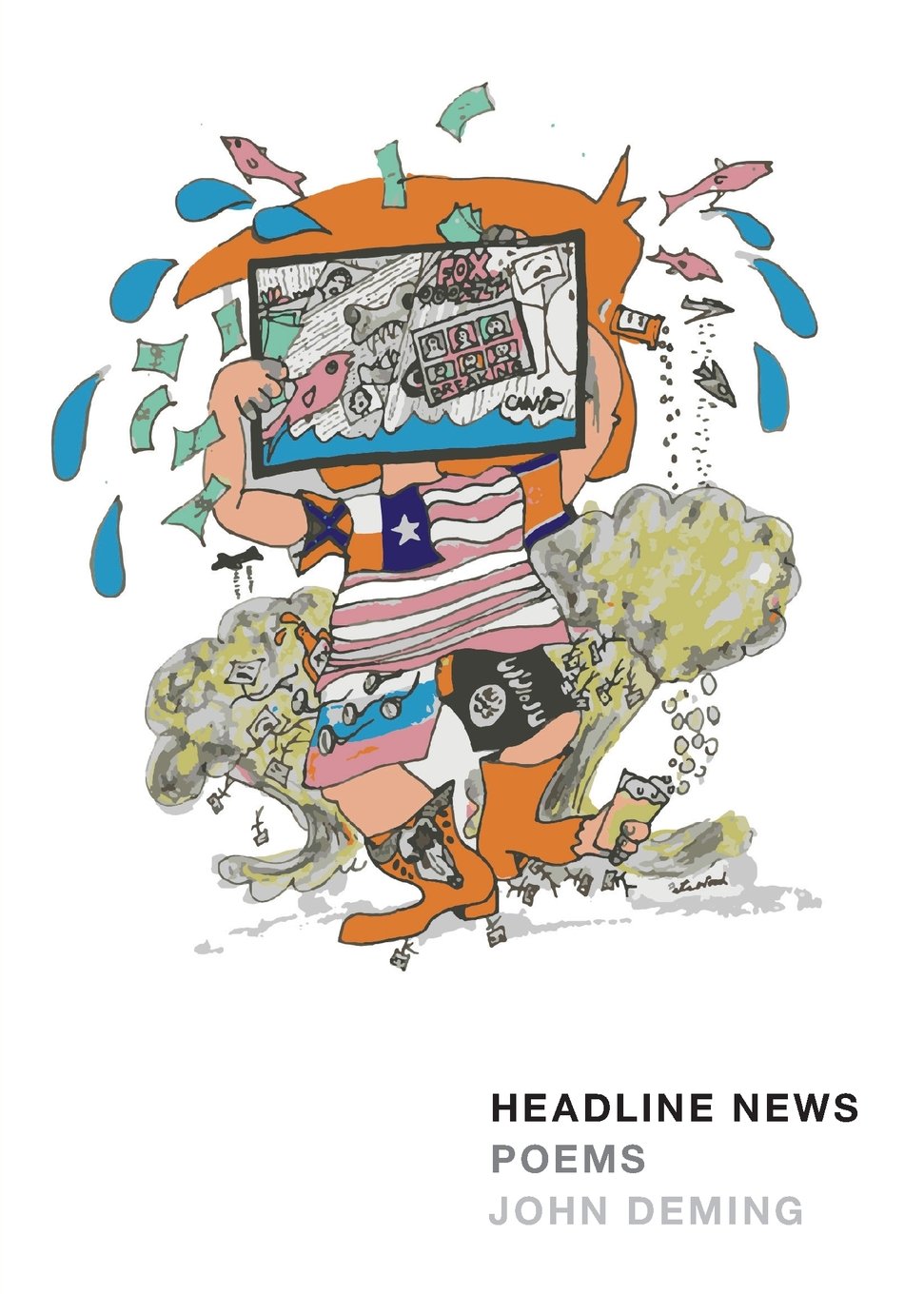
Headline News — John Deming (Indolent Books)

Today's book of poetry:
Headline News.  John Deming.  Indolent Books.  Brooklyn, New York.  2018.


what is my relationship with your god

what is my relationship with your god
what is my relationship with your media

the man with the black ski mask
the flashy blade in his hand
the man with the orange hat

INSIDE THE REPUBLICAN PARTY'S

DESPERATE MISSION TO STOP MR. TRUMP

compromising one's fears like putting
on an orange
hat

💫💫💫

John Deming is hot for headlines, Headline News is prescient and makes for an action packed read.  At a time when fewer and fewer poets are interested, Deming is gleaning gold from the mouths of power.

Deming's flash-card epistles scour the media, eat the bold print like crackers, and then like some wizened and wise sage, he parrots the memes to us in these postcard sized pronouncements.

N. KOREA; UNICORNS

N. KOREA: UNICORNS  
ONCE EXISTED  
I know
I've seen the tapestries

placid doesn't
know what
capture means

unicorn encircled
by a small pink fence
bleeding into flowers

💫💫💫

Today's book of poetry got a particular feeling in our stomach when reading Headline News.  With every turn of the page we felt like we were being let in on some new hyper-knowledge.  Reading John Deming makes you feel informed and a little edgy too.  That is a good thing - poetry should be unsettling once in a while.

Talk about unsettled!!, as I wrote those last lines a giant spider eight-legged over towards me.  I didn't notice him until he hoofed it over a yellow post-it note on the corner of my desk.  Today's book of poetry is an insect suck (and yes, I do know that spiders aren't insects).  Spiders scare the bejesus out of me, make me weak in the knees.

For the spider-lovers in the audience - it is time for you to turn your heads.

It was with a spontaneous and deadly thumping splat that I introduced myself to the dark brown arachnid.  It was a one time meeting but I'm afraid I had turned the beast into a Kurt Vonnegut doodled asshole ❋.

Today's book of poetry would never kill a spider in the outdoors — but if you're in my house and on my desk — goodbye spider.

Today's book of poetry apologizes for the distraction.  Milo, our head tech, kleenexed the spider to a garbage pail and arachnid heaven.  Kathryn, our Jr. Editor, got the rest of us rolling with the morning read of Mr. Deming's thoroughly entertaining and enlightening Headline News.  

3 MEDICAL MARVELS SAVING LIVES

3 MEDICAL MARVELS SAVING LIVES
they'll be outdated
just as fast
you watch

the wheelbarrow
also was a tech
revolution

you can only save
lives for so 
long

💫💫💫

Deming is submerging us in the new language of today's media, the modern gaze.  Our future will be described in headlines only, or not at all.

Today's book of poetry was surprised by how easily Deming had us convinced that Headline News is future vision.  These poems had us bending our brittle brains around some surreal curves but Deming always gets his ship back on course.

Yes, John Deming can burn.

belief in the destiny of values

belief in the destiny of values
means community and fear

SCREENING FOR MENTAL HEALTH ISSUES

MAY NOT GUARANTEE CARE

when there is thunder
my schnauzer gets scared

the emotional lives of penguins
our emotional lives in dreams

birds fed by dreams and the holes they leave
as with unimpaired meteor streams

💫💫💫


Today's book of poetry is exited to bring John Deming into your poetry lives.  These are headlines you must read, poems that force you to think against your own grain and enjoy it are unicorn rare.
Good poetry is always worth your time and Headline News demands it. 

Today's book of poetry is going to share a rare fifth poem.  Why?  John Deming's Headline News earned it.

okay so the worst has happened

okay so the worst has happened
someone build a fire

TRUMP TRIUMPHS

I still have my Duane Reade
Rewards card I'll be fine

after all it's still just the rest of the world and you

some hundred million others wondering
how to overcome extreme
sadness
what to do

💫💫💫

Image result for john deming photo

John Deming

ABOUT THE AUTHOR
JOHN DEMING has published poems and articles in Boston Review, Salon, Fence, New Orleans Review, A Public Space, Critical Studies in Men’s Fashion, and elsewhere. He is editor in chief of Coldfront and lives in New York City, where he directs the writing center at LIM College and, with Jason Schneiderman, co-curates KGB Monday Night Poetry in the East Village.

BLURBS
“It is difficult to get the news from poems,” wrote William Carlos Williams, “yet men die miserably every day for lack of what is found there.” In Headline News, John Deming gives us the news and makes a poem of it, springboarding into a prosody informed by brevity, clarity and precision, a kind of decalinear sonnet unfolding itself into blossom. Deming’s great gift here is a capacious and capricious mindfulness, improvising and responding to the deadpan lunacy of newspaper headlines in such a way as to make them seem almost mystical.
     —D. A. POWELL

In Headline News, John Deming makes us feel the strangeness of what we’ve been hearing and seeing in 21st century America. Reading these poems, “I’m feeling weirder/and clearer tonight.” Quoted headlines appear in all caps, but the rest of the writing is equally telegraphic and punchy—until we get punch drunk, wondering what’s real news and what isn’t. This mix-up seems telling and inevitable now.
     —RAE ARMANTROUT


711

DISCLAIMERS

Poems cited here are assumed to be under copyright by the poet and/or publisher.  They are shown here for publicity and review purposes.  For any other kind of re-use of these poems, please contact the listed publishers for permission.

We here at TBOP are technically deficient and rely on our bashful Milo to fix everything.  We received notice from Google that we were using "cookies"
and that for our readers in Europe there had to be notification of the use of those "cookies.  Please be aware that TBOP may employ the use of some "cookies" (whatever they are) and you should take that into consideration.

Wednesday, July 26, 2017

Dear Liz - Lisa Andrews (Indolent Books)

Today's book of poetry:
Dear Liz.  Lisa Andrews.  Indolent Books.  Brooklyn, New York.  2016.

Front_cover_ANDREWS

Ok, you've probably heard this from Today's book of poetry before but everyone in this office is in love with Carson McCullers.  If they aren't, they don't last long.  So when Today's book of poetry opened Lisa Andrews' Dear Liz to this quote:

     And how can the dead be truly dead when they still
     live in the souls of those who are left behind?

     -Carson McCullers, The Heart Is a Lonely Hunter

we suspected we were on terra firma, in high cotton, following the right road.

Lisa Andrews loves the movies as though theatres were churches and films religion.  Today's book of poetry can relate to that particular sensibility.  Growing up that was where all our heroes/heroines were made.  Dear Liz entertains, uses movies/cinema as fodder, but in fact is an eloquent eulogy for a departed friend.

Advantages of Watching a Movie
From 1944 at 3:00 in the Afternoon

1.  I have not been born; therefore,
     none of my friends are sick, dead or in trouble.

2.  If the movie ends, it can begin again. What I am watching has the illusion
     of a beginning, middle and end, but it's really a loop.

3.  If the movie from 1944 is, say, two hours long, I know, in the last five
     minutes or so, what's likely to happen has to happen soon. There's only so
     much time.

4.  In this movie, there are no insurance companies, no double billing, no
     dedicated service teams, no issue resolution experts, no hierarchy of
     obfuscation, inefficiency or cruelty.

5.  No one inside this movie is going to correct my grammar, fire me, suggest
     I find another place to live.

6.  No once inside this movie is going to call and call and put me in the
     position of not picking up for as long as the phone keeps ringing, because
     I know, without knowing, this is not a call I want to receive, and I actually
     think if I don't pick up the call, I can keep it from happening. The "it"
     cannot happen, will not happen, cannot have happened. Even if the caller
     hangs up and keeps calling back, I will not have to answer or willfully
     ignore this phone. If the phone rings, it's safe to assume it's not me they
     want.

7.  Nothing I know can harm me now. Not here, not inside this movie. The
     movie is the preexisting condition, and we are the condition not yet in
     existence.

8.  Nothing bad has happened yet.

9.  Not that wind-knocked-out-of-you feeling; not that abrupt lack of desire
     for anything in the present or future tense--unimaginable state. No tears
     at inopportune moments--the airplane, the department store, the cross-
     town bus--the tears that are endless. The body, the heart, the mind would,
     if it could, cry forever.

10.  Only, if I watch this movie from 1944, if I can somehow enter the movie,
       the way, for example, you could and did--could not help but enter each
       movie, pass through to the very inside--it means, even now (now that I,
       too, am inside this movie)--no matter that it is 1944--we are both alive.

11.  It's a little like breakfast in childhood. No one is drinking yet; no one is
       screaming or crying--not at 7:00 a.m. Not in 1944.

12.  I haven't met you yet or been born; therefore, you can't have died, are not
       now dead, especially since I don't think I ever really believed--apparently
       not--even when it should have been obvious--inescapable cold fact--not
       even then did I think you were dead. After all, I didn't see it. Not the end.
       Not with my own eyes.

13.  But I've seen you enter a movie. And when you told your film professor
       you believed every movie was real, how whatever was happening on the
       screen was also happening to you, he said, I'm afraid I can't help you with
       that--which means you are inside the movie I am watching now, which
       means you are the movie I am watching.

14.  I leave your phone numbers and address intact. I will not update, I will
       not delete. I will remember.

15.  The way, in that hushed auditorium, you shouted, Don't drink that glass
       of milk! The way you stood in that theater in Times Square, announced:
       I am Spartacus.

16.  If I watch a movie, then am I anywhere nearer? Are you?

17.  When I see something I know you'd like to see, I lose control.

18.  It's the opposite of the way a friend of mine, pregnant, would muse, when
       crossing the Brooklyn Bridge, Oh, this is a view my child will one day see.
       You see, it's like that, only in reverse.

19.  But not with the movie from 1944. You could be sitting right here beside
       me, watching every frame. Even now. And if I watch what you have
       watched, am I not watching you? Am I not being watched by you?

...

Dear Liz is a sad playground littered with elegant memory and palatable love/grief, the knowing certainty that there is no return from death.  Andrews has imagined every generous plot she can conjure but is left with the knowledge that once that real life screen goes dark there is no coming back.

Andrews laments the loss of a dear friend in a language she is certain the friend will understand.  The loss so real and immediate that clearly Andrews is haunted by it -- until she turns it into the melancholy music of poetry.

Lucent Machine

I don't know who left it or why--
this message on a Friday in the middle of the day.
Not the usual 8:00 a.m. hang up. Not Citibank
Identity Theft Solutions. Not Capitol One
still calling with an offer. No wrong number
about a change in an appointment--not mine.
No survey. No one asking for money or my vote.
No one telling me the car is outside. No one asking
about a sign in our yard. No solvable mystery--
not like the friend who called as the Easter Bunny--
a mystery it took us years to solve.

No record under "calls received"--
not "private caller" or "caller unknown"--
not even "out of area." No record at all.
Only this voice--a woman singing, then whistling--a voice
barely embodied by breath--hypnotic and jazzy
and pulling me in--this bluesy lullaby from beyond--
drowning in static and taking its time--
the only recognizable words--sometime and goodbye--
a voice so close to the one I keep telling myself
it can't possibly be.

...

Today's book of poetry's morning read was dominated by the women in our office this time around. Kathryn, our Jr. Editor, orchestrated the reading, added some film references when she thought we needed them, and generally ruled the roost.  The readings were gentle, the conversation that followed full of missing friends.

Dear Liz was an excellent vehicle for our morning read, we all climbed in and drove it a while. These poems are diamond hard, heart soft, and by the end of our reading of Dear Liz everyone in the office was a Lisa Andrews fan.

The Dead Are So Invisible

The dead are so invisible--no matter how deeply felt
their absence is--their presence, so resolutely denied us.

It's almost boring really--how invisible they are--
like some childhood game, Come out, Come out, Wherever you are.

The dead are it. No we are it--and this
the coldest game of hard to get. And still

we chase them, want them to save us,
come back for us--no matter the dead

have others things on their minds--
and who can say what mind might stand for?

Surely the dead are not so preoccupied with the living.
No one wants that, do they? And yet,

who if not us will they come back for? And how else
will we know how to find them?

...

A bit of a revolving door here at the Today's book of poetry offices.  You've all heard about the sad departure of Odin.  Yesterday our Chief of Security, Otis, left for a month in Belgium.  He'll be drinking fruity beers and eating "frites" with mayo by the time he reads this.  In other office news our next door neighbour Caroline is leaving for a month in South Africa in a couple of days.  But rest assured dear reader, Today's book of poetry isn't leaving his front porch.

As long as our much maligned mailman Yves continues to bring poetry to the door we'll hang around. Volumes like Lisa Andrews' Dear Liz continue to raise the ante.  Dear Liz is one sad geography -- but it is also a book full of promise, Lisa Andrews can burn.

Lisa Andrews

ABOUT THE AUTHOR
Lisa Andrews grew up in Michigan and moved back to her native New York to study acting at the Neighborhood Playhouse School of the Theatre. A graduate of Hunter College, she received an MA in English Literature and an MFA in Poetry from NYU. Recipient of a New Voice Poetry Award from the Writer's Voice of the West Side YMCA, Lisa has had residencies at Blue Mountain Center, the Virginia Center for the Creative Arts, and the Vermont Studio Center. She lives in Brooklyn, N.Y., with her husband, artist Tony Geiger.


BLURBS
Luminous, whimsical, and heartbreakingly tender by turns, the poems in Lisa Andrews’s Dear Liz are a portrait of a beloved friend, movie-going companion, and fellow human, a portrait unfailingly loyal to the telling detail, unfailingly appreciative of the quotidian. To read these poems is to enter a world that is full of feeling, at once loving and quirky. There is grief here, but these poems, more, help us continue in the world, which Andrews, sometimes plainly, sometimes in stunning images, shows us to be full of beauty. Dear Liz is a moving reminiscence, and to be offered the friendship this book offers its readers is to feel healed and restored.
      —Sharon Kraus

In these poems that confront the loss of a dear friend, Lisa Andrews makes us confront our own connections in the world and our own mortality. Here, we long to walk familiar city streets; to slice the avocado so thinly that there is little left to slice; to stand in the oblivious snow; to sit in the darkened theater and stop Joan Fontaine from drinking the milk; and we long to do it in the company of someone we love. An homage to friendship and to living, Dear Liz is a beauty, a heart breaker, an oracle, and a lament.
     —Nicole Callihan


590

DISCLAIMERS

Poems cited here are assumed to be under copyright by the poet and/or publisher.  They are shown here for publicity and review purposes.  For any other kind of re-use of these poems, please contact the listed publishers for permission.

We here at TBOP are technically deficient and rely on our bashful Milo to fix everything.  We received notice from Google that we were using "cookies"
and that for our readers in Europe there had to be notification of the use of those "cookies.  Please be aware that TBOP may employ the use of some "cookies" (whatever they are) and you should take that into consideration.