Showing posts with label a misfit book. Show all posts

Sunday, August 27, 2017

The Cloud Versus Grand Unification Theory - Chris Banks (ECW Press/a misFit book)

Today's book of poetry:
The Cloud Versus Grand Unification Theory.  
Chris Banks.  ECW Press.  a misFit book.  Toronto, Ontario.  2017.
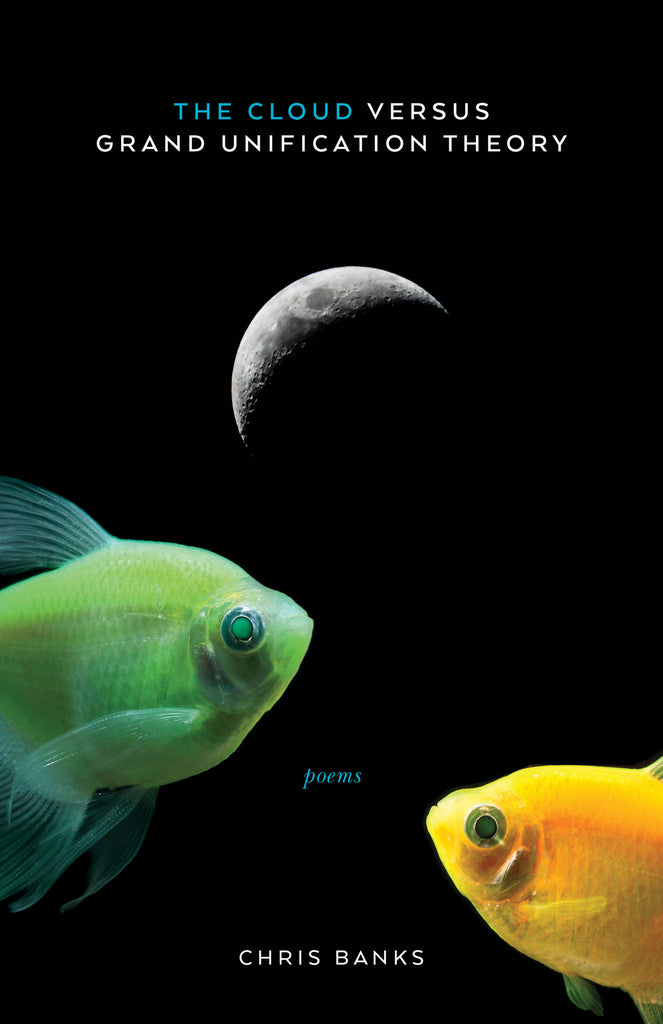
Cloud Versus Grand Unification Theory, The by Chris Banks, ECW Press

Milo, our head tech, went to the stacks this morning and brought out Chris Banks' Anstruther Press chapbook Invaders (2015).  Today's book of poetry remembered Invaders as a tight and muscular little celebration.  With The Cloud Versus Grand Unification Theory Banks moves into fully fledged killer poetry assassin territory.

602 blogs/reviews into this project and Today's book of poetry is still regularly amazed.  Re-discovering Chris Banks is a bit of poetry lottery win.  The Cloud Versus Grand Unification Theory may be the best book of poetry you read this year.

Banks applies a carpet-bombing theory of poetics, he builds line after line of incendiary verse, each as solid, dependable and explosive as it's predecessor.  The poems in this collection are constructed like those extraordinary Japanese temples where no nails or screws are used.  Instead the construction is held together with elaborate, almost invisible, joints that fit just so.

The Hundreds

Eight-tracks of Neil Diamond's Hot August Night are gone.
Cassettes lost. Don't look, but Betamax and VHS tapes
are no more. All around us, the old century, The Hundreds
as my daughter calls it, is vanishing. The K-car is gone.
Wood-panelled basements and macrame wall hangings.
Airbrushed vans, teen hitchhikers, Corvette summers.
Moon landings. Woodstocks. Live Aid. Lollapaloozas.
Henry Morgentaler and Ian Curtis are gone. Terry Fox
and Andy Kaufman. East Germany and Czechoslovakia.
The rotary phone is gone. The modem is gone. Even
intricately folded high-school notes, written in cursive
in April of 1986, no longer exist. The Khmer Rouge
and Nelson Mandela are gone. Kennedy and Brezhnev too.
Atari is gone. The arcades are gone. Pong. Pac-Man.
Donkey Kong. Transistor radios. Walkmans. Discmans.
Boomboxes. Ghetto blasters. Hi-fi stereo receivers.
Billie Holiday, Satchmo, John Lennon, Freddie Mercury.
Rock. New Wave. Punk. Hardcore. Grunge. Shoe-gaze.
I cannot tally it all, but still I keep trying like a man
poring over microfiche, not memories, hoping for a clue
or two that might tell a person how to live
with loss when already oceans are rising, the climate
is changing, the animals are leaving us, one species
at a time: Dusty seaside sparrow. Mexican grizzly bear.
Golden toad. The past seems more real than a world
where Greenland is melting, where people stare at phones
the way they once did at paintings. The Hundreds,
smelling of old money, sibling rivalry and white privilege
are not coming back, and it's time for time to settle up,
to explain what it was all about, before we too one day,
after breakfast, or a walk in the park, or a trip to the city,
find ourselves suddenly, and irrevocably, gone.

...

Chris Banks has mastered a particular school of the great riff.  He makes leaps where others might consider walking around.  The journey through one of Banks' missives might seem disjointed and uncertain but you are under the care of some masterful hands.  You might come sliding into home sideways, or muscling up to the dock with a big wake, but every inch of your navigation has been previously considered by the poet for you.

The Cloud Versus Grand Unification Theory may be a catalogue of human responses to an increasingly difficult and hostile world.  Banks expansive voice is elastic enough to embody contradiction and compromise without ever changing key.

Dusk Till Dawn

You imagine the moon filling a bedroom window
as the towering screen of a drive-in movie theatre
high above a winter field strewn with meltwater.
Soon cars prowl past the ticket booth's closed sign.
An unlighted snack bar hunched in snow and rain
gathers a crowd. The moth-stutter of faint images
flicker from a projector filled with stopped clocks.
Someone has already begun to lay aside his clothes
in a borrowed car. Someone's white bare shoulder
is sending a boy's desire up in flames, burning him.
Someone feels branded by delight. Even on a night
as cold, as ordinary as this evening, somewhere it is
the summer of 1985 and Back to the Future is playing.
Somewhere people stagger in between rows of cars,
drinking beer, laughing heartily, suspecting nobody
will ever grow old, or expire, or be forgotten again.
Many are wrong -- it is already tomorrow's music
leaking out of FM radios, speaker poles like crosses
marking the graves of teens who came before them,
until someone finds himself locked out of some car,
twenty years older with an adolescent girl long dead
in a car wreck. What happened two decades ago.
Someone wishes he could go back to another time
to loiter under a different moon, in another century,
but already there is a fight in the parking lot. Already
police are gathering at the entrance, waiting for dawn
to come, for people to finally get tired and go home,
while someone drunk yells Come on!, holds up his fists
unaware the invisible projectionist who is smoking
absentmindedly, dusting ashes off one last cigarette,
stares out his tiny window, knowing how it all ends.

...

Today's book of poetry enjoyed reading these poems out loud.  Late last night, in bed, I read "The Hundreds" to my wife K, she put down the giant biography of Theodore Roosevelt she was reading and listened hard.  K is always a good measure, I didn't have to prompt, just waited for her response. "Remarkable."  She was right.  Chris Banks has found a secret source of almost perfect metaphor and hammered it into these well crafted narrative poems. 

Our morning read was a particularly happy one this morning as we welcomed back Otis, our security chief, from Belgium and the Pistol, our Dutch translator, who was out in eastern Canada learning French and swimming with the fishes in the very cold ocean.  Both men are sometime contributors to Today's book of poetry but we always miss them when they are not around.

The Cloud Versus Grand Unification Theory

I am not asking for anything except a little wisdom
from this life. Experience has taught me to be
prepared for when a bullet passes clean through,
it leaves a hole behind. Praising things is its own job.
That we might actually know two or three people,
despite battalions of online friends, is a consolation
prize for not solving the Grand Unification Theory
or writing thirty novels or discovering a ninth planet.
Living becomes its own masterpiece. A catalogue
of blunders and missteps and then, a surprise party!
I have met a few certifiable geniuses in my day
and they were all disappointingly human. Failure
is a bogeyman. What happens next is up to you.
The brain does not care we are are only so many miles
of nerve-endings. It wants to go further off-leash.
What is the real story here? Some days, it is all
caviar and champagne, and the next, forty horses
die in a barn fire. No angels earn their wings. People
lie to each other out of fear, to spare each other's
feelings. What kind of man does that make me?
I tell elaborate lies to ascertain the truth. I resolve
to get out of bed most mornings, to witness
the past like a boarded-up pawn shop, to read
what life throws in my path the way ancient priests
read bones, which is to say inscrutably. Make it
up anyways. What I need is another mass grave
for my doubts to pile into. I keep thinking about
that engineering student who tied a piece of rope
to a hydro pole, passed it through his car's window,
before cinching it around his neck and driving off,
or a woman I saw once spread her arms before
diving off a three-storey parking lot. At what
point do we give up and surrender to our desires,
even if they end up killing us?  Maybe I'm being
greedy wanting art to be more than a bowl of fruit,
wanting there to be answers. Who is listening?
The partygoers nibble the caviar and move on.

...

The Cloud Versus Grand Unification Theory is about as good as it gets here at Today's book of poetry.  What else can we ask for?  This is exactly the sort of magic we live for here.  Intelligent, witty, inventive, exciting, lyric and so on.  But by far the most important quality is that these are accessible poems.  Today's book of poetry always looks for that first, the rest is gravy.

Chris Banks surprised the bejesus out us with The Cloud Versus Grand Unification Theory.  We should get this lucky more often.

Image result for chris banks poet photo
Chris Banks

ABOUT THE AUTHOR
Chris Banks is the author of Bonfires, The Cold Panes of Surfaces, and Winter Cranes. His first full-length collection, Bonfires, was awarded the Jack Chalmers Award for poetry by the Canadian Authors’ Association in 2004 and was a finalist for the Gerald Lampert Award for best first book of poetry in Canada. His poetry has appeared in the New Quarterly, Arc, the Antigonish Review, Event, the Malahat Review, and Prism International, among other publications. He lives and writes in Waterloo, Ontario.


602

DISCLAIMERS

Poems cited here are assumed to be under copyright by the poet and/or publisher.  They are shown here for publicity and review purposes.  For any other kind of re-use of these poems, please contact the listed publishers for permission.

We here at TBOP are technically deficient and rely on our bashful Milo to fix everything.  We received notice from Google that we were using "cookies"
and that for our readers in Europe there had to be notification of the use of those "cookies.  Please be aware that TBOP may employ the use of some "cookies" (whatever they are) and you should take that into consideration.

Tuesday, August 9, 2016

Slow States of Collapse - Ashley-Elizabeth Best (A Misfit Book/ECW Press)

Today's book of poetry:
Slow States of Collapse.  Ashley-Elizabeth Best.  A Misfit Book.  ECW Press.  Toronto, Ontario.  2016.

Slow States of Collapse by Ashley-Elizabeth Best, ECW Press

Ashley-Elizabeth Best's Slow States of Collapse is the least apologetic and beautifully maniacal book of poems Today's book of poetry has encountered in some time.  Best kind of reminds us, briefly, of a young Judith Fitzgerald's brave Victory (Coach House Press, 1985) and even, momentarily, of Linda Pyke's Prisoner (MacMillan, 1978).  Both of these were revelations, brimming with new kinds of daring.  But Best has upped that game.  Slow States of Collapse is stunningly good almost all of the time.  Every once in a while it is great.

I'd Like to Be the Subject
of Your Neck Tattoo

I spent three years
translating his smile,
abandoned words moulding
the silence after our fights.

I thought about him more
in French than I did English,
and even my prized bilingual
tongue could not word his feelings.

A tattoo rounded his throat, curved
behind the soft flesh of his ear --
the faded blue skin read, Betty.
I've known Betty for three years,

have never heard him mention her.
Something too tender to touch.
In the night, I stare her down.

...

Best's poems wrestle with some dark angels and once in a while a demon shows up to play.  Best's poems call these demons out and puts faces on their guilt.  Best doesn't seem to be frightened by a single thing.

There is a throbbing sensuality at work in Slow States of Collapse, a genuine swoon when called for but this isn't Penthouse Letters or Red Shoe Diaries.  The carnage the collision of love leaves behind in Best's poems is real.  This is where "all we can give is a gift of blood on stone."

Best gave Today's book of poetry a hard time.  Our recipe of a three poem meal just doesn't seem enough on certain days and today is one of them.  It is a hard pill leaving some poems behind.  This was one of those days when during the morning read we put things to a vote.  During the vote, Kathryn, our Jr. Editor, siddled up beside me like the sweet and considerate associate I've known for a couple of years and playfully/then not so playfully at all whispered into my ear that I was to use her list of three Best poems or Kathryn would "cut" me.  "Quick,  No one would even see!"  Then she smiled like a young Audrey Hepburn and scampered back to her desk with her best wistful grin.

Growing Up

Loving Daddy was like inviting
wasps to nest under your skin.

I grew up believing in the rough
cascade of a watermarked horizon,
never to trust in praise,
to remember how much of our lives
are rounded with sleep,
to thrash the moment from its bone.

...

No one is coming to save anyone in Slow States of Collapse, that's pretty clear.  But in case you were still wondering Ashley-Elizabeth Best puts any rumours to bed.  Today's book of poetry simply loved this hard charging, take no prisoners, bridge no bullshit, go down swinging marvel of a book.

There is so much heart at work in these poems Today's book of poetry was momentarily concerned for Best.  Then we realized that hearts like these are virtually infinite and possibly indestructible, even if they are burning a bit around the edges.

How to Recognize a Wolf in the Forest

I was just thinking
maybe I have too much time.

I lounge the skirts of a dance floor,
admire articulated spines, bodies
mournful enthusiasm, beats
that thud and fall, yaps of whalesong,
arms porpoising above
the overcrowded dance floor.

I want to build a skeleton of their
stories, grief heaped on the bones
of a schoolgirl's map, dancers
with a painted past.

Some poor girl's man is throwin' leg
with a young brunette. She's pinned
to the wall, her skin dog-eared
and foxed like a well-read book.

No matter how hard I drink or dance,
nothing here ever feels good.

The guy I find myself under later
is sexy in a coked-out kind of way,
body modifications tasteful and
numerous, metal shine roadmapping
his known history.

The need for it has grown.

In my life, I've been loved more than I know.

...

Oh Canada!  To have so many fine wonders.  Ashley-Elizabeth Best is the best discovery Today's book of poetry has made since maple-sugar met bacon on a water chestnut.

Ashley-Elizabeth Best

ABOUT THE AUTHOR
Ashley-Elizabeth Best is from Cobourg, Ontario. Her work has appeared in Fjords,CV2, Berfrois, Grist, and Ambit Magazine, among other publications. Recently, she was shortlisted for the Robert Kroetsch Award for Innovative Poetry. She lives and writes in Kingston, Ontario.

BLURBS
An impressive debut by an important new voice in Canadian poetry.  Ashley-Elizabeth Best's poems are sharp, and smart, and moving.  Slow States of Collapse is a collection to savour.
     - Helen Humphreys

The words of Ashley-Elizabeth Best send shocks of pleasure into the reader's brain and heart.  The poems in this debut collection remind me of Susan Musgrave's early work.  There's the same daring, sexiness, and lyricism.  Without a doubt, she's a new writer to celebrate and watch.
     - Lorna Crozier

Ashley's poetry "riddles the river with dark-wet / pocks of gold light"; she illuminates the terrain of everything we see and yet couldn't before name.  Her poetry is liquid and warm, a golden gift.
    - Sarah Yi-Mei Tsiang, author of Status Update


497

DISCLAIMERS

Poems cited here are assumed to be under copyright by the poet and/or publisher.  They are shown here for publicity and review purposes.  For any other kind of re-use of these poems, please contact the listed publishers for permission.

We here at TBOP are technically deficient and rely on our bashful Milo to fix everything.  We received notice from Google that we were using "cookies"
and that for our readers in Europe there had to be notification of the use of those "cookies.  Please be aware that TBOP may employ the use of some "cookies" (whatever they are) and you should take that into consideration.

Thursday, July 16, 2015

Cut Up Apologetic - Jamie Sharpe (ECW Press/A Misfit Book)

Today's book of poetry:
Cut Up Apologetic.  Jamie Sharpe.  ECW Press/A Misfit Book.  Toronto, Ontario.  2015.


Today's book of poetry gets the impression that Jamie Sharpe may not be wired like the rest of us.   His ideas come faster than a twenty person snowball fight with nineteen people on the other team.

Most of us think "light-bulb" ideas.  Sharpe comes up with "mirror-ball" ideas.  The inside of his head is like a ballroom with shards of light constantly spiking into new corners of the room, then like the wizard sorceror he appears to be, Sharpe spews light into the corners of our minds, corners that were previously dark.

Back in July, 2013, Today's book of poetry had the pleasure of reading/blogging about Sharpe's Animal Husbandry Today, his excellent first book.  Cut Up Apologetic is more of the same brilliant lunatic assemblage.  Except that these poems are tighter, just slightly more crisp, and that is an unexpected delight.

One Metre Diet

Birch leaves are delicious:
add truffle oil.

Your lawn's delicious:
add truffle oil.

Pine needles are delicious
soaked in vodka.

Give thanks: life offers
simple, abundant pleasures.

Take any local green
then fatten with foreign nectar.

          Translate me,
          Charles Simic.

          Transform my
          sour, green lines.

...

One of the things my minions like to see is me in a good mood.  Jamie Sharpe poems are a great step in that general direction so things are smooth in the office this morning.  I haven't had to rip a yard off of anyone yet.

Reading Cut Up Apologetic is like watching television while someone else has the remote -- and they are skipping through channels with glee and somehow it turns into an orchestrated concert with a start, middle and ending, coda included.  Just when you recognize the road you are on Sharpe changes the channel so that you arrive at a totally unexpected yet appropriate destination.

This is a good trick to know.

Because It Ties In
With The Throw Pillows

There is a potential for immediacy
in painting not readily found in poetry.

Walk through a museum, viewing
three-hundred-paintings-an-hour:

     Which did you like?
     Monet's lily pads were glorious.

Won't read three hundred
poems this lifetime.

The prefab art section at Linens N Things
permeates our lives.

I'm jealous; I want my sestina
above your couch.

...

Today's book of poetry let the minions pick today's poems knowing full well they could not go wrong.  Jamie Sharpe's second book of poems is confirmation of what we all thought when reading Animal Husbandry Today,
                                                                                                        
Cut Up Apologetic is cherse.

We can't wait to see what he gets up to next.

Segues: In Search Of An Expansive,
Finely Tuned Conception Of Vocation

(I)

A hummingbird
is a bird able to hover

but the Peruvian ridged hummingbird
has to maintain forward momentum

and the Arctic plover (not a hummingbird)
can suspend itself in mid-air.

(II)

I teach at an ESL summer camp
where one activity is go-karting.

At the racetrack I stand the gaggle
of foreign teenagers beside the Rules Board
(that they can't read)

and give a safety talk
(they can't understand)

I then point to the track
where carnage will ensure and say,
Let's make some poetry out there.

...

Jamie Sharpe has very quickly become one of Today's book of poetry's favourite poets to pull out of a hat, "Here! Read this!" I say, grinning like Hell.

Jamie Sharpe

ABOUT THE AUTHOR
Jamie Sharpe is the author of Animal Husbandry Today (ECW, 2012). He lives in Whitehorse, Yukon Territory.

Here is an excellent profile of Jamie Sharpe from Open Book Toronto:


362

Poems cited here are assumed to be under copyright by the poet and/or publisher.  They are shown here for publicity and review purposes.  For any other kind of re-use of these poems, please contact the listed publishers for permission.

Friday, March 6, 2015

Paper Radio - Damian Rogers (a misfit book/ECW Press)

Today's book of poetry:
Paper Radio.  Damian Rogers.  a misfit book/ECW Press.  Toronto, Ontario.  2009.


There are a few people whose opinions about poetry make me pause and take notice.

If you read this blog with any regularity you'll know that Stuart Ross (Small Press Poetry God) is a poet I look up to.  He is my friend and when he tells me to read something it brings a new urgency to the task.

Another person I listen to is Bardia Sinaee (Poet/Editor/Publisher of Odourless Press).  On one of my rare visits to Toronto I was in a secondhand bookstore with Bardia and asked him what I should read. We had been milling over an excellent and vast selection of poetry - he was without hesitation and handed me Paper Radio by Damian Rogers.

I loved it.

That was a few years ago.  As always, Bardia knew what he was talking about.

You cannot imagine my delight when Today's book of poetry got a copy of Paper Radio in the mail from ECW Press/a misfit book.  The arcane rules of Today's book of poetry only allow me to write about books sent by publishers/poets, none that I purchase.  Now I can tell you about one of the books I have enjoyed with relish but was unable to share.

Don't Look

It's like when you eat sour candy,
how the sugar-coated acid
twists your tongue into a knot.

At the Ambassador Roller Rink
no one would slow-skate with me.

A boy rolled over to you during the power ballad
and I turned into a pillar of salt.

No, that's wrong. I mean, I felt a lot like a sand dune. Or like
that baby food jar our family member filled with volcanic ash.

I asked the DJ to help me prove I knew the secret moves
from transforming my body into four different letters --

Y: raise your hands to the sky.
M: touch your shoulders like a mountain range.
C: pull your belly toward the door.
A: place your palms over your head and pray.

He said no. He said we don't play that song.

I said oh. I said wait, hold on;
I am changing into someone
completely different and better.

...

Paper Radio was shortlisted for the 2010 Relit Awards and the Pat Lowther Award.  And for good reason.  These poems are electric, fully charged bullets.

Roger's dexterity and intelligence spew out in machine-gun bursts of ideas.  Monster slaying lines like this: "because you woke up hating yourself and thought of me" from the poem "One Lie".

Lines like this stop me in my tracks.  Paper Radio has a stream of consciousness feel that tapers down to laser precise insight at Rogers' whim.

In The Back of a Cab

I lean my body against the door
of a car I'll never ride in again.

In the long line of stores and restaurants
I'll never visit, your name blinks
on a sign that says it has your pizza.
I've never found my name
on any sign, in any city.

So many people move around me,
invisible within the labyrinths
of skyscraper and subway.
They can't know how I planned to save us all
with the secret of human happiness,
which just this morning
I held in my hand like a rock.

But today was too long --
now all I remember is
a few lines from a song,
something about 20,000 roads,
how they all lead back to me,
here, alone in a stranger's car

in the middle of the night,
secretly hoping the driver
who politely pretends I don't exist,
would devote the rest of his life
to taking me home.

...

You, dear reader, will be like me.  So entirely in love with and swept up by these poems.

Okay, a bit out of left field, but these poems, this book, left me feeling somewhat like I'd read one of Jerzy Kosinski's better novels.  Please know the high esteem I hold Kosinski in.  And it is just a feeling, like you've been in a conversation with someone whose intelligence has covered you like a blanket and you hope to hang on to some of that wise warmth.

Milk and Honey

A cardinal flits through the branches
and the bush appears to burn.

Who are we to say we were thrown out?

We fell asleep,
the garden withered.

We turned our eyes inward
toward our dearest lies.

After weeks of late snow
last year's daffodils shove up
beside blue and white hyacinths.

The grass is so green it's shocking.

This may or may
not be true:

I'm only here
to sing for you.

...

Paper Radio gets Today's book of poetry highest ratings.  Coach House Press with be launching Damian Rogers' second book, Dear Leader, on March 24.  Rogers' has also recently been named Poetry Editor for Walrus magazine.

Damian Rogers

ABOUT THE AUTHOR
Originally from the Detroit area, Damian Rogers now lives in Toronto where she works as the poetry editor of House of Anansi Press and as the creative director of Poetry in Voice, a national recitation contest for Canadian high-school students. Her first book of poems, Paper Radio, was nominated for the Pat Lowther Memorial Award.

BLURBS
“Damian Rogers’ troubled teens, ecstatic utopians, and distracted deities are evidence of a powerful poetic storyteller. In Paper Radio, nature has multiple personalities, perception sits at the table with emotion and superstition, and meaning speaks in dark, mellifluous tongues. This is a poetry of attack and decay, of synchronicity and sleight-of-hand, alive with sudden, vertiginous moments of clarity. It’s rare to find a young poet so deeply invested in both her own experience and the reader’s pleasure. A splendid, memorable debut.”  Kevin Connolly
“In Paper Radio, Damian Rogers emerges as a poet of startling clarity, intelligence, toughness, and tenderness. Her gifts for aphorism, for sudden swift changes of mood and perfectly rendered emotional landscapes, are those of a dramatist. There is not a dull moment in this book — and while that alone is a high accomplishment in this age of dullness, Rogers keeps us awake to a purpose. She keeps faith with the premise of the lyric, which is that, by speaking most truly from the self, we are able to reach others and stay awake to this business of being human together.” —April Bernard
The poems in Paper Radio are very brave. Many tend to look at the past with a real understanding that there is so much there that will never be made right. But what makes them brave is the way they pivot and then drive on with hope because, well, they have to. —Joe Pernice
“Sometimes memories are so distant, we only remember them when an old friend reminds us of those last events. Damian Rogers is such a friend. She tells us of dreams that sound like our own, shooting little arrows of insight that split the heart to reveal the shocking vulnerability of life. Paper Radio is a jewel of a book that you will want to read over and over and over again.” —Greg Keelor

Damian Rogers
reading from Paper Radio
video courtesy of ECW Press


314

Poems cited here are assumed to be under copyright by the poet and/or publisher.  They are shown here for publicity and review purposes.  For any other kind of re-use of these poems, please contact the listed publishers for permission.