Showing posts with label eduardo c. corral. Show all posts

Sunday, October 29, 2017

Dead White Men - Shane Rhodes (Coach House Books)

Today's book of poetry:
Dead White Men.  Shane Rhodes.  Coach House Books.  Toronto, Ontario.  2017.
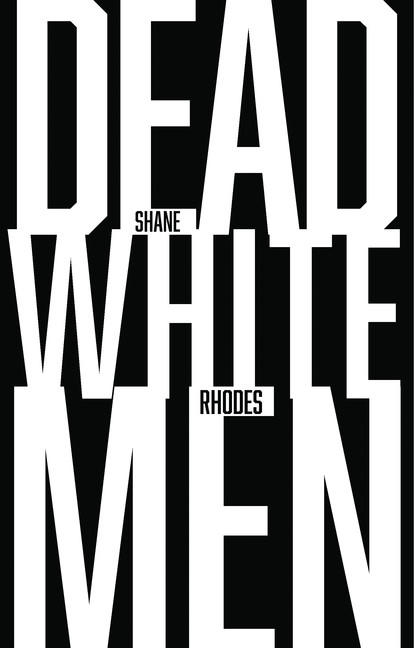

Shane Rhodes Dead White Men is quite unlike almost any book of poetry we usually see here at Today's book of poetry.  Even more to the point Dead White Men falls outside of the parameters of the poetry we usually celebrate.  Put on your thinking caps please.

Shane Rhodes is swimming in some pretty deep water.  Today's book of poetry found that Shane Rhodes "Notes" at the end of the collection were very helpful when considering his poems.  We want to share them here:

"Early European narratives of exploration and contact with the 'New World' often intertwine the languages of scientific discovery and colonization and bring along with them all the attendant European concerns of race, commercial exploitation, and male domination over muted landscapes
and the peoples who inhabited them.  In writing and researching Dead White Men, I was interested in looking to these past stories (especially those focused on North America and the South Pacific), not to add to the fictions of past white heroism but to better understand the problematic relationship between the stories, the mythologies they have become, and the lands and peoples they describe.  For many settlers, our understanding of the history of the land upon which we live is often limited to the names that have been given to it by past white explorers and the mythologies we have built up around exploration and discovery.  I wanted to use poetry to interrogate this past and the texts upon which it rests.

This is the mandate of this book.  This is the manner of its history."

So, Dead White Men, what is it?  This is a rhapsodic blend of William S. Burroughs style cut-ups and concrete poetry served up within a ballistic barrage of indictment against the status quo of white colonial power.  That and it fits between the covers just like a regular book.  Shane Rhodes isn't your run-of-the-mill poet, Dead White Men is not Milk and Honey.

Animal Electricity      
after Luigi Galvani

Little flames, fixed fires
that certain men give out
when walking
or when silk garments are donned
in a very dark chamber.
Latent in the livid integuments,
it is a difficult thing to be known
even with electrophore
of dried nerve and bone.
Upon the caloric animalcules
dissected, I employed
an electrical machine
so that an eel, if bisected
transversely, trembled its tail
when a metallic arc was applied.
With current, a frog (hook secured
to its spine) jumped vigorously about,
while the wings of a chaffinch
slightly contracted.
Even stricken with a pinch
of pear powder or pernicious gases
(sometimes mephitic, sometimes opium,
powdered nicotine and arsenic),
a newborn cat moved its legs --
a phenomenon not lacking
with the head cut off.
Vipers have not yet been tested.
From the house high in the air,
we erected an iron wire,
hung upon it prepared frogs
and the legs of warm animals.
The thing went according to our desire.

...

Canada has a great deal to do to undo and even more to make right with our First Nations.  Rhodes uses a wide brush to capture colonialism and the snakes of its progress beyond just the Canadian home grown variety.  Today's book of poetry are big fans of Rhodes, although he is more work than your average bear.  We wrote about Mr. Rhodes X back in November of 2013 and you can see that blog here:


Our morning read here in the Today's book of poetry offices was an almost sombre affair today, not much in the way of chucks and giggles in Rhodes incendiary condemnation.  But just to be clear, this is not your typical Sunday drive poetry fest, before it's over you'll find yourself upside down and backwards.

from page 110...

     Nothing special today unless the great coldness of the wind from the North is
     worth mentioning unless the entire air swimming with watery exhalations
     is news unless a dense fog exceeding thick is of interest unless dark Squals
     and Lightning are most curious things unknown in Europe unknown to
     me and these people unknown and dangerous but what Winds we have
     had this day set down in the journal beneath a close-reefed Manitopsail
     which caused us to Tack several Times and paff within a cable's length of
     a very large ifland of ice (it appeared to be nothing elfe) we Serv'd Slops
     to the Men put on our winter rigging saw the footsteps of people fresh
     upon the sand which Painted the Boat with a Genteel breeze and the fog
     {o thick we could fcarce fee a man on the forecafile then a fresh Trade wind
      with heavy Albetrosses all wings and Tails so we hauled our courfes when
      there came along a boat with feveral Elkim'aux women and we traded
     wind with the people (I saw what I took and left them in Strings of beeds)

...

Today's book of poetry has to admit that there are often books of poetry that intimidate my intellect and understanding and Dead White Men is one of them.  That doesn't mean it wasn't riveting, it was.  And even more importantly Today's book of poetry believes Shane Rhodes is bleeding some necessary blisters, opening some festering wounds so that they can drain and heal.

White privilege has always extended to our histories, the way we write about our past.  Essential poetry like Shane Rhodes Dead White Men is another elemental step towards narrowing that damned gap.  White privilege will only be disassembled when white people recognize it exists and start measuring the costs.

More Translations of the Lappish Language

Their Words for Sounds

                       : a gently running stream whirring over river rocks

                       : an animal in the water splash

                       : wolves singing when I cry ass drunk

                       : a fire salt sprayed

                       : a bow when the arrows are shot out

                       : knocking as I roll down the hegyrs

                       : an empty vessel when tapped by two empty containers

                       : water falling in a fire

                       : a tree mouse gnawing Girr

                       : sand between your teeth or a ball stuck in a tube

                       : knocking a fish

                       :  a dog that flatters

                       :  noisily sipping like when someone eagerly drinks

                       : sometimes here this sound when the larynx nip slips

...

In the interest of full disclosure, Mr. Rhodes and I know each other.  You could even say we are friends.  We don't chum together but their is a sizable mutual respect, I hope.  

Today's book of poetry has long admired the poetry of Shane Rhodes, his dedication to the craft and his willingness to go further than most of the rest of us.  Rhodes isn't interested in the status quo at all.  Rhodes is all about breaking down walls and building new understanding.  Today's book of poetry is behind that all the way.  That and Rhodes is brilliant.

Image result for shane rhodes photo
Shane Rhodes

ABOUT THE AUTHOR
Shane Rhodes is the author of five books of poetry, and has won awards including an Alberta Book Award and the National Magazine Gold Award for Poetry. He lives in Ottawa, Ontario.


BLURBS
‘A provocative and galvanizing read … Riveting and dazzling invention is visible on almost every page: fonts shift size, language cascades and cleaves, and images disrupt order. Dead White Men should be widely read and taught.’
     – Eduardo C. Corral, author of Slow Lightning

Dead White Men is not only a searing indictment of colonialism but also a painful reminder of the violence that underpins the logic of exploration. Each poem strikes at the heart of the issue: there are often unarticulated, unacknowledged Indigenous presences here that have been flattened over by the lies and mirages of empty landscapes. Dead White Men is a stinging and difficult journey, and one that continues to remind us that stolen land has always been the most pressing concern for Indigenous peoples and settlers. This is an absolutely essential book.’
     – Jordan Abel, author of Injun


Shane Rhodes Reads
Video: Arc


622

DISCLAIMERS


Poems cited here are assumed to be under copyright by the poet and/or publisher.  They are shown here for publicity and review purposes.  For any other kind of re-use of these poems, please contact the listed publishers for permission.


We here at TBOP are technically deficient and rely on our bashful Milo to fix everything.  We received notice from Google that we were using "cookies"
and that for our readers in Europe there had to be notification of the use of those "cookies.  Please be aware that TBOP may employ the use of some "cookies" (whatever they are) and you should take that into consideration

Thursday, October 1, 2015

Otter - Ben Ladouceur (Coach House Press)

Today's book of poetry:
Otter.  Ben Ladouceur.  Coach House Books.  Toronto, Ontario.  2015.


Today's book of poetry had written an entire blog/appreciation of Ben Ladouceur's absolutely incendiary first book, Otter, but I called an editorial veto to that tri-blurb blasphemy.

Instead I will start by telling you that Otter has more weight per line than any book I've read since I started this blog.

Nuncle

Our century brims with abstractions, with
clashes: I want to know its taste.
So I chase chocolate with white wine. pair
tilapia with a most acidic merlot.
My evening has been ghastly. I just got

some dark post. A former comrade found his way
to the Seven Sisters, where the moon
huffs waves fro and fro and fro, its breath
cerulean, embossed by frost; where the moon
makes the chalk cliffs cerulean too.

Blind since Amiens, he was led
by a servant of the Red Cross
whose face, I'd wager, was something to touch.
My comrade gave a measly sermon, then
jumped. The little letter told me so. A sermon

fell with is flapping eyeless body
to the sea and still, I'd wager, adheres to the lip
that has lost blush. I'm sorry to tear
up like this. If my wife saw this despicable
spectacle, she'd punch me with her rings

on. Once, in Dvinsk, the suicide and I
found a house already deserted. Latvians
had shat on every surface before their
departure. He turned his bright face away from what
a kettle housed, locked eyes with me and spoke.

I have one son within my marriage, one without it.
How ghastly that half my pedigree shall occupy
our world, and half shall orbit. At once
we made for the nearest bed, and I'd wager
you know what we found there.

...

Today's book of poetry usually chooses three poems for inclusion, today I've chosen fifteen.  Otter is stunning stuff but although these poems all come from Ladouceur's very strong voice any combination of the fifteen reduced to three would most likely lead the reader to expect a different book.  I won't reproduce all fifteen, even though Milo is begging me to.  But I will share a few choice lines as appetizers:

     Crickets scraped song off their bodies with their legs. "OK"

     At night touch me when day breaks.  "Printout Found In Bottle Found In The River Aare"

     All the most beautiful things are things we rarely feel the weight of. "Gibraltar Point"

     I did love him, the crimson acne flecked across his neck, he was like a man a guillotine had made
     an attempt at. "I Am In Love With Your Brother"

Now try this on:

Salutations From Abitibi

Alone clouds refused to cohere.
They darkened the city in blotches.
They rendered the city dalmatian.

I forgot my lover on the bus.
The brakes woke him up
at Abitibi and he found work there.

All year mosquitoes bit his fumbling frame.
The bites were like Grecian constellations
seen on a clear taupe day.

My Zippo was on his person.
I was planning to quit with the smoking
but how shall I now singe the frays

of my only warm coat? When winter arrives
the mosquitoes will expire
and material will cover the bodies of men.

At least I received a blank postcard
on the birthday of my lover, its message
white on white: I am alive I am alone

I am not willing to speak. Some men
are darkened, in the long run, by sun.
Others, more quickly, by clouds.

...

Queer, Queer, Queer.  That is meant as a compliment to Ben.  For the rest of you it a label that you must remember and then immediately forget.  These poems are Queer, have a Queer agenda, and are great Queer poems.  Remove the label, they are just great poems.  All poems work better without labels and these gems would rise to the top of the pile in any company.

Ladouceur is an erudite Eros and these poems glitter with the sheen you get when bodies collide.
Ladouceur has no trouble at all finding the beauty regardless of the beast.

Marigold

As some scrotum
skims my tongue
like a dusted bulb
that might later do
an impressive bloom

I think of Paul
Monette in a bathtub
that's in a kitchen
asking his hosts
to scour his skin pink.

Paul later held his lover
Roger as he lost his
eyesight and enough
blood to give
a fruit bowl a fulcrum.

He is ambiguous here.
Some men can get away with
ambiguity. Tonight it is best
to forget whose bowels
are whose. Whose words.

I want to lose my legs
between our chests.
That is how little
room I want to ask
the world for. I'll be home

before dawn. Home
is the word that come closest.
There's a door I will enter,
a grey bar of soap. A rosiness
I'll scrub my way to.

...

Ben Ladouceur has a poem titled "All Men Are Equal" and nothing could be more true.  But all poets are not created equal.  Not be a long shot.  Ben Ladouceur's remarkable debut Otter will simply push him towards the head of the class, any class.

Great poetry.


Ben Ladouceur

ABOUT THE AUTHOR
Ben Ladouceur is a writer originally from Ottawa, now based in Toronto. His work has been featured in Arc, The Malahat Review, PRISM international and The Walrus, and in the Best Canadian Poetry anthology. He was awarded the Earle Birney Poetry Prize in 2013.

BLURB
Formally impeccable and richly imagined, Ben Ladouceur's poems track the awe of a mind as it engages with epiphanal moments, both personal and historical. His language is filtered through an intelligence that's queer and graceful, always in search of the singular phrase and a music that startles with its precision.  As each poem unfurls, keen insight gives way to the wonder of words.  Otter is a magnificent debut.
     -  Eduardo C. Corral, author of Slow Lightning, winner of the Yale Younger Poets Prize


Ben Ladouceur
 Interview - OTHER MEN Wed Series
Video: OTHER MEN - a web series    


Ben Ladouceur
Tree Reading Series, Ottawa
September 14, 2010
Video: Tree Reading Series


387

DISCLAIMERS

Poems cited here are assumed to be under copyright by the poet and/or publisher.  They are shown here for publicity and review purposes.  For any other kind of re-use of these poems, please contact the listed publishers for permission.

We here at TBOP are technically deficient and rely on our bashful Milo to fix everything.  We received notice from Google that we were using "cookies"
and that for our readers in Europe there had to be notification of the use of those "cookies.  Please be aware that TBOP may employ the use of some "cookies" (whatever they are) and you should take that into consideration.

Friday, June 19, 2015

Blood, Sparrows and Sparrows - Eugenia Leigh (Four Way Books)

Today's book of poetry:
Blood, Sparrows and Sparrows.  Eugenia Leigh.  Four Way Books.  A Stahlecker Series Selection.  Four Way Books.  New York, New York.  2014.


Eugenia Leigh offers us a startling first book with the sparkling Blood, Sparrow and Sparrows. 
Leigh is also now an official entry for Today's book of poetry's best title of the year.

These poems are loosely focused on God, father and family -- but it is Leigh's precise weight we enjoy most, regardless of subject.  Her voice has weight, resonance, echo and these poems can make you laugh out loud, usually just before Leigh kicks you in the throat.

Pretty Universe

God stalked me on Marion Avenue. Said, You can't
fix it. Then, I can't either.           That morning,

my ceiling lamp had ripped from its cord. Even after
I welded the fragments with duct tape, everything
felt cracked--like your five-hundred dollar glasses

I smashed that winter--so I thought, if I couldn't fix that,
what the hell am I doing piecing together
your eyes? Our crumbling

kisses? So I didn't question God. Sometimes, God wants
to be understood. Sometimes, God hates

his perfect grammar. His pretty
universe. So he'll pluck a butterfly of its left wing. Call it
art. He'll turn from a hurricane. Say, It wasn't me.

If artists were created in his image, how often
does God abandon his mistakes?

The day I stopped talking to you, I said
nothing to him too. I cursed. My entire drive home.
I littered the freeway with fistfuls of tissues

while God shuffled his God feet
and pretended not to see.

...

The reader will be forgiven if they can't quite decide whether Eugenia Leigh is happiest talking to, or at, God.  We're never quite sure whether the praise is hopeful wishing or snickered bravado.  But the conversation Leigh is engaged in is a constant delight for the reader.

We're all Pagans here at Today's book of poetry.  We run around the office burning sacrifices to the strangest assortment of deities and demigods.  And we all adored the poetry of Eugenia Leigh.

Leigh's narrator is a dutiful daughter, a guilty daughter, a disdainful daughter, a confused child of God and a strange mistress -- but she is always an interesting poet.

Leigh's narrator/poet persona is brave enough to step outside of expectations, keeps trying to answer big questions, keeps coming up with bigger dilemmas, more paradox.

Every Hair on Your Head

     Every hair on your head is counted.
     You are worth hundreds of sparrows.
                  --SPARKLEHORSE, "HUNDREDS OF SPARROWS"

The day you pushed a bullet through your heart,
the length of a day on earth shortened by a millionth of a second.

That same day, a NASA satellite captured an image of a dust storm,
Chile withstood its one hundred thirtieth aftershock in a week, and I
glimpsed a bird, twitching

on the floor of a Brooklyn metro station. Its eyeballs
bulged as if to literally absorb the ocular world,

and I shuddered away. For hours, I saw that flinching
creature in my mind. I saw hundreds of similar birds
shimmering into the station to lie

next to it--a quilt of silvery bodies tiled wing to wing. On good days
I want to be saved. Most days, I want

every savior in our hell--so they'll know
torment in the bloodstream--death's whistling, ceaseless,
blurring the cleanest heartbeats.            My first time, I was thirteen.

I tested five pills. My stomach barely ached. I ate ramen, lived, solved
math problems. But for days before that, I envisioned my body
smeared. Inside out. A swarthy, dazzling canvas.

What I wouldn't give to graze that silence.

Did you do it standing up
or crouching?         Which was the bigger surprise--
                                      the gun punching              or the angel catching you?

...

Eugenia Leigh's Blood, Sparrows and Sparrows is bejeweled with very smart poems that like to dance between the Devil and disbelief, they challenge notions of parenthood and piety.  These poems get the brain working in more than one direction.

There was much discussion around the office about this book.  Angels come and go with alacrity in the poems of Eugenia Leigh, just like they appear in real life, the devils too.

Sex Education

Folded into the carpet, eyes closed, I huddle
next to my small sisters--the baby
curled in the middle. My parents shuffle

in the couch bed beside us, and I wake. I peek.
I absorb the wet sounds of one mouth
guzzling another's laughter--and without

health class pamphlets, without Eve's Adam
and the fruit still rich on his chin, I learn

the music of bodies smacking together.
I learn the word yes. And how yes--

when whispered over and over--seems to free
other meanings--secret meanings

I never heard them speak in daylight.

...

Eugenia Leigh steps out onto the poetry stage fully formed.  Many, if not most, of these poems have previously been published in journals of one sort or another.  No surprise there.  Leigh has considerable dander, she even sounds dangerous on occasion.  Everyone here at Today's book of poetry enjoyed Blood, Sparrows and Sparrows a ton.

Eugenia Leigh
(Photo: An Rong Xu)

ABOUT THE AUTHOR
Eugenia Leigh is the recipient of awards and fellowships from The Asian American Literary Review, Kundiman, Poets & Writers Magazine, and Rattle. She earned her MFA from Sarah Lawrence College, and her poems and essays have appeared in numerous publications including The Collagist, North American Review, and the Best New Poets 2010 anthology. Eugenia serves as poetry editor of Kartika Review and lives in Chicago.

BLURBS
"Built out of blood and awe, rooted in sorrow and radiant lyricism, these poems remind us that 'to survive is to be / wholly human.' Divine and earthly voices haunt these poems. God and parents singe the speaker's heart; angels and sisters redeem it. These poems are brutal and brilliant. But also instructive. They teach us to 'weld our wounds / to form tools.' This is a book of moving and startling epiphanies. I can't wait to teach it."
     - Eduardo C. Corral

"This book went through me like a blue lightning strike. Part lyric, part narrative, and always alive, unflinchingly alive. A wonderful book and an even more astonishing debut!"
      - Thomas Lux

Eugenia Leigh
at Kollaboration, New York
June 26, 2010
Video: angelle 527


353

Poems cited here are assumed to be under copyright by the poet and/or publisher.  They are shown here for publicity and review purposes.  For any other kind of re-use of these poems, please contact the listed publishers for permission.