Showing posts with label fran lebowitz. Show all posts

Wednesday, June 12, 2019

Twenty-Five — Emily Izsak (above/ground press)

Today's book of poetry:
Twenty-Five.  Emily Izsak.  above/ground press.  Ottawa, Ontario.  2018.

Image result for above/ground press emily izsak twenty five

Twenty-Five is one interesting little kettle of smart fish.  Emily Izsak currently lives in London, Ontario (where Today's book of poetry was born, just saying), and as such counts Tom Cull and Blair Trewartha among her friends.  Our regular readers will recognize their names as having appeared in Today's book of poetry.  You can see our take on those two gentlemen here:

Tom Cull/What the Badger Saw
Tom Cull/Bad Animals
Blair Trewartha/Easy Fix
Blair Trewartha/Porcupine Burning

The reason Today's book of poetry mentions London's Cull and Trewartha in the same breath is that Izsak has some of the same quick light in Twenty-Five and Today's book of poetry was wondering "what's in the water?"  All of this to clumsily say that just like Cull and Trewartha, Today's book of poetry is hard struck and happy reading Emily Iszak's poetry.  It burns.

πŸ’«πŸ’«πŸ’«

Cyclists binge on round                 gimmicks
            mash their crabmeat
            with clawed
                             objectives

The matter of sole or psychomotor
            is off topic

                             better to question               which reflex
                             sits madonna                      sidesaddle

At last
in a liminal       bike lane
the decade's accent
slackens and            be
comes apart

πŸ’«πŸ’«πŸ’«

Twenty-Five is one long poem and Today's book of poetry is just offering up snippets for your digestion.  Today's book of poetry believes Twenty-Five is a love poem for Ariel.  Today's book of poetry thinks Twenty-Five is taking the current cultural temperature from ground zero and with the patience of William Carlos Williams.  Today's book of poetry isn't exactly sure what is happening in Twenty-Five but we were constantly jolted, prodded, disassembled, shuffled, intrigued.

Maybe this is one long autobiographical confession delivered by a modern day hipster scat singer.  All Today's book of poetry knows is that "heaven's breadbox is empty."  Izsak has some wicked chops.

πŸ’«πŸ’«πŸ’«

             A semi-  modest defense
                           for inaccessible          manpower

outlasts the downdraft if  push come to   push harder


                          A volunteer cocktease
                                                                     tells him    please
                                                                                                    the people
                                                                                             braid famine into updos

                          for a spot
                                      in the anthology

πŸ’«πŸ’«πŸ’«

Our morning read started with a question that Today's book of poetry will share with you readers.  Does anyone know how to contact Robert Jutras, author of Looncalls?  Today's book of poetry returned home a few days ago to find a copy of Mr. Jutras's lovely book between our doors but nary a note or card.  Today's book of poetry wants to thank either Mr. Jutras himself (or whomever else was kind enough to leave us Looncalls between the doors.

Emily Izsak's Twenty-Five continues the long running tradition of Ottawa's rob mclennan and his proliferate above/ground press - of finding the very best poetry available in Canada and beyond.  

Izsak has a Fran Lebowitz smart to her swagger and a Sue Goyette eye.  Our actual morning read was a bit like over stuffing a pinball machine and it lighting up and spitting us around the room with haste.  Twenty-Five doesn't waste one second of time, it shouts itself out in Tommy-gun bursts.

πŸ’«πŸ’«πŸ’«

By the ruins of contemporary themes
under the cheek of  a limp
pioneer gowned in
faith-based weather    Beyond WCW's
use of prepositions    standing and fallen

Now the offer         tomorrow
the in-laws flense our history

πŸ’«πŸ’«πŸ’«

And Emily Izsak sent Today's book of poetry to our living dictionary, in our case it is Max, our Senior Editor.  Knocked on Max's door and heard grumbling from within.  I don't think I've actually seen Max for several months, when the door opened a funky green slumber of smoke pushed into the rest of the office.  Of course Max knew what "flense" meant.  He was insulted that the rest of us didn't.

So when I went back to reread Izsaks line:

      "                                tomorrow
        the in-laws flense our history"

I did the poetry glee dance.  Today's book of poetry loves to be amused and we love to learn.  Emily Izsak did both, at least Twenty-Five times.

Twenty Five is yet another above/ground press chapbook that you really should read.

Image result for emil izsak photo

Emily Izsak

ABOUT THE AUTHOR
Emily Izsak’s poetry has been published in Arc Poetry Magazine, The Puritan, House Organ, Cough, The Steel Chisel, The Doris, and The Hart House Review. In 2014 she was selected as PEN Canada’s New Voices Award nominee. Her chapbook, Stickup, was published in 2015, and her first full-length collection, Whistle Stops: A Locomotive Serial Poem, was published by Signature Editions in April 2017.


Emily Izsak
Augur Magazine - Preview Issue
Video - Augur Magazine


763

DISCLAIMERS

Poems cited here are assumed to be under copyright by the poet and/or publisher.  They are shown here for publicity and review purposes.  For any other kind of re-use of these poems, please contact the listed publishers for permission.

We here at TBOP are technically deficient and rely on our bashful Milo to fix everything.  We received notice from Google that we were using "cookies"
and that for our readers in Europe there had to be notification of the use of those "cookies.  Please be aware that TBOP may employ the use of some "cookies" (whatever they are) and you should take that into consideration.

Wednesday, April 4, 2018

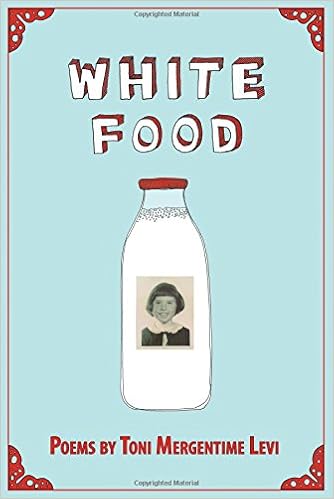
White Food - Toni Mergentime Levi (Mayapple Press)

Today's book of poetry:
White Food.  Toni Mergentime Levi.  Mayapple Press.  Woodstock, New York.  2016.


Your mother lost to dementia, your ex lost to the suburbs and your father was missing from the start, what do you do?  You make fine poems that are a powerful statement of self determination and womanhood.  If you're Toni Mergentime Levi you make poems out of it to make sense of the world.  Levi is a romantic loser poet of the most optimistically hopeless type, just like me.  Unlike Today's book of poetry Levi is expressing a world view of womanliness.  

Toni Levi's White Food is too grounded and reasonable to let it all get away but as we are all gloriously doomed Levi reports on that from the inside and with a sense of irony as earned as a bad boxing nose.  White Food is a poetic catalogue of a woman's survival in a world where gender is a systemically unbalanced barrier.

Toni Mergentime Levi is completely aware that as a Jewish woman the scales are not balanced in her favour.  White Food doesn't bemoan as much as report from inside the battlefield.

Milk

Milk arrives like a blessing in my dreams --
blue-white as a glacial waterfall from a far-off thaw.
In my most joyous dream, a precious rare appearance,
I am old -- old as I am now. But suddenly, my breasts
are filled with milk again and waking I remember

the neonatal ward, where my full-term bilirubin baby
looked like some blue-ribboned, beefy best-in-show.
In reality, of normal size, my jaundiced giantess
dwarfed the pink wrinkled heartbreaking preemies
riddled with tubes and sensors in the Isolettes.

They sent me home in tears, bereft, without my baby --
blindfolded in her fish tank under therapeutic light,
without me (impossible!) - her only known universe.
For two unrelenting days at home, my milk dripped,
useless as my love. For two years after, she drank her fill.

Milk courses through my dappled world of dream.
My breasts are swollen, tender, nipples tipped in red.
My milk is a river flowing to the land of tiny babies.
All -- now all can emerge from their boxes, alive.
Those who said I wouldn't have enough were wrong.

...

White Food works for a variety of reasons and one of the big ones is that Levi's sense of humour, as dark as it is, adds a little light at all the right moments.  Levi laughs, sometimes through her tears and these poems are about the resilience a woman needs to summon in the world of men.

Levi is giving admirable advice to anyone listening, Levi is saying that life is short and if you're jumping in, jump in all the way, go big.  Levi is endorsing taking that chance because she is well aware that there are only so many chances meted out before there are none left and cancer or dementia or that big dark train destiny coming down the crooked tracks blowing your name loud and clear and ominous as it appears at the short end of your horizon.

Absence

I don't miss anyone
who's truly gone.
Thanks to my father,
absent when present,
the dead are with me
as much as they ever
were in life.

My late mother,
devoured by dementia,
has been redelivered
to my mind
like Red Riding Hood
from the bad wolf's belly,
whole and sound.

My grandmother lives anew
in rum-laced cakes I bake,
following her recipe.
Grandpa's voice
echoes in the chorus
when operatic drinking songs
are on the air.

Yet now and then
I miss my husband (ex),
remarried in suburbia,
while I sleep alone
in the bleached sheets
of our half-empty bed,
sometimes reaching for
a ghost.

...

Winter just won't let go in this neck of the northern woods.  Snow on the ground this morning here in Ottawa.  

Today's book of poetry has been deflecting efforts from my staff to modernize.  I've insisted that long underwear allows us to turn down the heat in the office and they insist I am heartless.  That I refuse to scrap our steam-punkish Commodore 32 RCA Victor word processor with a 33 RPM modemish thing just because there is a little smoke and a few sparks only seems reasonable to me.  There are a couple of more years of good servic left in that little creature, even if it has traumatized one or two of the younger staff.

We have people in our office now who do not understand that at one time telephones were connected to the wall by a short wire.

Not one of their new finagled phones helped a single bit with today's shovelling or with our morning poetry read.  Toni Mergentime Levi reminded Today's book of poetry of Fran Lebowitz, if Fran Lebowitz wrote poetry.  That is meant as a compliment.  Lebowitz has saintly status in our offices and has done since she first published Metropolitan Life in 1978.

Strong, smart and funny woman are far more common than they are given credit for.  The truth is that many of us simply aren't listening closely enough to the stories women are telling us.  Misogyny has some deep roots.

White Food is a Toni Levi casting an honest and revealing light on the relationships that make and define what we can call family.

Letter to a Daughter

                                                            Peterborough, NH
                                                            Friday night, August 16th

Rebecca, do not magnify the dangers of the city.
Here birches crack in little wind
and fall on whatever passes by,
tractors have accidents,
farmers lose thumbs.
A boy broke his neck
diving too shallow,
children go hungry,
bring red welts
not apples
to school,
neighbors are
murdered,
people
lock up.

The only safe place where no one can hurt you
or break your heart or steal your money
or burn down your home
or snatch your children
or torture the cat
is death.

I know many ways to die.
Not to love is death.
Not to allow the sear
of grief or pain.
Not ever to eat fruit
and let the juices drip.

Blaming and beating
the tree that grows aslant
is death, especially
if you are the tree.

Shunning silence,
loving thunder
more than the work
of making rain
is death.

And taking all your light
from a single source
is death.
So is being absolutely sure.

Remember that boy
who dove too shallow.

Dive deep.

...

Toni Mergentime Levi's White Food might pretend to be light snack food and sneak in the door but the disguise is amusing.  Levi is really a far more formidable tasting menu.  Levi can orchestrate and she can burn.

Image result for mayapple press white food toni mergentime

Toni Mergentime Levi
Photo: Patrick Somerville

ABOUT THE AUTHOR
Toni Levi is the author of three books of poetry: White Food (Mayapple Press, 2016), Watching Mother Disappear & Other Poems (Mayapple Press, 2009) and For A Dancing Bear (Three Mile Harbor, 1995). Her poems have appeared in numerous journals including Prairie Schooner, Crosscurrents, Confrontation, Kansas Quarterly, California Quarterly, Apalachee Quarterly, and Manhattan Poetry Review. Her work has also been featured on the Internet on Poetry Daily, on WBAI-FM and in a number of anthologies, including two editions of the Anthology of Magazine Verse & Yearbook of American Poetry.

Toni has been awarded writing residencies by the MacDowell Colony, Djerassi Resident Artists Program, VCCA/Virginia Center for the Creative Arts, Ucross Foundation, Millay Colony for the Arts, Saltonstall Foundation for the Arts, KΓΌnstlerhaus Schloss Wiepersdorf in Germany, and Konstepidemin in Gothenburg, Sweden.

A long-time singer with the New York Choral Society (www.nychoral.org), Toni has written two original opera librettos and has had a number of poems set to music by classical composers. Venture, a collaboration with composer Charles Fussell, premiered at Tanglewood in 2007 and will be released on a recording by the Boston Modern Orchestra Project. Her opera libretti include Thanksgiving, one of several collaborations with composer Paul Alan Levi, which won a Grand Prize for New Opera given by the National Music Theater Network and Seagram’s. The opera, which takes a serio-comic look at hypocrisy in family relationships, has been performed at the American Music Theater Festival, Mitzi Newhouse Theatre at Lincoln Center and other venues.

Toni’s second libretto, In the Beginning, is a surreal parable showing how child-rearing in western society produces a destructive civilization. Toni was also a prizewinner for the book and lyrics for Happily Ever After in a Theater for Young Audiences Competition sponsored by Theatreworks, USA.

A native New Yorker, Toni Levi lives in Manhattan. She is a graduate of Cornell University (BA in English) and the Newhouse School of Communications at Syracuse University (MA in journalism). She works as an independent fundraising consultant for non-profits, specializing in foundation and corporate grant-making.

BLURBS
A wonderful book! In this lovely and affecting collection Levi's poetic stories take us on a life-long journey, wherein the stewardship of time, memory, humanity and love passes from one generation to another, challenging each of us as we travel on. It may, indeed, be darkness that lies at the end of our journey, but as Levi suggests, we are sustained by the hope that some essential trace of who we are and those we've loved will survive.
      - Eleanor Lerman

Toni Levi's poetry has grace, intelligence, delicate feeling and wit. Her clear vocie can be heard in all she writes.
     - Molly Peacock

mayapplepress.com

674

DISCLAIMERS

Poems cited here are assumed to be under copyright by the poet and/or publisher.  They are shown here for publicity and review purposes.  For any other kind of re-use of these poems, please contact the listed publishers for permission.
We here at TBOP are technically deficient and rely on our bashful Milo to fix everything.  We received notice from Google that we were using "cookies"
and that for our readers in Europe there had to be notification of the use of those "cookies.  Please be aware that TBOP may employ the use of some "cookies" (whatever they are) and you should take that into consideration

Monday, August 24, 2015

For Your Own Good - Leah Horlick (Caitlin Press)

Today's book of poetry:
For Your Own Good.  Leah Horlick.  Caitlin Press.  Halfmoon Bay, British Columbia.  2015.


If a collection of poetry starts with a quote from Sharon Olds I generally sit up a bit straighter and pay a little more attention.  Sharon Olds holds a lot of weight at Today's book of poetry.

We've always believed the maxim that what you read isn't as interesting as what you read twice.  We read Sharon Olds every chance we get.  And now we'll do the same with Leah Horlick.  Not for using the Olds blurb, no, for hammer and chiseling this heart of darkness to share with us.

Ringmaster

There's an alleyway, and a secret place,
     and you know it's right because the books

tell you as an invert, all your love stories begin
     in hiding. And you love her because she is angles

and shoulders, twin blue yard lights for eyes. How her teeth gleam
     sharp when she throws those hoops in the air, how the listeners

leap to twist through them, flames so close they singe
     your hair. She wears a horse's bridle on her

left wrist to signal she is not to be kept, and she blisters
     under its chafe. One night you reel her

into a corner with a bandage. She says she thought you
     were going to kiss her, she doesn't love women

but anything could happen. She has a talent, dreams
     the future, won't reveal the one

that wakes her with you in it. But it's closing night. She has an empty
     seat, passenger side, with your name on it. You say of course,

because you have a backpack, a matching ring of red
     skin around your wrist, and you thought you'd never find her.

...

These poems blister gentle as they get under your skin.  Leah Horlick is doing us all a favour in For Your Own Good, these poems snap you alert like the first crack from Billy the Kid's pistol.

Let me take another shot at that -- I was thinking about the German film Lola und Bilidikid (Lola and Billy the Kid, 1999).  In that spectacular film, Lola and Bili are fighting a battle of sexual identity in a world that is not openly welcome to their particular disparity.

Leah Horlick's poems are a coming of age tapestry of punk circus and shadowed violence colliding in a rich vein of sexual tension.  These poems trace a journey through self doubt brought about by sexual abuse.  Our protagonist moves quickly through the animated joy of her first sexual discovery headlong into an abusive relationship that deteriorates into a dismal hell.

These poems delve into that murky water of guilt and desire and fear, but even at the lowest ebb you always sense that Horlick is swimming towards clear, clean water.

Little Voice

That morning in the motel
     where your best friend lived,
new snow outside, at least in the memory

and the stranger--he was eighteen,
     you were alone, she was downstairs
at the pop machine or something

while you watched the snow, the nest
     of beached antlers in the yard
behind the pine trees and then he was there, too

in the room, telling you about
     a guitar, or something useless
and you thought

empty room, you thought quiet house
      you were a very smart girl and you felt
the footstep he took one step closer behind you

at the window, and from the rising star
     of your gut you heard it, like twin
drops of water--you have to leave the room

Right. Now. And quietly, and you did.
     That was smart. You were a smart
girl, and you did not tell anyone

not when they found out he was
     in her room at night, not
when they sent him away, not

until you were a grown woman, and what
     you wouldn't give
for that little voice again, now

...

Leah Horlick's For Your Own Good may be the best book of poetry to come out of Canada this year. I've read hundreds of 'em and this is as good as any,  Had the rest of the staff read it out loud.  Great, now Milo is in a funk, two other interns are crying, that might be over something else.  But consensus was excellent.

These poems are Fran Lebowitz smart and that is damned smart indeed.  They are Dorothy Parker funny and that is wicked,  They are Erica Jong horny and it is as zipless as it gets.  Add a Sapho/Lesbian undercarriage, some time at the circus, a sassy pseudo-masochistic mistress, some Sharon Olds wisdom and that is one hell of a Grand Old Opera.

Fran Lebowitz and Sharon Olds.  I can't throw out any higher compliments.

Crows

In the dream of the new house, I have my own window
     facing west; cherry blossom and fig trees,

monkey puzzle and magnolia. Everything flowers.
     Whatever city this is will be good to me.

And then, the crows, tiny shreds of black cloth
     thrown over the sunset, and I think the world

is ending. A kind hand tells me, this is the largest murder
      in North America. If I ride my bike far enough,

I can roost with them at night, east beneath the mountain.
     A stray crow wings away from the path of feathers, back

towards the squares of land I imagine, flat and brooding.
     You're going the wrong way, crow! Come Back!

But she was never really going, and I watch as she returns
     with that other bird, as dark and near as her own shadow.

...

This is a book about survival.  And survive Horlick does.  It's the reader who is in danger of being spun out of control.  These fierce poems deserve your attention.

Leah Horlick

ABOUT THE AUTHOR
Leah Horlick is a writer and poet from Saskatoon. A 2012 Lambda Literary Fellow in Poetry, she holds an MFA in creative writing from the University of British Columbia. Her first collection of poetry, Riot Lung (Thistledown Press, 2012), was shortlisted for a 2013 ReLit Award and a Saskatchewan Book Award. Her second collection, For Your Own Good, comes out Spring 2015. She lives on Unceded Coast Salish Territories in Vancouver, where she co-curates REVERB, a queer and anti-oppressive reading series.

BLURBS
“Reading Leah Horlick’s collection, I felt a sense of relief. Finally, we’re here. Finally, we’re talking about this.”
     –Mette Bach, Plenitude magazine

“It is not often that a collection of poems can be read like a book; For You Own Good will grab you by the collar and demand consumption. It is a page turner in the most literal sense of the term…readers will venture through the narrator’s experiences with enough ease to make it consumable and enough complication to leave room for thought and interpretation. The more you read, the more you want to read. You will feel what she feels. You will want for her to heal, but you will know she may not. You will find solace in her escape, but you will feel the anguish of her past as it remains in her present. But, still, you read because you are invested in her journey.”
     –Emily McGaughy, After Ellen
“Arresting poems…[these] impassioned but meditative pieces explore uneven power dynamics and the confused interior life of the solitary young woman who blames herself and is trying to make sense of a suddenly restrictive and harmful relationship.”
     –Brett Josef Grubisic, Xtra West

“Sometimes it feels as though there are Poems About Important Issues and Good Poems, and the two camps rarely meet. For Your Own Good is a startling combination of the two, skillful poems both defiant and self-aware, and close to my femme heart. We need this book.”
     –Zoe Whittall, Holding Still for as Long as Possible
“‘Magic,’ which is the title of one of the poems in this collection, is a word I’d use to describe Leah Horlick’s work. Each piece takes us through a transmutation–from frightened girl to woman, from lover to abuser, from audience to performer, from alone to beloved. Horlick doesn’t back away from hard realities, deep longing or fierce desire, and drapes language around them like fitted silk–revealing and reflecting.”
     –Jewelle Gomez, author of Waiting for Giovanni

‘These poems are beautiful. Solid and glittering as ice or crystal, they hold secrets and hard truths in their core. The wonder and lushness of Horlick’s voice imparts a loveliness to countless hidden tragedies, never sugaring them but bearing an elegant, whispering witness.”
–Michelle Tea, author of How to Grow Up

“Leah Horlick’s most recent collection of poetry is a beautiful rendering of grief, love and survival. This poignant poetic offering left me feeling the sensitive grace of her words long after I finished reading. The way she weaves stories into poetry is both haunting and powerful, elegant and unsettling. While reading, I had to keep reminding myself to breathe!”
     –Lishai Peel, author of Why Birds and Wolves Don’t Trade Stones

Leah Horlick
Streetcrossing
Vancouver Poetry Slam
video courtesy of: Vancouver Poetry Slam


375


DISCLAIMERS

Poems cited here are assumed to be under copyright by the poet and/or publisher.  They are shown here for publicity and review purposes.  For any other kind of re-use of these poems, please contact the listed publishers for permission.

We here at TBOP are technically deficient and rely on our bashful Milo to fix everything.  We received notice from Google that we were using "cookies"
and that for our readers in Europe there had to be notification of the use of those "cookies.  Please be aware that TBOP may employ the use of some "cookies" (whatever they are) and you should take that into consideration.