Showing posts with label today's book of poetry.. Show all posts

Saturday, February 6, 2016

Paper Wings - Rosemary Clewes (Guernica Editions)

Today's book of poetry:
Paper Wings.  Rosemary Clewes.  Guernica Editions.  Essential Poets Series 215.  Toronto - Buffalo - Lancaster (UK).  2014.


Rosemary Clewes got my full attention when she Tom Thompsoned into poetry her kayaking experience in Georgian Bay.  Then she turned all eloquent Billy Bishipish and flew me into World World I with her father.  These were both excellent maneuvers.

Clewes writes with a thorough clarity that has you instantly involved and invested in her narrative.   These narratives travel, visit the arctic, fall in love, age graceful and curious.

Shadows

When the cloudless sky has both eyes open
and you're wandering
in the dim keep of the old growth forest,
you might notice the absence of twitter.
The till's tinny ring after lunch
that sense and nonsense traded between the tiny tables
made you hungry for earth smell,
sun's hesitation amongst the ferns.
This is August after all.

You leave the protection of Sitka spruce and pine
for the sea, the eleven mile beach of light & light.
Sun, looking for a shadow,
falls headlong over you,
puddles a Quasimodo at your feet.

You take a photograph of this to remind you
the geometry of light is incalculable.

* * *

There's an epicene beauty peculiar to shadows.
You suspected you were lost to your real shape and name --
yet the sun's blind flourish rights itself,
assures you, you are a woman:
shade's voluptuary, flaring hips over sand.

* * *

Sundown's elongations are dying to go home.
Sit. Wait now for the faint music of your shadow's
   protraction,
your shadow's shadow filling up with moon.
This is no trick.
                        Don't leave the desert beach
until you see
                        how ocean's ebb leaves ripple-repeat in sand,
the same signature over and over,
like stories you tell about yourself.
You have told so many, you think you know who you are.

...

Clewes tells us "the geometry of light is incalculable" but that doesn't stop her from showering her considerable light in calculated measures sure as a metronome.  Today's book of poetry was touched to my fragile heart by how Rosemary Clewes understood water from a kayak's point of view. Kayaking is a relatively new experience for me but Clewes gives words to the most eloquent of my own imaginings in such a way that I am both jealous and grateful.

Milo read the flying poems this morning and imagined himself all Snoopy and Red Baron, he imagined himself airborne. Kathryn read the kayaking poems and is now doing a google-search for everything else Rosemary Clewes.  After this morning's read Kathryn quickly nixed Milo's flying lesson plans and told him that they were going on a kayaking trip this summer.  Neither of them asked me about holidays.  Milo has never been away from electricity but he has also yet to say no to Kathryn.  

I read the other poems and it was my pleasure.  Paper Wings is from Guernica Editions "Essential Poets" series and Today's book of poetry couldn't agree more, every poetry collection should have some Clewes in in.

Dawn Paddle on Lake Huron

Before the wind so much as shivers the bay
I'm out in my quick yellow kayak
cutting trails through the reflected sky
                                        bent on everything;
silence, light and big water,
                 the seeable clearness of under,
                         the slip-shod tongues of rubbled stone,
the green reach into shadowed boulders.

Some undercurrent of the lake's body always alive
quivers on the crooked field of stones beneath my bow.

                                               I drift, seabird idle,
summoned beyond myself, restless for the never end,
the spine and flex in the mind,
                                                 the inside-out of water,
the sedges, the silt and swimming things.
                                                         Put me inside that too.
The gills, the cyclopic eye and the still mouth.

...

Today's book of poetry is now a Rosemary Clewes admirer.  We're pretty sure that anyone else who picks up a copy of Paper Wings is going to be an admirer as well.  This is smart poetry by a witty and wise woman who sees the universe with optimism.  There's no sentimentalism in the Clewes canon but there sure is a lot of grace.

Bill

You died, and then I dreamed we were young again.
You fed me sweet cake, spreading it over my lips
so I could taste it. I wake to the scent of gardenia,
creamy petals, deckled brown
crushing against your blue serge suit.
I'll See You In My Dreams, always the final cut
the disc jockey played to wind up another holiday ball.

When I learned you were sick I wrote, reminded you
of the 'snowball dance' we won at Judy Blackey's party;
how you doubled me back over your arm, kissed me
under the mistletoe.
I wore pale yellow net, boned bodice with a frill
to hide my budless chest, and after supper
you 'dosey-doed' my strapless dress from front to rear
and when I thought you weren't looking
I swung it back.

Earlier still, your sweet trebles at our piano --
my brother, you,
rehearsing Gilbert & Sullivan's Mikado:
the light rain of your voice falling fifty years
like a continuing sentence.
How you noted my name.

...

Today's book of poetry was thrilled to be introduced to Rosemary Clewes and Paper Wings.  Clewes struck me as someone I've been reading my entire life, or should have been, that's how natural her voice feels.  TBOP felt like Clewes had been giving the low-down all along.  

We're sure glad she's come along.  This sort of charm and experience doesn't come along nearly often enough.

Rosemary Clewes
Rosemary Clewes

ABOUT THE AUTHOR
Toronto poet Rosemary Clewes is the author of two books: Thule Explorer: Kayaking North of 77 Degrees(2008) and Once Houses Could Fly: Kayaking North of 79 Degrees (2012). In 2005, she was nominated by The Malahat Review for The National Magazine Awards and, in 2006, a finalist in the CBC Literary Awards. She has made seven trips to the Arctic, travelling by kayak, raft and icebreaker.

BLURBS
Paper Wings is born in the ground of the Bruce Peninsula and then hovers above its landscape like a hawk, surveying rock/shore/tree magic, moving into the imagination, the spirit, other landscapes, all the way to the Yukon and the High Arctic … Using her intense language and the white page in original patterns, Rosemary Clewes goes beyond what is real or what isn’t into the poetry of the spirit, the great journey. It’s a book of power and energy and image and rhythm and prayer – and marks her immediately as a poet to watch.
     - Brian Brett

Here is a poet utterly taken by the universe, by the created world, natural and human, in all its glory and with all its artifacts, its deep and delicate mysteries. Her lines cut a clean kayak-path through the waves and currents of experience. Her words, with disarming ease and grace, pilot through the skies of the Great War with a father long dead, and perform surprise tangos on the gravel bar of a northern river. These poems are talismans for keeping the ordinary, extraordinary.
    - John Terpstra

guernicaeditions.com 

434

DISCLAIMERS

Poems cited here are assumed to be under copyright by the poet and/or publisher.  They are shown here for publicity and review purposes.  For any other kind of re-use of these poems, please contact the listed publishers for permission.

We here at TBOP are technically deficient and rely on our bashful Milo to fix everything.  We received notice from Google that we were using "cookies"
and that for our readers in Europe there had to be notification of the use of those "cookies.  Please be aware that TBOP may employ the use of some "cookies" (whatever they are) and you should take that into consideration.

Wednesday, March 18, 2015

Circa Nineteen Hundred and Grief - Tim Bowling (Gaspereau Press)

Today's book of poetry:
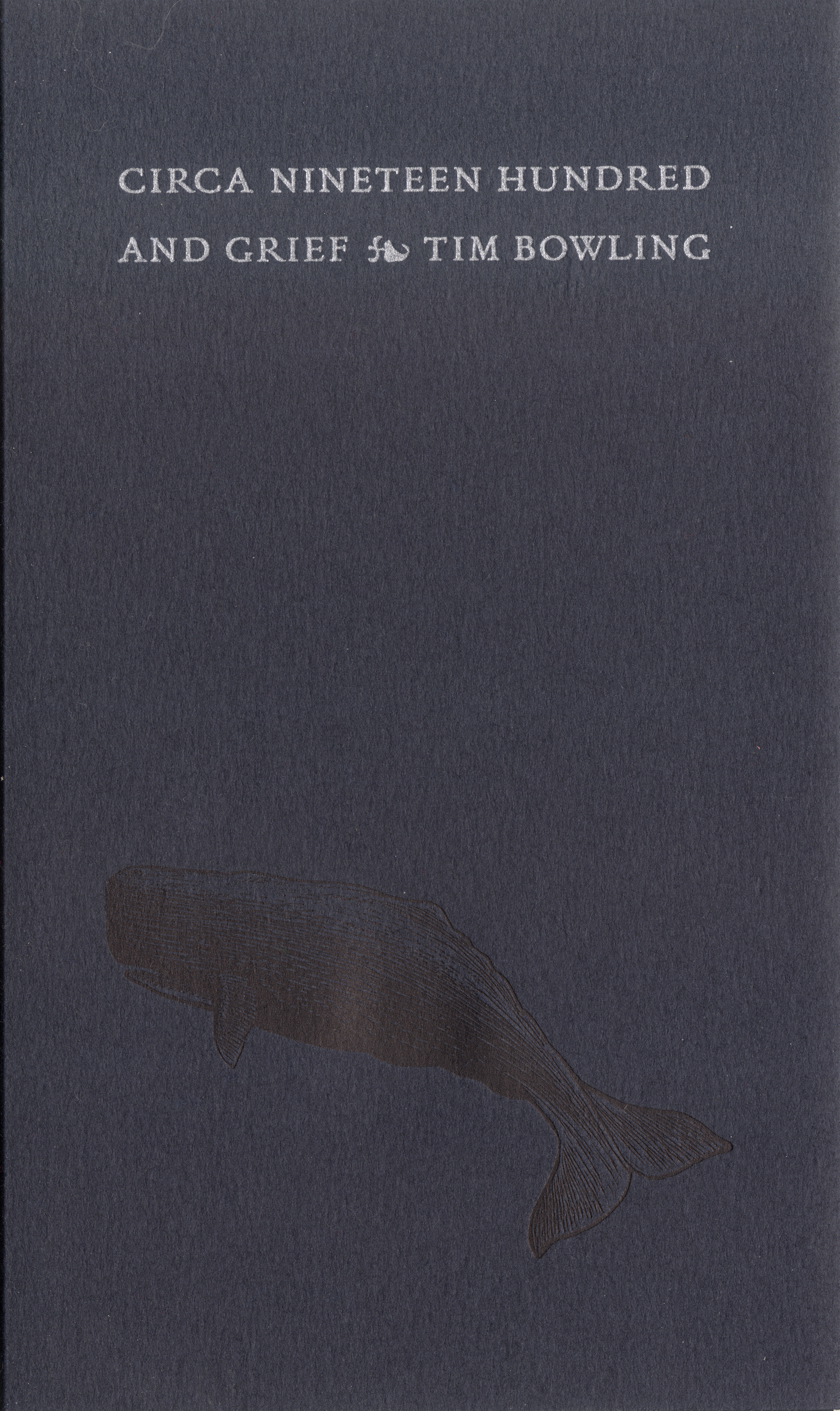
Circa Nineteen Hundred and Grief.  Tim Bowling.  Gaspereau Press.  Kentville, Nova Scotia.  2014.


The picture I have of the cover does not do justice to the lovely Wesley Bates woodcuts that grace this beautiful book.  Gaspereau Press books are not like the others.

Today's book of poems looked at Tim Bowling's Selected Poems (Nightwood Editions, 2013) back on May 13, 2013.  We loved it.

You can see that blog here:
http://michaeldennispoet.blogspot.ca/2013/05/selected-poems-tim-bowling.html

Circa Nineteen Hundred and Grief is Bowling's twelfth book of poetry and perhaps his best to date - which is saying a hell of a lot.  Bowling has been a big favourite here at Today's book of poetry.  His book Low Water Slack (Harbour Publishing, 1995), is required reading for our interns.

Childhood

I want it back. It is unseemly
to admit so. The many who confuse
a love for the present of the past
with a love for something dead
roll their eyes. Forget them.
This is for men and women
of certain years who,
having left prints on the sand,
remember the feeling
of castles in their fingers
and turn for the fanfare
blowing silent out of the mouth
of the sun, for those who,
when the utilities are paid
another month and the children
in their intensities occupied
and the laundry transferred
once more to the light,
sit on the grass in the yard
and place one hand
on the sun-warmed gold
of the sleeping retriever's fur
to take the pulse
of that small self
they say goodbye to
a little more each day,
for those voters, tax-payers,
bearers of the ordinary burden
without end or praise who
for a few seconds
bury their faces in the old trinity
earth-sun-beast
and breathe that lost present alive
tending the last coals of a fire
in the woodcutter's woods
before the blank page of the story
turns back again
with the sound of a whale
sliding its Victorian nursery
for the last time
into the sea.

...

"Childhood" starts off this sterling collection like the whistle of a train announcing its definitive arrival with authority.  This lament to aging is Bowling at the height of his considerable powers.  It breathes the same air as The Old Man And The Sea.

Time is a lonely hunter bearing down on us all as invariably as Orion looking down on every night. Bowling knows time and the stars burns equally bright.  These poems read as though they were chiseled into stone, carved as runes of wisdom for those to come.  As though the very earth loosed them in a fit of chthonic wonder.

Two Young Men In A Duck Punt

It's still dark, they wait for something.
Light? Time? Though their lives
and ours consist of light and time
it is not for these they wait.
But see the tension in their necks
shoulder -- what else could be
the cause? Even if you say
they wait to kill, what
have you ever done to the light
and time besides?

The river around the rushes
flows black, the salmon smolts
cluster thick in separate gleams --
the knives of the knife-
throwing before the show.
Frost thaws on the gunwales
water drips off the oars
the breath of the young men
comes down-slow
and visible, there are no rings
on their raw hands. They wait
without knowing, for everything

as you have done, are doing,
there in your row at the seminar
at the breakfast table, on the knife-
scored seat of the city bus,
with the frost burning off
and the day's last windfall
rotted in your lap, waiting
for the horizon's stir
the thousand clock hands
at the centre of the present.

How fleetingly lovely
the ordinary annulment
of our skies
as the tide changes
and smoke leaves the barrel
and those young hands
like ours
gather all morning
each soft inch
of the bloody rope
whose pulling sounds only the silence
in which is heard

light and time
light and time
light and time

...

Today's book of poetry has always enjoyed the poetry of Tim Bowling and Circa Nineteen Hundred and Grief cements what we always thought.  Bowling is one of our best.

Bowling is more formal than he first appears, and fiercer.  These poems work like the inside of a fine watch, all delicately intertwined and necessary for the silent mechanism to keep track of time.  All those gears grinding away and we don't hear a sound.

The Last Days of Summer
Before the First Frost

Here at the wolf's throat at the egress of the howl
all along the avenue of deer-blink and salmon-kick
where the spider lets its microphone down
into the cave of the blackberry bush -- earth echo
absence of the human voice -- wait here
with a bee on your wrist and a fly on your cheek
the tiny sun and tiny eclipse.
It is time to be grateful for the breath
of what you could crush without thought
a moth, a child's love, your own life.
There might never be another chance.
How did you find me, the astonished mother says
to her four-year-old boy who'd disappeared
in the crowds at the music festival.
I followed my heart, he shrugs,
so matter-of-fact you might not see
behind his words
(o hover and feed, but not too long)

the bee trails turning to ice as they're flown.

...

These poems long to understand our world, put it into perspective despite the complex layers of narrative that demands.  Bowling has found the language that both connects us to and explains mysteries we have yet to unravel about ourselves.  We want to listen to everything Bowling has to say and he never disappoints.

Bowling must be an excellent listener because it appears he doesn't miss a thing.

Gary Dunfield and Andrew Steeves should be sainted by the small press world.  They are the Huckleberry Saints of Canadian publishing as far as Today's book of poetry is concerned.  No one does it better.  They can be counted on to produce books of unsurpassed physical beauty.  Circa Nineteen Hundred and Grief is but one of a long line of visually stunning and consistently gorgeous books lovingly produced by Gaspereau Press.

Tim Bowling

ABOUT THE AUTHOR
Circa Nineteen Hundred and Grief is Tim Bowling’s twelfth collection of poetry, others of which include TheAnnotated Bee & Me, Fathom, The Memory Orchard, and Selected Poems. He has also published a memoir, four novels (including The Bone Sharps and The Tinsmith) and a creative work on book collecting and poetry entitled In The Suicide’s Library. Bowling lives in Edmonton, Alberta.

gaspereaupress.com

320

Poems cited here are assumed to be under copyright by the poet and/or publisher.  They are shown here for publicity and review purposes.  For any other kind of re-use of these poems, please contact the listed publishers for permission.

Wednesday, January 14, 2015

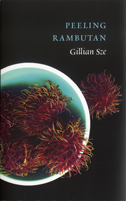
Peeling Rambutan - Gillian Sze (Gaspereau Press)

Today's book of poetry:
Peeling Rambutan.  Gillian Sze.  Gaspereau Press.  Kentville, Nova Scotia.
2014.


FOR SABERA

"sorrow becomes a friend if it hangs
around long enough"
                                --from East is the Sun Behind a Tree
                                           Gillian Sze

Back on October 14, 2014, Today's book of poetry (blog #257), I had the pleasure of writing about Gillian Sze's utterly illuminating second book, The Anatomy of Clay.  Peeling Rambutan feels and reads as though it were written by a different poet - but one of equally fascinating and obvious talent.

Whereas there was a lightness to The Anatomy of Clay, an almost casual brilliance - Peeling Rambutan has weight.  It is full of focused energy and power.  But it is never too heavy.  This balancing act takes game.

Once again, Gillian Sze is dazzling.

Come

and show me our various forms of leaving. By boat, by foot,
by the flash of our thumbs. By storm, by nightfall, by the
infant hours. Play me the heave of a train horn pushing
through the dark. Show me how a railway crossing rises as
easily and slowly as a dancer lifting one leg. Show me the
silent lightning, as if the sky surrendered, and we're waiting
for ash. Tell me that someone has already seen this and is
still looking up. Tell me how to prepare for the weather next
Saturday. tell me how to reduce stories to their simplest
parts. Tell me again our various forms of leaving. With the
engine running. With joy, avidity, stifled regret. Tell me how
the rooms fell silent. Faces looming in the back window.
The eye falling to the fence. Tell me about two-toned living.
The incompatibility of temper. the worlds you worked to
unite. the tumbling languages that refused to stay aloft. The
ground-bound postscripts. The plummeted paper planes.

...

Many of the poems in this third book of poetry by Sze are prose poems - and yet they flow easily enough, slide off of your tongue as though by design.

Contemplative is a good word to describe these precise poems of captured moments.  Like you are constantly walking into rooms of new discovery.  The edges are clear, reading them is like watching one of those old Polaroid photos come into focus in front of your eyes.

Garage Band

In Wen Chong Village, beneath a small light,
a group of old men settle on their plastic chairs.
Cradling their instruments,
they smoke cigarettes
and drink kung fu tea to defeat the dark.
Inside, their women fret over what to prepare
and pack for next day's lunch.
Outside, a weathered man stands to face his players
and wavers out a Canton opera,
spitting during the interludes,
and picking up at his cues.

...

Once again I have to mention Gary Dunfield & Andrew Steeves.  This book continues Gaspereau's tradition of making the most beautiful books of poetry that Today's book of poetry sees.  Looks shouldn't matter to poetry - but Gaspereau gives all other poetry presses something to aspire to.

How To Kill A Cockroach

Without qualm,
she peers at the bottom of her shoe and says,
Never let a cockroach see your hand's shadow.

...

Peeling Rambutan is a travelogue of sorts that takes you inside the minds and language of foreign people and places that you will most likely never see - and leaves you feeling like you've been there.

That's a great trick.  Bravo Gillian.

Gillian Sze

ABOUT THE AUTHOR
Gillian Sze is the author of two previous collections: The Anatomy of Clay (2011) and Fish Bones (2009). Her work has appeared in a number of national and international journals, and has received awards such as the University of Winnipeg Writers’ Circle Prize and the 2011 3Macs carte blanche Prize. Originally from Winnipeg, she now resides in Montreal.

BLURBS
Peeling Rambutan traces a young poet's journey into the interior of China, a place where "religion is a game of telephone and illumination," where epiphany is found in ancestral kitchens. Sze shows us a luminous, lyric landscape where old village vendors ride into Shanghai singing in rhyming couplets. What a beautiful, unforgettable trip reading this book is!
—MARY DI MICHELE, author of The Flower of Youth

Gillian Sze's Peeling Rambutan is an unforgettably vivid collection, combining her characteristic intimacy with subjects and a gut-punching instinct to get it across. Richly detailed with uncommon knowledge and observance, poised in articulation and always present. Gillian Sze is one of our most enchanting poets.
—DAVID MCGIMPSEY, author of L'il Bastard

Gillian Sze's voice is so assured and so clear. She sets out to explore where she is from, where "Here can't be found on a map," and then sends the images our way. She records, and then tattles in the best of ways: with curiosity and awe and humour. I felt at times that I was reading a novelist writing brilliant poetry. That is to say, these poems are busy with story. I loved them.
—DAVID BERGEN, author of The Age of Hope


Gillian Sze's sensuous, precisely-observed poems trace her identity across cultures, eras and continents, weaving together scraps of family lore, visits to changing landscapes, the smell of Malaysian fruits and Canadian snow. Her far-flung home, often in the air, often lonely and built from memory is of a sort many of us share. The poems in Peeling Rambutan enlarge our sense of who we are.
—JOHN STEFFLER, author of Lookout


Gillian Sze reads from The Anatomy of Clay\
video from ECW Press


292

Poems cited here are assumed to be under copyright by the poet and/or publisher.  They are shown here for publicity and review purposes.  For any other kind of re-use of these poems, please contact the listed publishers for permission.

Thursday, October 16, 2014

Alibi for Two - Augustus Merrill (Parallel Press)

Today's book of poetry:
Alibi for Two.  Augustus Merrill.  Parallel Press.  University of Wisconsin-Madison Libraries.  Madison, Wisconsin.  2014.


The poems in Augustus Merrill's Alibi for Two are diptychs.  Or at least that's what they would be called if they were paintings.  Masterful painting at that.

I asked our intern to find the appropriate literary term for this form, a poem in two parts with a prose introduction, but she left the office for lunch yesterday and hasn't been heard from since.

Merrill is a retired English professor and I think, after reading these fine, fine poems, I would have enjoyed listening to what he had to say about almost anything.  I'm certainly game for more of these poems.

Perhaps these poems could be filed in the "call and response" tag - but ultimately it doesn't matter.   Each of the poems in this collection starts with a short prose section or introduction and ends with a brief poetic retort, summation, response.

The effect is startling.

The Crossing Guard

They moved to town for the sake of the baby. It was just too hard
living out like that. She was immediately relieved. The grocery store,
the Laundromat, the city parks. It took him the remainder of his life
to make the adjustment. As a very old man his greatest pleasure was
to look out his narrow window at the young crossing guards directing
traffic by the elementary school in the middle of the afternoon. If
civilization were like this, he thought, he never would have gone to live
in the woods.


Not a decade behind them

The young crossing guards stand duty at the stop.

Already they have assumed the serious and sober robes of responsibility.

In neon safety vests they arrive early at their stations

Dwarfed by the nine foot signs.

With miniature mirrored signs of their own they stop traffic.

On the world's windswept open streets.

Obediently the traffic halts

As the guards conduct their small charges to safety.

No one, not even the most hardened criminal

Would disobey their small upraised hand.

Whatever the future brings, into this scene

Such authority and obedience will never be theirs again.

The power and satisfaction given over to them as children

Will soon be replaced by defiance and disappointment at every turn.

Before accelerating again

We stop to admire the young guards and to admire ourselves

Doing what we are supposed to do.

...

Stylistically Merrill's intelligent poems read like a familiar, but Today's book of poetry has never seen quite this sort of poem work quite this effectively.

To go back to the diptych metaphor; Merrill has found the recipe to create the perfect union between the two halves of these poems.

Merrill has mastered pace and tension so that many of these poems read and sound and taste like folklore we had forgotten.

Leave Your Bow Man Alone

They had been married and divorced three times, and now they were
trying to go down a little, rocky, northern river together. He screamed
for her to paddle on the right. She paddled on the right. He screamed
for her to paddle on the left. She paddled on the left. All the while
she didn't say a word. Her thoughts flowed with the current as light
and easily as a leaf. Three times is enough, she thought, three times is 
enough.


Leave your bow man alone;

You are lucky to have him there,

And if he is a she, leave her alone too--

She has had enough of your bad advice already.

Choose which side is dear

Then change like the changing of the year

Without premeditation, plan, or word.

Leave your bow man alone.

Steer when you are tired,

Moving forward as you never would have done alone.

If you must command,

Command yourself to the passing world

Remembering that you are heavy

And that she is light

And that the two of your are only being led along

Because the water has forgiven you both.

Leave your bow man alone.

Go to the shore in silence and tenderly touch the limbs

That have brought you home at last

Where there is no water

And no need for forgiveness.

...

Augustus Merrill uses dry humour with much the same delicacy as a painter using the dry-brush technique.

Wait, that's the ticket!, diptych's, dry-brush technique -- this guy is a painter.  And what lovely paintings.

I Sit With You

It was not a good place to quarrel. In a city or in a town there would
be restraint, but there was no restraint there and the lake did not help.
When it began to freeze their differences were magnified. The water
creaked and groaned as though it were in its death throes. It pinged
without mercy through the fragile house and the fragile marriage.
When there was no more to say, a cruel silence would set in. Sometimes
it would last almost until the lake thawed in spring.


No wind over the eighty-eight acre face of Lake Nothing,

No moon in the leaf stained water.

The pike who has hunted the ducklings

All summer in the shallows

Is hunted himself now

By the pressures of the winter thermocline.

The otters in their den,

The city people in their city,

The loons flown south,

I sit with you, my silent wife,

Until the wind stirs and the ice forms

Between us and the lake.

...

Augustus Merrill's poetry has the confidence of the experienced and the humility of man who knows too much.  This chapbook of very human poetry remind us at Today's book of poetry that some of the very best things come in small packages.

Lee Merrill, his hunting dog, Belle, and his grandson, Bastiaan.

ABOUT THE AUTHOR
Augustus Lee Merrill is retired from a thirty-year career as professor of English literature at Northland College in Ashland, Wisconsin. He has been involved in the conservation issues of the Lake Superior region as a member of the boards of the Sigurd Olson Environmental Institute and Voyageurs National Park. His writing has appeared in College English, Poetry Now, The Wisconsin Academy Review, and Gray's Sporting Journal. Merrill lives with his wife Melinda in Washburn, Wisconsin.

parallelpress.library.wisc.edu

258