Showing posts with label unicorn press. Show all posts

Friday, May 18, 2018

Celadon — Ian Haight (Unicorn Press)

Today's book of poetry:
Celadon.  Ian Haight.  Unicorn Press.  Greenboro, North Carolina.  2017.

Unicorn Press First Book Award Winner, 2016-2017


Image result

Ian Haight's Celadon could easily be three different books of poetry.  When Today's book of poetry read Celadon the first time it knocked us off our feet, three times.

Celadon refers to an imagined paradise, a real enough area in Korea where potters, of a certain skill, made/make fine pottery with a pale green glaze.

Haight imagines a Utopian place where the earth slows down enough for contemplation.  But Haight is nothing if not a realist, these poems come from someone who has experienced the machines of industry and commerce.  Haight knows the price paid for anyone who steps outside the lines.

Stamping Parts

1.

I said no to summer
at the company's private
park, no to my own
lakeside trailer, tending
deer paths, picking up
garbage, and women my age
on a beach. Dad reclined in his 
re-upholstered La-Z-Boy—
the back, already sunfaded—
and looked out over the
front hill's lawn from our
living room picture window.
Ketchup stained the chest of
his long underwear—the flannel
plaid shirt, unbuttoned to near
his navel. He dragged slow on
a cigarette, flicked ashes
in a gold glass ashtray.
Behind him on the fireplace,
the hundred-year-old grandfather
clock ticked. Red leather
steel-toed work boots
slouched by the hearth's iron
candlestick. Through his wire-
framed glasses, Dad stared
at the TV, though the child-
sized Buddha statue bought at
a roadside flea market
lounged in meditation
close to the channel dials.
It's not easy for summer
help to get that job, he
said. I looked down at the
brick-brown sofa's seat
cushions, fibers unraveling
at the edges, mold-yellow
plastic exposed. The oak
coffee table's top
corners paled on the sides,
worn from soles of work-
boot scuff marks. I rested
my foot on the wear. Dreaming
of 13 dollars an hour
running steel machines
I said, But I can get
overtime in the factory.
He put his Diet Coke
on a coaster, let the air
sink out of his chest, and said,
Ok.

       Outside
the lifetime-old, cinder-
red brick factories,
a sign declares, "162
days since any injury."

At the rollforms, high-roofed,
empty-air spaces above 
machines as long as the building—
the machines smash steel sheets
into lengths for IBM's
office furniture panel
frames.

             Too young for steel
press work at seventeen,
with a bucket of turpentine,
I mop a conveyor line's
dribbled paint for the factory's
minimum hourly pay.

Workers do pushups
between passing parts, read
Principles of Accounting
or Gone with the Wind.

                                       Lunch
at half past midnight,
the break room filled with Penthouse
and Hustler, bathrooms busy
with washing hands; trash bins
full of paper towels.

Volunteering for overtime
means cleaning anodizing
vaults. A gas mask, if you're
a wuss, and middle-aged toothless
people, their hair near gone.
There's no union here
'cause the pay's so good.

On the first floor, men run
presses as big as houses,
drink cherry brandy between
loads, tell me their children's
names. The men say they majored
in English, and warn, Whatever
you do, don't come here
when you finish. Steve
makes sixty grand—enough
for most at our plant—but he drives
on old white Regal, rust-
holed, tansy-streaked from oxidizing
metal under the paint.

Al monitors the paint
gun lines. Every few
hours he replenishes
a hose with a full drum.
What do you do all day?
I ask. Not a damn thing.
Best job in the plant.
My eyes water from fumes;
Al doesn't wear a mask.

No cigarette packs,
so I ask, Do you smoke? No
way, the whole place'd blow
up—you can't smoke down
here. Besides, that stuff
is bad for your lungs. How
long have you been doin'
this? Fifteen years. They'll
have to drag me out.
He shows me his house, oil
pumping rig on a hill,
a tray of chessmen he's
painted with real gold.
Why do you work? I ask.
Where else is someone
going to pay me to sit
around all day? Besides,
it get me out of the house,
you know, gives me something
to do.

...

Today's book of poetry had to hold the reins a little tight at a couple of different points in our reading of Celadon.  One minute we were union obsessed and remembering our time on the motor-line, working for Ford in Windsor.  Then we were Buddha buddy happy in rural Korea and are negotiating our presence with the local population.  Questions arise about being  in a culture that embraces the past and the future with equal reverence.  But let me be clear, Ian Haight, is crystal.

Haight's poems are all aimed at understanding the social construct around human behaviour.  What people do in their efforts to get through a day.  Haight looks at the reconciliations we make with ourselves at the end of the day — the stories we tell ourselves to tie up the loose ends of our lives.  

This is one of those times when Today's book of poetry feels that we lack the skills to adequately express the pleasure we had reading Celadon.  We were certainly engaged from page one, Celadon
compels the reader with pace, from the factory floor to the rice fields, Haight's straight forward narration is always rich with the right detail.

All Haight is looking for is a safe place to land.  Like most of us, his search is for peace, for all, a reasonable world, a secure life, no unreasonable ask.

Peacock Meditation at a Thai Nunnery

     A rusted iron cage has a sterile sand floor covered with fern
seeds. Inside, a peacock half-spreads fronds of wispy tail feathers as
big as its cage, promenading.
     Chanting mantras, a nun bows to a gold-leaf wooden Buddha
statue, bows to a white granite pool. She walks into the pool as if it
has no temperature, stops when water touches her vulva—bows and
prays. She whirls in water, shifts her mudra hands, glides from lotus
meditation to flat on her back, the wideness of soles of her feet and
toes white—prays to Buddhas of ten directions. Arms extended,
she floats vertical over the pool's rock rim. She rises, bows to the statue,
walks to a far off house.
      In the shade of trees, dogs saunter behind monks of the temple.
The peacocks sit silent in their cages.

...

Haight isn't shy about bringing in some reinforcements, he pin points moments in time using keys like Penthouse Magazine to grab you by the nose.  But what he's really after is calling out the Gods of Industry who don't care who they crawl over in the name of progress.  The Gods of Industry who breath greenbucks and bury the evidence of the misdeeds in caves.

Celadon is highly polished, with a beautiful green glaze over it all.  Over the death of Detroit with its empty factories and empty homes and nary a dream in sight.  Over the gravel and mud of rural Korea, Japan and Tibet.  Haight is swinging a big broom but he's awfully sweet with the details.  Haight remains devoted, he is constantly misadventuring himself towards some bigger truth.

At Otter Creek, Florida

She said she wanted
to talk about love.
We hold hands and walk.
The tusk of a baor, half-
sunk in humus, gray
below an acacia's shade.
A manx once pawed
our bedroom window
beneath a full moon.
Vapors mist near lobes
of calyx. Loam sinks
under our steps.
Like leopards caged
in a cement summer zoo,
we pant. Growling moans
through mimosa,
Jaguarundis eat cardinals.
A spring-fed pool floats
mayla petals; we disrobe
and dive, dissolving
under specks of light.

...

To say that Today's book of poetry enjoyed frolicking through Celadon just doesn't cut it.  Whatever tools Haight employed, Today's book of poetry was hook, line and sinker.  Ian Haight says it all quietly and without ado.

You don't see the punch coming at all.
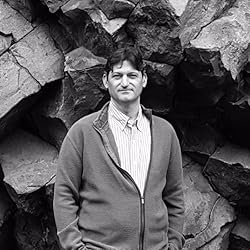
Image result for ian haight photos

Ian Haight

ABOUT THE AUTHOR
IAN HAIGHT was a co-organizer and translator for the UN’s global poetry readings held annually in Pusan, Korea, from 2002-4. He is the editor of Zen Questions and Answers from Korea, and with T’ae-yong Ho, he is the co-translator of Borderland Roads: Selected Poems of Kyun Ho and Magnolia and Lotus: Selected Poems of Hyesim—listed as a 2013 Notable Book in Translation by World Literature Today and finalist for the American Literary Translators Association’s Lucien Stryk Prize. He is the recipient of Ninth Letter’s Literature in Translation prize and five translation grants from the Daesan Foundation, Korea Literature Translation Institute, and Baroboin Buddhist Foundation for the translation, editing, promotion, and publication of Korean literature. His poems, translations, essays, reviews, and interviews have appeared in Quarterly West, Prairie Schooner, and Writer’s Chronicle, among other publications.

BLURBS
“Ian Haight writes wisdom-in-verse. He understands the mise en abyme of the abyss within the abyss within the mind, and he knows how to make meaning of it all. The poems of Celadon move fluidly from the spiritual to the commonplace to the vulgar. We encounter blue-collar workers and Korean Buddhist proverbs, Aristophanes and military pilots, Isaac Asimov and an assortment of human failures—and in Haight&rsuqo;s deft poetry, these marvelously varied elements form a coherent and utterly human whole. This volume marks the emergence of a new and remarkable talent.”
     —OKLA ELLIOTT, Judge, 2016-2017 Unicorn Press First Book Competition

“The large amount of geographical territory that is covered in this collection is distinctive and one of its great strengths. Ian’s work in these poems shows an attentive kindness . . . and the poems do not risk appropriation or indulge in privileged guilt.”
     —JULIANA SPAHR, author of Well Then There Now


"Magnolia & Lotus" by Hyesm
translated by Ian Haight & Tae-Young Ho
Video: Brad Havens


688

DISCLAIMERS

Poems cited here are assumed to be under copyright by the poet and/or publisher.  They are shown here for publicity and review purposes.  For any other kind of re-use of these poems, please contact the listed publishers for permission.
We here at TBOP are technically deficient and rely on our bashful Milo to fix everything.  We received notice from Google that we were using "cookies"
and that for our readers in Europe there had to be notification of the use of those "cookies.  Please be aware that TBOP may employ the use of some "cookies" (whatever they are) and you should take that into consideration

Thursday, May 12, 2016

Creeks of the Upper South - Amy Wright & William Wright (Jacar Press & Unicorn Press)

Today's book of poetry:
Creeks of the Upper South.  Amy Wright & William Wright.  Jacar Press & Unicorn Press.  Durham, North Carolina.  2016.

Collaborations in poetry can be damned hard work.  Creeks of the Upper South is a call and response collaborative book of poems from Amy Wright and William Wright and it is seamless.

Today's book of poetry has attempted different types of collaborative poetry with mixed results.  It's hard enough to find someone you agree with on anything let alone finding someone to share a page with.  It is deep, murky water and there are dangers everywhere.  All of that to say that Today's book of poetry marveled at the synchronicity in every danced step between Wright and Wright.

Memory and Prophecy

What She Remembers:

     That in the summer of her seventh year,
     storms slanted in and engorged the rivers
     and creeks until all waters buckled high,

     shattered the levies and bit to the quicks of berms:
     houses that did not kneel and drift away moldered.
     They moved the whole town eight miles north.

     That in her ninth year she came back to the creek
     then in drought and walked barefoot
     the dry bed's limb-trash and alabaster--

     That something in the slim sun-spears made
     her look up into the unshackling of April
     and witness a horse skeleton, brown-white

     as the soles of her feet and silty hands.
     She looked long at how vines twined its brisket,
     at the strange philodendron head, drained

     of flesh, brainless and almost comical in
     its stillness, staid and smiling long with gothic
     joy at the sheer oddness of how the Earth had reined it.

     That the winter of her thirteenth year
     in the frigid mineral-scent of dusk, the Harman
     boy breathed warmth on the small hairs of her neck,

     the whiskey on his child's breath, how they leaned
     into one another in the blindness and purity
     of the killed grass beside the creek, the water frozen

     pure to the floor, where stunned curves
     of minnows flashed tinny and motionless
     under the stars' arc-light.

     That the thaw snapped and pocked the air like gunshots
     so that in the first hint of spring the Harman brother
     slew the boy she kissed and dragged his kin down into the gorge.

What She Cannot Foresee:

     That centuries the white window of the moon will open,
     house roofs will crumble as the horse bones gripped
     in the long-fallen oak will fall themselves, then grind

     down with years, fold as dust and meld with the specks
     kept there of the murdered boy, millennia-old, both
     now in the earth proper, slack and laggard slow.

...

Now if that isn't gothic/romantic enough for you I'll eat my shorts.  Wright/Wright take you down to the water to see if you'll float.  They make you walk barefoot .through the millennial ooze, the silt of their ancestors.  This is captivating stuff, you open the cover to this little gem and you are instantly under the spell cast by Wright/Wright.

Wright x2 have a biologist, historian, anthropologist, geologist and a bevy of scientists on their research team and along with their own gothic charm it makes for a riveting crossing of all this stormy water, the Wrights have roiled up the water and we are in for an emotional voyage.  Their rich lingo sings of a particular notion of the South, I can see Carson McCullers and William Faulkner at the edge of one of these coulees, Flannery O'Conner is probably somewhere nearby.

Sanguinaria

In the chill before Easter, it was dusk again,
and my mother and I walked the berm, out past

the corn, The night's door warped: the sky
broken from its hinge swung down

low to us, low enough that the smell of rain
steeped our hair. Behind the springhouse,

we stopped to watch a possum crawl
over a years-old midden

with such reckless fear that she took a spade to its skull.
How can I justify a fear that blooms in the gut

and stings like thistle? Such creatures follow
me in my sleep, the ones harmless but foul,

the ones that must haunt: blowfly, centipede,
wolf spider, the bubbling muck of toads.

We trudged into watercress, across the field,
she in her country gown, a ghost before me--

down to the hemlocks and galax
when rain fell sudden, and the wind

pierced the thicket and drowned our scalps.
There is no such thing as empathy.

                         *
The storm drove through, just north
of us, a great spectral womb broken, ripped.

Our footfalls hugged the creekside's silence,
its washed-out susurrus, its sealed mouth.

There with her in that violet cold, all the blood
that ran through that shadow. All the bloodroot

we smashed through, the bloodwort, puccoon root,
into slanted fields two

farms over, up from the rushing creek curve
where heaped stones were draped with lichen.

The moon smeared behind clouds, a runnel
of milk. Why does the sight

of lanterns dawdling in a far pasture
ignite the heart with a joy and sorrow that, upon sleep,

the mind lumbers with false memories of farmhouses,
days and days of threshing grass, the chirr

and grind of crickets in the core of a summer long dead?
The rain fell hard: we quickened through briars, up

to the backdoor, the red light that framed it.
She said nothing. I witnessed her face

turning in the window--a shivering
leaf that withered, that would not release.

...

These poems have a cumulative effect on the sodden reader.  Wright & Wright know their business and their business is to write emotionally haunting and visually stunning poems that get under your skin like a poetry tick.

Today's book of poetry has long admired the voice of Shelby Foote.  Foote was a historian and novelist and he had a voice of such gravitas and humour, warmth and wit, that I could happily of sat and listened to him read a phone book.  Shelby Foote reading Creeks of the Upper South is an entertainment I would pay almost anything for.  He'd ride over these poems with the perfect verbal caress.  These are poems that should be read aloud.

Understory

And now we will witness the unseen flames:
cardinal shit, apple maggots, fishbone thistle, squama
and fauna scales, keratinous flakes flecking ground;
sporiferous trees (ambassadorial as they kneel);
hyssop, sometimes odoriferous; dried blood on bard,
dropwort, smartweed and sweetleaf; outhouses
still standing in a crush of woods (redolent of peaches);
early-century crates breaking under the weight of wild squash;

crimson minnows courting a swale (painterly over chalk-white silt
and rocks stroked with moss so green it hurts to look);
woad and its micro-cache of bluest rivers; witloof chicory
(good in salads); distant farmhouse windows on winter nights
shining like citrine stricken with sun; the yucca's
blades curdled over with cream-flowers a few April days;
jars of milk; smells of leaf-fire; poxy bogs

emeralded with mosquito eggs; itchweed, abelia,
and spittlebugs with their soapy secretions;
the half-buried bones of horses, their skulls
ghastly and beautiful; musket balls buried (for good);
possum oak and possums themselves (drooling
and conspiratorial in suburban sheds);
ivory nuts and ivy-tods; the helix-lattices of lichen;
gypsum and hagberry; the toothless kin-gone elderly

who grin at the edges of cracked doors (kind or wary);
snakeskins, fraxinella (burning bush); understory
flames; diatomoceous earth; the waxy cartilaginous
bulbs or rocky shoal spider litlies; cutworms that gnaw
on vegetable seedlings so that they fall like small timbers;
capillary mattings (wicking water from reservoirs);
wild decay (never gothic) and wildest revival (never lofty).

...

Amy Wright and William Wright have done something remarkable.  It is not just that they have become one voice for the purposes of Creeks of the Upper South, but that they have become a choir, in unison, with resolve.

Amy Wright


William Wright

ABOUT THE AUTHORS
Amy Wright has authored two poetry collections and five chapbooks. The Nonfiction Editor of Zone 3 Press, Coordinator of Creative Writing and Associate Professor at Austin Peay State University, she has been awarded a Peter Taylor Fellowship for the Kenyon Review Writers’ Workshop, an Individual Artist’s Fellowship from the Tennessee Arts Commission, and a fellowship to the Virginia Center for the Creative Arts. You may find some of her work online at: awrightawright.com.

William Wright is author of four books of poetry, most recently Tree Heresies and Night Field Anecdote, as well as four chapbooks. He is editor of eleven editions, including all volumes ofThe Southern Poetry Anthology series (Texas Review Press), two texts centered on Gerard Manley Hopkins (Clemson University Press, forthcoming, 2016), and Hard Lines: Rough South Poetry (USC Press, forthcoming, 2016). He is assistant editor of Shenandoah.

BLURBS
“The poems in Creeks of the Upper South rely on call and response—both within individual poems and from poem to poem—which seems fitting, given the collaborative nature of the collection. At times, the voices and personal narratives are alive and burgeoning, and at the same time fragile. Other times, primal and colloquial language fuses into a lexicon of ecological anxieties and understandings. This collection calls us to take off our boots, roll up our britches, and follow the creeks and voices meandering and forking through these poems. We can’t help but respond.”
     — Adam Vines

“Creeks of the Upper South is collaborative poetry at flood-surge. It is a braided stream, the skitter-flight of water-fowl, a storm event of vowels, childhood as rocky shoals, cutbank in language’s flow. Amy Wright and William Wright walk back the postmodern idea that word and place, signifier and signified, can’t roil the same deep channel.” 
    — John Lane

470

DISCLAIMERS

Poems cited here are assumed to be under copyright by the poet and/or publisher.  They are shown here for publicity and review purposes.  For any other kind of re-use of these poems, please contact the listed publishers for permission.

We here at TBOP are technically deficient and rely on our bashful Milo to fix everything.  We received notice from Google that we were using "cookies"
and that for our readers in Europe there had to be notification of the use of those "cookies.  Please be aware that TBOP may employ the use of some "cookies" (whatever they are) and you should take that into consideration.