Showing posts with label a midsummer night's press. Show all posts

Tuesday, April 23, 2019

Having Never Met - Inga Pizāne (A Midsummer Night's Press)

Today's book of poetry:
Having Never Met.  Inga Pizāne.  Translated by Jayde Will.  Periscope #05.  A Midsummer Night's Press.  New York, New York.  2018.

38891651

Inga Pizāne's Having Never Met comes to Today's book of poetry from Latvia via the very generous translation skills of Jayde Will, and we are all very grateful.  Today's book of poetry was swept up immediately by Pizāne's precise narratives on the acts of desire and the battles of the heart.

Inga Pizāne keeps things clean and tight regardless of whether she's writing about domestic bliss or the other evil end of the spectrum where relationships turn into a stinking dumpster of bad decisions that you never want to sleep with again.

💫💫💫

From I don't know you
to I know you better than myself
we traveled far and wide.

Until we reached our final destination.

Then we traveled back
even farther and wider
from I know you better than myself
to I don't know you at all.

💫💫💫

It's as though Pizāne knows us all, our inner thoughts and workings, what we think when we think of love and what we think of love when it leaves as though born on the wind.  Having Never Met is one tidy ship.  If this were jazz, Inge Pizāne would be a female Paul Desmond.  Complicated as you'd ever need but pure and direct and unmistakably cool.

We all want love and Today's book of poetry applauds Inga Pizāne in her attempts to sing with a real voice.  So much music we hear now is strained through a tuner so we no longer know what is true.  Pizāne suffers know such travail, we hear the pleasure of a natural and beautiful voice.  Inga Pizāne fights all those battles of the inside with aplomb.

💫💫💫

###
update
me
you have access
to my
old version

*

search in the settings
and update manually

*

use me more
update me regularly

make sure that I don't freeze up
please don't accidentally delete me

*

go ahead update it
I am a free
application

💫💫💫

Today is a bit of a landmark for Today's book of poetry.  Today's blog/review is our 750th.  

Today's book of poetry celebrated Easter with a little office hunt.  We had Milo, our head technician, hiding eggs, chocolate eggs everywhere.  I fear we'll be finding them until Christmas.

Today's book of poetry needs to give a huge shout out to Barbare Kulig Spanton and her family, Clara, Philip, Sean and Asilka, for the Easter egg dying experience.  Not sure how Today's book of poetry got to 62 without ever hot-waxing an egg but I can now strike that off of our list.  It was splendid.

Another thing Today's book of poetry is especially happy about is that Inga Pizāne proves what we have always believed.  There is excellent poetry all over our world.  Having Never Met can stand solidly in an poetry library.

💫💫💫

If not for you,
I would have left on that
airplane long ago,
a cheap flight
going whoknowswhere,
and while the stewardess would tell us about
the life vests and
how long the flight was going to be,
I would look at the clouds
which wouldn't even seem beautiful,

If not for you,
who smothers my migratory bird instincts,
if not for you,
who would keep me here
without keeping me here,

I would learn
happiness
at seminars

💫💫💫

Today's book of poetry is convinced that there is no better feeling than being in love.  No worse feeling than no longer being in love.  Having Never Met touches on both solitudes with equal charisma and charm.  

Inga Pizāne can burn.
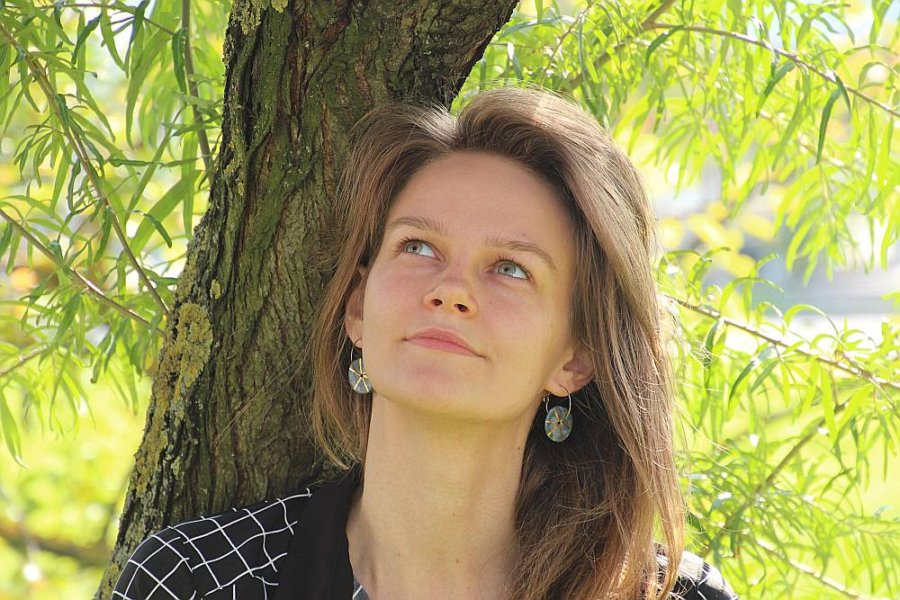
Image result for inga pizāne

Inga Pizāne

ABOUT THE AUTHOR
Inga Pizāne (born 1986 in Kraslava) is a Latvian poet. Pizāne has studied education in Latvia and Sweden, simultaneously attending lectures at the Literary Academy. Her first collection of poems titled You are no Snow (Tu neesi sniegs) was published in 2016 by Janis Roze. She has performed at the Poetry Days events in Riga, the European Poetry festival, the America’s Poetry festival in New York and in other international workshops and festivals; and her work has appeared in theatre and radio. She is currently preparing her second book of poems in Latvian and writing stories. Her collection of poems HAVING NEVER MET (translated from Latvian by Jayde Will) was published by A Midsummer Night’s Press. Her translated work has been published in Disclaimermag, Glasgow Review of Books, Tupelo Quarterly etc.

Image result for jayde will photo

Jayde Will

ABOUT THE TRANSLATOR
Jayde Will is a literary translator from Latvian, Lithuanian, and Estonian.  Recent or forthcoming translations include Latvian author Daina Tabuna's short story collection The Secret Box (The Emma Press) and Latvian poet Artis Ostup's collection Gestures (Ugly Duckling Presse).  He lives in Riga.


Inga Pizāne and Helen Ivory - European Poetry Festival : Norwich
Video: fowlerpoetry


750

DISCLAIMERS

Poems cited here are assumed to be under copyright by the poet and/or publisher.  They are shown here for publicity and review purposes.  For any other kind of re-use of these poems, please contact the listed publishers for permission.

We here at TBOP are technically deficient and rely on our bashful Milo to fix everything.  We received notice from Google that we were using "cookies"
and that for our readers in Europe there had to be notification of the use of those "cookies.  Please be aware that TBOP may employ the use of some "cookies" (whatever they are) and you should take that into consideration.

Saturday, August 19, 2017

This is What Happened In Our Other Life - Achy Obejas (A Midsummer Night's Press)

Today's book of poetry:
This is What Happened In Our Other Life.  
Achy Obejas.  A Midsummer Night's Press.  Body Language 01.  New York, New York.  2007.


Let's just start with the fact that before Achy Obejas had published this first book of poetry she was already a Pulitzer Prize and Lambda Literary Award winning author for her fiction and journalism.

Achy Obejas and her splendid book of poems, This is What Happened In Our Other Life, are all about memory.  Memory is often framed by promise.

Obejas' poetry comes from a Latina sensibility and a lesbian perspective.  These are two important facts to consider before you forget about them because neither of those are why these fine poems ended up here.  This is What Happened In Our Other Life belongs on Today's book of poetry so that we can celebrate Obejas' steel hardened tenderness.  These poems will appeal to your senses.

Dancing in Paradise

You lean against me
as we dance, the soft huddle
of our heads together,
our breaths clean steam in the blue
smoke, rapid, exhausted.
We mix margaritas, because
I like the name, a
woman you love. You're older.
I'm willing, drunk, unbuttoned.
You lead, peeling layer after
wet layer, a heap
of sweaters, shirts and precious
metals. Your breast is
slick with sweat, hands agile,
eels in glass waters.
When you scoop me up, I twist
in your lap, a think
needle thrust through my tongue. Later,
you give me a reading list,
blank journals, your mother's 
recipes. You take
what you need, knowing there's no
autonomy of the
senses, those five carnivores
in their own essential
food chain. What survives is memory,
twin jewels, the blade of
a pelvic bone. Instinctively,
we keep our eyes open,
ears keen, for marine smells,
salt, the plexus of light,
sound, water.

...

Clearly Obejas isn't afraid of the carnal, she blows right past that until she hits visceral.  "We will love the wrong people" intones Obejas and she is completely right, we have all faltered in love because our judgment gets lost in the braille of flesh.  Obejas won't stop there and tells us "I've learned to read my lovers scars," and then bids us the same learned wisdom.

Today book of poetry thinks Obejas wants us to saviour the discovery, journey and mystery as we find them, folded softly into the skin of the one we desire.  This is What Happened In Our Other Life is a meditation on desire and the destiny desire dances with.  Obejas wants to surrender to love if only she could find the right vehicle for the journey.

The Habits of The Blind

I am staring at a grey, pink and purple sky,
worrying about the imprint of our first embrace
(that awkward tangle of limbs)
the first time we were skin on skin.
What will sustain us later,
when we know everything,
if not this innocence?
I worry too much, and not enough.
I long ago surrendered:
The world breaks us all,
throws us up against the wall,
splits our hearts with a vengeance.
There is no right person.
We will love the wrong people.
What I've done is this: embraced chaos--
studied the habits of the blind,
their sixth sense, and Braille.
This way, I've learned to read my lovers' scars,
to appreciate the force or cunning
behind each cut,
the meanings of each tender pattern,
the beauty and depth.
Pain is the risk and the measure
not just of how far we're willing to go,
but of how much we're willing to feel
later, alone in the dark.

...

Aces.  Obejas has a deck of cards filled with aces.  Today's book of poetry likes the way Obejas gets to it.  Achy Obejas can burn.

This is What Happened In Our Other Life ends with a poem, an untranslated poem, in Spanish, "Historia De Amor," which Today's book of poetry has translated.  My apologies to all concerned. Our translator-in-residence, Otis, is currently residing in Belgium after only recently returning from Sicily.  It appears Today's book of poetry has been paying our staff far too much.  So I had to go it alone.  We are sure Otis would have cracked Obejas' Spanish with considerably more finesse, nuance and style -- but we did it anyway.

The poem and translation appear below.  Today's book of poetry does apologize in advance for the lack of proper Spanish punctuation/accents.  Our keyboard refuses to give up any secrets, nothing but broken English escapes regardless of how often Milo, our head tech, fidgets with it.

The important thing is that Today's book of poetry tackled "Historia De Amor" because we suspect it may be Obejas' codex.  It is possible that the poem sums up This is What Happened In Our Other Life quite succinctly.  Obejas gets it all said without much fuss but with so much beauty, isn't that what poetry should be?

Historica De Amor

Ella no existia
cuando la otra se fue.
Despues, no se entero de su regreso.
Se vieron de casualidad.
Una cruzaba la calle,
la otra esperaba un carro.
Se imaginaron un beso
(mas bien un roce de labios,
la mano en el vientre).
Siguieron
cada una por su camino.
Una miro hacia atras.
La otra no.

History of Love

She does not exist
when her other is gone.
I don't know if she'll return.
It was all by chance.
One crossed the street,
the other was waiting for a car.
They imagined a kiss
(rather a touch of the lips
hand on belly).
They followed
each one on its way.
One looks back.
The other doesn't.

(Today's book of poetry apologizes again to Achy Obejas for this translation)

...

Achy Obejas and Today's book of poetry are the same age but I didn't realize that until after I'd read This is What Happened In Our Other Life a couple of times.  Today's book of poetry was convinced we were reading a wise younger woman's book of poetry.  It's not trick, but it is certainly worth noting.  Achy Obejas is apparently timeless.

Obejas
Achy Obejas

ABOUT THE AUTHOR
Achy Obejas (Havana, 1956) is the author of three novels, Ruins (Akashic, 2009), Days of Awe (Ballantine) and Memory Mambo (Cleis), the latter two both winners of the Lambda Literary Award, as well as the short story collection We Came all the Way from Cuba so You Could Dress Like This? (Cleis). She is also editor and translator of the anthology Havana Noir (Akashic).

Her poetry has appeared in numerous journals, including Conditions, The Antigosh Review, Helcion Nine, Phoebe, Revista Chicano-Rique, and The Beloit Poetry Journal, and she received an NEA Fellowship in Poetry in 1986.

An accomplished journalist, she worked at the Chicago Tribune for over a decade, and has also written for the Village Voice, the Los Angeles Times, Vogue, Playboy, Ms., The Nation, The Advocate, Windy City Times, High Performance, Chicago Sun-Times, Chicago Reader, Nerve.com, Latina, and Out, among others.

Among her many honors, she has received a Pulitzer for a Tribune team investigation, the Studs Terkel Journalism Prize, and several Peter Lisagor journalism honors, as well as residencies at Yaddo, Ragdale, and the Virginia Center for the Arts.

She has served as Springer Writer-in-Residence at the University of Chicago and the Distinguished Writer in Residence at the University of Hawai’i, and is currently the Sor Juana Visiting Writer at DePaul University in Chicago.


Achy Obejas at Radar Reading Series
Video: San Francisco Public Library


599

DISCLAIMERS

Poems cited here are assumed to be under copyright by the poet and/or publisher.  They are shown here for publicity and review purposes.  For any other kind of re-use of these poems, please contact the listed publishers for permission.

We here at TBOP are technically deficient and rely on our bashful Milo to fix everything.  We received notice from Google that we were using "cookies"
and that for our readers in Europe there had to be notification of the use of those "cookies.  Please be aware that TBOP may employ the use of some "cookies" (whatever they are) and you should take that into consideration.


Monday, March 20, 2017

When I Was Straight - Julie Marie Wade (A Midsummer Night's Press)

Today's book of poetry:
When I Was Straight.  Julie Marie Wade.  A Midsummer Night's Press.  Body Language 11.  New York, New York.  2014.


It's only every once in a while I get to read a book of poetry like Julie Marie Wade's When I Was Straight.  They just don't come along all that often.  Why?  Because writing one fine poem is hard work -- writing a book full of them is almost impossible.  Wade never misses a beat, if she were shooting arrows the bullseye would be full.

When I Was Straight is a teeter totter of excellence, a balancing act of humour and pathos.  Wade marches right into the middle of all our misconceptions about what it is to be queer and comes out the other side in full pride stride.

When I Was Straight

Everything came to me vicariously -- a promise,
a post-script, a preview of coming attractions.

Desire a quiet rumour that rippled through the halls.

At the cinema, someone always paid for popcorn, a soda
with two straws, little licorice candies.

I loved to sit in the back row & watch
till all the credits rolled.

"You have a gift," the blond boy said, "for stalling."

Later, in a twin bed in a college dorm, I spoke without
     thinking--
"I like you. Let's get this over with."

His pink mouth amazed, so wide & round.
"Did you hear what you just said?" he asked.

I hadn't been listening.

...

These confessional poems are as celebratory as they are sensational.  Wade is so damned charming and at ease in the world that the big declarations she is tattooing into your senses don't hurt a bit.  

Julie Marie Wade might have also considered a career as a stand-up comic because her timing is Rolex and her punch lines all George Foreman.

Today's book of poetry was entertained at every turn.  Wade is wicked smart and it shows in every poem.  She never employs the heavy hand but we are certain she has one when needed.

When My
Mother Learns
I Am A Lesbian

At first, silence, & then a thud of breath as if
her throat has slid through the chute of her lungs
& landed, heavy -- like a stone -- like a sword
lodged suddenly inside it.

"This explains why you don't wear make-up!" she wails.

A snap -- a pulsing panic pulled back & lightly
camouflaged as fear: "What will I tell my friends?
How can I tell my friends? I can never tell my friends!"
Finally, fatigued & determined: "No one must know."

I give her permission to lie -- privilege she takes
as right. I promise her nothing has changed except
the second chromosome of the body resting next to me.

She asks, not wanting the answer: "I suppose you have
to sleep in the same bed?"

- No, in sleeping bags, Mom, cocooned on separate couches
still wrapped in our swaddling clothes. -

I could have said it, but I didn't.
No tolerance for the Absurd.
My mother's voice, all tissue paper & cellophane,
turns tearful, liquid in its pain: "Where did we go wrong?"

I want to tell her not to forgive me, plead through
the twisted wires that she will not waste her prayers.

"We raised you with God's laws," she says.
"We told you to be pure."

"You raised me to love," I say.
"You told me to be happy."

- But she didn't mean this way, didn't mean this way.
Dear God, she didn't mean this way. -

I watch out the window, sigh.
Already prayers are streaming up the sky.

...

We had a splendid read in the Today's book of poetry offices this morning.  It almost feels like spring in Ottawa today and our winter crazy staff are now willing to suspend their disbelief.  Everyone intoning a brief incantation of "please, no more snow!"

So, it was high stepping optimism ruling the floor this morning with Julie Marie Wade's When I Was Straight providing the fire and gender works.

Wade didn't get to her gracious heights without some other blazers cutting a path and setting a trail. Wade doffs her respectful hat to Maureen Seaton and her poem "When I Was Straight" and to Denise Duhamel and her poem "When I Was A Lesbian."  Wade tells us in her notes that When I Was Straight would simply not exist without the influence of Seaton and Duhamel.

When An Old
Classmate Learns
I Am A Lesbian

"Oh my God! I knew it! I always knew it. I was
like Julie is so gay, & people were like oh,
whatever, you just think everybody's gay because
it's an all-girls school, but I knew I wasn't gay, &
I knew most of those girls weren't gay, so I was
like fuck you, Jasmine, go suck on one of your
Jolly Rancher rings! Do you remember those?
So, how's it going? Do you have a girlfriend or
something? I have to tell you in college I had a 
gay roommate, & she got lucky like every single
night. Seriously. I'd come back to the room &
there'd be some ribbon tied around the door,
so I'd have to hang out by the vending
machines in the lobby looking like a total loser.
I never saw the girls go, through, I guess they
must have gone out the fire escape or
something. Nobody thinks there would be that
many gay girls in Iowa, you know, but I guess
they're kind of everywhere now. Do you still
live on the West Coast or what? If I were gay
I would be like San Francisco, here I come, but
truth be told, it's kind of dirty. My boyfriend took
me there once -- we're actually engaged so
technically he's my fiance now, but you know,
he wasn't then, so -- we just walked around a lot &
got some of that good chocolate & saw the seals.
& I was like hey, isn't there some really cool old prison
that you can see if you take a ferry from here, & then
he was like San Francisco is full of fairies, ha, ha!
I hope that doesn't offend you. I mean, I thought
it was funny, but my boyfriend is like totally down
with gay people. He would really like you because
you're smart & it's kind of hot when a girl isn't
into you at all, you know? Well, I guess you would
want a girl to be into you, huh? So scratch that.
But I mean most girls are always trying to get with
him & then I have to be like whoa, hands off, that's
my man. Sometimes I think it would be so much
easier to be gay. It would just take all the pressure
off. I wouldn't have to get my hair done or worry
how my boobs looked, & if somebody called me
fat, I could just be like I'm a lesbian, douchebag.
I mean, seriously, do you even have to wax?

...

Wade has no qualms about using humour/sarcasm to get us where we need to go.  When I Was Straight is one of those books you need to get into the hands of every queer person you know because it will make them feel better about the world.  Then we need to get When I Was Straight into the hands of every straight person because it will make them smarter.

Julie Marie Wade kills it.

Wadejpg
Julie Marie Wade

ABOUT THE AUTHOR
Julie Marie Wade (Seattle, 1979) completed a Master of Arts in English at Western Washington University in 2003, a Master of Fine Arts in Poetry at the University of Pittsburgh in 2006, and a PhD in Interdisciplinary Humanities at the University of Louisville in 2012.

She is the author of Wishbone: A Memoir in Fractures (Colgate University Press, 2010; Bywater Books, 2014), winner of the Lambda Literary Award in Lesbian Memoir; Without: Poems (Finishing Line Press, 2010), selected for the New Women’s Voices Chapbook Series; Small Fires: Essays (Sarabande Books, 2011), selected for the Linda Bruckheimer Series in Kentucky Literature; Postage Due: Poems & Prose Poems (White Pine Press, 2013), winner of the Marie Alexander Poetry Series; and Tremolo: An Essay (Bloom Books, 2013), winner of the Bloom Nonfiction Chapbook Prize.

Wade is a member of the creative writing faculty at Florida International University and a regular reviewer for Florida Book Review, Lambda Literary Review, and The Rumpus.

She lives with her partner, Angie Griffin, and their two cats in Dania Beach.

BLURB
“Julie Marie Wade’s lush post-confessional poems are unabashed in their desire, tentative then bold in their knowledge. They’re sparkly talismans to transform and transport us, delicacies with creamy insides to fill us up. WHEN I WAS STRAIGHT is a profound ‘before and after’ examination of the self, complete with cultural and family commentary—delightful, heartbreaking, magic and real stories with a multitude of prepositions to guide us: a gifted young poet’s coming to, coming out, coming jubilantly back into self. ”
     - Denise Duhamel and Maureen Seaton


563

DISCLAIMERS

Poems cited here are assumed to be under copyright by the poet and/or publisher.  They are shown here for publicity and review purposes.  For any other kind of re-use of these poems, please contact the listed publishers for permission.

We here at TBOP are technically deficient and rely on our bashful Milo to fix everything.  We received notice from Google that we were using "cookies"
and that for our readers in Europe there had to be notification of the use of those "cookies.  Please be aware that TBOP may employ the use of some "cookies" (whatever they are) and you should take that into consideration.

Sunday, December 11, 2016

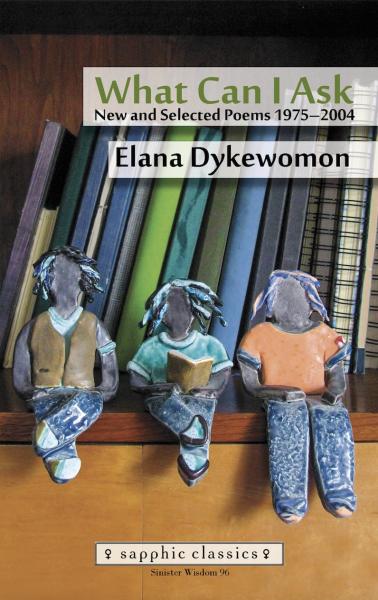
What Can I Ask - New and Selected Poems 1975 - 2014 - Elana Dykewomon (A Midsummer Night's Press & Sinister Wisdom)

Today's book of poetry:
What Can I Ask - New and Selected Poems 1975 - 2014.   Elana Dykewomon.  A Midsummer Night's Press & Sinister Wisdom.  Sapphic Classics 96.  New York, New York.  2015.


The Jewish lesbian-feminist activist poet with the extraordinary name of Elana Dykewomon brings a myriad of irons to the fire, isms, movements, belief systems and survivalist strategies.  They are all welcome.  Today's book of poetry is here to champion Dykewomon's persuasions with all the respect we can  -- but it is only because we like the poems that we are here.

Intelligent passion is always a good way to go and Elana Dykewomon is all over that.  These poems are a rebuke to a culture that has yet to embrace women as equals in every way.  Today's book of poetry read What Can I Ask with reasonable diligence and we can say that Dykewomon never asks for anything, she's long past that, the women in these poems are making demands, living with strident purpose, 

my mother used to have that dream

We were standing in her kitchen
the kitchen of the womon who
had been my lover
I was trying to leave
She didn't want me to go
I didn't want to go 
but I could see no other
way to be
She could not move toward me
she was crying
she said it wasn't that she
didn't want to, she didn't know
what stopped her
my need wasn't strange or
unreasonable to her still
she could not respond to me
unless we were having this scene
she said she dreamed she could not
move,     she opened her mouth
and no words came out
I said
my mother used to have that dream
she was standing on a beach
watching her children drowning
swept away on the surf
and she couldn't move to save them
she opened her mouth, like you
but she could not scream

I am my mother's daughter
I am out beyond the breakers
in dangerous water
the womon on the beach
sees me go down
tangled in kelp, exhausted
or a huge wave
catches me in its break
I see her standing there
fixed       unable to swim toward me
unable to make a sound,
neither cry for help nor encouragement

I have been lost at sea
to many womyn in just this way
including my mother
one minute they are thinking
everything is well with us
and the next
I'm a ghost

What they never see is how I
surface on the other side
of the wave
paddling slowly
for another coast

...

Remember that Today's book of poetry has no agenda other than poetry and frankly we tread with some trepidation when venturing into Dykewomon world.  Elana Dykewomon is writing for an audience of women/womyn and doing so without apology.  

Today's book of poetry wants to be clear that when we see the big hearted, big loving, big eating, big thinking poems Dykewomon has hammered out over the years we are filled with admiration.  But how does a sixty year old straight man, a product of a patriarchal culture and of Protestant/Catholic heritage and culture write glowingly about a Jewish lesbian activist and her poetry?

I went outside a few minutes ago to take a break and have a smoke.  I always have a celebratory smoke between finishing writing the blog and actually typing it out to post.  I write the blog by hand, usually on lined paper folded in half lengthwise.  It is very cold here in Ottawa this morning, -11 C. So, I'm outside for my smoke and our newest staff member Odin was with me.  He doesn't say much most of the time and he wasn't saying anything this morning.  But Today's book of poetry remembered that Odin, more than anyone TBOP has ever known, greets every single person he meets with the same gracious and open welcome and we remembered that is why we love him, that excellent example.

The lesson here, Today's book of poetry doesn't want to try and mansplain Elana Dykewomon or her very powerful What Can I Ask.  But we certainly encourage you readers to enjoy it.

We change each other

I am a womon of opaque windows
set at oblique angles
a face in each one
covered in nylon stocking or gray crepe.
You know
this image.
I close the shutters of my body
one by one
-- let no light in this house
and don't poke around in my vagina either.
You refuse to take it
seriously.
Suddenly I turn a corner
in the twenty-fourth corridor
where all the windows are made
of polished black amber
and the sills are volcanic ash.
There you are
you've brought your bright red pillow
you've got your feet up against the window
and have hung your god dam plants.
Doesn't that look nice?
No    I say   get out
I may love you in meadows
but this is queer palace
no room for two.
Effortlessly you unhinge the locked blinds.
There that's better these vines need sun.
Come on now -- we have to live where we can.
I start to weep
and you pull me to your breasts
with tough hands

...

Elana Dykewomon is writing for womyn but I doubt she she'll mind that there are men who admire her poetry.  

Our morning read was an all women affair today.  Kathryn, our Jr. Editor, thought it only right and proper that these poems be read by women so she brought in two friends.  Sally and Jody were a hoot and good readers to boot.  They were also wearing two pairs of cowgirl boots between them, one from each pair on both of their feet.

A fool for love

It's harder now, to organize,
than in my 20s.  Then
when I said I wanted to do it for lesbians
if there was a question
the question was
why do it for lesbians, who are they?
I was sure of my answer
of my love and pride
my pride in love

But now I fear
when I say I want us
who so clearly need each other
to speak every phrase of that need --
I want journeys with womyn
I can depend on, who can depend on me

I fear
the answer will be:
o that old thing

And no one wants to be a fool for love

Redwoods gutted by fire and ax
still grow
Where one redwood is destroyed
a ring of young trees sprout
redwoods have shallow roots
they need these circles
where root holds fast with root

after everything that's happened
because of everything that's happened
I want to imagine a world
in which we thrive
where difference engages us
and root hold fast with roots

...

Today's book of poetry thought Elana Dykewomon's What Can I Ask - New and Selected Poems 1971 - 2014 was properly incendiary.  This book brims with brave and honest poetry.

Image result for elana dykewomon photo
Elana Dykewomon

ABOUT THE AUTHOR
Elana Dykewomon is a Jewish lesbian activist, award-winning author, editor, and professor. Her first novel, Riverfinger Woman, published in 1974, was selected for The Publishing Triangle’s list of 100 best lesbian and gay novels. Best known for her Lammy winning historical novel, Beyond the Pale, Dykewomon was also awarded the 2009 James Duggins Outstanding Mid-Career Novelist’s Prize. She was the editor of Sinister Wisdom from 1987 to 1994 and currently lives in Oakland, California.

BLURB
Elana Dykewomon’s poems are reminders not to take anything for granted: to listen to the messages embedded in others' silences, to look beneath the rubble of violence, and to value the pleasures of intimate loving. Presenting the poetry written over the past four decades, What Can I Ask is wise, passionate, and inspirational. I so value this work and always keep it close to my heart.”
     --Irena Klepfisz, Author of A Few Words in the Mother Tongue 

Here is a video of Elana Dykewomon in Belgrade, the video is courtesy of Konsultacije zaLEZBEJKE


534

DISCLAIMERS

Poems cited here are assumed to be under copyright by the poet and/or publisher.  They are shown here for publicity and review purposes.  For any other kind of re-use of these poems, please contact the listed publishers for permission.

We here at TBOP are technically deficient and rely on our bashful Milo to fix everything.  We received notice from Google that we were using "cookies"
and that for our readers in Europe there had to be notification of the use of those "cookies.  Please be aware that TBOP may employ the use of some "cookies" (whatever they are) and you should take that into consideration.

Wednesday, September 14, 2016

Handmade Love - Julie R. Enszer (A Midsummer Night's Press)

Today's book of poetry:
Handmade Love.  Julie R. Enszer.  Body Language 05.  A Midsummer Night's Press.  New York, New York.  2010.

HANDMADE_cubiertasOK.indd

Julie R. Enszer's erotic poetry turns up the temperature of the room while gender politics clash against the day to day struggle of being human, straight, gay, lesbian, bisexual or transgender - which could make for a muddled dialectic but unlike this opening sentence Enszer doesn't get bogged down or falter.  

These poems are lightning flashes of sultry love.

Morning Pant

I know what women want to eat in the morning.
On Sunday, in college, I would cook eggs,
scrambled or fried, potatoes, and bacon--
pork then was still a subversion. Breakfast

for my best friend and the man she slept with last night.
I knew what women wanted to eat in the morning.
Alone on Saturday, I found ways to feed them on Sunday: eggs,
scrambled or fried, potatoes, and bacon.

The prospect of seducing a woman seemed simple, but
my best friend seduced the man she slept with last night
leaving my bed empty, my hands idle, my lips
alone on Saturday, until I found ways to feed them on Sunday.

Sauces can satisfy the need to break from the mundane.
The prospect of seducing a woman seems simple:
wine, marinara arrabiata, raspberry coulis. Delicious dinner still
left my bed empty, my hands idle, my lips

dry. I could only imagine the shimmer of gloss
sauce. Satisfy the need to break from the mundane
on my lips: a wax or paraffin base. Vaseline in a pinch.
Franzia, tomato sauce, berry puree -- a delicious dinner still,

but I imagined more -- a peak that would not leave my pussy
dry. I could imagine only the shimmer of gloss
from a woman's juices on my chin after licking and licking
her lips. No wax or paraffin. (Third) base; Vaseline; a pinch.

Then I met a woman one Sunday, in college.
Finally I had more -- a peak that left my pussy
weary but satisfied. After rest she begged for more:
I know what women want to eat in the morning.

...

Enszer is so matter of fact clear at every turn that we never get left behind, we follow her as she bids, along a clever trail of anger and lust and discovery.  As new as some of this is for the reader it seems Enszer is making some discoveries along the way as well.  Love and desire both get big workouts in Handmade Love and joy gets in there too.

Enszer makes no apologies for her feminist agenda (nor should she) which is clearly, eloquently and humorously laid bare with panache.

Absolutely No Car Repairs
In The Parking Lot

Three people are working on old, American cars.
One man with a white van -- his mobile mechanic's shop --
has pulled the engine out of a black Monte Carlo.
Another crawls from under a Sunbird
rusted and battered tail pipe in hand.
The third, an Escort, hood open, unattended.
Owners ostensibly inside the auto supply
searching for the proper replacement part.

Although I didn't need one, I've brought a man.
Newly minted. Nine months ago, breasts removed --
scars from the surgical drains healed quickly
now the only skin rupture from needles
delivering daily hormones he refers to as T,
and the resulting faux-adolescent acne pimpling his face.
He's more of a man than me. Still, it takes us two tries
with a return in between to find wiper blades that fit.

...

Now that all of the Today's book of poetry staff are back from holiday adventures we were all crackling with excitement at this morning's read.  Handmade Love made for a heated and spicy reading.  The consensus around the room was that Julie R. Enszer is an eloquently fearless poet and there are never enough of those to go around.

These poems are a genuine celebration of love and diversity.  These celebrations of love and diversity make for good poems.  The day to day of supposedly alternative lifestyles and cultures does not sound unfamiliar in Enszer's capable hands - and why should it?  People love and lust pretty much the same regardless of their performative gender.  And that's the truth Ruth.

Terms of Endearment

I mistakenly called you "missy"--
an inappropriate term of endearment for
a butch lesbian, the identity I assumed

you to have with your cropped hair, hip-riding
jeans and top buttoned down. Let me confess:
I assumed your identity for my own purposes.

I have an entire fantasy about your body and
what I could do with it based on your being
lesbian and butch. Then I learned you consider

yourself to be male -- transgendered.
Yes, "missie" seems inappropriate.
Yet without diminutive feminizations

I am left with few options to coo affection.
Immediately, I'd like to say "FTM trannie" and cast
upon you my feminine wiles, but can I?

I try Buddy? Pal? You chide me not to stoop to
Bubba. I won't. Still, all the phrases I think to utter
with cloying appreciation are wildly sexual--

How's it hanging? If I, an avowed fem lesbo,
flirt with you, now a man but still in a woman's body
(and, of course, with a woman lover),

Am I still gay? Or just queer? And if I don't
stoop, linguistically, that is,
but I would like to be on my knees and

have you fuck me from behind with a
big purple strap on like my wife does,
am I a homo? I just want to find

a word to address you and imbue it with affection.
I want to respect your gender identity and not reconsider
my own sexual orientation and erotic predilections.

That is probably too much to ask, which is why
my pussy is wet, my tongue is tied, and only my mind
has been fucked. Understand gender? Good luck.

...

Today's book of poetry believes that poetry this good blows right past simple discussions of sexual orientation stereotypes. This is a celebration for Enszer and a primer for the rest of us, one that opens up the door to every audience.

Handmade Love is strong and primal poetry, ultimately generous and humane.  With a side of hot sauce.

Julie R. Enszer

ABOUT THE AUTHOR
Julie R. Enszer, PhD, is the author of Handmade Love (A Midsummer Night’s Press, 2010). LambdaLiterary.org praisedHandmade Love noting, “Anyone who’s loved Dorothy Allison’s early chapbook of poetry, The Women Who Hate Me, will recognize the same brash confidence and articulation in Julie Enszer’s work.” Rigoberto Gonzalez said, “This poet is fierce, politicized and not afraid to point to the flaws even within her communities,” and Richard Labonte said of Enszer, “With seductive clarity, she celebrates sexuality – her own, that of other women, and of men.”

Enszer is editor of Milk & Honey: A Celebration of Jewish Lesbian Poetry (A Midsummer Night’s Press, 2011). Hila Ratzabi said of Milk & Honey, “This collection packs a punch…. This anthology is endlessly valuable as a collective voice of celebration and even protest.” Milk & Honey features beloved poets like Ellen Bass, Robin Becker, Elana Dykewomon, Marilyn Hacker, Eleanor Lerman, Joan Nestle, Lesléa Newman and Ellen Orleans, as well as new and emerging voices.

With language and imagery that moves from the sensual and political to the tender and serene, Milk & Honey , a finalist for the Lambda Literary Award in Lesbian Poetry, explores the vibrant, complicated, exhilarating experience of being Jewish and lesbian—or queer—in the world today.

Enszer’s second full-length collection of poetry is Sisterhood (Sibling Rivalry Press, 2013).

Enszer, who holds an MFA and a PhD from the University of Maryland, is currently a Visiting Assistant Professor in the Department of Women’s Studies at the University of Maryland. She is writing a history of lesbian-feminist presses from 1969 until 2000. Her public scholarship on lesbian poetry has been featured by the Poetry Foundation, the Poetry Society of America, Ms. Magazine, and The Huffington Post.

Enszer is the editor of Sinister Wisdom, a multicultural lesbian literary and art journal, and a regular book reviewer for the Lambda Book Report and Calyx. You can read more of her work at www.JulieREnszer.com.

Julie R. Enszer
"Beginnings", "Bed", "Dishes"
Video: Center Arts


502

DISCLAIMERS

Poems cited here are assumed to be under copyright by the poet and/or publisher.  They are shown here for publicity and review purposes.  For any other kind of re-use of these poems, please contact the listed publishers for permission.

We here at TBOP are technically deficient and rely on our bashful Milo to fix everything.  We received notice from Google that we were using "cookies"
and that for our readers in Europe there had to be notification of the use of those "cookies.  Please be aware that TBOP may employ the use of some "cookies" (whatever they are) and you should take that into consideration.