Showing posts with label andrew hudgins. Show all posts

Thursday, January 14, 2016

A World Without End - Matthew Graham (River City Publishing)

Today's book of poetry:
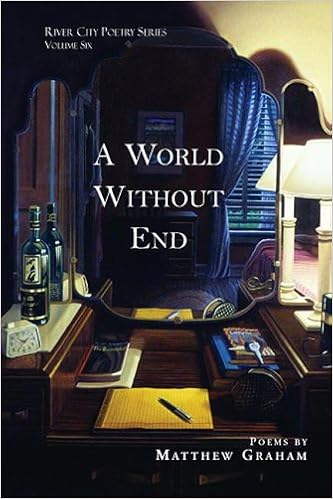
A World Without End.  Matthew Graham.  River City Poetry Series, Vol. Six. River City Publishing.  Montgomery, Alabama.  2005.

Today's book of poetry is ready to fire our entire research staff.  Try as they might, they came up short and almost empty-handed on Matthew Graham.  We know that A World Without End was his third book of poetry.  We will now send out our poetry swat-team to find those two early volumes.   Today's book of poetry sincerely hopes there are other, newer books by Mr. Graham because we need more poets like him.

These poems read like an Edward Hopper painting, you know exactly what you are seeing because the narrative is right in front of you, nothing abstract about it.  You also know, right away, that somehow you are the wiser for it.  Same thing with Graham.  These poems are never sermons (some of our wisest poets fall for that), but he certainly is leading a lesson.

Graham also has a finely tuned sense of humour.  When I read "When I Was a Kid" to K last night she almost fell out of our bed.  If I really want to know if something is good I read it to K, she has the best poetry barometer going.

When I Was a Kid

I thought pubic hair was public
And the perils of Tarzan were his pearls.
I'm still liable to dial 119.
In the late 1950's they didn't know from dyslexia.
You were just stupid
And got your head slammed against the blackboard.
I'm not complaining.
It made me humble and afraid to write.
It made me a quiet person on paper.
And forget about foreign words.
Once in Germany I ordered a pocketbook of coffee
And in a bar, told a Polish guy
I was a female professor.
Yes it all comes back to language,
That evil little dog at the door --
That brief flash we get
And translate as best we can.
Or as a French friends once said
To our boring host after an opulent dinner,
"Thank you. Thank you so much
For your hostility."

...

The cover art for A World Without End is a painting titled Before The Storm by Graham's wife, the painter Kathryn Waters and it is stunning.

Our intern Kathryn said that she'd happily kill our office techno-wizard Milo for that painting.  The rest of us thought of the painting as forbiddingly tender, much like many of these excellent poems.

What It Comes Down To

It happened in the spring,
A false spring, true, Still,
Birth seemed almost possible
In that shifting season.

Then blood, and starlight
Slipped away from a very small star.

I even had, secretively, names
I liked. One was Tess,
The others don't matter.

Later
My wife cried on her hands and knees
On the kitchen floor.

Suddenly the whole world came down
To a woman crying.

...

Today's book of poetry was a hopeless romantic mess when reading some of Graham's poetry.  His eulogical poem "News",  dedicated to the late Richard V. Hyatt, misted up my glasses something good.

Matthew Graham's poems make the reader trust the poet.  In a "lead, follow or get out of the way" world Graham is someone you'd happily follow.  He's not shouting directions, his poems simply exude confidence, clarity and wisdom.  Who wouldn't follow that guy.

The Sadness of Summer

Another summer gone,
The clapboard cottage swept clean.
Dust rises and falls along the back roads
Of September. Remember
The bouquets of Queen Anne's lace gracing the breakfast table
Beneath the sheer curtains of June?
There are no boats on the water today.
And as I looked at you in the yard
From the upstairs window, as I saw you bend
And clip the last of the wild daisies
And saw my own reflection,
I thought of all the years quietly gone
That we have touched together
And of the life that we have made
And worn
And have become together.

...

Today's book of poetry sometimes feels that my selection of three poems is inadequate and today is one of those days.  I have to confess that the three poems I've chosen are not the best three poems from A World Without End.  The three I choose today spoke directly to me and I loved them too much not to share.  It happens.

Andrew Hudgins is a poet I greatly admire and he is the editor for this series of the River City Poetry Series.  Here is what he had to say on the front cover flap about Matthew Graham's A World Without End:

     "A thoughtful, elegiac voice pervades Matthew Graham's A World Without End,
     his new book and best book yet. A small sense of mourning arises even in his
     celebration of deep and continuing love because he knows that love, in the 
     fullness of time, inevitably ends, even if the lovers never falter in their loving.
     That doubled understanding moves him to the richest music in a life's work
     rich in music and meditation. A World Without End is stately without stiffness,
     thoughtful without pretense, humorous without indecorousness, clear without
     simplicity. It offers a pleasure in every line and a fresh moment of insight and
     understanding on every page."

What he said.

Matthew Graham

ABOUT THE AUTHOR
(PLEASE NOTE THIS INFORMATION IS FROM 2005)
MATTHEW GRAHAM is the author of two books of poems, New World Architecture (Galileo Press, 1985) and 1946 (Galileo Press, 1991), and the recipient of awards and fellowships from the Academy of American Poets, the Indiana Arts Commission, Pushcart, and the Vermont Studio Center.
His poems have appeared in Harvard Magazine, River Styx, and Crab Orchard Review, among many others. He directs the creative writing program at the University of Southern Indiana, where he co-directs the RopeWalk Writers Retreat, and is poetry editor of the Southern Indiana Review.
Graham lives in Evansville, Indiana, and is married to the painter Katie Waters.

BLURBS
"A World Without End is masterful. The pitch of these poems is nearly perfect -- in the way that the poems of Weldon Kees and Donald Justice (two elegant and dour muses hovering behind this book) are nearly perfect. A reader feels that nothing is missing and that there is not a single extraneous syllable. More than this, I admire the maturity and intelligence with which Matthew Graham treats his book's subject: history and its failures, cruelties, oppressions. Beneath the beautifully modulated images, beneath the insouciance which is Graham's brand of stoicism, the bottom has fallen out of the world and the serpents of history hiss. In poem after poem, one is lulled by the beauty and surprised by the brutality. This is a quietly remarkable book."
     - Lynn Emanuel, author of Then, Suddenly, and Hotel Fiesta

"Matthew Graham has been one of the best and the most indispensable poets in America, about America: the dogs of America, the people, the weather, our possessions and our places, the vast matter of what we can and what we cannot afford. In a world where you can hear James Wright singing back-up with Hank Williams, Matthew Graham has a light, tender and elegiac touch that is all his own. Every fine poem here forks over a little wound, and we are better for having had the heard and wit to absorb it."
     - Liam Rector, author of American Prodigal and The Executive Director of the Fallen World


425

DISCLAIMERS

Poems cited here are assumed to be under copyright by the poet and/or publisher.  They are shown here for publicity and review purposes.  For any other kind of re-use of these poems, please contact the listed publishers for permission.

We here at TBOP are technically deficient and rely on our bashful Milo to fix everything.  We received notice from Google that we were using "cookies"
and that for our readers in Europe there had to be notification of the use of those "cookies.  Please be aware that TBOP may employ the use of some "cookies" (whatever they are) and you should take that into consideration.

Tuesday, July 28, 2015

Ready To Eat The Sky - Kevin Pilkington (River City Publishing)

Today's book of poetry:
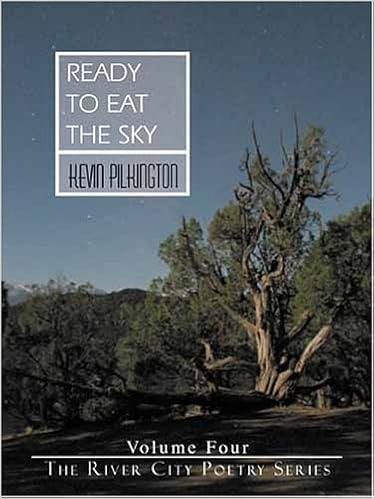
Ready To Eat The Sky.  Volume Four - The River City Poetry Series.  Kevin Pilkington.  River City Publishing.  Montgomery, Alabama.  2004.


Ready To Eat The Sky by Kevin Pilkington was published in 2004 but it only arrived on our desks here at Today's book of poetry recently.  I figure it was stuck in the mail somewhere between the continental divide and Swansea, Wales or Carmathenshire.

Pilkington is a Dylan Thomas fan and devotee.  If that's where you're going to set the bar you are dancing in pretty high cotton, you are going to have to be ready to burn.  Kevin Pilkington is up to the task and does some pretty sweet cooking in Ready To Eat The Sky.

Now I know Pilkington loves Thomas because I read it somewhere, you'd never see it in the poems, although it is certainly there.  Pilkington loves language like birds love sky.

These poems sound and feel like anecdotal narrative poems but that's a trick.  What they really are is emotional Venus-fly-traps.  Pilkington gets right into your bloodstream.

Grilled Fish

We had lunch
in a local trattoria
built into coastal rock,
picked a table on the deck
a few feet above water
that looked like the last
good novel I dove into.

A waiter came over
leaning on two metal canes.
He walked like stone
and his English was a coastline
of jagged rock. His smile
brought the sun closer,
and we said grazie
to things the sea didn't
need that day.

Another waiter brought
a pitcher of wine
with a round gold peach,
a tiny moon you can peel,
resting on the bottom.
We drank it with a salad
and tomatoes so sweet
and red the church should
make Satan blue.

Our main dish was grilled
fish who hadn't lost
their heads to the chef's knife,
or over the wrong woman
the way I did a while back.
We didn't recognize them
either. They might have been
French, swam down here
for the day, then were tricked
by hook or net.

They tasted as rich
as the sun resting
on waves filled
with every gold coin
from every ship that sank
since Caesar and kept
rolling towards shore.

...

Pilkington's golden tongue skirts the sweet edge of revealing too much, he's almost always on the verge of giving it all away.  He's a tease.  Once he gets you hooked he just starts reeling you in as easily as the big Hem on a Cuban fishing boat.

The sweetness doesn't hurt a bit and there is always just a pinch of tart when you need it.

When I did the office poll the vote was 9 to 1 for going with Pilkington today.  Our typesetter, Milo, doesn't like a damned thing, he tells us daily, yells at us in fact, "that there hasn't been a poet worth his/her salt (he puts in that slash with a wild gesticulation of his little spindly spiny spider white arms) since Ezra lost his gamble!"  We tolerate Milo because he can bake.

Dogs

My brother and his wife
bought a hunting dog.
It's white with black patches.
There's one that's shaped
like Rhode Island, a small state
that isn't too heavy for a three-
month-old puppy to carry
around on his back. As
he gets older, stronger and puts
on weight, it will stretch
into Texas.

They have already taught
him to sit but he is still
too young to learn about Jesus,
so when they took him
to the beach, he tried walking
on water, fell in then turned
and attacked a wave,
ripping it to shreds.

A mound of cookie dough
on a plate is how he sleeps
on a round mattress and
dreams of rabbits or grouse.
For now a tennis ball
is enough to hunt down,
and sheets flying like ghosts
over rose bushes from
a neighbor's clothesline
is what makes him bark.

My brother and I take him
out on the lawn, throw
his a stick into tall grass.
He runs after it, his ears
that will never be trained
bounce and flap like a loose
shirt. He comes back
with the stick in his mouth
and every dog we ever
had as kids following him.
We can't believe how many
years have gone by since
we've seen them. Then we sit
down on the grass, smile
and watch all our dogs
running.

...

Come on!!  A poem about puppies.  Give us a freaking break!!  But, but, but, I love this poem, and almost every other single poem in this great collection.  Pilkington could probably amuse me with a poem about the phonebook.  Probably get a tear in my eye as well.

Today's book of poetry was charmed, charmed, charmed by the elastic wit Pilkington uses as an emotional tightrope.  These poems are constructed like the pyramids.  One solid block on another. And so on.

I read these poems like eating dessert, they were such a pleasure to devour.

The Last Saint

Even too much wine
can't stop all the hurt
you packed, but thought
Customs would never let
you bring into the country.
When they asked if you
had anything to declare,
you said the last ten years.

Somehow you can still
walk past the medieval
tower tonight is just
how the Amalfi coastline
gets a hard-on for water,
cars, moon or anything
that moves. So you sit
on a bench.

Low tide rubbing against
rock is how a song finds
a way out of your throat.
And to think you couldn't
speak a word of Italian
when the night began.
But since English never
made any sense and makes
even less now, you decide
never to speak it again.

A couple is standing in
front of you. The man looks
Polish enough to be the pope
and the woman with him
is so large they must rub
her thighs down with olive oil
to squeeze her into Rome.
They are laughing but since
it's a joke you know the punch
line to, you laugh even louder.

Then they are gone and there
is a church like the one
in Sorrento where Christ
is stone. Before you think
about converting to concrete,
you are in an alley leaning
against a building older
than Octavian. A woman
is kneeling in front of you
opening your belt. And
this is where it happens,
the very moment when
you become the last saint
on the face of the earth
who doesn't have a prayer.

...

Kevin Pilkington has made my day.  Ready To Eat The Sky is a simply delicious book.  Find it.

Kevin Pilkington

ABOUT THE AUTHOR
Kevin Pilkington ​​​​​​​​​​is a member of the writing faculty at Sarah Lawrence College. He is the author of six collections: his collection Spare Change was the La Jolla Poets Press National Book Award winner and his chapbook won the Ledge Poetry Prize. His collection entitled Ready to Eat the Sky was a finalist for an Independent Publishers Books Award. A collection entitled In the Eyes of a Dog was published in September 2009 and won the 2011 New York Book Festival Award. Another collection entitled The Unemployed Man Who Became a Tree was recently published. His poetry has appeared in many anthologies including Birthday Poems: A Celebration, Western Wind, and Contemporary Poetry of New England. Over the years, he has been nominated for four Pushcarts and has appeared in Verse Daily. His poems and reviews have appeared in numerous magazines including: The Harvard Review, Poetry, Ploughshares, Iowa Review, Boston Review, Yankee, Hayden’s Ferry, Columbia, North American Review, etc. His debut novel entitled Summer Shares was published in June 2012. 

BLURB
"In Ready to Eat the Sky the reader encounters a poet of extraordinary fineness of vision, one whose language adheres to the surface of realities with an elegance and simplicity rare in today's poetry. There is humility and grace of being in these poems, which stand before the world openmouthed, hat in hand, heart on sleeve. I take guilty pleasure in the poems of Kevin Pilkington, and consider him an essential voice in contemporary poetry."
     -- Jay Parini, author of Why Poetry Matters

Kevin Pilkington
2012 Burlington Book Festival
Video: RETN


367

Poems cited here are assumed to be under copyright by the poet and/or publisher.  They are shown here for publicity and review purposes.  For any other kind of re-use of these poems, please contact the listed publishers for permission.

PLEASE NOTE:
We here at TBOP are technically deficient and rely on our bashful Milo to fix everything.  We received notice from Google that we were using "cookies" and that for our readers in Europe there had to be notification of the use of those "cookies.  Please be aware that TBOP may employ the use of some "cookies" (whatever they are) and you should take that into consideration.
Friday, September 19, 2014

Mountain Redemption - Nick McRae (Black Laurence Press)

Today's book of poetry:
Mountain Redemption.  Nick McRae.  Black Laurence Press.  Pittsburgh, PA.  2013.


"Miracles can't save us from our fears - "  says Nick McRae in the poem 'Pessimists Guide to Miracles'.  But perhaps poetry can help us understand the relationships that govern our congress.

McRae just sounds so true.

These poems read like sermons dispatched from some higher plain, yet McRae is never speaking down to his readers.  That's some fine juggling.

That's some fine poetry.

Mountain Redemption

When Ottis Wilkins lost his arm,
he burned his tiny sawmill down
then sold his long-dead in-laws' farm
and moved his family into town.
He opened a barber shop
and hired his sons to sweep and mop
the place each day and brew coffee
for the men who came to see
the one-armed barber. Inch by inch,
the fresh-barbed rose up from the seat
like sinners from the mourners' bench.

Petunia Eckert's heart was broken
down and blown out like a tire.
The skinny girl she loved had taken
all Petunia's pluck and fire
and moved to Blue Ridge. Petie took
to church and, Sundays, wailed and shook
and made the preacher smile. That summer
Pete got work as a part-time plumber.
In basements she would flail her wrench
and watch rats, terror-maddened, clamber
like sinners to the mourner's bench.

Old Jackie Raburn didn't hold
with killing. Even the mice and snakes
that shimmied nightly over the cold
stones of Jackie's floors caught breaks
no other man would care to give them.
He had a shotgun, though, one trimmed
with etched brass plates. Some days he'd haul
the thing outside and discharge all
his shells at the ground and blast a trench
in it, then wait for silence to fall
like sinners to the mourner's bench.

Whenever Sheriff Biggers drank,
and that was often, he revved his Chevy's
engine up, sped past the bank
and dingy Main Street shops with a heavy
foot and siren wailing just
to see the townsfolk gawk as the rust-
and dirt-stained cruiser barreled by.
Once, he had to shoot a guy
to death. He watched the man's jaw clench,
his dead eyes lifted to the sky
like sinner's from the mourner's bench.

Preacher Greene, a handsome man,
a widower of just a year,
made all the married women fan
themselves and smile from ear to ear
when he preached of David's lustful pride
or the spear that pierced the Savior's side.
At home, the phone set off the hook,
he's open to his favorite book--
Song of Songs--then feel the pinch
of chaste Paul's thorn as his fingers shook
like sinners on the mourner's bench.

And mountain people--hard as limestone,
rich as black silt, deep as clay--
dreamed each night of valley towns
where valley cornstalks stood up tall
like sinners from the mourner's bench.

...

McRae's mountain landscapes and people would almost seem to be carved out of another time and sensibility.  McRae's great gift, one of many, is that he bridges the gap between rural mountain understanding and those of us in the valleys with fierce candor.

These narrative poems echo.

Deacons Meeting

Five men smoke outside the convenience store
that doesn't exactly have a name. Over the door
hangs a sign: COLD BEER CHEAP GAS.
The men smell of hay and cow and hot skin.
Two perch on a tailgate, their boots
barely scraping the gravel.
One wears a damp red hat and he lifts it
to wipe sweat from his balding skull with a rag.
The one in the white t-shirt swears
and says, hell hath no fury like a woman's scorn,
that's what the Bible says, and the one
beside him disagrees, reckons it's not even in the Bible.
The hell it ain't, the other says, because he knows
it's a good one and all the good ones
come from the Bible. The sun pours out wet heat
like a steam engine and the ground
radiates and the hood of the truck shines dully,
reflecting in the eyes of a hound
whose tongue lolls and who hogs
the only bit of shadow cast by an old turnkey
Coke machine. The older one get to explaining
how that ain't necessarily so when high above
in the hot sky a jet breaks the sound barrier
with a jarring crack and the five men and the dog
crane their necks upward to figure out
where exactly it's flying to. I bet that sumbitch
is headed to Warner Robbins, one of them says.
Naw that's north it's headed, says another,
I betcha it's headed to Chattanooga,
and the shirtless one with the stubbled jowl
who has until now been silent
figures it's about damn time they talked about
something else besides women.

...

There is much dramatic tension in Nick McRae's Mountain Redemption.  It is a dark and cold world that does not favor the weak.  This narrative is about hard people in hard situations having to make hard choices.  But there is also a sense of hope.  McRae shows a sense of optimism as he hammers out Christian myths on the unrelenting anvil of the mountains.

Orpheus in Huntsville, Alabama

My mama, godly as she was,
never forgave my daddy for quitting
the church. For politics. She couldn't.
She'd always wanted to marry a preacher,
and married one, but then he ran
for mayor and won. The king of Huntsville.

Years later, when her mind was gone,
she told me how he'd lay her down,
his fingers circling her bellybutton,
breathe the scripture into her neck--
Thy navel is like a round goblet
which wanteth not liquor--and take her
with biblical authority.
She said that, once he'd shed the cloth
his touch no longer felt the same.
How could it? He forsook the Spirit.

Now both of them are long buried.
But daddy taught me the fiddle, and mama
sang her hymns so sweet they shimmied
out her throat and into mine.

...

Nick McRae illuminates the world these poems exist in from within with a language both borrowed from and steeped in the past - he does this in a thoroughly modern way.  Seamlessly.

There is no evidence of a white collar around McRae's neck but make no mistake, this Biblical diction comes from a broader sermon.  McRae gives body and depth to all his assertions by providing unanswered questions to ponder.

What is basic goodness?  Community?

Mountain Redemption is a surging voice, a choir, attempting to illuminate a vanishing space and time.  These are noble poems.

Nick McRae

ABOUT THE AUTHOR
Nick McRae is the author of Mountain Redemption, winner of the Fall 2011 Black River Chapbook Competition, as well the De Novo Prize-winning full-length The Name Museum (C&R Press, 2013). He is the editor of the anthology Gathered: Contemporary Quaker Poets (Sundress Publications, 2013). His poems, reviews, and translations appear in Cincinnati Review, Hayden’s Ferry Review, Linebreak, The Southern Review, Third Coast, and elsewhere. He serves as associate editor for 32 Poems, poetry coordinator for the annual Best of the Net anthology, and is a member of the Sewanee Writers’ Conference staff. Born in Chattanooga, Tennessee, and raised in the Northwest Georgia foothills, Nick earned an M.F.A. in creative writing at The Ohio State University and is currently a Robert B. Toulouse Doctoral Fellow in English at the University of North Texas.

BLURBS
"In Nick McRae's splendid Mountain Redemption, the contradictions of family and faith are hard to hold in balance. They are the fulcrum of a teeter totter that tips back and forth between passion and violence. But as he meditates on growing up in Georgia and the complexities of the faith he was born into, the poet himself is balanced, thoughtful, judicious--and loving. As he struggles to sustain that love, McRae sometimes borrows the cadences--large, passionate, and elegiac--of the prophets he knows so well: "Where, O Lord, is the home I only almost had--/mythic, bloody as a psalm in the mouths/of old and dying men who will take it/ with them wholly when they go?"
     Andrew Hudgins, author of American Rendering: New and Selected Poems

"These rich and strange but familiar and American poems remind us that the roots of the American language are in Jacobean English, the English codified in the King James Authorized Version of the Bible--a text often quoted in this book. In every mark of dialect, in every turn of a country phrase, we still hear a language that Shakespeare and Jonson would have recognized. But the experience--what would they have made of that? It is familiar to us, it is authentic, and this latest rendering reminds us that our language originally redeemed the heart and soul of English. Nick McRae's book prods us with the memory of that redemption. It is one to treasure.",
     Mark Jarman, author of Bone Fires: New and Selected Poems

Nick McRae - Paging Columbo
May 10, 2012


247