Showing posts with label anstruther press. Show all posts

Friday, July 26, 2019

Modern Warfare - David Alexander (Anstruther Press)

Today's book of poetry:
Modern Warfare.  David Alexander.  Anstruther Press.  Toronto, Ontario.  2016.
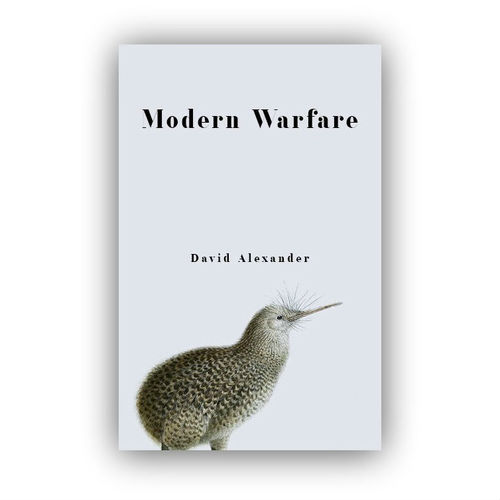
Cover Image for web-2.jpg

David Alexander's Modern Warfare is one tight little package.  Nine finely fashioned hand bombs of persistent persuasion make up this collection and it is entirely worth your visit.  Alexander got Today's book of poetry going with his poem "Aviary for Flightless Birds" and his sharp wit.  Humour goes a long way in the Today's book of poetry offices, humour with a dark and direct little kick in the ass, now you're talking.

Aviary for Flightless Birds

First fill the sky with water. Let penguins swim
for fish and colonize horizon. Stub-winged
cormorants splash as clouds and perch

like silver statues on rocky, secluded islands.
Fuelled by flowers and figs,
ostriches streak vapour trails across open blue,

a flock of nomads fleeing fate — to be leather,
feather, meat. Broadcasting from a floating
heathland, the mousey Atlantis rail patrol

a fern-bush — secret entrance to their exile station.
Twilight beckons kiwi to root constellations
for grubs and hallelujah if they find some.

Chicken-sized, they fear chainsaws and stoats.
Sagittarius. Let the last kakapo boom
and ching and skraark his symphony

from a forest pit with new found harmony.
Critically endangered like so many here,
his pleasant odour intones agreeable pet, but easy prey.

💫💫💫

David Alexander's Modern Warfare is old news as he has published a full collection, After the Hatching Oven (Nightwood Editions, 2018), last year.  If you haven't seen it, it's the best chicken wisdom since Col. Sanders started to batter them up.

Modern Warfare is an urbane walk through Alexander's pleasant peccadillo's and that is just dandy.  With a good poet, properly handled, watered regularly, they should be able to write about anything.  In Modern Warfare Alexander muses about the ineptitude of the forlorn Toronto Maple Leafs, crack dictionaries and a grade eight romance that never quite got off the ground.  We enjoy it all because Alexander directs traffic with a natural ease, we know and feel that these poems sound/reveal true.

Cousineau Road

From a frozen mud lot at the subdivision's
edge, I spy your Windstar in the road bend.

End of her night shift, your mom sips a soft drink
as I crack sheets of white, sing along

to the Top Nine with Casey leashed
and looking for information. Entrusted at fourteen

with the ritual of climbing porch steps,
I stuff creaky brass boxes with coupons

and gossip, save Christmas card cash
in my sock drawer for caf fries and weed.

Wind stings my toes numb.
The carrier bag digs.

At your door, I fumble a delivery list,
thumb your bell and consider ringing.

💫💫💫

Our morning read started a little earlier than usual today.  We had the mobile poetry repair truck outside the Today's book of poetry offices by seven this morning.  Both Milo, our head tech, and Kathryn, our Jr. Editor, are taking part in a poetry triathlon this weekend.  They've been training hard for weeks.  We weren't sure their young marriage would survive the Ezra Pound lightning round, none the less, they've both shown up at the office this morning in their poetry swimwear and are headed to the pond shortly.

Milo told us all that Alexander's high school poem, "Secondary Education," could have been taken from his own yearbook.  Kathryn added that Modern Warfare just felt right, the proper amount of pepper to get that proper poetry burn.

Hospital Room

i.

Everyone is dying. Some of us know how
or where or when
or nothing. I close my eyes,

lift my lids and all is born again. A woman
reading Canadian Living loses thirty years,
her blond son next to her. She got lucky —
the man across aged badly.


ii

The brown-haired man on the subway whose
bones stick through black jeans is dying.

The grey man beside me, rapt in Red October,
dying.

The young man next to him in cossack coat,
his dog at home,

both dying — I must be too. Call medic. Forge
hospital, graveyard, church.

Have HBO shoot one more season
of my darling show.

💫💫💫

Today's book of poetry needs to catch up in time or slow time down.  There never seems to be enough hours in a day.

That said, any time spent reading David Alexander is going to be time well spent.  Modern Warfare a small battlefield, an excellent treasure.

Image result for david alexander poet photo

David Alexander

ABOUT THE POET
David Alexander is the author of After the Hatching Oven (Nightwood Editions, 2018). His poems have appeared in Prairie Fire, The Malahat Review, The Puritan, subTerrain, The Humber Literary Review, the Literary Review of Canada and many other fine journals and magazines. David volunteers as a reader for The Puritan and works in Toronto's nonprofit sector.


772

DISCLAIMERS

Poems cited here are assumed to be under copyright by the poet and/or publisher.  They are shown here for publicity and review purposes.  For any other kind of re-use of these poems, please contact the listed publishers for permission.

We here at TBOP are technically deficient and rely on our bashful Milo to fix everything.  We received notice from Google that we were using "cookies"
and that for our readers in Europe there had to be notification of the use of those "cookies.  Please be aware that TBOP may employ the use of some "cookies" (whatever they are) and you should take that into consideration.



Friday, October 19, 2018

The Age of Revolution - Darren Bifford (Anstruther Press)

Today's book of poetry:
The Age of Revolution.  Darren Bifford.  Anstruther Press.  Toronto, Ontario.  2017.

The Age of Revolution.jpg

Ok, Today's book of poetry is in.  Any poet who stream of consciousnesswise throws in a line from Sir W.H. Auden's best poem in the world along with Jackson Pollock and the Rue St. Denis, has my full attention.  In fact Today's book of poetry is going to celebrate it.

Try this one...

This Sunset Lasts Forever

There must have been a lot of beauty
At the end of empire. Scratch that.
Strictly the usual amount,
More or less, like in a movie
When before he is shot
The soldier considers the dewy grass or the dawn
Over yon golden hills. Which is to say
I doubt it. Consider the fowls of the air and beasts of the field
Christ did not say on the Cross. Why, why, why, why, why, why?
Is closer to the mark. And it was no ordinary day
For those who were otherwise occupied with their lives,
Even given the torturer's horse scratching its innocent behind on a tree.
For there was a breaking sound in the sky;
We were all as terrified as other slow-witted animals, desirous and hungry.
I'm not getting over this in record time. Oh my heavenly days
Is what my grandmother sighed. Now which book will I take?
Will there be a record player? A mistake in these matters
Will commit us to eternal boredom. Help me
With a Jackson Pollock from the MoMA, whose paintings,
In lieu of small fires or snow storms, will serve to increase our contemplative
Capacity. Now if only we could get some help—I mean,
Help with the moving, not the moaning.
I've heard no pianos are housed on the isles of the blessed
Though the wind plays the trees and the trees are willing.
Nor that my will is broken I am either left for dead
Or I shall see them forever: my wife, my little boy. They are crossing
Rue St. Denis on a winter afternoon, holding hands. Flaring in the mind
Awhile longer like a flare shot to the height from which it falls in the night sky,
Tumbling into wine-dark oceans,
We went down to the ship —

💫💫💫

The Age of Revolution is an unassuming little chapbook of a mere nine poems - but when Today's book of poetry finished reading it felt like a tome that we'd been waiting for.  It was a much larger experience then Today's book of poetry usually finds in nine poems.  Expansive.

It is because Darren Bifford's poems are not fast food, these poems have been simmered, they have been stewed and tenderized, until the flavours are all rich and complex.

False Spring Is The New Thing

The first spring is always false. They call
It that because everyone wishes further
Hibernation. There's a town the existence
Of which I learnt when I was a child: all its
Inhabitants sleep as much of the day and night
As is possible. It's a thing to arrive into
Their public square unannounced.
My one practice is to summon indifference
To the most consequential events: what's left
Of the Great Barrier Reef, for instance; the situation
In Syria; my brother's long illness. I wish for a say
In what qualifies as an externality. That woman
In Toronto who, when asked about the last
Federal election, responded I don't know
What that means. The guy next door
With that fucking dog, for instance. Or Mark, who sits
Outside the liquor store, hat in hand, all spring,
Reading. Do I care what he's reading? Not all hope
Is great hope, even given this as if spring.
I've also felt the desire to join the slumber
Of that hidden town behind the mountains.
The kid who made it there came not without
His own questions. As for answers, what seemed
To him like reasons were little better than a roll
Of the dice, a yes and a no and a no and a no.

💫💫💫

Today's book of poetry went into Darren Bifford country back in June of 2016 when we looked at his Wedding In Fire Country (Nightwood Editions), and you can see that in the link below:


Today's book of poetry liked Bifford's poems then and we like them now, even more.  If the reader pays attention, Bifford reveals it all.  The Age of Revolution could just as easily been titled "How I See The World."  Well, Darren Bifford seems to have better than 20/20 vision, he sees just fine.

The Age of Revolution is one of those books you readers will thank me for, if you can get your hands on it.

The Scene From Here

So I see near the beach beside the docked
and decommissioned ferry, a makeshift flagpole
on which hangs, half-mast, the French Tricolore.

I run past. The route I take follows
the trail beside the channel, its slow waters
flowing from lake to lake, its currents shallow,

benign, so that no danger troubles the swimmers
who recline and drink on their rubber floats before
they leap in and submerge. Nothing is hidden of summer

in the Valley where all along the shore
children build tiny sand castles, dig twisting moats
into the mud. Lone suckers feed on the lake floor.

It's been a weird July. Every afternoon for over a week
storms break over the mountains—lightning, thunder—
the rain falls hard. Conversation turns to the weather.

What's the worst they've seen (if they've seen it before)
those who've been here a long time can't recall
or won't say, and the weather anyhow has its own way

of doing things. It's easy to stare at the hills and think
about nothing. As if the mountains would have you wander
into them, burrow into a fallen pine needles, stay there.

Soon I turn from the trail and run up-hill on the old track
or where the railroad tracks were that once ran the span
of the valley from the coast into Alberta. History marks

landscape like a scar, like the flesh healed into woven stitches
above my right eye, so that a reddened furrow is cut close
but hardly visible except to those women who've pressed

their fingers there. In the evenings I'm reading Euripides
on my mother's patio, near the lakeshore where a giant peach
is open until late; teenage girls serving ice cream floats

later flutter about the beach above the glow of their cell-phones.
Early in the morning last week I woke to the sound of a voice
announcing on a megaphone the names of marathon runners

as they crossed the finish line. AC/DC's Thunderstruck, applause,
all the spent athletes like in Ovid, that story near the end
about the runner who had escaped the finale of the last age,

when iron returned to fire and fire to sand. He moved like an ant
below the gods who at that point were left with little to do;
they say Apollo caught him easily, pressed him between his finger

and thumb, squished and ground him up until he too was sand,
flicking him down to where he was left with the rest of civilization,
subject to the wind's shifts. In the afternoon my three year old son

learns to swim. I prop him on my knees in the lake, cup my hands
underneath his arms; he does not let me relax my grip but screams
delight and terror when I throw him into the air and let him fall

again into my hands and collapse in my arms, splashing
cold water over his face and hair. He cries because water
is in his eyes and complains that it got into his mouth.

Later, on the sand, he tells me Babi, you protect me. The truth
of what he says, that total trust, turns my heart transparent.
He is a diamond cut into the air. My midway run inclines to dust-

dry ponderosa bluffs, the shelter of my ear like caves carved into the clay
cliffs which rise here on either side, the trail metamorphosed into scree.
The Trojan Women all wail and wail. There is no happy conclusion.

The ships on which they sail take them elsewhere far away.
Last week in Nice a few young drunk Brits took selfies next to a family
mourning their dead. Life returns to normal quickly.

Out on the lake the boats pull skiers; above the water a man
harnessed to a parachute is pulled around awhile. The scene
from here shows him minuscule, like a dead man in an airborne pulley.

What is normal? The air I breathe is dry, dry. The mountain flowers
are yellow. No sound from the trees.
Not even birds.

💫💫💫

Darren Bifford's The Age of Revolution, complete as it is, is a teaser.  You can't pick it up without wanting more of this intelligent poetry.  Bifford can open your heart and your mind.  

Simply splendid.

Image result for darren bifford photo

Darren Bifford

ABOUT THE AUTHOR
Darren Bifford is the author of Wedding in Fire Country (Nightwood Editions, 2012) and False Spring (Brick Books, 2018). He's the co-editor (with Warren Heiti) of Chamber Music: the poetry of Jan Zwicky (WLUP, 2015). He lives in Montreal.


Interview with Darren Bifford about his poetry collection False Spring
Video:  Brick Books


723

Poems cited here are assumed to be under copyright by the poet and/or publisher.  They are shown here for publicity and review purposes.  For any other kind of re-use of these poems, please contact the listed publishers for permission.

We here at TBOP are technically deficient and rely on our bashful Milo to fix everything.  We received notice from Google that we were using "cookies"
and that for our readers in Europe there had to be notification of the use of those "cookies.  Please be aware that TBOP may employ the use of some "cookies" (whatever they are) and you should take that into consideration.

Saturday, January 6, 2018

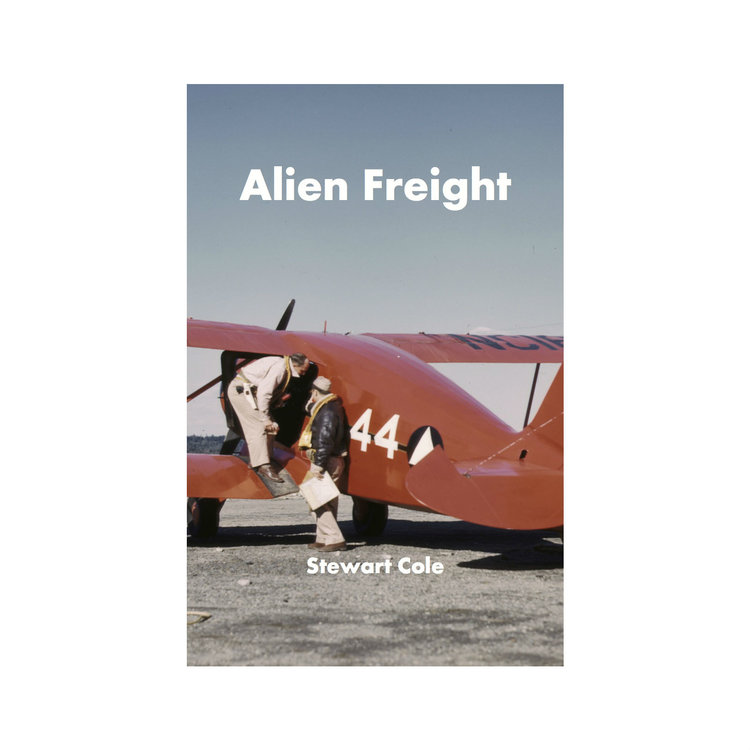
Alien Freight - Stewart Cole (Anstruther Press)

Today's book of poetry:
Alien Freight.  Stewart Cole.  Anstruther Press.  Toronto, Ontario.  2017.

Alien Freight.jpg

Stewart Cole's Alien Freight is Today's book of poetry's third book of the new year and it is a slightly different and difficult cargo.  Not for the reader, no, that's all pleasure -- it's Cole in his elegant laments.  In Cole world the need for change is being addressed, we don't always know what change will bring, but as Cannonball Adderley said, "Mercy, mercy me."

This short chappy has Cole "deluded raw" with prognosticators, mortified at his own imminent murder at the hands of a child he does not know, ending fashion, musing on the ambiguity of airport controllers and conversing about the sixth bell, the executioner's death knell, the Doom Bell.  And there's more.

What struck Today's book of poetry about Alien Freight was the palpable tension under the surface of Cole's very precise language.

Patricide

I am being followed by a child
This is a new kind of fear
The afternoon sprawls like a dog on its side
Adrift in oblivion
The sky is like a sheet of rock fired to the blue verge of combustion
The street a blotchwork of modest border gardens
Cropped walkways and flagpoles
Decked for summer's next rah-rah-liday
Everycolored front doors radiating
Tacit no thank yous
Is this place still pre-apocalyptic?
Am I really among the unplagued?
Other than the inexorable dot
Tracking me up the sidewalk at a steadily shrinking distance
Now swollen to a splotch
This scene lacks a fellow presence
Even the hazy humanoid shape
Of a faceless hose-wielder three lawns down
Or an umbral blur nursing a High Life deep in a stoop
Would lend me a clue
I am not wandering the solitary void
But without such neighbors I'm left to wonder
What if all the uncaught murderers are children
Because we just avoid looking there
Afraid the truth will stab us in the eyes
Oedipus-style
Or what if that kid behind me
Is ageing and growing the closer he gets
Oh yes he has bridged the distance by half already
Become a teenager and suddenly
I am old enough to be rebelled against
My genes have lost their modishness
Legs gone columnar
At this pace he will overtake me within not years but instants
Even now his lengthening arms
Could loop a garrotte around my throat if he chose
Outgrown shoelaces or catgut rent from a neighborhood stray
Some umbilical surrogate
But no he does not choose my death
He seems to want little more than to know I'm behind him
And there he goes like bony wind
Just as old as moments ago I was young
I look back hoping to glimpse
My little doomster
Who wasn't trailing me after all
Only briefly laying string along the same spell of asphalt
From his fuller spool

⃝⃝⃝

Cole's poetry has that crisp clean white sheet smell of spring and the first open windows because his language is so precise and dare I say proper.  But the counterpoint to Stewart Cole's explicit and careful diction are the ideas that fuel these poems.

Alien Freight is one of those books where first glance says that the water is tranquil and calm -- but as soon as you test the water you know, the reader realizes that there are eddies and undertoads lurking just below the surface.

Minding the Gaps

Glimpsing London's suburbs
Through gaps in a blue of hedgerows
I forbid myself to wonder
At least for longer than a leaf's breadth
What out there that might touch me is smudged out
This train is serpentine
A land eel furling with androidal ease
The ocular panels along its sides
Of which I am only one of many retinae
Perceiving only world-melt
I am ostensibly going to Exeter
But just now it's easy to slip
Into who knows
Adventure like abduction
Without the black hood
I can see and yet the sight is happening
Housing estates livestock a ruined abbey greening
Digested by the ancient hills
The grander-scheme import of which
You will forget
So drink
As the fanged stoat from the rabbit's nape
As though from a flagon of river water
Shaken with ancestral ask
As if it isn't knowledge you see
But some osmotic soul-food
To be filled up with blurs
That might later resolve themselves
Into memories
To return to where you really live
With changes in your blood

⃝⃝⃝

Our morning read was somewhat truncated this morning.  There were a few no-shows among the minions this morning. -39C (with windchill) so a few people were running late and starting slow.  Stragglers are still arriving.

Stuart Cole's Alien Freight might suggest he has little faith in our ability to right the ship, and then ship righted, not to drive the fucker right on to the rocks.  Cole sounds polite and proper but he has the heart of an anarchist.

Henceforth All Flags

Will fly at half-mast
Awaiting the miraculous
A lasting tribute
To the aching truth
We all possess within us
Like phosphorescence in a daylit sea
Dormant until nightfall
There dwell among us those
Who usurp the name of Optimists
Who want to simply cut
All flagpoles in half
And fly our banners at lowered summits
Heed them not
These kissers of ceilings
Whose cult of shrunken hope
Would suspend us in a choiceless chrysalis
Leaving forever unhoisted
The white flag of the Faceless
Which one day will wing to that barren pole-top
And bliss us collectively out
With its final I give up

⃝⃝⃝

Alien Freight is a short and tasty treat.  Today's book of poetry will be looking forward to Stewart Cole's next.

Image result for photo of stewart cole poet

Stewart Cole

ABOUT THE AUTHOR
Stewart Cole is the author of Question in Bed (Goose Lane, 2012).  A Canadian expatriate, he lives in Wisconsin, where he teaches at the University of Wisconsin Oshkosh.

anstrutherpress.com

648

DISCLAIMERS

Poems cited here are assumed to be under copyright by the poet and/or publisher.  They are shown here for publicity and review purposes.  For any other kind of re-use of these poems, please contact the listed publishers for permission.


We here at TBOP are technically deficient and rely on our bashful Milo to fix everything.  We received notice from Google that we were using "cookies"
and that for our readers in Europe there had to be notification of the use of those "cookies.  Please be aware that TBOP may employ the use of some "cookies" (whatever they are) and you should take that into consideration

Sunday, August 27, 2017

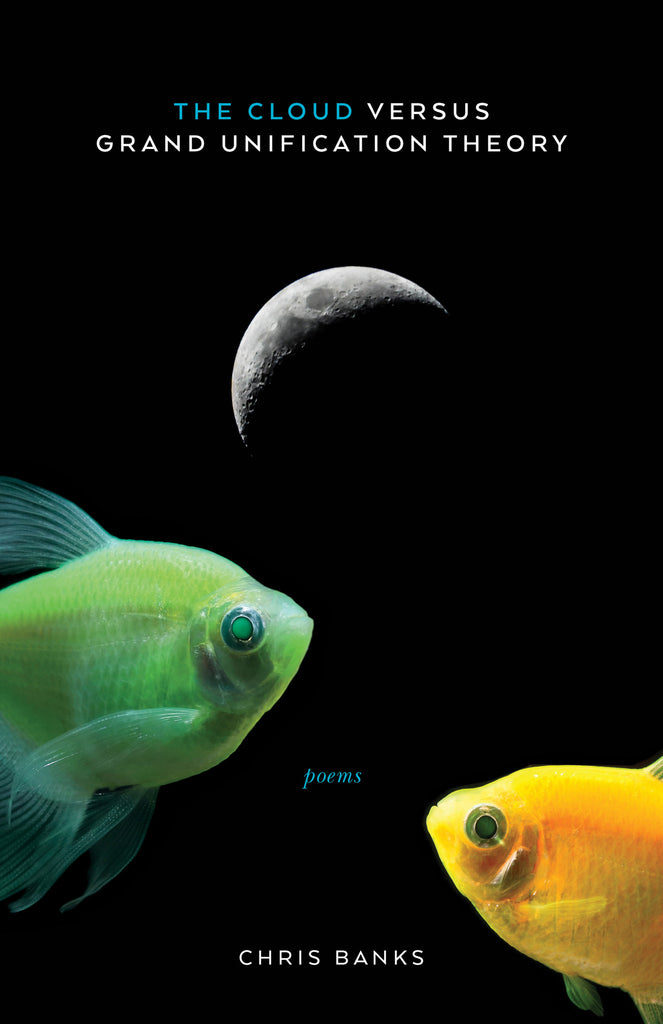
The Cloud Versus Grand Unification Theory - Chris Banks (ECW Press/a misFit book)

Today's book of poetry:
The Cloud Versus Grand Unification Theory.  
Chris Banks.  ECW Press.  a misFit book.  Toronto, Ontario.  2017.

Cloud Versus Grand Unification Theory, The by Chris Banks, ECW Press

Milo, our head tech, went to the stacks this morning and brought out Chris Banks' Anstruther Press chapbook Invaders (2015).  Today's book of poetry remembered Invaders as a tight and muscular little celebration.  With The Cloud Versus Grand Unification Theory Banks moves into fully fledged killer poetry assassin territory.

602 blogs/reviews into this project and Today's book of poetry is still regularly amazed.  Re-discovering Chris Banks is a bit of poetry lottery win.  The Cloud Versus Grand Unification Theory may be the best book of poetry you read this year.

Banks applies a carpet-bombing theory of poetics, he builds line after line of incendiary verse, each as solid, dependable and explosive as it's predecessor.  The poems in this collection are constructed like those extraordinary Japanese temples where no nails or screws are used.  Instead the construction is held together with elaborate, almost invisible, joints that fit just so.

The Hundreds

Eight-tracks of Neil Diamond's Hot August Night are gone.
Cassettes lost. Don't look, but Betamax and VHS tapes
are no more. All around us, the old century, The Hundreds
as my daughter calls it, is vanishing. The K-car is gone.
Wood-panelled basements and macrame wall hangings.
Airbrushed vans, teen hitchhikers, Corvette summers.
Moon landings. Woodstocks. Live Aid. Lollapaloozas.
Henry Morgentaler and Ian Curtis are gone. Terry Fox
and Andy Kaufman. East Germany and Czechoslovakia.
The rotary phone is gone. The modem is gone. Even
intricately folded high-school notes, written in cursive
in April of 1986, no longer exist. The Khmer Rouge
and Nelson Mandela are gone. Kennedy and Brezhnev too.
Atari is gone. The arcades are gone. Pong. Pac-Man.
Donkey Kong. Transistor radios. Walkmans. Discmans.
Boomboxes. Ghetto blasters. Hi-fi stereo receivers.
Billie Holiday, Satchmo, John Lennon, Freddie Mercury.
Rock. New Wave. Punk. Hardcore. Grunge. Shoe-gaze.
I cannot tally it all, but still I keep trying like a man
poring over microfiche, not memories, hoping for a clue
or two that might tell a person how to live
with loss when already oceans are rising, the climate
is changing, the animals are leaving us, one species
at a time: Dusty seaside sparrow. Mexican grizzly bear.
Golden toad. The past seems more real than a world
where Greenland is melting, where people stare at phones
the way they once did at paintings. The Hundreds,
smelling of old money, sibling rivalry and white privilege
are not coming back, and it's time for time to settle up,
to explain what it was all about, before we too one day,
after breakfast, or a walk in the park, or a trip to the city,
find ourselves suddenly, and irrevocably, gone.

...

Chris Banks has mastered a particular school of the great riff.  He makes leaps where others might consider walking around.  The journey through one of Banks' missives might seem disjointed and uncertain but you are under the care of some masterful hands.  You might come sliding into home sideways, or muscling up to the dock with a big wake, but every inch of your navigation has been previously considered by the poet for you.

The Cloud Versus Grand Unification Theory may be a catalogue of human responses to an increasingly difficult and hostile world.  Banks expansive voice is elastic enough to embody contradiction and compromise without ever changing key.

Dusk Till Dawn

You imagine the moon filling a bedroom window
as the towering screen of a drive-in movie theatre
high above a winter field strewn with meltwater.
Soon cars prowl past the ticket booth's closed sign.
An unlighted snack bar hunched in snow and rain
gathers a crowd. The moth-stutter of faint images
flicker from a projector filled with stopped clocks.
Someone has already begun to lay aside his clothes
in a borrowed car. Someone's white bare shoulder
is sending a boy's desire up in flames, burning him.
Someone feels branded by delight. Even on a night
as cold, as ordinary as this evening, somewhere it is
the summer of 1985 and Back to the Future is playing.
Somewhere people stagger in between rows of cars,
drinking beer, laughing heartily, suspecting nobody
will ever grow old, or expire, or be forgotten again.
Many are wrong -- it is already tomorrow's music
leaking out of FM radios, speaker poles like crosses
marking the graves of teens who came before them,
until someone finds himself locked out of some car,
twenty years older with an adolescent girl long dead
in a car wreck. What happened two decades ago.
Someone wishes he could go back to another time
to loiter under a different moon, in another century,
but already there is a fight in the parking lot. Already
police are gathering at the entrance, waiting for dawn
to come, for people to finally get tired and go home,
while someone drunk yells Come on!, holds up his fists
unaware the invisible projectionist who is smoking
absentmindedly, dusting ashes off one last cigarette,
stares out his tiny window, knowing how it all ends.

...

Today's book of poetry enjoyed reading these poems out loud.  Late last night, in bed, I read "The Hundreds" to my wife K, she put down the giant biography of Theodore Roosevelt she was reading and listened hard.  K is always a good measure, I didn't have to prompt, just waited for her response. "Remarkable."  She was right.  Chris Banks has found a secret source of almost perfect metaphor and hammered it into these well crafted narrative poems. 

Our morning read was a particularly happy one this morning as we welcomed back Otis, our security chief, from Belgium and the Pistol, our Dutch translator, who was out in eastern Canada learning French and swimming with the fishes in the very cold ocean.  Both men are sometime contributors to Today's book of poetry but we always miss them when they are not around.

The Cloud Versus Grand Unification Theory

I am not asking for anything except a little wisdom
from this life. Experience has taught me to be
prepared for when a bullet passes clean through,
it leaves a hole behind. Praising things is its own job.
That we might actually know two or three people,
despite battalions of online friends, is a consolation
prize for not solving the Grand Unification Theory
or writing thirty novels or discovering a ninth planet.
Living becomes its own masterpiece. A catalogue
of blunders and missteps and then, a surprise party!
I have met a few certifiable geniuses in my day
and they were all disappointingly human. Failure
is a bogeyman. What happens next is up to you.
The brain does not care we are are only so many miles
of nerve-endings. It wants to go further off-leash.
What is the real story here? Some days, it is all
caviar and champagne, and the next, forty horses
die in a barn fire. No angels earn their wings. People
lie to each other out of fear, to spare each other's
feelings. What kind of man does that make me?
I tell elaborate lies to ascertain the truth. I resolve
to get out of bed most mornings, to witness
the past like a boarded-up pawn shop, to read
what life throws in my path the way ancient priests
read bones, which is to say inscrutably. Make it
up anyways. What I need is another mass grave
for my doubts to pile into. I keep thinking about
that engineering student who tied a piece of rope
to a hydro pole, passed it through his car's window,
before cinching it around his neck and driving off,
or a woman I saw once spread her arms before
diving off a three-storey parking lot. At what
point do we give up and surrender to our desires,
even if they end up killing us?  Maybe I'm being
greedy wanting art to be more than a bowl of fruit,
wanting there to be answers. Who is listening?
The partygoers nibble the caviar and move on.

...

The Cloud Versus Grand Unification Theory is about as good as it gets here at Today's book of poetry.  What else can we ask for?  This is exactly the sort of magic we live for here.  Intelligent, witty, inventive, exciting, lyric and so on.  But by far the most important quality is that these are accessible poems.  Today's book of poetry always looks for that first, the rest is gravy.

Chris Banks surprised the bejesus out us with The Cloud Versus Grand Unification Theory.  We should get this lucky more often.

Image result for chris banks poet photo
Chris Banks

ABOUT THE AUTHOR
Chris Banks is the author of Bonfires, The Cold Panes of Surfaces, and Winter Cranes. His first full-length collection, Bonfires, was awarded the Jack Chalmers Award for poetry by the Canadian Authors’ Association in 2004 and was a finalist for the Gerald Lampert Award for best first book of poetry in Canada. His poetry has appeared in the New Quarterly, Arc, the Antigonish Review, Event, the Malahat Review, and Prism International, among other publications. He lives and writes in Waterloo, Ontario.


602

DISCLAIMERS

Poems cited here are assumed to be under copyright by the poet and/or publisher.  They are shown here for publicity and review purposes.  For any other kind of re-use of these poems, please contact the listed publishers for permission.

We here at TBOP are technically deficient and rely on our bashful Milo to fix everything.  We received notice from Google that we were using "cookies"
and that for our readers in Europe there had to be notification of the use of those "cookies.  Please be aware that TBOP may employ the use of some "cookies" (whatever they are) and you should take that into consideration.

Saturday, September 26, 2015

Blue Night Express - Bardia Sinaee (Anstruther Press)

Today's book of poetry:
Blue Night Express.  Bardia Sinaee.  Anstruther Press.  Toronto, Ontario.  2015.


Today's book of poetry is a big fan of full disclosure - I know Bardia Sinaee well enough that I can call him my friend.  In our short acquaintance I have called him many things, to his face -- but usually when he is out of earshot.  I probably talk about Bardia more that he would be comfortable with, I've been telling anyone who would listen that Bardia Sinaee is, in my mind, one of our very best young poets.

Blue Night Express only confirms what I've been jabbering about all along.  Sinaee's poems are pools of crystal clear water in a world where muddying the proceedings is often the order of the day.

Man On Verandah

Awake in shadows lie
the cats, while armoured, copper-
coloured bugs scale

the wall behind
the laundromat to taste our blood.
So mannered is

the waxing moon
and sheperd-like above a bank
of clouds, I can

almost feel Colville
painting a revolver next to me
to lend the scene

a little tension. but
it's enough to be awake when
others aren't.

To think there is
a lake not far from here. Across
the street, profiled

in computer glare,
a woman sits so fixedly upright
you'd think she

swallowed a cane,
like Whistler's mother if Mrs. Whistler
ever took her

bonnet off. Raccoons
alight from eavestroughs with
their night scopes

on the trash.
A blackened elm with elm disease
dispatches shrunken,

blackened leaves.
A blunt, diffusive dark prevails until
police lights crest

the hill, searching
the side streets for trouble or
trouble's silhouette.

...

I could talk about the different poets I see dancing around in Bardia's brain, his lovely nod to Ezra, just because he knows.  But instead I want to tell you how tickled I was when Blue Night Express came through the door, so tickled I barely noticed it's lovely Anstruther Press compatriot, Kayla Czaga's Enemy of the People.  You will all remember that Czaga won the 2nd annual KITTY LEWIS HAZEL MILLER DENNIS TOURBIN POETRY PRIZE here at TBOP.  Fine, fine company for Bardia and HEY!, Anstruther Press - great work on publishing these two.  History will show how wise you are.

Sinaee's poetry always strikes just the right note between sarcasm and wisdom.  Sincerity has become a dirty word, a saccharine insult, but when done right, like in the poetry of Bardia Sinaee, these poems rise above any cheap sentiment and truthfully, crisply, clearly, cut to the heart of matters.

Deposition

How harrowing the prospect
That there may be no clandestine agency after all,
Only our clamouring until we've built on spent faith
What we'd sooner take up arms for than name.

By now there ought to be some sort of saying for it:
To march all day through toppled statuary
And flags snapping in a trumped-up wind,
Surprised to find oneself inclined
Toward such hopefully destructive sentiments
As might find expression in a goose step chant.

I love my people, even you who have already yielded
To some private notion of the future,
One that alarms even you, that scales your fortitude
Then pleads for understanding.

...

Here's my memory of meeting Bardia.  At 52 I went back to university full time and jumped into the deep end.  Turns out I came in 2nd in a campus literary competition.  I don't remember my poem at all, although at the time I thought it winning enough, but I certainly remember the 1st place poem. Meet Bardia Sinaee.  As soon as I heard his poem, which I had been in a complete competitive slather over, I resolved two things - tell the man how fine I thought his poem was, become that man's friend.

Luckily I know the executives here at TBOP and have a free pass.  Otherwise, how could I gush so?
When I read Bardia Sinaee's poems they give me hope.  I can not reach any further for a compliment.

Fugue

Like the tide, silence asserts itself
Through a series of microaggressions, it's raining the same rain
On every station, doomsday theories infiltrate
The nations, profligate and free
In theory, we condemn silence in all its
Driftwood and spores, sleeper cells
Ensnare us from within
Like the Trojans, the nations disperse into new names

As silence is issued from clefts in the air
Like rain, I think we should sing
While we are together in danger, doomsday theories get stranger
With every station, a headlong grave
When the train pulls in
Like wreckage on the shore, I think we can be saved

...

Blue Night Express is everything you can ask from a chapbook.  It is both beautiful to look at and filled with beautiful, bright and sophisticated poems.  Sinaee always assumes his audience is as brilliant as he is.

Bardia Sinaee

ABOUT THE AUTHOR
Bardia Sinaee was born in Tehran, Iran and currently lives in Toronto.  He has poems forthcoming in 
The Malahat Review and The Best Canadian Poetry 2015 (Tightrope Books).


Bardie Sinaee
Reading at the Tree Reading Series, Ottawa
August 9, 2011


385

DISCLAIMERS

Poems cited here are assumed to be under copyright by the poet and/or publisher.  They are shown here for publicity and review purposes.  For any other kind of re-use of these poems, please contact the listed publishers for permission.

We here at TBOP are technically deficient and rely on our bashful Milo to fix everything.  We received notice from Google that we were using "cookies"
and that for our readers in Europe there had to be notification of the use of those "cookies.  Please be aware that TBOP may employ the use of some "cookies" (whatever they are) and you should take that into consideration.