Today's book of poetry is back with a special guest. We have asked our Southern Correspondent to come out from behind his Twangster moniker and take a look at my most recent book. Today's edition of Today's book of poetry was written by David Clewell. Clewell, the former Poet Laureate of Missouri has been a great supporter of Today's book of poetry and we are honoured to have him look at Bad Engine.
Today's book of poetry has avoided discussing my own work on this blog because it was never intended as a personal promotional vehicle for my own poetry. This is a first and I am hoping you will indulge us. We will return to our regular broadcast frequency in two days.
Today's book of poetry:
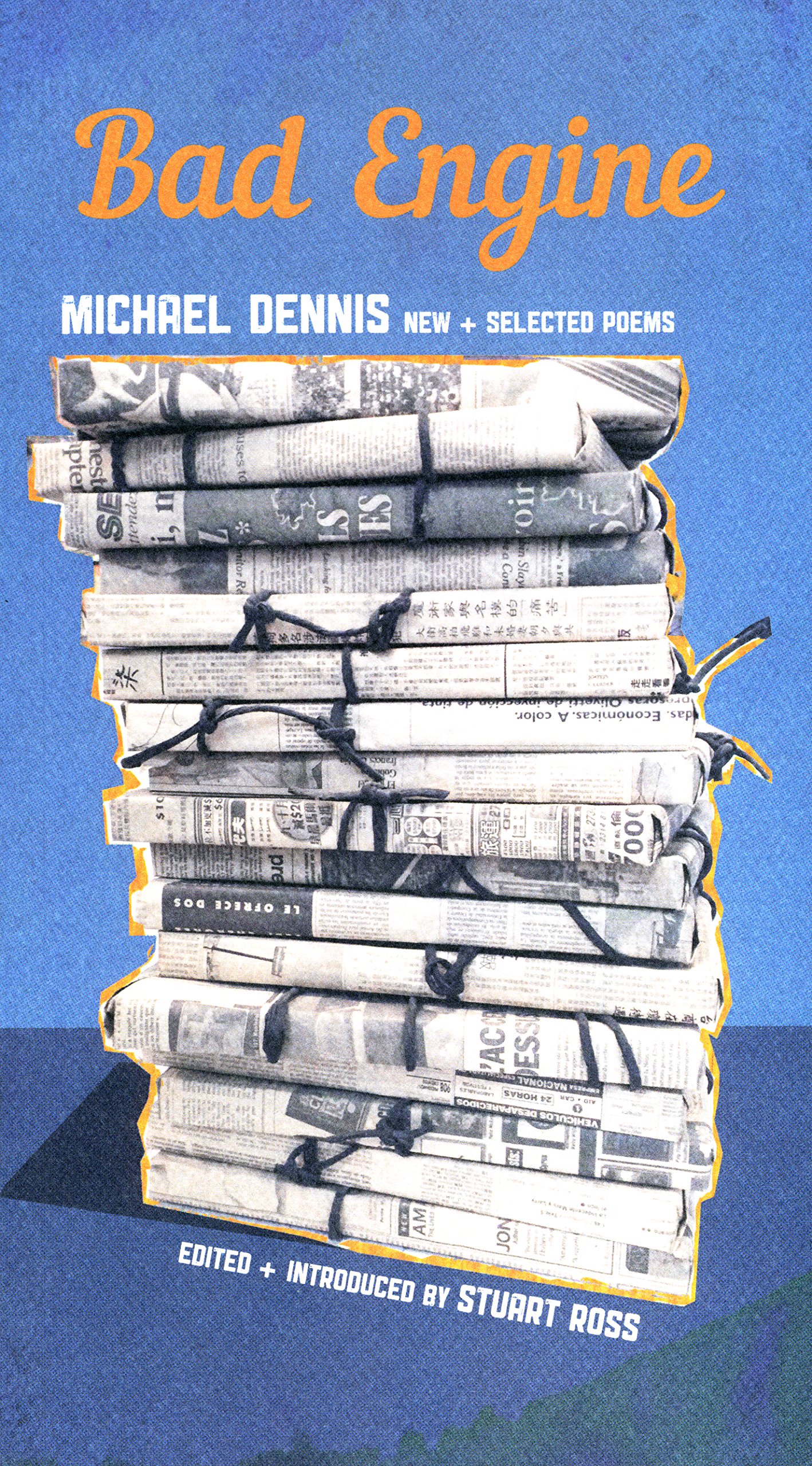
Bad Engine. Michael Dennis. Edited and introduced by Stuart Ross. Anvil Press, Vancouver, British Columbia. 2017.
In the interest of full
disclosure: I know this writer, although I’ve never actually met him in person.
Never sat on his porch, or helped him shovel his ungainly share of Ottawa snow,
or ridden shotgun in his car while carrying on with my cockeyed chatter of
flying saucers and Bigfoot and how I hope we’ll see some one of those any
minute now, or bellied up to his favorite neighborhood bar, or loaded him down
with obscure books from way too many used bookstores. I’ve never eaten his
cooking, drunk his wine, helped him hang artwork or take any down, watched even
five minutes of hockey on his television, spun records featuring our mutual
jazzman heroes—Monk, Prez, Miles, Coltrane—into any kind of Canadian wee hours.
Never shared a jail cell with the man, either (although I think we’ve both been
in jail, albeit briefly).
Until
just several weeks ago (and with that I’m getting ahead of myself), I knew
Michael Dennis only through his remarkable blog, Today’s book of poetry—which even now I’m preparing to commandeer as
I tap this out on the Demon Box that lives only in my office at work. (In the
words that opened each episode of the 1960s sci-fi TV show The Outer Limits: “There is nothing wrong with your television set.
Do not attempt to adjust the picture. We are controlling the transmission.”) That
this was our meeting-place (and did that happen truly just one year ago?...it feels as
if I’ve always known this guy who
shares so many of my psychic-radio frequencies!) strikes me as more than a little
surprising, seeing as how both of us undeniably hail from some Land of the
Techno-Dinosaurs—those creatures still able to remember, no matter how dimly, former
glory days of handwritten letters, along with poems, articles and reviews
coming off the rollers of manual Smith-Coronas, Remingtons, and Olivettis .
(Okay, we did manage finally to go electric
at the typewriter. If it was good enough for Dylan and his guitar at Newport in
’65…) And on the receiving end of any of
those efforts, that meant mail you were excited about holding in your hand,
scrutinizing the return address, then opening it in your own idiosyncratic way.
Still, for all that, though it seems like a fairly major concession to the
times we live in, we each manage somehow to engage the other in our
electro-stumbling peregrinations through e-mail.
Most of all, I’m grateful for his putting me
in some kind of meaningful touch with what’s going on these days in contemporary
Canadian poetry. Since starting up his
blog in 2013, Dennis has written about more than 500 (gulp!) books and chapbooks
of poems largely published by independent and university presses, making ample room
for books from U.S. publishers as well. He’s called his pieces “appreciations”
rather than reviews, and in that manner he’s a commentator after my own heart:
better to use whatever finite amount of energy available to show a reader
something amid the poetry welter that’s truly worth seeking out than to spend time
and space on anything less (what he’s referred to, rather diplomatically, as
“burnt toast”). And with that in mind, I promise: I really am creeping a little closer to telling you what happened “just
several weeks ago.” And it will have nothing to do with either flying saucers
or Bigfoot.
But first: let it be said that, for the long
border shared by Canada and the U.S.—the close proximity of our two countries—it
is not easy to find in the States books published by independent Canadian
presses. It was really hard, almost
impossible, to find Canadian-published poetry titles in the early ‘70s, when I
first fell under the spell of poetry—difficult even to order them into the
bookstore where I worked in New Brunswick (New Jersey’s version—not Canada’s!).
From this distance it’s a little hazy, but orders directly from publishers were
some kind of no-go, and very few U.S. book distributors were carrying them
(maybe for the same, whatever-they-were, international-trade reasons). I
remember finally coming across a distributor that had made some cracks in the
embargo-wall, although whether or not they were doing it completely legally is
something I can’t quite seem to recall.
And
suddenly it wasn’t just Leonard Cohen and Margret Atwood and Irving Layton,
fine poets though they were. But, hey: here came Michael (“Way-Before-The-English-Patient”) Ondaatje’s The Dainty Monsters, The Man with Seven Toes,
and Rat Jelly in beautiful editions
from Coach House Press, along with The
Collected Works of Billy the Kid: Left-Handed Poems from House of Anansi. Make
way for Victor Coleman, Margaret Avison, George Bowering, Al Purdy, Fred Wah, and
a clutch of significant others who came to matter to me as well. It was a kind
of hit-or-miss serendipity, to be sure, but at last there were physical books I
could browse through, deciding what to take home for keeps.
For a while, those were some exotic, heady
days: some terrific books of poems, both beautifully produced and affordable.
But as my life drifted away from that bookstore, I fell out of regular
touch with what was going on in the poetry to my North. Between the difficulty
of actually latching onto any of it and trying to keep up with the burgeoning
small/independent press scene coming on strong in the’60s and ’70s U.S. poetry
landscape, contemporary Canadian poetry with too few exceptions mostly
disappeared from my radar.
Now,
more than forty years later, that’s why I find Dennis’ blog to be a holy
godsend. He spends copious amounts of time and human energy showcasing an
impressive variety of books it just might be worth spending my time and energy with. He’s especially
generous with excerpts (providing a veritable browsing simulation, if you
will); his readers get substantial samples of the work he deems worthy of his
public appreciation—including whole poems by poets who write in
longer-than-lyric bursts and probably are not used to such kind,
non-eviscerating treatment. This man’s eclectic good taste is always the order
of the day. H.L. Mencken said something to the effect that we show our taste
through our enthusiasms, and it pleases me to report that so many of Dennis’
enthusiasms have become my own as well.
Okay—it’s
finally time for the surely-by-now-anticlimactic “just several weeks ago”
reveal: that’s when I received in the mail Michael Dennis’ Bad Engine: New & Selected Poems. Never for a moment did I consider this happenstance
any kind of potential friendship-breaker (what if I didn’t really like my
book-correspondent’s own stuff?). Hadn’t I previously tried to inveigle from
him some of the books and chapbooks already part of his lengthy bibliography?
I’d certainly asked after so you think
you might be judas, wayne gretzky in the house of the sleeping beauties, Coming
Ashore on Fire, and Watching the Late
Night Russian News in the Nude (what, you wouldn’t have asked?!), to name just a few of the most provocative
of his more-than-two-dozen titles. And while working through my own overstuffed
shelves during those initial weeks of our newfangled electro-correspondence, I
discovered that in fact I owned an earlier book of “selected” Dennis poems, This Day Full of Promise (Broken Jaw Press, 2002), which apparently I’d picked up
on a whim years before—either for the poems therein or for the nude depicted on its cover. So, truth be told at last, I
had at least a gratifying taste of what I might be in for—temporarily lost
though it might have been amid a few thousand other slender volumes of poetry
pleasure.
Bad Engine is one handsome beast
all around, from its cover stock to its papers, from its visual design elements
to its hard-to-describe-just-how-satisfying-it-is trim size. This classy
presentation brings together some forty years of work from this heart-smart
poet, assiduously and lovingly edited by Dennis’ friend and fellow writer,
Stuart Ross, who provides an introduction that’s both informative and warm.
With access to uncollected and unpublished work in addition to the productive Dennis’
many books, Ross has helped the poet assemble a collection that weighs in at
exactly twice the size of the 2002 “selected”—and with nary an ounce of poetry
fat. Ross writes: “The couple thousand poems I read to concoct this mixture
drove home to me that Michael Dennis is the real thing when it comes to poetry
without artifice.” I’m here to testify: you’d best prepare right now to say Amen, somebody. And while he’s been
compared in that regard—aptly, favorably-- to Al Purdy and Charles Bukowski, I
want to bring another one of my own poetry heroes under this “without artifice”
umbrella too.
I’m thinking here of the good doctor of my home
state, William Carlos Williams, who insists on no ideas / but in things (first in “A Sort of Song,” then later,
several times in his epic book-length poem Paterson,
where it finally turns into No ideas
besides the facts). He aspired to a kind of writing “in which the world
becomes what it is.” A world without
abstractions, without superfluous explanations, where the facts are the local specifics—the
physical and mental particulars encountered in walking through another day on
the planet. He certainly didn’t mean that poems should be devoid of ideas.
Rather, the poet’s selection of salient
things will more naturally reveal the poet’s heart and mind—along with a
world that’s remade, for better or for worse, every time we head out into it.
It’s also about the diction and the palpable
sounds that words make in the listening ear—because, no matter how
intrinsically entertaining, anecdote alone does not a poem make. It’s about the cadences of the lines they become
part of. It’s the music of starting and stopping and starting again—the lines themselves
that show us how to listen to what’s being spoken. It’s about simple (but not
simple-minded), plain-spoken (but
never just plain drab) language that
refuses to be gratuitously self-conscious or otherwise festooned; it’s speech
without artifice or affectation. In a Paris
Review interview near the end of his life, Williams says, “I wanted to say
something in a certain tone of my voice…
I couldn’t speak like the academy. It had to be modified by the
conversation about me. As Marianne Moore used to say, a language dogs and cats
could understand… Not the speech of
English country people, which would have something artificial about it; not
that, but language modified by our environment;
an American environment.”
Michael
Dennis is a member of the choir; poem after poem in this vibrant tome is
eloquent testimony to that rewarding mode of operation. Taking up a rich
variety of subject matters—a reticent ex-wrestler walking her dog, idyllic porch-sitting,
watching his beloved hockey on TV (I am a
Canadian boy and the artistry / of sticks
and skates is something I understand), driving (whether truck, cab, or ’62 Falcon), the act of
reading, the art of making love or making poems, reckoning with the end of the
world or the more immediate end of another long night—Dennis allows the
emotional content of the poem to grow out of the given situation’s most unabashedly
human locus. And that kind of content—significantly different from what’s
subject matter only—is surely the brightest “idea” worth having. These are the
human facts as Williams intended, brought to light in language that sings as much as it says, that just might allow the world another chance to become what
it is. The writer transmits that peculiar charge to the reader through the
singular, unlikely conduit of the poem itself. And for as many times as that’s
happened in my life, I am still no less astonished any time it happens again.
Along
with variety, versatility is a hallmark of Bad
Engine. In “because you’re fucked up and I’m perfectly sane,” the poet
declares that he can listen to Mozart one
minute / and Monk the next and can
read Proust and Popeye in the same night. After spending so much good time with this
book, I’m here to tell you that, yes, he absolutely can—and does. These poems
explore a range of tones and pitches, from the lighthearted to the more serious
(but never the solemn, where the
wrong kind of poets take themselves, I’m afraid, the wrong-kind-of-seriously). Both
an abiding grace and sense of humor inform Dennis’ ways of seeing the world—his
unflagging witness and his testimony.
Many of his poems evidence a distinctive blend
of lyric and narrative elements; the man likes a good story as much as he likes
a good song. And because I am not a
Canadian boy, I’m going to have to go, instead, all American football on him: he’s
one of poetry’s wide receivers who can go short and go long with equal aplomb.
For the short of it:
funeral
for a fly
with a book of Richard Brautigan’s
poetry
i killed an unsuspecting fly
(to be buried later in the
envelope
of a letter from my lover’s
mother)
i had no idea
that poems so short
could carry such weight
...
And
for the long of it:
no
savior and no special grace
what does it matter
i am sitting in my apartment
and looking out the window
at the people going by
it is summer and it is hot
the afternoon means nothing
the people on the street are dying
i am looking down and dying too
the mercury topped a hundred yesterday
and will do it again today
the rent is due
so is my bill at morries
the greasy spoon across the street
they know me there
i have a cheeseburger
a can or two or coke
say "hey, marg, put it on the bill"
if i have a reading and make a few bucks
i go in and cash my cheque
marg gives me the difference
we get along fine
i see people walking into morries
and coming out the same
hot and confused
i can see in the window
an electric fan rotates slowly
beside the bran muffins and butter tarts
it doesn't make any difference
just moves the hot air around the room
as cars drift by the window
they are doing nothing
just driving around the few blocks downtown
a clever plot by the mayor and his bandits
they've cut off the welfare
and are giving away gas to those with cars
to make it look like the city isn't dying
the only store doing any business
is the sally ann
it used to be only the broke
with holes in their shoes
wandered in the door
but not anymore
there is no pride left
if i had an egg
i could cook it on the danger high voltage sidewalk
and it i had some bacon
i wouldn't be sitting in the window
i'd be over at the king's
listening to the music
and watching one of the ladies
dancing and giving it away
she'd be wrapped in red
she'd be taking it off
but it doesn't matter because i hear them knocking
and they are coming for me
it doesn't even matter who they are
i've got the furniture piled against the door
if they want me
they come come in the windows
or through the roof
and until they do there is the street
with the cars drifting past
they come from somewhere
and go somewhere else
i watch the people go by
sometimes they'll be pretty women or a handsome man
doesn't matter
they are all doomed
they just have further to fall
when the boom comes down
the old women
with plastic bags full of their histories
they will survive if only from habit
but what of the beauty shop queens
who spend tuesdays at the club
when the club closes the doors
and they have nothing left
but to walk by my window
what will they do
they will scream in the streets
and pull their hair
their men will be weak things
crying and pulling at their teeth
there will be no saviour
and no special grace
the end will come
as quickly and surely
as the noon explosion
of the engine of a '63 pontiac
pushed to the limit just once too often
and i'll watch it
the engine blowing on the street below
marg will serve coffee to the bystanders
there will be blood and gasoline on the blacktop
the heat melting them to one
it will be a sign and
the stores will close their doors
...
When
it comes to the mixing of lyric and narrative, consider the longer poem above: there’s
almost no telling where one leaves off and the other picks up. A man looks out
his window, and that’s pretty much the extent of the narrative, the “what
happens” in this poem. So much of the rest is conjecture—hypothetical,
and…well…felt (sort of like Hamlet’s
“To be or not to be” lyric monologue, minus the annoying young-royalty angst).
And yet it somehow manages to be, at the same time, the story of what that man sees
(or not to be, if that’s how you’d
rather have it).
I
also can’t help but offer into evidence the entirety of another lyric
narrative/narrative lyric operation—a bit of “let’s say” conjecture made of
equal parts edginess and whimsy:
this day
full of promise
let's say you're a deer
and as deer go
you're smarter than average
you're having a good year
whatever it is you like to eat
is plentiful
you've found an excellent source
of cool, clean water
your antlers are coming in
things are on target
the doe of your dreams
is doing the doe-eyed thing
it's a monday morning
although that means nothing
it is just past dawn
you don't know
that you are upwind
from the bear
this is the forest
these are the trees
the flowers are beautiful
and the air is sweet
in the city
you could be walking home
from dinner or work
you could be in your bed
under safe sheets
a man approaches
out of the darkness
neither malice nor mayhem
on his mind
he thinks no more evil
than the bear
quiet in the shadows
there is no thought
to the natural order
no safe place for the hunted
noon shines down directly
as flies skydive
the crimson puddles
the bear
having manifested its will
its reason for being
has wandered to a nearby meadow
providence has blown a beehive
from the crooked branches of an aspen
into the sweet-toothed path of the bear
there is another shaded pool
where dessert and a nap ensue
the bear dreams bear dreams
none better than reality
in the city
the closed windows of the home
you once lived in
keep in the sound of blue flies
and the answering machine's
unhappy drone
hours, days, weeks
one of them pass
you're found
by a partner, a friend
the mailman
your story is in the paper
the killer is found
or not
the sun comes up
the following day
with no regrets
and no remorse
this day
as full of promise
as every other
since the beginning of time
...
And
while it might not be at all easy to render a fresh-seeming love poem in our time
where the post-modern, ironic, faux-fedora-wearing,
hip anti-love love poem threatens to drive out the honest-day’s-work of a bona
fide love poem (no matter how unassuming), Dennis shows us that, thankfully,
such a perfectly-pitched thing is still as possible as it is necessary:
breakfast
in bed
i am somewhere between
sleep and conversation
my face buried
in pillows
i am lying face down
spread-eagled on the mattress
the sun on my back
it must be a beautiful day
i feel you sit down on the bed
and hear you talking to me
you are peeling an orange
i feel it in my nose
it is the freshest thing i know
it is strong
it wakes me up
it is pure
like the sun
i am awake
i turn over
see you looking at me
say good morning
kiss your knee
ask for a small piece of orange
...
Although Dennis occasionally features a houseboat,
a lake, even a limitless starlit sky, his poems are characteristically rooted
in a distinctly urban landscape and accompanying psyche, where thankfully his
speakers have not a whiff of the faux-urbane
about them; they are unapologetic denizens, not sophisticates, who never fail
to appreciate that the hum of the city is
underneath everything (“the wrestler”). I hesitate to call him a “street
poet”: that moniker has gathered to itself too many knee-jerk connotations over
the years. I much prefer the precision of “street-level poet,” as his Canadian
writer-comrade Rob McLennan has referred to him. Dennis’ work is doggedly
down-to-earth, and his version of that earth is more often solid pavement than
any rich, loamy soil: I live in a big city / and do
big-city things (“my
lucky life”).
If some of his best poems are sparked into
life by marked juxtapositions, it’s surely because this poet can’t help but
note such things in the world outside of the poem. He doesn’t create them,
superimpose them, or contrive them into being for the sake of a merely clever
or poignant “well-made poem.” The woman who walks her three dogs one at a time
…used to be a wrestler
Mexican-style, with the
mask and everything
but won’t tell me her
story
which is too bad
truth usually kicks the crap
out of fiction
(“the
wrestler”)
Dennis
doesn’t gin up a story to compensate for the story she won’t tell. Instead,
she’s now a part of Dennis’ story, better than any fiction he could fabricate.
And that’s a great move on his part (maybe not as flashy as, say, a Pile-Driver
or an Atomic Drop—but just as effective).
And
for lovers of not-nearly-as-odd-as-they-first seem juxtapositions, here’s a masterful
poem that delivers almost too many smiles to count:
Wayne
Gretzky in the House of the Sleeping Beauties
I am watching hockey on television
after all, I am a Canadian boy
but I am also reading, I am a poet too
it is a small novel by Kawabata
the story of a man who frequents a bordello of sorts
a bordello for old men only
men no longer able to have sex
they go to this house
sleep beside beautiful young women
who have been drugged and are naked
I am reading this, my eyes full of Japanese women
and lotus blossoms and then of course
that goddamned Gretzky scores, it is inevitable
he is always scoring -- but I do not mind
Gretzky is an artist
I feel honoured to watch him work
I do not imagine him writing delicate Japanese prose
or taking Cecil Beaton-type photographs
like those in the book I'm holding on my lap
to use as a desk as I write this
but I am a Canadian boy and the artistry
of sticks and skates is something I understand
tonight I dream many dreams
winter and skating on a rink that never ends
in another dream I am wearing a kimono
my eyes are closed and my lips are waiting
in this dream I am thinking nipples
and the endless variety, beauty
I imagine I am with all of the girls
in Kawabata's House of the Sleeping Beauties
it is wonderful
and where does this all end
some incomprehensible metaphor
about hockey and Japanese women
the slash of skates into ice
like a knife into flesh
a strange version of hari-kari
and I think no, none of these things
I watch Gretzky score another goal
...
There’s
the initial juxtaposition, suggested immediately in the title: hockey great
Gretzky starring in the Japanese novel—and, further, Gretzky in the House of
the Sleeping Beauties that’s a literal place in the novel of the same name. Then
we meet a narrator who’s watching hockey on TV and reading Kawabata. The next juxtaposition is found in Kawabata’s
novel itself: the old men lying next to the naked young women (and, gadzooks, our
narrator will soon enough dream himself
next to Kawabata’s women). And if that’s not enough, there’s a book of
photographs the narrator’s using as a desk while writing the very poem we’re
reading right now (the narrator as writer, reader, and hockey fan all at once,
space-time collapsing and expanding all over the place)! Note especially the
last eight lines, where the poet refuses to “make something” of all this; let’s
not expect some incomprehensible metaphor
/ about hockey and Japanese women. Let’s instead enjoy, all over again, the
nutty ride we’ve just been on.
If you want to see this “Canadian boy” at full,
hockey-loving tilt, be sure to read Dennis’ much-celebrated “hockey night in canada,”
an exhilarating fantasia of the poet’s imagined glory on the ice; you can watch
him wield a stick more wicked than any of the greats’ in the history of the
game. The poem concludes with the speaker wondering if it’s all been a dream;
finally, he doesn’t think so:
i felt it
it was pure
and real
and it happened
just like i said
every word
as true as it gets
Throughout
Bad Engine, real life happens just
like this generous Michael Dennis guy says. He’s found some words for all of
us—as true as it gets. For Dr. Williams:
no ideas but in facts. For Marianne Moore: the language of dogs and cats. This
is telltale speech born of the poet’s passion for digging into a life as he’s
come to know it and his compassion for others trying their best to
do the same.
The
only bad in this book, this Bad Engine, is how bad-ass good it is—and how indicative of the writer’s heart that so
assuredly drives it.
Michael Dennis
photo: John W. MacDonald
ABOUT THE AUTHOR
Michael Dennis is a poet from Ottawa, Ontario. He has published seven books of poetry and nearly twenty chapbooks, and has been widely published in Canadian literary magazines and journals. For the last three years Dennis has been the labour behind Today's Book of Poetry, a regular blog where Dennis talks about books of poetry he likes. Dennis has posted over 450 blogs/reviews of Canadian and American small press poetry. These days he can be found in Vanier, keeping his laneway clean.
David Clewell
ABOUT TODAY'S GUEST HOST - DAVID CLEWELL
David Clewell is the author of a dozen books of poetry, including
Taken Somehow by Surprise,
The Low End of Higher Things,
Now We’re Getting Somewhere, Jack Ruby’s America, and Blessings in Disguise. He is a former poet laureate of Missouri and also formerly a circus laborer, professional weight-guesser, and professional wrestler. He currently labors as a professor of English and director of the Creative Writing Program at Webster University in Saint Louis.
Michael Dennis
reading at the inaugural Ottawa International Writer's Festival
video: Chris Mullington
The poem Hockey Night in Canada begins shortly after 1:50.
anvilpress.com
580
DISCLAIMERS
Poems cited here are assumed to be under copyright by the poet and/or publisher. They are shown here for publicity and review purposes. For any other kind of re-use of these poems, please contact the listed publishers for permission.
We here at TBOP are technically deficient and rely on our bashful Milo to fix everything. We received notice from Google that we were using "cookies"
and that for our readers in Europe there had to be notification of the use of those "cookies. Please be aware that TBOP may employ the use of some "cookies" (whatever they are) and you should take that into consideration.