Showing posts with label tom wayman. Show all posts

Monday, November 6, 2017

Escape from Wreck City - John Creary (Anvil Press)

Today's book of poetry:
Escape from Wreck City.  John Creary.  Anvil Press.  Vancouver, British Columbia.  2017.
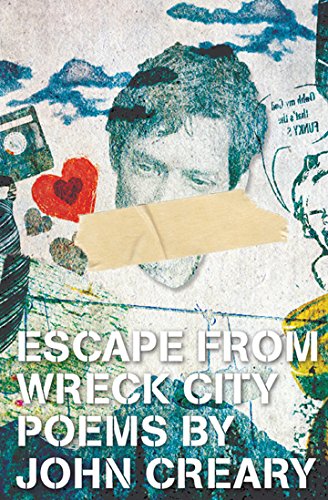

The morning read at the Today's book of poetry offices was a smoking affair.  Some of the poems from John Creary's Escape from Wreck City left literal smoke stains and lipstick smears all over the place.  Others merely flushed cheeks, warmed some collars.

Escape from Wreck City is a chuck e weiss meets Sal Paradise linguistic salad tossed with heavy vibrato and exactly the right amount of vinegar.

NSFW

This is a story of mouthwash and double-jointed coitus.
It's all carpet, lip gloss and the crevasse of your jeans.

I'm frantic to park this white car in the shadows,
eager to massage the blouse off your shoulders, early

before the cold feet come cock blocking through the vents
of the dashboard, pulling your ass into a world of what-if's

and long after school specials on resisting feral instincts.
I once had sex in a blue Porta Potty. It was how you imagine.

Popping Viagra on the Ferris wheel, your tongue like cotton
candy, the carnie whipping us around faster and winking

wildly, his belt buckle a galloping black steed in heat.
Let's eat those snacks and go back to being naked acrobats.

I'm rising to the occasion, ready to be your treadmill,
perform these circus tricks, mastered by the cocaine stars.

It's like making music the way we flicker bareback
beneath the full moon, panting, our pulse pushing past

it's resting rhythm, unfettered. That's the doorbell.
Invite Pizza Joe in, ask him to dislodge me from the rafters.

Here, wear this fake nose-moustache disguise while I take
the clinic through the hardest lesson. I know what this looks like.

I'm up to my elbows in K-Y Jelly and you keep calling me
the astronaut. The neighbours are parting their lips,

smelling the dirty laundry and posting pictures of what must
look like The Worm from over there. I'm disheveled,

our seams slowly unravelled, your thighs like magnets,
my disco balls all aglitter. Let's wash, rinse and repeat, again,

make the most of these wet dreams, but, Baby, who
the hell is Humpty Dangle? I've bounced back, groping

for a reason to care as our faces melt in this candlelit
sweatshop. Let's eat more pomegranates, whisper

our wishlists into cupid's canon, the squeeze play
in full orbit, our tongues raw and full of midnight hustle,

ready to burst the speech bubbles building off our grins,
mine -- something about bushwacking and the washing machine,

and yours -- well, your dripping mouth formed the letter
O in a big, buoyant font, over and over and over and over.

...

Escape from Wreck City is a couple of strangers wrestling under the coats at a New Year's Eve party or the argument  between the Stiletto Queen and her sad companion after too much coke and too little ginger.  It is a raucous affair.  These poems come at you like sniper fire, out of nowhere, extremely accurate and they blow your brains out.

These poems ripple at the edges and burst at the seams with the crowning heads of infants and kill lists, carnal countdowns and a league for men's toilet activities.

Escape from Wreck City

The things you mumbled
at your tattooist's

cold apartment
had little consequence.

You said the honour
of public greatness

is to be sweetly veiled
in pigeon droppings.

Having recently discovered
sherry you've forgotten

most of the last month.
Still, I'm enchanted

with how you let
the word Dubrovnik

roll around your mouth
like some forgotten

tonic. You sprawled out
in the witchglass

like a wounded insomniac
and this prism you insist

I window wash
has a crooked bullseye

slumped around a gross
misunderstanding

of what it really means
to act like evil twins.

There is only one true
vandal; let your eyes

orbit around the room.
You're mumbling again;

it sounds like you're saying
I'm fond of windows.

We're moving inappropriately
through Amontillado,

lightly headed for a mile
wide in-limbo.

Do you ever want to poke
around in the sticky

ink of something more
intimate? Less rhetorical?

I'm an old car in mint
condition. You're marooned

in an equinox as the melon
queen of tattoo parlors.

...

John Creary doesn't seem to have a slower gear or a dimmer switch.  If he's driving it is full speed and right off the end of the cliff if necessary, with the lights on high beam, of course.

But man oh man oh man this Creary cat is one silver-tongued flim-flam trapeze high-flying crazy Wallenda carnie-barker.  There's as much entertainment in almost any poem you choose from Escape from Wreck City to keep the lights burning in a modestly sized town.

The Pigeons Flock in Awe

around the dozing statue, zzzzz
wide amongst open wings.

The long curtains, paralyzed,
twisting off worst thoughts,

head swelling in odd angles.
We keep one foot in a bronze

bucket. It takes many clocks
to build a proper pawnshop,

double bed in the back, dead
celebrities clipped and tacked

to the post. The prize today
is inadequate, a strangled half-

heart. But there goes the lifetime
collective, boarding the carousel

in some Eros frenzy, fainting
like patients out from the shadows,

this morning too by email.
We need fifty wizened hands

lampin' on this perch, perception
amiable, gold package edible.

It's borderless being born again
and then born again, bundled

as caricature with a pesky
erection and a black torn ego

topped full with a toothy
ambivalence poised to stale.

Tonight we sleep or celebrate.
Tomorrow, we begrudgingly

feet these stout-bodied birds
a taste of the new enormity,

carefully open the handcrafted
corridor and wait for the utterly

speechless. But of course
things are never that simple.

...

John Creary's first book of poetry reads like a run-away-train that you are glad to be on.  You want to pull down your safety glasses, hammer some more wood into that burner and go cat go, you want to smoke.

There's enough energy in Escape from Wreck City to entertain Elon Musk.

Creary will sneak up on you.  There are touching moments of parental bliss, everyday life captured like in one of those snow-globes you shake to activate.  Escape from Wreck City is one hell of a first ride out of the gate.

photo of John Creary
John Creary

ABOUT THE AUTHOR
John Creary has had his poetry widely published in Canadian literary journals including The Best Canadian Poetry in English 2011, Arc, Event, Grain, CV2, Fiddlehead, Vallum, subTerrain, and The Antigonish Review. He was awarded the Calgary Literary Kaleidoscope Undergraduate Award for Creative Writing in November 2008. Escape from Wreck City is his first book. He currently lives in Calgary.

BLURB
“John Creary’s poems growl, roar, whisper, chortle, purr and shout. He’s a writer stoned on words, constantly surprised by what they can and can’t do. Language’s energy—clean, dirty, pulsing, spiking, minimalist—vibrates through Escape from Wreck City.”
— TOM WAYMAN, author of The Order in Which We Do Things


625


DISCLAIMERS


Poems cited here are assumed to be under copyright by the poet and/or publisher.  They are shown here for publicity and review purposes.  For any other kind of re-use of these poems, please contact the listed publishers for permission.


We here at TBOP are technically deficient and rely on our bashful Milo to fix everything.  We received notice from Google that we were using "cookies"
and that for our readers in Europe there had to be notification of the use of those "cookies.  Please be aware that TBOP may employ the use of some "cookies" (whatever they are) and you should take that into consideration

Friday, December 19, 2014

The Order In Which We Do Things - The Poetry of Tom Wayman, selected with an introduction by Owen Percy (Wilfred Laurier University Press)

Today's book of poetry:
The Order In Which We Do Things.  The Poetry of Tom Wayman, selected with an introduction by Owen Percy.  The Laurier Poetry Series/Wilfred Laurier University Press.  Waterloo, Ontario.  2014.


The following quote comes from Tom Wayman's Afterword: Work and Silence:

"I have tried to create art that is useful to people engaged in striving for beneficial social change."

I've been reading the very engaging and socially demanding poetry of Tom Wayman for almost forty years.  When I find one of his books it is an occasion.  There are few poets I admire more, so it is with that in mind that I was thrilled to see The Order In Which We Do Things.

The Laurier Poetry Series is an essential for Canadian letters, and in this case Owen Percy has done Wayman proud.

Days: Construction

Days when the work does not end.
When the bath at home is like
cleaning another tool of the owner's.
A tool which functions better with the dust gone from its pores.
So that tomorrow the beads of sweat
can break out again along trouser-legs and sleeves.

And then bed,
Night. The framing continues
inside the head: hammers pound on
through the resting brain. With each blow
the nails sink in, inch by blasted inch.
Now one bends, breaking the rhythm.
Creaks as it's tugged free. A new spike
is pounded in.

The ears ring with it. In the dark
this is the room where construction is.
Blow by blow, the studding goes up.
The joists are levered into place.
The hammers rise.

...

I've worked construction, not for long periods of time, but I've blistered up my hands, climbed those ladders, hammered those nails, had the sunburns, the long hours, dreamt work.

If you are like me Wayman is that smart uncle type character you consult when you want to know better.  He writes with his heart and soul set to honest.

No one in Canada knows the working man/woman better.

A Cursing Poem: This Poem Wants Gordon Shrum To Die
               1971

This poem wants to hurt another person.
This poem wants another person to die.
It wants him to suddenly stumble
feel a sharp pain just under the belly
a harsh pain, one that rips him so hard inside that he shits himself.
The poem wants him to become dizzy
feel a rush of sweat on the face
to begin to shiver, and have to be helped into bed.
The poem wants his teeth to chatter, wants him to throw up
gasping for air, wants mucus to pour from his nose and mouth.
It wants him to die in the night.

This poem wants Gordon Shrum to die.
First because despite all his company's rules and tariffs
despite every regulation they tell the press they apply
his company turned off the heat and light in the house.
They did this without warning, when the temperature was forty
             degrees by day
and the nights begin at four o'clock.
So that after working all day, the body could come home
to a room of black ice.

So after straining all day at the jobsite, with the fingers
numb at the hammer and slipping under the weight of the heavy
            boards
after the back was twisted trying to hoist the load of a wheelbarrow
the rest of the body could return to darkness and cold.

This poem also wants Gordon Shrum to die
because his company charges twenty-five cents every day
for the bus to carry you to work. And because you must
pay the same every evening to wait in the cold
to be jerked and stopped and jerked and stopped
all the way back to the house. Fifty cents a day
taken out of the dollars squeezed from the body's labour
so at the end of the day, the body can be hauled to where it stays
            overnight
can enter the black bedrooms, be lit by a candle
and eat bread and cold milk.

Lastly the poem wants Gordon Shrum to die
because at a meeting he reached over to my friend Mark Warrior
and smacked him in the mouth.
He was charged and acquitted
because Mark was shouting out at the time how the French
were finally getting off their knees
and striking back at the bullies that push them, at men like
            Shrum
--whom Mark didn't name.

But whom I name, with his bureaucrats and service division
his credit office and transportation system. Him, and
every other animal who is gnawing away at our lives.
May before they die
they know what it is like to be cold, may the cold eat into them
may they live so they cough all night and can't sleep
and have to get up the next morning for work just the same.
May the joints of their bodies swell with their labour
and their backs ache. And before they die
may they know deeply, to the inside of their stomachs
the meaning of a single word:
unemployment. May they understand it
as the nourishment a man gets by scraping the calendar over a
             pan for a meal.
May they have a future with nothing in it
but unemployment; may the end of welfare.

May they have to travel by bus
to get their welfare. May they wake at night and realize
that for the rest of their lives they will never eat together
all the things they love: steak and wine and hot corn.
They will never have these together again until they die.
May they die on welfare.
And may the Lord God Jesus have mercy on their souls.

...

Tom Wayman does controlled anger and justified vitriol better than anyone.

Thomas Ethan Wayman was born in Hawkesbury, Ontario, which is reasonably close to Ottawa.  He has lived most of his life in British Columbia.  These poems, an excellent sampling from his numerous collections, remind us of how Canadian Wayman is.  The sort of Canadian I want to be.

For many of us these poems remind us of how to be Canadian, at least a particular version, socially conscious, socially concerned, trying to be better citizens of the world.

Breath

          i

Tufts of snow
that rise from the branch
a chickadee alights on

          ii

Winter fog surrounding
the house: on the frosted slope of
the ridge behind, great spruce and pine
blur to white shadows

          iii

Straw-coloured humps of grass
interspersed with blotches of snow
are perfectly reflected
on the still surface
of the current

          iv

As I ski the river trail
--poles and legs scissoring
like a pendulum--
over me bursts a flight of
tundra swans:
V of white necks, white streamlined bodies

lifting into blue

the mouth of this world
                                      exhaling

...

And of course it isn't just a social exercise, Tom Wayman knows all about beauty, the breath a poem can give to the reader.

Tom Wayman

ABOUT THE AUTHOR
Tom Wayman has published nineteen poetry collections, edited six anthologies of poets writing about their employment, and published three collections of essays on labour arts. He has taught at the post-secondary level in the United States and Canada and co-founded the Vancouver Industrial Writers Union and the Vancouver Centre of the Kootenay School of Writing. Wayman has been the recipient of several significant literary awards over his career, most recently the 2013 Acorn-Plantos Award for People’s Poetry for his book Dirty Snow.

ABOUT THE EDITOR
Owen Percy is a teacher, writer, editor, and critic of North American and postcolonial literature. He earned his Ph.D. in Canadian literature and literary culture from the University of Calgary in 2010. He is a professor of literary studies at Sheridan College in Brampton, Ontario

BLURB
“Wayman...believes that poetry exists beyond ‘the money economy’ and because of this freedom it creates the highest potential to drive social change. His concerns are humanist and folksy, infused with the moral responsibility of integrity. This series, because of its...scope and space...allows the reader to see how Wayman’s immersions in these moral concerns have developed and morphed from those of the lowly factory worker to those of acute environmental observance. Always the poems are permeated by intense attention to...a sense of justice.”
     — Micheline Maylor, Alberta Views

Tom Wayman
video by Amy Bohigian


281