Showing posts with label wilfred laurier university press. Show all posts

Monday, July 24, 2017

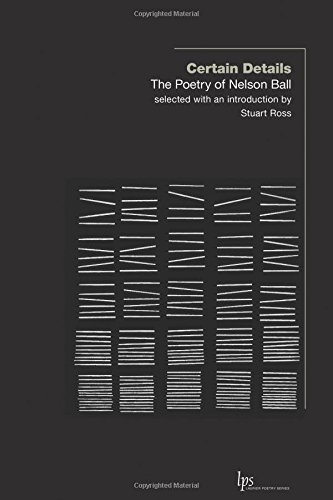
Certain Details, The Poetry of Nelson Ball - Nelson Ball (Wilfrid Laurier University Press)

Today's book of poetry:
Certain Details, The Poetry of Nelson Ball.  
Nelson Ball.  selected with an introduction by Stuart Ross.  Laurier Poetry Series.  Wilfrid Laurier University Press.  Waterloo, Ontario.  2017.

As the delightful Dame Edna might say, "Welcome back puppets."  Today's book of poetry has been on an extended leave and would like to thank each and every one of you for sticking around.

We ventured to Gaspe to the see Jardins de Metis http://www.refordgardens.com/english/ and once again we were amazed and delighted.  Spent a few nights sitting on the porch of our motel watching a seal frolic while we sipped beer and watched the sun set over the water.

Today's book of poetry started getting packages from our Southern Correspondent, the Twangster, a few months ago.  Since then there has been a beautiful barrage of David Lee, Dave Etter, Rodney Jones and others.  Today's book of poetry has been on leave but we've been reading.  Mr. Clewell has enriched the archives here and we just wanted to tip our hat in his crazy direction.

***

Today's book of poetry doubts that he is alone when he wishes he wrote like Nelson Ball.  Ball is some kind of Canadian Zen Nature poet -- who doesn't stop at nature.  Everything under the sun may be considered but what we get is some crazy (in the very best way) condensed vision that whispers instead of shouts.

When Nelson Ball whispers every poet in Canada leans in to listen because no one does it better.

Dead Flies

I

Three small piles
             of grey dust

flies expired
             on white paper--

a sheet of notes
             easily brushed off


II (with boots on)

Resting on hind legs and rearmost tips

of 
wings

             tilted
             like a rocket launcher

it died
just like that

...

Certain Details, The Poetry of Nelson Ball was selected and is introduced by Stuart Ross.  Any regular reader of this blog will be familiar with his name.  Stuart selected, edited and introduced my most recent book, Bad Engine (Anvil Press, 2017) http://michaeldennispoet.blogspot.ca/2017/06/bad-engine-michael-dennis-anvil-press.html 

Mr. Ross has an excellent skill set when it comes to showing poets in their best light.  Certain Details looks at work from eight previous Nelson Ball collections as well as a generous sampling of previously uncollected poems.

Nelson Ball isn't what I would call a minimalist but he's awfully careful with his word dispersal, selective to say the least.  It compels the reader to lean in closer and listen harder.

The Real Story

I've often wondered why Jesus Christ
who historically was one of many Jewish prophets

became famous, really famous.  Yes, he was
a good man.  There have been

many good men, some recorded in history,
most, probably not.  The real story

is that Jesus Christ had friends
who were writers.

...

Certain Details closes with a rare look inside Nelson Ball's world with a candid and humble essay Afterword: Me and My Poetry: An Autobiographical Essay.  And it is worth the price of admission alone.

Today's book of poetry has taken you readers into Nelson Ball territory more than any other poet and it is not hard for me to see why.  Others see it too.  At this morning's office read the entire staff were back from their various adventures and it made for a festive atmosphere.  Then Milo and Kathryn really got the party started when they said it best.  Milo stepped up in front of the room, rolled up his left sleeve and there, just above his wrist, in tiny lower case letters, "ball".  Before any of us could think or comment Kathryn stood up beside him, rolled up her right sleeve and there, in the appropriate spot was "nelson."

Writing A Poem

Writing a poem is like felling a tree.

The poem's point of attention, like
the tree's centre of gravity

is held back in rhetoric--
thick bush--if the

path isn't clear.

...

The Laurier Poetry Series has enhanced their legacy with the inclusion of Certain Details, The Poetry of Nelson Ball to their canon.

Today's book of poetry applauds these excellent poems as well as the future poetry of Nelson Ball, a quiet but true national treasure.

Image result for nelson ball photo poet
Nelson Ball

ABOUT THE AUTHOR
Nelson Ball, poet and bookseller, lives in Paris, Ontario. He has worked as a labourer, chauffeur, office clerk, forest ranger, record store clerk, and janitor. From 1965 to 1973 he ran Weed/Flower Press. The author of over thirty books and chapbooks, he is featured in Catherine Stevenson’s video “Nelson Ball & Barbara Caruso | Home Project | A Photo Documentary.”

ABOUT STUART ROSS
Stuart Ross is a writer, editor, and writing instructor. His recent books include A Sparrow Came Down Resplendent (2016), A Hamburger in a Gallery (2015), and Further Confessions of a Small Press Racketeer (2015). He has maintained a micropress, Proper Tales, since 1979, and has his own imprint at Anvil Press. He lives in Cobourg, Ontario.


589 

DISCLAIMERS

Poems cited here are assumed to be under copyright by the poet and/or publisher.  They are shown here for publicity and review purposes.  For any other kind of re-use of these poems, please contact the listed publishers for permission.

We here at TBOP are technically deficient and rely on our bashful Milo to fix everything.  We received notice from Google that we were using "cookies"
and that for our readers in Europe there had to be notification of the use of those "cookies.  Please be aware that TBOP may employ the use of some "cookies" (whatever they are) and you should take that into consideration.

Friday, December 19, 2014

The Order In Which We Do Things - The Poetry of Tom Wayman, selected with an introduction by Owen Percy (Wilfred Laurier University Press)

Today's book of poetry:
The Order In Which We Do Things.  The Poetry of Tom Wayman, selected with an introduction by Owen Percy.  The Laurier Poetry Series/Wilfred Laurier University Press.  Waterloo, Ontario.  2014.


The following quote comes from Tom Wayman's Afterword: Work and Silence:

"I have tried to create art that is useful to people engaged in striving for beneficial social change."

I've been reading the very engaging and socially demanding poetry of Tom Wayman for almost forty years.  When I find one of his books it is an occasion.  There are few poets I admire more, so it is with that in mind that I was thrilled to see The Order In Which We Do Things.

The Laurier Poetry Series is an essential for Canadian letters, and in this case Owen Percy has done Wayman proud.

Days: Construction

Days when the work does not end.
When the bath at home is like
cleaning another tool of the owner's.
A tool which functions better with the dust gone from its pores.
So that tomorrow the beads of sweat
can break out again along trouser-legs and sleeves.

And then bed,
Night. The framing continues
inside the head: hammers pound on
through the resting brain. With each blow
the nails sink in, inch by blasted inch.
Now one bends, breaking the rhythm.
Creaks as it's tugged free. A new spike
is pounded in.

The ears ring with it. In the dark
this is the room where construction is.
Blow by blow, the studding goes up.
The joists are levered into place.
The hammers rise.

...

I've worked construction, not for long periods of time, but I've blistered up my hands, climbed those ladders, hammered those nails, had the sunburns, the long hours, dreamt work.

If you are like me Wayman is that smart uncle type character you consult when you want to know better.  He writes with his heart and soul set to honest.

No one in Canada knows the working man/woman better.

A Cursing Poem: This Poem Wants Gordon Shrum To Die
               1971

This poem wants to hurt another person.
This poem wants another person to die.
It wants him to suddenly stumble
feel a sharp pain just under the belly
a harsh pain, one that rips him so hard inside that he shits himself.
The poem wants him to become dizzy
feel a rush of sweat on the face
to begin to shiver, and have to be helped into bed.
The poem wants his teeth to chatter, wants him to throw up
gasping for air, wants mucus to pour from his nose and mouth.
It wants him to die in the night.

This poem wants Gordon Shrum to die.
First because despite all his company's rules and tariffs
despite every regulation they tell the press they apply
his company turned off the heat and light in the house.
They did this without warning, when the temperature was forty
             degrees by day
and the nights begin at four o'clock.
So that after working all day, the body could come home
to a room of black ice.

So after straining all day at the jobsite, with the fingers
numb at the hammer and slipping under the weight of the heavy
            boards
after the back was twisted trying to hoist the load of a wheelbarrow
the rest of the body could return to darkness and cold.

This poem also wants Gordon Shrum to die
because his company charges twenty-five cents every day
for the bus to carry you to work. And because you must
pay the same every evening to wait in the cold
to be jerked and stopped and jerked and stopped
all the way back to the house. Fifty cents a day
taken out of the dollars squeezed from the body's labour
so at the end of the day, the body can be hauled to where it stays
            overnight
can enter the black bedrooms, be lit by a candle
and eat bread and cold milk.

Lastly the poem wants Gordon Shrum to die
because at a meeting he reached over to my friend Mark Warrior
and smacked him in the mouth.
He was charged and acquitted
because Mark was shouting out at the time how the French
were finally getting off their knees
and striking back at the bullies that push them, at men like
            Shrum
--whom Mark didn't name.

But whom I name, with his bureaucrats and service division
his credit office and transportation system. Him, and
every other animal who is gnawing away at our lives.
May before they die
they know what it is like to be cold, may the cold eat into them
may they live so they cough all night and can't sleep
and have to get up the next morning for work just the same.
May the joints of their bodies swell with their labour
and their backs ache. And before they die
may they know deeply, to the inside of their stomachs
the meaning of a single word:
unemployment. May they understand it
as the nourishment a man gets by scraping the calendar over a
             pan for a meal.
May they have a future with nothing in it
but unemployment; may the end of welfare.

May they have to travel by bus
to get their welfare. May they wake at night and realize
that for the rest of their lives they will never eat together
all the things they love: steak and wine and hot corn.
They will never have these together again until they die.
May they die on welfare.
And may the Lord God Jesus have mercy on their souls.

...

Tom Wayman does controlled anger and justified vitriol better than anyone.

Thomas Ethan Wayman was born in Hawkesbury, Ontario, which is reasonably close to Ottawa.  He has lived most of his life in British Columbia.  These poems, an excellent sampling from his numerous collections, remind us of how Canadian Wayman is.  The sort of Canadian I want to be.

For many of us these poems remind us of how to be Canadian, at least a particular version, socially conscious, socially concerned, trying to be better citizens of the world.

Breath

          i

Tufts of snow
that rise from the branch
a chickadee alights on

          ii

Winter fog surrounding
the house: on the frosted slope of
the ridge behind, great spruce and pine
blur to white shadows

          iii

Straw-coloured humps of grass
interspersed with blotches of snow
are perfectly reflected
on the still surface
of the current

          iv

As I ski the river trail
--poles and legs scissoring
like a pendulum--
over me bursts a flight of
tundra swans:
V of white necks, white streamlined bodies

lifting into blue

the mouth of this world
                                      exhaling

...

And of course it isn't just a social exercise, Tom Wayman knows all about beauty, the breath a poem can give to the reader.

Tom Wayman

ABOUT THE AUTHOR
Tom Wayman has published nineteen poetry collections, edited six anthologies of poets writing about their employment, and published three collections of essays on labour arts. He has taught at the post-secondary level in the United States and Canada and co-founded the Vancouver Industrial Writers Union and the Vancouver Centre of the Kootenay School of Writing. Wayman has been the recipient of several significant literary awards over his career, most recently the 2013 Acorn-Plantos Award for People’s Poetry for his book Dirty Snow.

ABOUT THE EDITOR
Owen Percy is a teacher, writer, editor, and critic of North American and postcolonial literature. He earned his Ph.D. in Canadian literature and literary culture from the University of Calgary in 2010. He is a professor of literary studies at Sheridan College in Brampton, Ontario

BLURB
“Wayman...believes that poetry exists beyond ‘the money economy’ and because of this freedom it creates the highest potential to drive social change. His concerns are humanist and folksy, infused with the moral responsibility of integrity. This series, because of its...scope and space...allows the reader to see how Wayman’s immersions in these moral concerns have developed and morphed from those of the lowly factory worker to those of acute environmental observance. Always the poems are permeated by intense attention to...a sense of justice.”
      Micheline Maylor, Alberta Views

Tom Wayman
video by Amy Bohigian


281