Showing posts with label Laurier poetry series. Show all posts

Monday, July 24, 2017

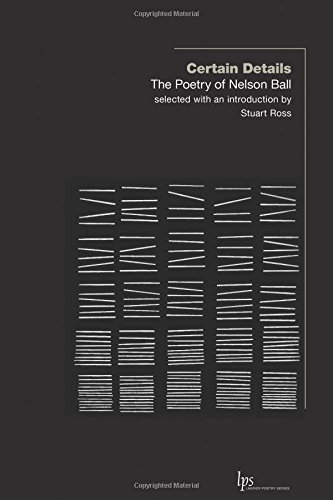
Certain Details, The Poetry of Nelson Ball - Nelson Ball (Wilfrid Laurier University Press)

Today's book of poetry:
Certain Details, The Poetry of Nelson Ball.  
Nelson Ball.  selected with an introduction by Stuart Ross.  Laurier Poetry Series.  Wilfrid Laurier University Press.  Waterloo, Ontario.  2017.

As the delightful Dame Edna might say, "Welcome back puppets."  Today's book of poetry has been on an extended leave and would like to thank each and every one of you for sticking around.

We ventured to Gaspe to the see Jardins de Metis http://www.refordgardens.com/english/ and once again we were amazed and delighted.  Spent a few nights sitting on the porch of our motel watching a seal frolic while we sipped beer and watched the sun set over the water.

Today's book of poetry started getting packages from our Southern Correspondent, the Twangster, a few months ago.  Since then there has been a beautiful barrage of David Lee, Dave Etter, Rodney Jones and others.  Today's book of poetry has been on leave but we've been reading.  Mr. Clewell has enriched the archives here and we just wanted to tip our hat in his crazy direction.

***

Today's book of poetry doubts that he is alone when he wishes he wrote like Nelson Ball.  Ball is some kind of Canadian Zen Nature poet -- who doesn't stop at nature.  Everything under the sun may be considered but what we get is some crazy (in the very best way) condensed vision that whispers instead of shouts.

When Nelson Ball whispers every poet in Canada leans in to listen because no one does it better.

Dead Flies

I

Three small piles
             of grey dust

flies expired
             on white paper--

a sheet of notes
             easily brushed off


II (with boots on)

Resting on hind legs and rearmost tips

of 
wings

             tilted
             like a rocket launcher

it died
just like that

...

Certain Details, The Poetry of Nelson Ball was selected and is introduced by Stuart Ross.  Any regular reader of this blog will be familiar with his name.  Stuart selected, edited and introduced my most recent book, Bad Engine (Anvil Press, 2017) http://michaeldennispoet.blogspot.ca/2017/06/bad-engine-michael-dennis-anvil-press.html 

Mr. Ross has an excellent skill set when it comes to showing poets in their best light.  Certain Details looks at work from eight previous Nelson Ball collections as well as a generous sampling of previously uncollected poems.

Nelson Ball isn't what I would call a minimalist but he's awfully careful with his word dispersal, selective to say the least.  It compels the reader to lean in closer and listen harder.

The Real Story

I've often wondered why Jesus Christ
who historically was one of many Jewish prophets

became famous, really famous.  Yes, he was
a good man.  There have been

many good men, some recorded in history,
most, probably not.  The real story

is that Jesus Christ had friends
who were writers.

...

Certain Details closes with a rare look inside Nelson Ball's world with a candid and humble essay Afterword: Me and My Poetry: An Autobiographical Essay.  And it is worth the price of admission alone.

Today's book of poetry has taken you readers into Nelson Ball territory more than any other poet and it is not hard for me to see why.  Others see it too.  At this morning's office read the entire staff were back from their various adventures and it made for a festive atmosphere.  Then Milo and Kathryn really got the party started when they said it best.  Milo stepped up in front of the room, rolled up his left sleeve and there, just above his wrist, in tiny lower case letters, "ball".  Before any of us could think or comment Kathryn stood up beside him, rolled up her right sleeve and there, in the appropriate spot was "nelson."

Writing A Poem

Writing a poem is like felling a tree.

The poem's point of attention, like
the tree's centre of gravity

is held back in rhetoric--
thick bush--if the

path isn't clear.

...

The Laurier Poetry Series has enhanced their legacy with the inclusion of Certain Details, The Poetry of Nelson Ball to their canon.

Today's book of poetry applauds these excellent poems as well as the future poetry of Nelson Ball, a quiet but true national treasure.

Image result for nelson ball photo poet
Nelson Ball

ABOUT THE AUTHOR
Nelson Ball, poet and bookseller, lives in Paris, Ontario. He has worked as a labourer, chauffeur, office clerk, forest ranger, record store clerk, and janitor. From 1965 to 1973 he ran Weed/Flower Press. The author of over thirty books and chapbooks, he is featured in Catherine Stevenson’s video “Nelson Ball & Barbara Caruso | Home Project | A Photo Documentary.”

ABOUT STUART ROSS
Stuart Ross is a writer, editor, and writing instructor. His recent books include A Sparrow Came Down Resplendent (2016), A Hamburger in a Gallery (2015), and Further Confessions of a Small Press Racketeer (2015). He has maintained a micropress, Proper Tales, since 1979, and has his own imprint at Anvil Press. He lives in Cobourg, Ontario.


589 

DISCLAIMERS

Poems cited here are assumed to be under copyright by the poet and/or publisher.  They are shown here for publicity and review purposes.  For any other kind of re-use of these poems, please contact the listed publishers for permission.

We here at TBOP are technically deficient and rely on our bashful Milo to fix everything.  We received notice from Google that we were using "cookies"
and that for our readers in Europe there had to be notification of the use of those "cookies.  Please be aware that TBOP may employ the use of some "cookies" (whatever they are) and you should take that into consideration.

Thursday, June 16, 2016

Barking & Biting - Sina Queyras (Wilfrid Laurier University Press)

Today's book of poetry:
Barking & Biting.  Sina Queyras.  Selected and with an introduction by Erin Wunker.  Laurier Poetry Series.  Wilfrid Laurier University Press.  Waterloo, Ontario.  2016.


"I am not interested in other words for honey. I am interested in honey."
      - Sina Queyras, "Water, Water Everywhere"

Queyras wants to be clear and she is.  This is a straight shot across the bow, full of intent.

Today's book of poetry likes a list poem and Sina Queyras gives us a lemon-tart sparkler with "If Only."  Poetry this smart is always going to turn heads and if Queyras has her way those heads will be more sympathetic, empathetic, reasonable.

If Only

If only men were more feminine. If only Judaism were
more feminine. If only industry were more feminine.
If only bridges were more feminine. If only trucks
were more feminine. If only airplanes were more
feminine. If only fruit were more feminine. If only
engines were more feminine. If only economics were
more feminine. If only test tubes were more femi-
nine. If only physicists were more feminine. If only
space were more feminine. If only Hollywood were
more feminine. If only America were more feminine.
If only farmyards were more feminine. If only the
weather were more feminine. If only Islam were more
feminine. If only engineers were more feminine. If
only city planners were more feminine. If only femi-
nists were more feminine. If only Catholicism were
more feminine. If only politicians were more femi-
nine. If only astronauts were more feminine. If only
corporations were more feminine. If only women
were more feminine. If only what was feminine were
firm. If only there were slots. If only things fit inside.

...

Barking & Biting is a tasting menu of sorts brought to you courtesy of the deft hand of Erin Wunker. Wunker's choices nip and tuck from some much longer works to bring us surprisingly self contained poetic essays on gender with both Holly Golightly and Virginia Woolf among the cast of luminaries.

And exactly as a tasting menu should, these bites leave us wanting more.

Sina Queyras writes poems that evolve in front of your eyes, they play with being short stories, novellas, epic.  Queyras has much to say about gender in these poems and her articulate charms add gravitas but never vitriol.

From Meanwhile, elsewhere, otherwise
     "Some other poets and the puddle"

          'When for no reason I could discover, every-
           thing suddenly became unreal.'
                                                              Virginia Woolf

She didn't notice the puddle. She was busy unravel-
ling the pavement. She clip-clopped past. She had
serious business. The words in her head were pleas-
ing her. She liked the sun. The smell of meat sizzling
called out to her. Language needed to be parted,
ordered. The children irritated her as they played in the
puddle. They were noisy. It was not her business.
There were no books in the playground, but there
were shapes to things. Sentences combusted. No
one recognizes. The words in her head grew cold.
They needed a rest. Her feet had an idea. She
thought they meant business. She saw herself in
everything and everything was good.

She saw the puddle as pewter. She swallowed it sweet
as figs. She saw it nestled in the cleavage of plum
girls. She held them over her head and cracked their
legs.

She saw the universe in the puddle. She saw a slide
show of organic compounds. She saw the key and 
the key fit. She saw the genital-less amoeba as a
hero. She put her ear to the puddle but she was no
naive child; she was listening for the rumble of
trucks, not the sweet musing of water beetles.

She waited until winter and when the puddle froze
over, she glided across it. She sat in the summer heat
and was content. She lifted the puddle and slid it
down her arm like pancake. She invited a girl gang
over and drank it. She had no puddles on her street.
She had no street. She leapt over the puddle on
horseback in pursuit. She saw streams of Nazis skim-
ming book black across the surface. She thought she
heard the apostles and so kneeled down to pee. She
dove in, scraping her nose. She had her father drain
all the puddles in the village. She splashed. She leapt
and bombed it with rocks. She floated and toppled
heads of Barbie dolls. She walked around. Then she
walked around again. She heard men flinging mud
and arranged a blanket of oak leaves across the
surface. She did a cartwheel. She knit a scarf out of
the letters R and E which she wound round and
round and round.

...

Queyras comes up with a phrase that Today's book of poetry has never encountered before when she says that "Lyric Conceptualism's goal is to create openings rather than closures."  This quote from the Sira Queyras poem Afterward: Lyric Conceptualism, A Manifesto in Progress is a succinct summation of the idea of these poems.  But it doesn't quite address the feeling that they create, this feels like a conversation that all are welcomed to listen to.  As robustly feminist as Queyras can quite rightly be, there is no matriarchal man-bashing, compassionate intelligence reigns here.

Kathleen, our Jr. Editor, took control of this morning's reading and made sure to include everyone.   Sina Queyras sailed around the room and over our heads like a wise hot-air balloon.

Proverbs of Hell

The body sublime, the heart SUV.
Fuel your plow with the blood of war.
Drive your car on the bones of the dead.
The road of CO2S leads to rising seas.
He who is preoccupied with the afterlife pisses on the present.
So the price of oil goes, so goes the number of wars.
A fool sees product; a wise man sees shade.
He who sullies the earth sullies himself; he who dulls the sun
     dulls his senses.
The future is the reversal of destruction.
Even a bee's too busy.
Profits are measure by the dollar, but read profit cannot be
     measured.
A wholesome food comes in fewer than sixteen pieces from
     seven states.

Prisons are built with the bricks of luxury items.

Let man wear the fell of the hemp see, woman the fleece of
     cotton.
The bird a thought, the spider a path, the mind the means.

What was once proved and known is now only rarely imagined.
What was once used to imagine now operates software.
The rat, the mouse, the starling, the squirrel; the lion, the
     tyger, the elephant, the whale -- only the useless, or root
     less, survive, otherwise; extinction porn.
The cistern pollutes, the fountain overflows, is of no use to
     itself.
Once thought filled immensity; now it purchases goods.
To speak your mind is to be unpatriotic; to be human, then,
     is to be unpatriotic.
All things imagined must be images of truth; all things
     created must be fragments of our imagination.

The eagle never wreaked so much havoc as when he
     submitted to the whims of profit.
The eagle provides for himself, but the air provides for the
     eagle.
Want in the morning. Buy at noon. Buy in the evening. Buy
     in your sleep.
He who has suffered you to impose on him knows the market.
As the plow follows the markets, so the market follows itself.
The tygers of the market are no wilier than the corporate dogs.
Expect poison form the standing mind.
The coals of Wall Street, the bricks of despair, the last drop,
     the last grain.
As the cat chooses the warmest place to curl her bones so the
     wise man seeks home.
To create a new kind of flower is the splice of genes.
The best wine is the oldest, the best thought is the first.
Cheerfulness is the hammer of the right.

The expressway is a straight line, but the crooked road
     remains the road of genius.

Where man is, nature is bereft.
Where nature is not man, is not known.
Where nature is not natural, man is not man.

As a dog returns to his vomit, so a citizen to his belief in
     separation.
More is destruction.
Less is the wisdom of the future.
Abundance is all context.
The end of thought is the end of man is the end of earth.
In absentia, in absence, in obsolesce, or obnoxious.
Where nature is, man is not enough.
Enough, or too much. Too much.

Go forth and undo harm.

Go forth and do.

...

How's that for a taste of the menu.  Queyras bounces around ideas like cartwheeling jackhammer.

Barking & Biting is the first poetry by Queyras that Today's book of poetry has encountered but we'll certainly be searching for her others now.

Sina Queyras

ABOUT THE AUTHOR
Sina Queyras is an accomplished poet and essayist. She edited the first anthology of Canadian poetry published by an American press (Open Field: 30 Contemporary Canadian Poets). Between 2005 and 2007 she co-curated the path-breaking feminist Belladonna* reading series in New York and was instrumental in bringing Canadian and American poets into conversation. She has published six books of poetry and a novel, Autobiography of Childhood (2011). She received the Pat Lowther Award and a Lambda Literary Award for Lemon Hound (2006). Her most recent book of poetry is MxT (2014).


ABOUT THE EDITOR
Erin Wunker is the chair of the board of the national non-profit social justice organization Canadian Women in the Literary Arts (CWILA) and co-founder, writer, and managing editor of the feminist academic blog Hook and Eye: Fast Feminism, Slow Academe. She teaches Canadian literature and culture at Dalhousie University. Her book The Feminist Killjoy Handbook will be published in the fall of 2016.

Sina Queyras

This video is from Fred Wah's Parlimentary Poet Laureate Series.


482
DISCLAIMERS

Poems cited here are assumed to be under copyright by the poet and/or publisher.  They are shown here for publicity and review purposes.  For any other kind of re-use of these poems, please contact the listed publishers for permission.

We here at TBOP are technically deficient and rely on our bashful Milo to fix everything.  We received notice from Google that we were using "cookies"
and that for our readers in Europe there had to be notification of the use of those "cookies.  Please be aware that TBOP may employ the use of some "cookies" (whatever they are) and you should take that into consideration.

Thursday, February 19, 2015

Before the First Word - The Poetry of Lorna Crozier, selected with an introduction by Catherine Hunter (Wilfrid Laurier University Press)

Today's book of poetry:
Before the First Word - The Poetry of Lorna Crozier, selected with an introduction by Catherine Hunter.  Laurier Poetry Series.  Wilfrid Laurier University Press.  Waterloo, Ontario.  2009. (2nd printing).


I am newly convinced of Lorna Crozier's vast talents.  Before the First Word makes clear to Today's book of poetry - what has been obvious to many for a long time - that Lorna Crozier is one of our best poets.

I do not personally have a vegetable fetish nor am I generally attracted to vegetable poems but Lorna Crozier's "Carrots" certainly won my attention.  Before the First Word is a short, crisp selection and Catherine Hunter has done well.  These poems come from the period from 1980 to 2002 and during that time Crozier had a big output with thirteen or fourteen books.  "Carrots" is a confident choice from an editor totally at ease with the certainty of the poems.

So today we start with a vegetable poem.

Carrots

Carrots are fucking
the earth. A permanent
erection, they push deeper
into the damp and dark.
All summer long
they try so hard to please.
Was it good for you,
was it good?

Perhaps because the earth won't answer
they keep on trying.
While you stroll through the garden
thinking carrot cake,
carrots and onions in beef stew,
carrot pudding with caramel sauce,
they are fucking their brains out
in the hottest part of the afternoon.

...

Crozier's poetry is witty, poignant, beautifully plain spoken narrative with startlingly clear moments of revelation, quick, deep Alice Munro like glances into our very nature.  It is like meeting someone with small town manners and common sense as well as big city savvy.

Three days ago I was having a discussion about poetry with my dear friend Stuart Ross.  He was asking me what I thought of Lorna Crozier's work.  I replied quite casually.  He should have punched me.  I'd certainly give him a different answer today.  Today's book of poetry is newly smitten with Lorna Crozier.

The Wild Boys

It was the wild ones you loved best,
the boys who sat surly at the front
where every teacher moved them,
the ones who finished midterms
first, who showed up late,
then never showed at all.

Under the glare of outdoor lights
you watched them bang
their hard bodies against the boards,
gloves and sticks flying.
In the cold they looked back at you
through stitched and swollen eyes,
smiled crookedly to hide
their missing teeth,
breathed through noses broken
in a game or pool-hall fight.
There was always someone older,
a fist and grin
they just couldn't walk away from,
there was always some girl, watching.

They were the first boys you knew
who owned a car, who rolled
a thin white paper, who talked
out of the side of their mouths,
cigarettes burning.
You watched them fall
quick and bright and beautiful
off the highest diving boards,
you watched them disappear
then throw themselves on top of you
till you thought you'd drown.

Oh, they were cool and mean,
but sometimes they treated you
with such extravagant tenderness,
giving you a rhinestone broach
they'd nicked from Woolworth's,
a fuzzy pink angora, giving up
their jackets on an autumn night
to keep you warm. How you loved
to move inside the shape of them,
the smell of sweat and leather
kissing your skin. For months
you wore their hockey rings
wound with gauze and tape
as if one day
you'd need to bind a wound.

The wild boys had the fastest
tongues, the dirtiest jokes,
and told anyone who'd listen
what they'd done to a girl
the night before
though in the narrow darkness
of a car or on a blanket
by the dam where eels slid
just beneath the surface, you knew
you did it to each other
and the words they said were sweet.

The boys you loved
knew everything, guided your mouth
and hands, showed you what you really
wanted from this life. Now,
it is their brokenness
you long to touch, the parts
they left behind or lost
as they learned too soon
too many years ago
what it took and took
to be a man.

...

Today's book of poetry has a new task.  I have five Lorna Crozier books on my shelf and two by Lorna Uher (a younger Lorna Crozier), that I am now going to have to reread before I do anything else.  Then all of my interns have to read them too.  It's not easy working here at Today's book - but the pay is great.

Before the First Word is another stirling example of why the Laurier Poetry Series is absolutely essential.  Along with this tasty sampling of Crozier's work, Catherine Hunter really has made a fine selection, there is also an excellent introduction to Crozier by Hunter, as well as an Afterwords by Crozier herself.  The Laurier Poetry Series remains the series of record for Canadian poetry.

How to Stop Missing Your Friend Who Died

The moon over Vancouver Harbour
is full and red.
Through the window
you can see a barge go by.
It is empty, returning
to whatever country sent it out.

You can't see any lights
but someone must be steering,
someone who doesn't know
you are sitting behind a window
that overlooks the sea.
The moonlight makes the barge
more important than it really is.

Then there's a sailboat
and a heron.
Its legs stretch so far behind
when it's flying
it forgets they're there.

...

I have been waiting for more than thirty years but i finally saw Mary Margaret O'Hara in concert earlier this week.  I left the concert hall convinced she is a Canadian legend/saint of a new kind.  I have to do me some more Lorna Crozier reading this week but I'm fairly certain I'm going to feel the same way about Lorna Crozier soon.

Lorna Crozier

ABOUT THE AUTHOR
Lorna Crozier’s work has won many awards, including the Governor Generals Award in 1992 (for Inventing the Hawk), the first prize for poetry in the CBC Literary Competition, the Canadian Authors Association Award for Poetry in 1992, a National Magazine Award in 1995, and two Pat Lowther Memorial Awards (1993 and 1996) for the best book of poetry by a Canadian woman. She has published fourteen books of poetry, most recently, Whetstone. Born in Swift Current, Saskatchewan, she now lives in British Columbia, where she is a Distinguished Professor at the University of Victoria.

ABOUT THE EDITOR
Catherine Hunter is a poet, novelist, editor of the Muses’ Co. Press, and associate professor of English at the University of Winnipeg. Her most recent work is the novella In the First Early Days of My Death.

Lorna Crozier
"Sex Lives of Vegetables"
WordsAloud, 2007, Canada
video by: WordsAloud2


308

Poems cited here are assumed to be under copyright by the poet and/or publisher.  They are shown here for publicity and review purposes.  For any other kind of re-use of these poems, please contact the listed publishers for permission.


Friday, December 19, 2014

The Order In Which We Do Things - The Poetry of Tom Wayman, selected with an introduction by Owen Percy (Wilfred Laurier University Press)

Today's book of poetry:
The Order In Which We Do Things.  The Poetry of Tom Wayman, selected with an introduction by Owen Percy.  The Laurier Poetry Series/Wilfred Laurier University Press.  Waterloo, Ontario.  2014.


The following quote comes from Tom Wayman's Afterword: Work and Silence:

"I have tried to create art that is useful to people engaged in striving for beneficial social change."

I've been reading the very engaging and socially demanding poetry of Tom Wayman for almost forty years.  When I find one of his books it is an occasion.  There are few poets I admire more, so it is with that in mind that I was thrilled to see The Order In Which We Do Things.

The Laurier Poetry Series is an essential for Canadian letters, and in this case Owen Percy has done Wayman proud.

Days: Construction

Days when the work does not end.
When the bath at home is like
cleaning another tool of the owner's.
A tool which functions better with the dust gone from its pores.
So that tomorrow the beads of sweat
can break out again along trouser-legs and sleeves.

And then bed,
Night. The framing continues
inside the head: hammers pound on
through the resting brain. With each blow
the nails sink in, inch by blasted inch.
Now one bends, breaking the rhythm.
Creaks as it's tugged free. A new spike
is pounded in.

The ears ring with it. In the dark
this is the room where construction is.
Blow by blow, the studding goes up.
The joists are levered into place.
The hammers rise.

...

I've worked construction, not for long periods of time, but I've blistered up my hands, climbed those ladders, hammered those nails, had the sunburns, the long hours, dreamt work.

If you are like me Wayman is that smart uncle type character you consult when you want to know better.  He writes with his heart and soul set to honest.

No one in Canada knows the working man/woman better.

A Cursing Poem: This Poem Wants Gordon Shrum To Die
               1971

This poem wants to hurt another person.
This poem wants another person to die.
It wants him to suddenly stumble
feel a sharp pain just under the belly
a harsh pain, one that rips him so hard inside that he shits himself.
The poem wants him to become dizzy
feel a rush of sweat on the face
to begin to shiver, and have to be helped into bed.
The poem wants his teeth to chatter, wants him to throw up
gasping for air, wants mucus to pour from his nose and mouth.
It wants him to die in the night.

This poem wants Gordon Shrum to die.
First because despite all his company's rules and tariffs
despite every regulation they tell the press they apply
his company turned off the heat and light in the house.
They did this without warning, when the temperature was forty
             degrees by day
and the nights begin at four o'clock.
So that after working all day, the body could come home
to a room of black ice.

So after straining all day at the jobsite, with the fingers
numb at the hammer and slipping under the weight of the heavy
            boards
after the back was twisted trying to hoist the load of a wheelbarrow
the rest of the body could return to darkness and cold.

This poem also wants Gordon Shrum to die
because his company charges twenty-five cents every day
for the bus to carry you to work. And because you must
pay the same every evening to wait in the cold
to be jerked and stopped and jerked and stopped
all the way back to the house. Fifty cents a day
taken out of the dollars squeezed from the body's labour
so at the end of the day, the body can be hauled to where it stays
            overnight
can enter the black bedrooms, be lit by a candle
and eat bread and cold milk.

Lastly the poem wants Gordon Shrum to die
because at a meeting he reached over to my friend Mark Warrior
and smacked him in the mouth.
He was charged and acquitted
because Mark was shouting out at the time how the French
were finally getting off their knees
and striking back at the bullies that push them, at men like
            Shrum
--whom Mark didn't name.

But whom I name, with his bureaucrats and service division
his credit office and transportation system. Him, and
every other animal who is gnawing away at our lives.
May before they die
they know what it is like to be cold, may the cold eat into them
may they live so they cough all night and can't sleep
and have to get up the next morning for work just the same.
May the joints of their bodies swell with their labour
and their backs ache. And before they die
may they know deeply, to the inside of their stomachs
the meaning of a single word:
unemployment. May they understand it
as the nourishment a man gets by scraping the calendar over a
             pan for a meal.
May they have a future with nothing in it
but unemployment; may the end of welfare.

May they have to travel by bus
to get their welfare. May they wake at night and realize
that for the rest of their lives they will never eat together
all the things they love: steak and wine and hot corn.
They will never have these together again until they die.
May they die on welfare.
And may the Lord God Jesus have mercy on their souls.

...

Tom Wayman does controlled anger and justified vitriol better than anyone.

Thomas Ethan Wayman was born in Hawkesbury, Ontario, which is reasonably close to Ottawa.  He has lived most of his life in British Columbia.  These poems, an excellent sampling from his numerous collections, remind us of how Canadian Wayman is.  The sort of Canadian I want to be.

For many of us these poems remind us of how to be Canadian, at least a particular version, socially conscious, socially concerned, trying to be better citizens of the world.

Breath

          i

Tufts of snow
that rise from the branch
a chickadee alights on

          ii

Winter fog surrounding
the house: on the frosted slope of
the ridge behind, great spruce and pine
blur to white shadows

          iii

Straw-coloured humps of grass
interspersed with blotches of snow
are perfectly reflected
on the still surface
of the current

          iv

As I ski the river trail
--poles and legs scissoring
like a pendulum--
over me bursts a flight of
tundra swans:
V of white necks, white streamlined bodies

lifting into blue

the mouth of this world
                                      exhaling

...

And of course it isn't just a social exercise, Tom Wayman knows all about beauty, the breath a poem can give to the reader.

Tom Wayman

ABOUT THE AUTHOR
Tom Wayman has published nineteen poetry collections, edited six anthologies of poets writing about their employment, and published three collections of essays on labour arts. He has taught at the post-secondary level in the United States and Canada and co-founded the Vancouver Industrial Writers Union and the Vancouver Centre of the Kootenay School of Writing. Wayman has been the recipient of several significant literary awards over his career, most recently the 2013 Acorn-Plantos Award for People’s Poetry for his book Dirty Snow.

ABOUT THE EDITOR
Owen Percy is a teacher, writer, editor, and critic of North American and postcolonial literature. He earned his Ph.D. in Canadian literature and literary culture from the University of Calgary in 2010. He is a professor of literary studies at Sheridan College in Brampton, Ontario

BLURB
“Wayman...believes that poetry exists beyond ‘the money economy’ and because of this freedom it creates the highest potential to drive social change. His concerns are humanist and folksy, infused with the moral responsibility of integrity. This series, because of its...scope and space...allows the reader to see how Wayman’s immersions in these moral concerns have developed and morphed from those of the lowly factory worker to those of acute environmental observance. Always the poems are permeated by intense attention to...a sense of justice.”
     — Micheline Maylor, Alberta Views

Tom Wayman
video by Amy Bohigian


281

Wednesday, September 24, 2014

Field Marks - The Poetry of Don McKay selected and with an introduction by Meira Cook (Wilfred Laurier University Press)

Today's book of poetry:
Field Marks.  The Poetry of Don McKay selected with an introduction by Meira Cook.  Laurier Poetry Series.  Wilfred Laurier University Press.  Waterloo, Ontario.  2006.


The entire Laurier Poetry Series should be on the shelves of every school library in our country. These slim volumes attempt an impossible task - to popularize poetry, and they do with such diligent elegance.

Meira Cook does Don McKay proud with her thoughtful and informative introduction to a man who
should need no introduction.  Don McKay is a benevolent Godfather to Canadian poetry.

VIA, Eastbound

To this widescreen three-day tracking shot--equal thirds
of mountain, prairie, boreal forest--
each of us will add a plot:
it is always The Past, but eased,
oiled so it glides and
whispers from its depth, often
with the voice of a lost dog.

Travelling east, we age more quickly,
running into time, which travels
west. This train wants to be evening, wants that
blue grey wash of snow and sky
eliding the horizon
fading fast.

Toiling through the mountains like the seven
thousand dwarves,
earning every upward inch,
it dreams that the hell of its gut will find release
as lightning.
Everything will lie down in its speed,
a sort of sleep.
Meanwhile each Rocky poses in a sculpted
slow tableau, easily
seducing us to grandeur and glib
notions of eternity.

By nightfall it is chuckling over prairie
running on nothing but the cold air
of Saskatchewan, its dome car
empty as the mind of Buddha.
Window turns to mirror,
a black lake faintly smoked by blowing snow.

In it we can see our ghosts, transparent
creatures of the dark, bravely reading their
reversed editions of the Calgary Herald,
riding the freezing wind like gulls.

...

I copied the following list of titles from Wikipedia, when I checked the shelves here I only had nine of the little rascals.  A perfect job for the new Today's book of poetry Intern, finding the rest. Look at what Mr. McKay has been up to:

Air Occupies Space (1973), Long Sault (1975),Lependu (1978), Lightning Ball Bait (1980), Birding, or Desire (1983) (nominated for a Governor General's Award), Sanding Down this Rocking Chair on a Windy Night (1987), Night Field (1991) (winner of the 1991 Governor General's Award for poetry), Apparatus (1997) (nominated for a Governor General's Award), Another Gravity (2000), (shortlisted for the 2001 Canadian Griffin Poetry Prize), Varves (2003; chapbook),Camber (2004) (shortlisted for the 2005 Canadian Griffin Poetry Prize), Strike/Slip (2006) (winner of the 2007 Canadian Griffin Poetry Prize and the Dorothy Livesay Poetry Prize), Field Marks: The Poetry of Don McKay edited by Méira Cook (2006), Song for the Songs of Birds, audiobook (2008), Leaf to leaf-Foglio a foglia (Italian translation by Sara Fruner and Filippo Mariano), edited by Angelo Longo (2010), Paradoxides (2012).

McKay has been publishing a steady stream of  his highly reliable and influential poetry since 1973.

from Black Spruce

Along the shoreline, shelves, soft
curves as the rock
erotically enters water. Shoulder
knuckle skull hip vertebreast combined and
recombined: three
hundred million years before the animals
appeared in the Triassic
they were dreamt of in Precambrian
volcanoes. Feel the muscle
slide over bone as your crouch
beside a Harebell, think of rootlets
reaching into rock, licking its slow
fury into food,
hoisting this small blue flag.

...

McKay's poetry is like drinking pure spring water.  It goes to and comes from a deeper root, an essential source.

Perhaps as important as his poetry is the mentoring role McKay has quietly taken on.  You will be hard pressed to pick up a really good book of Canadian poetry today without a thank you of some kind to Mr. McKay in the authors notes.

Astonished

astounded, astonied, astunned, stopped short
and turned toward stone, the moment
filling with its slow
stratified time. Standing there, your face
cratered by its gawk,
you might be the symbol signifying aeon.
What are you, empty or pregnant? Somewhere
sediments accumulate on seabeds, seabeds
rear up into mountains, ammonites
fossilize into gems. Are you thinking
or being thought? Cities
as sand dunes, epics
as e-mail. Astonished
you are famous and anonymous, the border
washed out by so soft a thing as weather. Someone
inside you steps from the forest and across the beach
toward the nameless all-dissolving ocean.

...

I have long admired the poetry of Don McKay.  I've met the man a couple of times and was gobsmacked at how nice he was, how down to earth.  I must confess to a man-crush.

Don McKay

ABOUT THE AUTHOR
Don McKay is the author of eleven books of poetry, most recently Paradoxides. He has won two Governor General’s Awards for Poetry and has been shortlisted twice for the Griffin Poetry Prize, most recently for Camber: Selected Poems, which was a Globe and Mail Notable Book of the Year. McKay is also known as a poetry editor, and he has taught poetry in universities across the country.

ABOUT THE EDITOR
Méira Cook was born in Johannesburg, South Africa, in 1964, received her PhD in Canadian literature from the University of Manitoba, and has recently completed a two-year term as a postdoctoral fellow at the University of British Columbia. She has published poetry, criticism, a novel and, in 2005, Writing Lovers: Reading Canadian Love Poetry by Women. She has taught creative writing in high schools, literature at university, and has worked as a freelance film and arts reviewer and editor. She lives in Winnipeg.

Poet Don McKay reads from Strike/Slip
Griffin Prize reading


249