The Names of Birds. Daniel Wolff. Four Way Books. New York, New York. 2015.

Daniel Wolff riffs fantastic all over The Names of Birds. This is an avian splendor, bird watching on a human scale we can relate to.
Wolff is the most recent provocateur in a noble tradition that gives meaning to our world by taking meaning from the acrobats of the sky, their flight and song. Canada's Don McKay most nobly flew over this terrain with his magnificent Birding, or Desire (McClelland and Stewart, 1983). McKay concerned himself with the "deep rhythms of family life" and Wolff filters through the whistle and birdsong of winged beasts to do the same.
Northern Mockingbird
How do I know which song is yours
when yours is composed as imitation,
culled from the calls of dozens of others?
I suppose if I knew the cardinal's solo
and could spot how you follow that with the sparrow's,
I could hear the two as one.
I could call you a hopeless romantic:
in thrall to others, forever trilling,
wintering only where the wild rose grows.
But for me to superimpose such meaning,
I suppose I'd have to believe I wasn't. Have to believe
it was you, not me. And that truth was never a mimic.
...
It's not that Wolff anthropomorphizes flight but instead he has learned to listen hard enough to decipher the difference between chirp and chip.
Today's book of poetry has often talked about joy in poetry and the genuine thing seems to be a rare commodity - which makes The Names of Birds that much more of a treat to share, there is optimism here, Daniel Wolff gives us reason to look up and forward.
Red-Tailed Hawk
"Easily identified by its distinctive, dark red tail."
Easy, maybe, if the northerly wind
would pin the bird as it rounds the point,
but it blows past, as does another
--smaller? barred? with black markings?
Gone before I can see what it is.
No: gone before
I can tell what it is.
A spotless day for migration: a spray
of old snow still left on the ground
and cold: the harbor frozen tight.
I walk as far as the channel markers.
They're dark red, too, but anchored in place
as if you could chart water.
...
This morning's read was a quiet and gracious ramble. Milo, our head tech, did us proud with projections of each and every bird onto the wall behind our readers. Milo came prepared this morning. Today's book of poetry should have told you that each of the poems in The Names of Birds is the name of a bird. Duh.
While I'm no naturalist I do marvel at birds, and now marvel at Daniel Wolff, an emotional Audubon who got these poems down in spite of the speed of flight. These poems quick scrabble over the page with such easy delight and elan that you are convinced the wisdom is real. The final feeling you are left with upon completing The Names of Birds is akin to witnessing the murmuration of starlings. And it is a damned good feeling.
Try this video and see if aren't smiling when it is over:
Barn Swallow
The pond is punctuated with weed.
The puddles along the road contain
microscopic, shell-shaped eggs:
code for mosquitoes-to-be.
Up in the air, barn swallows
sign what look like their signatures
by catching what I can't see.
One lands on a willow festooned with puffs
of pale yellow. Check the book:
"catkins."
They divide and subdivide the sky
at such speed that at some time
surely the bits have to collide? Never. Never.
They don't know their names.
...
Daniel Wolff has done something splendid with The Names of Birds.
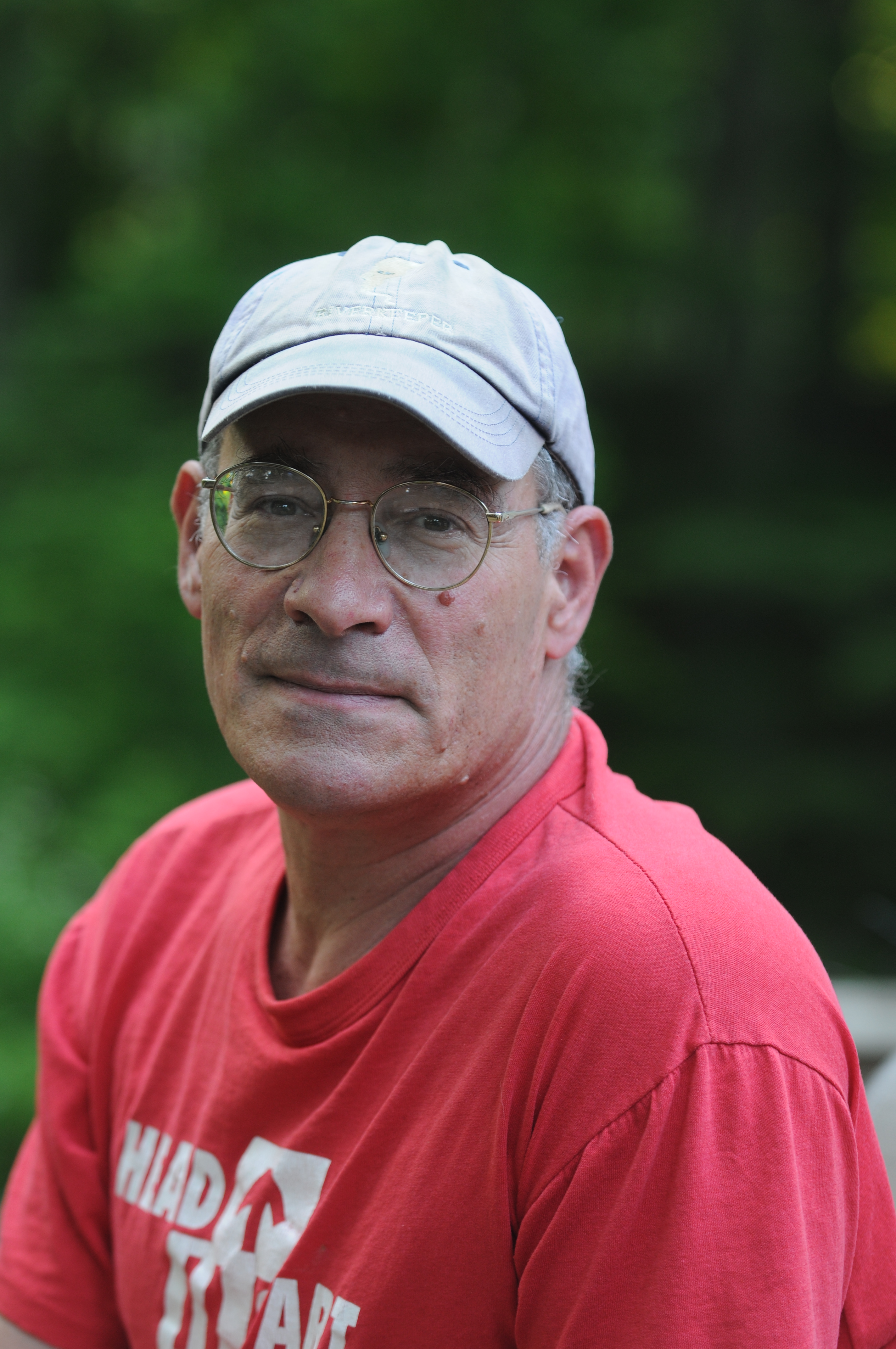
Daniel Wolff
ABOUT THE AUTHOR
Daniel Wolff has published numerous well-received non-fiction books, including a national best-seller that won the Ralph J. Gleason Award for the best music book in 1985. He was nominated for a Grammy in 2003 and was named Literary Artist of 2013 for Rockland County, New York. He has also collaborated on documentary films with Oscar-winning director Jonathan Demme, pop songs, and performance pieces.
BLURBS
"A beautiful book. Decisive and moving."
-- Jonathan Galassi
"The poems in The Names of Birds aren't really about birds. Instead each individual species is a filter through which the human is seen, so that observation and introspection become overlaid and compounded acts. These poems show us the more accurately we can look outward, the more deeply we can see within our human selves."
-- Lucia Perillo
"This poet ushers in a year's seasons by counting and naming 17 pages of birds for Fall; for Winter, only 7 actual birds as well as some featherless presences (in one poem, he sees instead of a bird a tanker!); of course Spring returns to a good many birds, 12 in fact, though he sees blue jays twice; then Summer concludes with a mere 5 birds -- what's going on here? You'll soon see if you read for yourself (take it slow: lots is told -- learned, cherished, despised, even worshipped -- besides those very real birds. Like that Horned Grebe, as the poet says: 'His dive extends and still extends. / I leave. The water mends / behind me. Funny how the brain defends / desertion. It hears the cry the grebe (finally) sends / as laughter.' Birds and all, as you can see. I promise you, Daniel Wolff is a wonderful poet."
-- Richard Howard
"Traveling the seasons with Daniel Wolff's stunning poetry collection is indeed a great gift. Big questions collide with nature's majesty here, moving us closer to see not just 'how the nest is attached to the tree' but how we are attached (or dis attached) to ourselves. The narrator of the poems 'Eastern Screech-Owl' declares that he is not an ancient poet, but there is so much heart and Art is these pages to show that neither he nor Wolff have to be. We are more than grateful for all they have already offered."
-- Edwidge Danticat
498
DISCLAIMERS
Poems cited here are assumed to be under copyright by the poet and/or publisher. They are shown here for publicity and review purposes. For any other kind of re-use of these poems, please contact the listed publishers for permission.
We here at TBOP are technically deficient and rely on our bashful Milo to fix everything. We received notice from Google that we were using "cookies"
and that for our readers in Europe there had to be notification of the use of those "cookies. Please be aware that TBOP may employ the use of some "cookies" (whatever they are) and you should take that into consideration.


