Showing posts with label four way books. Show all posts

Friday, August 12, 2016

The Names of Birds - Daniel Wolff (Four Way Books)

Today's book of poetry:
The Names of Birds.  Daniel Wolff.  Four Way Books.  New York, New York.  2015.


Daniel Wolff riffs fantastic all over The Names of Birds.  This is an avian splendor, bird watching on a human scale we can relate to.  

Wolff is the most recent provocateur in a noble tradition that gives meaning to our world by taking meaning from the acrobats of the sky, their flight and song.  Canada's Don McKay most nobly flew over this terrain with his magnificent Birding, or Desire (McClelland and Stewart, 1983).  McKay concerned himself with the "deep rhythms of family life" and Wolff filters through the whistle and birdsong of winged beasts to do the same.

Northern Mockingbird

How do I know which song is yours
when yours is composed as imitation,
culled from the calls of dozens of others?

I suppose if I knew the cardinal's solo
and could spot how you follow that with the sparrow's,
I could hear the two as one.

I could call you a hopeless romantic:
in thrall to others, forever trilling,
wintering only where the wild rose grows.

But for me to superimpose such meaning,
I suppose I'd have to believe I wasn't. Have to believe
it was you, not me. And that truth was never a mimic.

...

It's not that Wolff anthropomorphizes flight but instead he has learned to listen hard enough to decipher the difference between chirp and chip.

Today's book of poetry has often talked about joy in poetry and the genuine thing seems to be a rare commodity - which makes The Names of Birds that much more of a treat to share, there is optimism here, Daniel Wolff gives us reason to look up and forward.

Red-Tailed Hawk

"Easily identified by its distinctive, dark red tail."
Easy, maybe, if the northerly wind
would pin the bird as it rounds the point,

but it blows past, as does another
--smaller? barred? with black markings?
Gone before I can see what it is.

          No: gone before
          I can tell what it is.

A spotless day for migration: a spray
of old snow still left on the ground
and cold: the harbor frozen tight.

I walk as far as the channel markers.
They're dark red, too, but anchored in place
as if you could chart water.

...

This morning's read was a quiet and gracious ramble.  Milo, our head tech, did us proud with projections of each and every bird onto the wall behind our readers.  Milo came prepared this morning.  Today's book of poetry should have told you that each of the poems in The Names of Birds is the name of a bird.  Duh.  

While I'm no naturalist I do marvel at birds, and now marvel at Daniel Wolff, an emotional Audubon who got these poems down in spite of the speed of flight.  These poems quick scrabble over the page with such easy delight and elan that you are convinced the wisdom is real.  The final feeling you are left with upon completing The Names of Birds is akin to witnessing the murmuration of starlings.  And it is a damned good feeling.

Try this video and see if aren't smiling when it is over:

Barn Swallow

The pond is punctuated with weed.
The puddles along the road contain
microscopic, shell-shaped eggs:
code for mosquitoes-to-be.

Up in the air, barn swallows
sign what look like their signatures
by catching what I can't see.

     One lands on a willow festooned with puffs
     of pale yellow. Check the book:
     "catkins."

They divide and subdivide the sky
at such speed that at some time
surely the bits have to collide? Never. Never.
They don't know their names.

...

Daniel Wolff has done something splendid with The Names of Birds.
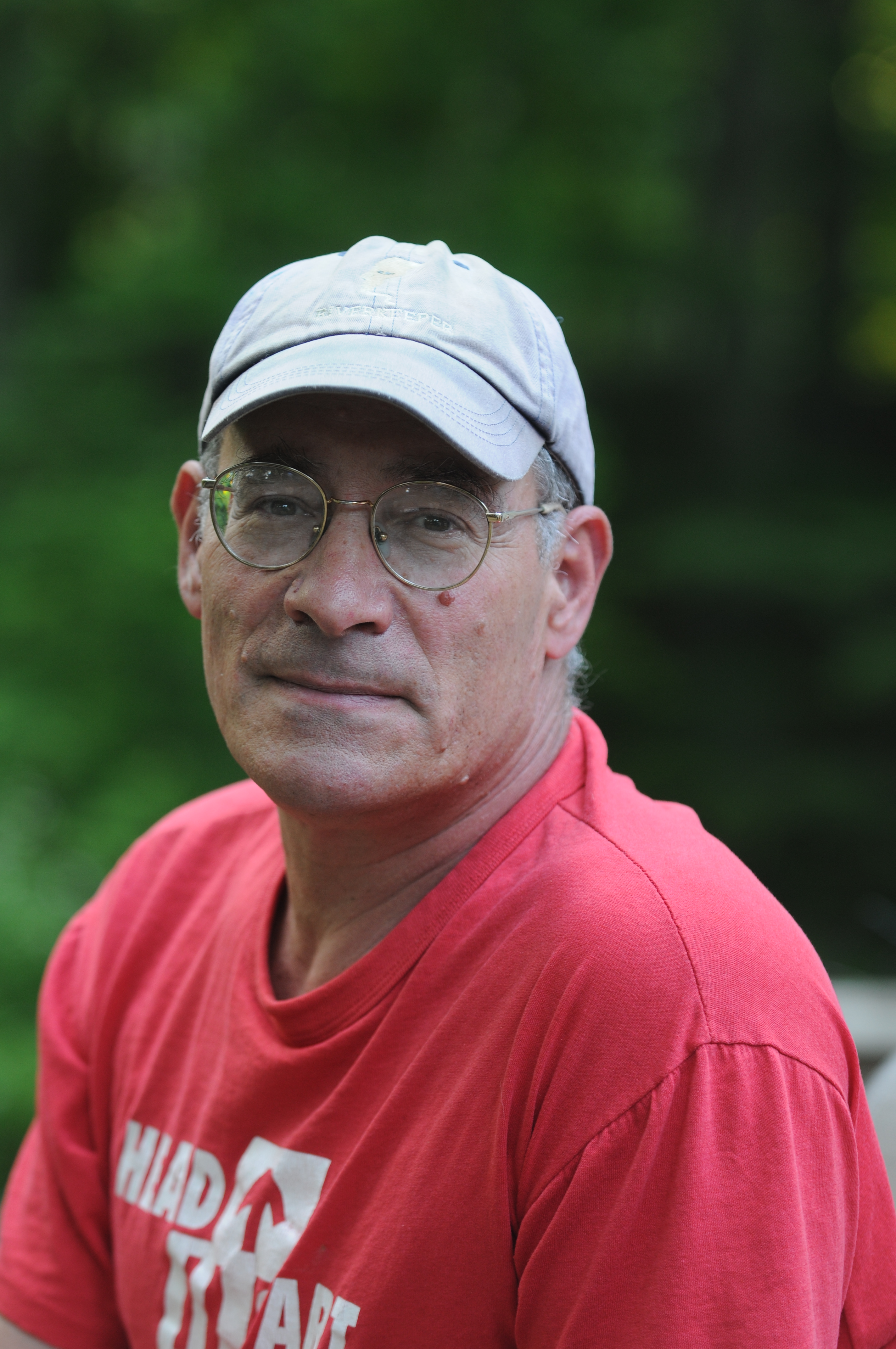

Daniel Wolff

ABOUT THE AUTHOR
Daniel Wolff has published numerous well-received non-fiction books, including a national best-seller that won the Ralph J. Gleason Award for the best music book in 1985. He was nominated for a Grammy in 2003 and was named Literary Artist of 2013 for Rockland County, New York. He has also collaborated on documentary films with Oscar-winning director Jonathan Demme, pop songs, and performance pieces.

BLURBS
"A beautiful book. Decisive and moving."
      -- Jonathan Galassi
"The poems in The Names of Birds aren't really about birds. Instead each individual species is a filter through which the human is seen, so that observation and introspection become overlaid and compounded acts. These poems show us the more accurately we can look outward, the more deeply we can see within our human selves."
      -- Lucia Perillo
"This poet ushers in a year's seasons by counting and naming 17 pages of birds for Fall; for Winter, only 7 actual birds as well as some featherless presences (in one poem, he sees instead of a bird a tanker!); of course Spring returns to a good many birds, 12 in fact, though he sees blue jays twice; then Summer concludes with a mere 5 birds -- what's going on here? You'll soon see if you read for yourself (take it slow: lots is told -- learned, cherished, despised, even worshipped -- besides those very real birds. Like that Horned Grebe, as the poet says: 'His dive extends and still extends. / I leave. The water mends / behind me. Funny how the brain defends / desertion. It hears the cry the grebe (finally) sends / as laughter.' Birds and all, as you can see. I promise you, Daniel Wolff is a wonderful poet."
     -- Richard Howard
"Traveling the seasons with Daniel Wolff's stunning poetry collection is indeed a great gift. Big questions collide with nature's majesty here, moving us closer to see not just 'how the nest is attached to the tree' but how we are attached (or dis attached) to ourselves. The narrator of the poems 'Eastern Screech-Owl' declares that he is not an ancient poet, but there is so much heart and Art is these pages to show that neither he nor Wolff have to be. We are more than grateful for all they have already offered."
     -- Edwidge Danticat

498

DISCLAIMERS

Poems cited here are assumed to be under copyright by the poet and/or publisher.  They are shown here for publicity and review purposes.  For any other kind of re-use of these poems, please contact the listed publishers for permission.

We here at TBOP are technically deficient and rely on our bashful Milo to fix everything.  We received notice from Google that we were using "cookies"
and that for our readers in Europe there had to be notification of the use of those "cookies.  Please be aware that TBOP may employ the use of some "cookies" (whatever they are) and you should take that into consideration.

Thursday, April 21, 2016

Furs Not Mine - Andrea Cohen (Four Way Books)

Today's book of poetry:
Furs Not Mine.  Andrea Cohen.  Four Way Books.  Tribeca, New York.  2015.


Andrea Cohen just blew my mind -- as well as the doors off.  Furs Not Mine hums from the beginning to the end with excellence.  These poems hit you like jolts of pleasure electricity, they hit your poetry receptors like joy machines.

Whether Cohen is telling us about the nature of peaches, the childish pleasure of hiding in a cherry tree or inviting her dead mother to come dance at her side at Cohen's own wake, these beautiful monsters delighted.

Moment of Truth

A matador imagines he has
many moments of truth, those

moments before his final sword
play, before he and the bull part ways.

Then one evening, in the sky
above the arena, he sees a reddish-

yellow streak that mimics his cape,
and a cloud that mirrors

his likeness precisely. It's a momentary
distraction above the crowd

that calls for blood, as the bull
is upon him. This is the critical

moment for the toreador: seeing
the airy man he might have been.

...

Those of you who follow us here at Today's book of poetry, today is our 462nd post, know we almost always choose three poems for each blog.  Furs Not Mine presented us with a dilemma, pushed that envelope, gummed up the selection process.  

This is my first list for today's blog: 3,4, 19, 29, 36, 38, 39, 45, 48, 49, 51, 53, 59, 63, 73, 75, 78, 79, 85, 86, 87,88, 89.  Those are the page numbers of the poems I felt it was essential to share.  The numbers in bold are poems we thought were instant classics.

So after this morning's read we voted for today's poems.  The problem was that everyone liked everything, Milo and Kathryn were eating this stuff up like hot-buttered popcorn.  Everyone had lists that were too long.

In the end, as Editor-in-Chief and Dictator of Poetry Operations here at the Today's book of poetry complex, I went with my gut.  It was a a no-lose game, Andrea Cohen is a braggart's worst enemy because she has all the tools, puts it down with understated precision.

Gravy Boat

I've got one foot
in the gravy, one
in the gravy boat.

It's the same foot.
The other one?
I cut it off.

Otherwise it would
have stood its one
foot in the grave.

I balance easily now
in the gravy boat
on my good foot.

I got the boat cheap,
when Bolivia lost its coast
and auctioned off its navy.

Where am I sailing?
Who can say?
Goodbye Bolivia, hello gravy!

...

Enchanted.  That's today's word from Today's book of poetry.  That's the word from me.  Andrea Cohen's poetry is like spring after a hard winter.  These poems will break you out of your funk, they break over the page like the sun after a long, dark night.

Smart, smart, smart.

I'm not going to say that Today's book of poetry has been reduced to mere cheerleading status by Furs Not Mine but I did break out the plaid skirts, mega-phones and pom-poms this morning.
Today's book of poetry will happily champion Furs Not Mine, an early front-runner for the prestigious KITTY LEWIS HAZEL MILLER DENNIS TOURBIN POETRY PRIZE.

Bargain

We paid him next
to nothing -- less than the little
he'd asked for -- to lead us

at dusk from the pyramids
on camels into the desert.
Such slim wages

to take us, without
complaint, all that way --
so far, without a star.

We were in the middle
of nowhere, or at its edge.
Friends, he asked, from

inside that blackness,
what will you pay me
to take you back?

...

This is some fine, fine stuff.  On days like today Today's book of poetry loves his job and loves all of you.

Furs Not Mine can't come any more highly recommended.

(c) Francesca G. Bewer
Andrea Cohen 
(Photo (c) Francesca G. Bewer)

ABOUT THE AUTHOR
Andrea Cohen’s poems and stories have appeared in The Atlantic Monthly, The New Republic, The New Yorker, Poetry, The Threepenny Review, and elsewhere. Her previous poetry collections include The Cartographer’s Vacation, winner of the Owl Creek Poetry Prize, Long Division, and Kentucky Derby. She has received a PEN Discovery Award, Glimmer Train’s Short Fiction Award, and several residencies at The MacDowell Colony. She directs the Blacksmith House Poetry Series in Cambridge, Massachusetts, and the Writers House at Merrimack College.

BLURBS
"Who says true wit should be read its last rites? Andrea Cohen's deft lyric gift makes short work of that dire thought, cutting to the quick of all that casts a spell or a pall. In Furs Not Mine, she's come into her own by mastering the disarming arts of the pithy epiphany and the mordant lament, the bittersweet testament that takes but three steps from feathers to iron, the beguiling Metaphysical trope with a hard-bitten American twist. Her wily ways with the mother tongue are equal to every curve the world throws, showing over and over how the soul of wordcraft can run rings around 'the central O / of loss and going on.'"
     -- David Barber
"Furs Not Mine is a book full of completely new form and tone. To call this work 'intricately crafted' is an understatement, but needs to be said. Reading these poems, one feels a little afraid to breathe, that to shift a comma or change a line break would be to blow down the cathedral that's been built out of grains of sand. This is craft, but it's also infused with mystical moments, sacred intuitions. Delicate and difficult, there are some of the most memorable poems I've ever read. Period."
     -- Laura Kasischke

Andrea Cohen
reads from Furs Not Mine
Video: Merrimack College


462

DISCLAIMERS

Poems cited here are assumed to be under copyright by the poet and/or publisher.  They are shown here for publicity and review purposes.  For any other kind of re-use of these poems, please contact the listed publishers for permission.

We here at TBOP are technically deficient and rely on our bashful Milo to fix everything.  We received notice from Google that we were using "cookies"
and that for our readers in Europe there had to be notification of the use of those "cookies.  Please be aware that TBOP may employ the use of some "cookies" (whatever they are) and you should take that into consideration.

Sunday, December 13, 2015

Tidal - Josh Kalscheur (Four Way Books)

Today's book of poetry:
Tidal.  Josh Kalscheur.  Four Way Books.  New York, New York.  2015.

Winner of THE FOUR WAY BOOKS LEVIS PRIZE IN POETRY


Josh Kalscheur sets Tidal in Chuuk State.  Chuuk State is a small island that is part of the Federated States of Micronesia.  Think west of Hawaii/Marshall Islands and east of Indonesia.

Chuuk State has both a rhythm and a language all its own and Kalscheur is immersed.  He has gone inside the stories, legends and miseries of a culture on the fringes of the western world and found a world not so different from our own. 

Explanation

I slung rocks into the roadside mango tree,
as the rotted clumps aching to drop what was too sweet
to hold any longer. I played my ukulele
and the strings broke. I sat and watched you.
The engine in the truck you rode whined
to a stall. Let me tell you this had nothing to do
with your thighs or the chewed pulp-red betelnut
wedged in your cheek, spat like sickness
into the jungle. You'd come this way before,
a turtle shell comb lodged in your hair, singing
acappella. You think I wanted to fuck you,
lead you to some concrete showerhouse and sing
a love song into the blossom tucked behind your ear?
It's true. You could've raised your eyebrows
and meant yes. You could've tugged on your skirt
for the men at the corner. I stripped a ukulele string,
sacrificed the neck, lobbed a mango your way.
It wouldn't fall but floated to the cliff above
the road, sweeping down and cutting wings
into its skin. It flew back to the branch. It looked past
where I sat on the carcass of a Honda, past the sway
of banana leaf, to the wall of mud behind me
and up the striated wall to the cliff again. It waited
for the ocean to sing to the shore, for exhaust to gray
in the sky and disappear. And then it fell softly
into the wind, the trail of juice and flies running after,
buzzing and catching in the braids of your hair.

...

The specifics of place dictate food and influence everything that shapes culture.  Place shapes how you see/appreciate the sun, how you walk across the ground.  Tidal both microscopes in on a specific time and place, Chuuk State, and telescopes out to encompass all that big world beyond all that big blue sea.

Beer and men and women and desire - that is a universal story.  I assure you that when we finally meet aliens and are taught their strange language by our new overlords, we are going to discover the same fault lines.  Alien beer and alien men and alien women and alien desire.

With Tidal Josh Kalscheur has both broadened our scope with his loving mural of a strangish yet familiar  land and reconfirmed our long held belief that we are all the same silly meat. 

Explanation

She dives off the dock along on her lightest day
of bleeding and even the leaves in the guava trees
shake free, even the mangrove branches crack
and clutter the shore. she breaks the waves clear

and turns a funnel of foam still, her song lost
in clouds of spray. Her mother wants to stop it
in the taro patch, twist the roots and squeeze saltwater
through raw cracks and veins that keep

leaking to the mud below. The clan must be saved
somehow. The sisters bury the rotting breadfruit
and wait for it to sweeten and run. The undertow
pulls shadows from the surface of the seafloor,

moving in blocks with schools of yellow-fins.
The aunties dry the seaweed caught in the coral.
They want to cover her piece by piece, heal her.
The brothers do what they can with dust

they rub off a tree they won't name. They take it
to heart when she grows sick and pats their cheeks
with the back of her hand. She wants a shift
in the night-wind, a distance to rush through

the way a fishbone threads a palm. She wants
to massage herself with swordgrass and bent stems,
to wait for harvest to swell and cleanse her.

...

Tidal is a both a celebration and a lament, but it feels more like an eulogy than a prayer,  Kalscheur has a big emotional investment in Chuuk State; it is a small corner of the world but for the length of this good read it becomes the center of the universe.  Kalscheur has a tender affection for his islands but that never tempers the fear of change nor the desperate clamor for it.

Funeral

The women wrap their dresses under their shins.
Their voices leave the meetinghouse for tree-beds
and cracked sheet metal roofs. Plumerias cover

the floor where a basket of money sits, where my father
shakes hands. Braided fronds loosen on the fence
by the road, and girls who knew my brother well

crouch by the wall looking in, their hands red
from plucking the rusted wire of a window.
I'm watching my mother fan the face and touch

the mouth with oil. I'm watching my cousins
who wear collared shirts pass a bag of betelnut
between them. My oldest uncle leans on a pipe,

his arms bulging from the sleeves. The generator clicks in
and shadows fade from unpounded nails
and sagging beams. I'm told they found him

two compounds from here, by the dying breadfruit tree,
by the house of a girl he went with, a spot he swept
the leaves from. In the waiting line aunties ask for plates,

for the bin of pig meat. They ask if I've had enough.
I remember shoving him to the edge of his truck
in front of my father and bruising his knee.

He slashed a V into my arm and ran off
to carve his canoe. And on the tables, flies pull bits
of fish from bones left by men I'm told are uncles.

I've never met them. Men file through with bags of rice.
Boys sit by the door or wait in picked-apart cars
alive with tapioca growing from the engine

or through springs under the seats,
where even the floor is rotted out and blooming.

...

Josh Kalsheur's Tidal is both the beautiful bloom of the flower and the inevitable descent of the petals to the dirt below.  Island life doesn't sound ideal but Kalscheur certainly makes it sound real.  Today's book of poetry thoroughly enjoyed this trip.

Josh Kalscheur

ABOUT THE AUTHOR
Josh Kalscheur has published poems in Boston Review, Slate, jubilat, Ninth Letter, Witness, Blackbird andBest New Poets 2013, among others. A graduate of Saint Olaf College and UW-Madison, he teaches classes at both UW-Madison and Madison College in Madison, Wisconsin.

BLURB
"Some great books of poems feel driven by the play of language, endlessly inventive syntax propelling us headlong down the page. Other great books feel driven by conviction, the poet enraptured by a world that feels bigger, messier than the language at hand. Josh Kalscheur's Tidal is both these books at once. Set from start to finish in the seductively claustrophobic culture of Micronesia, the poems make the act of recording the world seem indistinguishable from an act of the highest imagination. Every perspective (male, female, old, young, outsider, insider) is rendered here in a language whose inventiveness feels inexhaustible--syntax, line, and diction colluding to build poems that are themselves the world in which the poet walks. This world, the world of human suffering, human folly, belongs to all of us, but the language--pulsing, tender, giddy, suave--is Josh Kalscheur's alone." -- James Longenbach, judge

Josh Kalscheur
reading at the Midwest Writing Center's SPECTRA poetry event
Rozz-Tox, Rock Island
October 29, 2015
Video:  Therese Guise


417


DISCLAIMERS

Poems cited here are assumed to be under copyright by the poet and/or publisher.  They are shown here for publicity and review purposes.  For any other kind of re-use of these poems, please contact the listed publishers for permission.

We here at TBOP are technically deficient and rely on our bashful Milo to fix everything.  We received notice from Google that we were using "cookies"
and that for our readers in Europe there had to be notification of the use of those "cookies.  Please be aware that TBOP may employ the use of some "cookies" (whatever they are) and you should take that into consideration.

Friday, June 19, 2015

Blood, Sparrows and Sparrows - Eugenia Leigh (Four Way Books)

Today's book of poetry:
Blood, Sparrows and Sparrows.  Eugenia Leigh.  Four Way Books.  A Stahlecker Series Selection.  Four Way Books.  New York, New York.  2014.


Eugenia Leigh offers us a startling first book with the sparkling Blood, Sparrow and Sparrows. 
Leigh is also now an official entry for Today's book of poetry's best title of the year.

These poems are loosely focused on God, father and family -- but it is Leigh's precise weight we enjoy most, regardless of subject.  Her voice has weight, resonance, echo and these poems can make you laugh out loud, usually just before Leigh kicks you in the throat.

Pretty Universe

God stalked me on Marion Avenue. Said, You can't
fix it. Then, I can't either.           That morning,

my ceiling lamp had ripped from its cord. Even after
I welded the fragments with duct tape, everything
felt cracked--like your five-hundred dollar glasses

I smashed that winter--so I thought, if I couldn't fix that,
what the hell am I doing piecing together
your eyes? Our crumbling

kisses? So I didn't question God. Sometimes, God wants
to be understood. Sometimes, God hates

his perfect grammar. His pretty
universe. So he'll pluck a butterfly of its left wing. Call it
art. He'll turn from a hurricane. Say, It wasn't me.

If artists were created in his image, how often
does God abandon his mistakes?

The day I stopped talking to you, I said
nothing to him too. I cursed. My entire drive home.
I littered the freeway with fistfuls of tissues

while God shuffled his God feet
and pretended not to see.

...

The reader will be forgiven if they can't quite decide whether Eugenia Leigh is happiest talking to, or at, God.  We're never quite sure whether the praise is hopeful wishing or snickered bravado.  But the conversation Leigh is engaged in is a constant delight for the reader.

We're all Pagans here at Today's book of poetry.  We run around the office burning sacrifices to the strangest assortment of deities and demigods.  And we all adored the poetry of Eugenia Leigh.

Leigh's narrator is a dutiful daughter, a guilty daughter, a disdainful daughter, a confused child of God and a strange mistress -- but she is always an interesting poet.

Leigh's narrator/poet persona is brave enough to step outside of expectations, keeps trying to answer big questions, keeps coming up with bigger dilemmas, more paradox.

Every Hair on Your Head

     Every hair on your head is counted.
     You are worth hundreds of sparrows.
                  --SPARKLEHORSE, "HUNDREDS OF SPARROWS"

The day you pushed a bullet through your heart,
the length of a day on earth shortened by a millionth of a second.

That same day, a NASA satellite captured an image of a dust storm,
Chile withstood its one hundred thirtieth aftershock in a week, and I
glimpsed a bird, twitching

on the floor of a Brooklyn metro station. Its eyeballs
bulged as if to literally absorb the ocular world,

and I shuddered away. For hours, I saw that flinching
creature in my mind. I saw hundreds of similar birds
shimmering into the station to lie

next to it--a quilt of silvery bodies tiled wing to wing. On good days
I want to be saved. Most days, I want

every savior in our hell--so they'll know
torment in the bloodstream--death's whistling, ceaseless,
blurring the cleanest heartbeats.            My first time, I was thirteen.

I tested five pills. My stomach barely ached. I ate ramen, lived, solved
math problems. But for days before that, I envisioned my body
smeared. Inside out. A swarthy, dazzling canvas.

What I wouldn't give to graze that silence.

Did you do it standing up
or crouching?         Which was the bigger surprise--
                                      the gun punching              or the angel catching you?

...

Eugenia Leigh's Blood, Sparrows and Sparrows is bejeweled with very smart poems that like to dance between the Devil and disbelief, they challenge notions of parenthood and piety.  These poems get the brain working in more than one direction.

There was much discussion around the office about this book.  Angels come and go with alacrity in the poems of Eugenia Leigh, just like they appear in real life, the devils too.

Sex Education

Folded into the carpet, eyes closed, I huddle
next to my small sisters--the baby
curled in the middle. My parents shuffle

in the couch bed beside us, and I wake. I peek.
I absorb the wet sounds of one mouth
guzzling another's laughter--and without

health class pamphlets, without Eve's Adam
and the fruit still rich on his chin, I learn

the music of bodies smacking together.
I learn the word yes. And how yes--

when whispered over and over--seems to free
other meanings--secret meanings

I never heard them speak in daylight.

...

Eugenia Leigh steps out onto the poetry stage fully formed.  Many, if not most, of these poems have previously been published in journals of one sort or another.  No surprise there.  Leigh has considerable dander, she even sounds dangerous on occasion.  Everyone here at Today's book of poetry enjoyed Blood, Sparrows and Sparrows a ton.

Eugenia Leigh
(Photo: An Rong Xu)

ABOUT THE AUTHOR
Eugenia Leigh is the recipient of awards and fellowships from The Asian American Literary Review, Kundiman, Poets & Writers Magazine, and Rattle. She earned her MFA from Sarah Lawrence College, and her poems and essays have appeared in numerous publications including The Collagist, North American Review, and the Best New Poets 2010 anthology. Eugenia serves as poetry editor of Kartika Review and lives in Chicago.

BLURBS
"Built out of blood and awe, rooted in sorrow and radiant lyricism, these poems remind us that 'to survive is to be / wholly human.' Divine and earthly voices haunt these poems. God and parents singe the speaker's heart; angels and sisters redeem it. These poems are brutal and brilliant. But also instructive. They teach us to 'weld our wounds / to form tools.' This is a book of moving and startling epiphanies. I can't wait to teach it."
     - Eduardo C. Corral

"This book went through me like a blue lightning strike. Part lyric, part narrative, and always alive, unflinchingly alive. A wonderful book and an even more astonishing debut!"
      - Thomas Lux

Eugenia Leigh
at Kollaboration, New York
June 26, 2010
Video: angelle 527


353

Poems cited here are assumed to be under copyright by the poet and/or publisher.  They are shown here for publicity and review purposes.  For any other kind of re-use of these poems, please contact the listed publishers for permission.