Showing posts with label charles mingus. Show all posts

Wednesday, November 30, 2016

And the cat says... - Susan L. Helwig (Quattro Books)

Today's book of poetry:
And the cat says...  Susan L. Helwig.  Quattro Books.  Toronto, Ontario.  2013.

AndCat_Nov12

Any of you who truly know Today's book of poetry will know our true feelings about cats, so you can imagine with what trepidation we opened Susan L. Helwig's little marvel And the cat says... .  What we found were poems like "Letter to Philip Roth" and the extemporaneous explanation of the connection between eggplants and love.

And the cat says... is a cornucopia of entertainments.  Helwig has found a comfortable spot with enough humour and pathos to suit her sly needs.  It's like she has them tied together at the waist and and knee and this book is the dazzling three legged sprint.

Original Sin

The Bible got it wrong
it wasn't an apple that Eve ate
no apple spurted bright thick juice
stained her chin
made her breasts glisten

It was a tomato

Listen

What virgin bride in the Old Country
did not thank a tomato
hiding where the hymen used to be
for the groom's prideful groans
and carmine sheets in the morning?

when a mob spews anger
it's tomatoes that shout Revolution!

Tomatoes made the sauce in Little Italy
when young Corleone shot the Chief
no apple caused that amount of trouble, ever.

Why just the other day, dining el fresco
I planned a sensible order, salad, dressing on the side
vegetables in season
when the sun caught the ketchup on someone else's fries

I swear that red stuff winked at me
two shades off ruby.

...

Today's book of poetry wouldn't call Helwig bawdy, that would be less a compliment than a snide remark.  Helwig isn't bawdy but she is delightfully frank.  

My wife has a coterie of amazing female friends called "The Nasty Girls" (apologies to recent news cycles but my wife's friends coined this term for their tribe over a quarter of a century ago), women of sardonic wit and relentless humour and all of it tinged with their many years of life experience wisdom.  Their motto, if they had such a thing, could easily be "no bullshit allowed" and I'm convinced that they would welcome Susan L. Helwig into their fold as one of their own.

Da Capo, with repeats

Hard to do with a partner
what I've done alone for so long
the breathing, the rhythm
everything throws me
we start, we stop, soft laughter
high-pitched nerves

Underway again
he has a man's love of speed
I was thinking adagio, with no strings
and presto! here we are at the end

Perhaps a different position
if I were the one erect
bowing the violin in long caresses
and he sat at my piano
tickling the ivories

Afterwards, neither asks, how was it for you?
knowing full well which bars
were peppered with mistakes
the music doesn't lie
all we can hope is same time next week
another chance to come together.

...

Today's book of poetry is impressed by how tidily Helwig is able to keep her business.  These poems can be ribald but they're never rude, they are experienced but not tired, wise without the tiresome burden of wisecracks.  Today's book of poetry liked Susan L. Helwig's style.

Our morning read welcomed a couple of guests this morning and as you all know by now - everyone present has to read at the morning go round.  Dexter read a few in his slow and quiet loquacious fashion, then our friend Sara teased some sorrowful music out of one or two and some belly-laughs out of few more.  Our regular staff were inspired by our guests and upped their game.  And the cat says... sounded like the life of the party.

Now that we two love again

The world glows peppermint, rain-washed, new
and we can dally in a house the size of April
without the hurry-up of student sex
the roommate back from class too soon
now Marsalis, not Mingus, warms our tea

Out the window and down the street
the Salvation Army band, its jolly tuba
leads the parade

Later in the garden, grandchildren, yours
will make their shrieks and finds,
the softly tinted Easter eggs I hid last night
adobe cream and evergreen mist
the chocolate bunnies, bittersweet.

...

Today's book of poetry appreciates his job more every day - books like Susan L. Helwig's And the cat says... make it so.  Helwig has poems that ask important questions, laments about love and social issues and so on but mostly Today's book of poetry sees books like this as reportage from the generous heart and inquiring mind of another traveller.

No cats were harmed in the production of this blog.
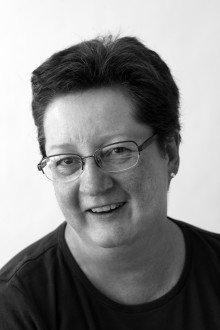
SusanLHelwig_Edit from Chris A. Hughes
Susan L. Helwig

ABOUT THE AUTHOR
Susan L. Helwig grew up on a dairy farm in southwestern Ontario just outside of Neustadt. From 1994 to 2002 she interviewed Canadian and international authors for the radio programme “In Other Words” on CKLN 88.1. Her poems have appeared in many literary journals and anthologies in Canada and abroad, and she has two previous poetry collections: Catch the Sweet (Seraphim Editions, 2001) and Pink Purse Girl (Wolsak and Wynn, 2006).

BLURB
Delicious.  Entertaining.  Susan L. Helwig's And the cat says... (her best collection so far), is so readable it makes poetry seem like a naughty pleasure.
     -  David Gilmour

quattrobooks.ca

530

DISCLAIMERS

Poems cited here are assumed to be under copyright by the poet and/or publisher.  They are shown here for publicity and review purposes.  For any other kind of re-use of these poems, please contact the listed publishers for permission.

We here at TBOP are technically deficient and rely on our bashful Milo to fix everything.  We received notice from Google that we were using "cookies"
and that for our readers in Europe there had to be notification of the use of those "cookies.  Please be aware that TBOP may employ the use of some "cookies" (whatever they are) and you should take that into consideration.


Thursday, August 27, 2015

Music from Small Towns - Al Maginnes (Jacar Press)

Today's book of poetry:
Music from Small Towns.  Al Maginnes.  Jacar Press. Durham, North Carolina.  2014.


Almost every poem in Al Maginnes' fine Music from Small Towns has previously been published in a magazine or journal that you and I would be tickled pink to appear in.  That is an enormous accomplishment, colour me green.

These poems are tremendous machines of muscle galloping across the page like a red-haired Secretariat.

Mingus and Stars

I am writing this on my 56th birthday.
On my father's 56th birthday, he died,
leaving little to measure my steps against
from this day forward. This day when I'm afraid
to close my eyes. The day Charles Mingus died
fifty six sperm whales died on the beaches in Baja.
And Mingus was 56. He left behind
a garden as sweet and thorny as the fields
father and sons have warred in since the first
measure of time, since stick or rock
first pounded imitation of the human heart.
Tonight, presents and phone calls, the prizes
for completing a year, done, the little cake I can
be allowed, gone, I should listen to music

instead of watching a movie whose outcome
I know, turning pages in books I read last year.
I'm old enough now for real listening, to close
my eyes and let music have its way with me.
"I want to be a star," said Mingus after he knew
he was dying, meaning not the faces on magazines
or the metal shapes in Hollywood sidewalks,
but the burning orbs or rock and gas we see
only at a distance, whose light continues long after
they go out, the way music continues after
the hand that wrote it is done. When I close my eyes,
fields of stars unfurl there. Those are the stars, bright,
unreachable, each singular as bass notes, stars
I want to shine among, but not today.

...

These poems say too much, go on too long, have streamers in their tails -- but they do sing.

Milo, our office crank and technical wizard, always claims to hate jazz but unabashedly loves poems that he calls "Charlie Rich voice ditties", that Milo is a romantic at heart.  And so is Al Maginnes.

Maginnes calls on various Gods both large and small to pepper these poems with notes hard as hammers, soft as your heart.

Something Words Will Not Say
                                    For Don Adock, 1926-2011

How long will it be before I buy
some jazz or see an announcement
for a show without thinking I need
to burn it for you or call to see
if you want to go. Last night, I listened
to different piano players until
I told myself I could hear the difference
in the pressure of fingers, could tell
their signature licks, small decorations
of melody, apart. Perhaps I can,
but it's knowledge that only lasts
until the next disc comes on.
One night you came in the bookstore
where I worked between semesters, pointed
to the speaker and said "That's Cedar Walton,"
and when, a few nights later, it was
Red Garland, you knew it too.
One evening while we watched a quartet
work through "Body and Soul,"
the piano player stumbled on his solo.
"He doesn't know what to do with it."
You elbowed me as the hapless pianist
nodded it to the sax player,
whose playing all night had surged
with invention. "He knows what to do
with it," you chuckled and leaned back.
Watching you was a lesson
in how to listen. There are chords
underneath the chords being played.
There are leaves blowing down sidewalks,
alleys filled with wind, the sound
of a name broken into three long notes.
I have always believed music was
trying to tell me something
words will not say. When I drive
at night, I sometimes listen to CDs
you copied for me--there are enough
to fill a shoebox--and those hours
are empty enough for the searching horns,
the splash of drums, the piano waiting
to drive, empty enough for me
to listen until I think I hear you say,
"He knows what to do with it."

...

Al Maginnes gets it.  Marcus Aurielius might be walking around in these suckers along with Charles Mingus, Billie Holiday, the Prez, John Keats, Eldridge Cleaver and Malcolm too.  Thomas Edison and Peter Coyote drop in.  You just cannot predict who is going to sit in on something to make it just right, but everyone plays nice.  The quartets and quintets Maginnes finesses out of his noggin astound just a little.

You get the drift though, these poems are full of hard-edged knowing and charm.

Passage Through the Body of Fire

Impossible to fathom lightning without
          dark and silence. One of our commandments
is contrast. There is silence so deep
          words, even thunder, will not find
the end of it. The house burning down
          on the news might be the church
of your childhood, dissolving in fire
          while half the town watches.

Can't faith crumble the same way?
          The nameless man pulled from the lake
offers the same excuse to break
          our soft code of silence as rain
or any weather we can name but can
          do nothing to change. Give us anything,
and we learn to make language,
          the way prisoners invent code to send

shorthand messages tapping through stones
          or flashing in bolts of light from mirrors.
His eyes were still open, said a woman
          at the bank; his body showed
he was not in the water long.
          The finger of lightning that touched
the church into flame, the ragged scars
          across the drowned man's chest

hold us in a place language will not
          free us from. Words will never be
all we have of language, as flame
          cannot be the whole of fire. The stare
of the drowned man, the architectures
          of burning wood might be signals from
the unspeaking world, like sullen braids
          of smoke rising from the ruin

of the church the night after the fire
          did its work, shards of metal, glass,
even wood still undigested after
          their passage through the body of fire,
the ghost of what had been there
          more real than when the door could be
opened, the body entered. Some prayers
          outlast every vow to forget them.

What you have of the fire-eaten church
          is smoke so thick it was language
all its own, body that might insist
          on seeking its own path,
as you resisted the hand that seized you,
          shoved you into the soundlessness
of water, making an unreachable heaven of
          the surface you suddenly prayed for.

...

We here at Today's book of poetry are especially fond of narrative poetry.  We love poems that tell a good story.  Al Maginnes is a master storyteller and they are rarer then hen's teeth.

Maginnes has a voice we want to listen to.

Al Maginnes

ABOUT THE AUTHOR
Al Maginnes was born in Quincy, Massachusetts and teaches at Wake Tech Community College in Raleigh, NC. His poems have appeared in many journals and magazines, including Poetry, The New England Review, The Georgia Review, The Antioch Review, Shenandoah and Quarterly West. He has been the recipient of a Writer’s Fellowship from the NC Arts Council and is the author of two collections: Taking Up Our Daily Tools (St. Andrews Press, 1997) and The Light in Our Houses (Pleiades Press, 2000), which won Lena-Miles Wever Todd Poetry Prize.

BLURB
“What I love about these poems is how they manage to be so eloquent without being pretentious. I’m also drawn to the way Maginnes juxtaposes fire and its quick losses with fire’s complement, slow vanishing. Not all the poems in this collection directly address either of those ideas — Maginnes is too smart for that — but I finished these pages thinking it was change that infuses the finest of them and that Maginnes, like so many of us, has striven to accept what is, even when it’s transition, and through that acceptance find peace. I admire that, and this book.”
— Lola Haskins, The Grace to Leave, Still the Mountain, Desire Lines, New and Selected Poems

Al Maginnes
Reading at Poetry Hickory
12-24-2010
Video:  T. Peeler


376

DISCLAIMERS

Poems cited here are assumed to be under copyright by the poet and/or publisher.  They are shown here for publicity and review purposes.  For any other kind of re-use of these poems, please contact the listed publishers for permission.

We here at TBOP are technically deficient and rely on our bashful Milo to fix everything.  We received notice from Google that we were using "cookies"
and that for our readers in Europe there had to be notification of the use of those "cookies.  Please be aware that TBOP may employ the use of some "cookies" (whatever they are) and you should take that into consideration.