Showing posts with label christopher buckley. Show all posts

Monday, January 13, 2020

Every Ravening Thing - Marsha de la O (University of Pittsburgh Press)

Today's book of poetry:
Every Ravening Thing.  Marsha de la O.  Pitt Poetry Series.  University of Pittsburgh Press.  Pittsburgh, Pennsylvania.  2019.

40945105


Marsha de la O waltzed in to our office like she owned the place.  Once we read Every Ravening Thing we weren't sure.  It was like a new kind of wind had swept through Today's book of poetry's brain, maybe a new type of sirocco or chimera.  These poems, happy or sad, play out like marvelous candies you can roll around your poetry mouth.  Not trivial penny candy, no Sir, these are not the lint-bound mints of Sunday disappointment, no, these are pure gold.  Toffee so pure and carmel smooth, these poems are almost smoky.

Every Ravening Thing is smart, smart, smart.  Today's book of poetry would suggest that instead of embracing any one narrative style, or structural framework, school, etc, de la O never boxes herself into a process induced corner.  de la O burns with extra sauce and comes out looking like the quintessential everywoman.

de la O isn't afraid of the dark and she's not offering up solutions, but she sure is taking a good look at what is important.  She certainly has things to say, worth listening to things.

In Those Months Gold Leaf Drifted onto His Skin

Late nights, late nights, rain fingered his guitar,
He played bars every weekend, trained dogs
on the side, dreamed an orchard out back,
white peaches, dark plums.
                                            Once he made a barbecue
from a fifty-gallon drum, simmered mussels
in wine.
                                            Late nights, late nights,
talking through winter, his laugh turned to velvet
when the temperature dropped.

Scorpion on his bicep, at his heels an Alsatian.
All through summer his garden spoke in tongues,
stone fruit, dark plums.
                                            The day they told him no,
not a chance for a transplant, he took a whisk
broom to the cemetery, swept his father's grave.

Dark nights, dark nights, rain pierced his eyes.
When the Feather River overtopped its banks
he finally got down
                               to the slow work of drowning.


❢❢❢

2020 is upon us and this past year's hangover feels worse, a little more difficult than others.  Even when President Reagan was standing under the red, white and blue Today's book of poetry didn't feel this particular sense of dread.  Today's book of poetry believes that a regular diet of helpful poetry is called for.  Marsha de la O falls right into this prescription, she is step ahead of the curve, leading, not following.  Take two helpings of Every Ravening Thing and call Today's book of poetry in the morning.

Today's book of poetry has to admit that de la O got under our skin, turned us around once or twice, Every Ravening Thing has weight.  Marsha de la O's landscapes resemble our own, it's when she explains the old terrain and makes it burn new that our eyes widen.

Star Pine

Time can slow to a halt in a hallway
with a view of a star-pine
by the pharmacy, and the roof below
with its carpet of asphalt and small rocks.
I've got a window seat and minor piety,
I've got a chant, thrumming:
               You, my faith, my ark, my bricks and mortar.
We've already said good-bye.

My rule is: keep your mouth shut.
We don't know how it gets in a body.
If I yawned, a tumor could flit inside
about the size of a cream puff or a golf ball
without symmetry - spikes and folds and webs
like a baby dragon.

And when it hatched, the mother
bent her fearsome neck
and moved that nestling
near where your blood bustles.

I've got a thick skull of hope
unwinding a vision, a picture
for afterwards:
you're pink faced and twinkling, rosy-all-over,
maybe shambling a little, but otherwise
the same.
You're looking good.

I'm the life form with a sour smell.
It's fear, but I tell myself that's covered here
by the dead smell of caution, they're non-committal.
They pad by in booties and hairnets, careful
of the I.V., the pole, the whole awkward procession,
a movable bed, a bag of clear liquid
dripping like mercy.

And the patients
with sheets drawn up to their chins
have suffered themselves to be tethered and pressed
like good and sweet animals.

The elevator opens, they're pushed inside,
the door closes behind them.
I watch them leaving, and wait for you.
The star pine leans toward the glass.
I'm mouthing thank you
and whispering please.

That star pine is your lost sister.
That star pine is your brother's soul,
sane and calm and cleansed.

The dragon
bends her fearsome neck;
the tree
is breathing next to the window.

Let it breathe for you.

❢❢❢

"I've got a thick skull of hope."  Today's book of poetry is going to have to contact Marsha de la O and ask if we can use that as a title for a book.

So de la O goes up one side of illness, fear and grief and comes down the other somehow hammering splendid.  And then she pulls out the Upanishads.  Today's book of poetry has a particular fondness of the Upanishads from our last time in a classroom.  We remembered "the essence of all beings is the earth," and more.  de la O has an understanding of the complications every life faces.  Every Ravening Thing takes a look at it all in these robust and lush poems where we learn, like de la O, to:  "let touch teach me."

To the Grandmothers

                Chernobyl, thirty years later

Old women with side gardens and jars
of moonshine alone in empty villages,

tell me, solitary lynx, multitudinous wolf
pack, how do you do it - all my life I've lived

in cities, bought food from grocery stores -
what's it like to return to the abandoned zone

on foot, reclaim your cottage beside the dank
canal, to howl, to hunt in packs, to foal calves,

fell trees, light down in the bodies of swans
and swim in cooling ponds, why would you

fly three thousand miles to build a nest
inside the cracked concrete sarcophagus

over the remains of reactor four?  She grins,
hands over a jelly jar of vodka, the good stuff,

Motherland is motherland, she says.

❢❢❢

Today's book of poetry is proud to start off 2020 with Marsha de la O's Every Ravening Thing.  We are big believers in the "start as you mean to go on" vibe.  We are all about the poetry burn and de la O is aces.

No promises for the forthcoming year but we are looking forward to reading all the poetry that comes through the door.  Our deepest gratitude to University of Pittsburgh Press and the almost 200 other poetry presses who send work Today's book of poetry's way.

Luckily we already know the line up for the next little while.  It makes Today's book of poetry blush it is so rich.

Stay tuned.
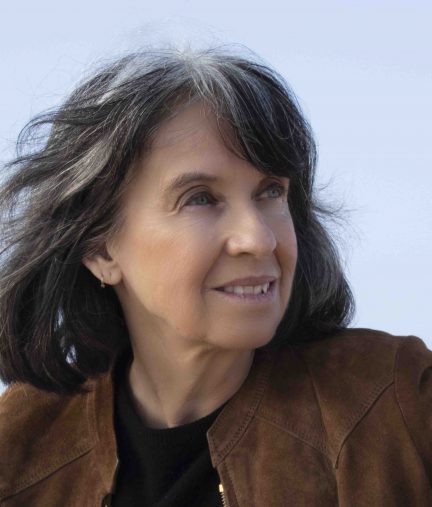
Marsha de la O

Marsha de la O

ABOUT THE POET 
Marsha de la O is the author of Antidote for Night, winner of the 2015 Isabella Gardner Award, and Black Hope, winner of the New Issues Press Poetry Prize and winner of an Editor’s Choice, Small Press Book Award. Other awards include the Morton Marcus Poetry Award and the da Poetry Award. She has published extensively, including recent poems in The New Yorker and the Kenyon Review, with work forthcoming in Prairie Schooner. De la O lives in Ventura, California, with her husband, poet and editor Phil Taggart. Together, they produce poetry readings and events in Ventura County and edit the literary journal Spillway. 

BLURBS
Every Ravening Thing presents a matchless intensity and intellectual grit, a fearless investigation into the world amplified by a vision that is both cosmic and detailed in our common suffering. This is a brave book of poetry.
      - Christopher Buckley 

What is ferocious – ravenous – here is the poet’s driven need to tell things as they truly are, which means it’s not always a pretty picture that she so carefully assembles for the reader. And I love the raucous regard she has for diction: reckless and powerfully inventive and fresh the way air can be fresh. All of this is held together by a commitment to the music that drives these poems in a way that soothes the ear. Every Ravening Thing could serve as a warning to all of us about our failures as men and women, and as a celebration of the good we’re capable of doing and in that way is a necessary part of our reading.
    - Bruce Weigl 

This is poetry meant to open hearts and change attitudes in fundamental and necessary ways, poetry of witness and utility. It is also often deeply moving. 
     -South Florida Poetry Review


MARSHA DE LA O at Writers Resist LA 2019 Reading
Video: Poetry L.A.


upress.pitt.edu

798

DISCLAIMER
Poems cited here are assumed to be under copyright by the poet and/or publisher.  They are shown here for publicity and review purposes.  For any other kind of re-use of these poems, please contact the listed publishers for permission.
We here at TBOP are technically deficient and rely on our bashful Milo to fix everything.  We received notice from Google that we were using "cookies"
and that for our readers in Europe there had to be notification of the use of those "cookies.  Please be aware that TBOP may employ the use of some "cookies" (whatever they are) and you should take that into consideration.






Wednesday, November 21, 2018

Chaos Theory - Christopher Buckley (A Plume Edition Book)

Today's book of poetry:
Chaos Theory.  Christopher Buckley.  A Plume Edition Book.  An imprint of MadHat Press.  Asheville, North Carolina.  2018.

Chaos Theory by Christopher Buckley

If Chaos Theory were only the first title poem, as illuminating as anything Blake hammered out, well, Today's book of poetry would be satisfied.  More than.  But Christopher Buckley has a multitude of universes on offer.

My buddy David Clewell, former Poet Laureate of Missouri, and Grand Daddy of the Knowledge, will stand up and cheer when he gets his hands on this B.B.Q.  Make no mistake, these poems are steeped in mystery and marinated in some freaky source of wisdom.  Christopher Buckley might be the craziest sumbitch in American poetry, he also might be the Campbell McGrath/Albert Goldbarth hardball link to a new reality.

All Today's book of poetry knows is that Buckley is smoking.  Today's book of poetry looked at Buckley's Star Journal - Selected Poems back in March of 2017.  Buckley poetry-bombed our heart.  You can see that blog/review here:


VII. Fractals

                Every great and deep difficulty bears in itself its own solution.
                    It forces us to change our thinking in order to find it.
                                            —Niels Bohr

A coastline, if measured down to its least irregularity,
tends toward infinite length, as do snow flakes. Clouds
or coastlines, no matter how close or far away we get,
the basic pattern, the surface and volume, repeat
ad infinitum...
                       Cloud or cauliflower, rough, broken
geometric shapes have an area that is finite, but
a perimeter that is not.
                                     It's a short walk from there
to Thomas Aquinas and Co., First Cause and effect,
and an intellectual trail of consecrated bread crumbs
back to a source we reflect.
                                            Computers came along
and we can enumerate all the patterned variations
in nature—lightning bolts, river networks, broccoli,
the branching of the circulatory system, pine cones
and ferns.
                Right now, someone is calculating the connection
between fractals and leaves in order to estimate how much
CO2 there is in trees, to help the environment with carbon
emission control so we might go on breathing and
piecing things together.
                                      Jackson Pollock's painting
appear to be composed of chaotic drippings and splatters,
but computers have mapped recursive patterns in the work;
high voltage has been trapped in an acrylic block, repeating
the bronchial patterns of trees.
                                                 Star clusters form
paisley patterns, and patterns repeat in the wobbly
orbits of satellites in the solar system, in weather,
economics, earthquakes and plate tectonics, and in
the mathematical model of eye-tracking disorders
among schizophrenics.
                                     Our universe could be a bubble
on an ocean of bubbles; a nearby universe might have Al Gore
as president and Elvis still singing in Las Vegas?
                                                                               Just like
the currents of the ocean, the brain itself might be organized
according to the laws of chaos—enfolded labyrinths, invisible
synapatic lingua franca, its grey death-mask mosaic
of temporary matter, the incremental and incidental tiles,
fragments that replicate, accumulate, and account for us
in every particular, and then are dispersed into the burning
dust fusing into the stars, into the silence that fills
every unaccounted for corner of the dark.

💫💫💫

"Like the wind, like the dust."  Such playful wisdom, such informed glee.  Buckley has a big tool box and he digs into it.  It's clear to us that Buckley is an old pro.

Today's book of poetry recently visited an old friend, a painter.  His house was literally ablaze with art, paintings, sculptures, pottery, much of it his own, the rest by his friends and fellow artists.  This man, Tom Campbell, is old, like me, yet his home sings with a vibrancy of intellect, hope and discovery — and that is exactly what Today's book of poetry feels when reading Christopher Buckley's Chaos Theory.

Buckley is warm and charming, hot and sharp.  Buckley recognizes the patterns in things, challenges us with the physics of emotion and shares his astonishment and wonder.  He imagines big; imagine a God particle.

Parallel Universes

                  Recent research has indicated the possibility of the gravitational pull of other
                      universes on ours.
                                       —Wikipedia

Einstein didn't live long enough
to work out the Theory of Everything,
the exact mileage to the immense...
but if parallel universes are the case,
he's out there in the stars still
putting the pieces together
even though Max Planck's study
of radiation suggested divergent laws
operating beneath the floorboards
of gravity and light...
                                     Now
they've turned up cosmic bruises—
4 circular patterns in the microwave
background radiation—evidence
that our universe has crashed
into others... One soap bubble
rubs against another and
you have a foam of universes,
 a mathematical crash and run-out
to the other side of the end of anything
you now have on hand... almost
endless permutations until you arrive
at a duplicate of our own
"Goldilocks zone" habitable planet!?
More or less.
                      It could vary by a micron
or two—the tiniest sub-atomic backfire
or jitter of an electron or quark
and scads of different outcomes,
though cosmic strings vibrate
essentially as Parmenides set it down
in his poem about the music of the spheres,
leaving out the north star as the still point
of the turning earth of course....
                                                   Thus
Elvis is still doing TV Spectaculars
from Hawaii; Al Gore was re-elected,
Rick got on that plane with Ilsa,
everyone in the middle east is sharing
pita bread and baba ganoush with his neighbor,
and somewhere on a stage Burns & Allen
are taking a bow: Say Goodnight, Gracie!
There's an even chance that communism
did not collapse, and instead of making reservations
at that French/Bulgarian fusion bistro,
you're eyeing the two potatoes and shriveled bit
of beet root left in the shop—some guy selling
lamp shades out the back....
                                             Sergei Krikalev,
Russian cosmonaut who flew six space missions,
could well head transportation for the EU.
We're here on condition that everything occurs
within the parenthesis of time,
within the end-stopped tributaries
to a sea, a great blind quantum scramble
where we arrive too late to the table
to translate the oscillating patterns and
packets of lights.
                            With every veneration
of my breath my cells are imminently obliged
to oblivion. You choose one god
or another, but religion is a trial,
an excuse to feel good about the fact
that you might be dead soon,
that, before you know it,
all your atoms will be headed
somewhere without you.

💫💫💫

In Buckley's world there are other worlds and for all we know; Elvis is still dancing in one of them.  Beautiful.

Our morning read was another doozy, as our old pal, poet and painter, Dennis Tourbin used to say.  Milo, our head technician, took a real shine to Mr. Buckley, he was still revved up from reading Star Journal - Selected Poems.  Milo said that it was like reading poetically about science and having morality/mortality/God dropped right into the middle of the conversation.

Christopher Buckley reminds us all of what poetry can do.  These conversations Buckley is having between himself and universe are worth listening in on.

On the Patio, after Reading Democritus

                   Nothing exists except atoms and empty space; everything else is opinion.
                                         —Democritus

I pour a little Absolut,
as clear as the glass
that holds it, clear as the soul
which Democritus said
consisted of atoms of fire....
As good a guess as any—
the air long let out of 
the old expectations,
that film of atoms
that was said to contain
the characteristics of the gods,
who, like the stars,
were not immortal.

And wafer by wafer
the darkness arrives
on my tongue...
what was it my father said
back there when I was 7—
the blink of an eye
and it's all behind you?
He was a dour man
who imparted that vision
to a child and was gone,
leaving the irresolute motion
of the sea as guide—
a haze, a veil between me
and whatever point there was
in the wind where chicken hawks
spun upward, lifting themselves
above the spindrift thumbed
from the bay, the tides fumbling
to shore, winter grating,
gravel washing out
at low tide. 
                   And the islands
floating across the channel,
the music of spheres
murmuring in the background,
microwave radiation,
its gravity waves
yet to reach us....
                            Still,
the stars pile up across the dark,
light years, like the sound
of a sled through snow
lost on the edge of wilderness....

Dog-walkers, star-gazers,
either way there's something
in our thoughts that interprets
the circles of light that fall to us,
that hold our gaze out there
where meteors streak
whether we are watching
with our sleeping hearts, or not—
our dreams tied to some idea
or other about our lives,
some silver stumbling cloud
being drawn into the gullet of time.

What if, finally, there was nothing
to fear?

💫💫💫

Chaos Theory was exactly what the doctor ordered for Today's book of poetry.  We were feeling in a poetry slump.  An early winter has hit our offices hard, calling for -18 C today.  And it is still November.  The snow is piled on the side of our lane, three feet high (we shovelled it there).  Chaos Theory warmed things up here.

Christopher Buckley photo

Christopher Buckley

ABOUT THE AUTHOR
Christopher Buckley’s Star Journal: Selected Poems was published by the Univ. of Pittsburgh Press in 2016. Back Room at the Philosophers’ Club, Buckley’s 20th book of poetry (Stephen F. Austin State Univ. Press), won the Lascaux Review’s Poetry Book Prize for 2015. SFA Press also published Varieties of Religious Experience in 2013. Rolling The Bones won the 2009 Tampa Review Poetry Prize and was published by the Univ. of Tampa Press in 2010, which published White Shirt in 2011.

Buckley was a 2007–2008 Guggenheim Fellow in Poetry. He has been awarded a Fulbright Award in Creative Writing to the former Yugoslavia, four Pushcart Prizes, two awards from the Poetry Society of America, and received NEA grants in poetry for 2001 and 1984.

With Gary Young, Buckley is the editor of The Geography of Home: California’s Poetry of Place (Hey Day Books, 1999). With David Oliveira and M.L. Williams, he is editor of How Much Earth: The Fresno Poets (The Round House Press, 2001). For the Univ. of Michigan Press Under Discussion series, he edited The Poetry of Philip Levine: Stranger To Nothing, 1991.

More recently he has edited the poetry anthologies Bear Flag Republic: Prose Poems & Poetics from California (with Gary Young) Alcatraz Editions, 2008; Homage To Vallejo, Greenhouse Review Press, 2006. With Alexander Long, he edited A Condition of the Spirit: The Life and Work of Larry Levis (Eastern Washington Univ. Press, 2004); with Christopher Howell, Aspects of Robinson: Homage to Weldon Kees (The Backwaters Press, 2011); again co-edited with Gary Young, One for the Money: the Sentence as a Poetic Form (Lynx House Press, 2012); and with Jon Veinberg, Messenger to the Stars: A Luis Omar Salinas New Selected Poems & Reader ( Tebot Bach, 2014).

Over the last 40 years his poetry has appeared in APR, Poetry, FIELD, The Georgia Review, The Iowa Review, TriQuarterly, The Kenyon Review, Ploughshares, The New Yorker, The Nation, The Hudson Review, The Gettysburg Review, Quarterly West, Prairie Schooner, The Southern Review, Five Points, The Harvard Review, & New Letters.

BLURBS
I don’t think I know of another poet who has such vertical range and depth; Buckley manages to have one foot in the physical muck and tenderness of the world and the other foot planted among the stars and galaxies of the universe.… There is something here that is deeply human and courageous, something like what I find in the essays of Loren Eiseley. And all of this would be nothing, of course, without the language, which is the glory of these poems.
     —Peter Everwine

There is a deep nostalgia here, but also wisdom and common sense, and beautiful writing. I welcome him at his maturest, poet of stardust.
     —Gerald Stern

These poems ask questions about an individual’s place in the universe and about the existence of the universe itself.… In his captivating voice, Buckley invites us to consider ideas of the mundane and the divine, ontology and epistemology, and what on earth we are here for.
     —Jerome Blanco, Zyzzyva

… we float in the universe … the slow gentle orbits of the planets progressing much like Buckley’s lives. [This] is a collection that is keenly aware of, but expertly deals with concepts of scope, space and time.
     —Nikki Stavile, reviewing Star Journal: Selected Poems in The Hollins Critic

There is a quietness to these poems and breakouts of lyrical intensity that define Buckley as a master of the art.
     —North of Oxford

These are poems of immortality and extinction that can still make you smile … [Buckley] has an exquisite ear for language and a gutsy way of blending bravado with humility.
     —Library Journal


Christopher Buckley
Read his poem The Shape of Things
Video: AskewPoetryJournal


728


Poems cited here are assumed to be under copyright by the poet and/or publisher.  They are shown here for publicity and review purposes.  For any other kind of re-use of these poems, please contact the listed publishers for permission.

We here at TBOP are technically deficient and rely on our bashful Milo to fix everything.  We received notice from Google that we were using "cookies"
and that for our readers in Europe there had to be notification of the use of those "cookies.  Please be aware that TBOP may employ the use of some "cookies" (whatever they are) and you should take that into consideration.

Sunday, March 26, 2017

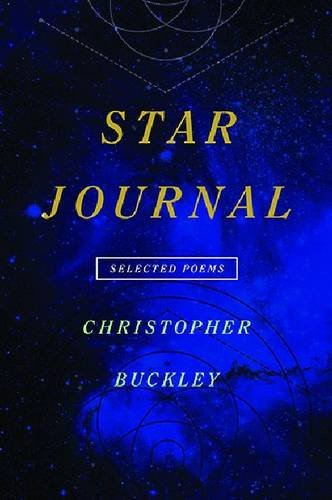
Star Journal - Selected Poems - Christopher Buckley (Pitt Poetry Series/University of Pittsburgh Press)

Today's book of poetry:
Star Journal - Selected Poems.  Christopher Buckley.  Pitt Poetry Series.  University of Pittsburgh Press.  Pittsburgh, Pennsylvania.  2016.


Star Journal - Selected Poems  by Christopher Buckley is as straightforward as a yardstick, measuring by star-light, the weight of a butterfly heart.  In fact Star Journal is a book of poet magic, a proverbial pot of gold.  Today's book of poetry defies you to open any page of this book and not be entertained and enlightened.

I don't hear 'em but I certainly feel the ghosts of Woody Guthrie and Will Rogers in the elusive space in the English language where intellect and emotion get to tango it out in an invisible swirl of yin and yang.  Here is a poet with a giant poet clock time machine, metronomes of logic, tiny unseen hammers of reason, all of ticking away in balance inside the Buckley noggin'.

Today's book of poetry couldn't help but think cinematic when reading these expansive certainties. There were moments of complete satisfaction, just like watching a Francis Ford Coppola movie where all the details are exact, all the details make it true.  Buckley does the same thing, makes sure you are hearing the right sound, fills the mirror in the corner with the proper reflection, colours in the edges of the image until you are there breathing it in.

Why I'm in Favor of a Nuclear Freeze

Because we were 18 and still wonderful in our bodies,
because Harry's father owned a ranch and we had
nothing better to do one Saturday, we went hunting
doves among the high oaks and almost wholly quiet air....
Traipsing the hills and deer paths for an hour,
we were ready when the first ones swooped
and we took them down in smoke much like the planes
in the war films of our regimented youth.
                                                                  Some were dead
and some knocked cold, and because he knew how
and I just couldn't, Harry went to each of them and,
with thumb and forefinger, almost tenderly, squeezed
the last air out of their slight necks.
                                                         Our jackets grew
heavy with birds and for a while we sat in the shade
thinking we were someone, talking a bit of girls--
who would "go," who wouldn't, how love would probably
always be beyond our reach...We even talked of the nuns
who terrified us with God and damnation. We both recalled
that first prize in art, the one pinned to the cork board
in front of class, was a sweet blond girl's drawing
of the fires and coals, the tortured souls of Purgatory.
Harry said he feared eternity until he was 17, and,
if he ever had kids, the last place they would go would be a
parochial school.
                            On our way to the car, having forgotten
which way the safety was off or on, I accidentally discharged
my borrowed 12 gauge, twice actually -- one would have been Harry's
head if he were behind me, the other my foot, inches to the right.
We were almost back when something moved in the raw, dry grass,
and without thinking, and on the first twitch of two tall ears,
we together blew the ever-loving-Jesus out of a jack rabbit
until we couldn't tell fur from dust from blood....
                                                                               Harry has
a family, two children as lovely as any will ever be--
he hasn't hunted in years... and that once was enough for me.
Anymore, a good day offers a moment's praise for the lizards
daring the road I run along, or it offers a dusk in which
yellow meadowlarks scrounge fields in the grey autumn light.
Harry and I are friends now almost 30 years, and the last time
we had dinner, I thought about that rabbit, not the doves
which we swore we would cook and eat, but that rabbit--
why the hell had we killed it so cold-heartedly? And I saw
that it was simply because we had the guns, because we could.

...

Christopher Buckley's poems are small stories that spin out so large you can't help but get caught up in the vortex, they becomes proclamations without ever proselytizing.  We can almost believe that Christopher Buckley has our planet sussed out, or at least our meagre scrabbling over its surface.

But in truth Buckley is asking as many questions as your average skeptic.

Range.  Good poets have range and Buckley covers it.  We are subject to musings on Mao Tse-Tung, a beautiful blue evening in Santorini, Bertrand Russell's musings on astronomy, reading/not reading Einstein, dancing "the Stroll," and so on.  These poems swell with the lovely interconnectivity of a man full of ideas, Buckley encompasses a big universe and he does it in big, big poems of staggering beauty and subtle intellect.  When you're reading these poems you are taking in a lot of new information but it is coming through the Buckley filter.

Watchful--Es Castell, Menorca

     But the truth is what we are always
      watchful, lying in wait for ourselves.
                                                 
                                            -Neruda

I remember the idiot in the town square
of Es Castell, trying each day to entice
the resident pigeons to eat the orange peels
he threw blissfully, and with hope,
on to the grass and walks.
                                                         But, after so much time,
they were on to him, and the worthless peels,
and waddled away in a mumbling cloud
of feathers....And each day he'd finally tire
of their truculence and unzip the jacket
of his purple warm-up suit, spread it wide
as a red kite's wings, and run
into their grey midst, scattering them
a few feet beyond the fountains, but never out
above the sky-colored water,
or into the water-colored sky....

Like the old men already sitting there
in the wet shadows on the benches,
we soon tolerated him--like the pigeons
who came back in a minute or two
and who seemed to forget,
as he did, such purposeless and 
momentary confrontations--days
like lost clouds.
                          I soon realized
that I was blessed simply
to walk out each morning
around the square and hear
the clock tower above the post office
strike the hour two times,
a few minutes apart, and not care
which could be correct; blessed
to sit next to the public phones,
which occasionally rang for no one,
and watch the bees dissolve into the sun,
knowing someone else had done the math of light--
the stars never showing any sign
of distress.
                  Yet, if there is some truth
about us, it's not in the stars,
or in the cluster of orange peels
almost as brilliant on the mid-morning walk--
but perhaps in the fact that we can tolerate
one among us to whom they are of equal
consequence.
                      I no longer need to look
to stars, the poorly punctuated dark,
for no matter what I tap out on the Olivetti,
the earth still looks inescapable from here.
But if some innocence remains,
a little of it might be here
on this small island
deserted in winter by tourists,
foreign commerce, and even the attention
of the more fashionable birds.
The green finch and the swifts are
content and have their say.
The boats are in each afternoon,
gulls climbing the air after them,
praising the fruits of the sea.

And if now we are not sure
what is of value--looking out
at the fig trees thin as refugees
along the cliff--we at least understand
what is worthless before our eyes
morning after morning, as the steam
and fog of industry lift off
beyond the port and to the west
without us.
                   I sit above the harbor,
happily on the benches provided
by the ayuntamiento for just this purpose,
beneath the orderly palms,
freighters and cruise ships slipping
in and out, going somewhere...
and make do with the intuition of wind,
the pines with their impromptu rhythms,
my hands and feet free
to defeat the intricate purposes of air,
to do nothing more than claim
the prosperity of light.
                                    Late afternoon,
I like the white tables fronting
the bars in the square, relaxing
with a small Estrella--a beer
named for a star--knowing that,
soon enough, around the corner,
I'll be on my way back
from the market and bakery
with a heart as full as the summer
5:00 sun, with a yellow grocery bag
in each hand as I ascend the steps
to our flat over the cove, where
I'll look out, and see in the reflection
of the glass doors, a happy man
arranging oranges in a bowl.

...

Buckley's Star Journal made for a great morning read in the office today.  His poems read like tidy little novels so the reader has time to sink their teeth in.

Christopher Buckley keeps a narrative line strong enough to climb up the side of a mountain with, or pull shipwrecked survivors from the sea.  He keeps it taut.  Buckley's narrative line is strong enough to be a lifeline, you could hang your hat on it.

Poverty

           for Phil

    la colera de pobre
     tiene dos rios contra muchos mares.

                                          --Cesar Vallejo

Vallejo wrote that with God we are all orphans.
I send $22 a month to a kid in Ecuador
so starvation keeps moving on its bony burro
past his door--no cars, computers,
basketball shoes--not a bottle cap
of hope for the life ahead...just enough
to keep hunger shuffling by in a low cloud
of flies. It's the least I can do,
and so I do it.
                      I have followed the dry length
of Mission Creek to the sea and forgotten to pray
for the creosote, the blue saliva, let alone
for pork bellies, soy bean futures.
                                                      Listen.
There are 900 thousand Avon Ladies in Brazil.
Billions are spent each year on beauty products
world-wide--28 billion on hair care, 14 on skin
conditioners, despite children digging on the dumps,
selling their kidneys, anything that is briefly theirs.
9 billion a month for war in Iraq, a chicken bone
for foreign aid.
                        I am the prince of small potatoes,
I deny them nothing who come to me beseeching
the crusts I have to give. I have no ground for complaint,
though deep down, where it's anyone's guess,
I covet everything that goes along with the illustrious--
creased pants as I stroll down the glittering boulevard,
a little aperitif beneath Italian pines. But who cares
what I wear, or drink? The rain? No, the rain is something
we share--it devours the beginning and the end.

The old stars tumble out of their bleak rooms like dice--
Box Cars, Snake Eyes, And-The-Horse-You-Rode-In-On...
not one metaphorical bread crumb in tow.
Not a single Saludo! from the patronizers
of the working class--Pharaoh Oil, Congress,
or The Commissioner of Baseball--all who will eventually
take the same trolley car to hell, or a slag heap
on the outskirts of Cleveland.
                                                I have an ATM card,
AAA Plus card. I can get cash from machines, be towed
20 miles to a service station. Where do I get off penciling in
disillusionment? My bones are as worthless as the next guy's
against the stars, against the time it takes light to expend
its currency across the cosmic vault. I have what everyone has--
the over-drawn statement of the air, my blood newly rich
with oxygen before the inescapable proscenium of the dark,
my breath going out equally with any atom of weariness
or joy, each one of which is closer to God than I.

...

Star Journal - Selected Poems is a big book full of big ideas and Today's book of poetry loved it.  The personal and political merge as Buckley storms over the horizon.  Today's book of poetry will be down for anything Christopher Buckley wants to cook from now till the end.  Buckley burns with the best.

Christopher Buckley


ABOUT THE AUTHOR
Christopher Buckley has published twenty books of poetry, several chapbooks and limited editions, and three memoirs. He is the editor of six poetry anthologies as well as critical books on the poets Philip Levine, Larry Levis, and Luis Omar Salinas. Buckley is the recipient of a Guggenheim Fellowship in Poetry, two National Endowment for the Arts Grants, a Fulbright Award, four Pushcart prizes, and two awards from the Poetry Society of America, among other awards. Buckley has taught writing and creative writing at several universities, and is emeritus professor of creative writing at the University of California, Riverside.

BLURBS
“The poems are modest, straight forward, intensely lyrical and totally accessible. . . . This is a humble poetry of great truths and profound emotions that never overstates its concerns for the events both in and above the world. It rewards countless readings and never betrays itself.”
  —Philip Levine on Sky in Ploughshares

“Time and the shifts of time are the burden: not simply time as recollection or loss, but also and everywhere the persistent loneliness of star time, mastodon time, so that finally these are poems in which reflection takes on uncommon amplitude and presence. And all this would be nothing, of course, without the language, which is the glory of these poems.”
     —Peter Everwine on Dark Matter

“Christopher Buckley’s gift for wide-ranging thinking meshes so gracefully with lovingly tender details, he feels like a companion voice for all time—a Hikmet, a Neruda, yes.”
      —Naomi Shihab Nye on Back Room at the Philosopher’s Club

“There is a deep nostalgia here, but also wisdom and common sense, and beautiful writing. I welcome him at his maturist, poet of stardust.”
    —Gerald Stern on And the Sea

“The poems are verbally so rich, generous, out-loud (I can't not intone the rhetorical flourishes), inclusive, wry. I like especially the orientation to the large-picture physics/cosmology at the same time that (Buckley) relates his own past. . . . I like the tone—how else to address one's mortality & mixed luck except with irony & affection stirred with gratitude?”
     —Dennis Schmitz

“Some poets like only celestial music, other the grit of the streets, but Buckley engages winningly with both.”
      —David Kirby in San Francisco Chronicle

“Prize-winning poet Buckley has a unique poetic voice, a sort of breathless, long-sentenced style that is gripping and captivating . . . . These are poems of immortality and extinction that can still make you smile. He has an exquisite ear for language and a gutsy way of blending bravado with humility.”
     —Judy Clarence in Library Journal

"There is a quietness to these poems and breakouts of lyrical intensity that define Buckley as a master of the art."
     —North of Oxford

upress.pitt.edu

565
DISCLAIMERS

Poems cited here are assumed to be under copyright by the poet and/or publisher.  They are shown here for publicity and review purposes.  For any other kind of re-use of these poems, please contact the listed publishers for permission.

We here at TBOP are technically deficient and rely on our bashful Milo to fix everything.  We received notice from Google that we were using "cookies"
and that for our readers in Europe there had to be notification of the use of those "cookies.  Please be aware that TBOP may employ the use of some "cookies" (whatever they are) and you should take that into consideration.

Monday, March 30, 2015

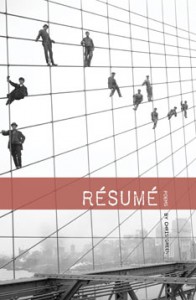
Resume - Chris Green (Mayapple Press)

Today's book of poetry:
Resume.  Chris Green.  Mayapple Press.  Woodstock, N.Y.  2015.


Today's book of poetry is tickled pink to be back in the saddle after our sojourn to the south.  Luckily I took a herd of fine books of poetry with me.

Today, Today's book of poetry is looking at Resume by Chris Green.

Resume is all about jobs, work and the world that demands that of us.

I'm not saying Chris Green is a genius, I don't know the man, but these are wizard smart poems.
They crack like the fast end of a bullwhip.

These poems are alive with dark humour and profound wit.  And knowing, Chris Green knows stuff, he knows the emotional toll paid by those that toil.

Janitorial Ode

Each month a new motivational
poster above the urinals:
nature scenes with slogans like
DARE TO SOAR. Management
trying to love us.
But someone was taking dumps
in the locker room shower.
A kind of protest. My job:
to muck out the message.
A typical day, I hardly said
anything to anyone
except Henry, the machinist
prophet, who always took
the short view: she's fuckable,
she's fuckable, she's
definitely fuckable.
In the factory, sex worked
like a machine's heavy
breathing -- obvious as the absence
of windows. Tom and Bill were lovers
who had the same small job:
pushing a rod. They wore too-short
denim cut-offs, tube socks,
shirts tails tied into halter tops.
Tom would call ooohhh baby,
snatch at my ass when I mopped.
I wanted Michelle, the opposite
of a rich girl, braless, up to
her elbows in toxic acetone
(lunch time, I'd grind into my
writing hand, a kind of one-armed
violence until I'd explode).
then during the full heat of noon
I'd eat on the bank of a drainage
canal. I was young, lying
in the sweet ditch grass, my feelings
buried deep, deep. I didn't
want to admit it, but I was
heading straight to the bottom.
As if to prophesy, one day
a whole swollen deer floated by.

...

Boy, oh boy!  Resume is that rare book of poetry where there are no extra poems, no floaters.  Every one of these suckers is essential to this collection and hot as a fired pistol.

These are all good poems, there are several I might even call great -- or at the very least, very, very good.

Mr. Green is diabolically beautiful almost every time he opens his mouth.

These poems had the staff here at Today's book of poetry screaming out loud and almost coming to blows to see who would read the next one out loud.

Amy Gerstler mentions Studs Terkel when she talks about Chris Green's Resume and she is right. Studs Terkel's Working is an encyclopedic look at the heart and calloused hands of working America. Resume, although slight in pages in comparison, packs the same modern punch.  His contemporary voice is a take on the same territory -- but it is a take informed by the journalism of Hunter S. Thompson, the poetry of everyone from Auden to Bukowski.  Green has his finger on the modern and sometime macabre world as though he were a puppet maker, the rest of us puppets.

Aviary Security

The Tracy Aviary in Liberty Park:
birds in their undress--
redheads, goatsuckers, Lucifer hummingbirds, rough-legged hawks.
And peacocks in blue-fire skirts.

You can't choose what you do. I was young. full
of fear. Birds barred from the sky
appealed to my sense of remoteness.
Then, as if a dark dream--
I caught a man raping a peacock.

Not mythic
like Leda and the swan, this was Salt Lake City,
a place where people swallow impossible plots:
Jesus appeared in America
after his resurrection and strong-armed natives
to make us a heaven of Mormon men.

The great fan of color
and the man, a squalid Yeatsian
thrusting through an emerald field, a burning wall.
He was moaning
like an idiot, kneeling like he was praying.
The inconceivableness.
The long blackness of the peacock's glance.

I dragged the man through the aviary. It made no difference.
The poor dead bird and the man never cured.

...

These dark and dense poems crackle with heartbreaking humanity, they grab the reader on the first page and thrash the crap out of him/her.

Read six lines of a poem by Green to my wife yesterday.  She is still talking about it.  In a good way. And she is aces.

Green seems to have a sensibility similar to a more literary Bukowski, but perhaps subtler, Green will still blow your head off, you just don't see it coming in quite the same way.

Loss Specialist, American Express

That morning Republican Sonny Bono
called and said, "Fuck!" no Gold Card;
needed some big dumb diamonds.
Otherwise, the day was drear...infinite hours
on a tiny salary in a gray sea.
I was reading a poem by Auden,
something bleak to stay awake.
My Mormon boss yelled, "Heck!"
His ex-wife appeared in full rage,
stopped everything, screamed, "Oh you know why!"
She yelled and yelled--
gripped their daughter's hand.
My boss stayed where he was, stared
as if at a precipice...
He began to cry.
We all waited and wondered
at their anguish.
The daughter,
spiraling, terrible. I understood:
family awkward implausible. Later on,
no one comforted him. He had his own heaven.
And I returned to Auden.

...

If you can, find and read this book.  Then go searching for anything else by Chris Green, I know I will be.


Displaying CGREEN AUTHOR PHOTO.jpg


 Chris Green

ABOUT THE AUTHOR
Chris Green is the author of three books of poetry: “The Sky Over Walgreens”, “Epiphany School”, and “Résumé”. His poetry has appeared in such publications as Poetry, New York Times, New Letters, Verse, Nimrod, and Black Clock. He’s edited four anthologies, including “Brute Neighbors: Urban Nature Poetry, Prose & Photography”, and the forthcoming “I Remember: A Poem by Chicago Veterans of War”. He founded LitCity (www.litcity312.com), a comprehensive literary site for Chicago. He teaches in the English Department at DePaul University. www.chrisgreenpoetry.com

BLURBS
This a wonderful cycle of poems. As Studs Terkel once wrote, “Work is about a search for daily meaning as well as daily bread, for recognition as well as cash, for astonishment rather than torpor; in short, for a sort of life rather than a Monday through Friday sort of dying.” Through the vehicle of various jobs, roles, labors, and employments–manual, artistic, emotional, literary, familial, etc.–Chris Green gives us a lyric tour of human complexity, oddity, behavior and occupation. He has a novelist’s powers of observation. Résumé is full of humility, wit, smarts and heart, and all kinds of quiet astonishment. Studs would have loved it.
 —Amy Gerstler

These clear-eyed yet inventive poems about work offer a hard-won wisdom that lifts us above suffering to understanding. Green’s is a marvelously spare and colloquial voice with the kind of detail that cherishes and transforms our lives, that compels us with the authority of experience. His material is his own and others’ brutal and toxic jobs, which in the hands of such a skillful poet, provide a vision that reaches beyond the subject to his spare but complex epiphanies.
— Christopher Buckley

Working odd jobs going nowhere, the fear of futility, the problem of money, the uncertainty of life—such are the burdens of youth. In Résumé, Chris Green resurrects and transforms such lost periods of life. He sees that every job teaches, affirms that even the lowliest job is a step. Résumé is not merely a record of employment— it is art employed so that human dignity can be redeemed through understanding and wisdom.
 — Richard Jones

Chris Green
reading his poem, "Deer Sonnets"
video courtesy: jonnymess


321

Poems cited here are assumed to be under copyright by the poet and/or publisher.  They are shown here for publicity and review purposes.  For any other kind of re-use of these poems, please contact the listed publishers for permission.

Tuesday, January 27, 2015

The Cave - Tom Holmes (The Bitter Oleander Press)

Today's book of poetry:
The Cave.  Tom Holmes.  The Bitter Oleander Press.  New York, N.Y., 2014.

Winner of the Bitter Oleander Press Library of Poetry Book Award for 2013


How do you make human those first moments of transition when a species is animal and then they become human?

Is it contained in that first deliberate painting on a cave wall?

Tom Holmes might have you feeling that.  The Cave posits those moments of the transformative human past and gives them scope, room to percolate in our active and overburdened minutiae.

The First Painting

I had no urge except to sleep
with her in the cave, but I felt
sympathy, I cared. I sensed
intelligence in a crevice. I saw

life. I saw a bison's back
in a crack, I saw
the whole world, the whole sky,
all of night. The night

with the bisons, the horses, and rhinos
before me, before my eyes -- I saw
a backdrop with all the beasts.

I saw blood on my finger.
The arc of a bison's back
appeared with one stroke.
The second urge arrived.

...

Tom Holmes is explaining who we are today by stepping into our giant footprints and deciphering what it is that makes us sentient, capable of thought and therefore choice.

These big question poems pose a challenge to the readers understanding of what it means to be human.

It is all in here, The Cave, the start of faith, the beginning of manufacturing, of commerce.  Holmes is outlining or at least providing a hypothesis for nothing less than the beginning of our conscious time on this planet.

Plato is just hanging out around the corner, Holmes has his own cave and in it all is explained in time.

The First Prayer

Father, it is cold for spring,
snow lingers in shadows
below cliffs and trees,
the ground is not giving,
and the beasts smell you.

The fat and dried meats
dwindled away days ago
as did your final breath.
The fire is warming.
Forgive us our next meal.

...

Holmes assesses the future using the tools of the present.  He has discovered and/or decided to share time travel.  He is in every moment, Holmes somehow spirals through time.  The poems in The Cave
are our first revelations as we move away from the black glass monolith, bones in our hairy fists.

Sorry, Kubrick obsessed intern writing copy for a moment.

Today's book of poetry thought these poems were cut with a digital laser, precise as that.

A Brief Autobiography Of The First Artist

I was carving
the sharp end of a spear
when I sliced myself
and my blood spilled out.

It was smooth and thick
and salty.
I tried to rub it off,
it spread evenly and thin.

More pulsed out
in rhythm with my heart.
I clutched my chest.
The blood continued its pulse.

I smeared my arm
and then my thigh.
I slapped a rock.
The blood held its place.

I found a red hand
on the rock. My red hand
detached and peaceful
like a greeting or foreboding.

My blood stopped.
I sliced myself again.
I made more hands
and flung red drops from my fingertips.

There was so much red
before it all went black.

...


Tom Holmes

ABOUT THE AUTHOR
Tom Holmes is the editor of Redactions: Poetry, Poetics, & Prose and the author of seven collections of poetry, most recently The Cave, which won The Bitter Oleander Press Library of Poetry Book Award for 2013 and will be released in 2014. He has been nominated for the Pushcart Prize seven times and his work has appeared a number of times on Verse Daily. His writings about wine, poetry book reviews, and poetry can be found at his blog, The Line Break: http://thelinebreak.wordpress.com/.

BLURBS
Hand art on Paleolithic cave walls is the artery, but observations like cut gemstones are woven into Tom Holmes' exciting tapestry of The Cave with its hunger for mystery to balance you along the edge: "When the wall opens, / I am lightning in the antelope's antlers / and the stripe along its jaw." These poems wrestle with the concept of time. They want to capture time, yet realize that time is elusive. So, they attempt to understand time through concrete experience, which poses its own dilemma. Even The Needle, a vehicle which hopes to stitch the fabric designed to apprehend time, is ephemeral: "Let me tell you about the needle. / It is and it is not. It points / to what will be, and what it isnt..." Undeterred, the poet continues his quest. Enjoy this exciting journey through the primordial future.
--Alan Britt, judge for the 2013 Bitter Oleander Press Library of Poetry Book Award.

A deep and selfless imagination anchors The Cave. Tom Holmes gives himself over completely to his vision and his project is nothing less than inhabiting the spirit and the flesh of our collective ancestors. The speakers here, in the daily specifics of early life on earth, retell the beginnings of our consciousness as it rises from fire and rocks to images illuminated on the cave walls and in the night sky. Each poem is a distillation of the individual efforts of art that result in the common bonds of our humanity. From “blood on his finger” and “burnt wood and ash” to “where the wind took form” we retrace our physical and spiritual past in song and paint. The voices in these poems are absolutely credible, and Holmes’ writing is “a song it carries from a star.”
– Christpoher Buckley, author of Back Room at the Philosopher's Club

A writer looks at the famous Paleolithic cave paintings in France, and then he becomes an ancestor at art’s birth, birthing himself as a writer at the same time. Tom Holmes “set down [his] bowl of burning animal fat / to illuminate this hollow the world” in poems that embrace what it means to be a fledgling human and nods toward Platonic allegory in poems that delight and sometimes sear. In “An Origin of the Other” the sacred and the earthy conjoin in manifesting this human world, what we have been, what we have become and are becoming still. An ambitious and strange book of intelligence and empathy.
– Laura McCullough, author of Rigger Death & Hoist Another

Today's book of poetry cut and pasted two of those blurbs from the excellent poetry site Redactions. Which you can see here:  http://www.redactions.com/our-books.asp 


Tom Holmes
Three Bad-Ass Poets: Tom Holmes - Reads Paleolthic Poems
Video by Semlohsa Moht


297

Poems cited here are assumed to be under copyright by the poet and/or publisher.  They are shown here for publicity and review purposes.  For any other kind of re-use of these poems, please contact the listed publishers for permission.