Showing posts with label steven heighton. Show all posts

Thursday, October 15, 2015

Monologue Dogs - Méira Cook (Brick Books)

Today's book of poetry:
Monologue Dogs.  Méira Cook.  Brick Books.  London, Ontario.  2015.


"Hunger fights Appetite to the death."
                                                                                     from Little children, little children

Early in  Méira Cook's excellent fifth book of poetry a young boyfriend spits W.H. Audenesque and Today's book of poetry was captivated.  But it did raise my suspicions about being up to the task as Cook rumbles through classical antiquity with a Tarantino grin.  Monologue Dogs is one of those books where your appreciation grows with every page.

Méira Cook's monologues are crisp and refined as she inhabits her characters like a mindful and diligent ghost.

The Devil's Advocate

My lords and ladies, gentlemen of the jury--
when you hear hoofbeats, assume horses, not zebras.
This is true in almost all parts of the world
except the African savannah, where it is safer
to assume zebras. Also eland, giraffes, herds
of this and that. In India, assume cows; in Spain,
bulls, matadors with their sun-blurred hooves.
In Tuscany, angels; in Kingdom Come, horses again,
pale quartets of Wish You Were Here.

My client sends his regrets. He is busy
falling through blank verse for all eternity, while a mere afternoon
passes its shadow over us. The sun moves from one window
of the courthouse to the next, and then it's tea time.
One sugar or two? Perhaps a bun. Stretch
and yawn and back we go. I submit
for your perusal Exhibit A.
This is a map of the world, of God, and of everything.
Above is heaven, below is hell--

the future is to the right, the past to the left.
My client, in his plea for mercy, wishes me to recall
his salient points. His sense of humour, direction, and yes, style,
his tendency to violent foreshortenings, and that finding
himself irredeemably zebra, he hoofed the streets
of his brawling, captious nature, kicking
up dust and all the limping platitudes
of this earth, our home. They tell you dreams
don't come true. But they never tell you how.

...

Today's book of poetry is always interested in listening to a smart Devil, there is generally some heat generated in his presence.

Cook has brought together a stellar cast from the staples of our literature, folk/fairy tales and the Bible.  Cook covers these bases, and more, with both vigour and a wicked sense of humour.  These poems compel you to a quick second and third reading.  That is because they are layered like a cake where you don't know what is beneath the icing until you bite in.  Devil's cake served up by Cook, who certainly likes to stir things up.

Once upon a time a mother...

I could say not hard or not very often
or his pain was worse than mine.
I could say I deserved it,
or I don't remember, not much,
or hunger is a flame blued through to salt.

First the rats come out of the fields
and into the city,
like one great rat with a million mouths
and each mouth with a thousand teeth
and the will to grind our lives exceedingly small.

Then hunger enters without knocking,
as if he's lived here forever.
He lays a place at the table and draws up a chair.
Good evening, good evening. Pass the butter, do.
My goodness, this porridge is thin!

The more he eats the leaner he becomes.
A skeleton, a piece of gristle, a singing bone.
The brats climb into my belly
and begin to gnaw their way out again,
cracking me like an egg,

not in half but in pieces.
I have put all my yolks in one basket,
now I can't sleep for the sound
of lapping in the dark.
In the morning, a cough of eggshell

on the sheets and the brats lolling
with their blue Persian tongues.
My darlings, my parasites!
One day their father returns
from the empty fields and the empty seas

and the sky where nothing grows.
Hunger, my lover, sits at the head of the table,
sharpening his knives and his teeth,
while the brats crawl
from their mother's eyes.

Little maggoty things, little grubs that feed
on the truculent gaze.
I could say not hard.
Not very hard at all. I could say
pain is a proof in the Theorem of Love,

or something less complicated to do
with the bruise and the sweetness
of the after-fruit.
I thought God would hear.
I knew the neighbours wouldn't.

...

Today's book of poetry sees Monologue Dogs as a gallery full of fine tapestry, you have to wander around, take your time, return to each well woven beauty like a warm memory.

Cook's cast of characters include Hansel and Gretel, Persephone, Federico Garcia Lorca, Vasco da Gama drops by and thinks he may be God, and then there are the rumpled pages of the Bible to contend with as well.  Cook takes it all with aplomb, gives her characters ample room to explain themselves, both in Eden and out in the rest of the world.

CRACKED

Young Eve

Summer's head of cabbage, each next
breath, the garter snakes oozing from the undergrowth,
fat ripples of black and gold. Some loose

green fuse tripped our intention.
I drove north along the highway with my boyfriend
in his daddy's pickup, looking for a place to park.

The day had a crack down the middle
was one way of looking at it.
Then I opened my shirt and unhitched my bra,

more for the relief of air than his distraction
although I achieved both.
Before was the garden, after the burn of day

down to the wick, the scuffle and cut,
his mouth stubbed out against my own.
And where did you hear we were naked

is what I want to know? Unzip unzip--
my jeans round my ankles, his open at the waist.
Blames me for what happened next, wants to snap

my thighs for a wishbone. As if there were wishes
(there are none). As if he could extinguish
himself in me.

...

Monologue Days has that thing, that mojo, vibe, rumble, whatever.  You recognize the feeling when you open the book and it never goes away.  

Méira Cook is entirely convincing.

Méira Cook

ABOUT THE AUTHOR
Méira Cook has published four poetry collections, most recently A Walker in the City (Brick Books). Her poetry won first place in the CBC Literary Awards, garnered a Manitoba Publishing Award (a “Maggie”), and has been featured in Winnipeg Transit’s “Poetry in Motion” program. She won the inaugural Walrus Poetry Prize in 2012. Her first novel, The House on Sugarbush Road (Enfield & Wizenty), won the McNally Robinson Manitoba Book of the Year Award in 2013. She has just completed her tenure as the Winnipeg Public Library’s Writer-in-Residence. Her latest collection of poetry is Monologue Dogs; her new novel, Nightwatching, was published in May 2015. 

BLURBS
“Again Méira Cook proves herself to be one of Canada’s most compelling poets.” 
     —Molly Peacock

“These are poems to read and reread with growing pleasure and admiration.”
     —Steven Heighton

Méira Cook
Read from Toward a Catalogue of Falling
video:  Brick Books

Méira Cook's poem "The Devil's Advocate" won the Walrus Poetry Prize in  http://www.thestar.com/entertainment/books/2012/10/19/walrus_magazine_announces_winners_of_its_inaugural_poetry_contest.html in 2012.


brickbooks.com

393

 DISCLAIMERS

Poems cited here are assumed to be under copyright by the poet and/or publisher.  They are shown here for publicity and review purposes.  For any other kind of re-use of these poems, please contact the listed publishers for permission.

We here at TBOP are technically deficient and rely on our bashful Milo to fix everything.  We received notice from Google that we were using "cookies"
and that for our readers in Europe there had to be notification of the use of those "cookies.  Please be aware that TBOP may employ the use of some "cookies" (whatever they are) and you should take that into consideration.

Tuesday, August 4, 2015

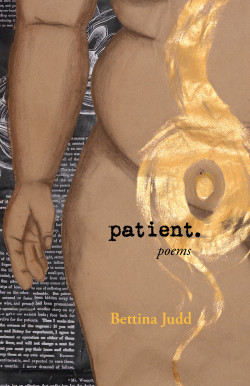
Patient - Bettina Judd (Black Lawrence Press)

Today's book of poetry:
Patient.  Bettina Judd.  Black Lawrence Press.  Pittsburgh, PA.  2014.
Winner of the 2013 Hudson Prize


I'm not black and I'm not a woman so with these incendiary poems by Bettina Judd I am definitely on the outside looking in.  Patient has me riveted.

These poems are specific in their lineage, they are tightly tied to the ghosts of four women; Betsey Harris, Joice Heth, Lucy Zimmerman and Anarcha Wescott.  These women visit Judd in her hospital bed, we hear their voices loud and clear.

These women's names are unknown to most of us regardless of their deeply earned sorrow.  What makes this book, these poems, interesting and necessary to us is the visceral and haunting honesty of Bettina Judd.

Lucy on the Train

I didn't want to go back. Not just to be cured but to
never have to take the train again. Mister Z cackled
said I won't run since he don't need a bloodhound to
track my scent.

The car had crates and a floor for chairs. If I were to sit
I would saturate myself more.         A jolt flung me into
the lap of a man who smelled it and tossed me into the
movement of the train. I hit the floor and the dark spot
began to expand. He snarled something about how
filthy women be.

I smoothed my dress. So not to trap his disgust inside.

...

Heth, Zimmerman, Harris and Wescott were enslaved women subjected to unthinkable gynecological experiments.  Bettina Judd's Patient gives them voice.

These poems come to us as high-pitched and justified screaming, low-voiced and liturgical laments whispered as incantations against the dark.  These poems are the bright red accusations, the broken blisters and snarling residue of unclaimed history.

Betsey Invents the Speculum
Fall 1845

Introducing the bent handle of the spoon I saw everything, as no
man had ever seen before.
    --from The Story of My Life by J. Marion Sims

I have bent in other ways
to open the body     make space

More pliable than pewter,
my skin may be less giving

Great discoveries are made
on cushioned lessons and hard falls

Sims invents the speculum
I invent the wincing

the if you must of it
the looking away

the here of discovery

...

Bettina Judd's voice is controlled, exact, precise and angry/sad.  She modulates her considerable and righteous anger so that her tempered reason never boils over.  These poems are not going to make you happy.

This is one of those books of poetry you are going to be happy you read but it won't make you smile.

Earlier this morning I was reading an essay by the excellent Steven Heighton entitled "In the Suburbs of the Heart" from his book The Admen Move on Lhasa.  Heighton was lamenting that a certain cowardice and gentility had overtaken contemporary poetry, those are my words not his.  What he did say was that "by feigning niceness for too long men and women can douse their vital flame."  Bettina Judd has done the opposite -- she embraces her vital flame and spits gasoline.

She has connected with the lives and horrors of these four forgotten Saints and given their stories light.  And that is always a fine step, towards truth, light.

At [The Teaching Hospital]
For The Second Time
April 27, 2006

To each doctor a speculum.

No time for a room with walls.
No procedure. No apologies. No
apologies all mine.

I have not yet learned
how to look
when I am entered.

Not yet learned
where to turn.
Ceiling?
Curtain?
The barrel of myself?

Or, to the patient beside me
who, in his sleep,
mumbles
i'm going nigger hunting,
i'm gon' get you, nigger.

...

Patient is not just the sad past.  Judd's ire is not simply historical, how would that be possible.  These poems hum and pulse like the air around a transformer during a heat wave.

These haunting poems are brave and bloody and bound to guilty truths that Judd artfully turn to balm. Patient is a book you can love, admire, extol.

Bettina Judd
photo: Rachel Eliza Griffiths

ABOUT THE AUTHOR
Bettina Judd was born in Baltimore and raised in Southern California. She teaches courses in Black women’s art, Black culture, and Black feminist thought. She has received fellowships from the Five Colleges, the Vermont Studio Center and the University of Maryland. She is a Cave Canem Fellow and has been nominated for the Pushcart Prize in poetry by Mythium Literary Magazine. Her poems have appeared in Torch, Mythium, Meridians and other journals and anthologies. More about her can be found at www.bettinajudd.com and www.patientpoems.com.

BLURBS
"J. Marion Sims, the legendary, now controversial, 19th century gynecologist looms large in Bettina Judd's recent collection Patient. Sophisticated, complex, haunting, Patient. beckons readers to remember, to feel, to think deeply, to discover, to probe. Slavery's stench, the bodies of Black women, death, scientific racism, memory—these themes link the poems in extraordinary ways. Judd is a masterful new poet. Patient. is unforgettable!!"
     —Beverly Guy-Sheftall, Founding Director and Anna Julia Cooper Professor of Women's Studies,                                              Spelman College

"In Patient Bettina Judd beautifully (and horrifically) draws on historical evidence of nineteenth-century medical experimentation on black women, scholarly explorations of the body and the archive, and personal medical history. The result is haunting in its insistence on laying bare these stories as they not only articulate experiences of the past but also resonate deeply with black women’s experiences with the U.S. medical complex in the present. Patient is a brilliant meditation on race, gender, and science and a thrilling anthem to black women’s self-knowledge."
     —Elsa Barkley Brown, University of Maryland

"Joice Heth. Lucy Zimmerman. Betsey Harris. Anarcha Wescott. Bettina Judd ensures you will remember the names of four women assaulted by science, violated by curiosity--survivors of physical invasion and torturous experiments. She presents their dignity, heretofore denied, as imagined in their own voices in conversation and parallel with a modern speaker, similarly (coldly) ensnared by a medical machine powered by detachment at best, cruelty at worst. Judd re-centers the narrative, however, to where it belongs--on the person(s) confronted, examined, in pain—not on the problem to be studied or solved. In visceral language that indicts, worships, haunts, and empowers, Patient illuminates 'a dynasty, a bloodline, a body' imbued with the full human spectrum of emotion and brilliance."
     —Khadijah Queen, author of Conduit and Black Peculiar

"Bettina Judd’s stunning poetry invites us to imagine the experiences of enslaved women subjected to gynecological experiments—the blood, pain, loss, shame, and survival. Linking past and present, Patient brilliantly condemns the inhumanity of professionals who infringe black women’s bodies and celebrates the humanity of those who resist them. It will disturb and move your spirit."
     —Dorothy Roberts, Author, Killing the Black Body: Race, Reproduction, and the Meaning of                                                           Liberty

"Bettina Judd’s phenomenal debut poetry collection, Patient., is about recovery in many senses: recovery of the subjectivity of several historical figures, through the recovery, reconstitution, and telling of their stories—among them Anarcha Westcott, Betsey Harris, Lucy Zimmerman, Joice Heth, Saartjie Baartman, and Henrietta Lacks, who were infamously 'patients' or subjects of inspection and 'plunder' by, among others, J. Marion Sims, the controversial gynecologist, and P.T. Barnum, showman and circus founder. Sims (and the speculum) and Barnum are the featured antagonists in many of these flawlessly empathetic poems, but an unnamed speaker who adds a contemporary voice to the lyric chorus implicates those in charge of her care during a present-day hospital stay at Johns Hopkins—suggesting the linkage of modern medical treatment to the traumas vulnerable Black women, enslaved and not, suffered at the hands of unethical scientists and physicians in earlier eras. In the collection’s opening poem, the speaker reckons, '…verdicts come in a bloodline” and she determines “to recover' from 'an ordeal with medicine' by “learn[ing] why ghosts come to me.' She ends her testimony by asking, 'Why am I patient?' (Read that line in however many nuanced ways you want.) In this profoundly layered witnessing, the subject might be “in the dark ghetto of my body,' or 'an idea of metaphors that live where bodies cannot.' Yet even as Judd vividly evokes the precise brutalities visited upon the Black female body and psyche—letting us see and hear women who 'quieted/ broke into many pieces'—these poems also speak of “shedding something, ' 'another kind of sloughing.' Ultimately, Patient. enacts a healing and move toward wholeness, recovery of, as one speaker puts it, 'spirit [that] flees the body and/ its treacherous/ tearing.'”
     —Sharan Strange, author of Ash, and creative writing faculty at Spelman College
Bettina Judd
Reads from "Citizen" by Claudia Rankine
video: Katy Richey


370

DISCLAIMERS

Poems cited here are assumed to be under copyright by the poet and/or publisher.  They are shown here for publicity and review purposes.  For any other kind of re-use of these poems, please contact the listed publishers for permission.

We here at TBOP are technically deficient and rely on our bashful Milo to fix everything.  We received notice from Google that we were using "cookies"
and that for our readers in Europe there had to be notification of the use of those "cookies.  Please be aware that TBOP may employ the use of some "cookies" (whatever they are) and you should take that into consideration.