Showing posts with label black lawrence press. Show all posts

Thursday, March 12, 2020

This Is Not A Frank Ocean Cover Album - Alan Chazaro (Black Lawrence Press)

Today's book of poetry:
This Is Not A Frank Ocean Cover Album.  Alan Chazaro.  Black Lawrence Press.  New York.  2019.

Black River Chapbook Competition Winner

Barrelhouse Reviews: THIS IS NOT A FRANK OCEAN COVER ALBUM by Alan Chazaro

Being a sixty-three year-old grumpy white man in Canada, Today's book of poetry is sadly unfamiliar with contemporary music.  Bird, Trane, Prez and so on, Billie, Sarah, these are the musicians I know.  Hip hop, as I've only very recently discovered, is rock n roll as much as any other.  But until I started to write this blog/review I had never heard of Frank Ocean or Christopher Edwin Cooksey, I certainly had never heard of Odd Future or listened to Channel Orange or Blond.  But after a first reading of Alan Chazaro's This Is Not A Frank Ocean Cover Album we figured we needed to hear Frank Ocean's acclaimed Blond.  Astounding.

Alan Chazaro's This Is Not A Frank Ocean Cover Album is like a slice of some new fruit, spicy, fragrant and tasty.  Alan Chazaro can cook.  So can Frank Ocean.

Self-Portrait as American

I say fuck
because it feels right
about now,
and I say love because
what wrong
could it bring?
I haven't shot a pistol
since my stepdad
flung his Desert Eagle
from the bedroom and took us
to burst freedom as kids.
The smell of sulfur
and devil, the pinch
of steel between my 10-
year-old finger. I didn't
seek this, was never good
at hitting body-
sized targets,
kept my eyes
shut while I curled
the trigger. It's heavier
than you think,
to hold and re-
lease thunder.
Not like the movies but
somehow like the movies.
Ears still ringing,
vibrations
in my bones.

💥💥💥💥

Alan Chazaro is doing some singing of his own in This Is Not A Frank Ocean Cover Album.  But wouldn't you know it, he's also looking at colonialism, toxic masculinity and tenderness.  Chazaro is using a multi-coloured brush and painting broad strokes when he paints his landscapes.  And of course he paints in the detail so that it all fits.

Yes, Today's book of poetry uses metaphors like cooking, singing, painting, to describe poetry and we feel good about it.  And just in passing, our photo does not do it justice, the cover of This Is Not A Frank Ocean Cover Album is one of the very best we have seen in a long time.  Splendid.

Self-Portrait as Cartographer

Have you ever retraced the borders on a world
map with your abuela's lipstick? Post-

colonialism is a word that means re-hustle,
but should never be re-Tweeted. This isn't

a political statement. The states have been on fire
for as long as they have been stated. What happens

when GPS can no longer locate what you are
looking for? I'm talking cartography,

the fog-swallow of clouds, a wandering
mathematics. Since we've come a long way

from the art of papyrus. Since we've come for more
than your blood can script. Return to your proper

homes. This land is full of forsaken places
I've never visited. What is a sign if it only points to you

in one direction? How can you sleep with your eyes
open and an open road ahead of you?

Is it possible to be found when you've fallen
off the map? I've been in wilderness. I've been in fluorescent

cities. I mean this literally--how the lights raged
across both places. How I know the silence

of hands that can draw worlds and hands
that won't even try.

💥💥💥💥

Today's book of poetry was listening to Frank Ocean this morning, but when we typing up this blog it was Billie Holiday, Miles Davis, that lot.  I don't think Mr. Chazaro would object.  

The world is on fire and Alan Chazaro is pointing fingers.  This poetry takes place in a world Today's book of poetry has not spent much time in - so why is it so compelling?

Actually, this is where Frank Ocean really comes in to play, listening to Mr. Ocean it was easy to imagine Chazaro writing these poems.  The same casual elegance and a little embrace of the classic "fuck you."

Chazaro writes about Oscar de La Hoya fighting Julio César Chávez and Today's book of poetry is in the room.  Today's book of poetry has nothing but admiration for this poem and the poet who got it down.

Julio César Chávez vs. Oscar De La Hoya, 1996

That night our apartment was an armpit, testosterone
and sweat-washed as if Papi and his friends were the ones

entering the ring. When he let me sip his Heineken I knew
it was a big deal. I stumbled and hiccupped, imitating

Dumbo from the cartoon I'd loved. The men laughed, easily
entertained until Chávez appeared on screen. The Mexican

Warrior, they called him. Papi reminded me
how he had battled one hundred fighters, more

than Ali, or Tyson, or Dempsey. The De La Hoya
entered. Everyone booed, telling him to go back

to his locker like the traitor he was. The Mexicans
thought he was gringo and the gringos thought

he was Mexican. I should've smiled
with missing front teeth for The Golden Boy

in his mixed-up outfit, a combo
of US and Mexican flags, but I didn't, I don't

remember the actual fight, a flurry
of blurred punches and the card girls in bikinis. I wasn't sure

what took place until everyone on the couch started
grumbling, their movements a slow and beer-confused

disappointment. I swear someone must've cried. Chávez 
was hunched over in his corner, right eye swollen

from repeated jabs to the brow, while De La Hoya
stood center, undefeated.

💥💥💥💥

Poetry may be the uniter of worlds, Alan Chazaro was not considering the attention of an aging Canadian, his house surrounded by snow, when he wrote these fine poems.  A true poetry voice always has a clear sound and Chazaro cooks that up proper.

Today's book of poetry will be waiting, both hopeful and anxious, for Chazaro's next poetry title.  The man is a stone cold poetry assassin and Today's book of poetry loves that madly.

Image result for alan chazaro poet photo

Alan Chazaro

ABOUT THE POET
Alan Chazaro is a high school teacher at the Oakland School for the Arts, the former Lawrence Ferlinghetti Fellow at the University of San Francisco, and a June Jordan Poetry for the People alum at UC Berkeley. A Bay Area native, his poems have been featured in the San Francisco Chronicle, Puerto del Sol, Huizache, Acentos Review, and Ninth Letter. He is a recipient of an AWP Intro Journals Award and has been nominated for multiple Pushcart Prizes. His first poetry collection, THIS IS NOT A FRANK OCEAN COVER ALBUM
(Black Lawrence Press, 2019), was the winner of the 2018 Black River Chapbook Competition, and his second book, PIÑATA THEORY (Black Lawrence Press, 2019), was awarded the 2018 Hudson Prize.

BLURBS
"Listen: This book is so good it makes me want to curse. Better still: it makes me want to go write. Alan Chazaro's THIS IS NOT A FRANK OCEAN COVER ALBUM is full of neon imagery—a blunt passed around like 'just-born stars,' an apartment full of men watching boxing as an armpit. Chazaro's lyric is expansive; his music is tight. Nod your head & find yourself going back to each poem to trace its wisdom like a kid hitting rewind on a Walkman to hear their favorite punch line over and over. Chazaro's poems explore masculinity & machismo with tenderness, they define & redefine ideas of home, and they shout out the Bay Area with love & precision."
—José Olivarez

"Welcome to the blood hymn of the fast-moving body. In THIS IS NOT A FRANK OCEAN COVER ALBUM, debut poet, Alan Chazaro, breaks open—beautifully—the contemporary poetry landscape, crossing bridges, contemplating borders, and reckoning with the legacies of a rumbling boyhood. The voices here are tender, intellectual; hungry for desert wonder and midnight hoops, they wind their way through the ruins of Athens, the streets of Mexico City, and back to the yards and bars of Oakland. 'We are byproducts of earthquakes,' confesses the speaker; 'Do not look away.' A burning and beautiful achievement by a poet on the rise."
 —Brynn Saito

"Alan Chazaro's THIS IS NOT A FRANK OCEAN COVER ALBUM challenges us to listen. To reckon with the troubling vibrations of diaspora and masculinity in the landscapes of a gentrifying America and postcolonial world. In these pages you'll find a poet who has done that listening, who has listened to himself, his loved ones, his community. Who knows 'there are streets that have retained the noises of ghosts,' and has found a way to remix those vibrations as a way of navigating the joys and perils of his world."
—Malcolm Friend

"THIS IS NOT A FRANK OCEAN COVER ALBUM is a full-throated song, a reclamation of language, history, and memory that resonates across time and space and generations. Here, the Bay Area is sentient and brimming with sound, possessing a body and blood of its own. Chazaro's language is pure electricity, revealing the sonic landscapes and silences that surround lineages, memories, and displacements. By alchemizing loss into light, these poems are both cosmic and deeply embodied. Chazaro rewrites masculinity and reckons with colonialism, all while guiding us toward the mythic possibilities of creation: 'how constellations are formed / from the darkness of our mouths.' Each poem contains a home within itself, a home that defies nation and gentrification, a home that can hold all of us. This collection is kaleidoscopic, alive with joy and mourning and defiance. With each singing line, it brings the future to us: 'One day, / let us all return to ourselves.'"
—Kristin Chang


Alan Chazaro -- "16 Reasons Why a Dreamer Will Be the First Person to Build a Spacecraft"
Oakland School for the Arts-- Heart of Oakland 2019 Written by Alan Chazaro Performed by Alan Chazaro and OSA students


808

DISCLAIMERS

Poems cited here are assumed to be under copyright by the poet and/or publisher.  They are shown here for publicity and review purposes.  For any other kind of re-use of these poems, please contact the listed publishers for permission.

We here at TBOP are technically deficient and rely on our bashful Milo to fix everything.  We received notice from Google that we were using "cookies"
and that for our readers in Europe there had to be notification of the use of those "cookies.  Please be aware that TBOP may employ the use of some "cookies" (whatever they are) and you should take that into consideration.

Thursday, February 13, 2020

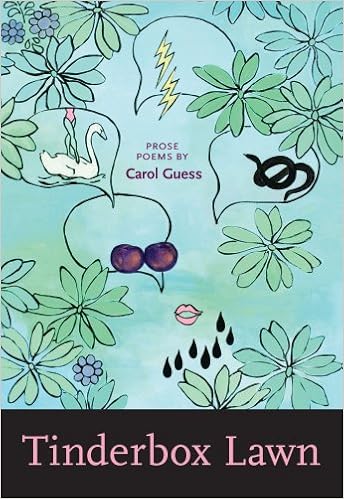
Tinderbox Lawn - Carol Guess (Rose Metal Press) + Human-Ghost Hybrid Project - Carol Guess and Daniela Olszewska (Black Lawrence Press)

Today's book of poetry:
Tinderbox Lawn.  Carol Guess.  Rose Metal Press.  Brookline, Maine.  2008.

Image result for tinderbox lawn carol gues

and

Human-Ghost Hybrid Project.  Carol Guess and Daniela Olszewska.  Black Lawrence Press.  Somewhere in the upper north-east.  2017.

Image result for human-ghost hybrid project

Today's book of poetry is entering uncharted waters.  This, our 806th blog/review, is our first post where we have tackled two books, one by a hybrid Human-Ghost, and the other by Carol Guess.  That's where we'll start, Today's book of poetry thoroughly enjoyed every second we were in Tinderbox Lawn.

Utterly charming with overshadows of dark and unforgiving wit.  Carol Guess beats the craps out of sardonic.  Tinderbox Lawn is a conflagration of tidy and tardy prose poems that collectively report on a fractured world.

Tinderbox Lawn is reporting the news of the day and every page feels like a scoop.  Think Lois Lane channeling Lucy Riccardo and Anne Sexton.  Though untitled, these harmonically connected bon bons and bon mots paint a rather fully textured picture.  Guess give us new entry points to our own imaginations.

. . .

We watched the girl through her open window. 45th Street
was hot but she was on fire. We were thinking we should
fuck her as she undressed in front of a face or a mirror. I
said look at her hair, soft. You said look at her lips, bloom.
We'd prepared our room: dog in her cage, silk over skylights
because of the heat. You said she's sweet.  I said three's
sweeter. And after we'd take notes on who was better.
Seattle had never been hotter. You had a bottle and I had a
bottle. A building caught fire, rows of condos attached at the
hip. Fire trucks slipped on glossy pavement. Water filled the
moonlit basement. A man flew from a balcony into the air.
Ash stained our hair and the whorls of our dresses. Water
caressed us, the thick blue knife slicing away burnt boards
and glass. We lit cigarettes off the burning grass and breathed
smoke until the streets were clean, the dog lay dreaming,
and you were mine again. Breezes fanned the trees and the
tinderbox lawn. Both the window and the girl were gone.

💥💥💥

Tinderbox Lawn was entirely a first class gas.

Human-Ghost Hybrid Project teams up Carol Guess with Daniela Olszewska, together they conjure the Human-Ghost and the Human-Ghost is another gas altogether.  Sublime.

Human-Ghost Hybrid Project is made up of short, prose poems, much like Tinderbox Lawn.  Human-Ghost sounds a lot like Carol Guess, but also like someone new, something new, enter Daniela Olszewska.  Today's book of poetry doesn't know how these two shared the reins but they sure do gallop.  Today's book of poetry does have some experience writing poems with another poet, my associate and I would like to think the results were fruitful.  With Human-Ghost Hybrid Project there is no doubt the success of these poems.

Humour makes up a large part of the Human-Ghost mystique but that's just a clever entry point to the radical possible the Human-Ghost seems to champion.  There is all sorts of poetry magic happening in these lines.  The poems have titles like "Parking Garage Pastoral" and "Watering the Dead", both great titles, stand alone three word poems in fact.  Once you get inside this book these poems, sometimes disguised as fables, you see that Human-Ghost has a new paradigm for Human-Ghost world.

Superstition Sale

On Sundays, we set up a fort and sell wind-up woodland animals
painted to look like moral imperatives. Let's try and sustain our
autumnal wet-fruit-wrapped-in-hair-smells. We aren't hapless; we
just dress this way to people will give us a little less guidance. On
Monday, we scrap whatever's unsold: usually crows and tube-nosed
bats and wind-up foxes. We junk their parts for baby seals. No one
wants black cats' eyes or boys raised by wolves.

💥💥💥

Human-Ghost Hybrid Project had much the same affect on Today's book of poetry as the somewhat haunting Tinderbox Lawn.  We were wildly amused, animals are named, a text message arrives in a bottle, the flattest robots are revealed and rowboats meet royalty.  What more could you ask?

Guess and Olszewsky have, without ego, merged into a single entity, a singular voice, Human-Ghost.  Today's book of poetry digs the Human-Ghost and gets off on their clever burn.  We can only hope this hybrid hothouse finds time to go exploring again.  Witty gets over-used and smart just won't cut it.  Carol Guess and Daniela Olszewska do it right.

Eyelet and Eyesore

The boss said prenup, not pre-need.

Here I am, married to my job again.

Sometimes a girl just has to wear white, trip over her veil on the
way to HR.

The honeymoon was downsized off yachts overlooking offshore
accounts.

It isn't easy being smarter than Marketing or negotiating a
rainbow-colored parachute without a ripcord.

Even my dress dressed down on casual Friday, leaving me unlaced
and French-cut in the breast pumping closet.

We down corporate coffee on company time ("we" meaning "me
and peeps at my pay grade").

We passed notes in infrared ("we" meaning "the two secretaries
from Legal").

My dowry was ivy-covered, everyone meant for me to wed up.

Every Halloween, I costume in a new First World Problem.

I love my ability to love whatever loves me back, it makes me stay
slim enough to look good in lace.

All day long, I've been surfing the web for vintage jewelry. My best
friend from college wanted to be an astronaut. I don't know whether
or not I should send her this link about the planet they just
discovered: it's made entirely out of diamonds, it's like four
thousand light years away.

💥💥💥

Today's book of poetry admires this poetry very much, it beyond our imagination to write, but reading it is pure pleasure.  Carol Guess and Human-Ghost partner Daniela Olszewska are welcome at Today's book of poetry any time.

Image result for carol guess poet photo

Carol Guess

Image result for daniela olszewska photo

Daniela Olszewska

ABOUT THE POET
Carol Guess is the author of numerous books of poetry and prose, including Darling Endangered, Doll Studies: Forensics, and Tinderbox Lawn. In 2014 she was awarded the Philolexian Award for Distinguished Literary Achievement by Columbia University. Recent BLP titles include With Animal, co-written with Kelly Magee, and Human-Ghost Hybrid Project, co-written with Daniela Olszewska. She is Professor of English at Western Washington University.

Daniela Olszewska is the author of three full-length collections of poetry: cloudfang : : cakedirt (Horse Less Press, 2012), True Confessions of An Escapee From The Capra Facility For Wayward Girls (Spittoon Press, 2013), and Citizen J (Artifice Books, 2013). With Carol Guess, she is the co-author of How To Feel Confident With Your Special Talents (Black Lawrence Press, 2014) and Human-Ghost Hybrid Project (Black Lawrence Press, forthcoming).


806

DISCLAIMERS

Poems cited here are assumed to be under copyright by the poet and/or publisher.  They are shown here for publicity and review purposes.  For any other kind of re-use of these poems, please contact the listed publishers for permission.

We here at TBOP are technically deficient and rely on our bashful Milo to fix everything.  We received notice from Google that we were using "cookies"
and that for our readers in Europe there had to be notification of the use of those "cookies.  Please be aware that TBOP may employ the use of some "cookies" (whatever they are) and you should take that into consideration.

Thursday, November 15, 2018

Flatlands - Ruth Williams (Black Lawrence Press)

Today's book of poetry:
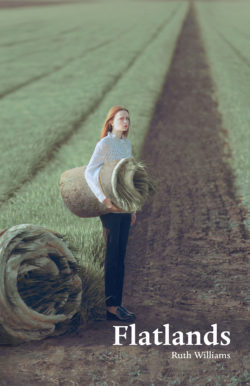
Flatlands.  Ruth Williams.  Black Lawrence Press.  Pittsburgh, Pennsylvania.  2018.


Today's book of poetry is parroting Erin Belieu when we say that the spirit of Willa Cather breathes sturdy throughout Ruth Williams most excellent Flatlands.  But that is a narrowing of focus when Williams has so much more to offer.

An old man's perspective on a young woman's poems has to be taken with several large grains of salt.  So Today's book of poetry will tell you our secret methodology.  Today's book of poetry grew up in a matriarchal home environment with four sisters, all of fine mind, and when reading I sometimes call upon them.  I ring the poems off of their ears to see if what feels true to me feels true to them.

Radial Plain

     As she lay with her eyes closed, she had again, more vividly than for many
      years, the old illusion of her girlhood, of being lifted and carried lightly by
     someone very strong[...] She knew at last for whom it was she had waited
     and where he would carry her.
     —Willa Cather, O Pioneers!

In my 13th year, hanging
the laundry, the white sheets
were like blowsy dresses
and my heartache

was a new
nostalgia, the plains
the leavening,

grasses a long cry,
the hair of my later years
growing before me.

How I spent that summer
like Cather, wanting
the strong arms

of another coming
round me, knowing
that this too was a foretaste

of what it meant to be flattened,
to love like the dirt,
hard, packed,

how fertile then
not to know what
I would become.

💫💫💫

It is hard to point out precisely how she does it but Williams likes to lead the reader down the garden path, gentle them to acquiescence, and then truthpounce them right between the eyes.  Williams is an understated gem.

Flatlands can be read as a book of hard won truths.  The reader can be sure at every turn because Williams makes you want to stay.  Once you've read one of these twisters you're hard wired to want more.

Import

On TV, the fattest man in the world
says his body was the result of
childhood issues.

It's a practiced explanation
I know.

Significantly, he notes,
he began losing weight
when his mother died.

His arms
hang with wings
the pretty doctor
says she'll
clip.

I don't mean to make more of it
than I should.

We are all envelopes
of loose teeth.

💫💫💫

"We are all envelopes of loose teeth."  Today's book of poetry almost fell off of our seat when we read this line, we are thinking it might go on our headstone.

Today's book of poetry has been laying low for the last little while; there are all sorts of unavoidable reasons.  Today's book of poetry will continue on a reduced schedule for a brief period.  We will return to regularly scheduled programming as soon as possible.

Our morning read was full of enthusiasm so these poems came out charged.  They bounced around the office like laser beams of clean, clear light.  Straight as an arrow.

Plain Winter

The winter lengthens. The blank horizon is a way
of being more profound than snow. Inside it, a lantern
swatch of yellow curling over a buried leg.

In pioneer days, they'd tie frozen
bodies to the fencepost. The twine a way of
waiting for spring.

💫💫💫

Ruth Williams is a poet after our own poetry heart.  Today's book of poetry is a big fan of the unadulterated voice, the real voice.  

Williams writes understated bulls-eyes.  There is music here.

Williams

Ruth Williams
Photo: Kira Whitney Photography

ABOUT THE AUTHOR
Ruth Williams is the author of Conveyance (Dancing Girl Press, 2012). Her poetry has appeared in Michigan Quarterly Review, jubilat, Pleiades and Third Coast among others. She has also published creative nonfiction in DIAGRAM and Crab Orchard Review as well as scholarly work on women’s writing and feminism in Tulsa Studies in Women’s Literature, The Journal of Popular Culture, and College Literature. Currently, Ruth lives in Kansas City where she is an Assistant Professor of English at William Jewell College and an editor for Bear Review.

BLURBS
Some writers approach the Nebraska plains as a big, empty other into which they may imagine. I understand the appeal of that mythology. But in Ruth Williams gorgeous new collection, Flatlands, the landscape is as alive as the plains truly are, and serves as both a generating place and quixotic companion to Williams's subtle, precise speaker. Throughout the poems, Williams images are beautifully wrought and full of surprises: a salmon being filleted opens like “a girl’s coral dress come undone,” and the "night heat” of spent fireworks sleeps in the hands of children who are “ready to knock.” I love this book—it’s musical syncopation, the tight, clean transparency of the poems’ lines. I think Willa Cather, the collection's genius loci, would admire Williams’s work, recognizing its fundamental truthfulness. Which is about the highest compliment I have to give.
     —Erin Belieu, Author of Slant Six, Co-founder, VIDA: Women in Literary Arts

Ruth Williams' Flatlands starts from the premise of emptiness and uncovers resources for what can be found and what's to be made. Landscape, identity, desire, the past and the moment—the distinct constellation of her concerns is thrown into focus by a taut, understated craft. These seemingly casual observations break out in bursts of insight flaring against the broad horizon.
     —Don Bogen, author of An Algebra

Written in the key of Willa Cather and in kinship with the spare and located writing practice of Lorine Niedecker, Ruth Williams’ Flatlands could very well be a continuation of the Prairie Trilogy. A subtle defiance circulates through these poems—a book of mouths—whose investments include the erotics of place, gender expectations, insecurity, and boredom—the "radical blah" that fills in and out so much of a life. Williams works through what it means to be from and in a place, understanding we are shaped by land and language. In an era of platitudes, I admire the reluctance in these poems, balanced by awe that our bodies may be our best souvenirs—“I don't mean to make more of it/ than I should.// We are all envelopes/ of loose teeth.” Reading Williams’ poems, I feel a little less weary about being a packet of debris, about being, in general.
     —Kristi Maxwell, author of That Our Eyes Be Rigged

In Flatlands, Ruth Williams turns her surroundings into well-crafted poems that deeply explore the physical and metaphorical landscape. We glimpse youth growing into maturity through a lens of desire and the elusive nature of love. Williams’ poems are filled with imagery, making inventive use of repetition (“Radical Blah” and “Sister” poems), syntax (“Surviving on Equations”), surprising, delicious sounds (“His Georgette”), and more. Her poems wisely lead us up to the edge, to the sense that there’s more beneath what is said. A fine collection.
     —Twyla M. Hansen, Nebraska State Poet, author of Rock • Tree • Bird


727

Poems cited here are assumed to be under copyright by the poet and/or publisher.  They are shown here for publicity and review purposes.  For any other kind of re-use of these poems, please contact the listed publishers for permission.

We here at TBOP are technically deficient and rely on our bashful Milo to fix everything.  We received notice from Google that we were using "cookies"
and that for our readers in Europe there had to be notification of the use of those "cookies.  Please be aware that TBOP may employ the use of some "cookies" (whatever they are) and you should take that into consideration.

Friday, March 2, 2018

This Much I Can Tell You - David Rigsbee (Black Lawrence Press)

Today's book of poetry:
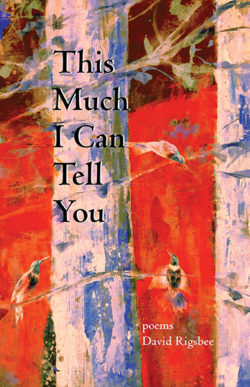
This Much I Can Tell You.  David Rigsbee.  Black Lawrence Press. Pittsburgh, Pennsylvania.  2017.


This Much I Can Tell You is a curious cat.  You wonder/wander about within the comfortable environs of superbly constructed poems, almost formal in their elegant narratives, and almost Chandler like.  Yet within the same narratives The Cure might purr their particular nectar or Richard M. Nixon may stroll through to cuss the cat.

Today's book of poetry is clumsily trying to say that David Rigsbee is an excellent juggler.  Rigsbee has no problem with holding three or four disparate ideas together with nothing between them but air, brief moments in time, and slight of hand.  Being the craftsman/old-pro poet/juggler that he is Rigsbee brings it all home with an astute and gentle logic.

This Much I Can Tell You

Sometimes it feels as if the mind
will seal itself up and you can go
a great distance without ever seeing
those who ever spoke your name.
You hear everything from cacophony
to a symphony played on instruments,
provenance unknown, stored out of sight
long ago. It is a closed system
but vast, and time unfolds there too,
unrelenting, nothing in abeyance,
like animal eyes suddenly appearing
in the roadside weeds and fields,
through which the highway plunges,
and on it a car traveling, not speeding,
not hanging back either. This much 
I can tell you: there is smoke
beyond the mind, to which the mind turns,
as to a burning house, flames raging,
spurting from the second story windows.
Shouldn't you be running up the lawn?
Shouldn't there be, in truth, more fires?

...

More fires.  Rigsbee people's his poetry with every character from a racist southern Governor Wallace to the German philosopher Hegel and Roy Orbison singing all the high notes and Paul Valery not singing at all.  Frankie Avalon and Lou Christie both sing falsetto, they are both clamouring for the bright light and worrying about the front of the stage until Pavarotti saunters in to take his natural place center stage.  

Singers and philosophers litter Rigsbee's poems like touchstones.  You might think that these characters are distracting but in fact Rigsbee uses our knowing these names and their stories to access a vaster recess in our curious brains.  This Much I Can Tell You coils around these associations and our prior knowledge.  David Rigsbee has a bigger plan than we first see, this discourse is in search of truth and joy.

Unfriend Me

I used to crank up that Toni Braxton song
when I drove through the mountains of Virginia
at night on my way to a certain apartment
on a hill. And I used to find my edge
at the tip of my finger, some unbefitting
thing, some toy Rubicon, and press Enter.
I was one inch above the law, above
public order and good behavior, but,
I could argue, within the standard deviation.
Meantime, I was this other person too. Now
the part you have to believe, since unbelief
has been my downfall, is that I put the truth
out there unvarnished, yet weirdly shining,
like some creature just discovered next
to a volcano vent at the bottom of the ocean.
I put it out there to be examined, named,
prized maybe, then put appropriately away.
The way we do. The way scientists do
because as some point they have to get
home. So much is going on in the ordinary
there's no need to track the specimens.
There are containers and labels at the ready
for that. As for home, the man finds love
in the trivial urgencies, the flotsam and small
change, homework, bills, dishes, whatever,
and later that night the husband drapes
his arm over his wife and covers her crotch
with his big, plain hand before the first dream
is even finished, and she, also dreaming,
covers his hand and tenderly pulls it away.

...

This Much I Can Tell You sets a firm tone, Rigsbee has important stories to tell us and wants to present as a stern advocater of history's firm lessons.  But ultimately hope and joy tip the scales.

Our morning read was held under ominous winter type clouds.  We had Coltrane playing in the office this morning as his "Alabama" seemed an appropriate silver lining for this grey, grey day.

The King of Thebes

There were the barefoot girls in see-through dresses,
and she had been one of them. She pauses to let that
sink in. Just then a house wren flies up to the window,
looks in curiously and darts out of the frame.
He knew them too, so many summers back, so many
towns-with-a-square ago. His were different beaches,
some with bunkers that spoke of an even older time,
all with the rippling seas grass, as if people leaned
against a cordon, waving to their favorite movie stars
who stepped from limousines, faultless in tuxedos
and furs, and made their way to the premiere.
She speaks in a low, conclusive voice across the table,
opens a fresh pack of cigarettes and selects one
from the back row of the pack, like a magician
choosing a helper from the back of the nightclub.
There are no more birds now, and the window frames
her head, the new hair not as glamorous as the old.
Then there is the whisky, which has been sitting on the floor
by her chair, named after a man, himself silhouetted
on the label. She speaks of the first husband, now dead,
how he had squirreled away boxes of porn, even
as he descended into Hades with his memory wronged
by the ghouls sent to pick through his remains.
Pity rises in his mind, though he knows it doesn't belong there.
She pushes the cigarette pack in his direction,
but he only remembers, for a moment, his father hunched
and terminal, and then all those other men
who fought so bravely when the war crashed ashore.
They are small figures now, punctuation marks that guide
the mind across its terrain. He knows the girls
on her beach; they too wish to be accorded a name,
but he can't come up with any. He may have slept with a few
once, but birdsong leaves everything winsome and vague.
She means to say there is greatness abounding
in small amounts, blowing smoke that the screen catches
and directs outside. His pity is abstract to her,
like a ceremony where presence is a placeholder, when men
in suits stand silently by women in dark gowns,
having discharged the obligations of the outside
to the inner force that drives the bridegroom to unite
with the sailor. But she is a friend to such sacrifices,
and she deserves the bottle at her foot, the whisky
she sips from a cup, as though it were the King of Thebes
who offered up a toast, lest the war be forgotten,
lest it be turned over to the bird, still audible
above the angry traffic, the horns, and the jackhammer.

...

David Rigsbee's instantly accessible narratives burn brightly.  Along the way he forges out a voice that knows what Mishima knew, explains it all like Auden.

How good is that.

Rigsbee

David Rigsbee

ABOUT THE AUTHOR
David Rigsbee is the author of 21 books and chapbooks, including seven previous full-length collections of poems. In addition to his poems, he has also published critical works on Carolyn Kizer and Joseph Brodsky, whom he also translated. He has co-edited two anthologies, including Invited Guest: An Anthology of Twentieth Century Southern Poetry, a “notable book” selection of the American Library Association and the American Association of University Professors and featured on C-Span Booknotes. His work has appeared in AGNI, The American Poetry Review, The Georgia Review, The Iowa Review, The New Yorker, The Iowa Review, The Ohio Review, Poetry, Prairie Schooner, The Sewanee Review, The Southern Review, and many others. He has been recipient of two creative writing fellowships from the National Endowment for the Arts, as well as a NEH summer fellowship to the American Academy in Rome. His other awards include The Fine Arts Work Center in Provincetown fellowship, The Virginia Commission on the Arts literary fellowship, The Djerassi Foundation and Jentel Foundation residencies, and an Award from the Academy of American Poets. Winner of a 2012 Pushcart Prize, the Vachel Lindsay Poetry Award and the Pound Prize, he was also 2010 winner of the Sam Ragan Award for contribution to the arts in North Carolina. Rigsbee is currently contributing editor for The Cortland Review.

BLURBS
"Another name for this book could be The Museum of Life As We Know It Today. From public figures like Mishima and Nixon, from musicians like Frankie Avalon and Roy Orbison, as well as the Cure and the Everly Brothers, Rigsbeewalks us through our past and present even as he points us toward the future. The world that awaits will be a beautiful one as long as it contains poets and poems like these."
     --David Kirby

"For decades now, David Rigsbee has crafted poems of a bracing lyrical intensity that is both refined and tough-minded. His new collection shows him working at the height of his considerable powers: these are poems of heartfelt retrospection and surprising associations. Above all, they celebrate the blessings and consolations of a cultured life, one that can honor Auden and Roy Orbison, Faust and one-hit Doo Wop groups. These elegant and lovingly constructed poems deserve to be read and—more importantly—reread."
     —David Wojahn


David Rigsbee
Reading for The Cortland Review
Video:  Cortland Review


662


DISCLAIMERS

Poems cited here are assumed to be under copyright by the poet and/or publisher.  They are shown here for publicity and review purposes.  For any other kind of re-use of these poems, please contact the listed publishers for permission.
We here at TBOP are technically deficient and rely on our bashful Milo to fix everything.  We received notice from Google that we were using "cookies"
and that for our readers in Europe there had to be notification of the use of those "cookies.  Please be aware that TBOP may employ the use of some "cookies" (whatever they are) and you should take that into consideration


Wednesday, November 8, 2017

Aroma Truce - Terrell Jamal Terry (Black Lawrence Press)

Today's book of poetry:
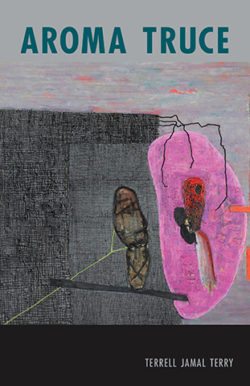
Aroma Truce.  Terrell Jamal Terry.  Black Lawrence Press.  Pittsburgh, PA.  2017.

Terrycw


"We go inside through the doors
of libraries & bars  --  lonely
by choice because we're choosy."
      from "A Dusty Portrait"

"We take up topics we cannot
comprehend: strange things
about untreated weather."
     from "Woman Peels Water"

Today's book of poetry is always drawing conclusions and we'll be the first to admit that we might be wrong but here we go --  Terrell Jamal Terry's solid Aroma Truce is no truce at all.  It's a silver-tongued indictment disguised as love poetry.  It's the poet telling us to:

"Make a little space's
because death's a parade.
Don't hate the way it loves you."
      from "Segue Gauze"

Terry is confessing, firing a warning shot over the bow with beautiful contempt and butterfly footwork.

How I Came Here

Grab shade, shed & mend how I
broke open into real things,
leather & woodlace. I brushed
hardwire music away from my life,
towards woods to burn
throughout half-painted winters.
I picked the dark glass from my head.
I didn't enter for politics
or to persuade--how I came here
was the same way as weather,
a bemused breath stain, but liberation
let the bathrooms be clear.
Unfocused wolf-shaped lightning
over the beach air is the sauce.
Turn your head--freshness.
All night walk. Four or five hours
from a bus stop to bedtime
& that feathery pink smell of a KJV's
barely touched, crisp pages.
I drive my feet dreary. I'll walk
the round staircase, spin the knob it not
knock the door down.
Obsession bursts, my name naps
raining splinters or else,
what am I doing in super-blue
with these cottony glands?

...

Today's book of poetry thinks Terry's Aroma Truce is a conversation between Terry and himself.  Sometimes we need to give voice to more than one side of a consideration before we allow it to be real.  Terrell Jamal Terry reins in his discord with reason but these poems still burst at the seams with a tethered aggression.

Terry is too smart to let loose his hold completely on his emotions, even so these almost polite poems snap, crackle and pop with a dexterous intensity.

Door

To deprive or provide the full disclosure
& afford a relaxed richness
of concealment. I'll write this:

here is a door; everywhere before was
& since is not. Save for me some
honest work. Tell me where we can live.

Maybe tomorrow. Come early--spelled
with my lungs. By late morning
what's beneath begins your only voice

in need. The crackle of that first word
& then more clean hope waking,
as the sores of scientific names slip

past the latch of meaning mistaken.
Voices in eyes wipe the slick moisture
to see what wasn't, to say I don't

see through, asking where is the kind light?
The plan is now a strayed leaf crumbling
in an unmade hour washed by the sun.

If the vulnerability of bare eyes requires
no protection, you may have to trust
as glass gets crushed in a garden of terrors

& treats each tragedy with equal indifference.
Did your kidnapped lover come
back? Where you rock-wrapped in pain?

They weren't taken away. Time unravels.
You've sat under a miraculous long shade,
your thoughts removed from cold violence.

...

Today's book of poetry's morning read was slightly delayed by an excursion by moi to another province.  Our one and only patron saint and benefactor, the beautiful and mysterious K, works in Quebec and bicycle season is now over.

When I returned to the office Charlie Parker was dancing around the place like he owned it.  Dizzie was on the box as well along with Bud Powell, Roy Haynes and Tommy Potter.  They sashayed around the place like they owned it.  Well, there was no way I could complain about that but we do like to have the morning read without distractions.  I promised my unruly minions that Dexter Gordon would show up following the read; Only Flight Up - "Tanya", parts I and II.  That did the trick.

Terry's poems read like elegant sprints full of harnessed rage.

"I got your texts.
They were odd with wild clarity. However,
I am tired in a tangent over a half-century
of technology I don't love or loathe.
I hear the molecules mule your mind.
You are as elusive as warmth in ice,
with your wet stars & endless jovial motives."
      from "Wrinkled Respite"

Our gang ate them up.  Aroma Truce made for a very spirited reading from the minions.

Nightmornings

Damn, we die.
I'm a few blocks from the biblical cemetery.

White doors open.

The water is warm
with quiet vagueness.

I carry a secret morality,
a homemade cosmology
in notebooks.

Compassion is a dirty word.

I'm more curious about
planting myself
& not being bored wet.

My thought are movies
passing the graveyard's vapid flowers.

When it's dark in the morning
I approach with desperate eyes.

Before I reach the tiny market
I'm tearing packages apart.

There's no need
for actual touch
on islands in the city

I trust mostly mystery
& subtle beliefs,

the brown river & selfish escape.

...

"I lose interest in sugar."
     from "Limn"

Terrell Jamal Terry's Aroma Truce is strong stuff.  Death is such a staple that it frames almost every page but Terry is never morbid or lurid.  There's a haunting warning of the inevitable, of the maybe, maybe even of the hopeful.

Terry fights the urge to write flat out love poems but he springs a few longing/lusting moments at us that are both poignant and doomed.  He knows it.

Today's book of poetry thinks Aroma Truce is a stunning first book of poetry.  More of Terrell Jamal Terry is what the future needs.

Terry
Terrell Jamal Terry

ABOUT THE AUTHOR
Terrell Jamal Terry is the author of Aroma Truce (Black Lawrence Press, 2017). His poems have appeared or are forthcoming in Denver Quarterly, Poetry Northwest, The Literary Review, The Journal, Green Mountains Review, West Branch, Crab Orchard Review, Guernica, Washington Square Review, Columbia Poetry Review, The Volta, cream city review, the anthology Bettering American Poetry 2015, and elsewhere. He resides in Pittsburgh, PA.

BLURB
The poems in Terrell Jamal Terry’s Aroma Truce announce their arrival with language that is both instinctual and inevitable, “the same way as weather,” the speaker tells us in the opening poem. Each poem creates its own stunningly perfect world, yet somehow each of these worlds manages to open up and say something about the one we inhabit. Through this continual unfolding, this is a book for our time, a book of both “frail worry” alongside “stubborn hope,” a book that offers desire alongside what one might hope for others: “I would like goodness & to be good.”
     —Adam Clay

An auspicious and powerful debut, never satisfied with the seam between the spiritual and the sensual, the anecdotal and the merely true. “Don’t guess,” Terry admonishes—indeed, every line of these poems feels hard-won from the guesswork of experience and language. “Do I go too far / with this?” Terry asks; “That’s not everything. / Animals & rain. My body, it stings.”
     —G.C. Waldrep


626

DISCLAIMERS


Poems cited here are assumed to be under copyright by the poet and/or publisher.  They are shown here for publicity and review purposes.  For any other kind of re-use of these poems, please contact the listed publishers for permission.


We here at TBOP are technically deficient and rely on our bashful Milo to fix everything.  We received notice from Google that we were using "cookies"
and that for our readers in Europe there had to be notification of the use of those "cookies.  Please be aware that TBOP may employ the use of some "cookies" (whatever they are) and you should take that into consideration


Monday, November 7, 2016

The Czar - Mary Biddinger & Jay Robinson (Black Lawrence Press)

Today's book of poetry:
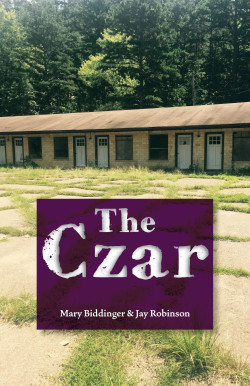
The Czar.  Mary Biddinger & Jay Robinson.  Black Lawrence Press.  Pittsburgh, Pennsylvania.  2016.

9781625579485

The Czar is an elegantly seamless patchwork quilt, an on-going riff trilling electric about the fate of the modern world and all of us peasants bouncing around in it.

Who is this Czar?  Mary Biddinger and Jay Robinson never say for sure but Today's book of poetry thinks it's a metaphor.  

Today's book of poetry would be very curious to know the process used by Biddinger and Robinson, how to meld two poets into one, because The Czar speaks with one clear voice.

The Czar, the character, not the title, is a mitigating dictator.  The Czar is looking over your shoulder as you read this.

The Czar

To those who can afford underpinnings of quality.

To those who dine on other people's roof-straw.

To those directly responsible for increased surveillance.

To those owls who know but don't consent or tell.

To those whose voting stickers never adhere.

To those princes you dealt with accordingly.

To those who doubt the true innuendos of torture.

To those directly responsible for Miley Cyrus.

To those pollsters you later seduced with mints.

To those who insist every vote should count twice.

To those who dine on salami every day for lunch.

To those faxes we sullied with biological materials.

To those who grow a beard when they shouldn't.

To those undergraduates who dine on each other.

To those walls you climbed -- naked and drunk on icing.

To those who secured the borders of my pants.

To those workers who bodyguard the potholes.

To those who cannot afford free health care.

To those directly responsible for bathing the Czar.

To those directly responsible for the Virgin Afterbirth.

To those peaches, actual peaches, not innuendos.

To those miniskirts I refused to wear in the elevator.

To those owls who occupied Wall Street.

To those directly responsible for your orgasm.

...

It has been quite some time since Today's book of poetry has come across a book so ripe with list poems and we are delighted to include this one.  The Czar is peppered with them.  Nicely spiced.

Biddinger and Robinson start this Czarfest off with a quote from old Nicholas II, and frankly, he was last real authority on the matter before Biddinger and Robinson.

     "I am not yet ready to be Tsar.  I know nothing of the business of ruling."
                                                                             -- Nicolas II

True to form, our Czar is flawed, often unprepared.  But in a world of dictators both large and small, real and imagined, it is reassuring to find a fallible fob fop Czar.

The Czar

Ironically, the Czar was a terrible student of foreign languages.
His parents complained to the principal. He called his OEUVRE
his OUVRIR. He'd spend the rest of his life attempting to open
someone or another. The Czar thought a body of work was for sex
(emphasis mine). His biggest challenge was the pluperfect. One
day he was taking a piss at work and terrified himself with the
prospect of pissing in the same pissoire for the next thirty years.
Not to mention...

The Czar recalled the word for rabbit in French, but asked for a
fish at the small game restaurant. We will not speak of the brief
tutorial regarding Belgian engineering. In Mexico, the Czar
announced himself as an organ thief, and then placed his request
for The Entertainer. He claimed Sister Carrie to be his favorite
Russian novel, the best cure for hangover to be another trip to Las
Vegas. What happens in the Czar's fancy room never stays in the 
Czar's fancy room...

Once, as a sophomore in college, the Czar drove to Canada. He
took a wrong turn, ended up in Montreal instead of Windsor. Every
map looks like it's written in the Cyrillic alphabet, he said to his
roommate. But he had a bottle of Wild Irish Rose in a thermos and
one foot out the window. Both of them drunk on freedom for the
better part of a dozen hours. The Czar thought the Cyrillic alpha-
bet a soup he hadn't been served as a boy. His roommate laughed,
got left beside a sagging barn outside Ottawa...

But the Czar can roll a joint in any language. As a Czar, he could
make a priest confess. We will not speak of this, the Czar mumbles
to an otherwise preoccupied prostitute in German. We will not
speak of this...

...

The Czar gets around.  This morning's read of The Czar in our office was a rollicking tic-tac-toe affair. Milo was in top form, he is our head tech.  Kathryn, our Jr. Editor was equally splendid and in fine Czarina form.  The big surprise was Max, our Sr. Editor and former Bolshevik.  He burst out of his office all hammer and sickle eyed and ready to read.  It's always a treat when Max reads, he gets his voice into every corner of the room.

The poems in The Czar have a cumulative affect on the reader and when Max started bouncing them around everything else stopped.  These are wicked smart whippet poems, bounding by with such ease and handsome energy that you hardly notice the power.  Biddinger and Robinson have ample reserves, their Czar has moxie.

The Czar

wonders if his mistress is taking things
seriously. A little less time as Bjork

the swan, a little more Lady Gaga
in her meat frock. Somewhere the spin

cycle stops spinning. Somebody's ears
pop. But it's another day in this empire.

Cold feet, Advil, layers. V-neck sweaters
in the top secret paper shredder. The

Czar plans a trip to Paris but forgets
to pack the trip. His mistress suggests

what she calls the Carbonite Method.
It's a fancy name for the Czar's favorite

number, the one only he was allowed
to screen print onto his baseball jersey.

Well, he's the Czar, one parent said. We
never give up, his mistress observed,

but we might go down. She was 12, and he
was a spring training enthusiast. Now

he's a baseball card of bloated stats.
His mother never realized that Duffy's

Tee House was actually a head shop.
She inquired the price of a brilliant red

hookah, wondered where the flowers
were supposed to go, while the Czar

selected a Van Halen iron-on for front,
fuzzy Courier letters to spell out CZAR

on back (ringer tee, of course, striped
sleeves). Sometimes his mistress still

wears this shirt. It used to be her sole
garment at bedtime. Now she wears it

beneath the first of two lumberjack
flannels, practically undetectable,

much like her attachment to the Czar,
which is all undershirt, zero bra.

...

The Czar is a modern construct and an intriguing everyman/everywoman, The Czar is a marvelous book.  Mary Biddinger and Jay Robinson have created a thoroughly modern character to live among us.

"Somebody gets the last laugh. Somebody gets crumbs."
                                                      - The Czar

Mary Biddinger

ABOUT THE AUTHOR
Mary Biddinger is the author of the poetry collections Prairie Fever (Steel Toe Books, 2007), Saint Monica(Black Lawrence Press, 2011), O Holy Insurgency (Black Lawrence Press, 2013), A Sunny Place with Adequate Water (Black Lawrence Press, 2014) and Small Enterprise (Black Lawrence Press, forthcoming 2015). She is also co-editor of The Monkey and the Wrench: Essays into Contemporary Poetics (U Akron Press, 2011). Her work has recently appeared or is forthcoming in Denver Quarterly, Green Mountains Review, jubilat, The Laurel Review, and Pleiades, among others. She edits the Akron Series in Poetry at the University of Akron, where she is a Professor of English. Biddinger is the recipient of a 2015 NEA creative writing fellowship in poetry.

Jay Robinson

ABOUT THE AUTHOR
Jay Robinson is the co-author of The Czar. He teaches at Ashland University and The University of Akron. He’s also the Co-Editor-in-Chief/Reviews Editor for Barn Owl Review and helps edit The Akron Series in Contemporary Poetics. Poetry and prose has appeared in 32 Poems, The Laurel Review, Poetry, Whiskey Island, among others. The Czar, forthcoming in August 2016, is his first book.

BLURBS
As a child, my mother taught me to zigzag Z to avoid getting eaten by an alligator. Mary Biddinger and Jay Robinson employ this technique here: in the clever curve of C around the subject, in the sharp switchback tack of Z for zealous. They commit to wordplay revolution, erasing origins, replacing narrative with wit, sound, and imagery so surprising it feels, by poem’s end, perfectly natural: the thing that waited, haunting, in the swamp. I don’t know how else to explain The Czar, whose unexpected becomes so expectant with meaning. This is a brilliant collection/collaboration. 
     - Carol Guess, author of Doll Studies: Forensics

This exquisite, feature-length project is the comic jam. But it's no joke. You can thank Mary Biddinger and Jay Robinson later. For now, arm yourself with a few questions: What rules does this Czar follow? Which ones does he break? And just how many ways can you fold a Czar in the first place? Are you ready? The Czar demands your participation. Enter the parlor!
     - Matthew Guenette, author of American Busboy

This book is not a book, it’s treatise on empire, a manifest destiny, a pack of wild peasants outside the gate, a mesmerizing tour d’effluvia in its Czar not Czar, throne not throne, overthrown mistresses, Lady Czar is no Czarina, cappuccino foam isn’t foam, revolution was a hoax, naming and renaming, unlearned cursive, unheard flute solo, empire under construction, not New York, not Sacramento, non-tabloids, non-violent non-women. Biddinger and Robinson rebuild our world and take it away piece by piece to show the conviviality of our destruction.
     - Elizabeth J. Colen, author of What Weaponry

blacklawrence.com

521
DISCLAIMERS

Poems cited here are assumed to be under copyright by the poet and/or publisher.  They are shown here for publicity and review purposes.  For any other kind of re-use of these poems, please contact the listed publishers for permission.

We here at TBOP are technically deficient and rely on our bashful Milo to fix everything.  We received notice from Google that we were using "cookies"
and that for our readers in Europe there had to be notification of the use of those "cookies.  Please be aware that TBOP may employ the use of some "cookies" (whatever they are) and you should take that into consideration.