Showing posts with label brooklyn arts press. Show all posts

Thursday, October 13, 2016

Take This Stallion - Anais Duplan (Brooklyn Arts Press)

Today's book of poetry:
Take This Stallion. Anais Duplan.  Brooklyn Arts Press.  Brooklyn, New York.  2016.

Take-This-Stallion-website

Anais Duplan has a big voice and Take This Stallion is loud.  Duplan is marvellously excessive in her exasperations, take this title:  "An Account Of A Child Born Alive Without A Brain And The Observables In It Upon Dissection."  

Duplan would also have us believe that her dog is God.  Today's book of poetry followed along with rapt and somewhat nervous attention.

A Fledgling Is A Young Bird
That Has Its Feathers
And Is Learning To Fly

[1]

S-H-E-D-E-V-I-L,
I, on the other hand,
make sure to wash my mouth
whenever I say something slippery. I am washing
right now, ma cherie, with a pen
in my left hand and my page on the rim of the sink
and my right hand is reaching toward you,
you in the mirror, to pull your hair out.

[2]

The terror of having to realize the unrealizable: I am a baby
on the kitchen counter, one of many. My mother continues
to unload us from a crate. The counter is littered with knives.
No one is hurt except all of us are hurt and yearning
to sleep. It is cold. Keep this in mind, it is cold.
My mother, the woman, she is wearing a chain
of children's molars. A man wearing the same chain
appears in the doorway and begins to eat us one by one.

[3]

My mother in a blue apron. It is springtime inside
and outside the kitchen. I hear the dog screech from the yard,
his "body" is caught under the lawnmower
my father is driving. I tell my mother to get off
the machine, to let this one live, but he doesn't listen,
he takes off his apron and steps outside,
sees the dog screeching and by now, it is still springtime.

[4]

You are in control. The day is yellow
in the sense that the grasses are dying. There are animals
dying every minute, waiting, even after their deaths,
to be adopted. Pick up the phone. Pick up the baby
and set it in a meadow. Wait for a bird to settle
on its head and take a photo. Mail the photo to your mother.
Write to her, write, Just this once, just this once,
would you please come to my recital. I promise I will do better
than Jenny. Take the baby back into your hands
and promise me.

[5]

What makes us go all the way to the bottom. The brother had severed
one of his fingers attempting to slice a fig. The mother took him
to the emergency room but only the brother returned. Since then,
I have had to be the woman of the house. I am proud to say
that the brother's fingers have grown six inches since I took over and the father
is very well near portly. I promise to fill them up. I say this every time
I pass the emergency room on the way to bed.

[6]

At least we have our authenticity. This is the last time
I'll ever lend my skin to a man who tells me he'll give it
right back. Keep this in mind: it is cold and my eyes
are too bloated for my head. I have had to squeeze them dry
at day's end. I do this in the bathroom, where a lady is safe
to take her apron off and her eyes out.

[7]

I say to Michael, I say, Michael,
why don't you go out and find yourself a woman. I say,
Michael, any lady would be lucky to let you have her. I say, Take
this cake and take it into your arms and find a woman.

[8]

You are in control. Take this stallion and ride it
to your demise. (Read: the sunset, behind the stars,
the green green garden.) Compare my flesh to yours. Look at my hair:
my neck hair and my toe hair. (Read: I am a woman and a woman
is a woman.) My unconscious is under siege,
Papa Bear. Take up your arms
and throw them around me. Bring a bouquet,
bring your big cowboy hat. Show me how to kill a horse.

...

It's clear Anais Duplan is comfortable going all back-beat to the regular rhythms of things but this doesn't stop her from finding a big, deep groove.  Take This Stallion isn't an easy get - the reader has to take a minute to find firm footing because this is surprisingly new ground.  Anais Duplan is teaching us her new vernacular and it is splendid.

Why Would You Ever Go
To A Pool Party Anway

I.

Anais, you needn't cry
like a baby seal. You needn't wear
your hair long, just to divert
the passing sailors--
                O what flag waves outside the windows
of all fledgling girls
when they detect
what lives
between their legs.
                                   John Paul once said to me,
O Anais, o Anais, what lives between your legs,
and I opened up to him, put his hand inside me
and said, This is the fiery throat of God -- be careful.
You may find you are no longer every-
thing you had been
before you arrived.

II.

He said, she said, we wrote of a great awakening.
Instead of death we only moaned
every time the sun did wane and how
it waned every morning. Today could be
the day that does not end
in your death-
ly embrace.

...

A lot of fun at this morning's read.  Take This Stallion lent itself to a dramatic show.

Not sure how Anais Duplan has done it but Take This Stallion feels like a strange familiar.  I know I have never been here before and some of the language is foreign but these poems ring the ears off of my inner reader.  I'm happy/sated, deja-vued and curious for more.

I Felt Like A Traffic Light
As Soon As I Got Inside You

I.

This is how to be honest:
I learned it on the subway: look
me in the eyes and tell me

I'm not beautiful. Sometimes
it's best just to drop out tune down
let go so ever so deep. So deep

was her throat and how the gods
did sing, how the dog doth sing,
Happy birthday, darling. And thank you, too.

II.

I met a girl named Martha
with eyes as big as Arizona,
relative to other states.

Martha, I promise to change
your bandages forever 'n'ever,
and if the doctors should ever say,

O Anais, Martha will not survive
without your limbs, I would
tear them off one-by-one.

III.

Lift me up --

I am looking at the neighbor's wife,
I am looking at the neighbor's wife
and wond'ring where she buys her things.

Lower me down, just below your eye-
level and tell me about the time

your mother made you wear clothes you didn't want to wear.

IV.

Never forget to greet the doctor in the room,
I know it was your birthday but I never got
the prescription you wrote me.

Dancing is not permitted in certain towns and that's ok
for some. Don't stop get it get it get it get it get it get it
before it gets you.

As soon as you walked into the room
all the flowers said O hell yes.

V.

My life is a ballad, it goes: O
ooooo! I can't breathe
when you hold me so

cold. Get paid get paid
tomorrow. Wake up get
paid tomorrow. You deserve
everything you get.

You don't know nothing and you never did, silly bill.
I don't have a gun but maybe one day I will.

...

It can't just be me.  There are a strokes worth of vicarious thrills both carnal and poetic in this rambunctious first book of poems.  Today's book of poetry will happily champion Take This Stallion until Anais Duplan gives us some more sugar.

Anais-Duplan-BAP
Anais Duplan

ABOUT THE AUTHOR
Anaïs Duplan was born in Jacmel, Haiti. She is the director of a performance collective called The Spacesuits and of The Center for Afrofuturist Studies, an artist residency program in Iowa City. Her poems and essays have appeared in Birdfeast, Hyperallergic, The Journal, [PANK], and other publications. She is an MFA candidate at the Iowa Writers’ Workshop.

BLURBS
“I have never before read a book like Anaïs Duplan’s Take This Stallion. Her major talent is recognizing the self in the other, making for poems that flow forward in a tone of oneness—is oneness a tone?—poems that make evident an ever-expanding world by opening themselves up into that world. This debut does what poets in their fifth or sixth collections are still trying to figure: it balances the intellect, image, music, and emotion in ways so unfamiliar that a blurb couldn’t possible characterize the work.”
     - Jericho Brown

“For all the ways we pad our language with qualifier, with apology, with hedge, Anaïs Duplan is antidote. Her poems are talkative, inappropriate, obsessive, and sexy. They put everything on the table and if there’s no table, she erects one: of the mechanic’s lobby, of men selling peanuts at her door, of the George Washington Bridge underpass, of the ocean. Sometimes the poems hang the air with obsession like tangential rope. like snake. Sometimes they pick up their skirts and dust the ground. Duplan’s work is at once this methodical, and this unhinged. She confirms a fear that drones and Kim Kardashian have more to do with our therapy sessions than we wish. And then at times, she puts all that away, and the poems wash out their mouths. This first collection is, after all, of this world. And though it might be haunted by a voice that says “Don’t be too cocky,” on nearly every page it talks back. Heroic, inspired, and smart: these poems are on their own two feet, saying “I’m always cocky.””
     - francine j. harris

“Take This Stallion is the sound of a generation finding its voice; it is a sound of a generation that has more rapidly than any since the generation that came of age in the 1960’s turned the world on its head, both exposing the faithlessness of the generations before it, and reifying the promises those generations made. Listen: “When she was lost to them/ they took to striking/ each other over the head with empty fists,/ striking until blood ran freely in the city/ ditches. All of this sounding like horses thundering/ into each other, peeling themselves/ off of each other, and thundering/ again. The whole city, this sound.”In Take This Stallion, the whole city is made new, and the maker who re-makes it is new, and the songs they sing as they work are the new songs.”
     - Shane McCrae

Anais Duplan at SPECTRA
Video:  Therese Guise


513
DISCLAIMERS

Poems cited here are assumed to be under copyright by the poet and/or publisher.  They are shown here for publicity and review purposes.  For any other kind of re-use of these poems, please contact the listed publishers for permission.

We here at TBOP are technically deficient and rely on our bashful Milo to fix everything.  We received notice from Google that we were using "cookies"
and that for our readers in Europe there had to be notification of the use of those "cookies.  Please be aware that TBOP may employ the use of some "cookies" (whatever they are) and you should take that into consideration.


Thursday, December 17, 2015

Emergency Anthems - Alex Green (Brooklyn Arts Press)

Today's book of poetry:
Emergency Anthems.  Alex Green.  Brooklyn Arts Press.  Brooklyn, New York, 2014.


This book could walk on water.

Today's book of poetry was re-reading Emergency Anthems in bed last night and screaming out loud as a result.  Luckily K was awake because there was no way she could have slept through my repeated exclamations, shouts of joy and wonder.  How in the hell was Alex Green touching nerve endings I didn't know I had?

K could see and hear my obvious delight and excitement and asked me to read one aloud.  I gave her "The Wide Gates of the Lowlands" and she was hooked, she sat bolt upright in bed and said "I have got to hear another."  I hit her with "All Night the Airfields, Amy Winehouse" and that was it.  K was in, she gave me carte blanche for outlandish displays and loud retorts.  She was amazed too.

It's what David Porter, in his very worthwhile review of Emergency Anthems at Amazon.ca, says, "The best poetry reads like a secret language in which you are already fluent."

Why a Chokehold only Works
if the Person Is Standing near You

On the news you never hear about someone who is good at
karate saving the day; banks get robbed, cars get stolen, buildings
explode, but no crime ever gets derailed by a black belt who can
kick the air into stars and snap limbs behind his back. Once you
signed up for a martial arts class, but in the first few minutes you
tore your groin so badly you felt the muscle split from the bone
and orbit violently below your abdomen. In the car, the pain
vibrated in the new pocket of empty space. When you got home
you needed the retired magician with emphysema to help you
out of your car and into your house. You feel asleep on the couch
to a cooking show in which everybody cheered when alcohol
and cheese got added to pasta sauce. When you woke up, the
magician was still there, sitting next to you and passing coins
over his fingers; you watched the silver rise from nowhere, stand
up like wheels, and roll down his wrists, moving to the best of
what little breath he had left. You could hear how the gears of his
lungs had snapped and were gone--you imagined them wet and
frayed, dangling over the boneless galaxies of his throat. There
was dried blood on the wall, the lights kept flickering and you
were sure you would never be amazed by anything ever again.

...

All hell broke loose at our morning read.  Milo phoned three friends, Kathryn called in reinforcements.  Now all of them are in the back room reading Alex Green with a megaphone Milo made out of my desk blotter.  We are going to need better locks on the doors.  Milo and Kathryn insisted that their friends votes should count, the consensus was we hadn't seen a book we liked more yet this year.

I first read Nicanor Parra's Emergency Poems (New Directions Publishing, 1972) back in the late 70's.  It's been a cornerstone book ever since.  I'm here to tell you that Alex Green's Emergency Anthems is a book I will return to for a long, long time.  Once I love something I love it forever, if I can.

Green has the surgeon's scalpel, the laser touch.  He consistently cuts closer to the bone.  These prose poems are uncanny magic.  In Green's universe there are archetypes and certain seasons that shape the tides of men.  There are sharks and Captains and the end of summer is always looming -- and we feel it all as a new familiar.

Blue Door Option

Everybody knew the magician was dying and this would be
his last party. All of his ex-girlfriends were there -- even Stacey
Mitchell, the news anchor who he had lived with on a houseboat
in the '70s when he held his breath for the whole summer. Today
he was taking requests. He would make birds explode from his
chest, he would steal wallets from anyone in the room, he would
build a house of cards on the back of his hands. All anyone
had to do was ask. But no one did, because they were sure he
would crack in the middle, fall to the floor, and leave something
suspended they could never fix. So instead of magic, he sang an
old Nathan McCoy song about losing something in Hawaii. He
had a falsetto you could feel across your shoulders. His hands
were thin, he hadn't slept in two months, and you were the only
one who knew that a few weeks earlier he had parked his car
somewhere and lost it. When he was too sick to come out for his
own garage sale, he told you to give everything away. You watched
people take his couch, his television, his doves, and you felt like
you were officiating a slow robbery. If you're a decent magician, he
once told you, when you die people will miss you. But if you're a really
great magician, they'll always think you're alive and in the middle of the
best trick of all time. Even though you watched him fade in front
of a machine, heard his breathing disappear like a radio station
slipping off the air, you still look for his now. In the eyes of the
teller at the bank, in the stands at minor league baseball games,
in the credits of independent movies from Iceland. The only way
to be sure is to look everywhere.

...

These novels disguised as poems read like insights in an autobiography you are part of.  Green's personal universe is filled with symbols we somehow recognize, his sad songs a lament so familiar it sounds like an echo.

Green has a Bill Hicks funny bone and a Raymond Carver brain.

Emergency Anthem

When the guy with the gun ran into the restaurant she owned,
stole a strawberry danish, and shot his head off in the women's
bathroom, you stood around the body unsure of what to do
with your hands. The man with the beard and the hat said he
had known a little bit about him, told you he'd swallowed glass
at a party once to prove a point. What was the point, she asked.
Just chewed it up and swallowed it while everyone watched, he
said. What was the point? she asked again. It's probably still in
him, he said. The the police came and did quick math around
the body, all the while not looking worried, as if the seriousness
of a thing depended on how long it took to clean it up. Later,
she closed the restaurant and the two of you sat around the big
black table in the back. She was sad about the man and you were
sorry you had nothing clever to say about dying. On the news a
boy broke a record by skipping a rock thirty-four times, baseball
players were traded for other baseball players to be named later,
and the weatherman you went to high school with said the big
storm was going to be bigger than he thought. You held her hand
and waited for the rain and thought about how terrible it is that
we remember so much.

...

There were lines in almost every poem in this book that made me shout out loud.  

I really do have the best job in the world for a man like me.  Pharoah is barking out "I Want To Talk About You" on the box, I have a good friend coming over and we are going out to lunch, later today I'm meeting K downtown for an event we are both excited about.  And with any luck at all another book of poetry will come through the mailbox while I'm out to lunch. 

Emergency Anthems is THE book I will be recommending to all my friends.  Today's book of poetry believes discerning readers will be doing the same for years.  Alex Green's first book is so much better than I am able to express.

Alex Green

ABOUT THE AUTHOR
Alex Green was born in California and raised in the East Bay. A two-time nominee for the Pushcart Prize in Poetry, his work has appeared in RHINO, The Canary, Mid-American Review, and Barrow Street. He is the author of The Stone Roses (Bloomsbury Academic), currently teaches at St. Mary’s College of California, and is Editor of Stereo Embers Magazine. You can visit him at www.alexgreenbooks.com.

BLURBS
“Alex Green’s work blossoms on the page like small explosions. A surf-side Spoon River tinged with Chandler, Dali, and David Lynch. Neon sunsets, lost girls, grifting tennis instructors, and dazed surfers with bite scars shaped like lightning bolts. And through it all, the dark, swift flash of sharks. Serious and hilarious, Green’s pop culture satire lunges with the same deft surprise as those sharks.”
     -- Tom DiCillo, director of When You're Strange and Living in Oblivion

“Green’s short pieces read like secrets, someone sharing a passion, a bias, a humiliation, a love. They crash into your ears like the surf, and you flip the page, awaiting the next beauty, the next set of waves.”
    -- Joshua Mohr, author of Some Things That Meant The World To Me

“Alex Green is the uncrowned poet laureate of the last day of Summer and his first book is an absolute stunner—rich with metaphor, confessional honesty, and melancholy narrative. In Green’s sun-battered landscape, it’s always the last day of summer, nothing worked out the way it was supposed to, and the optimistic pop songs in the background play a jangly counterpoint to real life disappointments. In the afterglow, he finds humor, revelation, and that much maligned old measure of poetic meaning: beauty. Green forgoes opaque linguistic ornamentation in favor of coherent narrative, honesty, and lyricism. His gift for sudden and surprising metaphors is unmatched. This is a collection to return to over and over again and one that marks the debut of an important and refreshing poetic voice. Emergency Anthems is incredible, my favorite book of poetry of the last five years. Maybe of any five years.”
     -- Jesse Michaels, author of Whispering Bodies


419

DISCLAIMERS

Poems cited here are assumed to be under copyright by the poet and/or publisher.  They are shown here for publicity and review purposes.  For any other kind of re-use of these poems, please contact the listed publishers for permission.

We here at TBOP are technically deficient and rely on our bashful Milo to fix everything.  We received notice from Google that we were using "cookies"
and that for our readers in Europe there had to be notification of the use of those "cookies.  Please be aware that TBOP may employ the use of some "cookies" (whatever they are) and you should take that into consideration.
Monday, July 20, 2015

The Word KINGDOM in the Word Kingdom - Noah Eli Gordon (Brooklyn Arts Press)

Today's book of poetry:
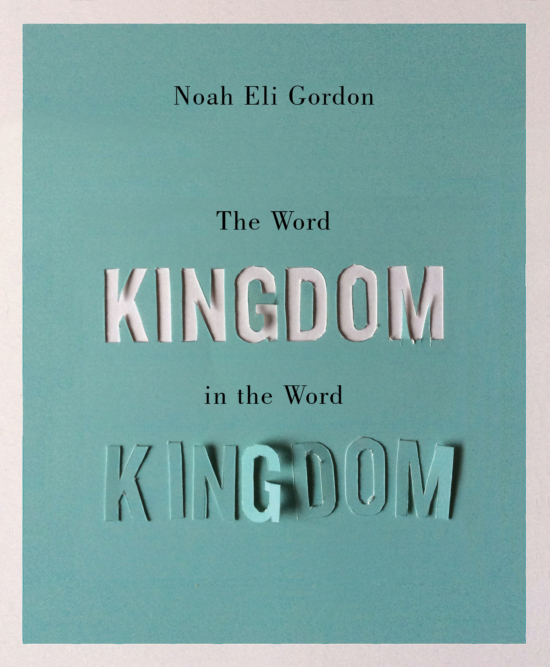
The Word KINGDOM in the Word Kingdom.  Noah Eli Gordon.  Brooklyn Arts Press.  Brooklyn, New York.  2015.


This collections starts with the poem "An Example" in which Noah Eli Gordon invokes the name of the poet James Schulyer and several of his lines of poetry as the center piece of a conversation between Gordon and several other poets.  My ears pricked up Joe Orton style.

One of my favourite poets and the most knowledgeable person I know when it comes to poetry, Stuart Ross, visits my lucky home regularly, almost frequently, often stays overnight, and when he does he rummages through my thousands of poetry titles.  I keep them in alphabetical order, naturally. Almost every single time Stuart visits he alights onto a copy of James Schulyer's book The Morning Of The Poem and then takes it to his room for a fix.

When Stuart Ross talks poetry, as you all know, I listen.  When I saw Schulyer celebrated/honoured in the first poem of Gordon's book The Word KINGDOM in the Word Kingdom -- I knew I had to pay special attention.  Good thing.

Historical Criticism And
The Image Of The Heart

Its beating was always allegorical. One hears it
in a scene where someone crouches
behind something, or in the subbasement
of one's own response to what the day, stumbling in
at an odd hour, strews across the bathroom floor.
Isn't fashion last year's scandal declawed?
The books we'd loved best told us on every page
to wake, whether to hunger, cannon fire,
or the warmth of another's body. As for painting,
its greatest achievements, of which you know
I'm no authority, are replicated in
wrinkled sheets. By you, I mean the both of us.
A new focal point brings the promise
of finally seeing for the first time what we'd been
looking at all along: sunsets. Then photographs
of sunsets. Then better photographs of sunsets.
Then perfect digital copies. Then computerized
reenactments. Then, simply, ones and zeros.

...

It's not just that the poems in Noah Eli Gordon's The Word KINGDOM in the Word Kingdom are precise -- they are, they are laser cut and seemingly predestined, all full of logic and wonder.

At first you think Gordon may be toying with the reader like a cat playing with mice.  But that's not it at all. Gordon is directing, leading, cajoling the reader through a splendid maze of language and opening dazzling doors of light along the way.

An Experiment In Artifice
And Abject-Oriented
Ontology

between a prayer for the telescope

and a prayer for the microscope

pixels flare into the image of an atom

in an anthill an airplane entering

the troposphere an idea orbiting

that of human cognition in the authoritative

shape of earth seen from elsewhere

antiquating the twentieth century's

representational doubt or doubting

representations of ownership

in our condensed book of vigilance

where the absence of a crown

shows hierarchy to have no color

I prefer the muddy ghost of one

sustained cello note over one

hundred thousand science experiments

I prefer two electrified balloons

pushing away from each other

like localized points of reference

perhaps one can love the academic sentence

for its ethical contortions the footnote

for its fishhooks pulling up islands

from an ocean floor perhaps a barge

passing below a bridge exemplifies

a green horizon free from the expectation

of green blackened with carbon completely

submerged the egg holds around it

a fine film of air it is silver the silver

of barges and silver of bridges

a perfect pear-shaped lampshade

bringing to the room an understanding

of artifice the silver shape of Colorado

in spring its glossy parody of an ideal

landscape shattered by the airplane window

crossed out like the X wedged into

a representation of the upper atmosphere

the sun's light is white this the light

of example a world within a red lampshade

whose idea of orange is a tiny dandelion

giving to a field its greenness anyone

can bend and scatter blue and violet rays

but who puts together a life by praising

mathematical air around an elephant

half of the sky excuses itself

from such a question sixty-five million

years ago an asteroid smashed into

the earth what remains is loneliness

for the nihilistic imperative withdrawn

as Copernicus withered as an oak leaf

clinging like an aura of classical inevitability

around the little effort it takes to imagine

a scorpion you don't admire an icon you

just click on it the airplane and the

atmosphere were never one spiraling

through a pre-Mayan zero's impossible

boundary the barge and the bridge were

never one a seed disintegrates in soil

complete potentiality comes to the elephant

and the egg one validates the other's

annulment reaching toward the lamp

someone's decided the world's too full

of illumination both captain and pilot

survive scrutiny as the barge destroys

the view from the bridge and the

nomenclature of clouds gives the day

another creation myth to ignore the guts

of a piano would make a good example

but of what I'm unsure so we continue

to engineer our architectural music

taking cues from Chaucer like clues

from the hourglass shape of a Chinese

alchemist's furnace too much symbolism

annihilates the sublimated form therefore

no one mentions swans anymore would you

rather have a goddess of terror

to whom goats are sacrificed or

the implications of Eve signifying human

sensitivity entrenched in the post-

European psyche for another millennium

I'm through thinking in images says

the bodily eye to its narrative

dismemberment while a decapitated head

rolls out of the cliche and I've built

another victim of fully embodied rhetoric

and in this lies the difference between

picture and proposition between

thinking afresh as if nothing had happened

and taking a tidal wave apart a salty

phoneme sinks in sand it is not

novel pictorial noise but the limits

of draftsmanship standing for the limits

of earthly existence removed from

the videocassette multi-petaled rose-like

I give you permission to see beneath

the apparent image of the flower

in this model two prongs of a fork

are pushed into a cork J'Lyn moves

from Joshua Paul and Kristin expand

without tipping or toppling over the fern

marks an absolute conclusion simplistic

and perishable impermanence yes

the gymnast considers another balancing

experiment and our boat demonstrates

a failure to parse the greenest of sentences

the fork however is easily returned

to the drawer the fern to the forest

airplane to the air and the elephant

to the twisted nucleotides that give it order

after the piano was repaired its music

seems dated derivative as attention

tossed to the ruptured balloon ruining

the experiment's proof of repulsion

but proving sideways listening a kind

of detonation a miniature electric cell

in which notes are to noise as bees

are to a shaft of wheat compressed

into the best tasting bread things don't

correspond they coalesce a lion crushes

a dandelion a crown crushes abstract

autonomy Dante damns his enemies

in every new translation as true images

are collapsing again into the earth

we enter the Clouds of Magellan

only to drift like heterogeneous ideas

yoked together by violets this is

the terrible loneliness of an electron's

orbit botany and pornography fused

into the most aerodynamic of asteroids

goodbye Hegelian aliens the rational alone

is a real hinge pulpy and puffy children

swing in summertime alive as animation

so much for the playground hypothesis

of a disaster movies ripping open

an already cauterized cultural wound

you like novels and I like nudity

underneath all utilitarian and decorative states

an instrument of epiphany sits unstrung

as a book of etiquette from the age

of cause and effect American acoustics

thrive in their theatrical qualities

while the sky drained of any significance

drops like a curtain over our embrace

or reading into the empirical now

the piano implicates us in its generous

and possessive melody the cricket emerges

an imago parents roam from room

to room demolishing themselves

like Socratic students both egg

and airplane crack leaving no other trace

than the transitory and arbitrary volume

of a little air tender wreckage

grass nailed objectively to the ground

...

Gordon isn't as committed to an obvious narrative line as much as Today's book of poetry usually prefers but these are speed-racer poems.  Once you are aboard -- warp speed is introduced and The Word KINGDOM in the Word Kingdom is at full speed.

Gordon whips through ideas with his foot firmly on the floor, the focal point keeps shifting, images fly by the windows, but oh what a ride, oh, what a view.

Against Erasure

Tinkering with trace elements
or punching holes
to pry the copper piping
from your mother's insect voice
either way you'll wake up in static
which is like falling asleep in snow
Call it a tiny treasure
surrounded by a summer horse
& admit that there's a cup of coffee
inside every meaningful thing
you've ever said

...

Noah Eli Gordon's very tightly knit and intelligent poems operate "under Emerson's assertion that '[e]very word was once a poem.'" according to the editors at the Brooklyn Arts Press.

For us here at TBOP these were challenging poems -- my brain is old and stupid.  But they were very rewarding poems where surprises abound.  Even I can see that Noah Eli Gordon's The Word KINGDOM in the Word Kingdom is sublime.

Noah Eli Gordon 
Author portrait by:  Zachary Schomburg

ABOUT THE AUTHOR
Noah Eli Gordon is the author of several books, including The Year of the Rooster (Ahsahta Press, 2013), The Source (Futurepoem, 2011), and Novel Pictorial Noise (Harper Perennial, 2007), which was selected by John Ashbery for the National Poetry Series and subsequently chosen for the San Francisco State Poetry Center Book Award. He is an Assistant Professor in the MFA program in Creative Writing at The University of Colorado–Boulder, where he currently directs Subito Press.

BLURBS
“Eileen Myles, Alice Notley, and Clark Coolidge were among the poets I looked up to as a youngster. When I think of poets from my generation who bring that same shock of living magic, Noah Eli Gordon tops the list. I’m always excited for his latest book, each a departure for unknown terrain. This is essential poetry, which is an urgent way of saying highly recommended!”
     - CA Conrad

“I’ve known Noah ever since he was a flower on fire. This book burns.”
     - Dorothea Lasky

“[I]nside this kingdom there is a syntactical logic that radicalizes ontological concerns, a sensation of waking under marvelous pressure, hills of storks and swans and lions, various collusions and collisions mapping the breath-spaces between words.”
     -  Selah Saterstrom

Noah Eli Gordon
Reading his poem "A New Hymn To The Old Night"
From his book A Fiddle Pulled From The Throat Of A Sparrow
Video:  The Continental Review


364

Poems cited here are assumed to be under copyright by the poet and/or publisher.  They are shown here for publicity and review purposes.  For any other kind of re-use of these poems, please contact the listed publishers for permission.