Showing posts with label jericho brown. Show all posts

Tuesday, March 13, 2018

When I Grow Up I Want To Be A List Of Further Possibilities - Chen Chen (BOA Editions)

Today's book of poetry:
When I Grow Up I Want To Be A List Of Further Possibilities.  Chen Chen.  BOA Editions.  Rochester, New York. 
2017.

Winner of the A. Poulin, Jr. Poetry Prize
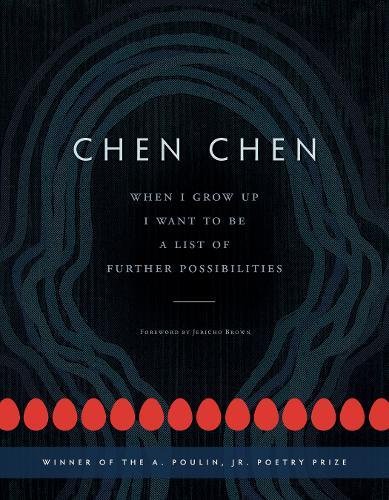

Where to start with Chen Chen and When I Grow Up I Want To Be A List Of Further Possibilities?  Today's book of poetry could write a blog about Chen Chen's sense of humour, it's priceless.  Or, Today's book of poetry could write a blog about Chen's culture jumping headstands and his jumping through hoops, they are both formidable.  Today's book of poetry could write about the love poems of Chen Chen, deeply touching, humble and tender.  How about poems about family and diaspora and acceptance, Chen finds the room on his dance card for all this and more.  You get the picture.

Or, Today's book of poetry could take the proselytizing approach and tell you that When I Grow Up I Want To Be A List Of Further Possibilities will be good for your poetry soul.

First Light

I like to say we left at first light
          with Chairman Mao himself chasing us in a police car,
my father fighting him off with firecrackers,
          even though Mao was already over a decade
dead, & my mother says all my father did
          during the Cultural Revolution was teach math,
which he was not qualified to teach, & swim & sunbathe
          around Piano Island, a place I never read about
in my American textbooks, a place everybody in the family
          says they took me to, & that I loved,
What is it, to remember nothing, of what one loved?
          To have forgotten the faces one first kissed?
They ask if I remember them, the aunts, the uncles,
          & I say Yes, it's coming back, I say Of course,
when it's No not at all, because when I last saw them
          I was three, & the China of my first three years
is largely make-believe, my vast invented country,
          my dream before I knew the word "dream,"
my father's martial arts films plus a teaspoon-taste
          of history. I like to say we left at first light,
we had to, my parents had been unmasked as the famous
          kung fu crime-fighting couple of the Southern provinces,
& the Hong Kong mafia was after us. I like to say
          we were helped by a handsome mysterious Northerner,
who turned out himself to be a kung fu master.
          I don't like to say, I don't remember crying.
No embracing in the airport, sobbing. I don't remember
          feeling bad, leaving China.
I like to say we left at first light, we snuck off
          on some secret adventure, while the others were
still sleeping, still blanketed, warm
          in their memories of us.
What do I remember of crying? When my mother slapped me
          for being dirty, diseased, led astray by Western devils,
a dirty, bad son, I cried, thirteen, already too old,
          too male for crying. When my father said Get out,
never come back, I cried and ran, threw myself into night.
          Then returned, at first light, I don't remember exactly
why, or what exactly came next. One memory claims
          my mother rushed into the pink dawn bright
to see what had happened, reaching towards me with her hands,
          & I wanted to say No, Don't touch me.
Another memory insists the front door had simply been left
          unlocked, & I slipped right through, found my room,
my bed, which felt somehow smaller, & fell asleep, for hours,
          before my mother (anybody) seemed to notice.
I'm not certain which is the correct version, but what stays with me
          is the leaving, the cry, the country splintering.
It's been another five years since my mother has seen her sisters,
          her own mother, who recently had a stroke, who has trouble
recalling who, why, I feel awful, my mother says,
          not going back at once to see her. But too much is happening here,
Here, she says, as though it's the most difficult,
          least forgivable English word.
What would my mother say, if she were the one writing?
          How would her voice sound? Which is really to ask, what is
my best guess, my invented, translated (Chinese-to-English,
          English-to-English) mother's voice? She might say:
We left at first light, we had to, the flight was early,
          in early spring, Go, my mother urged, what are you doing,
waving at me, crying? Get on that plane before it leaves without you.
          It was spring & I could smell it, despite the sterile glass
& metal of the airport--scent of my mother's just-washed hair,
          of the just-born flowers of fields we passed on the car ride over,
how I did not know those flowers already
          memory, how I thought I could smell them, boarding the plane,
the strange tunnel full of their aroma, their names
          I once knew, & my mother's long black hair--so impossible now.
Why did I never consider how different spring could smell, feel,
          elsewhere? First light, last scent, lost
country. First & deepest severance that should have
          prepared me for all others.

...

We're going to take the chump's choice, the easy way out  --  When I Grow Up I Want To Be A List Of Further Possibilities is flat out, easily one of the very best books of poetry on the horizon.  No amount of my faint praise will do the trick proper justice, you will have to see to believe because Chen Chen may be the best poet you haven't heard of yet.

Chen is perfectly capable of the big subjects but his psyche is on hyperdrive and many of his poems read like the musings of some eloquently drunk monk/priest/poet nodding on good wine and mixing a new scripture with imaginative and gigglish glee.  Chen changes direction with the dexterity of a unicycle riding juggler.  Just another trick he pulls out of his sleeve.

Things Stuck in Other Things Where They Don't Belong

My mother one afternoon in a cowboy hat, sitting on a Texan bench of hay.
Me in the same configuration of time, space, & cowboy hat.
The memory in my brain like a boulder in a haystack, like a bad joke.
The sun in our faces.
The year we spent in Fort Worth, Texas, our first year in Mĕiguó.
The fluent Not-English I spoke in kindergarten.
The blond boy from Germany in the same sandbox with me, laughing at my jokes.
His name, Eammon, like Amen, unlike any Chinese or American name
I'd ever heard, a ticklish raindrop
in my ears.
The soy sauce + Tabasco sauce + mud in my "soups."
The same ingredients + sugar in my "pies."
Me in the biggest kitchen I'd ever seen, running around the "island,"
chased by an elderly white man my father said to call my "Texas grandpa."
My father with his full head of black hair & British-inflected English
in the graduate religion program at Texas Christian University.
The grease-tang of kung pao chicken in my mother's skirts,
in my mother's far-away look, after shifts.
The Bengal tigers in the tightly fenced "forest habitat" in the zoo. Eammon & I
          visited.
The sand in our shoes, the sun on our faces
as we sweated over castle fortification, all afternoon.
The Goodbye I placed in Eammon's ear.
The motels & motels I played Power Ranger in, leaving Texas
because my father had won a scholarship.
The way I came to learn the French word for "scar"
by seeing it over & over in a French Harry Potter, in my American head,
in the small bald spot on the left side of my head,
which I received one afternoon in Texas,
when I was the skinniest, sincerest Superman, & flew into the kitchen
where my mother was removing from the stove
a saucepan of milk, still boiling,
& we bumped into each other -- "cicatrice."
The cicatrice of Eammon's Christmas card, once kept bedside,
now in a box, a basement.
My dream in the motels that my father's scholarship
was a type of ship & soon we'd get to ride it
& read Massachusetts, a vast
snowy island.

...

Our morning read was snowed out.  Milo, our head tech, and Kathryn, our Jr. Editor, called in with "shovelitis".  Most of the others had "snowflu" or "late bustosis".  I ended up putting Sonny Stitt on the box and bounced Chen Chen's simply marvelous When I Grow Up I Want To Be A List Of Further Possibilities off the walls as the troops slowly marched in.

You all know how much Today's book of poetry loves list poems and Mr. Chen Chen may become the patron Saint of the genre.  He has made something new for all of us that is funny, heartbreaking, illuminating, astonishing, fierce and gentle and sometimes just beautifully bright and sparkly.  Chen Chen is the Joey Alexander of poetry.

You can look Joey up on YouTube and you'll see he cooks on a whole different planet.

Elegy to Be Exhaled at Dusk

I am an elegy to be exhaled at dusk. I am an elegy to be written on a late
October leaf. An elegy to be blown

from its tree by a late October wind. To be stomped on & through
by passersby old & young

& dead & unborn. To be crinkled & crushed into tiny brown-
orange pieces. & then

collected, painstakingly, no painfully, piece by piece, & assembled like
a puzzle or collage or

Egyptian god, but always incomplete, always a few bits & limbs
missing. An elegy to be

misplaced, stuffed away in the attic's memory & only brought out again
once every occupant of the house has

ceased. Yes, I am an elegy properly architectured by ruin. An elegy that has
experienced crows & lake effect

snow, an elegy that has seen Ukrainian snow falling on the forehead
of Paul Celan, Palu Celan's mother,

the German tongue, the tangled tongues of all your literary
& literal ancestors--but more

than that, an elegy that has felt light, the early morning light falling
on your lovely someone's

lovable bare feet as he walks across the wood floor to sit by the window,
by the plants, with a cup of jasmine

& a book he will barely open but love to hold the weight of
in his lap, I am,

my friend, an elegy that has taken into account, into heart & October wind,
the weight of someone's soft

hair-covered head in someone else's warm, welcoming lap.

...

Today's book of poetry continues to be gob-smacked happy when something like When I Grow Up I Want To Be A List Of Further Possibilities comes along.  And for those of you who remain skeptical after this small sampling - Today's book of poetry is here to tell you that Chen Chen should make you think of a young Gretzky with the powerhouse Oilers, think Glenn Gould in Russia or Aleksandr Baryshnikov with the New York City Ballet.  This is how to make an entrance.

* A special reminder today to check out the BLURBS section below to hear what others think of Chen Chen's When I Grow Up I Want To Be A List Of Further Possibilities.  Today's book of poetry is not the only admirer of Mr. Chen.

Image of Chen Chen

Chen Chen

ABOUT THE AUTHOR
Chen Chen was born in Xiamen, China, and grew up in Massachusetts. His debut poetry collection, When I Grow Up I Want to Be a List of Further Possibilities, won the A. Poulin, Jr. Poetry Prize. His work has appeared in two chapbooks and in such publications as Poetry, Gulf Coast, Indiana Review, Best of the Net,and The Best American Poetry. He is the recipient of fellowships from Kundiman, the Saltonstall Foundation, and Lambda Literary. He earned his BA at Hampshire College and his MFA at Syracuse University. He lives in Lubbock, Texas, where he is pursuing a PhD in English and Creative Writing at Texas Tech University. For more about Chen Chen, visit www.chenchenwrites.com.

BLURBS
"The A. Poulin, Jr. Poetry Prize honors a poet’s first book, and this book wears its radical innocence on its literal sleeve. It lives within this 'never of knowing'—ecstatically, agonizingly, where every encounter has the capacity to astonish."
Drunken Boat
"Debut poet Chen Chen’s When I Grow Up I Want to Be a List of Further Possibilities has, in addition to a killer book title, a beautiful and complex story of identity to share. The collection tells describes a mother/son relationship from the perspective of an Asian American immigrant, queer son, and explores the complicated grief and love of familial bonds."
Bustle
"Chen Chen’s work is versatile, skillfully adapting to different forms and functions; on one page, there will be a traditional poem, lines grouped together in rhythmic couplets. On another, lines run together into paragraphs, blurring the difference between poetry and prose. Chen Chen’s poems are odes and elegies, considerations of everyday life. In When I Grow Up I Want to Be a List of Further Possibilities, Chen Chen muses his way through the idea of inheritance (specifically, what it means to inherit things like love and family), a concept that is central to his identity as a queer Chinese-American immigrant. American Book Award winner Jericho Brown gave When I Grow Up I Want to Be a List of Further Possibilities his seal of approval in his introduction to the book."
Literary Hub
"Chen balances the politics surrounding shame and desire with hearty doses of joy, humor, and whimsy in his vibrant debut collection. To consider the titular act of growing up—to recognize what potentialcould mean—Chen must make sense of his past to imagine a better future in his poems. . . . To this end he recounts a personal history in which he playfully addresses deeply serious issues, particularly a longing to defy the fate prescribed to him by family members or others’ cultural ideas of normalcy . . . As a gay, Asian-American poet, Chen casts his poems as both a refusal of the shame of sexuality and of centering whiteness or treating it as a highly desirable trait. Readers encounter sharp, delightful turns between poems, as Chen shifts from elegy to ode and back again. . . . Moving between whimsy and sobriety, Chen both exhibits and defies vulnerability—an acute reminder that there arecountless further possibilities."
Publishers Weekly 
"I am drawn to poetry about the difficulties of family, about the pain of feeling one is a disappointment to their parents, about the sense of separation that can come as a result. Chen Chen’s debut collection is filled with work which explores this universe. This is tricky subject matter to tackle, because it lends itself to both rant and cloying sentimentality and it’s easy (I know from experience) to have them go sideways like a car on ice. . . . The result of Chen Chen’s unique take is that many of the poems in this book show how joy and pain, far from being opposites, coexist and even exist symbiotically."
—Brian Spears, The Rumpus
"What does Millennial poetry look like? One answer might be this wild debut from Chen Chen. He seems to run at the mouth, free-associating wildly, switching between lingo and 'higher' forms of diction. Nothing's out of bounds or off limits, no culture too 'pop' to find its place in poetry . . . nor anything too silly to point the way toward serious aims. And yet this is a deeply serious and moving book about Chinese-American experience, young love, poetry, family, and the family one makes amongst friends."
—NPR Books
"The collection, as the title itself suggests, is about 'further possibilities,' about revising, reinventing, and reimagining the relational modes we currently have. If we are all tasked with being 'someone ‘for’ someone else—a son, a friend, a partner, a student, a dear love,' we cannot afford to be complacent or static in the ways that we inhabit and think about those relations. Interdependence is at the heart of Chen’s writing, and if we are to survive in these troubled times, we must continue to believe that there really are new ways to find the impossible honey."
Up the Staircase Quarterly

"Chen Chen refuses to be boxed in or nailed down. He is a poet of Whitman’s multitudes and of Langston Hughes's blues, of Dickinson's 'so cold no fire can warm me' and of Michael Palmer’s comic interrogation. What unifies the brilliance of When I Grow Up I Want to Be a List of Further Possibilities is a voice desperate to believe that within every one of life’s sadnesses there is also hope, meaning, and—if we are willing to laugh at ourselves—humor. This is a book I wish existed when I first began reading poetry. Chen is a poet I’ll be reading for the rest of my life." 

—Jericho Brown
"Chen Chen is already one of my favorite poets ever. Funny, absurd, bitter, surreal, always surprising, and deeply in love with this flawed world. I'm in love with this book."

—Sherman Alexie
"The radioactive spider that bit Chen Chen [isn’t that how first books get made?] gave him powers both demonic and divine. The bite transmitted vision, worry, want, memory of China, America’s grief, and People magazine, as well as a radical queer critique of the normative. What a gift that bite was—linguistic, erotic, politic and impolitic, idiosyncratic and emphatic. What a blessing and burden to write out of the manifold possibilities of that contact."
—Bruce Smith
"I so deeply love this poet’s imagination where old shoes might walk back up the steps of a house, where one speaker pledges ‘allegiance to the already fallen snow’ and another says ‘Let’s put our briefcases on our heads, in the sudden rain, // & continue meeting as if we’ve just been given our names.’ In precise and gorgeous language, Chen Chen shows us that the world is strange and bright with ardor. He reminds us of the miracle of the sensual and sensory. This is a book I will return to whenever I forget what a poem can do, whenever I am in need of song or hope. If a peony wrote poems in a human language, I think that these would be his poems. If the rain wrote poems… I mean: this is an important work by an astonishing and vital voice."
—Aracelis Girmay 


Chen Chen
PoetryLA Interview
Video: PoetryLA


666

DISCLAIMERS

Poems cited here are assumed to be under copyright by the poet and/or publisher.  They are shown here for publicity and review purposes.  For any other kind of re-use of these poems, please contact the listed publishers for permission.
We here at TBOP are technically deficient and rely on our bashful Milo to fix everything.  We received notice from Google that we were using "cookies"
and that for our readers in Europe there had to be notification of the use of those "cookies.  Please be aware that TBOP may employ the use of some "cookies" (whatever they are) and you should take that into consideration


Wednesday, September 20, 2017

The Brighter House - Kim Garcia (White Pine Press)

Today's book of poetry:
The Brighter House.  Kim Garcia.  White Pine Press.  Buffalo, New York.  2016.

Winner of the White Pine Press Poetry Prize


Today's book of poetry is a bit weak when it comes to his mythology, its history, characters and so on.  Kim Garcia's whippersnapper The Brighter House invests fairly heavily in legend, the deep mysteries of our collective past.  So how does Garcia manage to make The Brighter House feel so current, urgent, how does Kim Garcia make us care?

We care because we can identify with Garcia's demons, we understand that the monster dying in the hospital bed is still a father.  We know what that Blackdog anger does to perception.  Garcia has the anger but these poems are too smart to resort to simple revenge, vengeance.  Kim Garcia finds beauty even on the starkest panorama.  She also knows that sometimes beauty has a price.

For my father and the cancer that killed him

                                                                   Once
in a drainage ditch I saw a duck and hawk
rolling, like wrestlers--old Greeks--to the death,
and the duck was taking his dying hard. It took

a long, silent time for the sugar to run out

in its muscles, for the hawk to find the place
between its neck and back, to pierce the artery,
open the blood gate, let out the fight and begin
                                                                 to feed.

...

Our morning read at the Today's book of poetry offices was slightly overshadowed by the splendid weather.  Ottawa is having the nicest September anyone can remember and getting my staff in off the lawn and out of the sun has only been achieved by threat.  Today's book of poetry won't share the particular threats uttered but we had a different killer for each of our minions.  So then, under threat, and under a roof, in the shade of our offices and with a slight hint of protest...

Kathryn, our Jr. Editor, got the ball rolling.  Once in gear Kim Garcia's The Brighter House did all the hard work.  Whether Garcia is imagining/wishing into place her sister, appearing as a vengeful matador or imagining her father as God: Garcia invites the reader into her somewhat magical world with language.

Garcia peoples these poems with characters who scrape up against the smooth edges of your soul.  They know where you are tender.

Strangers

The man with the grass truck, for instance,
looking in on me through the car window.
I sat in my robe passenger side, engine humming
while my mother went for my prescription.

I was pale, very still. I was always
sick in those days. His eye moved
over my shoulders, into the folds of my robe,
a ticklish insect-footed sensation on my skin.

I stared back. Probably I flirted.
I don't remember, but I did things like that,
swallowed whatever came in the capsules.
I was pale, and my eyes were almost black.

My mother came out of the drugstore.
Who called who? He came down
from a load of sod he was pitchforking
to two black men below. They spoke.

Our lawn was dead.
The car was dying.
She wanted grass.
I was useless to her.

A few days later he came with a load.
After he laid the sod, he drank
a glass of lemonade at the kitchen table
with my mother. Then he took me to the drive-in.

We saw a trucker picture. Convoy, I think,
and he didn't handle me much
or force his mouth over my mouth
or speak in any way about the sod he'd unloaded
all day in Texas heat--for what?

To buy me popcorn,
to run his arm along the back
of the vinyl single seat of his pick-up
and stare in silence at a girl
stiff and scared in the seat beside him,
not knowing what she was beginning or ending.

When the movie ended
he took me home
and walked me to the door
like a real date would have done.

And the only thing he got for what he'd paid
my mother was one brief run of his warm palm
from my hip to my bra strap
along my thick, fifteen year old waist.

Which couldn't have been much a thrill
for a full grown man.

My mother was in bed. No.
She was up. Watching television,
sitting in the chair she'd rocked me in
as a child. Outside the sprinkler's steady tick
broke suddenly into a run and return.
The peepers spoke under the damp leaves,
to a steady tap of beetles against the yellow light.
Moths folded flat against the dark siding.

There'd be new grass in my mother's voice
as she looked up from her lap
where she'd have some work,
some bill to worry or dress to mend,
and ask, "What did you do?"

Just beyond the window lay the lawn, her lawn,
which would be lovely today, tomorrow
and years from now. Children changed.
You fed them and put a roof over their heads,
and one night your daughter might walk in
and look at you like a stranger.

...

Dreamland.  There is an ethereal sense to these poems, they sometimes feel too light, almost too perfect to hold together but they do.  Gossamer usually refers to something delicate or insubstantial yet Garcia's gossamer poems pack power.

In The Brighter House Kim Garcia's power comes from her "felted hammer on razored strings."  These dignified and almost quiet poems carry the big knockout punch.  When Garcia ties up the loose ends these poems are wicked sharp.  Garcia is the proverbial iron fist in the velvet glove.

Heaven

Finally I am ready for heaven. Go ahead,
let it in now. I stare at winter branches
and try to imagine summer--all that green,
early urgency to late summer flapping
a crowd, a host.

                            I never had the time
before, never saw the point. I was getting
ready for the next ting, saving up.
Death might, I know, come quickly,
but that's not the main thing.

Something is leaking in, and I
can clear the way, make it easier
for it to enter. Yes, I'm saying yes.
Not to death, which isn't really my
business, but to heaven.

It may be that I'll be a scattering
of matter. It may be that I don the robe,
whatever that is. This morning
I wrap the gray wool light around me
and say to everybody morning sounds,
you can tell me everything now. All of it.

...

The Brighter House took Today's book of poetry in with the first poem and jerked me around like a fish on a hook until Garcia was finished with me and threw me back in the water.  I'm back blowing bubbles in the weeds, but for a few moments, I was out of my element, I had a clear vision of another universe. 

Garcia did that.

Image result for kim garcia photo
Kim Garcia
Photo: Frank J. Garcia

ABOUT THE AUTHOR
Kim Garcia is the author of The Brighter House, winner of the 2015 White Pine Press Poetry Prize, DRONE, winner of the 2015 Backwaters Prize, and Madonna Magdalene, released by Turning Point Books in 2006. Her chapbook Tales of the Sisters won the 2015 Sow’s Ear Poetry Review Chapbook Contest. Her poems have appeared in such journals as Crab Orchard Review, Crazyhorse, Mississippi Review, Nimrod and Subtropics, and her work has been featured on The Writer’s Almanac. Recipient of the 2014 Lynda Hull Memorial Prize, an AWP Intro Writing Award, a Hambidge Fellowship and an Oregon Individual Artist Grant, Garcia teaches creative writing at Boston College.

BLURBS
How does she do it! In The Brighter House, Kim Garcia speaks in the language of delicate and mesmerizing touch with phrases like "feather-brush antennae" and "ticklish insect-footed sensation" and "wished-for snow" without ever falling into precious sentimentality. Over and again, these poems mount to harsh and cold violences that speak to the intricacies of the soul in a gorgeous way that leaves the reader feeling bruised--as in pressed upon--but not bloody. This is a brilliant book of first-rate artistry.
     - Jericho Brown

Rainer Maria Rilke said that there are two inexhaustible sources for poetry, childhood and dreams, and Kim Garcia drinks deeply from both wells in these magical, spooky, riveting, and mysterious poems.
     - Edward Hirsch

This collection is a powerful exploration of the mythological roots of a home, a father, and sisters. The author cleans away that which obscures with the miracle of lyricism. We are lost in the stark beauty of the journey. Then, we are found.
     - Jay Harjo

Interview with
Kim Garcia
Video: Arkansas International


611


DISCLAIMERS

Poems cited here are assumed to be under copyright by the poet and/or publisher.  They are shown here for publicity and review purposes.  For any other kind of re-use of these poems, please contact the listed publishers for permission.


We here at TBOP are technically deficient and rely on our bashful Milo to fix everything.  We received notice from Google that we were using "cookies"
and that for our readers in Europe there had to be notification of the use of those "cookies.  Please be aware that TBOP may employ the use of some "cookies" (whatever they are) and you should take that into consideration.


Friday, April 14, 2017

Reflections on the Dark Water - M. P. Jones (Solomon & George Publishers)

Today's book of poetry:
Reflections on the Dark Water.   M.P. Jones.  Solomon & George Publishers.  Opelika, Alabama.  2016.


M. P. Jones is sitting on the side of my desk all Reflections on the Dark Water and quiet, a genteel version of Ashokan Farewell is sounding quiet from the box and for a moment Today's book of poetry is back in the American South.  All we need now is the ghost of Shelby Foote to amble forth from the next room and regale us with his melodious wisdom.

M. P.  (Madison) Jones sets a big table with Reflections on the Dark Water.  Jim Morrison, Emily Dickinson and several other break bread in these lyric narratives bursting at the seams with quietly sustained power.  Jones is no muscle laden singe punch heavyweight, these poems are all footwork and lightning jabs.

A Genealogy of Silence

1917:  An American boy and a German boy stare
           at one another in a French trench for a full minute
           behind a Colt New Service and a Luger.
           Each marvels at how close a likeness the other
           bears to his own visage, like a mirror image. One shoots.

1925:  She watches the shadows swim under the door
           as her impatient husband paces the hospital corridor.

1936:  A man films the last known Tasmanian tiger
           walking back and forth between the cage walls
           just before it disappears.

1952:  A soldier's hat falls as he bends to avoid seeing
           his superior. Polished boots sound like hoof-clatter
           on cobblestones as he slams the brothel door.

1970:  In a soybean field in middle Georgia, the crowd roars.
           Not far away, a pregnant girl at a roadside peach stand
           says to a Strychnine-panicked boy, "I cannot help you;
           the lines are down," as he stumbles into the darkness.

1976:  A red telephone is ringing in the early light. She cannot
           hear it. She studies the light on the countertop, not wondering
           who waits at the other end of the line, for whom it rings.

1987:  A girl waits in a hotel room purchased on her father's
           credit card for a boy who said, "I ache for you."

1993:  A man holds his first-born by the legs out the window-
           frame of an incomplete second-story addition.

1997:  A young man drives through the night, perhaps in
           Arizona, perhaps nowhere at all, until he comes upon
           a waterless sea of solid glass. Nobody believes him.

2000:  The neighbor boy soaks toads in gasoline to watch
           them move through the dark like shooting stars.

2004:  Christmas eve, the tire of an overturned car spins
           in a ditch where two boys sit staring at a patch
           of morning sun shining through the pines.

2005:  Midnight in the mother's day darkness:
           the telephone rings.

2012:  A young man cuts his own right hand off
           with a chainsaw. After, he cannot explain.

2013:  Forgotten candles in the bathroom resemble
           green moonlight where two lay naked in the dark.

Five       A boy and a girl watch the last Tasmanian tiger
(A.M.):  pace back and forth on a bright screen. No sound.

...

"A Genealogy of Silence" is a list poem of sorts and you readers keeping score know that list poems frequently hit a Today's book of poetry soft spot.

In a book of poems with such monster title marvels as "To The Liquor Store With Hayden Carruth" and "Emily Dickinson Sewed Her Poems Shut" or how about this dandy "Throughout the Dismal Glade Our Bodies Shall Be Hung, Each on the Wild Thorn of His Wretched Shade."  I can't help but hear the footsteps of some of the Gothic southern Gods like McCullers and O'Connor.

Jones shapes his memory with myth, prays for appropriate weather, dazzles with a steady velocity and tells his tall tales.  Today's book of poetry read Reflections on the Dark Water an extra time or two, poems like these only get better with each new reading.

Fish Tale

My brother died with a truck full of fish

                       and beer bottles crashing together--
                                             in the Mother's Day darkness--
I am endlessly returning

                                             as if to a worn photograph,
a lure drifting along the lake's rim
                                                                   in Vermont,
a place I've never seen, and so

can only imagine some dim shore growing certain
                       in torn threads of afternoon light.

I go back to those improbable stories

he would tell, eyes alight with the consuming
fire of beer and bourbon,

like the one where he is driving through the desert
all night,
just driving through the sand, until finally he stops
at noon--perhaps in Arizona,
                                                                     perhaps nowhere at all--

on a waterless sea of solid glass,
supposedly the wake of some explosives test.

Walking over the burnt sand-lake's surface, breaking apart
                                               frozen waves and currents
beneath his boots,
crumbling like some hopeless metaphor for certainty.

I listen as he wavers--wanting only to fix some narrative
over the near end--
                                                       recounting as his slurring sways,
circling to the moment just before the hooks are set,

before the surface quivers,
the bottles break,
                     and everything is finished.

And everything is finished;
                                              the bottles break
                       before the surface quivers,

circling to the moment just before the hooks are set,
                       recounting as his slurring sways

                                                                            over the near end,

I listen as he wavers, wanting only to fix some narrative.

Crumbling. Like some hopeless metaphor for certainty
beneath his boots,
                      frozen waves and currents.

Walking over the burnt sand-lake's surface, breaking apart--
                        supposedly the wake of some explosives test--

                                                on a waterless sea of solid glass.

Perhaps nowhere at all

                       at noon, perhaps in Arizona,
just driving through the sand, until finally he stops
all night.

Like the one where he is driving through the desert
                                              fire of beer and bourbon.

He would tell, eyes alight with the consuming.

I go back to those improbable stories
                      in torn threads of afternoon light,

can only imagine some dim shore growing certain--
                      a place I've never seen--and so,

in Vermont,
                      a lure drifting along the lake's rim
as if to a worn photograph--
                       I am endlessly returning

in the Mother's day darkness

                      and beer bottles crashing together,

My brother died with a trunk full of fish. 

...

Today's morning read at the Today's book of poetry offices took place on the front porch with bright sunshine and guest readers.  M. P. Jones got aired out proper.  When I took the staff outside it was to find Mrs. Today's book of poetry on the front porch arguing in French with Dr. Alexandre.  The doctor stuck around along with Mrs. TBOP and they both joined in the fray.

Jim Morrison Believed that the Right Words in the Right
Order Could Kill You

Lying in the dark waters of that tub,
velvet drapes trimming the night
inside the golden facade
of the rue Beautreillis,
listening to the voices
drifting up from the Seine,
with the light already going
out of his dull eyes,
and another cigarette, perched
like the last link
of a short, broken circle
on his swollen belly, burning
like a candle lit at both ends, lies
the beardless shaman, with that deep,
death-rattle cough ringing
in his ear. Who knows
what he mumbled to himself?

...

Today's book of poetry was lizard king struck with the poetry of M. P. Jones.  Reflections on the Dark Water reads solid from front cover to back.  This is no narcissist looking into his dark reflection but M. P.  Jones clearing up all that brackish water to let the it run clear and clean, pushing his way to the truth.

M. P.  Jones

ABOUT THE AUTHOR
Madison Jones is a Graduate Research Fellow at the University of Florida—where he works with the TRACE journal and innovation initiative. He is editor-in-chief of Kudzu House Quarterly. Reflections on the Dark Water (Solomon & George) is his second poetry collection. Recent publications include co-editing Writing the Environment in Nineteenth-Century American Literature; an article forthcoming in ISLE: Interdisciplinary Studies in Literature and Environment; poetry forthcoming in Birmingham Poetry Journal, ISLE, and The Goose, and recently appearing in Canary, Tampa Review, Painted Bride Quarterly, Greensboro Review, and elsewhere; book reviews in ISLE, Kenyon Review Online, The Journal, and elsewhere. Visit his website: ecopoiesis.com.

BLURB
Reflections on the Dark Water concerns itself with memory and myth, how the bridge between the two--how the line where they intersect--is the irrevocable location of history. M.P. Jones crosses that bridge, that line over and again in poems that view the past in order to make sense of the present. This is a book that wants to separate "truth from chaff."
     - Jericho Brown, author of The New Testament


571

DISCLAIMERS

Poems cited here are assumed to be under copyright by the poet and/or publisher.  They are shown here for publicity and review purposes.  For any other kind of re-use of these poems, please contact the listed publishers for permission.

We here at TBOP are technically deficient and rely on our bashful Milo to fix everything.  We received notice from Google that we were using "cookies"
and that for our readers in Europe there had to be notification of the use of those "cookies.  Please be aware that TBOP may employ the use of some "cookies" (whatever they are) and you should take that into consideration.

Thursday, October 13, 2016

Take This Stallion - Anais Duplan (Brooklyn Arts Press)

Today's book of poetry:
Take This Stallion. Anais Duplan.  Brooklyn Arts Press.  Brooklyn, New York.  2016.

Take-This-Stallion-website

Anais Duplan has a big voice and Take This Stallion is loud.  Duplan is marvellously excessive in her exasperations, take this title:  "An Account Of A Child Born Alive Without A Brain And The Observables In It Upon Dissection."  

Duplan would also have us believe that her dog is God.  Today's book of poetry followed along with rapt and somewhat nervous attention.

A Fledgling Is A Young Bird
That Has Its Feathers
And Is Learning To Fly

[1]

S-H-E-D-E-V-I-L,
I, on the other hand,
make sure to wash my mouth
whenever I say something slippery. I am washing
right now, ma cherie, with a pen
in my left hand and my page on the rim of the sink
and my right hand is reaching toward you,
you in the mirror, to pull your hair out.

[2]

The terror of having to realize the unrealizable: I am a baby
on the kitchen counter, one of many. My mother continues
to unload us from a crate. The counter is littered with knives.
No one is hurt except all of us are hurt and yearning
to sleep. It is cold. Keep this in mind, it is cold.
My mother, the woman, she is wearing a chain
of children's molars. A man wearing the same chain
appears in the doorway and begins to eat us one by one.

[3]

My mother in a blue apron. It is springtime inside
and outside the kitchen. I hear the dog screech from the yard,
his "body" is caught under the lawnmower
my father is driving. I tell my mother to get off
the machine, to let this one live, but he doesn't listen,
he takes off his apron and steps outside,
sees the dog screeching and by now, it is still springtime.

[4]

You are in control. The day is yellow
in the sense that the grasses are dying. There are animals
dying every minute, waiting, even after their deaths,
to be adopted. Pick up the phone. Pick up the baby
and set it in a meadow. Wait for a bird to settle
on its head and take a photo. Mail the photo to your mother.
Write to her, write, Just this once, just this once,
would you please come to my recital. I promise I will do better
than Jenny. Take the baby back into your hands
and promise me.

[5]

What makes us go all the way to the bottom. The brother had severed
one of his fingers attempting to slice a fig. The mother took him
to the emergency room but only the brother returned. Since then,
I have had to be the woman of the house. I am proud to say
that the brother's fingers have grown six inches since I took over and the father
is very well near portly. I promise to fill them up. I say this every time
I pass the emergency room on the way to bed.

[6]

At least we have our authenticity. This is the last time
I'll ever lend my skin to a man who tells me he'll give it
right back. Keep this in mind: it is cold and my eyes
are too bloated for my head. I have had to squeeze them dry
at day's end. I do this in the bathroom, where a lady is safe
to take her apron off and her eyes out.

[7]

I say to Michael, I say, Michael,
why don't you go out and find yourself a woman. I say,
Michael, any lady would be lucky to let you have her. I say, Take
this cake and take it into your arms and find a woman.

[8]

You are in control. Take this stallion and ride it
to your demise. (Read: the sunset, behind the stars,
the green green garden.) Compare my flesh to yours. Look at my hair:
my neck hair and my toe hair. (Read: I am a woman and a woman
is a woman.) My unconscious is under siege,
Papa Bear. Take up your arms
and throw them around me. Bring a bouquet,
bring your big cowboy hat. Show me how to kill a horse.

...

It's clear Anais Duplan is comfortable going all back-beat to the regular rhythms of things but this doesn't stop her from finding a big, deep groove.  Take This Stallion isn't an easy get - the reader has to take a minute to find firm footing because this is surprisingly new ground.  Anais Duplan is teaching us her new vernacular and it is splendid.

Why Would You Ever Go
To A Pool Party Anway

I.

Anais, you needn't cry
like a baby seal. You needn't wear
your hair long, just to divert
the passing sailors--
                O what flag waves outside the windows
of all fledgling girls
when they detect
what lives
between their legs.
                                   John Paul once said to me,
O Anais, o Anais, what lives between your legs,
and I opened up to him, put his hand inside me
and said, This is the fiery throat of God -- be careful.
You may find you are no longer every-
thing you had been
before you arrived.

II.

He said, she said, we wrote of a great awakening.
Instead of death we only moaned
every time the sun did wane and how
it waned every morning. Today could be
the day that does not end
in your death-
ly embrace.

...

A lot of fun at this morning's read.  Take This Stallion lent itself to a dramatic show.

Not sure how Anais Duplan has done it but Take This Stallion feels like a strange familiar.  I know I have never been here before and some of the language is foreign but these poems ring the ears off of my inner reader.  I'm happy/sated, deja-vued and curious for more.

I Felt Like A Traffic Light
As Soon As I Got Inside You

I.

This is how to be honest:
I learned it on the subway: look
me in the eyes and tell me

I'm not beautiful. Sometimes
it's best just to drop out tune down
let go so ever so deep. So deep

was her throat and how the gods
did sing, how the dog doth sing,
Happy birthday, darling. And thank you, too.

II.

I met a girl named Martha
with eyes as big as Arizona,
relative to other states.

Martha, I promise to change
your bandages forever 'n'ever,
and if the doctors should ever say,

O Anais, Martha will not survive
without your limbs, I would
tear them off one-by-one.

III.

Lift me up --

I am looking at the neighbor's wife,
I am looking at the neighbor's wife
and wond'ring where she buys her things.

Lower me down, just below your eye-
level and tell me about the time

your mother made you wear clothes you didn't want to wear.

IV.

Never forget to greet the doctor in the room,
I know it was your birthday but I never got
the prescription you wrote me.

Dancing is not permitted in certain towns and that's ok
for some. Don't stop get it get it get it get it get it get it
before it gets you.

As soon as you walked into the room
all the flowers said O hell yes.

V.

My life is a ballad, it goes: O
ooooo! I can't breathe
when you hold me so

cold. Get paid get paid
tomorrow. Wake up get
paid tomorrow. You deserve
everything you get.

You don't know nothing and you never did, silly bill.
I don't have a gun but maybe one day I will.

...

It can't just be me.  There are a strokes worth of vicarious thrills both carnal and poetic in this rambunctious first book of poems.  Today's book of poetry will happily champion Take This Stallion until Anais Duplan gives us some more sugar.

Anais-Duplan-BAP
Anais Duplan

ABOUT THE AUTHOR
Anaïs Duplan was born in Jacmel, Haiti. She is the director of a performance collective called The Spacesuits and of The Center for Afrofuturist Studies, an artist residency program in Iowa City. Her poems and essays have appeared in Birdfeast, Hyperallergic, The Journal, [PANK], and other publications. She is an MFA candidate at the Iowa Writers’ Workshop.

BLURBS
“I have never before read a book like Anaïs Duplan’s Take This Stallion. Her major talent is recognizing the self in the other, making for poems that flow forward in a tone of oneness—is oneness a tone?—poems that make evident an ever-expanding world by opening themselves up into that world. This debut does what poets in their fifth or sixth collections are still trying to figure: it balances the intellect, image, music, and emotion in ways so unfamiliar that a blurb couldn’t possible characterize the work.”
     - Jericho Brown

“For all the ways we pad our language with qualifier, with apology, with hedge, Anaïs Duplan is antidote. Her poems are talkative, inappropriate, obsessive, and sexy. They put everything on the table and if there’s no table, she erects one: of the mechanic’s lobby, of men selling peanuts at her door, of the George Washington Bridge underpass, of the ocean. Sometimes the poems hang the air with obsession like tangential rope. like snake. Sometimes they pick up their skirts and dust the ground. Duplan’s work is at once this methodical, and this unhinged. She confirms a fear that drones and Kim Kardashian have more to do with our therapy sessions than we wish. And then at times, she puts all that away, and the poems wash out their mouths. This first collection is, after all, of this world. And though it might be haunted by a voice that says “Don’t be too cocky,” on nearly every page it talks back. Heroic, inspired, and smart: these poems are on their own two feet, saying “I’m always cocky.””
     - francine j. harris

“Take This Stallion is the sound of a generation finding its voice; it is a sound of a generation that has more rapidly than any since the generation that came of age in the 1960’s turned the world on its head, both exposing the faithlessness of the generations before it, and reifying the promises those generations made. Listen: “When she was lost to them/ they took to striking/ each other over the head with empty fists,/ striking until blood ran freely in the city/ ditches. All of this sounding like horses thundering/ into each other, peeling themselves/ off of each other, and thundering/ again. The whole city, this sound.”In Take This Stallion, the whole city is made new, and the maker who re-makes it is new, and the songs they sing as they work are the new songs.”
     - Shane McCrae

Anais Duplan at SPECTRA
Video:  Therese Guise


513
DISCLAIMERS

Poems cited here are assumed to be under copyright by the poet and/or publisher.  They are shown here for publicity and review purposes.  For any other kind of re-use of these poems, please contact the listed publishers for permission.

We here at TBOP are technically deficient and rely on our bashful Milo to fix everything.  We received notice from Google that we were using "cookies"
and that for our readers in Europe there had to be notification of the use of those "cookies.  Please be aware that TBOP may employ the use of some "cookies" (whatever they are) and you should take that into consideration.