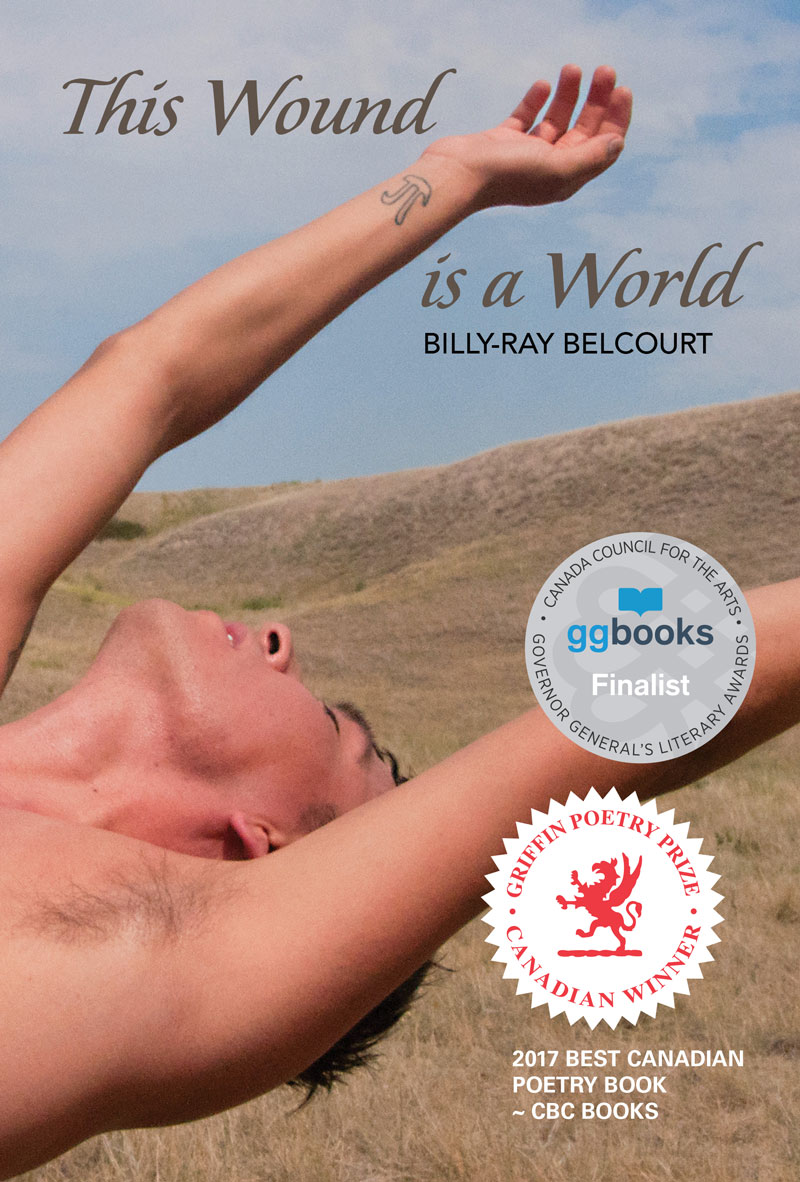
Today's book of poetry: This Wound is a World. Billy-Ray Belcourt. Frontenac House Poetry. Calgary, Alberta. 2017.
Griffin Poetry Prize 2017 CBC Best Canadian Poetry Book 2018 Robert Kroetsch City of Edmonton Book Prize Winner
Billy-Ray Belcourt's stunning This Wound is a World deserved every prize it won and more. There might be other poets who hammered at these walls but there has yet to be one, as far as Today's book of poetry is concerned, who might actually bring them down. Billy-Ray Belcourt is such a poet.
It doesn't matter what you think you know about being gay or straight, Indigenous or not, these poems are going to change some of your perceptions. In Today's book of poetry world we know that only the very best poems can pull off this sort of magic, this sort of medicine.
Billy-Ray Belcourt pulls the rabbit out his hat like some sort of Trickster. The reader just has to sit back and watch the show.
The Cree Word For a Body Like Mine
Is Weesageechak
the cree word for a body like mine is weesageechak, the old ones know
of this kind of shape-shifting: sometimes i sweat and sweat until my
bones puddles on the carpet in my living room and i am like the water
that comes before new life.
i was born during a falling leaves moon; which is to say that i have
always been good at sacrifice. it is believed that women are most
powerful during their moontime and because of this do not take part
in ceremonies in order to let the body cleanse itself. there are
weesageechak days when gender is a magic trick i forgot how to
perform and my groin floods and floods trying to cleanse itself like
the women and i too become toxic for men who have built cages out
of broken boys.
maybe if i surrendered myself to grandmother moon she would know
what to do with these pickaxe wounds. there is so much i need to tell
her about how my rivers and lakes are crowded and narrowing. how i
managed to piece together a sweat lodge out of mud and fish and
bacteria. she gives me the cree name weesageechak and translates it to
"sadness is a carcass his tears leave behind."
and the crows and flies who don't care about gender will one day
make away with my jet-black finger nails and scraggly armpit hairs.
they will lay tobacco at my grave and tell their crow and fly kin that i
was once a broad-shouldered trickster who long ago fell from the
moon wearing make-up and skinny jeans.
💫💫💫
Belcourt will be in a unique poetic position, everyone who reads poetry is going to be anxious to see what he does next. Today's book of poetry is already convinced This Wound is a World is a Canadian classic, we will be looking at this marvel for a long time.
True, hard-nosed blood letting is a dangerous game to play. But it is clear Belcourt has big shoulders. In this case it means the poet has put it all up for grabs, Billy-Ray doesn't hesitate for one second, he is full in, all in. Billy-Ray Belcourt is a straight up gunslinger poet with dead-eye aim.
And dear readers, there is so much happening in This Wound is a World that I simply won't be able to tell you. For example, you all know how much Today's book of poetry loves "list" poems. We are a sucker for them. Billy-Ray Belcourt has several excellent, I repeat, excellent, list poems in This Wound is a World. Today's book of poetry loves those list poems - but, but, but, this is a book brimming over with the necessary.
If I Have A Body, Let It Be a Book of Sad Poems
i keep listening to a song by tom odell called grow old with me, i am
hung up on the enormity of that kind of project, of asking someone
to architect a livable world with you, what a blessing and a curse!
i hooked up with a man who insisted he was 42, but i suspect he was
older given the soft and reckless way he met my body with his. it was
9pm and we were making small talk and he told me a story about
how a relationship of his had started and ended at the same ski resort
in france. recently, he returned to that resort, and was caught
unawares by a wave of memories about his ex-boyfriend. today,he
lives alone in a houseboat, unwilling to be beside himself with desire.
how could he have expected anything but what christina sharpe calls
"the past that is not past" to haunt him? maybe that is why he wanted
to sleep with me last night. maybe that is why i invited him over in
the first place. i should have said: i don't have it in me to transform you.
if i have a body, let it be a book of sad poems. i mean it. indigeneity
troubles the idea of "having" a body, so if i am somehow,
miraculously, bodied then my skin is a collage of meditations on love
and shattered selves.
ok yes, i have been reading a bit of psychoanalysis lately. forgive me.
i am desperate. desperate to figure out how someone like me is still
here.
if i know anything, it is that "here" is a trick of the light, that it is a
way of schematizing time and space that is not the only one available
to some of us. maybe i am not here in the objectivist sense. maybe i
am here in the way that a memory is here. now, ain't that fucking sad
and beautiful?
💫💫💫
Reading Billy-Ray Belcourt's This Wound is a World the first time is like watching/hearing Stevie Ray Vaughan's all consuming attack on Jimi Hendrix's "Voodoo Child" for the first time. It is hard to take it all in, quite, because the artist is so far ahead of the curve that the reader has to lean into it. But make no mistake, Belcourt is:
"Standing next to a mountain"
and will
"chop it down with the edge of my hand."
It's exciting to read and instantly rewarding poetry. Milo, our head tech, said that he had to get copies of This Wound is a World into the hands of a few of his friends, pronto. Kathryn, our Jr. Editor, asked: "Do you think he knows what he's done?"
To which Today's book of poetry replied, "Damned right he knows!"
Wapekeka
in january 2017
two girls, 12, carried out a suicide pact
on the wapekeka first nation.
what is suicide
but the act of opening up
to the sky?
but wanting to live
more than once?
yesterday
a cloud fell onto me
and i never felt more at home.
sometimes i cry
in indian
and it sounds like
i am speaking
in english.
don't open your eyes.
pretend that
everything is a bird
and no one is hungry
for what they can't have.
...
Today's book of poetry is certain that poetry this necessary will find an audience. This Wound is a World is going to be remembered as a landmark book.
Today's book of poetry is thrilled to back on the job and excited to be starting the year with Billy-Ray Belcourt's amazing and brave This Wound is a World.
Billy-Ray Belcourt
Image from CBC Books
ABOUT THE AUTHOR
Billy-Ray Belcourt is from the Driftpile Cree Nation. He is a PhD student in the Dept. of English & Film Studies at the University of Alberta. He is also a 2016 Rhodes Scholar and holds an M.St. in Women’s Studies from the University of Oxford. Billy-Ray was named one of six Indigenous writers to watch by CBC Books in 2016, one of ten Indigenous writers to read right now by VICE in 2017, and he was the recipient of the 2017 P.K. Page Founder’s Award for Poetry. This Wound is a World is his first book.
Poems cited here are assumed to be under copyright by the poet and/or publisher. They are shown here for publicity and review purposes. For any other kind of re-use of these poems, please contact the listed publishers for permission.
We here at TBOP are technically deficient and rely on our bashful Milo to fix everything. We received notice from Google that we were using "cookies"
and that for our readers in Europe there had to be notification of the use of those "cookies. Please be aware that TBOP may employ the use of some "cookies" (whatever they are) and you should take that into consideration.
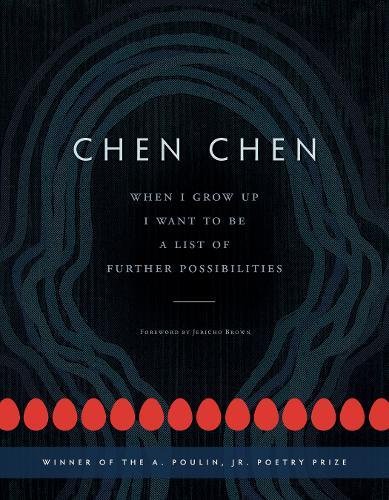
Today's book of poetry: When I Grow Up I Want To Be A List Of Further Possibilities. Chen Chen. BOA Editions. Rochester, New York.
2017.
Winner of the A. Poulin, Jr. Poetry Prize
Where to start with Chen Chen and When I Grow Up I Want To Be A List Of Further Possibilities? Today's book of poetry could write a blog about Chen Chen's sense of humour, it's priceless. Or, Today's book of poetry could write a blog about Chen's culture jumping headstands and his jumping through hoops, they are both formidable. Today's book of poetry could write about the love poems of Chen Chen, deeply touching, humble and tender. How about poems about family and diaspora and acceptance, Chen finds the room on his dance card for all this and more. You get the picture.
Or, Today's book of poetry could take the proselytizing approach and tell you that When I Grow Up I Want To Be A List Of Further Possibilities will be good for your poetry soul.
First Light
I like to say we left at first light
with Chairman Mao himself chasing us in a police car,
my father fighting him off with firecrackers,
even though Mao was already over a decade
dead, & my mother says all my father did
during the Cultural Revolution was teach math,
which he was not qualified to teach, & swim & sunbathe
around Piano Island, a place I never read about
in my American textbooks, a place everybody in the family
says they took me to, & that I loved,
What is it, to remember nothing, of what one loved?
To have forgotten the faces one first kissed?
They ask if I remember them, the aunts, the uncles,
& I say Yes, it's coming back, I say Of course,
when it's No not at all, because when I last saw them
I was three, & the China of my first three years
is largely make-believe, my vast invented country,
my dream before I knew the word "dream,"
my father's martial arts films plus a teaspoon-taste
of history. I like to say we left at first light,
we had to, my parents had been unmasked as the famous
kung fu crime-fighting couple of the Southern provinces,
& the Hong Kong mafia was after us. I like to say
we were helped by a handsome mysterious Northerner,
who turned out himself to be a kung fu master.
I don't like to say, I don't remember crying.
No embracing in the airport, sobbing. I don't remember
feeling bad, leaving China.
I like to say we left at first light, we snuck off
on some secret adventure, while the others were
still sleeping, still blanketed, warm
in their memories of us.
What do I remember of crying? When my mother slapped me
for being dirty, diseased, led astray by Western devils,
a dirty, bad son, I cried, thirteen, already too old,
too male for crying. When my father said Get out,
never come back, I cried and ran, threw myself into night.
Then returned, at first light, I don't remember exactly
why, or what exactly came next. One memory claims
my mother rushed into the pink dawn bright
to see what had happened, reaching towards me with her hands,
& I wanted to say No, Don't touch me.
Another memory insists the front door had simply been left
unlocked, & I slipped right through, found my room,
my bed, which felt somehow smaller, & fell asleep, for hours,
before my mother (anybody) seemed to notice.
I'm not certain which is the correct version, but what stays with me
is the leaving, the cry, the country splintering.
It's been another five years since my mother has seen her sisters,
her own mother, who recently had a stroke, who has trouble
recalling who, why, I feel awful, my mother says,
not going back at once to see her. But too much is happening here,
Here, she says, as though it's the most difficult,
least forgivable English word.
What would my mother say, if she were the one writing?
How would her voice sound? Which is really to ask, what is
my best guess, my invented, translated (Chinese-to-English,
English-to-English) mother's voice? She might say:
We left at first light, we had to, the flight was early,
in early spring, Go, my mother urged, what are you doing,
waving at me, crying? Get on that plane before it leaves without you.
It was spring & I could smell it, despite the sterile glass
& metal of the airport--scent of my mother's just-washed hair,
of the just-born flowers of fields we passed on the car ride over,
how I did not know those flowers already
memory, how I thought I could smell them, boarding the plane,
the strange tunnel full of their aroma, their names
I once knew, & my mother's long black hair--so impossible now.
Why did I never consider how different spring could smell, feel,
elsewhere? First light, last scent, lost
country. First & deepest severance that should have
prepared me for all others.
...
We're going to take the chump's choice, the easy way out -- When I Grow Up I Want To Be A List Of Further Possibilities is flat out, easily one of the very best books of poetry on the horizon. No amount of my faint praise will do the trick proper justice, you will have to see to believe because Chen Chen may be the best poet you haven't heard of yet.
Chen is perfectly capable of the big subjects but his psyche is on hyperdrive and many of his poems read like the musings of some eloquently drunk monk/priest/poet nodding on good wine and mixing a new scripture with imaginative and gigglish glee. Chen changes direction with the dexterity of a unicycle riding juggler. Just another trick he pulls out of his sleeve.
Things Stuck in Other Things Where They Don't Belong
My mother one afternoon in a cowboy hat, sitting on a Texan bench of hay.
Me in the same configuration of time, space, & cowboy hat.
The memory in my brain like a boulder in a haystack, like a bad joke.
The sun in our faces.
The year we spent in Fort Worth, Texas, our first year in Mĕiguó.
The fluent Not-English I spoke in kindergarten.
The blond boy from Germany in the same sandbox with me, laughing at my jokes.
His name, Eammon, like Amen, unlike any Chinese or American name
I'd ever heard, a ticklish raindrop
in my ears.
The soy sauce + Tabasco sauce + mud in my "soups."
The same ingredients + sugar in my "pies."
Me in the biggest kitchen I'd ever seen, running around the "island,"
chased by an elderly white man my father said to call my "Texas grandpa."
My father with his full head of black hair & British-inflected English
in the graduate religion program at Texas Christian University.
The grease-tang of kung pao chicken in my mother's skirts,
in my mother's far-away look, after shifts.
The Bengal tigers in the tightly fenced "forest habitat" in the zoo. Eammon & I
visited.
The sand in our shoes, the sun on our faces
as we sweated over castle fortification, all afternoon.
The Goodbye I placed in Eammon's ear.
The motels & motels I played Power Ranger in, leaving Texas
because my father had won a scholarship.
The way I came to learn the French word for "scar"
by seeing it over & over in a French Harry Potter, in my American head,
in the small bald spot on the left side of my head,
which I received one afternoon in Texas,
when I was the skinniest, sincerest Superman, & flew into the kitchen
where my mother was removing from the stove
a saucepan of milk, still boiling,
& we bumped into each other -- "cicatrice."
The cicatrice of Eammon's Christmas card, once kept bedside,
now in a box, a basement.
My dream in the motels that my father's scholarship
was a type of ship & soon we'd get to ride it
& read Massachusetts, a vast
snowy island.
...
Our morning read was snowed out. Milo, our head tech, and Kathryn, our Jr. Editor, called in with "shovelitis". Most of the others had "snowflu" or "late bustosis". I ended up putting Sonny Stitt on the box and bounced Chen Chen's simply marvelous When I Grow Up I Want To Be A List Of Further Possibilities off the walls as the troops slowly marched in.
You all know how much Today's book of poetry loves list poems and Mr. Chen Chen may become the patron Saint of the genre. He has made something new for all of us that is funny, heartbreaking, illuminating, astonishing, fierce and gentle and sometimes just beautifully bright and sparkly. Chen Chen is the Joey Alexander of poetry.
You can look Joey up on YouTube and you'll see he cooks on a whole different planet.
Elegy to Be Exhaled at Dusk
I am an elegy to be exhaled at dusk. I am an elegy to be written on a late
October leaf. An elegy to be blown
from its tree by a late October wind. To be stomped on & through
by passersby old & young
& dead & unborn. To be crinkled & crushed into tiny brown-
orange pieces. & then
collected, painstakingly, no painfully, piece by piece, & assembled like
a puzzle or collage or
Egyptian god, but always incomplete, always a few bits & limbs
missing. An elegy to be
misplaced, stuffed away in the attic's memory & only brought out again
once every occupant of the house has
ceased. Yes, I am an elegy properly architectured by ruin. An elegy that has
experienced crows & lake effect
snow, an elegy that has seen Ukrainian snow falling on the forehead
of Paul Celan, Palu Celan's mother,
the German tongue, the tangled tongues of all your literary
& literal ancestors--but more
than that, an elegy that has felt light, the early morning light falling
on your lovely someone's
lovable bare feet as he walks across the wood floor to sit by the window,
by the plants, with a cup of jasmine
& a book he will barely open but love to hold the weight of
in his lap, I am,
my friend, an elegy that has taken into account, into heart & October wind,
the weight of someone's soft
hair-covered head in someone else's warm, welcoming lap.
...
Today's book of poetry continues to be gob-smacked happy when something like When I Grow Up I Want To Be A List Of Further Possibilities comes along. And for those of you who remain skeptical after this small sampling - Today's book of poetry is here to tell you that Chen Chen should make you think of a young Gretzky with the powerhouse Oilers, think Glenn Gould in Russia or Aleksandr Baryshnikov with the New York City Ballet. This is how to make an entrance.
* A special reminder today to check out the BLURBS section below to hear what others think of Chen Chen's When I Grow Up I Want To Be A List Of Further Possibilities. Today's book of poetry is not the only admirer of Mr. Chen.
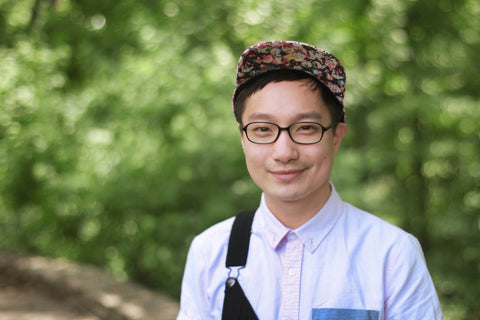
Chen Chen
ABOUT THE AUTHOR
Chen Chen was born in Xiamen, China, and grew up in Massachusetts. His debut poetry collection, When I Grow Up I Want to Be a List of Further Possibilities, won the A. Poulin, Jr. Poetry Prize. His work has appeared in two chapbooks and in such publications as Poetry, Gulf Coast, Indiana Review, Best of the Net,and The Best American Poetry. He is the recipient of fellowships from Kundiman, the Saltonstall Foundation, and Lambda Literary. He earned his BA at Hampshire College and his MFA at Syracuse University. He lives in Lubbock, Texas, where he is pursuing a PhD in English and Creative Writing at Texas Tech University. For more about Chen Chen, visit www.chenchenwrites.com.
BLURBS
"The A. Poulin, Jr. Poetry Prize honors a poet’s first book, and this book wears its radical innocence on its literal sleeve. It lives within this 'never of knowing'—ecstatically, agonizingly, where every encounter has the capacity to astonish."
—Drunken Boat
"Debut poet Chen Chen’s When I Grow Up I Want to Be a List of Further Possibilities has, in addition to a killer book title, a beautiful and complex story of identity to share. The collection tells describes a mother/son relationship from the perspective of an Asian American immigrant, queer son, and explores the complicated grief and love of familial bonds."
—Bustle
"Chen Chen’s work is versatile, skillfully adapting to different forms and functions; on one page, there will be a traditional poem, lines grouped together in rhythmic couplets. On another, lines run together into paragraphs, blurring the difference between poetry and prose. Chen Chen’s poems are odes and elegies, considerations of everyday life. In When I Grow Up I Want to Be a List of Further Possibilities, Chen Chen muses his way through the idea of inheritance (specifically, what it means to inherit things like love and family), a concept that is central to his identity as a queer Chinese-American immigrant. American Book Award winner Jericho Brown gave When I Grow Up I Want to Be a List of Further Possibilities his seal of approval in his introduction to the book."
—Literary Hub
"Chen balances the politics surrounding shame and desire with hearty doses of joy, humor, and whimsy in his vibrant debut collection. To consider the titular act of growing up—to recognize what potentialcould mean—Chen must make sense of his past to imagine a better future in his poems. . . . To this end he recounts a personal history in which he playfully addresses deeply serious issues, particularly a longing to defy the fate prescribed to him by family members or others’ cultural ideas of normalcy . . . As a gay, Asian-American poet, Chen casts his poems as both a refusal of the shame of sexuality and of centering whiteness or treating it as a highly desirable trait. Readers encounter sharp, delightful turns between poems, as Chen shifts from elegy to ode and back again. . . . Moving between whimsy and sobriety, Chen both exhibits and defies vulnerability—an acute reminder that there arecountless further possibilities."
—Publishers Weekly
"I am drawn to poetry about the difficulties of family, about the pain of feeling one is a disappointment to their parents, about the sense of separation that can come as a result. Chen Chen’s debut collection is filled with work which explores this universe. This is tricky subject matter to tackle, because it lends itself to both rant and cloying sentimentality and it’s easy (I know from experience) to have them go sideways like a car on ice. . . . The result of Chen Chen’s unique take is that many of the poems in this book show how joy and pain, far from being opposites, coexist and even exist symbiotically."
—Brian Spears, The Rumpus
"What does Millennial poetry look like? One answer might be this wild debut from Chen Chen. He seems to run at the mouth, free-associating wildly, switching between lingo and 'higher' forms of diction. Nothing's out of bounds or off limits, no culture too 'pop' to find its place in poetry . . . nor anything too silly to point the way toward serious aims. And yet this is a deeply serious and moving book about Chinese-American experience, young love, poetry, family, and the family one makes amongst friends."
—NPR Books
"The collection, as the title itself suggests, is about 'further possibilities,' about revising, reinventing, and reimagining the relational modes we currently have. If we are all tasked with being 'someone ‘for’ someone else—a son, a friend, a partner, a student, a dear love,' we cannot afford to be complacent or static in the ways that we inhabit and think about those relations. Interdependence is at the heart of Chen’s writing, and if we are to survive in these troubled times, we must continue to believe that there really are new ways to find the impossible honey."
—Up the Staircase Quarterly
"Chen Chen refuses to be boxed in or nailed down. He is a poet of Whitman’s multitudes and of Langston Hughes's blues, of Dickinson's 'so cold no fire can warm me' and of Michael Palmer’s comic interrogation. What unifies the brilliance of When I Grow Up I Want to Be a List of Further Possibilities is a voice desperate to believe that within every one of life’s sadnesses there is also hope, meaning, and—if we are willing to laugh at ourselves—humor. This is a book I wish existed when I first began reading poetry. Chen is a poet I’ll be reading for the rest of my life."
—Jericho Brown
"Chen Chen is already one of my favorite poets ever. Funny, absurd, bitter, surreal, always surprising, and deeply in love with this flawed world. I'm in love with this book."
—Sherman Alexie
"The radioactive spider that bit Chen Chen [isn’t that how first books get made?] gave him powers both demonic and divine. The bite transmitted vision, worry, want, memory of China, America’s grief, and People magazine, as well as a radical queer critique of the normative. What a gift that bite was—linguistic, erotic, politic and impolitic, idiosyncratic and emphatic. What a blessing and burden to write out of the manifold possibilities of that contact."
—Bruce Smith
"I so deeply love this poet’s imagination where old shoes might walk back up the steps of a house, where one speaker pledges ‘allegiance to the already fallen snow’ and another says ‘Let’s put our briefcases on our heads, in the sudden rain, // & continue meeting as if we’ve just been given our names.’ In precise and gorgeous language, Chen Chen shows us that the world is strange and bright with ardor. He reminds us of the miracle of the sensual and sensory. This is a book I will return to whenever I forget what a poem can do, whenever I am in need of song or hope. If a peony wrote poems in a human language, I think that these would be his poems. If the rain wrote poems… I mean: this is an important work by an astonishing and vital voice."
Poems cited here are assumed to be under copyright by the poet and/or publisher. They are shown here for publicity and review purposes. For any other kind of re-use of these poems, please contact the listed publishers for permission.
We here at TBOP are technically deficient and rely on our bashful Milo to fix everything. We received notice from Google that we were using "cookies"
and that for our readers in Europe there had to be notification of the use of those "cookies. Please be aware that TBOP may employ the use of some "cookies" (whatever they are) and you should take that into consideration