Showing posts with label frontenac house poetry. Show all posts

Monday, January 14, 2019

This Wound is a World - Billy-Ray Belcourt (Frontenac House Poetry)

Today's book of poetry:
This Wound is a World.  Billy-Ray Belcourt.  Frontenac House Poetry.  Calgary, Alberta.  2017.

Griffin Poetry Prize 2017
CBC Best Canadian Poetry Book
2018 Robert Kroetsch City of Edmonton Book Prize Winner

Billy-Ray Belcourt's stunning This Wound is a World deserved every prize it won and more.  There might be other poets who hammered at these walls but there has yet to be one, as far as Today's book of poetry is concerned, who might actually bring them down.  Billy-Ray Belcourt is such a poet.

It doesn't matter what you think you know about being gay or straight, Indigenous or not, these poems are going to change some of your perceptions.  In Today's book of poetry world we know that only the very best poems can pull off this sort of magic, this sort of medicine.

Billy-Ray Belcourt pulls the rabbit out his hat like some sort of Trickster.  The reader just has to sit back and watch the show.

The Cree Word For a Body Like Mine
Is Weesageechak

the cree word for a body like mine is weesageechak, the old ones know
of this kind of shape-shifting: sometimes i sweat and sweat until my 
bones puddles on the carpet in my living room and i am like the water
that comes before new life.

i was born during a falling leaves moon; which is to say that i have
always been good at sacrifice. it is believed that women are most
powerful during their moontime and because of this do not take part
in ceremonies in order to let the body cleanse itself. there are
weesageechak days when gender is a magic trick i forgot how to 
perform and my groin floods and floods trying to cleanse itself like
the women and i too become toxic for men who have built cages out
of broken boys.

maybe if i surrendered myself to grandmother moon she would know
what to do with these pickaxe wounds. there is so much i need to tell
her about how my rivers and lakes are crowded and narrowing. how i
managed to piece together a sweat lodge out of mud and fish and
bacteria. she gives me the cree name weesageechak and translates it to
"sadness is a carcass his tears leave behind."

and the crows and flies who don't care about gender will one day
make away with my jet-black finger nails and scraggly armpit hairs.
they will lay tobacco at my grave and tell their crow and fly kin that i
was once a broad-shouldered trickster who long ago fell from the
moon wearing make-up and skinny jeans.

💫💫💫

Belcourt will be in a unique poetic position, everyone who reads poetry is going to be anxious to see what he does next.  Today's book of poetry is already convinced This Wound is a World is a Canadian classic, we will be looking at this marvel for a long time.

True, hard-nosed blood letting is a dangerous game to play.  But it is clear Belcourt has big shoulders.  In this case it means the poet has put it all up for grabs, Billy-Ray doesn't hesitate for one second, he is full in, all in.  Billy-Ray Belcourt is a straight up gunslinger poet with dead-eye aim.

And dear readers, there is so much happening in This Wound is a World that I simply won't be able to tell you.  For example, you all know how much Today's book of poetry loves "list" poems.  We are a sucker for them.  Billy-Ray Belcourt has several excellent, I repeat, excellent, list poems in This Wound is a World.  Today's book of poetry loves those list poems - but, but, but, this is a book brimming over with the necessary.

If I Have A Body, Let It Be a Book of Sad Poems

i keep listening to a song by tom odell called grow old with me, i am
hung up on the enormity of that kind of project, of asking someone
to architect a livable world with you, what a blessing and a curse!

i hooked up with a man who insisted he was 42, but i suspect he was
older given the soft and reckless way he met my body with his. it was
9pm and we were making small talk and he told me a story about
how a relationship of his had started and ended at the same ski resort
in france. recently, he returned to that resort, and was caught
unawares by a wave of memories about his ex-boyfriend. today,he
lives alone in a houseboat, unwilling to be beside himself with desire.
how could he have expected anything but what christina sharpe calls
"the past that is not past" to haunt him? maybe that is why he wanted
to sleep with me last night. maybe that is why i invited him over in
the first place. i should have said: i don't have it in me to transform you.

if i have a body, let it be a book of sad poems. i mean it. indigeneity
troubles the idea of "having" a body, so if i am somehow,
miraculously, bodied then my skin is a collage of meditations on love
and shattered selves.

ok yes, i have been reading a bit of psychoanalysis lately. forgive me.
i am desperate. desperate to figure out how someone like me is still
here.

if i know anything, it is that "here" is a trick of the light, that it is a
way of schematizing time and space that is not the only one available
to some of us. maybe i am not here in the objectivist sense. maybe i
am here in the way that a memory is here. now, ain't that fucking sad
and beautiful?

💫💫💫

Reading Billy-Ray Belcourt's This Wound is a World the first time is like watching/hearing Stevie Ray Vaughan's all consuming attack on Jimi Hendrix's "Voodoo Child" for the first time.  It is hard to take it all in, quite, because the artist is so far ahead of the curve that the reader has to lean into it.  But make no mistake, Belcourt is:

     "Standing next to a mountain"

and will

     "chop it down with the edge of my hand."

It's exciting to read and instantly rewarding poetry.  Milo, our head tech, said that he had to get copies of This Wound is a World into the hands of a few of his friends, pronto.  Kathryn, our Jr. Editor, asked:  "Do you think he knows what he's done?"

To which Today's book of poetry replied, "Damned right he knows!"

Wapekeka

in january 2017
two girls, 12, carried out a suicide pact
on the wapekeka first nation.
what is suicide
but the act of opening up
to the sky?
but wanting to live
more than once?
yesterday
a cloud fell onto me
and i never felt more at home.
sometimes i cry
in indian
and it sounds like
i am speaking
in english.
don't open your eyes.
pretend that
everything is a bird
and no one is hungry
for what they can't have.

...

Today's book of poetry is certain that poetry this necessary will find an audience.  This Wound is a World is going to be remembered as a landmark book.

Today's book of poetry is thrilled to back on the job and excited to be starting the year with Billy-Ray Belcourt's amazing and brave This Wound is a World.

Image result for billy-ray belcourt photo

Billy-Ray Belcourt
Image from CBC Books

ABOUT THE AUTHOR
Billy-Ray Belcourt is from the Driftpile Cree Nation. He is a PhD student in the Dept. of English & Film Studies at the University of Alberta. He is also a 2016 Rhodes Scholar and holds an M.St. in Women’s Studies from the University of Oxford. Billy-Ray was named one of six Indigenous writers to watch by CBC Books in 2016, one of ten Indigenous writers to read right now by VICE in 2017, and he was the recipient of the 2017 P.K. Page Founder’s Award for Poetry. This Wound is a World is his first book.


Billy-Ray Belcourt
recites one of his poems
Video: Edmonton Journal


729


Poems cited here are assumed to be under copyright by the poet and/or publisher.  They are shown here for publicity and review purposes.  For any other kind of re-use of these poems, please contact the listed publishers for permission.

We here at TBOP are technically deficient and rely on our bashful Milo to fix everything.  We received notice from Google that we were using "cookies"
and that for our readers in Europe there had to be notification of the use of those "cookies.  Please be aware that TBOP may employ the use of some "cookies" (whatever they are) and you should take that into consideration.

Tuesday, February 6, 2018

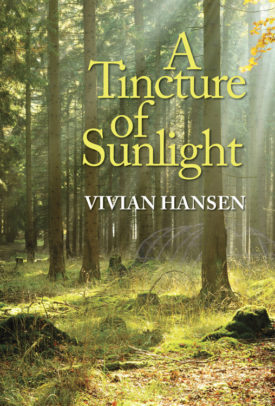
A Tincture of Sunlight - Vivian Hansen (Frontenac House Poetry)

Today's book of poetry:
A Tincture of Sunlight.  Vivian Hansen.  Frontenac House Poetry.  Calgary, Alberta.  2017.


A Tincture of Sunlight makes me think of Hemingway's The Old Man and the Sea along with Robert Ruark's The Old Man and the Boy or The Old Man's Boy Grows Older for a moment.  Vivian Hansen's "Old Man" is Cree/white and he is everyone's "Old Man."  And old men are smart.

Part Trickster and part Gulley Jimson, Hansen has appropriated the "Old Man" voice, as narrated by his lover, as a tool to bend and fold as needed to tell these remarkable little stories.

Acapella Wind

Old Man says he likes to hear the wind
stealing past
my kitchen window,
howling, like a coyote
wailing and trolling,
echo through a storm.

Air and anger shove
through the window's eyes.

For these speechless lamentations,
he is back in depression Saskatchewan.

Wind sucking
through dead-pine clapboards slats,
moaning inside his head,
soothing edges,
singing past
the drunken blasts
of father-yells below the staircase.

This is A Capella.
The lyric of wind.

Coyotes in spring heat.

The used-to-be of smoking
willow leaves
sucked
through a prairie howl.

Almost 85,
he says he's in his second childhood
drags on a roll-your-own.
Sucks.

Listens.

I ask him what his dreams are about inside the wind.

He says:
They're wet.

...

The "Old Man" seems to know almost everything that has happened and everything that is going to but he doesn't know how to soothe his own aching heart.  In this life "Old Man" has been a soldier and a lover and a scientist and a father and so on.  Hansen shares some of the vast research she has assembled as inserts in the text when necessary and it is helpful, it adds context.  Hansen also borrows a little from some friends:  from Leonard Cohen, Robert Service and Don McKay, Annie Dillard and Lorna Crozier, G.D. Burgess and more...

The resulting poems have a seductive quality to them, it's a tone in the Lover's voice that she has adopted from the "Old Man."  That tone comforts the reader like the smell of an evening fire, a subtle invitation to sit down and talk or to just sit and listen.


Counting Coup

Got to thinking it wasn't a bad idea
to steal something from the enemy.

There was one stinking battle one night.
We shelled the square-heads most of the night.
Left them to rot.
Battle of Falaise Gap.

I strolled through the field the next morning.
Sun was up and bright,
shining on a field of dead German stumps.
Sunlight landed on light
from the ring -- nearly blinded me.

young guy, blonde, about my age.
Just married, I guess.
Couldn't get the ring off of his finger because his carcass
had blown into a balloon.

The ring had a beautiful design --
a switchback criss-crossing the circle of gold.
Inside, the engraving of an Iron Cross.
I wanted it.

Old Man waves his pinky finger,
still wearing the wedding ring of the dead German soldier.
He takes it off and shows it to me.
All the years wore off the switchback design
from its hopeful circle.
It no longer held a pattern, except in his memory.

I peer at the engraved Iron cross.
Imagine the widow identifying the body,
looking for the ring and finding -- a missing finger.

...

Today's book of poetry wants to take a moment to tip our hats in the direction of Frontenac House Poetry for their new direction in design.  Neil Petrunia designed A Tincture of Sunlight and it is both elegant and cool.  Frontenac House Poetry's new books are striking.

Vivian Hansen has created a universe in A Tincture of Sunlight that seems far more generous and warm then our present one.  Today's book of poetry knows that each universe has it's own Gods and Demons and the "Old Man's" Lover carries him and us with tender determination.

Our morning read got started late again.  More snow today.  Winter in Ottawa, who knew?  When the troops stumbled in they were all snow-shovelling beat and weary.  Vivian Hansen's "Old Man" and his lover both soothed their snow bruises and inspired their poetry engines.

Milo went into the stacks and brought out a copy of Hansen's A Bitter Mood of Clouds (Frontenac House Poetry, 2013), which we happily threw into the mix when the gang had finished reading A Tincture of Sunlight.  Hansen apparently knows how to inhabit any voice she wants.  What A Bitter Mood of Clouds demonstrated to Today's book of poetry, thoroughly, is that Hansen may be the real Trickster.

Sticking to Bones

Old Man's subtle sarcasm:
why don't you do some praying
for your own sins, if you believe there's a God at all!

-- imagine that --

I tell him it's really his own he wants forgiven.

His Old Bones,
etched with arthritis,
grieve him with the treachery
in his own body.

Pain that forces him to stop
driving, off an eternal highway
to stretch the seams of his knees.

It must have been here
I began inhaling grace,
exhaling whispers.

Enfolding him in my heart, praying
for Jesus to touch him.
And he kept driving, his knees suddenly painless.

I couldn't believe it

He said later, the simple
testimony of the unbeliever.

When I asked God to touch Old Man,
I meant his Old heart,
his tortured mind.

But instead, a laughing God
began to work
on his aching, arthritic, knees.

...

Today's book of poetry loves a book that swallows you whole like Jonah in the Whale; Okay, the whale was a big fish, but still.  Vivian Hansen writes poems that border on myth and she does it with a natural elan that welcomes the reader into every poem.  Hansen's "Old Man" is trying to make sense of the world and his life which is both a big job and to him, a big joke.  Making sense of the world, ha.  Hansen's ribald Lover and her "Old Man" can take a joke.

A Tincture of Sunlight is as pleasantly surprising as it is impressive.

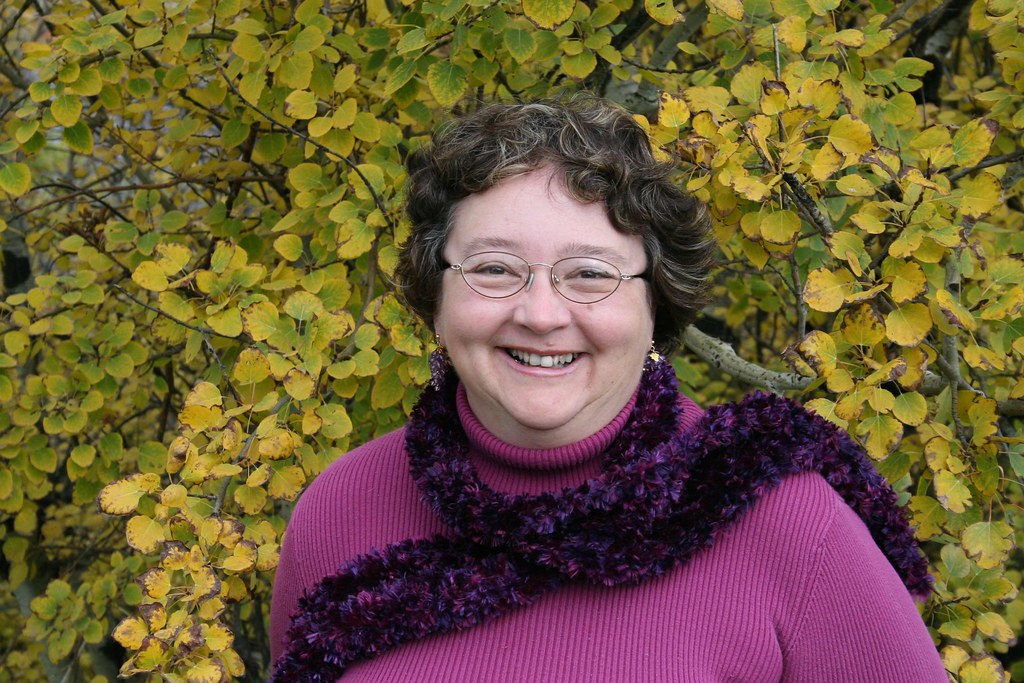
Image result for vivian hansen photo

Vivian Hansen

ABOUT THE AUTHOR
Vivian Hansen has published in genres of fiction, nonfiction, and poetry. A Bitter Mood of Clouds was published by Frontenac House in 2013, a Long Poem that tells the story of Arne Petersen, who received gender reassignment in Denmark in 1953. Earlier work includes Angel Alley: the Victims of Jack the Ripper and Never Call it Bird: the Melodies of AIDS (Passwords Enterprises) and Leylines of My Flesh (Touchwood 2002), which chronicles the immigration experience of Danish Canadians. Vivian’s essay ‘Hundedagene and the Foxtail Phenomena” appears in Coming Here, Being Here: A Canadian Migration Anthology (Guernica 2016). Vivian teaches creative writing at Mount Royal University and the University of Calgary, as well as at the Alexandra Writers Centre. She is a member of The League of Canadian Poets and The Writers Guild of Alberta. She holds an MFA in Creative Writing from the University of British Columbia.


Vivian Hansen
Reads from A Bitter Mood of Clouds
Video: Frontenac House


654

DISCLAIMERS

Poems cited here are assumed to be under copyright by the poet and/or publisher.  They are shown here for publicity and review purposes.  For any other kind of re-use of these poems, please contact the listed publishers for permission.
We here at TBOP are technically deficient and rely on our bashful Milo to fix everything.  We received notice from Google that we were using "cookies"
and that for our readers in Europe there had to be notification of the use of those "cookies.  Please be aware that TBOP may employ the use of some "cookies" (whatever they are) and you should take that into consideration

Wednesday, October 25, 2017

Seva - Sharanpal Ruprai (Frontenac House Poetry)

Today's book of poetry:
Seva.  Sharanpal Ruprai.  Frontenac House Poetry.  Calgary, Alberta.  2014.                                                        
23352190

Sharanpal Ruprai is opening a window to a world most of us have never seen, much less experienced.  Seva tells the life story of a young woman growing up in a Sikh household.  If that was all if did we could still find ample reason to celebrate this poetry.

But that is only where Seva and Ruprai begin.  She illuminates a very private world and when she casts the light that private world responds.  Being a young woman in a world where domestic rules and cultural norms are radically different inside and outside of the home is an incomprehensible task.  Seva bravely walks us through the challenge.

Sharanpal Ruprai faces a myriad of challenges when she wakes up in the morning.  Being a young woman of colour as an outsider in a dominant culture where most others are white, prone to labelling turban wearing brown people as "Pakis," and where tolerance and understanding are never a safe bet, never a given.  As Ruprai's mother laments: "never trust anyone."

Five Day Sin

My mother insists.
She takes my measurements and I clinch my pelvis,
stomach, thighs and bum cheeks, praying the numbers
work in my favour. Kachera are too much like baggy shorts
with a draw string. She purchases light blue broadcloth,
tells me the colour is more feminine than pure white.
She did not grow up in Canada, does not know that girls
are size-eyeing each other up and checking out who is wearing a bra
with matching panties. The name-brand ones.
You have to purchase each panty separately. I covet those panties.
My mother on a mission from Guru Gobind Singh.
What did he care about bras and panties?

There was no getting out of my body I am stuck in my body-time
but my body my body bled for days menstrual pads did not stick
blood trickled down my body my thigh.
I was sent home for stomach pains.
              Tampons were out of the question.
Mother surrendered and bought me a package
of five oversized-white-no-name-brand underwear.
I was told I would be forgiven
for wearing panties for five days out of the month. Never
did I have cramps or what boys called pms.
Each month, I willed my body
my body to release as many eggs
as it wanted, as long as I bled
for five days, so I could be
like the other girls.

...

There is much joy and beauty in many of the small moments of family and community that Ruprai accessed to tell her story, it is not all woe.  But figuring out who you are is a struggle we've all engaged in at one point or another in our lives.  Most of us haven't had to double down to step outside of our culture to fit in.  Sure, we've rebelled against our parents with hostile cigarettes dangling from our lips.  Then most of us turn into a slightly different version of our parents, and we haven't had to step outside our own traditions to do it.  And let's face it, in almost every case, women have a tougher go than man.

Ruprai never laments, these aren't sad, "look at me" songs.  These poems are about growth and experience and endurance and rebellion.  These poems tell the journey of how a young girl grows strong to become and empowered woman.  These poems kick the odds to hell.

One Strand as a Time

Every morning, a disciplined choice of a black starched turban.
Dreams of combing fingers through short black hair vanish
every morning. In front of an open locker
an inspection for unruly strands.
Bullies yell down the hall ride them' cowgirls!
Avoid eye-contact and stare at yourself in the mirror.

In the washroom, a fist into a mirror.
Every morning, a disciplined bully trashes a turban
avoid gym, too hot and sweaty to play tag and cowgirls
do not care for brown skinned cowboys.
                                                 Dreams of track'n field gold vanish
Parents think, a bookish child, good thing really. Strands
of rope tucked away in a locker.

Down the hall a push into the open locker
a click of a lock, a scream, let me out, a mirror
shatters and unruly strands
poke out and bullies pull at an unravelled turban
Dreams of making it through the day unharmed vanish,
bullies yell heehaw heehaw, ride them' cowgirls!

No more heehaw or ride them'cowgirls!
No more being shoved into a locker.
Dreams of short black hair vanish.
A pair of scissors, black elastic, a mirror
and a hacked up turban,
in the school basement long black strands.

Snip one strand, snip two strands, snip three strands
of hair hacked up all over the floor, no more cowgirls
taunts, mo more dirty turban
lover jokes, no more being thrust into a locker
a sneer in the mirror
a sneer, tears and fears in the mirror vanish.

They gawk, we gawk, parents gawk
                                         and dreams of a good Sikh child, vanish.
Tears stream and hair strands
are stuck to the school bathroom mirror.
Students cowered in the gum. No brave cowgirls
anymore, police, principal, and parents peer into a locker
the murder weapon is longer than a turban.

Every morning, in front of a locker, sounds of snipping strands
In the school bathroom, a turban cowgirl
vanishes in the mirror.

...

Today's book of poetry has a morning read every day and today's was held out on the front porch to enjoy the spectacular fall weather here in Ottawa.  Short sleeves and sunshine in late October.  Hard to imagine but it is here.  Some of the local kids; Clara, Bela, Theo, Maya, Julian and Daniel, were playing one of their self-styled games of hide n' seek.  The sky is blue, blue, blue and it is unnaturally warm for October.

The reading was a gaudy affair with summer hats and drinks with fancy, funny straws.

Ruprai's poems are rapid, sure fire shots, bursts of clarity, but there is always enough in there to assure us that these are poems of intelligent rebellion and emotional growth.  These poems can also be seen as a template for other young women frozen in place by circumstance. 

Today's book of poetry recognized the intensity of an old soul in a new voice, it appears in every smart poem.

Baker's Dozen

A woman who creates and becomes, as she wished.
She who is simply unsatisfied.
She who does not take pleasure in tracking down clean water.
Two suited women, side by side in a cubicle.
The women, contemplate ovulation and children.
The midwives who kill girl babies, though it may not please them.
A woman and a woman, who learn how to read and translate.
She who stokes the fires for light, not heat.
A woman who justifies the missing salt and butter.
A woman who takes pleasure in washing her lover's hair.
She who prefers salt over butter.
These women, aware of how they are saving the world.

There women add one more line, add to the world.

...

Sharanpal Ruprai's eye on the world is one the poetry world could use a lot more of.  Today's book of poetry is going to be first in line for her next book of poetry riches.  Sharanpal Ruprai makes Canadian poetry just that much richer, broader, and more tolerant and understanding.  What could be better than that?

Image result for sharanpal ruprai photo
Sharanpal Ruprai

ABOUT THE AUTHOR
Sharanpal Ruprai earned a Ph.D. from the Department of Humanities at York University, Ontario, Canada. She holds a Masters degree in English from the University of Calgary and a Bachelor of Education and Bachelor of Arts from the University of Winnipeg.

BLURBS
“There is much to be learned and appreciated in this project. Sikh culture and mores unfold in a poetic narrative that both entices and educates. Arrangement of the words on the page and the Sikh words complement the telling. Clear images. Consistent mode of foreboding.”
     — Barb Carter

“I think it’s wonderful. I found it powerful and a way into a secret world. I laughed and wept. It’s beautiful. I can’t wait to talk about it — on and off the air.”
     — Shelagh Rogers


620
DISCLAIMERS

Poems cited here are assumed to be under copyright by the poet and/or publisher.  They are shown here for publicity and review purposes.  For any other kind of re-use of these poems, please contact the listed publishers for permission.


We here at TBOP are technically deficient and rely on our bashful Milo to fix everything.  We received notice from Google that we were using "cookies"
and that for our readers in Europe there had to be notification of the use of those "cookies.  Please be aware that TBOP may employ the use of some "cookies" (whatever they are) and you should take that into consideration.

Tuesday, May 9, 2017

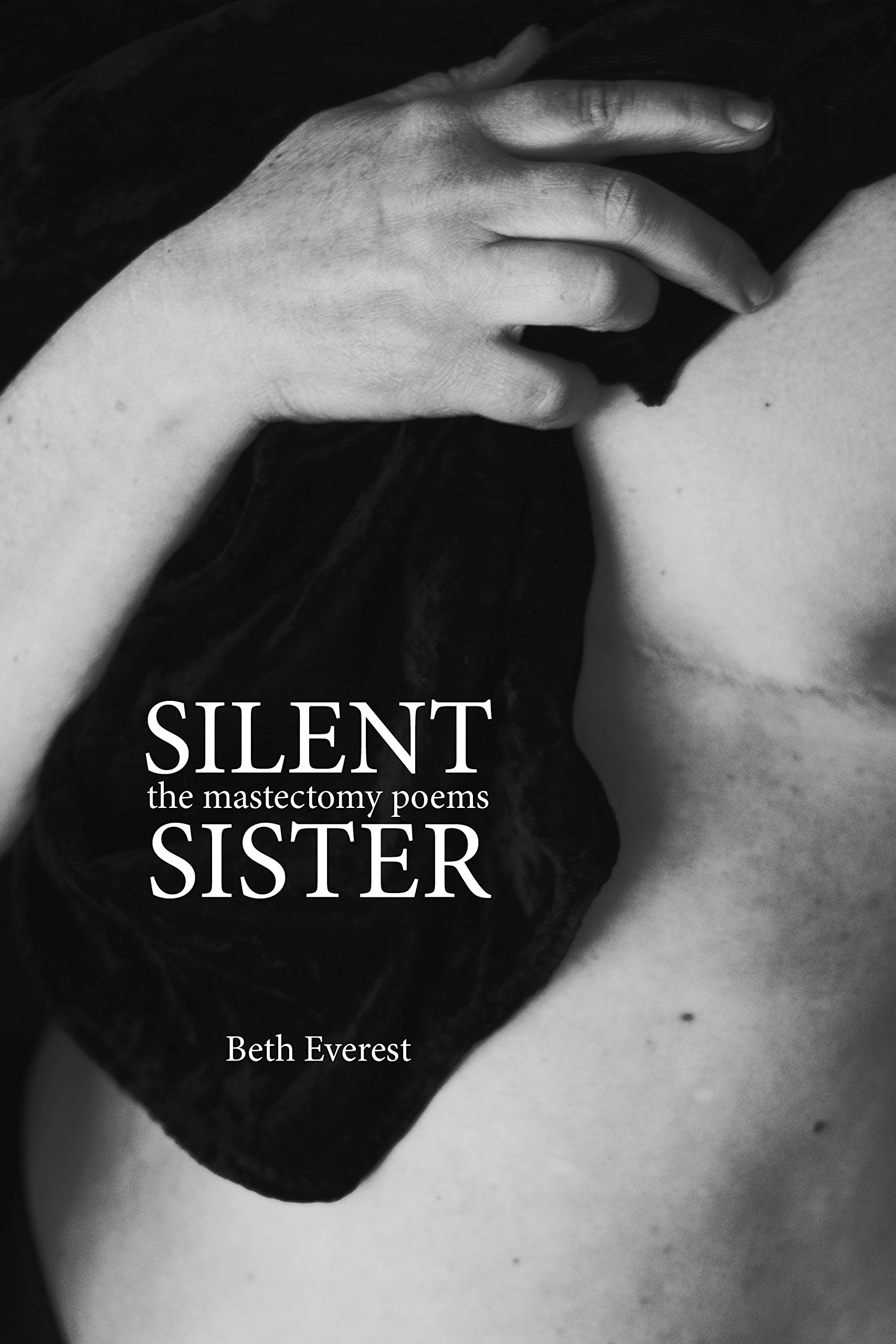
Silent Sister - the mastectomy poems - Beth Everest (Frontenac House Poetry)

Today's book of poetry:
Silent Sister - the mastectomy poems.  Beth Everest.  Frontenac House Poetry.  Calgary, Alberta.  2016.


~~~~~

is chemo as awful as
some people say it is?

you never ever want to know.

~~~~~

Beth Everest goes to hell and back and writes poems about the experience.  They are as immediate as a slap to an unsuspecting face.  Silent Sister - the mastectomy poems is a harrowing coming to terms with cancer and the fallout around that terrible disease.

Everest takes honesty to chemo-puking levels and shares the intimacies of emotional mountain climbing and the literal physical breaking point.  Her illness is a cross she bears and a painful platform and from that stratified vantage point Everest muses on relationships, family, the concept of the/a future and the pain.  There is almost always the pain.

~~~~~

sometimes

i lie in bed, hoping
morning comes.
other times, i lie in bed
hoping it doesn't
but it does
and maybe the sun comes
out, or doesn't
but my nurse
tells me rain
clears toxins
even if it feels like

burning,
burning
rain.

~~~~~

Today's book of poetry was very curious to find out that Beth Everest had the opportunity to study with both W.O. Mitchell (Who Has Seen The Wind) and Saint Alistair MacLeod (No Great Mischief), two of Canada's greatest story-tellers.  

Today's book of poetry was lucky enough to study with W.O. Mitchell's son Orm Mitchell, as good an English professor as you'd ever want to find.  The closest Today's book of poetry ever got to St. Alistair was to stand beside him at a small cocktail party while he and Margaret Laurence traded war stories.  I made sure their glasses were full, listened, gobsmacked.

Today's book of poetry mentions Mitchell and MacLeod because in our story of the world they are a special kind of deserved royalty.  That Everest studied with them shows serious intent, and it never hurts to rub elbows with the gods.  But to my knowledge neither MacLeod or Mitchell dabbled in the dark art of poetry.

Silent Sister - the mastectomy poems works very effectively as a book of poems.  The immediacy, intimacy and voracity of these extremely personal poems is electric.  But it would be very easy for Today's book of poetry to imagine much of this text in a longer narrative work of fiction.  We would stop short of saying we can see the particular influence of Mitchell or MacLeod but we certainly see the quality, the precision.  Beth Everest writes poems singed with the fire and flame of having been to Hades.

~~~~~

docetaxel

smells like medicine we were given
when we were kids, one teaspoon each
year before the wormy winter of sucking
on frozen sweater sleeves, eating snow
for God's sake, a dog might have peed there,
the carmine suspension that tasted like
coins, thick on the tongue.

open your mouth, it's just one teaspoon,
my dad holds my hands back, mom pries
at my mouth and just the smell i am
spitting it into the next year.

and now i am 53, the oncology nurse with
the slow rubber gloves, funnels the bag of
red into the syringe, into my arm, it smells
like, it feels like, it tastes like
forever
will it be over, the slow 45 minute
squeeze,
does it burn? tell me if it burns and
i will slow down, hurry, please, too
toxic to drip, too toxic to touch, too toxic
to spit and when you get home you'll pee
red for up to four days, all your body
fluids are toxic, take precautions especially
around the toilet, wash your hands, be
careful, tell your family, and watch your pets, do you
have pets? a dog, maybe?
yes, yes, hurry, please yes,
and when we are done,
we'll start the slow
2 hour
drip.
drip.
drip.

~~~~~

There is much rough going on in Silent Sister - the mastectomy poems, so much pain shared that it's hard to rub it off when you are done.  At the same time Everest has found her way to a voice that is measured with enough tenderness to get through to the end.  She is not without hope.

In this very difficult time Everest and her poems find some solace in the consoling hands of caring friends.

~~~~~

i am at a local store,
flipping thru the racks of discount clothing
sort of hoping to find something to fit
my reshaped
body.

hey. i look up at the sound of a woman's voice,
soft and friendly, and realize she is speaking to me.
you in treatment? she says. i've been there.
twice. as in two sets.

i think i am afraid
to think about that possibility.
what stage? she asks.
2B comes surprisingly to my tongue.
can i hug you? she asks and moves to my
side of the rack.

and you? i say, what stage are you? i ask this
mid-hug. she steps back.
she smiles, they are making me comfortable
and she walks away.

wait, i think, but not thinking loudly
enough for her to hear. wait, please
tell me your name, as if somehow
the naming would make all the difference.

~~~~~

Everyone here at Today's book of poetry has been touched by that rat bastard cancer at one point or another.  Our Sr. Editor Max lost his youngest son to the scourge almost twenty years ago and we miss him so.  One way or another cancer has thunder-fucked each and every one of us here at Today's book of poetry so this morning's reading was a highly charged affair.

Today's book of poetry's mother, Effie, had a breast removed when she was in her early 20's and then had the other breast removed when she was in her early 40's.  For the first time in my life, thanks to Silent Sister - the mastectomy poems, I have had a small glimpse, a moment of perspective, into the horrors my mother braved.  Four small children and a fifth on the way when the Big C first knocked on my mother's door.

Beth Everest is doing some very brave sharing with Silent Sister - the mastectomy poems.  Many, many women will weep with understanding and empathy, any man who reads Silent Sister will come away with more understanding than previous and certainly more sympathy.  That is an awfully big success for any book of poetry.

And Everest manages to throw in some hope, a trickle of optimism.  An "I'm still here, dammit," smiling sneer.

This book of poems should be in every Dr.'s office and waiting room in the country.

Beth Everest author photo
Beth Everest

ABOUT THE AUTHOR
Beth Everest is a Calgary based writer whose poetry and fiction have been published in journals across the country. Her new book, silent sister: the mastectomy poems, forthcoming from Frontenac House (2016), is her second book of poetry.

Beth has won numerous awards for her work and her teaching. Most recently, her piece “this poem is about desire” was awarded the silver medal at the Alberta Magazine Publishers Association Awards (2014), and “hanging clothes” won second place in the 2013 Freefall Fiction Contest (judged by Patrick Lane).

Beth holds a Doctorate in Education (University of Calgary), a Master of Arts Degree (University of Windsor, where she had the notable honour of studying with the great story-tellers W.O. Mitchell and Alistair MacLeod), a Bachelor of Education Teaching Certificate (University of Calgary), and Bachelor of Arts Degree (University of Alberta).

Currently, Beth is an Associate Professor in the Department of English,
Languages and Cultures at Mount Royal University, where she teaches Creative Writing (fiction).

BLURBS
Your writing makes me wake up and think and feel and remember.
     - Judy O'Leary, cancer survivor

Telling the story of breast cancer is brave but not so important to helping others who often feel very alone. Even more effective when poetry brings alive the daily experience in such a graphic way.
     - Jeremy Hughes, former CEO, Breakthrough Breast Cancer, UK

Dr. Everest has composed an honest, reflective collection of her art, sharing with us her hard-fought battle against breast cancer. She vividly captures the fragile moments of her journey; there is intense emotion in each verse.
      - Dr. J. Kanashiro, surgeon

Powerful. Poignant. Heartbreaking, yet ultimately hopeful. Silent Sister is about more than breast cancer. It's about the loneliness of modern medicine, our seach for meaning, our dogged resilience in the face of a crow's nest of cancer. The flesh may be pierce, but the human heart never.
     -Will Ferguson, Giller Book Prize Winner


579

DISCLAIMERS

Poems cited here are assumed to be under copyright by the poet and/or publisher.  They are shown here for publicity and review purposes.  For any other kind of re-use of these poems, please contact the listed publishers for permission.

We here at TBOP are technically deficient and rely on our bashful Milo to fix everything.  We received notice from Google that we were using "cookies"
and that for our readers in Europe there had to be notification of the use of those "cookies.  Please be aware that TBOP may employ the use of some "cookies" (whatever they are) and you should take that into consideration.
Friday, February 12, 2016

Folding the Wilderness Within - Joan Shillington (Frontenac House Poetry)

Today's book of poetry:
Folding the Wilderness Within.  Joan Shillington.  Frontenac House Poetry.  Calgary, Alberta.  2014.


Joan Shillington's second book of poetry, Folding the Wilderness Within, is rock steady from the first page to the last.  These poems are gorgeous constructions ripe with tension, drama and passion. 

Shillington's poems carve us a new notion of what it is to grieve, to lose.  That loss is there like a weight but then these poems redeem and reward the reader with intelligent surprise.

The Neighbour Speaks from Beyond

Let me say, this is not how anyone could imagine it is to drown.
August water creeping over my soles, then ankles. Slow list of
boat and there I was, caught between nightmare and reality. I
tipped the last of the twenty-six past my lips then lashed my
wrists to a rope and eased myself across the overturned hull.
Rum burned in my gut as if I had swallowed glass from the
bottle. Haunted voices hurled themselves from a distant

shoreline. Words, distorted, sank. Confused letters on black
water. I counted the seconds between lightening and thunder.
Paper, scissors, rock. Our Father who Art in Heaven. Cold
cleaved my body. I rocked and swayed with waves. I became
boat. Storm. Water. Rain. Soon, I was not seen but could see. I
saw the dark beyond the cottage. Family. Wife. Children. A girl
on the opposite shore who could not come. And now, she has
forgotten my name.

...

Today's book of poetry picked out a hoard of poems from this collections that we felt you HAD to see.  Shillington sets the bar rather high at the start of Folding the Wilderness Within and then she sustains that fierce standard like John Coltrane holding a moment of beauty in one note and turning it into a song.  We liked this book.  Shillington calls on the voices of the dead and the dying to help when no other voices will do.

Shillington mentions poet Richard Harrison as a friend and mentor in her notes.  Harrison is an old and respected friend of Today's Book of Poetry.  We don't quite go back to our teens, but close.
It is easy to imagine this manuscript going through Richard's disciplined hands.  If these poems meet his standard then they certainly meet ours.

Ordinary
         After Kindness by Naomi Shihab Nye

Before you know what ordinary is, you must visit a funeral home
and view the body of a friend you made plans with just a few
days before. You must watch as the people dearest to you, buried
beneath flowers, sympathy cards and lasagne casseroles, have
their mother's urn pressed into their hands. You must stand in
their home and see the unmade bed and laundry still scattered
on the floor. Then you must hug and kiss good-bye, turn the key
in your car and drive home less than a week after the phone call
and discover that milk and bread still line grocery store shelves,
traffic lights change green, yellow, red. Your dog needs grooming.
You step into the rain, walk through the neighbourhood,
past the church. Yellow parking lines gleam wet, your dog busy
on new grass and then look you look up as an SUV pulls
alongside and see the smiling face of Vivian, who you haven't
seen in six months. She rolls down her window and you pick up
your wet dog, hold him as he shivers beneath your jacket. Your
feet sink into the soft earth as you walk across the boulevard and
then you stand in the rain as the city hums around you, and
become one of the two women talking in the quiet of a road.

...

The poems in Folding the Wilderness Within, romantic lamentations, prayers, praise-songs, made for a very passionate morning read at the Today's book of poetry offices.  Our head tech Milo and our new intern Kathryn both brought in friends for the event - and as you all know - you show up for the morning read then you have to participate in the morning read.

Today's guests were an excellent addition to the poetry reading team.  We here at TBOP believe that the real music in poems is best heard aloud.  Ms. Shillington did not let us down.  These beauties sounded better than spare change.

TBOP's morning reads are open to the public.  

Summoning

         Please come before winter.

         Before north winds crumple veined leaves to the ground
and prairie grass is laid by snow.

         Before river's rage slows to a trickle between ice floes
or low clouds obscure landscape and snow muffles earth.

         Please come before frost snaps limbs or yellow birdsong
is erased by this season.

         Please come before the absence of light weighs on me.

         Please.

...

Joan Shillington's narratives follow a hard clean line and we like that, clean as the burn from the flame of a one-hundred and fifty proof flame.

Joan Shillington

ABOUT THE AUTHOR
Joan Shillington is a Calgary poet and has been published in The Antigonish Review, Fiddlehead, Grain, Prairie Fire and Freefall Magazine as well as four anthologies. She has won various contests over the years.  She is currently a poetry editor for Freefall Magazine.  Joan’s first book of poetry, Revolutions, was published by Leaf Press (2008).

BLURBS
These poems, at their best, achieve their power through withholding, to create an intimacy – sometimes gentle, sometimes brutal – that involves us even as it reveals the unspoken otherness of lives not our own. Though there is much loss here, the poems’ sustained attention to what endures makes the collection a celebration of the essential force of family. 
     ~ Stephanie Bolster

Joan Shillington’s new collection mines “this threshold of ordinary” to show the gleaming moments in all our small lives. Anchored in the detritus of daily routine, Joan knows “each word and their order”, revealing memories as archetypal as a hand of cards. Her adolescent narrator is unforgettable, “flamed one hundred and fifty proof in metal spoons, / sliced elk membrane from out-of-season carcasses, / fur falling wild …” For Shillington, the dead “are just people who / are very quiet.” But Shillington gives the quiet ones space to roar. Her poems spill over with the full throttle details of lives thoroughly lived. This book illuminates, offering us moments of grace in our flawed world.
     ~ Lisa Pasold

Welcome. You’re in for a treat, a second book from a poet fully committed to the art. I’d say a perfect second book because I can hear, in the Tsar-like footsteps of the poet’s father in all his daring, bare face turned to the wind, the echoes of history’s grasp on Joan’s first poems. And then hear the change in the insights that arise from a story but flash free of it to stand outside of any particular narrative in order to fit with many. Consider, “I dozed beside sleep,” or, of a butterfly on her arm, “Now this little epistle pleats its bright wings slowly,” or, of anywhere: “Here, we are all strangers, separated by death pains and dusty roads, quiet about the wrongs in our lives.” These are poems filled with the double-pleasure of poetic truth: the secrets are disclosed, but the mystery remains.
     ~ Richard Harrison

frontenachousepoetry.ca

436

DISCLAIMERS

Poems cited here are assumed to be under copyright by the poet and/or publisher.  They are shown here for publicity and review purposes.  For any other kind of re-use of these poems, please contact the listed publishers for permission.

We here at TBOP are technically deficient and rely on our bashful Milo to fix everything.  We received notice from Google that we were using "cookies"
and that for our readers in Europe there had to be notification of the use of those "cookies.  Please be aware that TBOP may employ the use of some "cookies" (whatever they are) and you should take that into consideration.

Tuesday, October 13, 2015

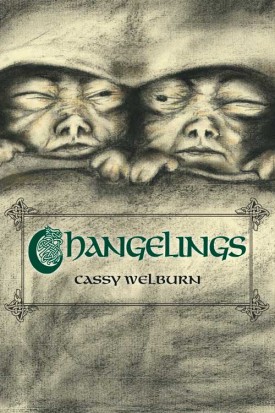
Changelings - Cassy Welburn (Frontenac House Poetry)

Today's book of poetry:
Changelings.  Cassy Welburn.  Frontenac House Poetry.  Calgary, Alberta.  2015


Cassy Welburn's Changelings reads like a book of incantations.  Welburn has an other-worldly noggin' and is translating these missives from languages we are yet to know.

These are deeply personal narrative poems that are attempting to make us see new worlds, better understand our own.

The Solitary Cyclist

My thirteen year-old self comes unbidden
out of the sky,
always on the same strip of road
on the outskirts of memory,
coming right at me
cycling home from school
in the wide green spring,
birds chattering through the pedals
to the click and whir of wheels,
leaning over the handlebars,
her eye on me,
she startles with familiarity,
beckons me slowly
from my life of glass--
this state of emergency.

Nothing should be lost,
she says,
and I'm caught
on this path, this hill,
while my body
whatever age it has become
or injury sustained,
remembers
her centre of gravity,
the spokes beneath me
turning.

...

"in the wide green spring."  This is such a simple perfection, Welburn laces these poems with gems like this as though she were tightening her skates and about to do double-axles, score on a breakaway.

Todays' book of poetry was utterly enchanted by Welburn's poetry.  Although there are many voices at hand the reader always feels secure because Welburn's steady countenance cornerstone's every poem.

Welburn counts on a little help from friends like William Butler Yeats, a quick kick in the pants from Walt Whitman.  David Bowie, Francis Child and Mary Oliver make guest appearances.  Gerard Manley Hopkins rears his old head and the nicest man on the planet, President Jimmy Carter, kicks in his two lovely cents.

Welburn understands the universe and our small part in it.  These poems feel wise but hard won.

At a Morning Truck Stop

The waitress calls out orders
over the sound of retarder brakes
and exhaust,
will that be to stay or to go?

Men climb down from their
diesel bodies, pull off caps,
as heat goes picking its way
across the parking lot
looking for plunder--
the swollen bag the busboy leaves in the bin,
a squirrel's bid for freedom
before the lid clangs shut--
a young woman leaning against the tire
of her car to smoke, a map of her whole life
spread out on the pavement--
Will that be to go or to stay?

Her young daughter's small
round head peeks
up through the sun roof,
eyes blue and cloudless,
cheeks catching the air,
right here,
one small glimpse
of paradise.

...

These poems are aching to connect.  The characters Welburn inhabits and conjures flay themselves open to make that human connection, that moment where understanding reveals the hearts' intent.

Today's book of poetry was consistently surprised reading Changelings.  Reading Welburn is a bit like watching the high jump competition at the Olympics, the bar just keeps getting raised by one gloriously beautiful leap after another.  We forget that this flight is human effort as we learn to enjoy to the soar.

Wade in the Water

The drowning man
still has a hospital bracelet around his wrist
though the name is washed out.
I've changed my mind, he says
almost cheerfully
allowing us to pull him from the river.
A light jacket and pajama pants
cling in sodden embrace,
outline his lean bones.
Memory fading, he's aging
before our eyes, forgetting already,
why we are there.
They're taking my wife away,
he says, teeth beginning to chatter.
We have a blanket around him,
carry him from the cold current of his mind
into the lap of the present,
jolt him with questions, pull down his patience
take him back where he does not belong.
There's a river flowing, he says, I saw
it from the window. Reminds me of the
sound of my own blood.
I wanted to go down there,
you know how they dunk you,
let the river wash over you, give you a new name?

...

It's a dark and rainy morning here at Today's book of poetry, Pharoah Sanders is wailing away on the box, "Save Our Children", live, it's booming and I'm blog-happy.  Day after day I get these marvelous books of poetry in the mail and Cassy Welburn's Changelings makes for an ear-mark day.  Good poetry is something magical because it changes your view of the world.  Welburn casts a spell that is both desolately honest and human about our grim world and yet she manages to find hope.

President Carter is quoted in the last poem of this collection, the last two lines in fact.  I think it sums up Welburn's poetry and frame of mind:

"We are attempting to survive our time
      so we may live in yours."    - President Jimmy Carter


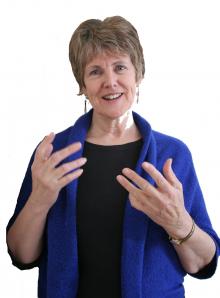
Cassy Welburn

ABOUT THE AUTHOR
CASSY WELBURN is a poet and storyteller whose work has appeared in literary journals, anthologies and on CBC radio. She has travelled across Canada sharing her work at festivals, and for audiences of all ages. She works part time as a teacher to new Canadians and as Artist in Residence at many schools. She lives in Calgary, Alberta.

BLURB
“Cassy Welburn writes with insight and revelation, as she examines the nuances of personal story, transformation and healing. Her poetic narratives integrate strong images with lamenting vignettes. Welburn presents her reader with rich portraits of people and landscape, through a tight lens and then again through the optic of a hermetic breath.”
      – Sheri-D Wilson


392

 DISCLAIMERS

Poems cited here are assumed to be under copyright by the poet and/or publisher.  They are shown here for publicity and review purposes.  For any other kind of re-use of these poems, please contact the listed publishers for permission.

We here at TBOP are technically deficient and rely on our bashful Milo to fix everything.  We received notice from Google that we were using "cookies"
and that for our readers in Europe there had to be notification of the use of those "cookies.  Please be aware that TBOP may employ the use of some "cookies" (whatever they are) and you should take that into consideration.

Tuesday, May 12, 2015

kissing keeps us afloat - Laurie MacFayden (Frontenac House Poetry)

Today's book of poetry:
kissing keeps us afloat.  Laurie MacFayden.  Frontenac House Poetry.  Calgary, Alberta.  2014.


kissing keeps us afloat is a sustained torrent, a laughing rush, a relentless scream/yodel of passion.

This red boat has no oars as it crashes against the shores of love, breaks up on the rocks called desire.

And Laurie MacFayden could care less, she's laughing her ass off.

That's not really true.  She cares.  Like the rest of us MacFayden's humour usually comes at some powerful price.

But check this out, a list poems of sorts - and you know how much Today's book of poetry enjoys a good list poem.

to be honest, i lied (my country song)

to be honest, i lied when i said i never meant to hurt you
when i said every single word is true
when i said it was a wrong number
when i said that looks really good on you

to be honest, i lied when i said i can keep a secret
when i said the cheque is in the mail
when i said i wore this just for you, sweetheart
when i said i'd be happy to post your bail

to be honest, i lied when i said i wasn't flirting
when i said i'm ready for this
when i said it doesn't hurt
when i said i've never been kissed

to be honest, i lied when i said i have the answer
when i said i do not care
when i said i'll always love you
when i said i really like your hair

to be honest, i lied when i said you're perfect, angel
when i said i'm never doing that
when i said yes, this is my natural colour
and oh no, that doesn't make you look fat

to be honest, i lied when i said you were the first
when i said you'll be the last
when i said you're the only one for me, darling
when i told you the god's sacred truth about my past

to be honest, i lied when i swore i'd never drink again
when i said i could never be untrue
and baby, i told a big fat juicy whopper
when i said i could never lie to you

...

Fearless, charismatic, funny, elegant, eloquent and frequently so horny you'd think the sky was falling before her final possible hump.  Laurie MacFayden has done something wonderful in the dazzling kissing keeps us afloat.

And we love, love, love the joyous title.  Around the office it won the poll for best title this spring.

This collection is a "page-turner".  You really can't wait to hear what MacFayden is going to burn up and turn red next.

lying woman

once upon a time
i lay a rough canvas on my paint-spattered floor.
i lay down upon it
and traced an outline of myself.

this particular portrait was long overdue.
i used a black felt pen
which was surprisingly co-operative
fluid, even.

the result was not entirely fetal
nor was it a spread-eagle sprawl.
you see, i wanted to make a collage, a map,
an abstract expansionist island of myself,
my body's outline,
its linear essence and bulk; fully clothed
but without the usual armour.

i wanted to put the foothills on my chest,
unleash the prairies across my upper back.
the eyes, of course, would be paris.

i wanted to make little toe drips
at the ends of my feet for findhorn
and tofino and that lake in the muskokas.
i invited aotearoa fern to caress my cheeks
and salt spring orange to gloss my lip and tongue.

i intended to leave space between shoulder and ear
for the city that never sleeps, but perhaps that should be lower down.
i wanted the desert of ghost ranch in the small of my back
and i would place a bit of boreal forest under each arm,
maybe a malta temple on each buttock.

i wanted new orleans between my legs

the plan was to lie back and let fierce waters wash over me.
the wet colours would be random and delightful.
the tides would go maelstrom on me in brilliant psychotic precision
not so much wreaking havoc as quickening me to a familiar moon,
or 12 moons really, all of which would float and bob
around my laughing head
just behind my imperfect right ear.

i wanted my outline to be a lying woman.
never a nude but an honest woman simply lying
a self-seeded simple woman lying
in the truth colours of her own skin
stretched to the limit and varnished by sky and sea
and probably a bit of blood.

i wanted none of the words to need to make sense.
i wanted none of the words.
i wanted the hues to be primal, and selfish,
and unwilling to open the usual locks.

i wanted the abstract interventionism of it all
to spontaneously combust, leaving just my paris eyes twinkling
and my new orleans delta burning,
all glorious damp and jazzy.

...

What MacFayden has done over the course of kissing keeps us afloat is to romp ribald, I mean Henry Miller, Anais Nin, Erica Jong rutting - and like those excellent writers, reach so much more of the reader than simple erotica ever could.  In these poems love does not always win, passion is not always requited.

That's not the point.

It is the celebrations, the joy you remember that gets you through the dark.  The promise of joy that brings us to the threshold of another dawn.

All that jazz and more is in the keen, crisp kissing keeps us afloat.

Watch what she does in the last lines of "Liars' Motel".  Perfect.

liar's motel

we plotted for months
but now that we have arrived
at this unfamiliar place
packing cherries and beaujolais,
both of us are nervous,
she, tentative

rented sheets, pay-tv
mountain view
we have also brought
toothbrushes, hiking shoes
pears and honey for the morning
but no cellphones
or laptops
nothing to distract us from
each other

are we really going to do this?

it is just you and me
the weekend infidelity rate
and this awkward, scoundrel weight
heavy on both of our chests

so we fidget and stall
open the cheater's wine
sip across the room from each other
and discuss the drive

made good time
thought there'd be more traffic
...nice little town

nice. little. town.
and suddenly the curtains are on fire
your mouth is on mine
we forget how to speak
we forget how to breathe
neither of us remembers
how this got its start.

this.

...

That Laurie MacFayden, she's a howler.  An Allen Ginsberg howler, celebrating hope and hard love.

Today's book of poetry thinks MacFayden's kissing keeps us afloat steps up and delivers big time.   Love isn't all sweetness and light, she knows everything.

Laurie MacFayden

ABOUT THE AUTHOR
Laurie MacFayden grew up in southern Ontario and has lived in Edmonton since 1984. Her debut book of poetry, White Shirt, won a Golden Crown Literary Society award and was shortlisted for the Lambda Literary awards. A painter, poet, photographer and avid traveler, she spent more than 30 years as a sports journalist. Her work has appeared in The New Quarterly literary journal, Queering The Way, and DailyHaiku I: A Daily Shot of Zen. When not wordsmithing or playing with light, she enjoys drinking strong coffee in faraway places. She blogs at spatherdab.com and her art lives at www.lauriemacfayden.com

BLURBS
“Swinging and searing verses, meditative narratives, honky-tonk tunes and catalogues of favoured things (including what lovers bring — or leave behind), all merge to make Kissing Keeps Us Afloat a book for tongues and lips to sing. MacFayden knows painting and music, and she loves words and women. The result is art without limit, craft without regret, and poetry that faces trauma and embraces the erotic. MacFayden’s poetry is both red-hot and cool-blue, white lies and film noir, memory and truth. In the supposed mundane, she shows us, transcendence awaits.”
     - George Elliott Clarke

“The colour red infuses Kissing Keeps Us Afloat as blood, anger, and love infiltrate our lives. Red flows as wondrous crayons shading in the shape of a life lived passionately. With flashes of humour and the occasional playful rhyme, MacFayden urges us to keep loving, losing, caring, and colouring. Not always with the red crayons, but these poems remind us to keep those ones — in their hues of crimson and lust — well-sharpened.”
     - Kimmy Beach


Poems cited here are assumed to be under copyright by the poet and/or publisher.  They are shown here for publicity and review purposes.  For any other kind of re-use of these poems, please contact the listed publishers for permission.