Showing posts with label edward hirsh. Show all posts

Wednesday, September 20, 2017

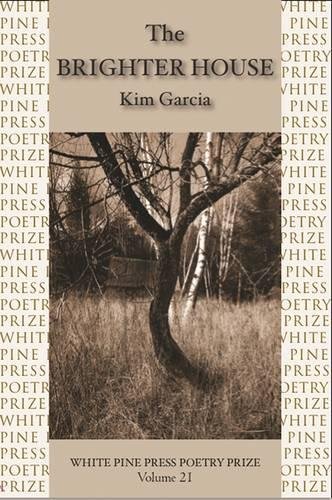
The Brighter House - Kim Garcia (White Pine Press)

Today's book of poetry:
The Brighter House.  Kim Garcia.  White Pine Press.  Buffalo, New York.  2016.

Winner of the White Pine Press Poetry Prize

Today's book of poetry is a bit weak when it comes to his mythology, its history, characters and so on.  Kim Garcia's whippersnapper The Brighter House invests fairly heavily in legend, the deep mysteries of our collective past.  So how does Garcia manage to make The Brighter House feel so current, urgent, how does Kim Garcia make us care?

We care because we can identify with Garcia's demons, we understand that the monster dying in the hospital bed is still a father.  We know what that Blackdog anger does to perception.  Garcia has the anger but these poems are too smart to resort to simple revenge, vengeance.  Kim Garcia finds beauty even on the starkest panorama.  She also knows that sometimes beauty has a price.

For my father and the cancer that killed him

                                                                   Once
in a drainage ditch I saw a duck and hawk
rolling, like wrestlers--old Greeks--to the death,
and the duck was taking his dying hard. It took

a long, silent time for the sugar to run out

in its muscles, for the hawk to find the place
between its neck and back, to pierce the artery,
open the blood gate, let out the fight and begin
                                                                 to feed.

...

Our morning read at the Today's book of poetry offices was slightly overshadowed by the splendid weather.  Ottawa is having the nicest September anyone can remember and getting my staff in off the lawn and out of the sun has only been achieved by threat.  Today's book of poetry won't share the particular threats uttered but we had a different killer for each of our minions.  So then, under threat, and under a roof, in the shade of our offices and with a slight hint of protest...

Kathryn, our Jr. Editor, got the ball rolling.  Once in gear Kim Garcia's The Brighter House did all the hard work.  Whether Garcia is imagining/wishing into place her sister, appearing as a vengeful matador or imagining her father as God: Garcia invites the reader into her somewhat magical world with language.

Garcia peoples these poems with characters who scrape up against the smooth edges of your soul.  They know where you are tender.

Strangers

The man with the grass truck, for instance,
looking in on me through the car window.
I sat in my robe passenger side, engine humming
while my mother went for my prescription.

I was pale, very still. I was always
sick in those days. His eye moved
over my shoulders, into the folds of my robe,
a ticklish insect-footed sensation on my skin.

I stared back. Probably I flirted.
I don't remember, but I did things like that,
swallowed whatever came in the capsules.
I was pale, and my eyes were almost black.

My mother came out of the drugstore.
Who called who? He came down
from a load of sod he was pitchforking
to two black men below. They spoke.

Our lawn was dead.
The car was dying.
She wanted grass.
I was useless to her.

A few days later he came with a load.
After he laid the sod, he drank
a glass of lemonade at the kitchen table
with my mother. Then he took me to the drive-in.

We saw a trucker picture. Convoy, I think,
and he didn't handle me much
or force his mouth over my mouth
or speak in any way about the sod he'd unloaded
all day in Texas heat--for what?

To buy me popcorn,
to run his arm along the back
of the vinyl single seat of his pick-up
and stare in silence at a girl
stiff and scared in the seat beside him,
not knowing what she was beginning or ending.

When the movie ended
he took me home
and walked me to the door
like a real date would have done.

And the only thing he got for what he'd paid
my mother was one brief run of his warm palm
from my hip to my bra strap
along my thick, fifteen year old waist.

Which couldn't have been much a thrill
for a full grown man.

My mother was in bed. No.
She was up. Watching television,
sitting in the chair she'd rocked me in
as a child. Outside the sprinkler's steady tick
broke suddenly into a run and return.
The peepers spoke under the damp leaves,
to a steady tap of beetles against the yellow light.
Moths folded flat against the dark siding.

There'd be new grass in my mother's voice
as she looked up from her lap
where she'd have some work,
some bill to worry or dress to mend,
and ask, "What did you do?"

Just beyond the window lay the lawn, her lawn,
which would be lovely today, tomorrow
and years from now. Children changed.
You fed them and put a roof over their heads,
and one night your daughter might walk in
and look at you like a stranger.

...

Dreamland.  There is an ethereal sense to these poems, they sometimes feel too light, almost too perfect to hold together but they do.  Gossamer usually refers to something delicate or insubstantial yet Garcia's gossamer poems pack power.

In The Brighter House Kim Garcia's power comes from her "felted hammer on razored strings."  These dignified and almost quiet poems carry the big knockout punch.  When Garcia ties up the loose ends these poems are wicked sharp.  Garcia is the proverbial iron fist in the velvet glove.

Heaven

Finally I am ready for heaven. Go ahead,
let it in now. I stare at winter branches
and try to imagine summer--all that green,
early urgency to late summer flapping
a crowd, a host.

                            I never had the time
before, never saw the point. I was getting
ready for the next ting, saving up.
Death might, I know, come quickly,
but that's not the main thing.

Something is leaking in, and I
can clear the way, make it easier
for it to enter. Yes, I'm saying yes.
Not to death, which isn't really my
business, but to heaven.

It may be that I'll be a scattering
of matter. It may be that I don the robe,
whatever that is. This morning
I wrap the gray wool light around me
and say to everybody morning sounds,
you can tell me everything now. All of it.

...

The Brighter House took Today's book of poetry in with the first poem and jerked me around like a fish on a hook until Garcia was finished with me and threw me back in the water.  I'm back blowing bubbles in the weeds, but for a few moments, I was out of my element, I had a clear vision of another universe. 

Garcia did that.

Image result for kim garcia photo
Kim Garcia
Photo: Frank J. Garcia

ABOUT THE AUTHOR
Kim Garcia is the author of The Brighter House, winner of the 2015 White Pine Press Poetry Prize, DRONE, winner of the 2015 Backwaters Prize, and Madonna Magdalene, released by Turning Point Books in 2006. Her chapbook Tales of the Sisters won the 2015 Sow’s Ear Poetry Review Chapbook Contest. Her poems have appeared in such journals as Crab Orchard Review, Crazyhorse, Mississippi Review, Nimrod and Subtropics, and her work has been featured on The Writer’s Almanac. Recipient of the 2014 Lynda Hull Memorial Prize, an AWP Intro Writing Award, a Hambidge Fellowship and an Oregon Individual Artist Grant, Garcia teaches creative writing at Boston College.

BLURBS
How does she do it! In The Brighter House, Kim Garcia speaks in the language of delicate and mesmerizing touch with phrases like "feather-brush antennae" and "ticklish insect-footed sensation" and "wished-for snow" without ever falling into precious sentimentality. Over and again, these poems mount to harsh and cold violences that speak to the intricacies of the soul in a gorgeous way that leaves the reader feeling bruised--as in pressed upon--but not bloody. This is a brilliant book of first-rate artistry.
     - Jericho Brown

Rainer Maria Rilke said that there are two inexhaustible sources for poetry, childhood and dreams, and Kim Garcia drinks deeply from both wells in these magical, spooky, riveting, and mysterious poems.
     - Edward Hirsch

This collection is a powerful exploration of the mythological roots of a home, a father, and sisters. The author cleans away that which obscures with the miracle of lyricism. We are lost in the stark beauty of the journey. Then, we are found.
     - Jay Harjo

Interview with
Kim Garcia
Video: Arkansas International


611


DISCLAIMERS

Poems cited here are assumed to be under copyright by the poet and/or publisher.  They are shown here for publicity and review purposes.  For any other kind of re-use of these poems, please contact the listed publishers for permission.


We here at TBOP are technically deficient and rely on our bashful Milo to fix everything.  We received notice from Google that we were using "cookies"
and that for our readers in Europe there had to be notification of the use of those "cookies.  Please be aware that TBOP may employ the use of some "cookies" (whatever they are) and you should take that into consideration.


Saturday, August 12, 2017

Dementia, My Darling - Brendan Constantine (Red Hen Press)

Today's book of poetry:
Dementia, My Darling.  Brendan Constantine.  Red Hen Press.  Pasadena, California.  2016.

Image result

Brendan Constantine's Dementia, My Darling.  Narrative poetry, mostly.  Surreal but surprisingly narrative.  Surprising poems.  Narrative, surreal when Constantine needs it, surprising and witty. Witty and surprising narrative poems with a surrealist kick.

Inconsolation

There used to be different words here,
a lawn with benches, a statue of wind.
This is where your hand would go, my
shoulder, a good laugh. We shared
a sixth sense of humor, that is,
we always knew what the dead found
funny: calendars, money, an informed
opinion. Now the birds sing like
car alarms. The bees just want out.
You can push the night around
with your tongue.      We do.
We go to the cafe and order a bed.
We ask for curtains, a notebook, then
blow on our cups without drinking,
blow away. Say, How long's it been?
When's it gonna' be soon? What
we wouldn't give for what we gave.
And this is when the dead start
laughing, when you and I decide
to keep waiting. Let tomorrow cool
awhile, until we're two other people.
They'll know if we're inconsolable.
They'll know how to drink lying down.

...

Today's book of humour greatly enjoys Constantine's "sixth sense" of humour.

Today's book of poetry has been reading Edward Hirsh's How to Read a Poem and Fall in Love with Poetry.  It's an insightful and gracious read, a sterling guide if you ever feel you need one.  Brendan Constantine's Dementia, My Darling made me think of Hirsh's concept that poems contain "stored magic."

      I believe such stored magic can author in the reader an equivalent capacity
      for creative wonder, creative response to a living entity.  The reader completes
      the poem, in the process bringing to it his or her own past experiences...

      ...the kind of knowledge--one gets from poetry cannot be duplicated elsewhere.
                                                                    
                                                                                             Edward Hirsh
                                                                                             How to Read a Poem

Dementia, My Darling bursts at the seams with "stored magic."  In Constantine's poetry universe logic is one step ahead or behind.  That's not quite right.  In Constantine world he builds invisible bridges to some parallel universe that chugs along next door to ours so that he can traverse that distance at whim.  It makes for some sharp poems brimming with considerable guile.

Another Natural Cause

People die from falling out of bed--
five hundred a year--more than are
killed by tigers, sharks, crocodiles.
There's a quota, a "stat" on a big
chart, next to famine & disease,
murder & plane crashes. Mostly
small children, the elderly, people
who can dream too hard. At least
twice as many have to explain it
to somebody else. Thousands of 
relations, not to mention cops,
medics, morticians, have to say
out loud, No really, it happens
all the time. Tonight, while we go
to school naked, get chased by bees,
discover we can fly, a few of us
pass into nothing, into bright light,
into marble stations of cloud. We
come yawning, rubbing our faces,
our faces creased by books, cups,
clocks, whatever we kept close by.

...

The poems we liked most, the superior poems, in Dementia, My Darling, and they were many in number, were top flight cooking.  Constantine can burn, there are new recipes here, some unusual spices, but the kitchen smells wonderful and all the plates keep coming back clean.

Today's book of poetry wanted to call in some big guns for morning's read but Milo, our head tech, and Kathryn, our Jr. Editor, said they had it covered.  Constantine's poetry made for a very engaged reading for both the readers and the listeners.  These poems rarely stretch to a second page but they all read longer, short stories, novels and so on bursting out of these few short lines.

The Bear Chapter

No one watches the stewardess anymore;
how she demonstrates the belt, the mask,
the life vest. We've got it down. Maybe
not our lives, our money & regret, or how
to breathe while kissing, but, by God,
we know how to survive a water landing.
The stewardess doesn't look at us either,
but at someplace that's really behind her,
the way dancers do. It's a recital, after all.
In the wild we're told not to sleep too near
our food, to put ever our champagne far
away. There's a checklist of other things,
written by a man so bored, he's forgotten
what survival is. Bears attack, he says,
if we surprise them. But he won't say
how; whether bears are easily frightened
or just don't like parties. When shipping
a bear by air, its ticket must be taped to
the cage in a waterproof bag. Someone
has to check this, someone who long ago
stopping imagining a sea full of floating
luggage, full of drowned bears in boxes.
The stewardess swims by. We call to her,
she to us; the ocean swallows our cries.
No surprises here.

...

Dementia, My Dear is Constantine's fourth book of poetry and these poems read every bit like they are from the hand of an old pro.  These poems are strong enough to swagger but Constantine is a little subtler than that.  These poems strut with confidence.

Brendan Constantine joins a long list of poets Today's book of poetry admires.  We have already assigned Milo the task of finding Constantine's previous three poetry titles.

Brendan Constantine
Brendan Constantine

ABOUT THE AUTHOR
Brendan Constantine is a poet based in Hollywood. His work has appeared in numerous journals, most notably Ploughshares, FIELD, Zyzzyva, Ninth Letter, Poetry Daily, Verse Daily, ArtLife, PANK, and L.A. Times Best Seller, The Underground Guide to Los Angeles. His first book, Letters To Guns (Red Hen Press 2009), is now required reading in creative writing programs across the nation. His most recent collections are Birthday Girl With Possum (Write Bloody Publishing 2011) and Calamity Joe (Red Hen Press 2012).

BLURBS
““Brendan Constantine’s Dementia, My Darling is a mediation on memory. Poems address the difficulty of the death of memory and how does a survivor deal with recollections of a father’s lie, a collective lie about snow, school desk carvings, sleep talking, moths, and hospital ceilings. This collection examines consciousness, connotations, and relationships. Constantine is a master poet illuminating the ordinary and extraordinary with his distinct voice holding humor and heart equally.”
     —Steven Reigns, author of Inheritance

“Dementia, My Darling is a suite of acute, beautiful poems about coming apart, slippage, love, emptying out, transformation, and carrying on. Every absurdly human moment in them is handled with smarts and just the right mix of inventiveness and delicacy. Each poem leaves its mark on the reader. Tender and humane and unsparing, the poems never surrender to despair. They all have a kind of brightness. Constantine renders the creeping surrealism of dementia from many angles, with the awe that is its due. Gaps, anagrams, collage and montage are employed to convey the myriad ways we fragment, multiply, dissolve. A fly is described as ‘an ink blot with wings / a blood spot / that sings a thin hymn.’ (!!) This book is a lyrical wrestling match with mortality.”
     — Amy Gerstler, author of Dearest Creature

“I love this collection. I’m dazzled by its spectacular acts of imagination, the places it invents, the ways it invents of describing those places. Its most wondrous feat, though, is the heart it allows to beat behinds its intelligence, the person that peers from its intricate, sharp, brilliant latticework: so much structure, so much sharpness, and that softness, too. Bravo.”
     —Mandy Kahn, author Math, Heaven, Time


Brendan Constantine reads at the 2014 Dodge Poetry Festival
Video: Dodge Poetry


596
DISCLAIMERS

Poems cited here are assumed to be under copyright by the poet and/or publisher.  They are shown here for publicity and review purposes.  For any other kind of re-use of these poems, please contact the listed publishers for permission.

We here at TBOP are technically deficient and rely on our bashful Milo to fix everything.  We received notice from Google that we were using "cookies"
and that for our readers in Europe there had to be notification of the use of those "cookies.  Please be aware that TBOP may employ the use of some "cookies" (whatever they are) and you should take that into consideration.