Showing posts with label white pine press. Show all posts

Wednesday, September 20, 2017

The Brighter House - Kim Garcia (White Pine Press)

Today's book of poetry:
The Brighter House.  Kim Garcia.  White Pine Press.  Buffalo, New York.  2016.

Winner of the White Pine Press Poetry Prize


Today's book of poetry is a bit weak when it comes to his mythology, its history, characters and so on.  Kim Garcia's whippersnapper The Brighter House invests fairly heavily in legend, the deep mysteries of our collective past.  So how does Garcia manage to make The Brighter House feel so current, urgent, how does Kim Garcia make us care?

We care because we can identify with Garcia's demons, we understand that the monster dying in the hospital bed is still a father.  We know what that Blackdog anger does to perception.  Garcia has the anger but these poems are too smart to resort to simple revenge, vengeance.  Kim Garcia finds beauty even on the starkest panorama.  She also knows that sometimes beauty has a price.

For my father and the cancer that killed him

                                                                   Once
in a drainage ditch I saw a duck and hawk
rolling, like wrestlers--old Greeks--to the death,
and the duck was taking his dying hard. It took

a long, silent time for the sugar to run out

in its muscles, for the hawk to find the place
between its neck and back, to pierce the artery,
open the blood gate, let out the fight and begin
                                                                 to feed.

...

Our morning read at the Today's book of poetry offices was slightly overshadowed by the splendid weather.  Ottawa is having the nicest September anyone can remember and getting my staff in off the lawn and out of the sun has only been achieved by threat.  Today's book of poetry won't share the particular threats uttered but we had a different killer for each of our minions.  So then, under threat, and under a roof, in the shade of our offices and with a slight hint of protest...

Kathryn, our Jr. Editor, got the ball rolling.  Once in gear Kim Garcia's The Brighter House did all the hard work.  Whether Garcia is imagining/wishing into place her sister, appearing as a vengeful matador or imagining her father as God: Garcia invites the reader into her somewhat magical world with language.

Garcia peoples these poems with characters who scrape up against the smooth edges of your soul.  They know where you are tender.

Strangers

The man with the grass truck, for instance,
looking in on me through the car window.
I sat in my robe passenger side, engine humming
while my mother went for my prescription.

I was pale, very still. I was always
sick in those days. His eye moved
over my shoulders, into the folds of my robe,
a ticklish insect-footed sensation on my skin.

I stared back. Probably I flirted.
I don't remember, but I did things like that,
swallowed whatever came in the capsules.
I was pale, and my eyes were almost black.

My mother came out of the drugstore.
Who called who? He came down
from a load of sod he was pitchforking
to two black men below. They spoke.

Our lawn was dead.
The car was dying.
She wanted grass.
I was useless to her.

A few days later he came with a load.
After he laid the sod, he drank
a glass of lemonade at the kitchen table
with my mother. Then he took me to the drive-in.

We saw a trucker picture. Convoy, I think,
and he didn't handle me much
or force his mouth over my mouth
or speak in any way about the sod he'd unloaded
all day in Texas heat--for what?

To buy me popcorn,
to run his arm along the back
of the vinyl single seat of his pick-up
and stare in silence at a girl
stiff and scared in the seat beside him,
not knowing what she was beginning or ending.

When the movie ended
he took me home
and walked me to the door
like a real date would have done.

And the only thing he got for what he'd paid
my mother was one brief run of his warm palm
from my hip to my bra strap
along my thick, fifteen year old waist.

Which couldn't have been much a thrill
for a full grown man.

My mother was in bed. No.
She was up. Watching television,
sitting in the chair she'd rocked me in
as a child. Outside the sprinkler's steady tick
broke suddenly into a run and return.
The peepers spoke under the damp leaves,
to a steady tap of beetles against the yellow light.
Moths folded flat against the dark siding.

There'd be new grass in my mother's voice
as she looked up from her lap
where she'd have some work,
some bill to worry or dress to mend,
and ask, "What did you do?"

Just beyond the window lay the lawn, her lawn,
which would be lovely today, tomorrow
and years from now. Children changed.
You fed them and put a roof over their heads,
and one night your daughter might walk in
and look at you like a stranger.

...

Dreamland.  There is an ethereal sense to these poems, they sometimes feel too light, almost too perfect to hold together but they do.  Gossamer usually refers to something delicate or insubstantial yet Garcia's gossamer poems pack power.

In The Brighter House Kim Garcia's power comes from her "felted hammer on razored strings."  These dignified and almost quiet poems carry the big knockout punch.  When Garcia ties up the loose ends these poems are wicked sharp.  Garcia is the proverbial iron fist in the velvet glove.

Heaven

Finally I am ready for heaven. Go ahead,
let it in now. I stare at winter branches
and try to imagine summer--all that green,
early urgency to late summer flapping
a crowd, a host.

                            I never had the time
before, never saw the point. I was getting
ready for the next ting, saving up.
Death might, I know, come quickly,
but that's not the main thing.

Something is leaking in, and I
can clear the way, make it easier
for it to enter. Yes, I'm saying yes.
Not to death, which isn't really my
business, but to heaven.

It may be that I'll be a scattering
of matter. It may be that I don the robe,
whatever that is. This morning
I wrap the gray wool light around me
and say to everybody morning sounds,
you can tell me everything now. All of it.

...

The Brighter House took Today's book of poetry in with the first poem and jerked me around like a fish on a hook until Garcia was finished with me and threw me back in the water.  I'm back blowing bubbles in the weeds, but for a few moments, I was out of my element, I had a clear vision of another universe. 

Garcia did that.

Image result for kim garcia photo
Kim Garcia
Photo: Frank J. Garcia

ABOUT THE AUTHOR
Kim Garcia is the author of The Brighter House, winner of the 2015 White Pine Press Poetry Prize, DRONE, winner of the 2015 Backwaters Prize, and Madonna Magdalene, released by Turning Point Books in 2006. Her chapbook Tales of the Sisters won the 2015 Sow’s Ear Poetry Review Chapbook Contest. Her poems have appeared in such journals as Crab Orchard Review, Crazyhorse, Mississippi Review, Nimrod and Subtropics, and her work has been featured on The Writer’s Almanac. Recipient of the 2014 Lynda Hull Memorial Prize, an AWP Intro Writing Award, a Hambidge Fellowship and an Oregon Individual Artist Grant, Garcia teaches creative writing at Boston College.

BLURBS
How does she do it! In The Brighter House, Kim Garcia speaks in the language of delicate and mesmerizing touch with phrases like "feather-brush antennae" and "ticklish insect-footed sensation" and "wished-for snow" without ever falling into precious sentimentality. Over and again, these poems mount to harsh and cold violences that speak to the intricacies of the soul in a gorgeous way that leaves the reader feeling bruised--as in pressed upon--but not bloody. This is a brilliant book of first-rate artistry.
     - Jericho Brown

Rainer Maria Rilke said that there are two inexhaustible sources for poetry, childhood and dreams, and Kim Garcia drinks deeply from both wells in these magical, spooky, riveting, and mysterious poems.
     - Edward Hirsch

This collection is a powerful exploration of the mythological roots of a home, a father, and sisters. The author cleans away that which obscures with the miracle of lyricism. We are lost in the stark beauty of the journey. Then, we are found.
     - Jay Harjo

Interview with
Kim Garcia
Video: Arkansas International


611


DISCLAIMERS

Poems cited here are assumed to be under copyright by the poet and/or publisher.  They are shown here for publicity and review purposes.  For any other kind of re-use of these poems, please contact the listed publishers for permission.


We here at TBOP are technically deficient and rely on our bashful Milo to fix everything.  We received notice from Google that we were using "cookies"
and that for our readers in Europe there had to be notification of the use of those "cookies.  Please be aware that TBOP may employ the use of some "cookies" (whatever they are) and you should take that into consideration.


Wednesday, April 19, 2017


Today's book of poetry:
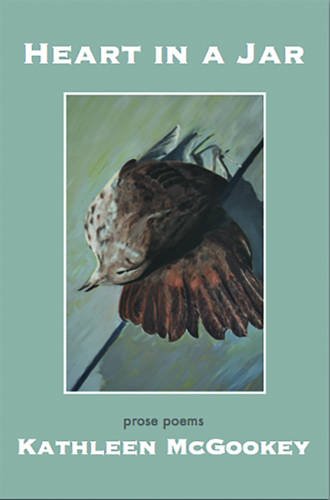
Heart in a Jar.   Kathleen McGookey.  White Pine Press.  Buffalo, New York.  2017.


Reading Heart in a Jar is like stumbling onto a lost manuscript of Charlotte's Web if it had been written by a dark and hallucinating Hieronymus Bosch or perhaps a time travelling Pieter Bruegel reincarnated as a poet.

Kathleen McGookey's poems do an instant connect with a part of your brain you'd previously been unaware of.  Your body jolts a little with new electricity running new circuits.  

Today's book of poetry is genuinely unsure of how to tell you patient readers about Kathleen McGookey's particular genius.  Today's book of poetry is convinced that McGookey has tapped into a deeper well than most and these short prose poems prove it time and again.  These aren't fairy tales or folk stories but given time they may become those to another generation.

Like His Heart in a Jar

The dead cat, stolen from Biology, showed up in my locker. Black-
haired Joe, who wanted to be my boyfriend, who sometimes gave
me rides in his father's Cadillac, put it there. You'd think it would
have been terrible, skinny toad-colored thing dangling from my coat
hook, but it didn't stink or drip. After Calculus, it was gone.

...

Strange magic abounds in Heart in a Jar.  Kathleen McGookey's poems inhabit a world where talismans teem and we are left to intuit their meaning.  These poems occur in a macabre and splendid universe that feels familiar, as though it were a place we all visited in our dreams.

Death seems to be around every corner wearing a "ratty robe and slippers" but McGookey has her eyes wide open, she sees Death coming and calls his bluff.

Dear Death,

can't you see we're busy riding bikes in the sun? Later we'll cut out
paper hearts and sprinkle them with glitter. I have had enough of
you. I'd rather learn facts about penguins: what they eat, how much
they weigh, how they stay warm in the Antarctic. Some are called
Emperor. Some, Rockhopper. First-graders with gap-toothed smiles
hold out the class guinea pig for me to pet. Let's pretend you forget
all about us.

...

The poems in Heart in a Jar were perfect for a good morning read, short, sharp and savvy.  Death is in there dancing up a shit-storm but McGookey isn't without hope, the characters that inhabit her poems are not without resources.

Gary Young, author of Even So, called Kathleen McGookey's Heart in a Jar "a rapturous Memento mori."  Today's book of poetry had to look that up; a memento mori is "an object serving as a warning or reminder of death, such as a skull."  The translation from Latin is "remember that you have to die." Mr. Young is right, McGookey is constant in reminding us that the Dark Angel is always nearby, that she does so with such charming intrigue and invention is why we are here.

Kathleen McGookey can burn in any kitchen.

Once

I'd like to talk about something else for a change, like that small blue
frog, which, if licked, kills whatever licked it. The frog might be an-
other color. You might have to eat it to die. But I know I've got the
killing part right. Once, I had patience. Once, I had my own room.
I didn't have sisters. I didn't have roosters. I'd like to know who said
I have wasted my life. And was it true? When I lay my head upon my
desk, something inside me--a shadow, a ghost?--tries to sit up. Its
outline washes through me, like certain medications. I like not dis-
cussing certain subjects. I like going to the orchard to pick fresh
peaches. I like the idea of a different life. But that's what I thought
years ago, imagining this one.

...

Kathleen McGookey says some harsh things in Heart in a Jar, some of them fearless, almost all instantly recognizable to the heart as true or true feeling.  You get the impression that McGookey could pound out this particular type of perfection all day long.

Heart in a Jar is so much better than I've been able to express, you can trust that.

Image result for kathleen mcgookey photo
Kathleen McGookey

ABOUT THE AUTHOR
Kathleen McGookey’s prose poems and translations have appeared in many journals and anthologies, including Crazyhorse, Denver Quarterly, Epoch, Field, Ploughshares, Prairie Schooner, Quarterly West, The Best of The Prose Poem: An International Journal, The Party Train: A Collection of North American Prose Poetry, and The House of Your Dream: An International Collection of Prose Poetry. The forthcoming anthology Nothing to Declare: A Guide to the Flash Sequence includes her work, and her poetry collection, At the Zoo, will be published by White Pine Press in spring 2017. She has received grants from the Irving S. Gilmore Foundation, the Arts Fund of Kalamazoo County, the Sustainable Arts Foundation, and the French Ministry of Foreign Affairs. She has taught creative writing at Hope College, Interlochen Arts Academy, and Western Michigan University. She lives in Middleville, Michigan, with her family.

Letters to Death
Letters to Death by Kathleen McGookey
Music by Josh Trentadue (speaker and piano)
Steven Murtonen, percussion


573

DISCLAIMERS

Poems cited here are assumed to be under copyright by the poet and/or publisher.  They are shown here for publicity and review purposes.  For any other kind of re-use of these poems, please contact the listed publishers for permission.

We here at TBOP are technically deficient and rely on our bashful Milo to fix everything.  We received notice from Google that we were using "cookies"
and that for our readers in Europe there had to be notification of the use of those "cookies.  Please be aware that TBOP may employ the use of some "cookies" (whatever they are) and you should take that into consideration.


Saturday, July 25, 2015

To Some Women I Have Known - Re'Lynn Hansen (White Pine Press)

Today's book of poetry:
To Some Women I Have Known.  Re'Lynn Hansen.  White Pine Press.  The Marie Alexander Poetry Series, Volume 19.  Buffalo, New York.  2015.


"25 Sightings of the Ivory-billed Woodpecker" is a prose poem in 25 verses that weds anecdotal history of a possibly/likely extinct bird that lived in the swamp land of Louisiana - with a family memoir, a tribute of sorts to a matriarch with ivory qualities.

It reads more like a movie than almost any poem I've read, and I love movies.  This was a movie I want to see the poem of.  Re'Lynn Hansen's To Some Women I Have Known is a moviehouse filled with the robust lives of women.

If you have read Alice Munro - Re'Lynn Hansen spins a yarn, writes one of these solid poems, in much the same way.  These stories swallow you up with their seamless craft.

The Ghost Horse


We were going to get a horse. The horse would give us meaning.
Or a feeling we didn't have sitting in lecture halls during the day or
waiting on tables at night.

We would ride the horse from Illinois to Colorado and meet peo-
ple along the way who would also give us meaning.

Before we went to see the horse, my friend June bought a pair of
English riding boots in butter yellow. She found them at the local
Goodwill, four dollars.

The horse handler had a Gun N'Roses t-shirt and slapped at the
horse's chest. The horse went crazy. He pawed the ground and the
steam from his nostrils hung in the darkened stables.

As soon as June mounted, her boots slid from the stirrups. The
horse was gone like a ghost train, all light and muscle flying past.

And June was a horizontal dash on top of it---frightening and
comical---the stirrups bounced and flew beneath her, useless
apparatus to hook the rider.

There was a sift of snow on the stubbled wheat outside the corral.

I felt the moment pressing upon me, perhaps knew how I would
remember it: whitened girls on a whitened landscape with Ghost
Horse.

Freakin' sideshow hell horse, the horse handler shouted. The horse
breached the corral, jumped a low gate. The horse-hand ran and

tried to stop him. Whoa! Whoa! Several times the horse handler had
to ditch.

June hung on. The horse slowed himself.

Then for a moment June looked like god on a horse, straight in the
saddle. It was as we had imagined ourselves---we who did not believe
in god, but horses.

The horse handler grasped the reins. June dismounted, and we
walked away. There was a bus stop at the cul-de-sac, before the
fields and stables. Turning back i saw the horse handler standing
there with the reins of the colossal horse, a dejected giant, a Trojan
horse, the Appaloosa, a clown of a horse.

Everything huge and luminous and dying.

...

Barrie Jean Borich has it right when she suggests that Hansen is all about "the real beauty of this work is in the juxtaposition."  Hansen's poem about her grandmother and Mary Todd Lincoln sharing syphilis is a marvelous construction.  You don't know whether to laugh, cry or wind your watch - but you are juxtapostitioned into poetic glee.

What makes a prose-poem a poem and not prose?  You are going to need a better moderator leading that discussion - but Re'Lynn Hansen knows the secret.  These prose-like pages sparkle with poetic with and charm.

Patty Hearst on the Prairie

This is who I was, what the world was like that winter: The Way We
Were was number one at the box office. Barbara Streisand's
"Evergreen" was soon to be our prom song. My friend crashed her
car looking for a roach clip that had fallen under her seat and cried
when Robert Redford appeared in the scene with his white sailor's
suit.

To get over her melancholy for Redford, she played "Shining Star"
by Earth, Wind & Fire. We danced in the basement condo of a man
she had a crush on, a weightlifter. He managed the produce section
of the food store where she worked as a cashier. She liked it when
he stood by the cantaloupes.

He was gay, of course, she said. She was known for flippancy. Later,
while painting her toenails and watching Kojak in the bedroom, she
would lament over that--Why do all the men i love have to be gay?

There was a third who circled our lives--Lindsey Buckingham. He
had just hooked up with Stevie Nicks to form Fleetwood Mac. Of
course, my friend lamented.

In the evening in the basement condo--thin carpet and cold
floors, somehow a deep anchor to our talks--we would scream the
words: paradise, snow-covered hills, and landslides.

I did not see Jaws, but I did see Love Story. I went with Martha
Stegner, a tall, thin girl. I thought, Not at all like me. She wore a pea
coat and hat similar to Ali McGraw's.

We both had crushes on Ali, and both dressed as a cross between
her and Ryan O'Neal, wearing Ali-type hats and Ryan-type
fisherman's sweaters.

On the bus, girls from my senior class mouthed the words to
"Waterloo" streaming from the boom box. All our eyes met the
eyes of strangers getting on the bus.

We were looking for something.

Patty's fiance Steven Ward was beaten
up the night they took Patty.
Patty, Snatched from the Arms of Her Lover, the headlines read.
It was a quiet night in a quiet neighborhood.

Stephen Weed would remember this:
We were watching
Mission Impossible--

Later, Patty would describe it this way:
There was a knock on the door and
then a kidnapping happened.

The next night,
Walter Cronkite "live"
his body slanting over
his newsroom desk,
a close-up of
the tape recorder on his desk.
There, her voice,
disembodied from the tape:
I am a member of a ruling class family

(note from TBOP - this is how the poem starts but it is just a fragment, there are several more pages and I couldn't eat it up fast enough.)

...

Re'Lynn Hansen is somewhere between perception and deception.  Lovely deception.  These poems reflect how she wants to see the world as much as how the world really is.  She folds the two together as though she were kneading bread dough -- and then gives us finely baked bread.

These poems have lyrical notions and common sense all tied together in a kind of quiet and elegant rapture of memory and desire.

The Drought Just Then

The days were so hot that my roommates June and Harry were
reduced to drinking riesling. We wondered if soldiers in the
Middle East were as hot, carrying their fifty pounds of gear. We
kept the windows open around the clock and watered the sheets
regularly. This was something June's mother had told us to do. She
had grown up on a farm. The trains loomed close and dust came
in. It added to the effect. The apartment was a desert; the damp
mattress, an oasis we lay on. Our conversations were feverish. June
and Harry talked of food and wine all summer. Their jobs as
sommelier and head waitress had influenced the realm of ideas.
Harry thought Cote du Rhone was best with salmon cooked with
capers and zest of lemon. June set forth an elegant argument for
Pouilly Fuisse--chilled, served with caviar spread on rounds of
pumpernickel. She won me over just by saying Pouilly Fuisse ten
times really fast when I asked her to. June told me of her small
daring feminist move: she gives the first pour to the woman at the
table. I imagined women in black dresses, dark hair, leaning back to
swish the Pinot Noirs, Cote du Rhones, Pouilly Fuisses. But the
wine thing only fascinated me for so long. I was reading Crime and
Punishment that summer of the drought, where on a perfectly fine
day, by a perfectly fine man, a woman is murdered. I was convinced
that a tragedy was playing itself out beyond the facade of human
activity. Yes, I agreed with June and Harry: culinary taste was art.
Good art seduces and subverts, Harry was fond of saying, June and
Harry cooked a cool leek soup one night, and we all agreed that it
seduced the hell out of us. We had to drink vodka straight up just
to cut it. then we sat on the floor. On June's old oriental rug we
sipped Grey Goose, and dipped croissants into the silky green and
agreed that nothing else mattered. We'd give our lives for this
moment with leek soup. That was the third thing about great art--
it became its own entity, set its own rules; stepping into it was like
crossing the galaxies as dust. We were so taken by the taste of leeks
and vodka that we nearly forgot about how many had died in the
drought raging across the Midwest just then, and the war in the
Middle East was a tincture. For once, it was not enormous work,
as it usually was for us, to be not of something.

...

Re'Lynn Hansen's To Some Women I Have Known proves that "good art seduces and subverts", but it can also be wildly entertaining.

This is the book I will now be recommending to all women's book clubs, men's book clubs, Talking Giraffe book clubs, who fear poetry.

Re'Lynn Hansen

ABOUT THE AUTHOR
Re'Lynn Hansen's work in essay, prose poem and short story has appeared in numerous literary publications including Hawai'i Review, Prism, Rhino, New Madrid, Water~Stone, New South, Poem Memoir Story, and online at contrary. She is the recipient of the New South Prose Prize, and the Prism International Creative Nonfiction Prize. Her chapbook, 25 Sightings of the Ivory Billed Woodpecker, was published by Firewheel Editions. Her Novel, Take Me to the Underground, was nominated for a Lambda Literary award.

Her work combining image and word has been featured in Calyx and Fifth Wednesday journals. She has edited a journal with emphasis on lyric essay and hybrid work, South Loop Review: Creative Nonfiction + Art. She is associate professor in the Nonfiction Program in the Creative Writing Department of Columbia College Chicago.

Re'Lynn lives with her partner, Doreen Bartoni, near the southernmost point of Lake Michigan. Here also is where four forest eco systems converge—the northern hardwood with the northeastern coniferous, and the central broadleaf with the oak pine forests of the south. This is where they write, shoot films and photos, keep up with family and friends, mentor local youth, and drive down to the lake to watch the storm systems come in and sway the trees.

BLURBS
"Re'Lynn Hansen's book asks not the head's question 'what is meaning?' but the heart's question 'what has meaning?' What is worthy of recalling (calling out to again), of remembering (putting back together what is fragmentary, dissolute) from our prospect halfway between what is and what could be. Looking back at her old selves, old friends, old family, and old lovers, Hansen sees them all 'as we had imagined them to be' and as citizens of a lost world. Whatever these texts are—prose poems, lyric essays, memoir—they are luminous with loss."
     - Brian Clements

"Re'Lynn Hansen's To Some Women I Have Known is deliriously immersive, but the real beauty of this work is in the juxtaposition. What yokes the memory of a friend's dying mother, a kidnapped heiress, a syphilis-stricken aunt, the ivory-billed woodpecker, and a woman in a yellow steakhouse shirt? Birds, women, horses, and pears float interdependent in the persistent spume of this gorgeous book."
     - Barrie Jean Borich

"To Some Women I Have Known is poetic and essayistic, offering edges—of moments—and of genre. These pieces are lists and litanies, research and recitation, incantations and illusions, and they're all exquisite. Here is a collection about our yearning to look back at what and who has been lost by looking at the moments of such losing. Hansen finds her reflection in the snow, in her grandmother's eyes, in the sand, in the windows above the bar, and in the photographer's flash—as a way to trouble her own memory. There's a wistful distance to every line, a fade. The writing in this collection is lyrical and composed, controlled even, and I know I'll come back to it again and again."
     - Jill Talbot


366

Poems cited here are assumed to be under copyright by the poet and/or publisher.  They are shown here for publicity and review purposes.  For any other kind of re-use of these poems, please contact the listed publishers for permission.