Showing posts with label jack kerouac. Show all posts

Monday, September 23, 2019

Undiscovered Country — Al Rempel (Mother Tongue Publishing)

Today's book of poetry:
Undiscovered Country.  Al Rempel.  Mother Tongue Publishing.  Salt Spring Island, British Columbia.  2018.

9781896949697_cover

Today's book of poetry remembers where we were the first time we read Sir Charles Bukowski, Lord Alfred Purdy, Saint Jack of Kerouac.  And now we're going to remember meeting the work of Al Rempel.

Undiscovered Country is an undiscovered and staggering masterpiece.  Undiscovered Country begins with the long poem "Into The Cloud of Unknowing" and this is a truly great poem.  A life changing poem.

How is it possible that there is a poet that is this good and his name is not on every ones lips.  Today's book of poetry is embarrassed that we have never encountered Al Rempel's poetry.  Today's book of poetry will now correct that and acquire This Isn't the Apocalypse We Hoped For, Understories and Rempel's two chapbooks Four Neat Holes and The Picket Fence Diaries.

Today's book of poetry hasn't been this thrilled about discovering a new poet since our man in the south, David Clewell, introduced us to the poetry of David Lee.  Sir David of Lee.  That's how fine we think Al Rempel's Undiscovered Country is.  That's how wise/clever/smart Today's book of poetry thinks Al Rempel burns.

Undiscovered Country is a great pleasure to read.  You feel like you're in that movie where people are gathered at the knee of some old wise guy who doles out wisdom with each and every breath.  A sage.  Today's book of poetry knows these are ridiculously high claims, high praise.  But we can take the heat and welcome the conversation.  For Today's book of poetry - Undiscovered Country is simply one of the best books of poetry we have read.

He Talked In His Sleep

she wishes for a morning with wet snow
and the birds' flagrant disregard

their beaks stuffed with bits of straw
as they shuttlecock

between their peep-a-peep & the falling
she lets her eyes drift

once again the house lifts off
rising up to meet the snow

if only the only thing she could hear
was the clock

the inner works of the furnace
and the eternal hum

how he wore the shirt of his uniform
and played his old songs

how he would shudder alone downstairs
with the record player

the aura of the streetlamp pouring in
a sickly illumination

how he would carefully hang the shirt
back in the dark closet

scuttle crabwise into his side of the bed
as if under trip wire

💫💫💫

Today's book of poetry is in pure poetry pleasure heaven and Al Rempel's Undiscovered Country has taken us there.  These poems burn honest as a mother's promise, deep as a father's legacy, and yet always remain approachable, even tender, no matter how real/rough the world gets.

Undiscovered Country moved us.  Today's book of poetry thinks these poems will move you too.  Undiscovered Country is a delight because every poem works, as Dennis Cooley suggested, Undiscovered Country is "a rinse to the clouded soul."

Our morning read was held out on the front porch today's as our offices were taken over by a book club meeting.  The Today's book of poetry staff could all hear the city humming behind us, the weather muggy but still nice.  Maggie, our Jr. Editor, arranged our order and cleared the runway.

Al Rempel's Undiscovered Country sailed out into the cosmos, off of our front porch, with an enthusiasm matching these extraordinary poems.

I Thought I Saw Her In The Water

in territories of the mind, in middle distances I can't reach
with outstretched hand,
in dreams inlaid & lidded with a ceiling of leaves, some dangling
on threads, rear-tail swimming
in the air above me — we're all guppies you know, we're caught
on our backs
wordlessly gulping at what we cannot say

or at night, the grass a dewy halo around my head, like a chalk line
drawn about my arms & legs,
the stars are swimming too, unglued from the sky, they slide
past my vision
when I need them the most

could I reach into the depths of a lake at dawn, or a quiet river,
even in a flat-bottomed boat, I'd hardly dip further in than my elbow—
o mother
I know you're not down there, slipping between my fingers
bubbling through gills

or up here, skidding across the sky pell-mell with the stars, with leaves
on empty streets of morning, filling up with hours & hours
but I want you to be here, somehow, closer than dreams that clear off
like fog
leaving only the hard outline of crooked trees & a road that curves
out of view

💫💫💫

Al Rempel talks about love lovingly, he mourns with authentic dignity and he observes and understands it all.

You, dear readers of Today's book of poetry, never see and/or hear about the four books we read for every book that we write about.  You don't have to weigh through those empty pages, eat that burnt toast.  But Today's book of poetry will willingly endure mountains of dross to get to books as charming and fulfilling as Undiscovered Country.

Thank you Al Rempel, this is what today's book of poetry lives for.

from Once Around The Sun


one night I left the sliding door too far open, my love,
I'm sorry,
the house went cold,
cold as the world is

each morning, when we went outside,
we could feel its chill
pressing on our pant legs,
and we blew into our cupped hands to warm them

every evening darkness arrived
a few minutes too early

as I sit here, the last flurry of seed fluff
drifts by my window like a parody of winter,
and when I walk through buildings,
I stop in the sunlight & its heat
and let if fall on my face
and blind me

what is this narrow band of heat
that keeps us alive, this fire we scoop on our plates
and pour into cups, again & again?

one day my eyes will close for the last time,
and my breath will leave as if through an open door
and I will grow cold
as the earth waits to cover me


💫💫💫

Image result for al rempel photo

Al Rempel

ABOUT THE POET
Al Rempel’s books of poetry are This Isn't the Apocalypse We Hoped For, Understories and two chapbooks: Four Neat Holes and The Picket Fence Diaries. His poems have also appeared in various journals including The Malahat Review, GRAIN, CV2, Event, and Prairie Fire as well as in anthologies such as The Best Canadian Poetry in English, Rocksalt, 4Poets, and Half in the Sun. He was awarded Prince George's Arts & Culture Award for Poetry in 2012 and Shortlisted for the Fred Cogswell Excellence in Poetry Award in 2013. One of his poems was shortlisted for Arc's Poem of the Year Award in 2015 and his poems have been included twice in the Poetry in Transit project in Vancouver. Rempel has also had some of his poems translated into Italian by the poet Sandro Pecchiari. Rempel has also created a number of videopoems in collaboration with local artists. “Sky Canoe” was screened at the Visible Verse Festival in Vancouver, 2012, and at the Filmpoem Festival in Dunbar, Scotland, 2013, as well as Liberated Words in Bristol, UK, 2013. Three of the poems in Undiscovered Country have also been made into videopoems. Al Rempel currently lives in Prince George, where he teaches math and science at a high school, but grew up in Abbotsford and loves to visit the Gulf Islands.

BLURBS
"It is impossible to be unmoved by this book. Rempel hears 'the earth, the rain saying/fatherless, motherless...' and admits, 'I wish I could say I'm less afraid, now a father'—and we know the pained bewilderment in making our ways through the 'undiscovered countr[ies]' of our own lives. He sees the abysses that open within the details of the everyday; and at the same time, allows us to observe 'small green birds...circusing in the aspens,' and though he speaks of 'the stars...not meaning anything except/what we make of them,' Rempel sets us where "we sit aswirl in light.'"
     - Russell Thornton, author of The Hundred Lives

"Undiscovered Country is extraordinary in its focus. Rempel skillfully moves from internal landscapes—of grief, loss and mortality—to the external with crisp, fresh poetics: 'the moon was a giant rock/hovering up there in the sky/and ready to fall.' Undiscovered Country is about shifts in place, shifts in time, shifts in perspective—child turned adult, adult turned orphan, orphan turned parent. Rempel is beautifully pragmatic, yet hopeful: 'you could be anywhere—/but you're not, you're here.'"
     - Kerry Gilbert, author of Tight Wire

"Wow! A rinse to the clouded soul, tonic to the torpid. The poetry rejoices, grieves, muses. It moves and amuses and delights us, dares brazenly to embrace the palpable world and to love the words we provide it. In affection and anguish and deft comedy. Undiscovered Country celebrates extraordinary moments in our ordinary and temporary lives.  An absolute joy to read."
     -Dennis Cooley, author of The Home Place: Essays on Robert Kroetsch's Poetry


Al Rempel reads from Undiscovered Country
Video: Joanna Smythe


787

DISCLAIMERS

Poems cited here are assumed to be under copyright by the poet and/or publisher.  They are shown here for publicity and review purposes.  For any other kind of re-use of these poems, please contact the listed publishers for permission.

We here at TBOP are technically deficient and rely on our bashful Milo to fix everything.  We received notice from Google that we were using "cookies"
and that for our readers in Europe there had to be notification of the use of those "cookies.  Please be aware that TBOP may employ the use of some "cookies" (whatever they are) and you should take that into consideration.


Monday, May 13, 2019

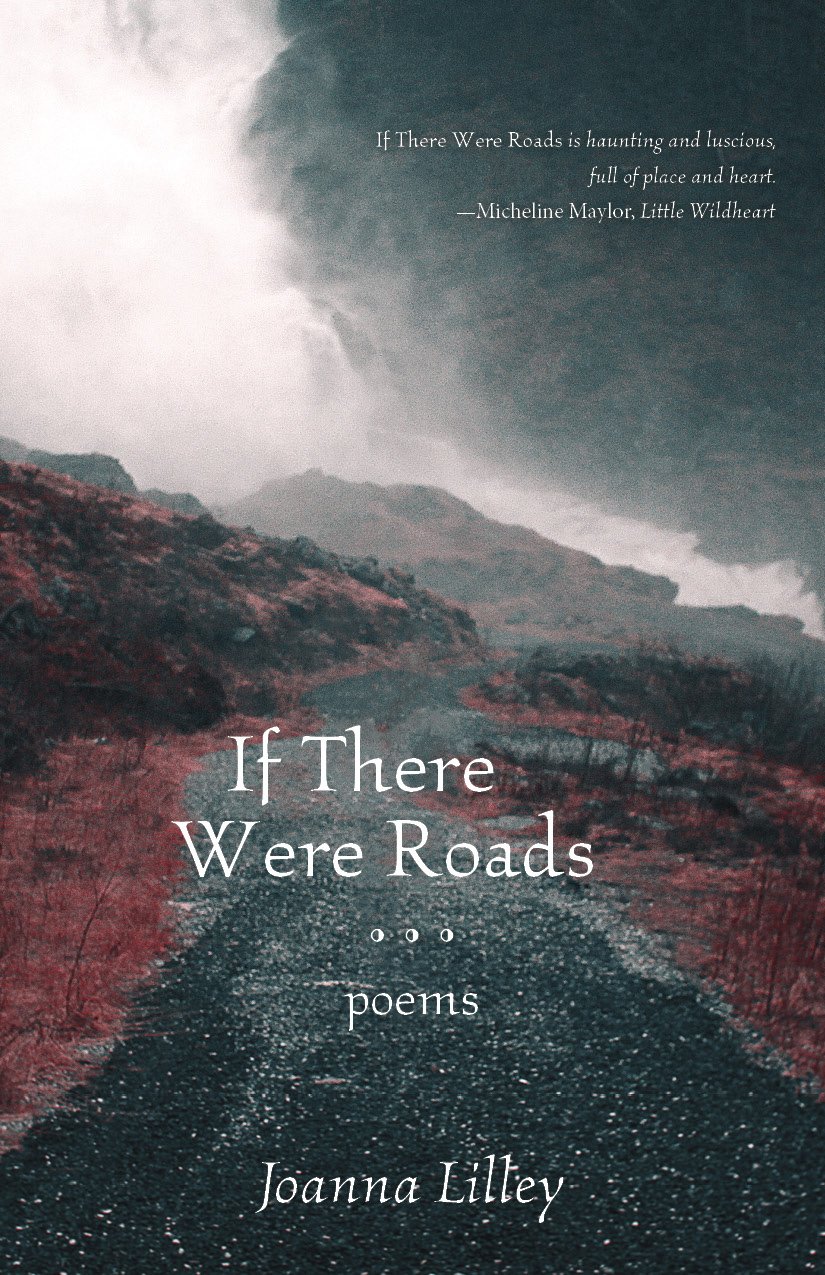
If There Were Roads — Joanna Lilley (Turnstone Press)

Today's book of poetry:
If There Were Roads.  Joanna Lilley.  Turnstone Press.  Winnipeg, Manitoba.  2017.


Joanna Lilley is very much a poet of place.  Geography plays a big part in her narrative of If There Were Roads.  The particulars of geography may sometimes confuse the reader because Lilley both writes about where she is — and where she isn't.

The constant is Lilley herself, her keen eyes and wickedly sharp pen.  Lilley makes a strong argument that we are shaped by geography and our place in it.  It is a simple concept but a far more complicated actuality.  Joanna Lilley navigates the territory of the present like an enlightened cartographer whose keen ear remembers and makes way for the past.

Bluebird

My boyfriend had a vision:
my bicycle chucked in a truck;
It would be red, he said.
As if he'd ever been to Canada.

A man I served at the bar asked
if I was going still, now the desert war
was on. I should carry a gun, another said.
As if he'd ever been to Canada.

It was twenty years ago today, the day
I started. A long bicycle ride,
drawing corners on a ragged country,
I stretched six thousand miles

to fit in enough aloneness
after all the cram of England.
Len the long-haul trucker saw me twice
on his trans-Canada run.

The third time, he came out of a cafe
as I went in. Fourth run, he bought me supper
at a truck stop. A salad, for a vegetarian,
with jelly and marshmellows.

He'd got out of Keeseekoose, saved
for a semi that cost more than a house
and made it home. He hadn't seen
his daughter for half her six-year life,

didn't know if he still had a wife.
Len said I shouldn't camp. He offered
me his bunk. We slept beside each other
after he got back ache on the front seat

and asked to share. When I left, he gave
me a song on a dirty, cracked cassette.
Anne Murray's Bluebird.
Not my thing but beautiful.

He said he meant it. That was Saskatchewan.
Chester in Nova Scotia had seen me too.
He made me pancakes. Marc in New Brunswick
took me home for apple pie.

He told me he had a girlfriend.
Ray — Ontario — kept giving me food,
said I must eat as I cycled along. I left
the helmet he gave in a campground.

Women didn't feed me.
Alice in Ontario said she was jealous:
all that time to think. Marianne
cried because I was on my own.

In Manitoba, Judy the teacher caught
me camping at the school.
I slept in her white house
down by the sunken Birdtail River,

a riddle of hills that were really the prairie
above. Helen in Alberta called me
a fellow traveller, told me the bird I'd heard
since Quebec was just a wood thrush.

It wasn't supposed to be about the people.
It was the land I wanted: skies, the muskeg,
taiga, the bear who crossed the highway,
the coyote who followed me, the foxes

who watched. In the Yukon, Julie
took me to her cabin on the Dempster.
It took me fifteen years to make it back.
As if I could live anywhere but Canada.

💫💫💫

If There Were Roads does concern itself with matters beyond geography.  Lilley dares to venture into the open and endless plain of the emotional landscape.  This is where Joanna Lilley really shines.

If There Were Roads got carried around quite a bit in the last ten days.  It spent several hours at various medical institutions as well as an over-night trip to a hometown funeral.  Whenever Today's book of poetry picked up If There Were Roads we found another of the myriad destinations Lilley serves up on a banquet platter.  It was better than carrying maps.

Just a Man

I wish I could be just a man
passing by a row of shops.

A man as ordinary as a road with potholes,
as a bridge across a river frilled with brown foam,

or the tugboats of a working firth.
A man where urban is normal,

where a park is unremarkable,
where dogs walk without pulling

and pigeons peck at screwed up burger wrappers.
I wish I was a man in a jacket, collar down,

a little fashion in my trouser leg, passing by
a doorway, a yellow skip, a litter bin,

past men and women at the bus stop
who barely notice me.

I wish I didn't care that the sun has set,
that the street lights have come on,

creating shadows,
and I'm still half a mile from home.

💫💫💫

When Joanna Lilley talks about such things as gender it is without bile.  A man becomes "as ordinary as a pothole."  Lilley's poetry is lush with thoughtful consideration given to the small moments that make up our existence, the detailed moments that make us human.

Tom the Wolfe made it abundantly clear "that we can't go home again."  Jack of Kerouac told us how to live "on the road," while Joanna Lilley charts a path where place is something inside the individual, to be carried wherever need be.

Can the solace we need and seek be manufactured by the strength of self, Today's book of poetry believes that Lilley does believe just that.  Then the knowing where are inside is the only direction one needs.

Where I Was Born

I am not just from where I was born;
I am from where I've lived.
On Dartmoor's sheep-cropped edges,
beside golden, bouldered tors.
A shingle beach, a chalky sea,
a land to a preceptory.
A valley, a waterfall, a cairn.
And, yes, that first rough field
of shaggy grass in Cambridgeshire
my parents brought me home to.
A brown pond, a thatched roof
over a weak floor, a sheepdog
watching my pram. For I was born
within the sound of horses' hooves,
across the county line in Suffolk
farthest from the Bow Bells
of the litter. My siblings
can have their London births.
My first breath yanked sheets of air
from fens as far as sea, from roofs
with spaces in between.
I have sought those spaces ever since
and found them even in the boughs
of plane trees on a city street.
They stay with me, these spaces.
I've brought them here to the forest edge,
where land might still be sacred.
Though far from field and moor and sea
I am at last where I need to be.

💫💫💫

We are in a slightly dishevelled office here at Today's book of poetry.  Much is afoot, including a lovely red "coffee table" that has become a central and critical component to our entire operation.  It is sitting on top of Today's book of poetry's desk.  Today's book of poetry has been distracted by reasons beyond your amusement, but Joanna Lilley's If There Were Roads has been close company and reminding us of what really matters.

There is a haunting, to come after, feeling to these poems.  A knowing, that once read, you'll want to travel this road again.

Joanna Lilley

Joanna Lilley

ABOUT THE AUTHOR
Joanna Lilley is an award-winning poet living in Whitehorse. Born in the UK, Joanna has always been drawn north, crossing the Arctic Circle twice, before settling in the Yukon. Her work has appeared in numerous literary journals, including The Malahat Review and Grain. If There Were Roads is her second collection of poetry.

BLURBS
Joanna Lilley claims in her poem “Two Ghosts” that “it wasn’t supposed to be about the people,” yet that is exactly what If There Were Roads is about—people and what they do to the bodies of animals; people on journeys accompanied by ghosts, and myth, and crows; people both lost and at home. Lilley’s journey takes us into the cycles of the seasons where certainty exists only in acute observation and reflection. If There Were Roads is haunting and luscious, full of place and heart.
     — Micheline Maylor, Little Wildheart

Poems of place and displacement, of leaving home and finding home, move seamlessly through inner and outer landscapes in Lilley’s lively, evocative collection. Arresting and captivating, If There Were Roads is poetry brimming with new ways of seeing.
     —Catherine Graham, The Celery Forest   


755

DISCLAIMERS

Poems cited here are assumed to be under copyright by the poet and/or publisher.  They are shown here for publicity and review purposes.  For any other kind of re-use of these poems, please contact the listed publishers for permission.

We here at TBOP are technically deficient and rely on our bashful Milo to fix everything.  We received notice from Google that we were using "cookies"
and that for our readers in Europe there had to be notification of the use of those "cookies.  Please be aware that TBOP may employ the use of some "cookies" (whatever they are) and you should take that into consideration.

Saturday, February 23, 2019

Rail - Kai Carlson-Wee (BOA Editions Ltd.)

Today's book of poetry:
Rail.  Kai Carlson-Wee.  A. Poulin, Jr. New Poets of America Series No. 41.  BOA Editions Ltd.  Rochester, New York.  2018.

Rail - BOA Editions, Ltd.

Kai Carlson-Wee lays out his songs of joy and sadness with such careful modulation that it is easy to miss the big moments.  

Nope, that doesn't cut it, another lesson in "first thought" not always "best thought."

Today's book of poetry will start over, try again.

Rail by Kai Carlson-Wee is a little unlike any ride we've ever taken here at Today's book of poetry.  We see and hear Kerouac, Whitman, W.C. Williams, and we're not even warmed up.  Carlson-Wee is world-weary and yet believably innocent at the same time.

We are all "hoping for some other miracle" as Carlson-Wee sings in his poem "Oaks."  Reading Rail will cement connect you to this young writer as though you had stumbled onto a crime scene you won't ever forget.

Rail

I find it here in the wild alfalfa, head full
of antipsychotics and blue rain. Twenty years old
on a freight train riding the soy fields
into the night. Leaning away from the shortgrass
prairie, the black Mississippi of dream.
My brother asleep on the well-wall beside me,
nodding his head to the sway. What home
are we leaving? What distances blur
the electric fence? What hundred low thundering
wheels of darkness are coming to carry us
there? Rain and the singing wind, over
the auto-racks. Staring out west at the stars
of our gods and the lonely dark stars of our hearts.
Boarded-up storefronts, burned-down
apartments, highway signs that only name
the dead. We cross the station tracks,
the broken legs of Sunday chairs left rusting
in the yards. We know the way the story ends.
Still, the whistle blows. The flare stacks whip
their excess methane candles against 
the night. The wheels that brought us this far
still roll, still churn the polished iron ash.
The road goes on. The highway turns a deeper
shade of black. And as the sun sinks down
on the eastern Montana hills, peppered with horses
and gun-shot cars, the rails still lead us
somewhere else, and shine in the falling light.

💫💫💫

Kai Carlson-Wee is no Tom Sawyer or Huckleberry Finn, but he may be the new American generation given voice.  And it is one clever and clear siren cry.  Mr. Carlson-Wee is young in age only, his voice is pure experience.  

Pure of heart but stripped of dreams, these poems promise nothing.  No promises, but a loud and unmistakable sirenwail that Carlson-Wee is on the job, he will mark the passing.

Damn it.  Today's book of poetry just turned Rail over and read the blurbs.  Today's book of poetry tries to avoid the blurbs until finished so they don't upset the works.  In this case, Robert Bly is as impressive as Dorianne Laux.  But then Sir Campbell McGrath.  Sinner/Saint/Savant/Seer and one of our heroes....

In Today's book of poetry poetry world it does get much more hallowed than Campbell McGrath.  Today's book of poetry was very pleased to see that McGrath has the same, very high, esteem for Kai Carlson-Wee.

Today's book of poetry thinks Carlson-Wee writes poems so well you might be lead to think he found them, carved in stone, in some sacred poetry place.

King

                               for Nik Zeidlhack 1981-2007

I go to the guardrail, looking out over the sea-foam.
Looking out over the salmon heads breaking
the waves. Muscling back to the place of their birth.
Trapped in the floodlights, failing to leap up the dam.
Sometimes the clarity. Sometimes the clarity
and night-river steaming. Time standing still
in its permanent memory. Flies in the backwater
gathered to feed on the skin. The smell of the ocean.
The waters combining with other more powerful
waters. Riding away from whatever would save them,
knowing the other direction is pointless and not worth
suffering through. What holds us together but also
what trembles. The first time you look at an actual lion,
pacing the length of its cage. The small irreversible
ink-stain breaking the face of whatever we skate on.
Slumped at the edge of your girlfriend's bed. Your
pulse gone flat. No sweat. No resistance. No steam
on the hand-held mirror they tested for breath.
The day you were found I watched ducks drop down
on the Nooksack River in pairs. Drifting together
in multicolored light, leaving small growing trails
behind them. At first I thought only the lights
were alive. The river, the fish, the clusters of flies—
they were tricks being played on the eyes. But now,
getting up on the guardrail, watching the line
where the river and ocean waves meet, the half-formed
outriders failing inside us, and something behind
all the highway signs shining. Not clarity of thought,
or light, or time. But clarity of small things believing
in themselves. Dark heads breaking the surface
again. More than the living. More than the dead.

💫💫💫

Our morning read was a delight.  Spring is in the air in Ottawa, although we know all too well that winter is not over.  Spring is in the air; that's the same thing as saying "we have new hope."  Rail could be seen as simply that, new hope.  But there is so much more going on.  Kai Carlson-Wee's Rail is an embarrassment of riches.

Our small cabal here at Today's book of poetry read Rail out loud with sentiments approaching glee and astonishment.  

Such extraordinary gifts and Carlson-Wee is a young man — there will be, we hope, much more poetry from this marvel.  Today's book of poetry will be waiting.

Seven-Day Fast

Now I forget what I wanted to say about hunger.
The tree's sharp arrangements of lines
on the white sky, clusters of off-shooting
branches dissolving among them
like outdated scans of the brain.
Faded by sunlight, or disuse, or whatever.
I barely imagine by what. The gathering
dust on the shoebox they wait in.
Filed away for a future appointment
with some other specialist, talking of
networks, compatible pathways,
unsourced receptors, the closest
approximate rate of attrition. They talk
with the same sympathetic restraint
used for death. We see the sterility first,
predictions unfolding in ribbons
of uncharted highways beyond
other skies. We use metaphors
like this. We say the spirit is more
than the critical mass. We say prayers
are reflected in atoms, in snowflakes
freezing, in magnified raindrops.
We say there is no way of knowing
the will. The hand held flat to the palm reader's
always astonished tones. We say dreams.
A series of blackouts, minor strokes.
We say there is more than the body's
measurable electrics. The forgotten
children who stand at the bedrail,
showing us pictures of speedboats and horses,
our own selves posing with tulips and lilacs
in front of our whitewashed homes.
We say the soul. The out-riding weather
inside us. The down-pouring water
that runs from the mountain, that sleeps
in the frozen beet field, that denies
this hunger, that sings in the blood.

💫💫💫

Kai Carlson-Wee is a cowboy/poet/prophet, just like his publisher claims.  It ain't bragging if it's true.

Image of Kai Carlson-Wee

Kai Carlson-Wee

ABOUT THE AUTHOR
Kai Carlson-Wee is the author of Rail (BOA, 2018). He has received fellowships from the MacDowell Colony, the Bread Loaf Writers' Conference, the Sewanee Writers' Conference, and his work has appeared in Narrative, Best New Poets, TriQuarterly, Blackbird, Gulf Coast, and The Missouri Review, which awarded him the 2013 Editor’s Prize. His photography has been featured in Narrative Magazine and his co-directed poetry film, Riding the Highline, received jury awards at the 2015 Napa Valley Film Festival and the 2016 Arizona International Film Festival. With his brother Anders, he has co-authored two chapbooks, Mercy Songs (Diode Editions) and Two-Headed Boy (Organic Weapon Arts), winner of the 2015 Blair Prize. A former Wallace Stegner Fellow, he lives in San Francisco and is a lecturer at Stanford University. For more information about Kai Carlson-Wee, visit kaicarlsonwee.com.

BLURBS
Rail is a lovely book, strong and inspired.”
     —Robert Bly

“This is a wholly unique and powerful collection of poems. The sense of purpose puts one in mind of Whitman’s ‘Song of the Open Road.’ Encounters with fellow vagabonds recalls the tramp-poetry of Vachel Lindsay. But the darker need to search for meaning in the American plains and points farther west—a vastness forlorn and almost unknowable—belongs to the particular vision of this poet. His journey through our national ambiguity discovers a flicker in our roots, a spark popping from obscurity that rises into the heavens. The lived experience behind these deft and subtle poems seems necessary, and reiterates the fact that resilience is not only a feature of the American character, it is a recurring tenet of American art.” 
     —Maurice Manning

“Brotherly love, a sense of displacement and lost time, and the deep care that reminds us of our humanity, form the heart of this book. These poems are a scavengers guide, a survivalist manifesto, a reminder of the way our daily experiences can fuel and forge our faith. A hauntingly beautiful and unusual debut.”
      —Dorianne Laux

“Equal parts dithyramb and lament, the great American bardic tradition celebrates lonesome wandering even as it hungers for enduring communion. Kai Carlson-Wee is a worthy inheritor of its dusty mantle, worn by Whitman and Kerouac before him, and Rail is a moving testament to the territories of freight trains, Minnesota roads, dumpster diving, and brotherhood. ‘The road goes on. With or without us.’ Yes, but how much better to have this unforgettable music to guide the way.”
      —Campbell McGrath


Kai Carlson-Wee
Reading the poem Thresher at the Best New Poets Reading in Madison Wisconsin, December 9th, 2010
Video: Kai Carlson-Wee


740

DISCLAIMERS

Poems cited here are assumed to be under copyright by the poet and/or publisher.  They are shown here for publicity and review purposes.  For any other kind of re-use of these poems, please contact the listed publishers for permission.
We here at TBOP are technically deficient and rely on our bashful Milo to fix everything.  We received notice from Google that we were using "cookies"
and that for our readers in Europe there had to be notification of the use of those "cookies.  Please be aware that TBOP may employ the use of some "cookies" (whatever they are) and you should take that into consideration


Friday, March 30, 2018

Union River - Poems and Sketches - Paul Marion (Bootstrap Press)

Today's book of poetry:
Union River - Poems and Sketches.  Paul Marion.  Bootstrap Press.  Lowell, Massachusetts.  2017.

Union River: Poems and Sketches

"The United States themselves are
essentially the greatest poem."
                                                                             - Walt Whitman, Leaves of Grass

Today's book of poetry almost walked into a wall last night while trying to remember just how attached Jack Kerouac was to Lowell, Massachusetts.  Today's book of poetry heard through the poetry grapevine that Paul Marion was involved with a Kerouac book a few years ago.  Then I'm thinking Robert Lowell's For the Union Dead for some damned reason.  Kerouac was searching for an America that was yet to exist and Lowell was lamenting a generational slaughter and still embracing that "greatest poem" the United States.  For the Union Dead is, as G.S. Fraser said in The New York Times, "a song of praise."

All of that to lead us to Paul Marion's Union River which we will contend is another song of praise and a worthy inclusion in that great American songbook.  Paul Marion has sunk over forty years of poetry into Union River and there is some deep water.

Mississippi Delta Blues Ballets Russes

     Muddy Waters (McKinley Morganfield) and George Balanchine (Giorgi Balanchivadze) both died
      on April 30, 1983.

America's all over the map.
Pick your plague, grab your cure.
There's no front curtain, no wall in back.
Every ticket has its price,
Any fence is full of holes,
And it's an open field from Montana to Canada.
America's all over the map,
It's a human soup boiled from scratch in gypsy pots,
Crazed vessels, rare skillets, iron bowls that were stashed in bags,
Lugged by hands of every language over purple hills,
Along the glacier trail, through a plasma sky, straight from the steppes.
America's all over the map, its mix a staple crop..
Muddy Waters pirouettes on steam-guitar, spreads the blues on canvas.
He's a rolling stone in the bayou, a boatman on the Volga.
There's a French Quarter balalaika, there's a jazz master in Red Square,
There's George Balachine in a golden cowboy suit.

...

It is an American dream of sorts although we never see Grand Funk Railroad in here anywhere.  Marion rambles over the American psyche, landscape, and his vision of the vast impressionist painting of a country spread like a quilt under the 49th parallel.  Paul Marion's catch-all is over-flowing with love for the American dream in all of its variations.  Not a vulgar image of jingoistic hysteria but a genuine exploration and understanding of what really does make America great.

It's not like Union River is beyond noticing some of the enduring legacies of discord and the painful truths that accompany systemic racism, aboriginal neglect/genocide, the American war dead and the emotional cost of demanding the lives of the poor in payment to feed a nation's war-machine.  Marion is packing it all in there along with the bread and circuses.

The Blackfeet Indian Pencil

I've been told I'm part Indian, but don't believe it.
North American tribe. Canadian blood.
Snow country natives. First people to make love on the continent.
The Marion, Ohio, All-Indian NFL team of 1922
Fielded Arrowhead, Black Bear, Deerslayer, Wrinkle Meat,
Laughing Gas, Red Fang, Baptiste Thunder, Lone Wolf, and Deadeye.
Indians made this pencil I'm using.
Same business as Henry Thoreau before his trip up the Merrimack River.
Like Jefferson and Lincoln, Marion spreads across the states,
Praise for the Swamp Fox, General Francis Marion,
Who tied the British in revolutionary knots down Carolina way.
Southerners captured the North's Merrimack, renamed the ship Virginia,
Then armored it for a clash with the Union's ironclad.
Marion Drive crosses Sunset Boulevard.
When actress Ruth Marion died in Carmel last week,
The L.A. Times praised her as "a stroke of good luck to her friends."
Her screen-star father had romanced Greta Garbo.
Jazz Age-script whiz Frances Marion earned Academy Awards.
I had not heard of the Hollywood Marions.
Costa Mesa, California, has a Merrimac Street.
In Missouri, one river is called Meramac.
The word can mean "Strong Place" in Algonkian,
Language of tribes from Massachusetts to the Rockies:
Pawtucket, Pemigewasset, Ojibawa, Cree, Fox
Shawnee, Arapahoe, Wamesit, and Blackfoot.

...

Most importantly, to Today's book of poetry, is how Marion is doing all this hard work and still coming up with poems that read like apple pie, peach pie, cherry pie, American Pie.  Paul Marion's Union River is tackling Ken Burns documentary territory in an attempt to tell the American story with as much unfettered and unfiltered honesty as his lens will endure.  These are fine poems and damned good stories.

The morning read here at Today's book of poetry was held under some minor duress.  It's a holiday weekend here in Canada and even though each and every one of our considerate and considerable staff is a complete heathen they all claimed religious fevers of one sort or another and abandoned their posts with considerable haste yesterday afternoon.  Only Max, our Sr. Editor, remains in the office today - and he was drunk on communal wine and rum-balls when I first opened the door to his dark cavern around eight this morning.  He was mumbling about the double-space after a period and whether the name Stormy was going to ruin weather based nom de plumes for the considerable future.

Harry at the Lowell Conference

He kept telling us he dropped out of high school, but Harry spoke as well
as any old politician at a hotel banquet. He asked why the U.S.A. and
South Africa are the only modern countries without national health care.
He called Reagan "a turkey" and described a White House full of smoky
mirrors. Harry Callahan of the Industrial Workers said Nancy's idea of
cruel and unusual punishment is being dragged to Sears and forced to
pick a dress off the rack.
     Harry isn't sure Labor should be a political party, but won't rule
it out. "We're like rats," he said, "and when cornered, we'll fight -- fight
dirty if needed." Harry went to the Soviet Union. He said they have
hearts and put pants on the same way we do. "Why shouldn't I go to
learn something? The Pepsi and Caterpillar executives go twice a month."
He wonders why Americans don't know history. He said most people
want to be in unions, but aren't -- people can see that union workers
make more a week.
     Harry said, "The democracy has problems. There's no democracy
at work -- never has been. American businessmen want authoritarian
systems at work." He said he might be the first guy to put a bullet between
the eyes of a capitalist if the fight goes to the street. He tells that to
businessmen, he said, and they listen, confident that it will never happen.

...

Today's book of poetry was very impressed with the passionate voice of Paul Marion and the reasonable speech of his sound and hearty Union River.  This is mature poetry and flawless story-telling from a first rate poet.

Image result for paul marion photo

Paul Marion

ABOUT THE AUTHOR
Paul Marion is the author of several collections of poetry, including Strong Place (1984) and What Is the City? (2006), and editor of Atop an Underwood: Early Stories and Other Writings by Jack Kerouac (Viking/Penguin, 1999), which has been published in translation in Italy (Mondadori) and France (DeNoel). His book Mill Power: The Origin and Impact of Lowell National Historical Park (Rowman & Littlefield, 2014) documents the making of a new kind of national park in Lowell, all told in the context of the city’s notable urban renaissance since 1970. A new collection of poems and sketches, Union River, is due in 2017 from Bootstrap Press. The book is a lyrical Americana address spanning 40 years of writing.

His poems and essays have appeared in Alaska Quarterly Review, Bohemian (Japan), Bostonia, The Café Review, Slate, Carolina Quarterly, The Christian Science Monitor, The Massachusetts Review, Public Art Review, Salamander, The Salmon Literary Quarterly (Ireland), Wisconsin Review, Yankee, and several anthologies, including For A Living: The Poetry of Work (University of Illinois Press), French Connections: A Gathering of Franco-American Poets (Louisiana Literature Press), Line Drives: 100 Contemporary Baseball Poems (Southern Illinois University Press), Québec Kérouac Blues (Canada), and Visiting Frost: Poems Inspired by the Life and Work of Robert Frost (University of Iowa Press).

bootstrappress.org
672


DISCLAIMERS

Poems cited here are assumed to be under copyright by the poet and/or publisher.  They are shown here for publicity and review purposes.  For any other kind of re-use of these poems, please contact the listed publishers for permission.
We here at TBOP are technically deficient and rely on our bashful Milo to fix everything.  We received notice from Google that we were using "cookies"
and that for our readers in Europe there had to be notification of the use of those "cookies.  Please be aware that TBOP may employ the use of some "cookies" (whatever they are) and you should take that into consideration


Tuesday, August 23, 2016

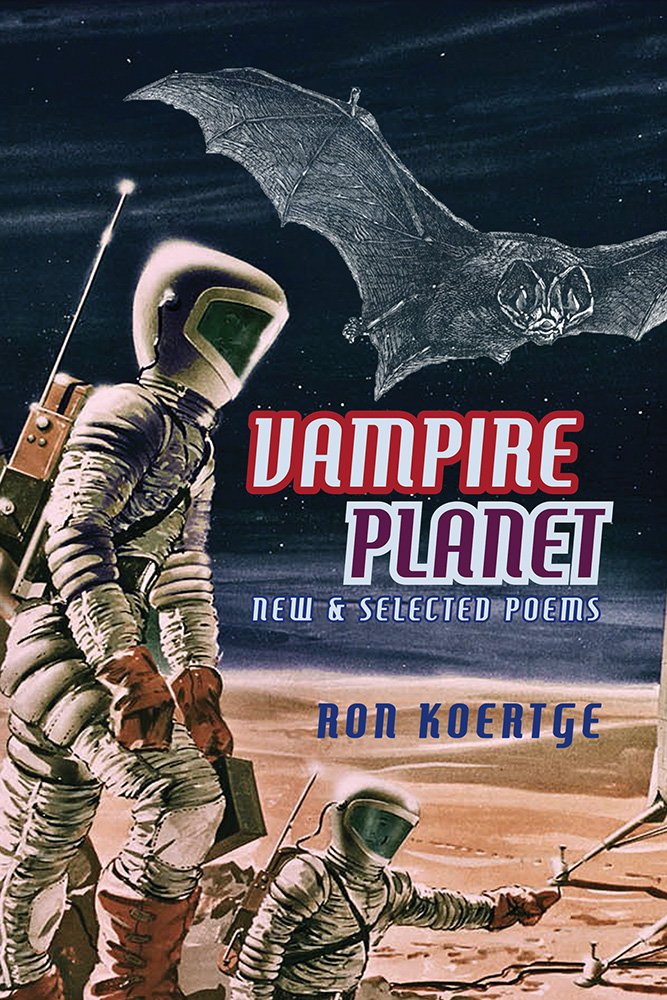
Vampire Planet - New and Selected Poems - Ron Koertge (Red Hen Press)


Today's book of poetry:
Vampire Planet - New and Selected Poems.  
Ron Koetrge.  Red Hen Press.  Pasedena, California.  2016.


Today is our 500th poetry blog here at Today's book of poetry and we've saved something very special for the occasion.  Ron Koertge's Vampire Planet - New and Selected Poems is simply Divine. Bloodsucking otherworldly in fact.

Today's book of poetry first read Ron Koertge in the early 80's.  Diary Cows (Little Caesar Press, 1981) jumped off the shelf and into my hands the first time I darkened the door of City Lights Bookstore in San Francisco.  I was working as a chauffeur at the time and had a three day stopover in the city by the bay.  I was all Charles Bukowski and Jack Kerouac in the head at the time and Koertge was like a drink of some very fresh water.

Diary Cows did it then, Vampire Planet is doing it now.  How any one poet can be so hilariously insightful at full gallop simply baffles the bejesus out of me.  How splendid.

Diary Cows

Got up early, waited for the farmer.
Hooked us all up to the machines as usual.
Typical trip to the pasture, typical
afternoon grazing and ruminating.
About 5:00 back to the barn. What
a relief! Listened to the radio during
dinner. Lights out at 7:00.
More tomorrow.

...

Ron Koertge is an accomplished author outside of poetry world -- but we here at Today's book of poetry are so happy that this man continues to write poems.  In a perfect Today's book of poetry world Koertge would translate every bedtime story, rewrite every nursery rhyme, as far as we are concerned you could put a Koertge filter on it all.

Cinderella's Diary

I miss my stepmother. What a thing to say,
but it's true. The prince is so boring: four
hours to dress and then the cheering throngs.
Again. The page who holds the door is cute
enough to eat. Where is he once Mr. Charming
kisses my forehead goodnight?

Every morning I gaze out a casement window
at the hunters, dark men with blood on their
boots who joke and mount, their black trousers
straining, rough beards, calloused hands, selfish,
abrupt...

Oh, dear diary--I am lost in ever after:
those insufferable birds, someone in every
room with a lute, the queen calling me to look
at another painting of her son, this time
holding the transparent slipper I wish
I'd never seen.

...

Had to call Max, our Sr. Editor, out of his booky lair this morning to discuss the use of more than three poems for today's Today's book of poetry.  He enthusiastically exclaimed that for Saint Ron of K he'd take the heat from the front office.

Kathryn and Milo bebopped Koertge poem after poem to anyone who would listen this morning including three passers-by from the street.  They liked this next poem so much that they came in to our office, sat down and volunteered to work at Today's book of poetry.

Moving Day

While sitting home one night, I hear burglars
fiddling with the lock. This is what I've been
waiting for!

I run around to the back and open the door
invite them in and pour some drinks. I tell them
to relax, and I help them off with shoes and masks.

In a little while we are fast friends, and after
a dozen toasts to J. Edgar Hoover they begin
to carry things out. I point to the hidden silver,
hold the door as they wrestle with the bed,
and generally make myself useful.

When they get the truck loaded and come back
inside for one last  brandy, I get the drop on them.
Using Spike's gun, I shoot them both and imprint
Blackie's prints on the handle.

Then I get in the van and drive away,
a happy man.

...

All silliness aside I want to tell you faithful readers that it is poets like Ron Koertge and books like Vampire Planet that make this blog possible.  Vampire Planet should be on every single poetry shelf out there just like Billy Collins says.  This level of wise humour is two moons in the sky rare.

I talked to my brilliant wife K last night about today's blog and expressed deep concern that after 499 other poetry blogs where I suggested that they were all books you should read how do I express my enthusiasm for Vampire Planet with sufficient enthusiasm and originality?  She said she figured that by now the readers were either with me or long gone so just say what you feel.  So, take my word for it, Mr. Ron Koertge gives more poetry happiness per page than any other living poet I've found.

Why I Believe in God

I'd failed the examination allowing me to bypass the MA
          and go straight for a PhD, so I was forced to let
my friends forge ahead reading, if possible, longer and fatter
          books than before while I worked on something
by the Pearl Poet for my thesis.

          My advisor was Mrs. Hamilton, a world-class
medievalist and the most patient lady in the world.
          Every week I'd bring her a few pages of translation.
She would smile and correct everything. With her help,
          I finished.

An orals board consists of three members of the English
          Department and someone from another
discipline, usually an assistant professor from chemistry
          who drinks coffee from a beaker. But my guy
was from the German Department. He had a scar, for God's
          sake, that might've come from a duel. He
also wanted to begin because he had a few questions.

          "Vhat was the root of zis word? Zah root for zhat?
Who in his right mind vould mistake zhat as zis!" I glanced
           as Mrs. Hamilton who looked like she was watching
Thumper get hit by a tank. I took a deep breath and replied
          that I knew I was less prepared in German than
I should have been but German was the very next course
          I planned to take. I then hoped to move
to Germany and become German.

He sneered, but Dr. Rosenblatt, God bless him, asked me
          something easy: "What was Keat's first name?"
Then Mrs. Hamilton wanted to know if Whitman had a beard.
          Yes or no would be enough.

I was just getting my sea legs when Dr. Death leaned
          forward. "Vhat," he hissed, "is zah function
of zah ghost is Hamlet?" Actually he may have been
          trying to be nice because it isn't that hard
a question. The ghost is the key that starts the engine
          of the play. Without him, Hamlet is just
another pouty prince.

          But I froze. I couldn't think of anything.
My teachers stared at me. They leaned forward
          encouragingly. "Do you remember the ghost,
Mr. Koertge?" asked Mrs. Hamilton. "Yes, ma'am.
          "What was he in the play for?" My mind
was a blank. Less than a blank, a cipher. Less than
          a cipher, a black hole. Finally I said.
"Uh, to scare people?"

          They almost collapsed. Mrs. Hamilton put her
head in her hands. Dr. Rosenblatt murmured, "Oh, my God."

          Then they sent me out of the room. I pictured
myself selling aluminum siding. Or going into the Army.
          Or both. Then I heard the arguing begin:
Shakespeare had not been part of my course work. I'd
          been blindsided from the beginning by
an arrogant outsider. Dr. Hamilton said she knew the German's
          publisher; all she had to do was pick up
the phone and he would never see another word in print.

          They called me back in, said congratulations
and (all but you-know-who) shook my hand. Mrs. Hamilton
          gave me a hug and said she'd never wanted
a cocktail so badly in her life.

I stepped outside into the Tuscon heat. God was sitting on
          the steps in front of Old Main staring at his sandals.
"Ronald!" He waved me over. "I protected you when you
          drove home drunk, I introduced you to Betty Loeffler,
and I got you through that."
          "You introduced me to Betty?"
          "You were lonely."
          "Gosh, thanks."
          "You don't believe in me, but I believe in you. So I'm
interested in what you plan to do next.
          "Not get a PhD. I'm a terrible student."
          "You're telling me."
          "I like writing poetry."
God stood up. He had a great smile and, except for those sandals, a cool
outfit. "Fine. Be a poet. But don't say mean
things about people in your poems. Be generous. Don't be deep
           or obscure. Try and make people laugh." Then, just
before he disappeared, He kissed me. And that is why I am
           standing here tonight.

...

Vampire Planet is one big Olympic sized swimming pool and I don't want to leave.  In Koertge world other dimensions reveal themselves.  These dimensions present different future options, different distant pasts.  Koertge has a real knack for retelling stories we already know but with better endings.  In Koertge world future happiness is possible and the past is made more easy to bear knowing things are not always what they seem.

Koertge has a big bag of tricks.  Good poetry tricks.

Happy Ending

King Kong does not die. He gets hip to the biplanes,
lets them dive by and ionizes them. Halfway down
the Empire State, he leaps to another skyscraper,
then another and another, working his way north
and west until people thin out and they can disappear.

Fay's boyfriend is sure she is dead OR WORSE,
but just as he is about to call out the entire U.S.
Army, a scandal mag breaks this story: the couple
has been seen in seclusion at a resort somewhere near
Phoenix. Long lens telephoto shots show them sunning
by a pool. There are close-ups of Fay straddling
the monster's tongue and standing in his ear whispering
something Kong likes. Look, his grin is as big as
a hundred Steinways.

...

Ron Koertge is a poet I've been looking up to for a long time.  When Vampire Planet came through the Today's book of poetry doors - that was the day I knew this blog had been a worthwhile venture. Vampire Planet is a place I'd like to go.  Think of this book as a problem solver.  From now on, whenever someone asks you why you like poetry you can just go the shelf, pick up your well thumbed copy of Vampire Planet and hand it to them.  Say "here, eat this!"

Kathryn, our Jr. Editor, and Milo, our head tech, Max, our Sr. Editor and the three passers-by from the street have just opened a ten a.m. bottle of Tuscan red and are all sitting on the floor in a circle in an apparent happy poetry place.

Koertge will do that to you, he did it to me in San Francisco over thirty years ago and now he is doing again.  The old poems sound as fresh as morning rain, the new poems amaze and astonish.
Today's book of poetry has been in love with poetry since I was twelve years old and in a few days I'll be 60.  I saved Vampire Planet for my 500th blog mostly as a gift to myself for getting old but damn it, Koertge makes me feel young.

Vampire Planet

On weekends we go to movies. Pay a fortune
for plush, satin-lined seats.

We sip V-8 and bitch about six dollar popcorn.
A medium, if you can believe that.

But tonight's movies is worth it. A robot kidnaps
a blonde. He carries her everywhere.

We are out of blondes here. We should have
planned ahead.

At home, I'm restless. I hate the way some
moonlight sprawls acorss the children's

playhouse in the yard. I remember plunging
through heavy air toward some lamp-lit

room brimming with smooth flesh. My wife
tugs at my cape and asks, "What are you

thinking about, sweetheart?" We've been
married for light years, so I know when to lie.

"That robot. I feel sorry for him." Her, draped
across those stovepipe arms, his staggering

like a tipsy groom looking for the bridal
suite with its scarlet, heart-shaped bed.

...


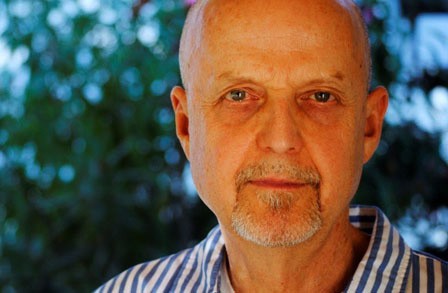
Ron Koertge

ABOUT THE AUTHOR
Poet and young-adult novelist Ron Koertge grew up in rural Olney, Illinois, and received a BA from the University of Illinois and an MA from the University of Arizona.

Comfortable in both free verse and received form, Koertge writes poetry marked by irreverent yet compassionate humor and a range of personas and voices. He has published numerous collections of poetry, including the ghazal collection Indigo (2009), Fever (2006), and Making Love to Roget’s Wife (1997). His novels and novels-in-verse for young readers include Shakespeare Bats Cleanup (2006), The Brimstone Journals (2004), and Stoner & Spaz (2004).

Koertge’s honors include a fellowship from the National Endowment for the Arts, a California Arts Council grant, and inclusion in numerous anthologies such as Best American Poetry, Poetry 180, and Ted Kooser’s “American Life in Poetry” column. Koertge’s young-adult fiction has won awards from the American Library Association and PEN.

Koertge lives with his wife in South Pasadena, California and teaches in the MFA in Writing for Children & Young Adults program at Hamline University in St. Paul, Minnesota.

BLURBS


“"Whimsey meet Oddness. Meet Oddness, Pathos. Hey, Pathos let me introduce you to Funniness. Don't make fun of her name, though, don't try to be funny—leave that to her. Fantastical! Say, I'd like you meet Whimsey, Oddness, Pathos and Funniness. (Yeah, shush, we've heard that joke—stick with the fantastical, O.K.?) Is that . . . ? Look, it’s Ron Koertge, hanging out with Tenderness. Hey Koertge! C’mere, I want you to meet Whimsey, Oddness, Pathos and Fun . . . Oh, you know them already? Oh. You guys know Ron? For a long time? Oh. Yes. Right. I knew that.”"

—--Suzanne Lummis


“"Wit, the impeccably dressed and better educated sibling of funny, suffers an unstable reputation: clever yet aloof, socially polished but oddly cold. In the warmer, less formal surroundings of Ron Koertge’s poems, however, wit lets down its guard and, behold: charm, intelligence, amazing inventiveness, and a kind of sweetness in its patient regard for a world so frequently bereft of those qualities. So what could be more welcome than a new Koertge collection, where wit presides, and wisdom elegantly clothed in laughter is always in attendance.”"

—--B.H. Fairchild


“"Ron Koertge is an expert in the art of disorientation. His tongue-in-cheek poems are clever, of course, but they also dispense an unsettling, probably illegal mixture of Novocain and Kool-Aid. When you finish a poem by Koertge, you look around with the sensation that your living room furniture has been rearranged while you were away. This is his long-standing, one-person campaign for wakefulness in the human situation. The New & Selected Poems is a serious cocktail.”"

--—Tony Hoagland


“"Many Koertge classics are gathered here (like ‘Coloring’ and ‘Cinderella’'s Diary’) alongside new and surprising poems that journey deep into the imagination’s outer limits.Vampire Planet deserves a place in the poetry section of every heads-up reader.”"

—--Billy Collins

Ron Koertge
video:  edwinvasquez


500

DISCLAIMERS

Poems cited here are assumed to be under copyright by the poet and/or publisher.  They are shown here for publicity and review purposes.  For any other kind of re-use of these poems, please contact the listed publishers for permission.

We here at TBOP are technically deficient and rely on our bashful Milo to fix everything.  We received notice from Google that we were using "cookies"
and that for our readers in Europe there had to be notification of the use of those "cookies.  Please be aware that TBOP may employ the use of some "cookies" (whatever they are) and you should take that into consideration.