Showing posts with label allen grossman. Show all posts

Sunday, February 4, 2018

Dazzle - Alison Stone (Jacar Press)

Today's book of poetry:
Dazzle.  Alison Stone.  Jacar Press.  Durham, North Carolina.  2017.


"Don't settle for pale,
idea filled days. Let joy slap
you out of sleep."
                                                                                                 from "Pleasure"

Dazzle is exactly as advertised, the damned thing "dazzles" as sparks appear between your fingers while you are trying to read.  Damned blue sparks that tickle your fingers and fuck up your brain.  Alison Stone has a trick where she leads you down one garden path or another and then she shivs the readers brain to an entirely different plane.

It's a madhouse inside Dazzle.  Stone is writing within a self-imposed and very formal technique in many of these poems but you simply don't notice specific literary technique until the second time around.  The first time you read these poems you do some sort of Dazzle jaw-drop.

After reading a couple of Alison Stone's monsters you are not only hooked, you're hooked bad and only the next last line will help.

Teenager

My body's hot-wired, brazen as the garter
on a bride's thigh. High on anger,
we climb our hill near
the graveyard, lean against the broken gate
to pass around a flask of Tang
and vodka while stars dye the dull green
bushes silver. Somewhere politicians rant
and old people, their dreams eaten
by money, rest up for the death they enter
every morning and call compromise. Eager
kisses leave me trembling and great.

...

Alison Stone plays with style for her own amusement, stretching those extraordinary poetry muscles simply because she can.  But whether she is writing free verse or adhering to a tight set of self imposed arbitrary rules - these poems all work the same way.  Stone softens us up with the tender details and careful suggestions all decorously arranged and then she lowers some sort of heavyweight boom.  It is simply marvelous how she sets them up and then knocks them down.

Abandonment

Tossed aside, I'm dull. Toad-
ugly. Fat. Dumb. Battered. Bent.
Each muscle and tendon
aches. Whatever I did wrong, let me atone.
Friends offer vodka, swear I'll mend.

One morning, I wake up. It's done.
Birds no longer chirp your name;
the sun's insistent yellow might mean
promise. When you can't get a date,
feel lonely, scared, don't
call. I'll be fucking a new lover with abandon.

...

Stone takes no prisoners and takes no sass.  Alison Stone is a poet after my own poet heart with Dazzle.  There is never a moment's hesitation in these poems.  Stone is willing to bet it all every time out of the gate.  Today's book of poetry thinks that Stone has her bad engine tuned to perfection, these poems are note perfect when at high rev and Stone never takes her foot off of the gas.

Sweetheart

I love you, but don't test
my patience. I won't share.

I know that
bitch from down the street
has starte-
d sniffing around, wanting a taste.

She better keep her twat
out of our happiness. Three's
a bloodbath. This is no threat,

it's a fact: I won't let you waste
our love. You'll only leave in a hearse.

...

There's five or six inches of fresh snow outside this morning and it is still coming down like Santa was expected.  That means that some of the minions didn't make it to the office in time for our morning read.  But I smell scotch all over Milo and Kathryn's meagre snow complaints.  I won't mention it because they are both poetry dedicated and work for the right price.

The reading itself was a gas.  So many of Stone's poems start out like the better angels of our hopes and dreams only to reveal the true nature of our devilish hearts.

These poems rang out across our offices like silver bullets and each and every one of us was a damned vampire.  At the end of the reading bodies were scattered all over the floor.

Twilight

The space between
husky and wolf,
between longing for
and shouldn't have.
No-man's-land
between lovers' bodies
and the thickening dark.

Short corridor of last chances,
final flickerings
before moths kamikaze
toward cracked street lights
and the dull sun,
sucker punched by night,
goes down.

...

Dazzle is exactly as advertised.  Whether Stone is taking apart a relationship and revealing the deep, dark heart of truth or simply musing about the "husky and wolf," if you aren't "dazzled" by these poems then your poetry engine is misfiring.

Today's book of poetry ended up reading these poems to K last night when we went to bed.  K is the better judge of almost everything and Alison Stone's Dazzle not only got K's seal of approval, it garnered actual profanity-laced praise.  Like me, K couldn't contain the combination of joy and awe these poems evoked without swearing.  Today's book of poetry doesn't have any higher praise.

Image result for alison stone photo

Alison Stone

ABOUT THE AUTHOR
Alison Stone has published three previous full-length collections: Ordinary Magic (NYQ Books, 2016), Dangerous Enough (Persa Press, 2014), and They Sing at Midnight, which won the 2003 Many Mountains Moving Poetry Award; as well as three chapbooks. Her poems have appeared in The Paris Review, Poetry, Ploughshares, Barrow Street, Poet Lore, and many other journals and anthologies. She has been awarded Poetry's Frederick Bock Prize and New York Quarterly's Madeline Sabin award. She was recently Writer in Residence at LitSpace St. Pete. She is also a painter and the creator of The Stone Tarot. A licensed psychotherapist, she has private practises in NYC and Nyack.

BLURBS
“With a jeweler’s lapidary skill, Alison Stone has fashioned a string of gemlike poems that indeed (dare I say it?) dazzle—with wisdom, wit, and brio. She’s crafted every line to a high polish, rich in metaphor and music. Wide-ranging in subjects—so much to catch the eye—this book brims with “the shimmer, the shiver, the quicksilver / flickers. The sparkle, the dazzle of poetry.” Readers, enjoy!”
     — Richard Foerster

“Stone is not a ‘literary’ poet (there are enough of them)… She is interested in a woman’s truth, and has something hard won (but won) to give her readers. This is strong poetry.”
     — Allen Grossman

“Stone offers lean and sparkling poetry that invites us to join with it — poems that are, in their way, multi-faceted spaces to explore, discovering what we may, and grafting what we bring.”
     — Timothy McLafferty


Poems from Dangerous Enough by Alison Stone
Video: DobraPolskaSzkola

jacarpress.com

653


DISCLAIMERS

Poems cited here are assumed to be under copyright by the poet and/or publisher.  They are shown here for publicity and review purposes.  For any other kind of re-use of these poems, please contact the listed publishers for permission.
We here at TBOP are technically deficient and rely on our bashful Milo to fix everything.  We received notice from Google that we were using "cookies"
and that for our readers in Europe there had to be notification of the use of those "cookies.  Please be aware that TBOP may employ the use of some "cookies" (whatever they are) and you should take that into consideration

Sunday, May 17, 2015

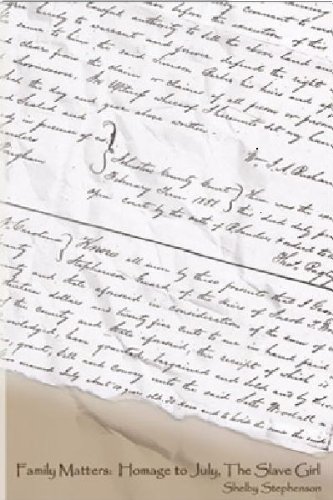
Family Matters: Homage to July, The Slave Girl - Shelby Stephenson (Bellday Books)

Today's book of poetry:
Family Matters: Homage to July, the Slave Girl.  Shelby Stephenson.  Bellday Books.  Pittsburgh, PA.  2008.


Shelby Stephenson's Family Matters: Homage to July, The Slave Girl gives us so much to discuss it is hard to know where to start.  It is all haunting.

The subject of this book is a family association, a family history, a deep connection to, slavery.

This is very personal poetry of the most public kind and it reads like a history book that has been turned into an illuminated text.  Stephenson inhabits another time and place and take us, the reader, with him.

"Memory believes before knowing remembers"

                                     -William Faulkner, Light In August

                                                  I

Your story, July, sticks in my throat:
violence splits the syllables down a back road,
the smell of horsesweat, leather
creaking in the gee and haw of tongue and trace,
lightning bugs dancing on Percy's wagon,
his hat, the hole in the crown, pulled down,
bobbing, while the slow mules
go on up the hill
where he will "carry the truckrow," his hindend facing the sun,
the mule, humbling and humoring toward the shade,
the end, the beginning, a piece, fabric
cut from the sweat--the rows topped,
middles swamped with rotten blooms,
greenblack juices, splattered tobacco worms--
and Percy barely moving the truckrow,
a frail man bloated with jagged currents,
little rivulets his pores spilling.


                                                   II

Percy moves across the yard
to get the knife
to sling the weeds.
You chase the bees
to the tops of blooms
now laid low
not one left
to kick about like a mule's
flopped ears.
Would the missus looking from the window
say while the man rakes in piles
his day's work--
there--slave's work, after all?
I see you there,
your comfort uncomfortably
stationed at the master's door;
your wound in the landlord's side
coming through the blooming sounds
brought on by going from field to field for somebody else,
never for yourself
nor your children I know about, their shrill hunger
mornings when the doorknob was cold,
the hearth cold, floor cold.

Percy didn't have a cow
Percy didn't have a mule
Percy didn't have a hog

he would split stovewood
tossing each stick aside with his bandaged thumb
rubbing his bloodshot eyes with the back of his chopping hand.

Worked his tail to the bone,
told skinny tales
and Minnie was his
fosterdaughter, July, motherdaughterchildwife!


                                                         III

Considering how Minnie Birch picked the plantbed, those dime-sized tobacco
leaves pushing the canvas in April, it's so quick, don't you think, squatting on her knees,
using a spoonhandle to pinch out the morning glory and mullein, the grass, of course,
the worst part of the job, since it is everywhere, all months, alive or dead. "Minnie, is your
Hard Rock growing?" "Like a weed!" Snuff ages her lower lip like a promise the father
might dart around the corner and light up the path like a horn blowing--who could bear
such news? Minnie stares at July, not even wondering (or caring).


                                                            IV

A field full of Hands trudge up at dinnertime, desperate from heat and lack of water, the
bench where the tobacco is being prepared for the barn a din of wonder. The Help hums
"Amazing Grace." The men and women from the field seem hotter than ever, their
gummy clothes clinging to their bodies, feet black with sweat. Nearby: dirtroad, shack,
some tarpaper: inside, a big woman, nearly blind, says how her time has come: through
she needs plenty, she does not need money now: "Where is July? If I only had her to
talk to, cook for me, help me along, sing me a song."


                                                               V

You turn back the canvas
and squat with a brokenoff spoon
to dig the weeds,
tiny as fleas,
around the tobacco plants
the size of dimes.

Percy knots the canvas,
on long snake of plantbed covering,
places it top the tobacco racks.
Bench Help hums:
The tobacco's being tied on sticks stuck in wooden horses.


                                                               VI

You and Mae Dinah hoe the sheepburrweeds
out of the corn--"Makes it greener," Mae Dinah says,
"but I don't know if I can last--with my Elvis tired,
Lord, just plain tired down on his feets."

Hallie Sanders looks down at the cotton on the sheet, wondering after this one
and that one, the one on the weighhorse, given up as offering: "Mister Paul, you
got some more work I can do?"

Hallie's brother, Algie, wants to become a boxer like Joe Louis,
Daddy ordering some gloves from Sears-Roebuck,

     drawing a ring in the pasture
     and Bud, nicknamed Little One,
     comes down from Mr. Hector's where he works and beats
     Algie who has prepared for his bout
     shadowboxing pines bobbing and weaving
     and Little One pounds his face so good and hard
     Algie pulls at the swells on his face for days
     Little One's friend who comes with him to referee
     down on his hands and knees
     outside the scrawled circle, flapping the dirt with his palms
     saying Little One done whupped him Little One

Buddy Dublin streaks the countryside in a SoupedUp
Cadillac Coupe de Ville: My daddy's a leatherskinned wampus cat
they call Pearl . . . my mama's a miracle whelped in hell and I am Dublin-

Buddy's my name - I can whup any man - love a woman to shame! Mauling a wedge
sinking into trees he centers cordwood for woodcutting tobaccobarns in steady windshake
of falling pines and blackgums. Slinging nasties with Paul's John Deere putting between

barn and field, wheels roll, spin--

a note in Obedience's diary: July knows the withers of mules like the back of her hand
and the drinkbottlecaps Clay nails to the bagging of the drags to hold the tobacco leaves.

...

Today's book of poetry thinks that slavery was bad, in parts of the world it still is.

Shelby Stephenson does pay homage, pays respects backward in time, he does this by being there and taking us with him.  Stephenson renders sad history eloquent and elevates the discussion by making it real.  These poems feel authentic, you can almost smell time, feel the heat of the southern sun.

That's the Way it Was

                                                                 I

Oldtimey preachers promised sin.

Van Della, princess, bronzedskinned,
could string tobacco fast as handers could get it to her.
Swing her hips, too; the earth moved galaxies
above her widebrimmed straw,
lifting globes paradise might claim
as plumbing for plumage,
the most splendid single light grass could yield to,
her heels down, toes pointing those bare feet
quivering grains under the chaineytree,
sand cooling her toes as she approached the tobaccobench.

Leaning forward, I see you bring the blackening pot to a boil,
the garments turning spotless on the fluted washboard,
listening to what the white folks say, hearing your mother pray again,
             telling you, July, wait and work - and once Freedom is declared-
             don't make no crops beyond the time, no matter what, and run and tell other
             slaves they can quit work now they are free! No matter what!

                                                               
                                                                   II

Uncle Reuben told me you are doing good if you have enough money to buy
             fertilizer for next year's crop.
I told him Seth Woodall paid Pap George $413.25 for July, the slave girl, in 1850.
He and Aunt Mary farmed just twenty-two acres.
Everybody wanted poundage in tobacco.
We would heat a kettle on the stove and pour the scalding water in the stems.
Uncle Reuben would build a fire in the washpot and heat his water
and drib it on the stems of the cured  tobacco to gain a little weight.
He could grin and stir up a little money.

                                                                   III

Old Jim was Reuben's mule before Rhody.
Reuben traded him in for one younger.
Didn't you know him, July?
I admired his muleshoes.
I went barefoot year round.
Wintertime my feet cracked open.

I could really pick cotton.
I'd get in the field early in the morning:
                it weighed more when dew was on the balls.
Even when my hands cracked open from the cold I kept on filling up my sack.
Me and Obedience would slip off to a sweet potato bank.
She told me a potato hill looked like a igloo.
I wondered where she'd seen one - I won't never forget that.
We'd build a fire and roast the white-fleshed batatas
               in the hot ashes and we'd sit and eat and warm our hands over the fire.
That was really living.

...

The material in Family Matters: Homage to July, The Slave Girl raises far more questions than I can address or answer.  I get squeamishly enthralled when I read books/poems that give me a start, the short sharp shot of adrenaline right to the brain stem.

Shelby Stephenson takes a brave and heartrending trip into the personal narrative of slavery and his own family history and mines it, looking for truth, finding so much grace.  This is startling candid honesty and it makes for startling good poetry.

Nancy

                                                                  I

Grandmuh Nancy leans on her elbow: oh my infantile paralysis-
she purses her lips,
that indexfinger in the middle,
her hair in a bun
a splintery look's not yet ruint.
From her Bible and Old Baptist hymnals
she teaches you to read and write.
She dreams that you will sing for her when she is gone:

                                                                 II

April 1, 1923

Dear July-

     I wrote you a short letter Dec. 4th, 1922, but never mailed it.   I only write for
relief of mind with no intention of sending it to you then.  Again I have a desire to write
you, trusting that it is of the Lord that prompts the same.
     I will try to tell you the dream I had about you.  If I mistake not it was the week
before the 4th Sun. in July.  I dreamed we were in a church house.  It was communion
and footwashing time.  You and I were sitting together.  You asked me to "take off your
shoes and stockings that we might wash each other's feet."  Oh, how unworthy I felt.
Words cannot express my feelings.  For years I had a desire to wash your feet, but I had
always felt so little and unworthy I could not ask you and at last this happy privilege was
mine!  In silence I meditated.  As I took off your stockings I saw there was a hole in your
left one large enough that your whole heel was bare.  This troubled me.  And I thought if
only I had a new pair of stockings I would give them to your to wear to the yearly
meetings.  I wished that I had some good enough for you.  We washed each other's feet
and I awoke.  This dream troubled me.
     Finally it came to me this morning:  I do not have to know what our dream
means.  I offer it to you for what it is worth, along with my love.

                                                                                                              Nancy

                                                                 III

You and Greatgrandpa Manly picked blackberries
down near the edge of the woods
in front of the Old Place
and Manly stirred up some wasps
and those things wrapped me up
and stung me around my eyes.
Mister Manly chewed some Picnic Twist
and put some of the juice on my stings.
Then he took his pocketknife and picked the redbugs off me.

...

This is poetry that I fell into like a lake.  Refreshing isn't the proper word, and it eludes me. Encompassing perhaps.  Good poetry doesn't grow old.  The truth is always the best story.

Shelby Stephenson

ABOUT THE AUTHOR
Shelby Stephenson grew up on a small farm near Benson, in the Coastal Plain of North Carolina. After leaving the farm for college, he graduated from the University of North Carolina-Chapel Hill (where he also studied law), University of Pittsburgh, and the University of Wisconsin-Madison. He is professor of English at the University of North Carolina-Pembroke, where he has edited Pembroke Magazine since 1979. The state of North Carolina presented him with the 2001 North Carolina Award in Literature. He has received the Zoe Kincaid Brockman Memorial Award, North Carolina Writers Network Chapbook Prize, Bright Hill Press Chapbook Award, and the Brockman-Campbell Poetry Prize. In addition to Family Matters: Homage to July, the Slave Girl, he has published a poetic documentary Plankhouse (with photographs by Roger Manley), Middle Creek Poems, Carolina Shout!, Finch's Mash, The Persimmon Tree Carol, Poor People, Greatest Hits, Fiddledeedee, and Possum. With his wife Linda he has made three musical CDs Hank Williams Tribute; Stephenson Brothers & Linda Sing the Old Songs; When Country Was Country. Shelby and Linda live on the farm where he was born.
Shelby Stephenson has been recently named Poet Laureate of North Carolina.

BLURB
An intense and hear-breaking poetic narrative which, in its exploration of historical and personal materials, holds affinities to the work of Susan Howe and to James Agee's classic Let Us Now Praise Famous Men. Family Matters is a strenuous questioning - and exposure - of the fictions of ownership, whether of persons or places, graves or farms.
     - Allen Grossman

Shelby Stephenson
North Carolina Poet Laureate
reads his poem "Etchings"
video courtesy:  The News & Observer


340

Poems cited here are assumed to be under copyright by the poet and/or publisher.  They are shown here for publicity and review purposes.  For any other kind of re-use of these poems, please contact the listed publishers for permission.