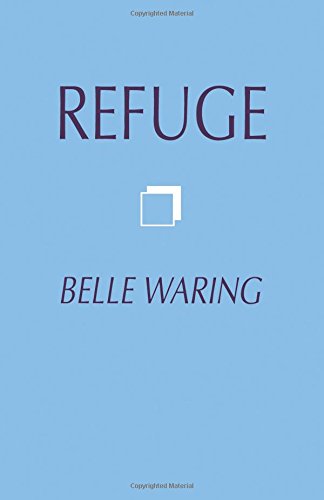
Refuge. Belle Waring. University of Pittsburgh Press. Pittsburgh, Pennsylvania. 1990
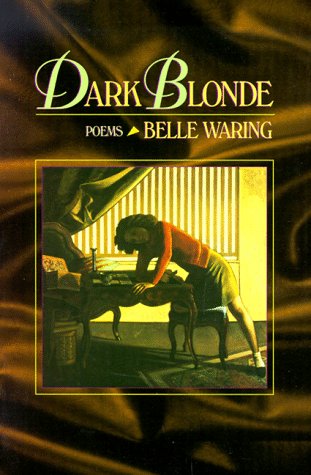
Dark Blonde. Belle Waring. Sarabande Books. Louisville, Kentucky. 1997.
"and the thrum of you jazzed me up like a champagne."
(Aftertaste)
Today's book of poetry will be happy to tell you how we came to hear of Belle Waring as soon as we finish telling you what reading her poetry is like. Reading Belle Waring is like walking into a room full of reason, decorated with grace.
It's also a slap up side your head.
When Belle Waring's two books arrived, I knew from their source that there would be something special inside and Today's book of poetry was not disappointed. Waring belongs to the narrative school of plain speaking, real life, real time, true this. But when her poems start to play out in front of you, you realize you've heard this voice from your sisters, honest and untethered.
Belle Waring knows what it is to be pixilated and she knows "how Dostoevsky said: People are unhappy because they don't know how happy they are."
Today's book of poetry is going both barrels for Belle, two poems a shot.
Reprieve on the Stoop
If your first memory was the arms of your father
about to chuck you out the window of that catpiss
apartment in Downington, you couldn't dream.
You don't remember dreams, like when I got
robbed, the scumface
broke in my room while I was alone
asleep and naked and when he left
I woke up
untouched. Now if the sun
abides in these brassy leaves
quivering over my ankles which talk
to you and you ask me to sit
so I do—you and I
were both alive and how bad is that—on the stoop
like a girl with her front door key on two feet of green
string around her neck, watching the boys shoot
hoops, how they crouch and leap extending to the rim
and sweat on the sweet lunette of neck over their T-shirts
only now we're not slinking
home for supper in time to boil a pork dog
and watch dad throw his liquid obituary in mom's
face. We sit down on the stoop and watch the earth
swing her hips to the next dance hit and the dark
slide his arms around her waist. Listen
—I'm not romantic, baby, but I do
know grace when I see it.
✍✍✍
I Dream I Am Back in Paris
walking east. It's hard to forgive
anything. The sky billows with a million
wild roses, backlit, as Monseigneur Soliel
crawls up the horizon. Nobody's awake but me & I'm
two places at once: Paris, district twenty, and my
grandparents' house in Virginia with its huge blue
spruce and roses all colors went nuts in summer
and lightning bugs fired with silencers into the dark.
I am going to surprise you on Rue St. Blaise. When I
burst into the courtyard the dream falls
dark like a curtain dropped on the photographer's
head. The government of Paris razed your house and left
a mess of squatter's huts. That house survived
the Revolution. Cows grazed there. You took in
all of us. Middle class renegades. Refugees
blasted from Chile. Algerians. Americans. Mornings,
I'd climb over the ones huddled in sleeping bags
and step out to see the sun sweet-talking its way down
the street. Now the light wakes me up
tapping its toes on the window ledge, same seductive
rosy light, only this time I'm not going anywhere,
my grandparents are dead, you're in Paris
turning thirty-seven and the most I can manage is to phone
transatlantic to report my dream which digs in
its Anglo-Saxon heels and sputters like Donald Duck
on dope. I wish to tell you that the sky I dreamed
vaults over our hearts, that we leap with its rose
in the night and return to each other, that the dream
dangles the old place intact, like a kid stalking light
at sunup, wound up in joy too big to put your arms around.
✍✍✍
Waring doesn't know her own strength or limitations so these poems come off the page entirely untethered. Today's book of poetry was terribly saddened to know that Belle Waring, who was born in 1951, died in 2015, we would have very much liked to express our admiration to her in person.
And on that sad note Today's book of poetry must remember the former American Poet Laureate Donald Hall. Hall died this past week, he was ninety. Back in the late 80s when Today's book of poetry moved to Czechoslovakia to teach English as a second language, I read Hall's The One Day (Mariner Books, 1987), a book length poem. I loved it and wrote to Mr. Hall, the result was that we had a brief correspondence where he was generous to a fault and very kind. I've always remembered his line "don't ever do anything you don't want to do." I might not have that exact, I read that book more than thirty years ago, That One Day. Great and simple advice but hard to follow through on. Donald Hall was a great American poet and we are less for his passing. Goodnight Donald Hall.
Back to Belle Waring. "I laugh like a struck match." (Blackout), inflames Waring, early on in her debut collection, Refuge. And Today's book of poetry was caught. Today's book of poetry became the proverbial "deer in the headlights." I could not turn my gaze away from the electric charms of Belle Waring.
Aftertaste
"It's the combat zone," the cop said, a Portuguese
fine-doll, mixed-up fine, black cheeks
sleek as an aubergine. I am letting you know
what you missed. "South Station's two miles,"
he warned me. "Cab's reasonable. Why walk?"
Because reasonable was too high. Like you,
I was limping home with a prepaid ticket
and change for the paper. "Globe!" the newsboy
wore an arm cast grubby with ink. I gave him an extra
quarter. You missed dodging the shark-faced men
who'd cut just to smell the blood. If you'd come
with me I wouldn't be moving
unescorted through these pisshole streets,
eyes front, with the faith of a firewalker,
while the powerglide car radios bunched up
throaty with pick-up songs.
South Station smelled like stranded worry,
gun metal. Soon the train was racing me
down the coast like a rock 'n' roll hit,
but instead of you, who's next to me is a college
girl leaving home. When the train rattled me down
to dream your face floated out of the dark
and the thrum of you jazzed me up like a champagne
✍✍✍
Letter to Morley, Never Mailed
My life was that moment when the train breaks
free: as the city retreats, one begins to hope.
You taught me how to lean into the wind
so stiff it blew the rank smoke out of my head.
What was it like growing up on the beach?
Did the wind suck the words off your tongue?
You said you slapped glue on the trees
so when the finches got stuck, you caged them
to sell. The morning I left, your face was a cloud
blown over the curve of the earth. You gave me
a rose that got slugged on the bus. We screwed
everything up. I came back to my country
more lost than a foreigner. You get drunk and tell
lies. Oui, je t'aime, mais je craque.
In the name of the finches, I take myself back.
✍✍✍
So, that ends the Belle Waring tasting menu for her first book, Refuge. Get comfortable because Dark Blonde is flashing aces while the rest of us are holding nines and tens. Hang on to something.
Oh, save us Belle Waring, save us all. Today's book of poetry is here to tell you the truth as we know it. Belle Waring's poems have steamrolled through our office, flattened us right the fuck out. This woman has the power and when she turns on the gas everything else disappears.
Dark Blonde jumps right off of the damned page, jumps up and grabs the reader by our lazy lapels and shouts, "listen up!" And we have to obey. Waring came into the poetry game late and left early but make no mistake, dear reader, she left a mark. Dark Blonde is a rogue pilot, willing and able to drop down anywhere. No runway needed. Waring must have been a spectacular conversationalist because these poems are ripe and verdent with the perfect line, the perfect pause.
People Think All Wrong About Manhood
When I met Jacob, he's just escaped a police state.
Scrawny white guy, he talked all jacked up on nicotine,
laughed like a .22
crak-crak echo in the alley. Eyes
you already know about—how they undercut
this dodobird reception chat, where Jacob looks forty-five, except
at me—his eyes like a kid who gets hit.
Hit. Then they tell him
Strip. And nobody calls the cops.
Because they are the cops.
I got a cat with six toes per foot who can smell the landlord
down the block. Jacob thinks I'm a sentimentalist.
So what. This past winter I worked just enough to pay my rent,
lived on greens and greasy cornbread, slept with the light and the radio on
so no one would think I was alone. I had bad dreams where I found
little boys in a cold steel sink, face down on a wire brush.
A dusky pulse threads one boy's arm. They have been
sexually tortured
then shadows grease over the windows and
the door no lock
I would wake up seized with a sick headache,
and lose whole days like that.
Jacob says there's no such thing as love at first sight.
You all know the lightning bolt—
Juliet and Romeo. But this is no
play. One morning after I hadn't slept
a silver stretch limo
nearly hit me in the alley where the neighbor kids hang
and the pigeons peck over the cobblestones,
when here comes this limo
with its minky black windows all rolled up tight so you can't name
names
and the sucker never even slowed down. Made me jump back,
skin my hand on the door of the shed.
I wanted to live
after that.
There's a park near my place
where the creek cuts the city clean down to the river.
Sunlight mottles the poplars, aggie-eyes the small water.
If you toss cat chow to those citified ducks, you draw
mamas in camouflage, splendid green heads,
a white rascal like Donald minus jacket and cap,
shimmying his dignified tush.
Ducks are appointed by God to give doofy people a safe date.
We walked through the city
counting up different riffs that we heard on the street—
boom boxes, radios, churches, jukes
girls jumping Double Dutch
boys drumming drywall buckets in their sidewalk bateria
a twelve-piece band of trombones and a tuba
a guy slamming cups of spare change for percussion
—count 'em up.
Get twelve tunes, go on home
and there the man next door plays Villa-Lobos on piano
'til he hits a change and splatters jazz riffs that feel like the rush
you get in a plane when the glaze-blue day pops out of the murk
then you're back inside and Jacob is just somewhere
quiet in the house with you.
These moments are underrated because they're not a Pepsi commercial
—no big male teeth, no young women with important hair.
Things quite silently
shift.
And when a man is brave enough
to cry whatever he's saved up—
you recognize him.
And you—you save up what comes
after he's finished his crying.
✍✍✍
Twenty-Four-Week Preemie, Change of Shift
We're running out of O2
screaming down the Southwest Freeway in the rain
the nurse-practitioner and me
rocking around in the back of an ambulance
trying to ventilate a preemie with junk for lungs
when we hit
rush hour
Get us the hell out of here
You bet the driver said
and pulled right onto the median strip
with that maniacal glee they get
I was too scared for the kid and drunk with the speed
—the danger didn't feel like danger at all
if felt like love—to worry about my life
Fuck that
Get us back to Children's so we can put a chest tube in
this kid
And when we got to the unit
the attending physician—Loretta—was there
and the nurses
the residents
they save us
Loretta plants her stethoscope on the kid's chest
and here comes the tech driving the portable
like it's a Porsche
Ah Jesus he says
The baby's so puny he could fit on your dinner plate
X-ray says the tech
and everybody backs up
except for Loretta
so the tech drapes a lead shield over her chest
X-RAY! says the tech
There's a moment after he comes down the lens
just before he shoots
You hold your breath
You forget
what's waiting
back at your house
Nobody blinks
poised for that sound
that radiological meep
and Loretta with her scrub top on backwards
so you can't peep down to her peanutty boobs
Lorette with her half-Chinese, half-Trinidadian
half-smile
Loretta, all right, ambu-bagging the kid
never misses a beat
calm and sharp as a mama-cat who's just kicked the dog's butt
now softjaws her kitten out of the ditch
There's a moment
you can't even hear the bag
puffing
quick quick quick
Before the tech shoots
for just that second
I quit being scared
I forgot to be scared
God
How can people abandon each other?
✍✍✍
Belle Waring sounds so reasonable, even with her big and hopeful heart just hanging off of her sleeve. Think of the Rev. Al Green and how his songs are all about the same thing: quiet intensity. You can feel, hear, sense the immense power, the sheer human will, the force. But the Rev. Al Green knew how to give just enough, every time. Today's book of poetry posits that Belle Waring's focused gaze spills with the same sort of intensity.
Volume has never been the way to judge a voice, Waring, like the Rev. Green, always knows how much to give, how much to hold back, when to breathe.
Our Today's book of poetry staff were in the dark about Belle Waring, as was I. I passed Belle's two books, Refuge and Dark Blonde around the office for the last couple of weeks.
At Today's book of poetry you can come to work drunk and we'll find a couch for you, bring aspirin and a cold drink, wipe your brow if needed. Today's book of poetry hates tardiness, but in truth, our head-tech and most valued assistant, Milo, has never been on time for anything a day in his life and we love him just fine. BUT if you work for Today's book of poetry and don't/won't/can't be bothered to read the poems—that is it.
Kicking stones, fired. Goooooodbyyyyyyye.
(It's never happened, every single one of the staff have a poetry Jones.)
Maggie, our new intern, and Kathryn, our Jr. Editor, both flamed out, red-eyed about a dead poet they'd never met, and Today's book of poetry understood. We often don't know what we love/need
until it is gone. Max, our Sr. Editor, came out of his dungeon, walked over to the podium (we stand to read here at Today's book of poetry) and quietly with exactly the right gravitas he read us Refuge and then read us Dark Blonde. Maggie and Kathryn were not the only poetry moles with red, red eyes.
So What Would You Have Done?
On the train to D.C., a priest sat beside me, and outside Philly
he turned and said, My daughter has only days to live.
Rawboned man. Under his eyes were purple crescents
like bruises dug out by a surgeon's thumb.
He wept, I was scared, but not for myself.
Of course, for myself.
I took his hand then—cold as inside of a limestone chapel.
Wilmington next. He pressed both my hands before he left.
I wanted him please
to bless me again, bless the train and the tracks for they could
snap like
fingers like the string of smoky pearls my sweetheart gave to me
before he got sick.
Before they admitted him.
One day, on my way to the hospital, I saw some movers drop a baby
grand—
it broke from its harness to the street.
One honors the chord of a crashed piano by scrounging ivory
for a charm.
There is logic in this.
When I walked into my sweetheart's room,
I saw the chemo had gotten to his scalp, he was ripping out
handfuls of his own hair, black dandelion seedfluff, shouting,
Take it. It doesn't even hurt.
I wound his hair round the shard of ivory to conjure the elephant
to save him. But on the train, I didn't tell the priest I had a charm
and after he left, a teenaged boy
with a ripped leather jacket took the same seat, still warm.
He looked at me staunchly: You all right?
I said, My boyfriend's dead.
Kid gave me a cigarette.
I showed the charm to him and he said
I should give it to my Mom to keep my Dad off her.
Crossing the Susquehanna, he fell asleep, twitching in a dream.
High arched brows. Eyes chasing, or being chased.
I unwound from the charm the black hair of my boyfriend,
and wrapped my own hair around it, to slip in the kid's pocket.
There was a pistol in it.
The train cut close by suburban yards
where cars roosted up on blocks, an upside-down dory perched like
a hen
warming herself in the sun-shot dirt, a kid climbing into a tulip poplar
tore off whole blossoms to toss to his mother
as dusty babies swarmed on the grass below.
They never looked up.
All I wanted was to hear them, please
calling each other.
✍✍✍
To Them, To Their First Conversation
Sunlight: Her pituitary balks at the lack of it
and he's an engraver, so for them
light is not taken for granted. On this day in October
downtown, lunch hour, the sun's acting paternal.
Showing them off to each other. The man
is flushed with the debonair mutiny of blowing off
his day job, of loafing on the sidewalk, flirting with a woman
and bobcat green eyes. Between the edge of her scarf
and the scoop neck of her sweater there's a crescent of her skin,
unprotected. Their first conversation alone.
Blaring noon. People have to step around them.
A southeastern sky tips down to them its light,
half cloudy, like tea dashed with milk,
which, after a long illness, is brought—
slowly now—
to the lips.
✍✍✍
Our Southern Correspondent, David Clewell, former Missouri Poet Laureate, introduced Today's book of poetry to Belle Waring. Our Southern Correspondent has been a little under the weather of late so if you don't mind Today's book of poetry would appreciate some collective love/karma combination sent in his direction.
Mr. Clewell has taught Today's book of poetry more about poetry and friendship than we quite know what to do with. Bless his cotton socks. So please send some love to St. Louis.
And while we are at it, let us send a joyous yawp out into the poetry ether, a yawp that lets Belle Waring know, wherever she is, that we read her, every word—and are better for it.
Goodnight Belle Waring. Thank you.

Belle Waring
ABOUT THE AUTHOR
Waring worked as a neo-natal intensive care nurse and as Writer-in-Residence at Children's National Medical Center in Washington D.C. Her first collection of poetry, Refuge, won the Associated Writing Program's Award for Poetry in 1989, the Washington Prize in 1991, and was cited by Publishers Weekly as one of the best books of 1990. Her second collection Dark Blonde received the San Francisco Poetry Center Poetry Prize and the Larry Levis Reading Prize in 1997. It was published by Louisville's Sarabande Books. Belle Waring died in 2015.
BLURBS
"Drawing from her work as a neonatal nurse and from some more common experiences (e.g. nervous breakdowns, incest and poverty), Waring exhibits the street-smart ear and unflinching eye that made her first collection, Refuge, one of PW's Best Books of 1990. The images and headlong rhythms of these new poems exert a wide-ranging, often irresistible pull."
--Publishers Weekly
"Waring creates a voice that we feel we can trust to lead us to the center of an experience, maybe because her language never feels artificial but seems to grow naturally out of the situation it presents. The remarkable range of subjects and characters in Waring's poems leads to an equally remarkable variety of tones and vocabularies."
"Waring creates a voice that we feel we can trust to lead us to the center of an experience, maybe because her language never feels artificial but seems to grow naturally out of the situation it presents. The remarkable range of subjects and characters in Waring's poems leads to an equally remarkable variety of tones and vocabularies."
-Word House, Baltimore's Literary Calendar
"When Belle Waring reads her poetry, the jazz-inflected words escape her mouth like a Lester Young solo: quietly, melodically, forcefully. . . . she provides weight to each short line, drawing out her words like sensuous kisses. Her work is also punctuated with politics and humor."
-D.C. City Paper
"Poetry, Robert Frost once said, is a way of taking life by the throat. It is in this tradition that poet and nurse Belle Waring approaches her craft-seizing difficult subjects and holding them in time. . . . "
"Poetry, Robert Frost once said, is a way of taking life by the throat. It is in this tradition that poet and nurse Belle Waring approaches her craft-seizing difficult subjects and holding them in time. . . . "
-Salon
Waring has written a collection that doesn't renege on us the promise of her first book and indeed has honed her craft to include a wider range of tonal shifts and allow for a finer lyricism while not losing the syncopated snap and humor of her earlier voice."
Waring has written a collection that doesn't renege on us the promise of her first book and indeed has honed her craft to include a wider range of tonal shifts and allow for a finer lyricism while not losing the syncopated snap and humor of her earlier voice."
-Indiana Review
Belle Waring
Friends of the Scranton Public Library Poery Series: Belle Waring
700
DISCLAIMERS
Poems cited here are assumed to be under copyright by the poet and/or publisher. They are shown here for publicity and review purposes. For any other kind of re-use of these poems, please contact the listed publishers for permission.
We here at TBOP are technically deficient and rely on our bashful Milo to fix everything. We received notice from Google that we were using "cookies"
and that for our readers in Europe there had to be notification of the use of those "cookies. Please be aware that TBOP may employ the use of some "cookies" (whatever they are) and you should take that into consideration


