Showing posts with label university of iowa press. Show all posts

Sunday, July 28, 2019

Attributed to the Harrow Painter - Nick Twemlow (University of Iowa Press)

Today's book of poetry:
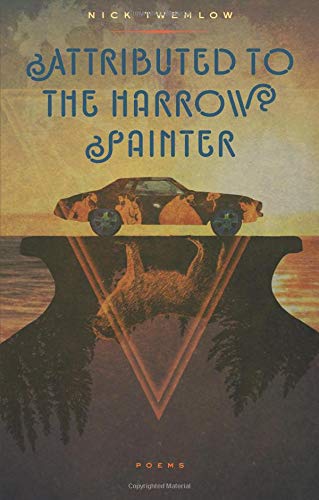
Attributed to the Harrow Painter.  Nick Twemlow.  Kuhl House Poets.  University of Iowa Press.  Iowa City, Iowa.  2017.

      "I must've eaten
       Ten clocks
       Waiting for you"
                               from - "Responding to my father's question"

Nick Twemlow has a section of poems near the end of Attributed to the Harrow Painter, ten of them, all titled "Responding to my father's question."  These poems seem to be a confessional primal scream of beautiful tone and duration.  Underlining every poem is long love letter to Twemlow's son Sacha.

Twemlow nails that lava hot emotional battlefield where families crash and burn or the relationships grow white/blue like tempered steel.

There are nine poems, groups of poems, making up Attributed to the Harrow Painter and they all have the same feel, a machine gun pace and the best bolognese temperament, proper burn.  Twemlow
is one of those whip-quick-smart poets.  His ideas come so quickly you can't figure them all out in one read.  These cats are dense, but man oh man, Twemlow can throw a line.

Mothland

All along you were Right, they were flanking our
house They Documented you taking off your clothes
every morning I requested these Documents & they
sent someone's Illicit hard drive I fucked with the
commandant Nothing that mattered Continued to
happen into the Nothing that made us laugh like Gas
does Most of us went WYSIWYG Which meant sand
kicked In our face &/or our Life was a fracking disgrace
I know you lived mostly Desirous of desolation A
kind of Interior branding a Lesbos of the Soul Let me
introduce you To my friends Who fry bacon & Spumoni
de Kooning cooling limbic An astral fryer. Thomas
Mann Spelling things out I exhausted I falling down
On my face the divorce Anything but legal Just shame
& egrets Shitting the windows I realm I record Life
begins to get in The way the life Of a novelist Which
I assume is not Only more comfortable The advance
is ridiculous But strident The perqs develop Their
own antiquities I always go back to my Preference
for medications that act swiftly I don't do time-lapse
So well I get hell I focus my gaze On Takashi Ito's
Structured vision Of the not this world But space is the
place Where we can mace the strangers walking into
our loathsome Into oblivion The usual I refuse My son
Wallows the smooth Tallows of the luxurious paradise
of Time to spinneret to Pearl the moustache I get that
You falsify Perfectly you stream experience Like a coin
you toss Into whatever Fountain I still Believe the
poem Delivers a brutal shrill lust for streaming Cusps
your romance With ecriture If my mother were To read
this How much shame Would envelope Her I'm sure
you assure us Reassured all of us Which might mean
Write out & out & out else Make this a god Or homeless
People to shine a light On a poem amending The title
Intended to circumscribe My mother's loneliness I am
thinking of My mother a lot These days which Pass 
in spasms In theory If we are anything If we have
nothing else uncommon My mother Finds comfort
in Planting bulbs each fall She left me a voicemail
Message for my birthday Several days late to which I
never responded I didn't Listen to it for months I can't
remember if I did listen to it. Fred told me he couldn't
Get over a line from the Poem I read in Chicago This
summer from a poem that shows up later in this book

"Look, I've loved my mother Most of my life."

Its permission to admit why the anxiety Over mother
love Why depict spiders skittering All over our dreams
I didn't mean I didn't always Love my mother her Name
is Robyn same As my wife When Oedipus says I get the
feeling his dumb Luck is his fortune Is his is Oedipus
Reminds us to behave Better in the future Which his
motherwife Reminds us is unknowable Every memory
I have Or choose to have Of my mother saturated In
the blues of a Dusky sky I should Cry I should inhabit
The cliches entrusted to me To exhibit A lonely boy
ill Treated defeated before Birth exiled from Chance
When I Remember my mother Crying I don't remember
Her ever crying She loved me I'm certain As she loved
her Spring tulips not unconditionally But with proper
proportion Unhappy that I cannot heave My heart into
my mouth I Love your majesty According to my Bond
no more nor less the man standing Next to me inside of
me in Permanent ecstasy the cyphers Scuttling under
passing cars Unable to find A shadow to Dissolve Into
The barrel Of a gun twists Back at me I lard The scene
with A company of C's I see the scene in every Register
but time-lapse returns No favor The mother coma The
mother coma The various strobing Or phasing The 
clock dial is a riot Planning itself Years in advance Go
quietly address The vending machine Snip wires Stare
at Pictures of you Jolted twenty feet back onto The hood
Of a viper Flicking its Capital relentlessly At the brine
of these new centuries Erupting like nothing You or I
know I pick at a scab I develop A hankering for Insta for
gratification A door that slides Shut just As invasion
of talk Of jetties & molly & away to Somalia As if
you could evade The glistening Of your Fund which
powers up In a shadow Enciphered this cruel media
this papering Over & proxy servers & Anonymous
nerve Tapping to allocate resource Assuaging Assange
Buffering Beyonce Journos Copping a feel in Ferguson
ecstasy of Entering the Gilgamesh Dying 'neath the
heath Hammered to a tinsel thin Instance of justice
You don't belong To tribe always acting as Leering
at The contents of the mirror Mirroring the Warhol
Insistence on or the Basquiat Keith Haring! Nauman
walks in a square that Occludes race & class Privilege
preening or Peacocking Queer Theory rasterized
Resisting salve of Semiotics Your brother arches His
eyebrow Thought This true & u spend so much of
yourself Spending credit scores & fantasy The vale
we Vulture in our waking dread Waxing what You
examine with your niggling X-ray You my standing
Camino All the world's nostrils flare & Zenith & zeroes
shiver Me back into my car & I Drive home totally

💫💫💫

Today's book of poetry would like to apologize to both Nick Twemlow and to the University of Iowa Press.  In its original form, in the book, this poem is justified on both sides, hence it appears as a monolith.  Idiots that we are here we haven't figured out how to do it.  Imagine.  Of course we are still posting these blogs/reviews with a Commodore 16, steam and coal powered.

Today's book of poetry had David Bowie's "Young Americans" on the box this morning.  Today's book of poetry finds "Young Americans" always takes us back to our cab-driving days, 6 pm - 6 am.  Mr. Bowie helped us get through more than once long night.  Today if feels a right companion to Attributed to the Harrow Painter.  Controlled mayhem meeting precision, Twemlow and Bowie are similar smart cats.  These poems go to your brain before they force their way to your heart.

Today's book of poetry would want to suggest Nick Twemlow plays with his readers, but he is a poet at play.

Responding to my father's question

I square dark spaces
In the places where
I'm an addict. I rinse &
Delete on repeat.
The addict
In me charms the
Awful offal, where
The memories (of you) collide
In stride, the memories
Of you glitch through.
Like tiny flashbacks
Flashing back your priors.
Now you tell me.
You think you're going
To hell. I look forward
To your review of the place.
The mild discomfort you'll
Feel is my two year old
Self wondering why
Mum looks so
Peaked & wearing
Hospital gown. She could
Barely look at me the one
Visit I remember taking.
There was an inner
Courtyard teeming with
Plants. She seemed to prefer
Being in there than being
Anywhere else. If you feel
Anything for her. If you
Can't stand all the
Involuntary
Redress. You've spent
Most of your life
Listening to the berserk
Among us spit our
Holiness at you. That'd
Kill most of you, which
It did. I can't come this
Weekend. I'm grilling
For three these days.
As my friend said when
She was pregnant with
Her only child, at brunch,
"Bacon wants sausage."

💫💫💫

Attributed to the Harrow Painter leaves marks.  By the time you've hammered your way through to the end you'll have notes all over the place, painters to look up, other new poems/poets to read.  Twemlow provides us with new areas of study.  He also heats the place up.

Our morning read was held in some summer sauna hot offices.  We have a couple of old aircraft sized propellers hooked up to two large fans.  They create enough to wind to lift my desk off of the floor so no loose paper in the office today.  You have to lean into the fans to get to the bathroom.  Unfortunately they're only pushing hot air around.  How ironic is that for us here at Today's book of poetry?

Champagne Dawn

Cassandra wrote
To tell me
That my 
"Problem
With chicks
Is over,"
& I jumped out of
My chair
& ran
To the picture
Window
In the living
Room,
Threw open
The curtains,
& saw
My neighbor
Hacking
His rake
At the still-
Fluttering
Body
Of a 
Barred
Owl.

💫💫💫

Reading Nick Twemlow was a new thrill for Today's book of poetry - so of course we sent Milo, our head tech, a note asking him to add Nick Twemlow to our list of "must find poets."  Attributed to the Harrow Painter has weight when you read it and a splendid aftertaste when you're done.

Today's book of poetry gets such pleasure out of introducing you to books like Attributed to the Harrow Painter, we can confidently promise "no regret" reading.
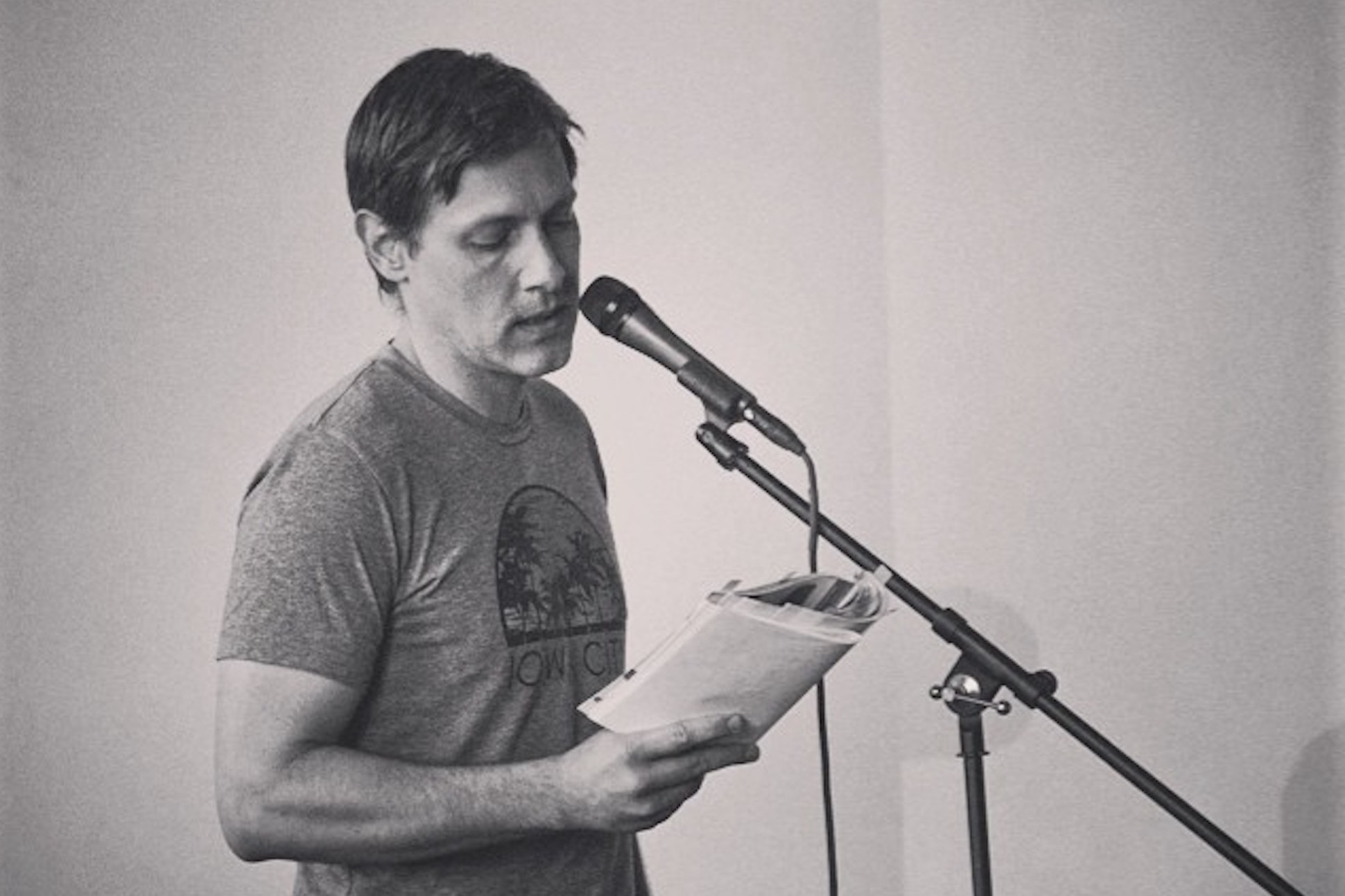
Image result for nick twemlow poet photo

Nick Twemlow

ABOUT THE POET
Nick Twemlow’s work includes Palm Trees, and his poems have appeared in Court Green, jubilat, Lana Turner, and the Paris Review. He coedits Canarium Books, and is a senior editor at the Iowa Review. He teaches at Coe College and lives in Iowa City, Iowa. 

BLURB
“Meandering around the edges of the beginning of someone’s mid-life, Attributed to the Harrow Painter dips back to lost teenage friends, traumas, accommodations, pleasures and losses and forward as the father of a young child, to the inevitable future. There’s the New York diaspora, and there are the blue jays 
and backyards of skull-fuck cold Kansas. Where are you most alive? Like Dana Ward and Ariana Reines, Nick Twemlow writes brainy poetry that’s as dispersed as real life without losing heart. I found the book very moving, and will read it again.”
     —Chris Kraus, author, I Love Dick and Summer of Hate 


Power in Poetry - Nick Twemlow Interview
Video:  Skylor Andrews


773
DISCLAIMERS

Poems cited here are assumed to be under copyright by the poet and/or publisher.  They are shown here for publicity and review purposes.  For any other kind of re-use of these poems, please contact the listed publishers for permission.

We here at TBOP are technically deficient and rely on our bashful Milo to fix everything.  We received notice from Google that we were using "cookies"
and that for our readers in Europe there had to be notification of the use of those "cookies.  Please be aware that TBOP may employ the use of some "cookies" (whatever they are) and you should take that into consideration.

       

Sunday, July 21, 2019

Transaction Histories - Donna Stonecipher (University of Iowa Press)

Today's book of poetry:
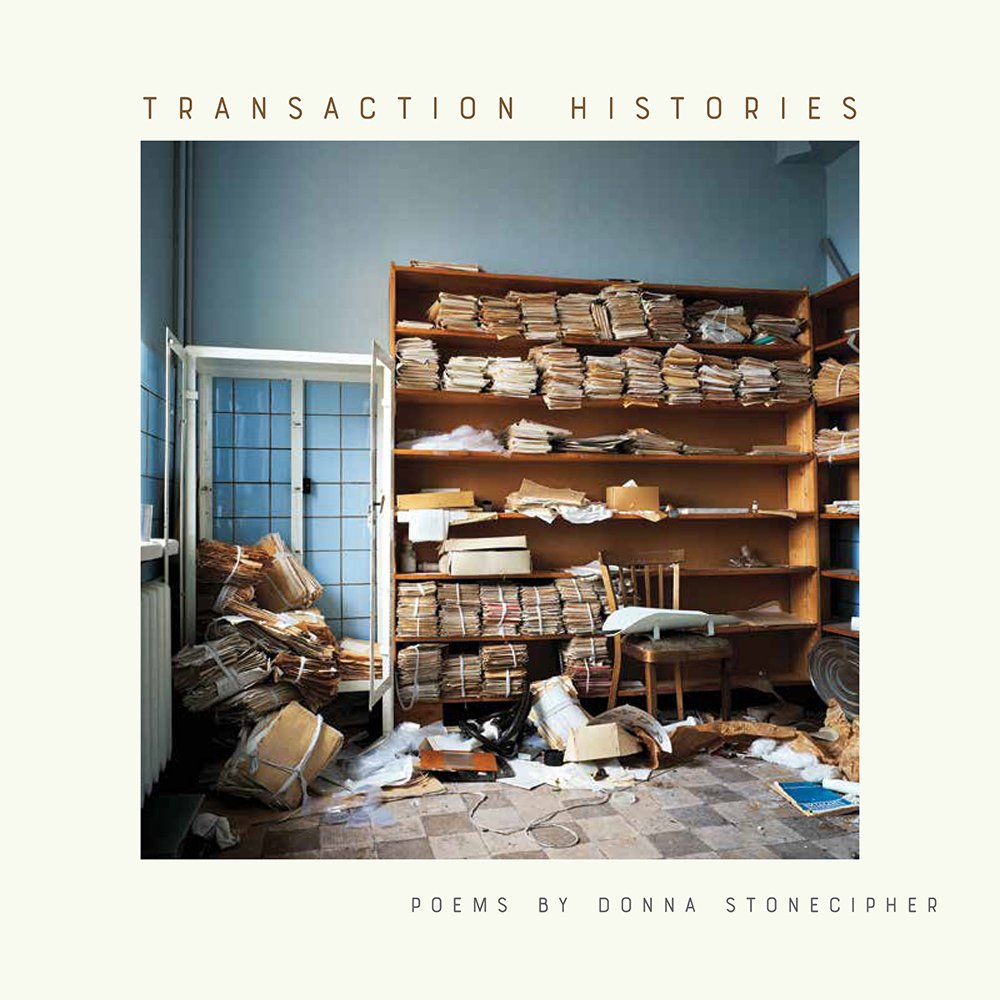
Transaction Histories.  Donna Stonecipher.  Kuhl House Poets.  University of Iowa Press.  Iowa City, Iowa.  2018.


Today's book of poetry read Donna Stonecipher with our usual hopes; Today's book of poetry always wants to like the books we receive.  Stonecipher gave us no choice.  Transaction Histories is made up of several long poems, each of them made up of numerous numbered prose passages of similar length.  It's a tidy package and solid as a brick.  Stonecipher takes these microcosms and uses them to decipher the world; Willy the Shake, Normandy, history books, Greek temples, oceans of plastic, architecture, psychology.  Donna Stonecipher takes it all on and this was just a tiny, quick disassembly of the first few pages.

Today's book of  poetry has recently started taking on Michel de Montaigne's Essays.  Maybe everything will feel this way but Stonecipher's Transaction Histories is similar in its accessibility, the author's limitless and generous curiosity, and perhaps even a touch of the Socratic method.

Transaction History 5

2.

      The photograph of grains of sand magnified 200 times revealed microscopic works of art
— gold, rose, opalescent scrolls, gaskets, sugars — where we had expected only a consoling
beige monotony, the consoling beige monotony we always counted on when we came to the sea
with our troubles to be consoled. Our troubles, too, were like artworks: constructed with love over
time.

💫💫💫

The grains of sand image was a brain tease and particularly apt because Today's book of poetry recently saw an enlarged photo of sand on the internet and was astonished.

Take a look as see if you can believe such beauty:

Such unimaginable beauty hiding in plain sight.  Perhaps Today's book of poetry feels the same about Transaction Histories.  This is one contemplative read.  Transaction Histories was set down several times, not out of boredom, on the contrary, to better contemplate what Stonecipher is burning.

Stonecipher's foot never comes off of the gas, the deeper you go into Transaction Histories the more intimately things are revealed.  At times it feels as though the brilliant Stonecipher is trying to emotionally engineer some sort of new and beautiful language, a whole new template.

Found to be Borrowed From
Some Material Appearance 4

2.

     That night we saw her again: the blonde girl who shuffled through the subway cars crying
and begging, her scruffy dog clutched in a hug. Was she an actress, or truly a fellow damsel in
distress?  We were like vending machines that couldn't tell the difference between coins and
slugs. Grief is only too real to the Madonna Lachrymae weeping in paintings and statues all over
several continents, for those who know what real grief is.

💫💫💫

Our morning read was hothouse sweaty as our offices have NO air conditioning and with the humidex it was 40 C or 110 F in the Nation's Capital when we ran this puppy into the ground.  Even in those torpid moments Transaction Histories regaled us with German translations about luck and happiness and mechanical Japanese cats.  

An intellectual roller-coaster that Stonecipher seats you in when you open the cover.  This cat can burn, Transaction Histories is a totally refreshing encounter.  These poems illuminate, shine light and new thought where previously there was just the dark.

Snow Series 2

     There once was a polar bear who didn't know that he was polar bear, because he'd been
raised in a zoo by people. What would a polar bear have to know, to know that he was a polar
bear? That's what the people would never know. All that winter, as we roamed around the 
gingerbread town, we kept noticing how the snowmen's bodies were segmented like insects', and
how the new snows kept resembling other, older snows.

*

       The beautiful young woman slowly realized that her beauty was a currency, but did not
know how best to spend it. "It is difficult to be beautiful for long," wrote Max Jacob. The young
woman read this and promptly forgot it. The Swiss chalets dotting the hillside did resemble other
Swiss chalets. The polar bear who didn't know that he was a polar bear had snowy fur reflecting
those regions where only our supercooled minds can go.

*

     You were the one who wanted to ride the telepherique all day long that winter, to float up
over the Alps and then back down into the valley in an endless paternoster loop that would keep
cycling us in and out of the sweetest ether. If "architecture is frozen music," then "music" must
be "liquid architecture." the architecture itself was frozen: there were chalets trapped in aspics of
ice. There were insects trapped in aspics of icicles.

*

     In another city, people flocked to the zoo to imagine owning a baby polar bear named
Flocke, whom they'd relinquish to her fate once she grew out of the phase in which they wished
to crush her snowy fur with bear hugs. "Flocke" means "snowflake." No two snowflakes are
alike. The wonder of uniqueness. The wonder of ownership. We opened our mouths to let unique
snowflakes explode all over our wondering tongues.

*

     Wonder upon wonder, tongue upon tongue, Alp upon Alp upon Alp. One Alp resembled
another Alp. Gliding higher and higher on the telpherique, we felt we were at last one with the
Alps: encased in a glass eye floating up over the snow, all eye ourselves, our intertwining bodies
architectonically segmented into distance, ownership, and desire. The glacier below us was beautiful, beautifully, violently expiring.

*

     But later, as we moved deeper into winter, I couldn't help noticing how your body was
starting to resemble a snowman's — it kept melting to nothing when I tried to hold it close. The 
old man wondered aloud why some valleys fill with water and become lakes, and others remain
simply valleys. Eventually the young woman would know that beauty's currency was like any
other: useless if hoarded, gone when spent.

💫💫💫

Today's book of poetry loved Donna Stonecipher's Transaction Histories and want you to love it too.  Why wouldn't we?  Emotionally engaging and accessible from the first page.  

The reader feels smarter with every page they read.  That's about the best trick in poetry.

Today's book of poetry will now have Milo, our head tech and book hunter, on the job.  There are several earlier Stonecipher poetry collections out there and Today's book of poetry needs to read them.  I suspect you do as well.

The game is on.

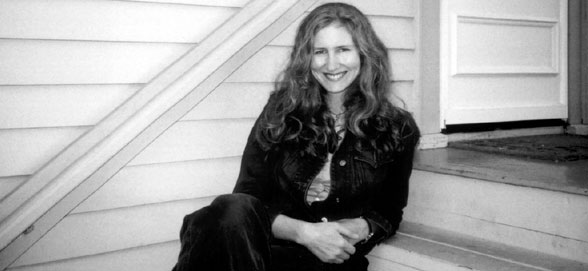
Image result for donna stonecipher photo

Donna Stonecipher

ABOUT THE POET
Donna Stonecipher is the author of The Reservoir, Souvenir de Constantinople, The Cosmopolitan, Model City, and Prose Poetry and the City. She lives in Berlin, Germany. 

BLURBS
“[A] highly affecting work of imagination and sensibility . . . one often feels afloat in a world concocted and dreamy, there and not there.”
     —Martha Ronk, The Constant Critic

“In the same way that architecture must abide by certain rules and regulations but can still create a thing of beauty, Stonecipher, by constraining herself to engineer within her own parameters, forms beautiful language and ideas.”
     —Hamzah M. Hussain, DURA

“How many poets are there in the world that you go looking for online, checking regularly, even impatiently, to see whether and when their new books will be out? Not many. Among the poets whose work I anxiously await, Donna Stonecipher has long been near the top of the list."
     —Michael Thurston, Massachusetts Review


771
DISCLAIMERS

Poems cited here are assumed to be under copyright by the poet and/or publisher.  They are shown here for publicity and review purposes.  For any other kind of re-use of these poems, please contact the listed publishers for permission.

We here at TBOP are technically deficient and rely on our bashful Milo to fix everything.  We received notice from Google that we were using "cookies"
and that for our readers in Europe there had to be notification of the use of those "cookies.  Please be aware that TBOP may employ the use of some "cookies" (whatever they are) and you should take that into consideration.

Monday, June 4, 2018

The Fix — Lisa Wells (University of Iowa Press)

Today's book of poetry:
The Fix.  Lisa Wells.  University of Iowa Press.  Iowa City, Iowa.  2018

Winner of the IOWA POETRY PRIZE


Image result for lisa wells the fix

The Fix is in.

Lisa Wells has climbed right into the poetry heart of Today's book of poetry.  Wells burns like her hands were made of matches.

Today's book of poetry did not recognize the language Lisa Wells was employing at first, some renegotiation was necessary, and it was my fault.  But Today's book of poetry did know from the very first poem in this insanely entertaining debut that it was going to require a seat-belt and helmet.

The Fix has a sureness to it, an accomplished voice, Wells gets to the heart with zest and immediately consumes the reader with her abandon fervor.  Today's book of poetry had to think about it for a minute and then it hit us.  We have only recently become aware of the superpoetry of the nurse/poet Belle Waring (Belle Waring died of cancer in 2015).  There's a zany, I don't give two shits - except that I care deeply, mantra.  A completely abandoned building sort of shouting that goes on in the poetry of Waring and Wells seems cut from the same fine cloth.

What Today's book of poetry was clumsily trying to say is that we are BIG admirers of Belle Waring and were surprised to find Lisa Wells raising the same hairs on our poetry neck.  Today's book of poetry will be looking at Belle Waring's Refuge (University of Pittsburgh Press, 1990) and Dark Blonde (Sarabande Books, 1997) at some point in the near future.  The Belle Waring books arrived in our offices courtesy of our Southern Correspondent, The Twangster, reigning St. Louis Champ.  He sends regular literary "care packages."

Today's book of poetry is so happy to introduce you to the poetry of Lisa Wells we can hardly sit still in our seats.

Theory of Knowledge

Alive on the highway shoulder.
The ruddy trucker passed

tossed a can from his cab
and I scrambled to retrieve it.


Cut like a twig and titless
the boys said
bbs on a breadboard.

Crossed my arms over my chest
in the frigid stock room of the mini-mart
while a classmate donned a nylon bib
and counted my cache into his hamper.


So I whipped a boy at school with my windbreaker
and where my zipper caught his shin, he split.

Blood slipped through the fold
mercury slow.

For that, a teacher faced me toward a wall
to think about my wrongs.


I don't need a wall to know.

...

When Today's book of poetry tells you the Lisa Wells poems are not concerned with point of entry, they attack you like an unseen gas, impervious to detection and thoroughly effective;  you're not going to believe what will happen to you — even as it is happening.

That last sentence/paragraph will have Max, our Sr. Ed., bleeding out his eyeballs; but Today's book of poetry has learned that we have to poke the beast once in a while just to make sure he is still breathing.

Back to point of entry.  Lisa Wells is the perfect poetry assassin because these poems come at you with such humour and wit that we often don't see the big "pop-up" mallet she keeps in other hand.  The Fix is devoid of trickery, These poems come at the reader straight down the middle of the page, Lisa Wells may be the Larry Csonka* of American poetry.

*Larry Csonka played for the Miami Dolphins and is universally respected for his inside game.  Fearless and unstoppable.  "The Sundance Kid" won a couple of Superbowls and was the star running back on the only professional football team to have a full undefeated season.

Memoir

I stitched my mask of hide- snout- sinew- talon- and rode
the vast savanna to war

in my former life. I was the hybrid. I sewed my brutal double-helix
     into a child

and packed her boots with greasy wool that felted as she walked in bright

stratified color. Carpathian bronze couldn't buy her off
when she leapt at the throat of my lover.

Him I called The Lion for his yawn and yellow ringlets.

I placed a Deglet date upon his tongue, I pressed
the golden scarab into amber, straddled all his lap, kissed

my cresset to the yurts of my superiors

and in this life, I think I'd like to do more damage.

...

Today's book of poetry thinks that Lisa Wells has a considerable reserve of grit, she knows that most injustices go unpunished and that many go unnoticed.  Wells is a reporter, and an excellent one at that, but she can't stay neutral.

Our morning read was robust to say the least with an excellent cast of characters here for the event.  Jeff popped by to measure my desk for another bookcase, at present I count something like fourteen bookcases, one-hundred and twelve shelves, in my office, but I need a couple more.  Jeff has the knowledge.  He also has a great voice and rattled off a couple of Wells poems.  Thomas was on this morning, he brought in his friends Pistol and Barb.  All three of them contributed.  The office was a busy place this morning.  

We laughed and laughed.  All complaints get sent to the fifth floor.

With Lisa Wells, no complaints at all.

"Poetry Man"

      after Phoebe Snow


To recall the cull of this life.

That one must harvest by selective annulment
the body they will wed

                     and the body they will hustle
from dress to tongue on the sly

                                           for days
I lay as a flank in my lover's maw

                      swathed in wine while warm
winds frisked the wisteria.

It was innocent.


He lashed my wrist to the mast.
He tied my blind because I wanted

to be battered in the swell
            and blossoms purple still
any place he pressed his mouth
any place

I asked for it.
By now I know, I begged:
relieve your mouth its bland aperture

Talk to me some more


~


Home's that place       somewhere      you go each day

in absence of his finger I have conveyed to my teeth
a relentless procession of corn chips, zoned out

on the bedroom wall.
Little my tongue does for the hole it circumnavigates.

It was a clear day, sun jigging figures from the leaves
on the alien green of College Park
              I was ocular in his arms

an enormous pupil, blown open.


     We knew the hour had come
by the way the light collected


raptured to several heavens
there's no need to choose.

~

If choice is obviated  "Le Paradis n'est pas artificiel"

his letter begins, anxiety of what is
in back of each long note.


He compares me to a garden.  "Why weed what winter will kill?"

Fidelity is perennial, survives the cold     cloaked as a peony.


He wishes me a grand carouse at the local dive, a dry
bottom bun for my rubber burger
and another man's sex         bashful boy.


~


do not touch the stove you will

fuse to its element    slaver over
the burn.             You don't have to go.

You're hiding something sweet
from this swollen thumb

and from these glossy welts derives
the suspicion that I am truly sick.


Monstrously wooed by these
reports of injury, he admits

         "its invocation of parts. You have a thumb. Eyes."

Instruments of agency.   Logic divides
pleasure from having
               give it to me

All Medea's remonstrations ended on a blade.
downed in the poisoned mug, draped in the tainted gown

but she never howled
when love departed

she muscled out to meet him.

...

Any of you regular readers of Today's book of poetry will know that we are always a sucker for poets who find hope.  Lisa Wells gives us renewed hope, and why not?  

This energy, zip and intelligence make for that rarest of books, can't miss poetry.  It will "muscle out to meet" you.

Burn, Lisa, Burn.


Lisa Wells

ABOUT THE AUTHOR

Lisa Wells is a poet and nonfiction writer who lives in Tucson, Arizona. Her work has appeared in Best New Poets, the Believer, Denver Quarterly, Rumpus, Third Coast, and the Iowa Review.

BLURBS
“Full and luscious as a grape before wine-making or a moon before love-making, the poems in The Fix live in a roadside space that’s earthy, sensual, erotic, and wild. Lisa Wells writes by feel, shaping, kneading, and bending the line the way a potter builds a ceramic vessel from the bottom up, coiling around a central idea until it’s solid, visible, and ready to be marveled at.”
     —D. A. Powell

The Fix is ruthless, sleepless, vigilant, obsessive: a profound work of mystery and matter, of power and pleasure, in which any singular truth is always just a step ahead, a bit beyond reach, below sight line. This new voice is so strange it sounds familiar, like family unforgivable or a lover who’s never over, or like a kind of food only grown on alien soil but that tastes disturbingly like your childhood. Here, every line is a surprise, a curve, a path this visionary poet cut just this moment for you to travel deep and emerge altered by this, her stark dark knowing. You’ll read this brilliant book again and again looking for the way back from it.”
     —Brenda Shaughnessy, judge, Iowa Poetry Prize

The Fix is perfectly executed. It’s always poetry, yet it never strains to be poetry. It’s flush with nervous and yet confidently directed energy. Its most striking moments are never haphazard, but are surprising and indelible. It doesn’t read like a first book, it reads like a book for life.”
     —Shane McCrae, author, In the Language of My Captor

“Lisa Wells knows all too well that a fix is just a habitual stay against the moment’s decay, and in these corporeal poems equal parts binge and purge, one can only wonder what rough bitch slouches down low to be reborn in a Paradise as dirty and comfy as a trucker’s blown rig.”
     —Timothy Liu


Lisa Wells
reads "The End"
Video:  BitchMedia


694

DISCLAIMERS

Poems cited here are assumed to be under copyright by the poet and/or publisher.  They are shown here for publicity and review purposes.  For any other kind of re-use of these poems, please contact the listed publishers for permission.
We here at TBOP are technically deficient and rely on our bashful Milo to fix everything.  We received notice from Google that we were using "cookies"
and that for our readers in Europe there had to be notification of the use of those "cookies.  Please be aware that TBOP may employ the use of some "cookies" (whatever they are) and you should take that into consideration