Showing posts with label campbell mcgrath. Show all posts

Saturday, February 23, 2019

Rail - Kai Carlson-Wee (BOA Editions Ltd.)

Today's book of poetry:
Rail.  Kai Carlson-Wee.  A. Poulin, Jr. New Poets of America Series No. 41.  BOA Editions Ltd.  Rochester, New York.  2018.

Rail - BOA Editions, Ltd.

Kai Carlson-Wee lays out his songs of joy and sadness with such careful modulation that it is easy to miss the big moments.  

Nope, that doesn't cut it, another lesson in "first thought" not always "best thought."

Today's book of poetry will start over, try again.

Rail by Kai Carlson-Wee is a little unlike any ride we've ever taken here at Today's book of poetry.  We see and hear Kerouac, Whitman, W.C. Williams, and we're not even warmed up.  Carlson-Wee is world-weary and yet believably innocent at the same time.

We are all "hoping for some other miracle" as Carlson-Wee sings in his poem "Oaks."  Reading Rail will cement connect you to this young writer as though you had stumbled onto a crime scene you won't ever forget.

Rail

I find it here in the wild alfalfa, head full
of antipsychotics and blue rain. Twenty years old
on a freight train riding the soy fields
into the night. Leaning away from the shortgrass
prairie, the black Mississippi of dream.
My brother asleep on the well-wall beside me,
nodding his head to the sway. What home
are we leaving? What distances blur
the electric fence? What hundred low thundering
wheels of darkness are coming to carry us
there? Rain and the singing wind, over
the auto-racks. Staring out west at the stars
of our gods and the lonely dark stars of our hearts.
Boarded-up storefronts, burned-down
apartments, highway signs that only name
the dead. We cross the station tracks,
the broken legs of Sunday chairs left rusting
in the yards. We know the way the story ends.
Still, the whistle blows. The flare stacks whip
their excess methane candles against 
the night. The wheels that brought us this far
still roll, still churn the polished iron ash.
The road goes on. The highway turns a deeper
shade of black. And as the sun sinks down
on the eastern Montana hills, peppered with horses
and gun-shot cars, the rails still lead us
somewhere else, and shine in the falling light.

💫💫💫

Kai Carlson-Wee is no Tom Sawyer or Huckleberry Finn, but he may be the new American generation given voice.  And it is one clever and clear siren cry.  Mr. Carlson-Wee is young in age only, his voice is pure experience.  

Pure of heart but stripped of dreams, these poems promise nothing.  No promises, but a loud and unmistakable sirenwail that Carlson-Wee is on the job, he will mark the passing.

Damn it.  Today's book of poetry just turned Rail over and read the blurbs.  Today's book of poetry tries to avoid the blurbs until finished so they don't upset the works.  In this case, Robert Bly is as impressive as Dorianne Laux.  But then Sir Campbell McGrath.  Sinner/Saint/Savant/Seer and one of our heroes....

In Today's book of poetry poetry world it does get much more hallowed than Campbell McGrath.  Today's book of poetry was very pleased to see that McGrath has the same, very high, esteem for Kai Carlson-Wee.

Today's book of poetry thinks Carlson-Wee writes poems so well you might be lead to think he found them, carved in stone, in some sacred poetry place.

King

                               for Nik Zeidlhack 1981-2007

I go to the guardrail, looking out over the sea-foam.
Looking out over the salmon heads breaking
the waves. Muscling back to the place of their birth.
Trapped in the floodlights, failing to leap up the dam.
Sometimes the clarity. Sometimes the clarity
and night-river steaming. Time standing still
in its permanent memory. Flies in the backwater
gathered to feed on the skin. The smell of the ocean.
The waters combining with other more powerful
waters. Riding away from whatever would save them,
knowing the other direction is pointless and not worth
suffering through. What holds us together but also
what trembles. The first time you look at an actual lion,
pacing the length of its cage. The small irreversible
ink-stain breaking the face of whatever we skate on.
Slumped at the edge of your girlfriend's bed. Your
pulse gone flat. No sweat. No resistance. No steam
on the hand-held mirror they tested for breath.
The day you were found I watched ducks drop down
on the Nooksack River in pairs. Drifting together
in multicolored light, leaving small growing trails
behind them. At first I thought only the lights
were alive. The river, the fish, the clusters of flies—
they were tricks being played on the eyes. But now,
getting up on the guardrail, watching the line
where the river and ocean waves meet, the half-formed
outriders failing inside us, and something behind
all the highway signs shining. Not clarity of thought,
or light, or time. But clarity of small things believing
in themselves. Dark heads breaking the surface
again. More than the living. More than the dead.

💫💫💫

Our morning read was a delight.  Spring is in the air in Ottawa, although we know all too well that winter is not over.  Spring is in the air; that's the same thing as saying "we have new hope."  Rail could be seen as simply that, new hope.  But there is so much more going on.  Kai Carlson-Wee's Rail is an embarrassment of riches.

Our small cabal here at Today's book of poetry read Rail out loud with sentiments approaching glee and astonishment.  

Such extraordinary gifts and Carlson-Wee is a young man — there will be, we hope, much more poetry from this marvel.  Today's book of poetry will be waiting.

Seven-Day Fast

Now I forget what I wanted to say about hunger.
The tree's sharp arrangements of lines
on the white sky, clusters of off-shooting
branches dissolving among them
like outdated scans of the brain.
Faded by sunlight, or disuse, or whatever.
I barely imagine by what. The gathering
dust on the shoebox they wait in.
Filed away for a future appointment
with some other specialist, talking of
networks, compatible pathways,
unsourced receptors, the closest
approximate rate of attrition. They talk
with the same sympathetic restraint
used for death. We see the sterility first,
predictions unfolding in ribbons
of uncharted highways beyond
other skies. We use metaphors
like this. We say the spirit is more
than the critical mass. We say prayers
are reflected in atoms, in snowflakes
freezing, in magnified raindrops.
We say there is no way of knowing
the will. The hand held flat to the palm reader's
always astonished tones. We say dreams.
A series of blackouts, minor strokes.
We say there is more than the body's
measurable electrics. The forgotten
children who stand at the bedrail,
showing us pictures of speedboats and horses,
our own selves posing with tulips and lilacs
in front of our whitewashed homes.
We say the soul. The out-riding weather
inside us. The down-pouring water
that runs from the mountain, that sleeps
in the frozen beet field, that denies
this hunger, that sings in the blood.

💫💫💫

Kai Carlson-Wee is a cowboy/poet/prophet, just like his publisher claims.  It ain't bragging if it's true.

Image of Kai Carlson-Wee

Kai Carlson-Wee

ABOUT THE AUTHOR
Kai Carlson-Wee is the author of Rail (BOA, 2018). He has received fellowships from the MacDowell Colony, the Bread Loaf Writers' Conference, the Sewanee Writers' Conference, and his work has appeared in Narrative, Best New Poets, TriQuarterly, Blackbird, Gulf Coast, and The Missouri Review, which awarded him the 2013 Editor’s Prize. His photography has been featured in Narrative Magazine and his co-directed poetry film, Riding the Highline, received jury awards at the 2015 Napa Valley Film Festival and the 2016 Arizona International Film Festival. With his brother Anders, he has co-authored two chapbooks, Mercy Songs (Diode Editions) and Two-Headed Boy (Organic Weapon Arts), winner of the 2015 Blair Prize. A former Wallace Stegner Fellow, he lives in San Francisco and is a lecturer at Stanford University. For more information about Kai Carlson-Wee, visit kaicarlsonwee.com.

BLURBS
“Rail is a lovely book, strong and inspired.”
     —Robert Bly

“This is a wholly unique and powerful collection of poems. The sense of purpose puts one in mind of Whitman’s ‘Song of the Open Road.’ Encounters with fellow vagabonds recalls the tramp-poetry of Vachel Lindsay. But the darker need to search for meaning in the American plains and points farther west—a vastness forlorn and almost unknowable—belongs to the particular vision of this poet. His journey through our national ambiguity discovers a flicker in our roots, a spark popping from obscurity that rises into the heavens. The lived experience behind these deft and subtle poems seems necessary, and reiterates the fact that resilience is not only a feature of the American character, it is a recurring tenet of American art.” 
     —Maurice Manning

“Brotherly love, a sense of displacement and lost time, and the deep care that reminds us of our humanity, form the heart of this book. These poems are a scavengers guide, a survivalist manifesto, a reminder of the way our daily experiences can fuel and forge our faith. A hauntingly beautiful and unusual debut.”
      —Dorianne Laux

“Equal parts dithyramb and lament, the great American bardic tradition celebrates lonesome wandering even as it hungers for enduring communion. Kai Carlson-Wee is a worthy inheritor of its dusty mantle, worn by Whitman and Kerouac before him, and Rail is a moving testament to the territories of freight trains, Minnesota roads, dumpster diving, and brotherhood. ‘The road goes on. With or without us.’ Yes, but how much better to have this unforgettable music to guide the way.”
      —Campbell McGrath


Kai Carlson-Wee
Reading the poem Thresher at the Best New Poets Reading in Madison Wisconsin, December 9th, 2010
Video: Kai Carlson-Wee


740

DISCLAIMERS

Poems cited here are assumed to be under copyright by the poet and/or publisher.  They are shown here for publicity and review purposes.  For any other kind of re-use of these poems, please contact the listed publishers for permission.
We here at TBOP are technically deficient and rely on our bashful Milo to fix everything.  We received notice from Google that we were using "cookies"
and that for our readers in Europe there had to be notification of the use of those "cookies.  Please be aware that TBOP may employ the use of some "cookies" (whatever they are) and you should take that into consideration



Friday, September 22, 2017

In Case of Sudden Free Fall - Deborah Bogen (Jacar Press)

Today's book of poetry:
In Case of Sudden Free Fall.  Deborah Bogen.  Jacar Press.  Durham, North Carolina.  2017.


"the sun rises like a guillotine"
                                                                                                 - Deborah Bogen

Deborah Bogen's poems have a distinct hum to them and Today's book of poetry fears we will never get the description of it quite right.  It's like these perfectly modern little prose poems are clever disguises for the epic movies underneath.  You can hear the poetry machine hum golden as though a soundtrack were about to burst through.  And Bogen's movies are a gas.

Today's book of poetry has all the time in the world for Bogen's type of clever. In Case of Sudden Free Fall has a cast of guest stars that runs from Vincent Van Gogh to Charles Dickens, Jean-Paul Sartre to Baudelaire and so on.  Bogen works these cultural iconic celebrities right into her narrative as though they were there all along.

Bogen has one of those technicolour pens and as a result these little movies appear in vivid colour.  Bogen's subtle twists on/of language had me working my way backwards to track her careful steps. In Case of Sudden Free Fall bursts with unassuming intelligence and confident logic.  Today's book of poetry likes how Bogen navigates.

Looking at Guernica

I'm thinking in terms of stage props, rubber knives and
plausible explanations. You say I should relax, take an as-
pirin, make some coffee, but where-oh-where, old friend,
are the shield-walls for our hearts? These days, these ter-
rible days, you tell me are only warnings, but we've both
seen Guernica. Chaos is a wild-eyed bull standing over a
dead child and Christians or no-Christians the messiah
isn't coming.

So we walk to the cemetery, to look at all the old-timey
names on the monuments. Did you know, I say, that in-
scribed is just another word for cut?

...

Today's book of poetry would be out of line with my own cosmic forces and make-up if we didn't mention that In Case of Sudden Free Fall has a poem where "Sonny Rollins and Sonny Stitt make things right."  If you don't know the two Sonnys stop reading this and look them up.  Respect.

Deborah Bogen drops jazz musicians and painters into her landscapes and soundtracks to great affect.  She uses these characters as a cultural shorthand, she knows the emotion generated by the charged names of the famous.  How when we hear the name of William Turner we cannot help but think of the sea, the sea-scape and the unknowable chorus of clouds.  Bogen knows that we readers are pre-conditioned and sends us through to her clever manipulations like Ivan Pavlov and his dogs.  It is no cause for alarm, our appetite whetted, we gulp it down like smiling pups on a juicy bone.

How-to For the Daughters of Suicides

First of all. Be Fine. They want you to. Fix your face,
brush your hair, say I'm fine, thanks, fine. And in a way,
it's true. Because now you don't care what you eat, when
you eat, if you eat. You don't care how you look. Or what
you think. You don't think. And that's weirdly swell. Like
lidocaine. Or being made of chrome.

Tomorrow a long dark car will take you to the cemetery.
Wear a plain black dress, or dark blue if you only have
that. Later, you must contend with the women who bring
casseroles, but otherwise you can relax. Remember, the
body must inhabit this space, but there's nowhere your
mind has to be.

...

Today's book of poetry's morning read was interrupted by the delivery of a parcel from our St. Louis correspondent David Clewell.  The entire staff danced around the box in anticipation and the Twangster did not let us down.  Once again, Mr. Clewell has brought holiday cheer to a new season. This particular reading assignment included Lynn Emanuel, David Kirby, Campbell McGrath and Albert Goldbarth.  We still don't believe in God or heaven here at Today's book of poetry but we're pretty sure the Twangster is a poetry monster angel.  Today's book of poetry is very thankful that he is out there monitoring the poetry ether.

To get back to the matter at hand, Deborah Bogen's poetry has pace, In Case of Sudden Free Fall rolls steady as a train.  Today's book of poetry was completely in Bogen world for this most pleasant journey, dark corners and all, because she allows the reader such easy access, decorates the path she wants followed.  Even with the occasional sad destination these poems make you open your happy eyes just a little wider.

In Case of Sudden Free Fall

You can put it in your pocket, in your tire well, in your
armpit. You can stash it under your baseball cap, or wrap
it up in a handkerchief. You can stuff it in your under-
wear or hide it in your brand new pigskin wallet. You
can slip it under your armband, or bury it in the desert
or whisper it into your cell phone. You can smooth it out
and cut it up with little scissors. Or you can fold it. Care-
fully. Like money.

...

In Case of Sudden Free Fall is Deborah Bogen's fourth book of poetry and it shows.  This is polished, old hand in the kitchen, stuff.  Bogen teems with charming wisdom.  Bogen's hum will convince.

Image result for deborah bogen photo
Deborah Bogen

ABOUT THE AUTHOR
Deborah Bogen is a poet and novelist. In Case of Sudden Free Fall is her fourth collection. Her three previous collections of poetry are Living By the Children's Cemetery, Landscape with Silos (National Poetry Series Finalist and winner of the X.J. Kennedy Poetry Prize) and Let Me Open You a Swan (Antivenom Press, Elixir Press). She was the winner of the 2016 New Letters Prize for Poetry for "My Stint as a Librarian & Other Poems." She lives in Pittsburgh, Pennsylvania.

BLURBS
“Grown-up poems for grown-ups.”
     — Stuart Friebert

“I loved reading In Case of Sudden Free Fall, Deborah Bogen’s beautiful and remarkable oneiric prose poem collection. A delicious gem, it takes the reader on a soulful and transformative journey. Under Bogen’s expert guidance, we travel from enchantment to melancholy, to surprising encounters with literary and artistic figures, to loss and death, and back to wonder. I’ll keep revisiting this collection time and again.”
     — Hélène Cardona


612


DISCLAIMERS

Poems cited here are assumed to be under copyright by the poet and/or publisher.  They are shown here for publicity and review purposes.  For any other kind of re-use of these poems, please contact the listed publishers for permission.


We here at TBOP are technically deficient and rely on our bashful Milo to fix everything.  We received notice from Google that we were using "cookies"
and that for our readers in Europe there had to be notification of the use of those "cookies.  Please be aware that TBOP may employ the use of some "cookies" (whatever they are) and you should take that into consideration.

Monday, September 14, 2015

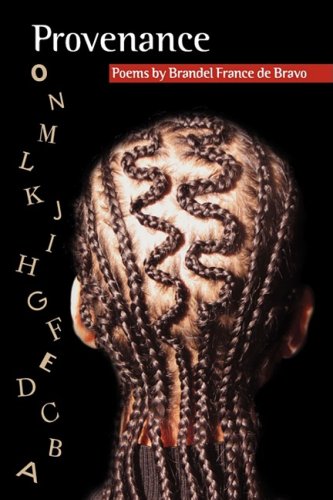
Provenance - Brandel France de Bravo (Washington Writer's Publishing House)

Today's book of poetry:
Provenance.  Brandel France de Bravo.  Washington Writer's Publishing House.  Washington, D.C.. 2008

Winner of the Washington Writer's Publishing House Poetry Prize


Today's book of poetry has taken our entire staff to a remote lake near Georgian Bay.  You can only get to this retreat by boat -- and you can't leave unless you are a Marilyn Bell type swimmer or you can wrest the boat keys from my cold dead hand.

We started the morning with French toast and bacon and then it was into the canoes.

Now the crew is muscle-sore and quiet.  It's how I like them best.  They are scattered over the furniture like exhausted rugs.  We are listening to Jan Garabeck blow the bejuses out of his saxophone while Ustad Fateh Ali Kahn's voice contemplates the universe one note at a time.

Today's assignment is Brendel France de Bravo's Provenance.  What an adventure.  France de Bravo's poetry is a carnival ride.  These poems range through a curio vision of the universe. Everything she sees is interesting -- or France de Bravo makes it so.

Apricot

A sarcastic Egyptian always speaks
of apricot season, which comes and vanishes
faster than dreams over morning coffee.
Oh sure, he'll take care of it -- in apricot season
which falls between manana and the cows coming home,
a time so fleeting, ephemeral,
it might as well be never
or what we cannot recover:
the buoyant forever when we held our noses
underwater where no one could see
and touched tongues for the first time;
the certainty that certain transgressions
meant no turning back.
It isn't innocence we miss
but the thrilling moment that we let go,
a stem splitting from the branch, fruit in free-fall.

Cecilia was the first among us to ripen,
breasts at eight, and shortly after
rendezvous with boys in the bushes.
No one called her "slut."
She floated above us
like Mary in a procession,
her wooden robes fluttering in the wind.
We supplicants longed for a guilty glimpse
of her panties, her early bloomers,
named for Amelia Jenks Bloomer,
who like Cecilia was ahead of her time.
While others fought for suffrage,
an end to slavery,
she dreamed of simpler underwear,
a garment so free, it might as well be nothing,
loose as an apricot,
that precocious apple,

Lolita of a peach.

...

France de Bravo provides an Abridged Etymologies and Related Words along with her Notes at the end of Provenance and this is helpful information but it is also a little like finding a sugary surprise as a treat.  Long before the time you reach the end of this book you realize Brandel France de Bravo is as nimble as Charlie Parker playing "Ko-ko", which conveniently enough is now blaring around the room.

I take my staff on holiday but they have to listen to MY music.  It drives poor Milo bonkers, his latest favourite band use hammers and spent ammunition.  I just played Yusef Lateef's "Don't Blame Me" and Milo wasn't amused at all.

France de Bravo would get the joke and make a good poem out of it.

Fornicate

Linguistic equivalent of latex gloves, the delicately intransitive
fornicate sounds sterile, scientific next to its censored Anglo-Saxon cousin,
which Shakespeare avoided but evoked with firk  -- to strike.

The Christian who's saved knows there's nothing highfalutin, exalted
about fornication, sensing perhaps its lowly origins in the vaulted
underground where Rome's dregs dwelled and trolled for sex.
Rather he hears in fornicate satanic seduction:
the way of the bifurcated tail, the hump of illicit union.

I believe in redemption, too, and in resurrection of the word

locked in its Latinate basement, outshined by its sensational
relation -- all penetration, fight and fist. I welcome
fornication -- crusty and soft as bread from a brick oven,
round as te amo and the whores of Pompeii. I listen for it
like a copulatory cry from the hotel room next to mine:
one column rising up
to meet another,
to make an arch.

...

These poems are each a small fable, a needed lesson, a deeper understanding of a corner that needed some light.  France de Bravo dances us outside of our usual perceptions, brings us to new ground, leads us by the hand.

Two of our interns have fallen asleep, we're now listening to Stanley Turrentine With The 3 Sounds playing "Since I Fell For You."  The interns have both fallen into that saxophone slumber that comes after canoeing across a big lake and back again and then having a big soft leather couch under you. And that's okay, they both told us what they thought of Provenance before drifting off.  Full consensus, even Milo nodded yes.

Oslo, Summer Solstice

That Norway night when day
held on -- a handshake
turned kiss --
I watched you sleep
because I couldn't.
How different we are.
In your country, the joke goes,
people say good-bye without leaving;
in mine they leave without good-byes.

In the half-empty, half-full
light, where darkness
and morning exchange vows,
I heard
the glass is love.

...

Today's book of poetry had a great deal of fun in Brandel France de Bravo world.  You will too. These poems are optimistic prayers full of hope and reason.  This is France de Bravo's first book of poetry, more recently she has published a second collection Mother, Loose.

Brandel France de Bravo
Photo: Stephen R. Brown

ABOUT THE AUTHOR
Brandel France de Bravo’s second collection of poems Mother, Loose won the Accents Publishing chapbook prize in 2014 and was published in 2015. Her first book, Provenance, won the Washington Writers’ Publishing House prize in 2008 and was a finalist for the ForeWord Book of the Year Awards that same year. Her poetry has appeared in Alaska Quarterly Review, Black Warrior Review, theCimarron Review, The Cincinnati Review, The Fairy Tale Review, Fugue, Gulf Coast, The Kenyon Review, and Poet Lore, as well as in various anthologies, including The Beacon Best of 1999, Creative Writing by Men and Women of All Colors. In 2009, the Washington, D.C. Commission on the Arts and Humanities awarded Brandel the Larry Neal Writers’ prize in poetry. She has also received an artist fellowship in poetry from the D.C. Commission on the Arts, and has been nominated for a Pushcart Prize three times. As a member of Washington Writers’ Publishing House, she has acted as senior poetry editor and organizer of the fundraising event, the Writers Ball. To read recently published poems, click here.

BLURBS
Sharp-eyed, sharp-tongued, sharply etched and sharply worded,Provenance is a book of alphabets and fables, of narrative precision and verbal passion. Across a host of exotic locales, and through the labyrinth of etymology, Brandel France de Bravo is a poet of restless travel and linguistic inquiry—what luck for the reader who accompanies her on the voyage!
     -  Campbell McGrath

In Provenance, Brandel France de Bravo writes with urgency of continuous displacement, an exile status rendering her exquisitely sensitive to the textures of daily life. She is forever a stranger among those who do not ask “where I’m from, but where I’ve just come from, / which country I left last.” At home in many cultures, at home in none, this gifted poet transforms a search for identity into a voyage through language, and finds her true roots in the alphabet letters that generate experience. This is a remarkable first book, and an important one in our time.
    -  Grace Schulman


381

DISCLAIMERS

Poems cited here are assumed to be under copyright by the poet and/or publisher.  They are shown here for publicity and review purposes.  For any other kind of re-use of these poems, please contact the listed publishers for permission.

We here at TBOP are technically deficient and rely on our bashful Milo to fix everything.  We received notice from Google that we were using "cookies"
and that for our readers in Europe there had to be notification of the use of those "cookies.  Please be aware that TBOP may employ the use of some "cookies" (whatever they are) and you should take that into consideration.