Today's book of poetry: Bociany (Storks). Jonathan Garfinkel. knife|fork|book. Toronto, Ontario. 2017.
(Two things about this photo - our apologies to Jonathan Garfinkel,
this was the best we could do and it is a sorry attempt. Milo, our
head tech, was on holiday today. Secondly, Bociany (Storks),
is a smart and tidy looking book, contrary to our photo.
Bociany - Przylecialy "the storks have arrived" Polish folklore.
Jonathan Garfinkel has that thing, we all want to see it in a poem, magic. And I bet he has it in his plays as well. This type of certainty isn't random.
One of the short gems from this golden jewel is titled "Ornithology." Ornithology is the study of birds and Garfinkel flights his poems with plenty of aviators. But Today's book of poetry couldn't help but think of the Charlie Parker song/anthem/call to prayer "Ornithology" and all of the flying it has inspired. Garfinkel's study is a poem that takes the same imaginative leaps of faith as Charlie Parker, he gives these poems wings.
Ornithology
I light a fire. Put on the coffee.
The radio struggles.
Wearing only a white towel,
'Molting,' you promise.
See no change. remember
your father beat you
to the punch. He wanted
to drive out the birds
from beneath.
We make love in the corridor
The station clearer.
A grey jay studies its reflection
moments before hitting the window.
💫💫💫
The storks are a good omen in Polish folklore and Garfinkel uses them and others flights of fancy as he is looking for silver linings when he looks to the cloudy sky. Today's book of poetry sees little but gold in Bociany (Storks). Jonathan Garfinkel takes us all over the world with his traveller's knowledge, with his knowing he reaches for the sky, every bird wants to eventually soar, but Garfinkel remains grounded every time out. This is fancy cooking.
Just to be clear, Today's book of poetry is convinced Bociany (Storks) is a remarkable publication. These poems are built of strong, solid stuff. This is a kitchen that burns.
Border
The taut-faced crowd waits to board.
Too little food, too much prayer. One line
becomes four, a sniper takes aim.
Then the trampling and the panic.
I think of Forest Hill, tree-lined streets.
the multitudes of Mercedes
docked at the synagogue.
Rich women kvetch over lattes
too much foam, not enough heat.
Somewhere in their grief, a prayer.
Calling us: All aboard. The captain
whittles the air with his bamboo stick.
'Back,' he screams. We press forward,
teeter toward India.
The clouds full of hidden maps.
The White Nuclear Night.
Women in black burqas dart
to and fro, children
yelp in terror or delight.
The ferry swings towards the lights.
💫💫💫
Today's book of poetry came away from Bociany (Storks) full of admiration for Jonathan Garfinkel. We think in another life he may have been a watchmaker. His poems are finely crafted, wheels inside wheels, all in perfect motion, one concentrated motion, every elaboration fitted precisely, every essential puzzle piece dropping into place as though nature intended it.
It's Sunday morning and the Today's book of poetry offices are a tad quieter than usual. Everyone is here, except Milo, but few are vocal. The morning reading was followed by several orders for jet-black coffee as the peons scurried back to their poetry-hidey-holes.
All humour aside, Today's book of poetry is a new convert, we're in for every word Garfinkel cares to utter. We loved Bociany (Storks), what can we say? The only fault was its brevity, we wanted more and more and more.
Watch
The soul is not a stone
to carve into.
But we take care of the world.
Bridges, gardens, mending.
Of all his jewelry I loved it most.
Light, elegant, a square face
with gold hands.
The watch repairman pried
the case back to show me
dust and moisture seeped into the crown.
Microscopic footprints,
a corroded mechanics, lunar.
When I was a child
I curled into his body.
Seconds that made so much noise.
Time, like love, wanting.
💫💫💫
Today's book of poetry apologizes for our recent absence from the scene, we were filling up our tanks in Quebec. We visited the Abbaye De Saint-Beniot-Du-Lac where a cluster of Benedictine monks live in silence but sing during their services. We were lucky enough to hear some of this beautiful chanting. Nothing like a little perspective to help set the mind straight.
We also bought some cider and cheese, those Benedictine's are industrious.
Jonathan Garfinkel's Bociany (Storks) went down like untapped spring water directly from the source. Today's book of poetry could not get enough of it.
Jonathan Garfinkel
ABOUT THE AUTHOR
Jonathan is an award-winning poet, playwright and prose writer. His genre-bending work bridges the personal and the political, and is often inspired by his travels to far-flung, dangerous places, with an eye toward the humourous and absurd. He is the author of the book of poetry Glass Psalms. His plays have been produced across Canada and Germany and include The Trials of John Demjanjuk: A Holocaust Cabaret, and the 2011 Governor General's nominated House of Many Tongues. His award winning non-fiction has appeared in Walrus, Tablet, PEN International, 18 Bridges and the Globe and Mail, as well as Cabin Fever: An Anthology of the Best New Canadian Non-Fiction. His memoir Ambivalence: Crossing the Israel/Palestine Divide, was published to critical acclaim in five countries. In March 2016 his theatrical adaptation of the novel Cockroach by Rawi Hage will premiere in Calgary at Alberta Theatre Projects. Jonathan teaches creative writing at the National Theatre School of Canada.
Poems cited here are assumed to be under copyright by the poet and/or publisher. They are shown here for publicity and review purposes. For any other kind of re-use of these poems, please contact the listed publishers for permission.
We here at TBOP are technically deficient and rely on our bashful Milo to fix everything. We received notice from Google that we were using "cookies"
and that for our readers in Europe there had to be notification of the use of those "cookies. Please be aware that TBOP may employ the use of some"cookies" (whatever they are) and you should take that into consideration
Today's book of poetry: Cruise Missile Liberals. Spencer Gordon. Nightwood Editions. Gibsons, British Columbia. 2017.
Spencer Gordon's Cruise Missile Liberals sounds like the astute patter of a poetry carny convincing you to step right up. Gordon is slick and his slick poems blister past in a new age be-bop patter of sophisticated memes.
Gordon has a vise grip on the necessary lingo to storm the castle but he's not about organizing the revolution. But he certainly is going to record it. Take names.
The feel of these poems, this book reminds Today's book of poetry of Joe Orton's "Kicking Against the Pricks" because Gordon showers the reader with a sustained marvel of devilish disenfranchisement.
Here and Now
More people believe a wafer
becomes the body of Christ
than a slick strip of bacon
comes screaming from a pig.
But what do you want from nothing?
Focus groups? Blood from stone? Ex nihilo?
Suppose everything wants to be alive
so long as life is not all pain.
Suppose god sees all time as one--
then imagine the fulcrum
of screams She endures as each
woman and man and dog
gives up the only thing it wants.
Two men stomp a lamb to death;
a woman French-kisses a doomed
sow through the frost-bit bars
of a trailer. Kiska the Orca circles her pond
300 times a day for the rest of her fucked life.
Today, I see an animal online, I dive for cover.
It's going to be unbearably cute, or it's going
to be torture. Inshallah. I had to stop
looking at things, talking to faces.
A woman locks a puggle in a closet
and starves it to death. A child
watches Peppa Pig and chews
a ham sandwich. "It's Earth Day," her mother says,
turning off all the lights before grilling steaks
on the barbecue. No, nothing new, nothing
the maniac won't enjoy mansplaining
as human nature, God's will, economics,
evolution. Jobs. Another perspective
on your little cell. "I have PTSD," says
the filmmaker, the photographer, the eyeball
that can't look away. Dear God, I prayed,
and I mean a very traditional Catholic God
except a Mother:
Please make everything better for all
the suffering bodies on the planet.
Signed, a tiny child with a tiny head.
Then I sat in Catholic Mass and wept, wanting
my God back, or to be real. Everything is flayed
by one very sharp knife, because #vintagefur.
Because McDoubles.
But one day, instead of wine and bread, one
man to one chalice rimmed with ghostly life,
we'll become one mass, one set of eyes, wet
with salt, sentimental as old hysterics--
and what we'll eat is only love.
...
In hopes of continuing our record of full disclosure Mr. Gordon wrote a review of my own Coming Ashore on Fire (burnt wine press, 2009). You can see that review here:
Spencer Gordon isn't someone Today's book of poetry knows and we were a little post-review skeptical when we first opened Cruise Missile Liberals. Not all of what Gordon said in his review was easy to take - but it was all true. Some of the minions had their dander up but I assured them that I was very proud of Gordon's review. He treated my poetry with respect. Today's book of poetry tries to do the same but our biases come out all over the place regardless of how much I try to rein them in.
Gordon quickly allayed all of our fears with his "detailed passion" and spontaneous enthusiasms. Once you align your gears properly Gordon steamrolls.
Survey
I have a loving mother and father and baby sister and girlfriend and I
am surrounded by people who respect me and take what I say seriously
and meditate on the things I say to them and want to know my take on
things and think my feelings are important and
when I drive through
the slanting autumn light in my car I think about all the aching leaves
withering into next winter and when I get home my girlfriend puts her
arms around my neck and we eat and talk about our days and the light
is slanting and then some music and wine or television
which I watch without
guilt and then work on things people value and respect and the work
goes well because it is honest and the phone rings and it is my loving
mother and father and they say we love you and I say where is my baby
sister and she comes
on the phone and tells me she drew a picture of me driving through
the slanting autumn light in my car and I am smiling and going home
to my girlfriend who is pretty and intelligent and someone I rely upon
when things are tough so yes I would say I
strongly agree.
...
Our morning read was interrupted by a small snowfall that we quickly brushed aside. Post brooming and shovelling, Milo, our head tech, said that he was particularly taken by Gordon when he lets down his guard and plays out some of his emotional wisdom unbroken by skeptical analysis.
Today's book of poetry is always going to appreciate any poet who finds a place for Billie Holiday and Charlie Parker in their poetry and Spencer Gordon folds both of them into his roadwork.
Today's book of poetry also likes "list" poems, Gordon's "The Winter Wind" is one hell of a list. Dead wrestlers falling out of the ring and into despair as though they were dominoes someone cruelly set on fire with fatigue and grief. This is heart-wrenching and powerful stuff. Cruise Missile Liberals is full of marvelous stuff.
A Good Life
Keep busy, keep frantic and active. Don't let the chest
slow, the mind find time to seek its reflection, for what
it will show cannot bring release. Engage in difficult,
repetitive activities: scrub the kitchen sink, strip the linens
from your squalor, scour the floor with bleach and rip
the shameful pages from your diary. Run, mouth agape, with dogs
through blinding parks. Swim in frigid lakes. Agitate the skin
with acidic lotions. Give yourself wholly to the feeling
of inherent calamity. Drink sixteen cups of coffee, then get falling-
down-drunk in the doorways of your cold, ugly trysts. Only
eat when you are gasping, sputtering with sobriety, and then
only the foods most rich in carbohydrates, proteins, sugars
and the bile you need to keep on ravaging your body. Find
toxic streams; give yourself over to charity; make yourself cum
incessantly while bleeding from wounds with no end, and no beginning.
If you are crying, you are not winning. There is no good living.
...
Today's book of poetry thinks that Spencer Gordon is eloquent with quirky reason, Cruise Missile Liberals is a very tasty well-cooked repast.
Gordon's poetry sometimes revs high with a "gaudy opulence" but that is when he is at his best. When Gordon takes his foot off of the brakes he speeds into some beautifully hellish chaos, when it breaks his previously calm surface ripples over all of us. These poems are a new type of missile.
Spencer Gordon
ABOUT THE AUTHOR
Spencer Gordon is the author of the acclaimed short story collection Cosmo (Coach House Books, 2012), called “startling and invigorating” (and “Canada’s Most Underrated Book”) by Quill and Quire, “rare [and] brave” by the National Post, “poignant and hilarious” by This Magazine, “both heartwarming and heartbreaking” by The Winnipeg Review, and “both ridiculous and absolutely perfect” by The Walrus.
He is also the author of the poetry collection Cruise Missile Liberals (Nightwood Editions, 2017), one of CBC’s “16 Poetry Books to Watch.” To the Winnipeg Free Press, it showcases a “disturbing, wry intelligence … [and] taut, careful craft.” The Toronto Star writes that it “offers plenty of laughs, but it’s also got heart.” The Globe and Mail claims that it’s “completely submerged in the zany, disturbing thick of it … [and] might be the oddball balm you need.” And, in a starred review, Quill and Quire comments: “Cruise Missile Liberals is a complex and accomplished first collection from a writer who has honed his voice by listening. Gordon’s examination of the self in late capitalism is not always optimistic but is, in its humanity, enormously affirming.”
Spencer also wrote the poetry chapbooks Anno Zombie Dance (Emergency Response Unit, 2016), Conservative Majority (Apt. 9, 2013) and Feel Good! Look Great! Have a Blast!(Ferno House, 2011, shortlisted for the 2012 bpNichol Chapbook Award). He is one of CBC Books’ Writers to Watch and the winner of a CBC Book Award for Cosmo.
He is co-founder and was senior editor of the ten-year-old magazine The Puritan, one of the country’s premier literary journals (nominated for a National Magazine Award and a regular submitter to Best Canadian Poetry and The Journey Prize). He often serves as a reader and judge for university publications (such as the University of Toronto Magazine), literary magazines (like The Antigonish Review), national prizes (like the CBC Short Story Prize), and arts councils (namely, the Canada Council for the Arts). His writing has appeared in The Globe and Mail, the National Post, the Toronto Star, EVENT, THIS Magazine, Poetry Is Dead, The Winnipeg Review, CNQ, Broken Pencil, Joyland, and many other periodicals and anthologies, including Best Canadian Sports Writing (ECW, 2017).
He holds an MA in Creative Writing from the University of Toronto and a BA in English and Philosophy from the University of Ottawa, and he has taught writing, both professional and creative, at OCAD University, George Brown College, Humber College, and with the University of Toronto’s School of Continuing Studies. He works as the senior writer for The Lavin Agency Speakers Bureau in Toronto (the traditional lands of the Mississaugas of the New Credit, Huron-Wendat, Anishinaabe, Haudenosaunee, and other peoples).
BLURBS
Spencer Gordon’s Cruise Missile Liberals is, as its title suggests, a very funny, often despairing book. Jammed with on-point pop and breathtaking turns of phrase, this collection of poems is genuinely compelling: it is hard to stop reading, so sweetly twisted is Gordon’s world.
— Lynn Crosbie, Author of Where Did You Sleep Last Night, Life Is About Losing Everything, and Liar
There is a generosity of spirit on offer here for we who are tired, placeless, saturated in social media, and wasted on the bright horror of a future that never arrives. This collection is deft, intelligent, and tender, if tenderness is something that can also crush you—an intimacy that panics shut. For we who are “Nature Woke,” “alchemical kids with gold teeth,” “wanting to live as I do, shockingly new,” Gordon sings and memes against “Canada the Good” and presents us with an arresting portrait of our present moment
— Liz Howard, Author of Infinite Citizen of the Shaking Tent (Winner of the 2016 Griffin Poetry Prize)
Cruise Missile Liberals could easily be called Late Capitalism. Spencer Gordon voices the anger and dejection that many of us feel as we survey the detritus of our political and corporate ideologies and attempt to find an alternative to the cultural crack that has previously pacified us. But Gordon does not patronize us with false hope. “There is no system to replace the ruling system,” he writes in “Ticker Tape.” Elsewhere, he notifies us: “If you are crying, you are not winning. There is no good living.” As a solution: “You should burn down your life.” Like an excitable social media stream, these poems persist to the point of “sincere emotional fatigue” yet somehow Gordon manages to make an art of exhaustion, an art of the rant. Reading Gordon’s poetry and fiction, one feels caught in a Mobius strip where life and entertainment loop infinitely into each other. We are sometimes ourselves and sometimes we are Taylor Swift, Avril Lavigne, and Peppa Pig. Or they are us, our teetering elected representatives. — Ian Williams, Author of Personals (Shortlisted for the Griffin Poetry Prize), Not Anyone’s Anything, and You Know Who You Are
Poems cited here are assumed to be under copyright by the poet and/or publisher. They are shown here for publicity and review purposes. For any other kind of re-use of these poems, please contact the listed publishers for permission.
We here at TBOP are technically deficient and rely on our bashful Milo to fix everything. We received notice from Google that we were using "cookies"
and that for our readers in Europe there had to be notification of the use of those "cookies. Please be aware that TBOP may employ the use of some "cookies" (whatever they are) and you should take that into consideration
Today's book of poetry: Almost Nothing To Be Scared Of. David Clewell. University of Wisconsin Press. Madison, Wisconsin. 2016.
Winner of the Four Lakes Prize in Poetry
"We were overwhelmingly underdogs."
- Yogi Berra
Whether David Clewell is "Trying on Hats With Rahsaan Roland Kirk" or talking politics with a bartender who wants to talk baseball we here at Today's book of poetry want to hear it. Clewell's Almost Nothing To Be Scared Of is one remarkable tablet of tales.
David Clewell writes poems of every length, from two liners that are precise as lasers, to monsters that crawl over page after page. These are beautiful monsters. Clewell has just the right voice to glue Today's book of poetry to our seat. These poems pulsate with stories we need to hear.
When I Called the National Security Agency to Complain
About the Indiscriminate Collection of Private Citizens'
Telephone Records, I Was Put on Hold for a Suspiciously
Long Time
Your call is very important to us. All your calls, as you must know,
are very important to us. This particular call may be monitored
for quality-control purposes or for no good reason we can think of.
Just because we can. Because these days, you never know.
People remain on the line until we've made a proper threat
assessment. Calls will be answered strictly in order of priority.
If you've got nothing to hide, you've got absolutely nothing.
to fear. This is still America last time we checked,
and we're doing everything in our power to keep it that way.
No one's ever guilty of anything as long as they can prove otherwise,
so please remain on the line. this country's storied history is one
of human ingenuity: we've always made it up as we go along.
Right now we're flying by the seat of our Patriot-Act balloon-pants,
but hey, at least we're still here, and we're especially glad
that you're part of this too, so please remain on the line.
That your Walgreens prescriptions have been ready for days
is not a threat, although they might reduce your mounting anxiety.
That you haven't spoken to your mother in weeks doesn't much
concern us either, but you don't want to hear the trash she's talking.
And frankly, we didn't realize anyone was still giving money to
Greenpeace. We're long past caring about that -- go save the whales,
but you could have sprung for much better seats down at the stadium.
Please remain on the line. Due to the extraordinarily high volume
of calls nationwide, your estimated wait time would be
just a wilder, more worthless guess than usual on our part. Someone
surely will be with you, though, sooner or later. So listen carefully
for a voice on the line or a knock on the door or even someone
bumping into the rearranged furniture in your dark living room.
And that's no lie, nor is it a threat. Consider it a promise, made
right here in America, where Security is our middle name,
and right now you need to remain on the line more than ever before.
The only thing we can never know for certain is tomorrow's weather.
There's no percentage in it for us, anyway--there's no stopping it
before it happens, ever. That's how weather is. It isn't ricin or
anthrax or fertilizer bombs. You can gather all the best intelligence
in the world, but if it rains, you're still going to get wet.
So please remain on the line, where it's always nice and dry.
We know where you live. We know how you live. It's almost as if,
oddly enough, you're a friend, but still we have no idea why
some outmoded notion of privacy is so damn important to you,
someone with nothing to hide. Nothing to be afraid of.
That's the reason every one of your calls is so very important to us.
If you want to be a dog with a bone, then you can count on us to be
the bigger, many-headed dog you'll never piss with, and rest assured
we've got a few bones of our own that we're not about to let go of.
Please remain on the line, even though we know already, word
for indignant, self-righteous word, what you're going to say,
and all because last night you felt strangely compelled to run it by
your old college professor of creative writing, who couldn't imagine
anything so important that you had to call him at 2 in the morning,
especially when, truth be told, it wasn't really much of a poem
he ended up only pretending to listen to, anyway.
...
Today's book of poetry loves Clewell's hammer. "When I Called..." isn't a list poem exactly but is a choice entertainment of political satire and mirth. Clewell gives us a master class is paying attention because nothing seems to escape his bemused intellect. He has a kind eye and a predatory heart.
Clewell is joined in Almost Nothing To Be Scared Of by a large coterie of pals, they show up on almost every page and bring something to the party. Here are just a few of the gang that drop in: Philip K. Dick, Frank Stafford, Walt Whitman, Thomas Pynchon, Don Delillo, Roger Paterson, the infectious silly 60's song "Itsy Bitsy Tweeny Weeny Yellow Polka Dot Bikini," Ammon Shea, some Jevovah's Witnesses, Charlie the Tuna, Buddy Holly, more than one UFO (as you will shortly see), Lee Harvey Oswald and JFK, Jack Ruby, Donald Finkel (more on him in a minute), old Cadillacs, Plato, Debbie Fuller, Shakespeare and believe me when I tell you that this list just scratches the surface.
We pay attention to our fan mail and we've had some complaints about Today's book of poetry being a sucker for any poetry that mentioned, smelled of, tasted like, jazz. So as much as we loved Clewell's excellent Charlie Parker, Rahsaan Roland Kirk, Ben Cartwright (Bonaza hat), Dizzie Gillespie, Thelonious Monk, Miles Davis, Charles Mingus, Sonny Rollins and Saint John of Coltrane poems, we won't mention them here.
I'm Sorry There Are No More Flying Saucers
These days everything is a UFO instead:
military stealthy planes and flying triangles, satellites
and meteorites, suborbital space debris, the planet Venus
and Chinese lanterns attached to a horde of helium balloons--
hell, sometimes even my unlikely Uncle Bud,
lit up and soaring after a few too many again, until finally
he's recognized by someone who will see him the long way home.
It used to be when you said flying saucer,
you meant a nuts-and-bolts machine that had come to Earth
from somewhere else, and Bud never would have been confused
for anything like that--he's been down-to-Earth forever,
as homegrown as they come. And there's no way he'd ever be
onboard for even a minute with beings whose brightest idea
was invariably some version of Take me to your leader, which
always led to Bud shaking his head. He knew a bad idea
when he heard it, and he wasn't about to believe
this flying saucer business had anything to do with
the likelihood of intelligent life anywhere else in the universe.
...
Today's book of poetry loved how thick some of these poems were, like an extra warm quilt. We're convinced. Clewell is a poet we greatly admire -- and never more than when we read his tribute poem to Donald Finkel. Today's book of poetry has long admired Donald Finkel. We checked the stacks and Milo, our head tech, came back with A Mote In Heaven's Eye and the book length long poem Answer Back, but Finkel published at least 14 books of poetry and they are well worth checking out.
Too Far This Time
Never trust a poet at the wheel.
- Martin Amis, The Information
for Donald Finkel (1929-2008)
You were at your very best on foot,
never missing a step as you kept walking, always
thinking on your feet, your hands completely free
to animate the words you coaxed out of one more day's thin air.
A born pedestrian on the move.
If there was anywhere
we had to go that wasn't walking distance, I was the one
who said I'll drive. You'd be relieved again, a natural
riding shotgun. And so we made it every time:
to Santoro's or the races or hot jazz or Pizza-a-Go-Go,
to another far-flung poetry reading at Why-Do-They-Want-Us-U.
But most of all, I see you walking through your life
to the north through the woods near Holy Smoke, Vermont.
To the south in the hills above San Miguel, and still farther south
in Antarctica, where you carried the geologists' ice-cold water
just for the chance to write postcards from the South Pole.
Even that far away from the rest of the world, you weren't
about to drive. You knew better back East, too--your phantom
Bronx, where you first learned what it meant to walk.
I'll see you forever walking in St. Louis, this town
that somehow passed for your idea of the Wild West:
the U. City Loop at high noon, gunsmoke along the River Despair,
and your last-stand routine: Lafayette Park, visiting Willie,
the swan that lived there for as long as he could--strangely
gentle, you said. For a swan. You couldn't believe
your luck: this unlikely friendship. But it was something
more than that, my odd-duck, rare-bird friend.
***********
Finkel-at-the-Wheel-of-the-VW-Van was already
the stuff of local legend. Forgive me when I say I'm glad
that was a legend mostly before my own St. Louis time.
Thirty years ago, when you first walked into my apartment,
Woody Guthrie's Car Song was spinning out its final notes.
You stood there at attention, laughing: Did I just hear
my national anthem? You had to cue it up once more:
Take me riding in the car, car. Take me riding
in the car, car. You and me and Woody, raucous all together.
We talked into the dark, luxurious part of morning--then
one last chorus: I'm a-gonna take you home again,
I'm a-gonna take you home again. Riding in my car,
with the lone-but-gigantic exception of those 1,600 miles
to Mexico, summer 1995. You insisted on the driver's seat:
I know exactly how to get there, man. Connie--regardless
of your mode of locomotion, your unwavering compass, love
of your life--was stubbornly back-seat driving up front.
And in the true back seat, where I hadn't been much
since Jersey childhood, I hunkered down with Patricia,
the love of mine. Fearing for ours, although we couldn't say so.
Each night's hotel was a sanctuary with a bed
we never wanted to get out of the next morning. To be driven
stir-crazy again in Spanish: Alto, Don, alto. But once you got going,
it was always hard for you to stop.
***********
I wish I could have driven you to the Great Beyond
and back--especially back. It's always seemed to be a place
more out-of-the-way than it probably is. And I
wouldn't have known exactly how to get there.
I wish I could have heard you say It wasn't really all
that great, man.
You've gone too far this time, old friend.
Beyond where I can pick you up and steer you home
alive again. And here I am, driving myself a little nutty
thinking of your so irretrievably departed. I'm driving myself
talking for us both. and it's just not the same.
...
Today's morning reading was one hell of an affair and a very spirited reading. We invited every character that David Clewell mentioned or referenced in Almost Nothing To Be Scared Of. They all showed up. Shakespeare was resplendent. JFK, Oswald and Jack Ruby sat in a corner chatting amiably enough and they all took their turns when called on. Walt Whitman and Miles Davis kind of took hold of the proceedings, reading and laughing and assigning poems to the others. They cracked us up when they took turns telling jokes. It was a long reading because David Clewell has plenty to say.
Today's book of poetry is certain Almost Nothing To Be Scared Of is worth every second you can devote to it.
David Clewell
ABOUT THE AUTHOR
David Clewell is the author of a dozen books of poetry, including Taken Somehow by Surprise, The Low End of Higher Things, Now We’re Getting Somewhere, Jack Ruby’s America, and Blessings in Disguise. He is a former poet laureate of Missouri and also formerly a circus laborer, professional weight-guesser, and professional wrestler. He currently labors as a professor of English and director of the Creative Writing Program at Webster University in Saint Louis.
BLURB
“Clewell’s lanky, chatty, extravagant, gimlet-eyed poems would make Ulysses ask to be tied to the mast again, they’re that seductive. This collection not only provides a place to catch our breath—it administers CPR to any disheartened reader.”
- Ron Koertge
David Clewell
Missouri poet-laureate David Clewell, Webster University professor of English, reads from his collection of poems.
Poems cited here are assumed to be under copyright by the poet and/or publisher. They are shown here for publicity and review purposes. For any other kind of re-use of these poems, please contact the listed publishers for permission.
We here at TBOP are technically deficient and rely on our bashful Milo to fix everything. We received notice from Google that we were using "cookies"
and that for our readers in Europe there had to be notification of the use of those "cookies. Please be aware that TBOP may employ the use of some "cookies" (whatever they are) and you should take that into consideration.
Today's book of poetry: /\/\/\/\/\/\/\/\ /\/\/\/\/\/\/\/\ /\/\/\/\/\/\/\/\ [Sharps]. Stevie Howell. Icehouse Poetry. An Imprint of Goose Lane Editions. Fredericton, New Brunswick. 2014.
The Today's book of poetry offices are empty this morning. The windchill it is -39C here in Ottawa - but get this, it has warmed up from yesterday.
Milo, our head tech and Kathryn, our new intern, both called in this morning with a case of the St. Valentine's Day Flu. The same telephone number popped up on the screen for both calls, quelle surprise.
Happy, happy, happy Valentine's Day my poetry puppets.
/\/\/\/\/\/\/\/\/\ [Sharps] is made up of sledgehammer blows and razor-sharp ax swings. Get into it or get the hell out of the way, Stevie Howell cut Today's book of poetry to shreds. At every turn of the page Howell was able to bust up a different corner of my heart.
If you talk Rip Torn, if you dedicate a poem to Jimmy Webb you damned well better know the way to Phoenix and Galveston and every damned thing in between. And Howell does! She knows everything in some dark twist of fate. [Sharps] is an attempt to go public with her larceny and after reading it you're going to want more.
No Good
There's only one thing you can do
With a sawed-off rifle, a low IQ, and curiosity
about human biology.
You wake at sunset, yourself still,
a storm-eye of boredom, drink and LSD.
The only thing that
ever made sense, was tidy or clean:
how convenient and pre-emptive excuses are,
arising out of capitulated-to
desires, imbibing, cussing, so many
'good times.'
We can assume you were estranged
from yourself that night. But this is even truer
sober. We can guess your past
is a neighbour's unfinished basement,
and when you recline you feel his breath
on your freckles again.
You are a victim too, and the violence
of your life is all you've ever known. It gulps to unwind
its weaving, unknot, and breathe,
but undone can't be done
by doing.
Rabbit trapped, quickening,
you march a man through a thicket, where no one
can hear him plead.
You crush by moving, mulch
the recently fallen autumn leaves, snap branches,
snag open the tear in your jeans.
Your panting.
His panting.
It's a kind of transfusion.
...
There is some dark, dank and dangerous territory in Stevie Howell's world and she is fearless. Todays' book of poetry was dazed and confused several times before I cracked dawn at the end of Howell's [Sharps]. The language in these poems comes off of the page as though an Al Capone tommy-gun were spitting the words at you in a ratatatatatat exclamation, Howell spills it over the sides of the cup, she turns up the volume, more, more more more.
[Sharps] is exciting stuff - full stop.
Howell has the ability to both kick and kiss your ass at the same time. She is a poetry contortionist.
Airporter driver, ex-European tour guide, through Canmore says,
Canmore smokeless coal afforded war destroyers their
stealth. Stealthier. Carved out coal beds,
the town eroded, as a cough strip-mines and deepens.
The mine was shuttered in the seventies.
An open-mouthed, boomerang valley. The Olympic luge
was going to save it all, they said,
but the price was dear. Up on that peak, it is coiled and asleep.
They used if for that film about
the Jamaican boblsed team, Cool Runnings.
Now the wealth is folks clamouring in who aren't allowed
to buy a home in Banff. They come to ski
or hunt and try to stay -- royalty, celebrities, you name it.
But you have to own a business in town.
One woman, a doctor, schemed and plotted: promised
she'd open a medical office. Council said yes.
She bought a chalet up the side of a hill, leased a storefront on Buffalo,
placed a desk and phone inside, and never crossed
the threshold again. A bitter pill.
They filmed Brokeback Mountain on the Three Sisters. Little Big Man.
See those rocks there, those fingers
of rock like ribs? They say it's a man reclined. The Edge was filmed
up on that range. A terrible film, we can agree.
Alec Baldwin, his grimace and spittle-coated crescendos, beseeching
Sir Anthony Hopkins: How the fuck are we
going to get out of this hellhole? At the free screening
for the residents, we screamed: Look behind you,
you idiot! At the highway!
They dug animal tunnels beneath the road, like a colliery, and paved
animal bridges above. Cougars stalk their prey
from the bridges. Chain-link along the road discourages animals,
but doesn't repel them completely. Years ago, the big fire
cut us off from Banff. Wilder than anything Hollywood could dream--
smoke hurling bears, wolves, elk out of the woods--
ursus jaws, saber teeth, antlers, nautilus claws,
fur for miles, pummelling the fence,
droving their own hearts into the wire.
...
TBOP would be remiss if we didn't mention the spectacular cover on [Sharps]. Julie Scriver has given us an almost perfect looking book. Icehouse Poetry is making us all look better.
The best part of the Today's book of poetry world is opening up a book like Stevie Howell's [Sharps] If you love poetry, and we do, books like this fill you with hope, not necessarily in the world, but in poetry's ability to give you a real experience. Maryse Holder would have said "to give sorrow words."
[Sharps] is an ontological scat of particular beauty, it is a roller coaster ride worthy of St. Charles of Parker. Howell isn't trying to impress on us a system for a better understanding of God or faith but instead is sharing her rather unpredictable exuberance to light up some dark corners.
Ballad of Blood Hotel
A film on Bill Callahan,
I was to be the soundwoman.
The director and I rode a limo through Manhattan,
rented my equipment, then he queried what
I thought of every suit jacket he tried on at Kenneth Cole Reaction.
He insisted I sleep in
his 1-bedroom apartment,
informed me we would share a room when we visited
Drag City. Why didn't I move to New York to become
his live-in assistant? He darkened when I said I had a concert ticket
and plans that evening.
He filmed me while muttering
'I might not let you go -- and who'd know if I didn't?'
I made a fake call to a 'friend' as proof
someone was waiting for me. There's footage of this.
Outside, from a sticky payphone,
I cold-called hotels getting 'no, no, no';
until a vacancy by the Hudson, a scoliotic mansion.
A man inside a bullet-proof terrarium, lined in wire,
with taped up chicken-scratch signs: No visitors in rooms.
TV show laugh tracks
ricocheted through the ingress.
Four locks. Inside, a double-hung window,
the faint waft of bleach. The sun-faded floor
highlighted a dark rectangle where the bed had once been.
A black cockroach
the size of a butterflied sausage
hustled across the plaster wall and clung
to the window screen. I pulled down the pane, trapped him
in the lower sash, and he body-drew a panicked infinity sign.
Sweat spurted
from my scalp as I staked
blattaria. Closet: One wire hanger.
Nightstand: Bible-less. Beneath the bed: Not one mote
of dust. Behind the headboard, instead of bugs, an inch-wide
ray of blood sprayed
down the wall, thick as a surveyor's
fluorescent cross on an arterial. A line
steadied by force, the splatter deviated from mean,
skewed left. An ax, no doubt, one blow, to a person prone.
I kneeled on the bed and wept
about Woody Allen, Joan Didion, even Billy Joel's
insipid hit, A New York State of Mind. A class action lawsuit
ought to be launched over the decades of artists' propaganda that lures
you to New York, only to find yourself using a rooming house's
communal washroom,
where a man is asleep or expired
in a shower stall, door agape, water pelting his rump
like an instagram of a foreign countryside. 'Well, that's one way to escape.'
Bill Callahan fired the filmmaker on the third day.
There's all this.
There's all this.
There's all this unedited tape.
...
Stevie Howell just won over some serious fans here at Today's book of poetry. I can hardly wait to foist this upon the troops when they return tomorrow. /\/\/\/\/\/\/\/\/\/\ [Sharps] is so good you should wear gloves, it might cut you.
It got me right to the bone.
Stevie Howell
(photo by Neil Harrison)
ABOUT THE AUTHOR
Stevie Howell’s poetry and criticism have appeared in publications such as The Walrus, Maisonneuve, The Globe and Mail, and National Post.
Her poems have been finalists for the 2013 Montreal International Poetry Prize and the 2012 Walrus Poetry Prize.
She is from Scarborough, lives near the Mink Mile, and studies psychology.
BLURB
"These poems are coded emergency and emergent code; hail, cut glass, cathedrals, systems, skeletons, and scorched earth. Stevie Howell has found a fault line underwriting Reality and turned this fissure, this terrible brokenness, into a lens. She sees the queasy, exact particular and can phase from its contours into metaphysics and back before we sense the ground shifting. As astounding debut. An astonishing collection, full stop."
- Ken Babstock, author of Methodist Hatchet
Stevie Howell
Live at the Thirty-fifth Taddle Creek Happening
(June 12, 2015)
video: Taddle Creek
gooselane.com
437
DISCLAIMERS
Poems cited here are assumed to be under copyright by the poet and/or publisher. They are shown here for publicity and review purposes. For any other kind of re-use of these poems, please contact the listed publishers for permission.
We here at TBOP are technically deficient and rely on our bashful Milo to fix everything. We received notice from Google that we were using "cookies"
and that for our readers in Europe there had to be notification of the use of those "cookies. Please be aware that TBOP may employ the use of some "cookies" (whatever they are) and you should take that into consideration.
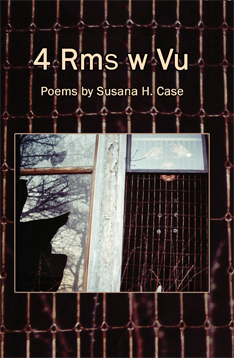
Today's book of poetry: 4 Rms w Vu. Susana H. Case. Mayapple Press. Woodstock, New York. 2014.
There is nothing better than the powerful whisper-blow of Ben Webster's tenor and that is what we are listening to this morning in the Today's book of poetry office. It's -19 C or some other ungodly temperature outside. Every time Milo and I want to have a smoke we have to bundle up like explorers. We both end up looking like kids going off to kindergarten, everything but mittens on a string.
But now that we are back here in our warm office and listening to Ben we can tell you why we are excited by Susana H. Case and her utterly vibrant 4 Rms w Vu, although given any sort of chance Case would handle that with aplomb. Case writes our kind of poetry. Her poetry is down to earth, wildly emotional but almost controlled, anarchy of the best kind.
And Now Let's Revisit Sex and Death
Getting into bed with you,
it's afternoon, my mind on play,
I'm wearing chiffon, I'm grinning
like the cows have already come home
for me when you say,
could you take a look at my lip -- I'm thinking cancer,
which of course stops the whole thing dead
while we go to the lamp
get you angled right and yes,
there's something there, could be anything,
there's a definite thing that doesn't belong,
like a dog in a tree
and you couldn't know the number of my women friends
whose men are no longer here,
how it always starts with,
could you look at this bump on my neck, this spot on my leg,
as if any of us had expertise in more than fear and rage,
rage because you just had to wrap your lips
around your smoke, didn't you, instead of around
some more compliant part of me,
always this conjunction of sex and death,
it's like the good twin hopelessly
sharing a brain with the evil twin,
the one who pops open a beer,
whispers, go ahead--light the match--mess it all up,
through nicotine-yellow teeth, the one
who makes me think that if you're ill,
I'll shoot you myself, kill you right now
for carelessly leaving me in this fucked-up place alone.
...
Case has no problem leading with her heart but be careful because she is coming for yours and she is a take-no-prisoners poet.
4 Rms w Vu takes the reader to the steppes of Kazakhstan, the Adirondacks, a car accident in Kansas and a new apartment in New York City. The last Inca ruler plays a part and so does Charlie Parker. Susana H. Case is an equal opportunity poet. But regardless of the setting she is always aiming for some new truth, a better understanding of the tumultuous relationships that make us human.
While Case is striding through all this scenery the important consideration is how engaged you become as a reader, how invested you become in the outcome. Case is all about relationships but has no trouble at all blowing them up to get a better look at what was inside. And we get to go along for the frenetic ride.
Girls You Could Love
girls you could fuck
and straddle-both-world girls
like me, you showed off
to your friends. Peaking early
girls. Peaking late. Prom queens.
Science girls. Nasty girls.
Straight-A girl with my intricate
knowledge of each protrusion, slit,
crevice. Don't forget the stockings,
the heels, you'd say, fetish boy
with your dual-career
parents, your empty house,
housekeeper who pretended
not to notice, the gilt phones I laughed
about to my friends. So good to be
inside you--or--you
inside me. I got so lost in it. My parents
who devoured relationship
books frowned, symbiosis
--a big word for us, fat
on the tongue--and yes,
I thought I'd crumple without
you, but also knew to direct you, slowly
run your hand up here, along the 15 denier
nylon you had so crazily fixed upon. Little
garter button indents red on my thighs
that read: the one with these legs
knows exactly how to want.
Anyone who thought the power was yours
really didn't understand.
...
Case is trying, quite diligently, to break down all impediments to the truth in these narratives. These poems hit like a wrecking ball. 4 Rms w Vu reminds us here at Today's book of poetry of Maryse Holder's Give Sorrow Words, if only for a moment. Case has some of the same intensity of emotional clarity and frankly, some of the same female anger that compelled Holder.
That's not a bad thing at all.
Today's book of poetry loved Give Sorrow Words and we are quite fond of Susana H. Case at the moment, we have nothing but admiration for any poet who is willing to put it all on the table.
Incantation
The best thing to die from is living.
Let me kill myself slowly with pleasure.
Let me dance round and round in circles first.
Let me blow a lot of fuses.
Let me age like a good slab of steak, tender
with the mold trimmed. Let me be
a car going 80 miles per hour.
Let me reach 80--the exquisite
torture of those many years is compelling.
Let them not be Chaplinesque. Let them say
she never knew what hit her. Let it be like
the one James Dean got, only much later.
Let me not surrender to humiliations.
Let me end when my mind, still sharp,
is somewhere else--dreaming of perfectly
grilled lamb, the rosemary perfume so strong,
it could be sealed in my pillow, of hot sex,
and let that be not so long gone
that it burns like a bad joke. In the valley
of the shadow of death, I'd still like
my red lipstick please. Let my breasts not reach
my waist. Let there be very little
scar tissue on me at the time and
let there be a weeping willow, under it
a significantly younger man,
my own little honey cake, who is weeping,
too--thought I don't wish that on him for long,
He'll have a life to live.
...
Is a good life possible? Today's book of poetry thinks so and so does Susana H. Case, she just makes it clear it won't come easy or without bruising. It might leave a scar. Just like these poems.
Susana H. Case
ABOUT THE AUTHOR
Susana H. Case is a Professor and Program Coordinator at the New York Institute of Technology. Her photos have appeared in Blue Hour Magazine, pacificREVIEW, and San Pedro River Review, among others. Author of several chapbooks, her Slapering Hol Press chapbook, The Scottish Café, was published in a dual-language version, Kawiarnia Szkocka, by Poland’s Opole University Press. Her previous books of poetry are: Salem In Séance (WordTech Editions), Elvis Presley’s Hips & Mick Jagger’s Lips (Anaphora Literary Press), and Earth and Below(Anaphora Literary Press). Please visit her online at: http://iris.nyit.edu/~shcase/.
BLURBS
The poems in 4 Rms w Vu, like most of Susana H. Case’s work, demand full participation—no watching here—that we live in their apartments, wear their clothes, down to the “denier nylon.” At the end we’re a little shaken, but a lot wiser. Susana is a daring poet, not so much for the sake of issuing challenges, but more to the cause of poetry itself; she defies one to bring the whole body and soul, and deny no part of this experience called living.
– Mervyn Taylor, author of The Waving Gallery
4 Rms w Vu is a poetic open house in which Susana H. Case guides us through the rooms of the heart. In poems addressed to husbands, lovers and parents, Case shows how the past, the curious details of daily life and wonderings about the future all weave together endlessly, how nothing is ever really lost—not a loved one, not a hurt—if you can remember. In her moving new collection, we see how this poet’s art is an act of holding on in language that is sure-footed.
– Matthew Thorburn, author of This Time Tomorrow
Susana H. Case’s 4 Rms w Vu superimposes an intricate map of a lover’s mind on the floorplan of a New York City apartment in poems that never shrink from the “weep and stink of everyday brutality.” Moving from room to room and year to year, 4 Rms w Vu passes through meditations on life with dogs, the metaphysics of lipstick, and the peculiarly American primal scene of the isolating, moving, colliding car, in square footage inhabited by a woman with the brio to ask, as final prayer — “Let me blow a lot of fuses.”
-B. K. Fischer, author of St. Rage’s Vault
In these poems, Susana H. Case captures a vision of New York that can no longer be seen but in memory. Filled with characters frenzied by love, desire & hope, 4 Rm w Vu reminds us not only where we’re from but also who we are.