Showing posts with label icehouse poetry. Show all posts

Thursday, September 26, 2019

Amateurs At Love — Patricia Young (Icehouse Poetry/Goose Lane Editions)

Today's book of poetry:
Amateurs At Love.  Patricia Young.  Icehouse Poetry/Goose Lane Editions.  Fredericton, New Brunswick.  2018.

Amateurs at Love

Today's book of poetry has Pharoah Sanders on the box and he's cracking out a sterling version of his song "Africa/You've Got To Have Freedom" and we are loving it.  That's about as good as it gets.  Today's book of poetry wanted something lively, joyous, up beat to help us celebrate Patricia Young's Amateurs At Love. 

Patricia Young is no amateur.  Today's book of poetry has been down the Patricia Young road twice before.  Once for Short Takes on the Apocalypse (Biblioasis,2016), and once for her Consider The Paragliders (Baseline Press, 2018).  You can see them both here:


And here we go again.  It should be clear why, once again Patricia Young has hit us in the poetry sweet spot.

Amateurs At Love is crafted into six sections, each alive with its own magic.  Today's book of poetry got stuck in the first section, "This Could Be Anyone's Story", stuck isn't the right word, neither is paralyzed.  We're going to go with transfixed.  These short prose poems are note perfect, precise and patient.

Young is a pro.

Inside Sleep Country, Bird Murals

INSIDE SLEEP COUNTRY, BIRD MURALS glow on the walls:
peacocks and flamingoes, macaws and parrots. The old man wants
a firm mattress. The old woman longs for a good night's rest.
But the warehouse is a gruelling maze of daybed, canopy beds,
waterbeds, platform beds, sofa beds, truckle beds. Beds the size of
coffins and sandboxes. Beds sluggish as tugboats and shallow as
wading pools. They lean against a child's bunk and remove their
shoes. After you, he says, and she begins her ascent. They climb the
ladder, heads butting through clouds and sunsets, until they roll,
exhausted, onto a super-deluxe, memory foam mattress. Lying on
their backs, they talk about old wounds, betrayals, and whiplash
lust and bursitis. They have children, don't they? Grandchildren,
too? The lights dim. They hear the last customer leave. Doors lock.
Plumage rustles. There's a lone creeing sound. They reach shyly
across the expanse. After all these years, how is it possible? They're
still amateurs at love.

💫💫💫

Today's book of poetry sent Thomas, our newest intern, into the stacks to see what else we had in stock from Patricia Young.  Young has published 12 books of poetry and six chapbooks (as well as a novel).  We have eight of her poetry titles on our shelves, in no particular order:

Those Were The Mermaid Days
Melancholy Ain't No Baby
More Watery Still
Here Come The Moonbathers
Night-Eater
What I Remember From My Time On Earth
Short Takes on the Apocalypse
Consider The Paragliders

And now young Thomas, our newest intern, will be tasked with finding Patricia Young's other titles. 

Today's book of poetry would be remiss not to suggest you dear readers do the same; look for Patricia Young books.  We suspect, that like us, you will discover a voice worth your good time and a wit you wish you had.

Amateurs At Love is gold.  Like the afore-mentioned Pharoah Sanders, Patricia Young knows how to come correct.  In "Animal Tales", another of the six sections, Young and anthropomorphism get into a Noah's Ark of four legged and winged creatures.  Young treats them with respect, reveals their wit.  You'll believe every word because Young has the true burn.  It all sounds like the truth.

Rabbit

When the children peered through gaps in the fence surrounding
their play area they were confronted with a shocking sight — a
teenage girl whipping a rabbit with a willow branch. The girl
heard the children's whimpering and came over and threatened
to whip them too. So young and so pitiless, the daycare workers
said as they shuffled the little ones into the church basement where
they sloughed off their Muddy Buddies and rolled out their mats. It
was time to nap. Time to dream. That night the children told their
parents about the girl and rabbit, and the next day their parents
told their friends, who then told their friends, and so on, person
to person, until rumours of the girl's pathology travelled around
the globe, full circle, returning to the rabbit who merely rolled his
pink eyes. The children were fantasists, of course. To the rabbit's
mind, truth was the water dish in the corner of his hutch, the whiff
of clover on a summer morning, the diamond stud in the girl's ski
jump nose.

💫💫💫

Goose

The goose was in love with three ganders and they loved her in
return. The farmer, however, had no time for romance. Financially,
he was in over his head and also underwater. He needed to
downsize. This worried the animals, especially the goose. A month
earlier, on her birthday, she'd laid her last egg. Now, no matter
how she bore down — not one speckled oval. Like all lovesick
creatures, the ganders were a font of ideas and suggested the goose
feign broodiness. An excellent plan, she said, and refused to leave
her nest, even to eat or drink. Day and night her adoring ganders
gathered around to recite sonnets in praise of her fertility but after
the third debt collector had driven off, the farmer summoned his
hapless  waterfowl. You've laid more eggs than any other goose, he
said, and I am grateful, but you are old, old girl, and now you must
return to the bee balm and sky. Too dignified to make a fuss, the
goose arranged her head on the chopping block and the axe came
down. Instead of blood, a bouquet of dandelions spouted from her
neck. The awestruck ganders watched as the yellow clusters turned
swiftly to seed balls. Puff, they cackled, puff, puff.

💫💫💫

It's a rainy gray day in the nation's capital but we're all smiles here at Today's book of poetry.  When the pros drop in they make our life easy.  The morning read was both humorous and profound.  Young can be Richard Pryor funny and deadly serious at the same time.  Great trick.

Thomas, our newest intern, was introduced to the morning read this morning and of course because he is new he had to read first.  Thomas looked us right in the eyes and then nailed it, read Patricia Young with wit and timing.  We gave him and Amateurs At Love the full standing ovation.  Thomas bowed.

Mother

I took her hand and pulled her toward the park and begged her to
explain why everything I wanted to know was unknowable, like the
boys hanging around the edge of the canal. I wanted to know the 
difference between hypocrisy and lust. Also: the true story of Adam
and Eve. Was the Garden of Eden a foreign country where you
drank from a porcelain fountain or was it the beast with two backs?
I wanted to know: how could a beast have two backs? Other things
too: tricks to stay sane in prison. Should I memorize passages from
the Bible or Dante? Hanging upside down on the monkey bars,
I wanted to know why she, my mother, sitting on a stone bench
unwrapping a small meat pie, had blotted out her past. She bit into
the cold pastry, gravy oozing from the corners of her mouth, and I
wanted to know, would I too have to reinvent myself with duct tape
and flowers?

💫💫💫

Today's book of poetry is clearly a Patricia Young fan, you will be too if you can get your hands on Amateurs At Love.  Just like Pharoah Sanders, you can't go wrong.

Image result for patricia young photo

Patricia Young

ABOUT THE POET
Patricia Young has published twelve collections of poetry and one of short fiction. Her poems have been widely anthologized and she has received numerous awards for her writing, including the Dorothy Livesay Poetry Prize, the B.C. Book Prize, the Pat Lowther Memorial Award, a CBC Literary Prize, several National Magazine Awards, the Bliss Carman Award, and the Confederation Poets Prize. She has twice been nominated for the Governor General's Award for Poetry. She lives in Victoria.

BLURBS
"Amateurs at Love is as delectable as anything I've read in ages. Young delivers her salty truths in dreamscapes that straddle a ridge between drollery and devastating one-two punches. Here you will find prickly pangramics, grousing animalia, family fables, insight and allegory, and — as in the best of teh best — yourself." 
     — Sharon McCartney

"These poems could well be anyone's story, but each told in light touches is particular, the tone sometimes dark, if kept steadfastly whimsical in intent. A horse gorges on fermented daisies. Mice haunt a cottage with their absence. A boy comes to understand his mother has no answers for him. Not Patricia Young. Thankfully, in Amateurs at Love, she has found one for almost everything."
      — John Barton

"In Amateurs at Love, Patricia Young reveals parallel realities, not ghosts but fleeting glimpses of ourselves. Everyday love coexists as drama on a momentary stage, just on the other side of a veil, or it lives in a dreamlike state in which we are not sure if we are being dreamed or are dreamers. Young's extraordinary power of observation draws us in with fine detail, and the resonant precision of her language carries us along." 
     — Patrick Friesen


Patricia Young Reads from An Auto-Erotic History of Swings
Video: Sono Nis Press


788


Poems cited here are assumed to be under copyright by the poet and/or publisher.  They are shown here for publicity and review purposes.  For any other kind of re-use of these poems, please contact the listed publishers for permission.

We here at TBOP are technically deficient and rely on our bashful Milo to fix everything.  We received notice from Google that we were using "cookies"
and that for our readers in Europe there had to be notification of the use of those "cookies.  Please be aware that TBOP may employ the use of some "cookies" (whatever they are) and you should take that into consideration.


Monday, April 2, 2018

Stray - Allison LaSorda (Icehouse Poetry/Goose Lane Editions)

Today's book of poetry:
Stray.  Allison LaSorda.  Icehouse Poetry/Goose Lane Editions.  Fredericton, New Brunswick.  2017.

Stray

"Listen, I would never Jolene your man."
                                                                                                          Fluid Dynamics

Stray does some remarkable maneuvering with the tic, tac, toe of our daily grind.  It's not that Allison LaSorda is seeing a different world from the rest of us but she is certainly seeing a different set of possibilities.

One of the things I have discovered writing all these blogs/reviews is that with certain poets you can see in their first poem -- they are smarter than you and there is nothing you can do about it but to enjoy it.  Take Allison LaSorda, but first a generalization about Alison/Allisons, every Allison I've ever met was smart like a great detective and LaSorda doesn't let the Allison side down.  Our British cousin Alison, same thing.  Even Elvis Costello knows this to be true

Elver

Hook an eel and reel it in. It wraps around my hand
and constricts like a boa. My cousin yells to hurry,
get the lure out -- but the muscle, the persistence grips.

For the past week I've been visiting. I hug people,
see them pause to sculpt an answer.
Someone concedes they last saw me at a funeral.

Blueberries wither in an old ice cream bucket.
Things grow faster than I remember; I eat quickly.

Clouds look different, more cheerful.
Ancestors made nuisances of themselves here, casting
their nets, planting, skills that have long left my blood.

A high school friend tours me around the valley sites:
the pig farm he can't afford will be developed;
this used to be that. The drive makes me ravenous.

Stay in his childhood bedroom. He tells me he used to open
a drawer to lock himself in when he got in trouble.
I open the drawer while I undress.

...

LaSorda is quiet like a thought until she unloads the hammer.  Stray is just so much fun to roll around in your brain while you savour the tasty bits.  And there are tasty bits in every bite.

Read a poem from Stray out loud to K last night and her eyes opened real wide.  I knew they would.  when LaSorda takes off the gloves it is all business, bruises be damned, and what entertaining business it is.  Lasorda is playful like a cat with your poetry mouse and you all know how that story ends.

Today's book of poetry risks the lament of the broken record but LaSorda's Stray is the entire reason we are in the poetry blog/review business.  Stray was a seriously hampered read simply because after almost every poem I had to get up and do the "great poem dance."  Most good poetry titles limit themselves to a few golden dance tracks, LaSorda had me jumping out of my comfortable reading bed like I was dancing at a RockaBilly K Dj'd Peterborough house party.

Glory Days

I quit music for Lent, but sighed
so loud a tune came out.

See, I can never tell
how I want things to be.
That's why I'm unlovable
or at least hard to please.

I want every song sung by Springsteen.
I need a boss for my home life.

Sketch me the monuments
I tried to forget. Let's meet halfway
in a green card marriage, so I can swaddle
my bouncing baby boys to Born in the U.S.A.

I figure Bruce dreams the same
way he sings, plainly, earnestness
drawn out so clear I am embarrassed
by my secrecy, by all his feelings,
eyes closed for the good parts.
There's a dream there
and I've earned my slice.

...

Allison LaSorda sneaks up behind you, quietly as before mentioned mouse, with her emotional billy club and that's all she wrote.

Our morning read was sensational.  If we were a jazz band, and everyone on the Today's book of poetry staff secretly thinks they are a legit nighthawk at the diner Charlie Parker/John Coltrane gypsy jazz rat chef, today would have been one of our best all-star jams.

Otis, back from Sicily, almost blew the lid off of the place with his usual nuanced narrative dancing LaSorda home with charm, grace, panache and a revealing of  LaSorda's subtle and almost secret intimacy.

The End of Grief

When the end of grief was announced
the houses on our street
slouched until all were lopsided.
Those of us who dwell
on the mysteries of our dead
wedge our bodies into the foundations.
We want as long as possible to figure out
what might be beautiful about loss.
The river rushes anew,
water so opaque it looks
pleated. We want clothing
that hangs as loose as river.
Knock on the underside
of floors but nobody answers --
this, too, is a sign. The houses
heave with our pulses.
Children whisper through dirt
that since the declaration
and resultant slanting of their beds,
they only dream of flying.
We feel sorry for them.
Our dreams do the chores.
They self-repair, dig trenches,
throw leaves into gutters clogged
with competing impulses:
eke out consolation
in what's fixed, or hazard
the pang of stranger gravity.

...

Allison LaSorda will make your poetry day or Today's book of poetry will refund your money.  This isn't an offer we make often, knowing how whim wants cash, but it is a promise.

We know when a cat can burn and LaSorda's Stray will have you running to her poetry kitchen all night long.

 Image result for allison lasorda photo

Allison LaSorda

ABOUT THE AUTHOR
Allison LaSorda grew up in Campbellville, Ontario, and, after some years in the Maritimes, now lives in Toronto. A recipient of scholarships from the Banff Centre Writing Studio and the Vermont Studio Center, she holds an MFA from the University of Guelph. Her work has appeared in PANK Magazine, PRISM international, Brick, Riddle Fence, the Malahat Review, the Fiddlehead, and others.

BLURBS
"Keats spoke of a heightened aesthetic state which, as I understand it, sees apparently contradictory hopes and fears as inseparable. Allison LaSorda’s shining debut never strays far from that vital, difficult, human work. There’s tough talk here, but also compassion, clarity, love, and humour. Listen and learn." 
     — Kevin Connolly

"‘There may not be enough light for all of us,’ warns Allison LaSorda in this moody, shadowy collection, but what light she finds — in language and landscape — she holds warily aloft for all to see. In poems that reflect upon layers of memories among people and places, LaSorda often conveys a sense of weariness or resignation, but the liveliness of her thinking casts just enough light to make the shadows dance. Her readers will be moved — and enchanted." 
     — Heather Christle


673
DISCLAIMERS

Poems cited here are assumed to be under copyright by the poet and/or publisher.  They are shown here for publicity and review purposes.  For any other kind of re-use of these poems, please contact the listed publishers for permission.
We here at TBOP are technically deficient and rely on our bashful Milo to fix everything.  We received notice from Google that we were using "cookies"
and that for our readers in Europe there had to be notification of the use of those "cookies.  Please be aware that TBOP may employ the use of some "cookies" (whatever they are) and you should take that into consideration


Saturday, November 18, 2017

Collected Poems of Alden Nowlan - Edited by Brian Bartlett (Icehouse Poetry/Goose Lane Editions)

Today's book of poetry:
Collected Poems of Alden Nowlan.  Edited by Brian Bartlett.  Icehouse Poetry.  Icehouse Poetry is an imprint of Goose Lane Editions.  Fredericton, New Brunswick.  2017.

Collected Poems of Alden Nowlan

Three reminders of why I love this poetry game.  Earlier this week we finally heard from our Sr. Editor, Max, who had gone on a bit of walkabout.  He's fine, keeping out of the bad weather and we are greatly relieved to hear he is okay.  Today's book of poetry also got a phone call from our Southern Correspondent, the Twangster.  A phone call from his lair is as rare as hen's teeth but more welcome than Christmas.  Damn it, for the first few minutes of the call my short-term memory left the room and my old brain didn't even recognize the voice.

Why were these calls so important to Today's book of poetry?  Max knew me back in the day and tolerated my poetry just enough that I kept going.  The Twangster, through a variety of selfless acts of charity has helped Today's book of poetry renew his love for poetry and our small community.

The third.  Sir Alden Nowlan.  I gave him the Sir moniker and if you want to make something out of it - you know know where I live.  Alden Nowlan (1933-1983) was around when there were real giants roaming the poetry earth, Laytons, Cohens and such.  But Alden didn't get quite the same sort of press or recognition or fame.  I'm here to tell you that long before I worshipped the legendary Irving Layton I was hip deep in Alden Nowlan.  The perfect gateway to a life of loving poetry.

Bread, Wine and Salt (Clarke, Irwin & Company Limited, 1967), The Mysterious Naked Man (Clarke, Irwin & Company Limited, 1969) and Between Tears and Laughter (Clarke, Irwin & Company Limited, 1971) were cornerstones of my early poetry world.  Today's book of poetry never met or knew Alden Nowlan but we loved him because his poetry was real to us in the most important sense of being real.  The emotions I felt as a young man reading Sir Alden of Nowlan have never gone away.  When I read these poems they still feel fresh.

Did I say Sir?

Saint Alden of Nowlan is a genuine Canadian poetry hero.  Brian Bartlett, the editor of this massive completest's joy, the Collected Poems of Alden Nowlan says it all much tidier and with less emotional bombast.  Here is his opening salvo:

     Czeslaw Milosz once wrote of another great twentieth-century Polish poet,
     Wislawa Szymborska: "Poetry that speaks to the enduring and irreversible
     coordinates of human fate -- love, striving, fear of pain, hope, the fleeting
     nature of things, and death -- leads us to believe that the poet is one of us,
     and shares in that fate." The same could be said about one of Canada's most
     distinctive and beloved poets, Alden Nowlan.  He once wrote of a desire to
     leave behind "one poem, one story / that will tell what it was like / to be
     alive" ("Another Poem").  Many times he did just that, with candour and 
     subtlety, emotion and humour, sympathy and truth-telling.  Only now is the
     true range of Nowlan's poetic achievement finally available between two 
     covers.  Collected Poems offers in one volume all his poems previously
     published in three early chapbooks, eight full-length collections, "new
     and selected" compilations, and the script of a long poem for voices.

And here is mine.  The first time I opened a book by Alden Nowlan I was in high school, I graduated over 47 years ago.  Alden Nowlan was one of the first poets on my bookshelf.  Because...

In Those Old Wars

In those old wars
where generals wore yellow ringlets
and sucked lemons at their prayers,
other things being equal
the lost causes were the best.

Lee rode out of history
on his gray horse, Traveller,
so perfect a hero
had he not existed
it would have been necessary to invent him--
war stinks without gallantry.

An aide, one of the few who survived,
told him,
Country be damned, general,
for six months these men
have had not country but you.
They fought barefoot
and drank blueberryleaf tea.

The politicians
strung up Grant
like a carrot,
made him a Merovingian.
They stole everything
even the coppers from Lincoln's dead eyes.

In those days, the vanquished
surrendered their swords like gentlemen,
the victors alone
surrendered their illusions.
The easiest thing to do for a Cause
is to die for it.

...

Today's book of poetry's old copies of Bread, Wine and Salt and The Mysterious Naked Man have been rifled through so many times the bindings are loose, they have so many paper page markers sticking out of the tops -- they look like they've grown plumage.  

What Today's book of poetry found in Alden Nowlan was a voice that sounded so real and true and fine you wished he were your Uncle.  Your smart/wise Uncle who wrote poems like this:

The Hollow Men

They tell me they have never aspired to be poets.
Their jobs, when they were young, were more
     demanding than mine.
With their sweetest smiles: "Nothing great was ever
     accomplished
by writing before breakfast; to create a man must
     be free."
Someday, perhaps, they'll live in Mexico or Italy.
Meanwhile, they endure as they must...
Then hand me the poem
they've preserved since their last year
in university.

...

or

The Last Waltz

The orchestra playing
the last waltz
at three o'clock
in the morning
in the Knights of Pythias Hall
in Hartland, New Brunswick,
Canada, North America,
world, solar system,
centre of universe--

and all of us drunk,
swaying together
to the music of rum
and a sad clarinet:

comrades all,
each with his beloved.

...

Our morning read was splendid.  The air in Ottawa is crisp, the way it always is before the first big storm of winter.  The sky that foreboding sunless gray.

The minions did Sir Saint Alden of Nowlan proud, we read poems from every lovely section of the Collected Poem of Alden Nowlan as though they were the Psalms and we were all religious.  Even though we are not.

Here's the truth of it.  Alden Nowlan never seemed to be speaking over us, he spoke directly to us, me.  It felt like I was being included in an erudite conversation about things that mattered, it was  a conversation I wasn't expecting to be included in.

Snapshot

It takes even more than this to make you cry
or laugh
     aloud
            when you are old enough
to find a forgotten snapshot of yourself,

take it up in your hands,
hold it close to the light,

discover slowly
     and for the first time

that once
     long ago
             you were almost

beautiful.

...

Nowlan was a gem factory.  A high class jeweller.  Try this jewel on for size:

Fireworks

Fireworks are being set off
from the highest point in the city
and because explosions scare me
I sit here sullenly, bracing myself for the next one,
hoping it will be the last.
       After all, we've set off so damn many
explosions this past seven or eight hundred years
it stands to reason God must be getting sick of them.
One of these days he's going to hear a firecracker
and decide that's it, I've had it, they've gone far enough.

What a hell of a bang there'll be when that day comes.

...

Icehouse Poetry and Goose Lane Editions have done a national service with this handsome book.  The Collected Poems of Alden Nowlan may be the most important book of poetry published in Canada this year.  Every poetry bookshelf in the country should have this book on it!

Why I am not more afraid of the dark

You are:
                 windows.
                                    That
is the name
                    for you.
And the darkness
                                 moving
within
and behind
                      your terrible brightness
is not
           the wings
                            of bats caught
in a furnace, not
something nameless
                                  rising, but
men
and women
behaving like humans.
                                     Still I all but
say it aloud:
                     Windows.
                                      Humans.
And am grateful
that I possess words:
                                     charms
unknown to animals.

...

Sir Alden Nowlan, bard, poet-Saint and namer of things, names it here.  "I possess words: /  charms / unknown to animals.  

Today's book of poetry has looked up to Alden Nowlan since we first picked up Bread, Wine and Salt in it's tidy small paperback format.  It didn't take me long to realize it was one of the biggest books on my shelf.  Over forty years later -- nothing has changed.

Alden Nowlan should be remembered from that time when giants strode the earth for he was their equal in every way.  I know, he took giant steps into this poet's heart all those years ago.  And just like Mr. Coltrane and his own Giant Steps, they are there to stay.

Photo credit: A painting of critically acclaimed Canadian poet, novelist and playwright Alden Nowlan by Stephen Scott.

Alden Nowlan

ABOUT THE AUTHOR
Born in Hants Co., Nova Scotia, in 1933, Alden Nowlan moved to Hartland, New Brunswick, when he was nineteen, and worked on the Hartland Observer as reporter, editor, and general facilitator until he went to Saint John (and the Telegraph Journal) in 1963. In 1968 he was invited to take up the position of Writer-in-Residence at the University of New Brunswick in Fredericton. Alden Nowlan died on June 27th, 1983.

ABOUT THE EDITOR
Brian Bartlett has published many books of poetry and non-fiction, including The Watchmaker's Table, Ringing Here & There: A Nature Calendar, and Wanting the Day: Selected Poems. He teaches creative writing at Saint Mary's University in Halifax.

BLURBS:
"Both the Ukraine and Russia lay claim to Gogol, Wales has Dylan Thomas, and America, Poe. We (in Atlantica) have Alden Nowlan. He might tell you you've got the balls of a bull moose to say something like that. Just think how hard as a youngster he was treated by his native place. That doesn't matter now, since he turned it all to gold. Nowlan reminds us our English is good. Our cold winter-tempered Irish English, modern, spare, and mythological. These poems are enough to make you want to put your guitar down." 
     — Al Tuck

"The publication of this book is an historic event in our literature. The collection is a life's work, and like the work of life, this writing wrestles with ancient forces that are pure and unchanging. Nobody else saw the world with Alden's kind of clarity and nobody else worked the language so hard — trying to make it hold, or embrace, our shared experience with such furious tenderness. If you still think honesty is possible, if you worry sometimes about truth and the struggle for sincere connection, Collected Poems of Alden Nowlan will give you comfort." 
     — Alexander MacLeod

"Well over thirty years after his death, Alden Nowlan's poems are still hot-blooded — living, breathing incantations that beat with the pulse of Eastern Canada. Imbued with what Brian Bartlett dubs "the illusion of speech," Collected Poems of Alden Nowlan brings together the work of a master craftsman, a writer whose rangy, conversational poems benefit from appearing where they emerged within his career arc. A definitive volume that consolidates Nowlan's standing in Canadian letters." 
     — Jim Johnstone

"After I was brought up on the Romantics in school, my love of Alden Nowlan's poetry began with his dense, metrically perfect lyrics, some of them so dark they made me shiver. Later, his plain-speaking voice, his honesty and vulnerability drew me in. My husband and I hold Alden in such high regard that shortly after his death we named our first cat after him. He is our laureate of human frailties. No one makes me feel less alone in life and in literature than Alden." 
     — Lorna Crozier


Alden Nowlan: The People's Poet
video: Norflicks Production


630


DISCLAIMERS

Poems cited here are assumed to be under copyright by the poet and/or publisher.  They are shown here for publicity and review purposes.  For any other kind of re-use of these poems, please contact the listed publishers for permission.


We here at TBOP are technically deficient and rely on our bashful Milo to fix everything.  We received notice from Google that we were using "cookies"
and that for our readers in Europe there had to be notification of the use of those "cookies.  Please be aware that TBOP may employ the use of some "cookies" (whatever they are) and you should take that into consideration

Monday, June 26, 2017

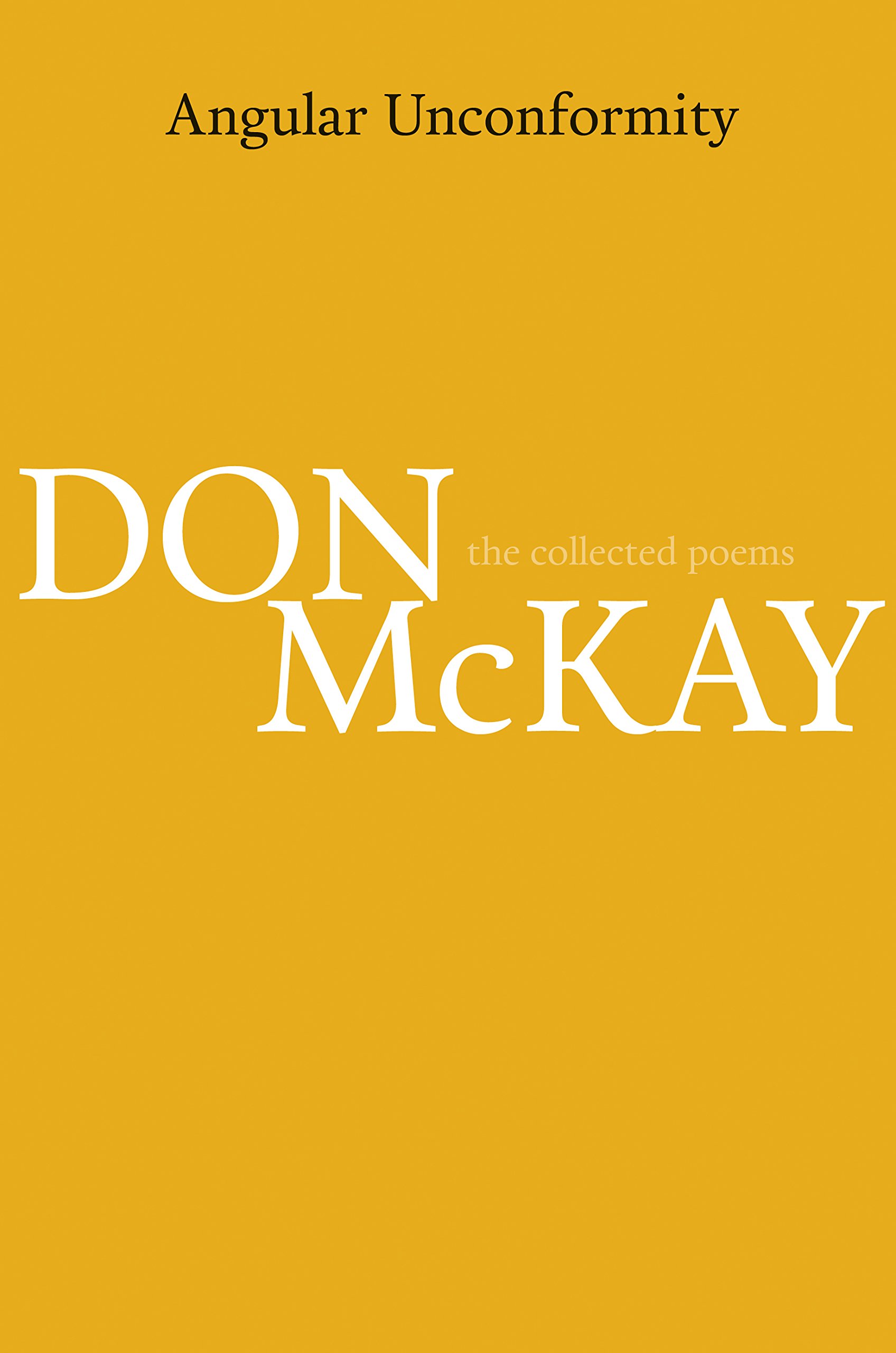
Angular Unconformity, Collected Poems 1970-2014 - Don McKay (Icehouse Poetry/Goose Lane Editions)

Today's book of poetry:
Angular Unconformity, Collected Poems 1970-2014.  Don McKay.  Icehouse Poetry/Goose Lane Editions.  Fredericton, New Brunswick.  2014.


Angular Unconformity means a particular gap between two known strata of rock in a geological formation, at least that's what Milo, our head tech, came back with.  It is the space that occurs between what we know for certain and what we want to believe is true.

Today's book of poetry's personal adventure with the excellent poetry of Don McKay began over thirty years ago in a class on the "long-poem" taught by that Black Mountain/Tish poet Robert Hogg. It was in that class where I first read McKay's Long Sault.

Far more importantly, Robert Hogg's class on the long-poem was where I met the joy of my life, my wife, K.

It doesn't stop there.

It was only a few short years ago that K and I were invited to an elaborate garden party/dinner/BBQ for an old friend who now lives in Newfoundland and Labrador.  Turns out she brought Don McKay with her and I got a chance to meet him.  More accurately, I wouldn't leave him alone until he talked to me.

Since that time I have been lucky enough to share a couple of more meals with the esteemed Mr. McKay courtesy of my Scrabble friend Nurse Rachet.  Don, one of the more humble people on the planet pretends that he is amused by me and I follow him around like a I'm a puppy and he has bacon in his pocket.

We're not exactly buddies but he certainly is a friend.  Long before I met him I wrote my undergraduate paper for the long-poem class on his Long Sault and I have admired his poetry ever since.  In person he is nicer than you can imagine.

From Long Sault

A Feeling Of If, A Feeling Of But, A Field Of Fire Hydrants

For a time, we were
amazement--
     they got
     this house-moving machine with tires so big I can
     show you the picture my brother standing up
     inside the hub he is ten years old that can move
     a house so gentle they just leave the pictures on the walls--

unfettered, soaring in suspension of feeling.

The rhetoric was
a shepherd to us (though later
we might have said superintendent without sensing
any change) the way
we could be inside its shell but never
really know which history
was being made, and never asking
whose.

Here was a map coming out in dotted lines
to be filled in with the right answer.
Here was a rapids in the noose.
Here was a field of fire hydrants waiting for a town.
Here was a marina in the field of fire hydrants
waiting for the water to arrive
to whisper sibilant up to the waiting wharf.

The river was about to swell.
It was doing the Charles Atlas course, would be
the servile giant.
Its language was unlocked: Power & Prosperity, Development & Growth.

Look at that bicep
                              (or that
snake-bit arm we would never completely think,
or think only as far as
the feeling of if
the feeling of but, never to the fettering flag-
planting noun, as though
the making of the feeling and
the making of the dam were cognate
pregnancies
                    (or carbuncles, as we
couldn't have said until we'd seen, a feeling
of if, a feeling of but, a feeling of smelling,
even when we named our humdrum town
'City of Power and Progress,' smelling
its industries still smoking at both ends like cigars.


...

McKay's Birding, or desire came out in 1983 and hit Today's book of poetry right on the chin, we were smitten.  Tight, allegorical magic/music.

McKay has built an unassailable reputation in Canada for his poetry, wait until you read his bio, but Today's book of poetry would be remiss if we didn't tell you all how often Don's name shows up in the back of other books of poetry, when they are giving thanks.  Don's kind poetry hand has supported and encouraged an army of younger Canadian poets.

From Birding, or desire

L'Hirondelle

     To be idiomatic in a vacuum
     it is a shining thing!

Would I pass her by again, as always leave her standing with her head
bowed by her locker, looking like she'd forgotten the combination to
everything? Could I tell her now that no one, not the most depraved of
us, deserves high school? Could I explain the way we locked her in our
lust, never speaking to her but only of, and only in the locker room, how
we turned her into a statue of desire? Could I ask her about the feathers in
her locker, taped to the inside of the door? What would I say to that sad
fabulously breasted creature, now that my clumsiness has gnarled? Walking
down the corridor of metal doors to find you crying soundlessly, black hair
pouring, the weight of the combination lock heavy in your hand like --
I see this only now -- the absence of a cock you loved. In memory, I fur-
nish you with drapes, a used fridge and a bedroom suite ($299 at Zellers)
which I carefully arrange around you. On your cold fake marble floor I
lay this old braided rug I bought and lived on later in Saskatoon. Here
on your coffee table (slightly scratched, half price) I am leaving my copy
of The Birds of Canada. And listen: during the long industrial softball
double-headers of your future, be sure to look up at the lights in case the
Nighthawks may be up there

                sideslip

                                        downglide

             flashing their long barred wings they

                                               intersect with shadflies on the ad lib,

moves we never thought of, never made.

...

Today's book of poetry enters a Don McKay book with the certainty that with eyes and ears open we are about to be amazed.  Angular Unconformity, Collected Poems 1970-2014 weighs in at a hefty fill your boots 584 pages and does not disappoint.  It is a necessary treasure.  We here at Today's book of poetry believe Mr. McKay still has a library of fine poems yet to write but this tome will bring you up to date.

Today's book of poetry is always surprised by how McKay gives us access in his poems.  The topography and subject range always vary but the emotional accessibility is a constant.  The poems are always intelligent whip-quick, as though there were a built-in codex we all knew.

From Strike/Slip

Pond

Eventually water,
having been possessed by every verb--
been rush been drip been
geyser eddy fountain rapid drunk
evaporated frozen pissed
transpired -- will fall
into itself and sit.
                            Pond. Things touch
or splash down and it
takes them in -- pollen, heron, leaves, larvae, Greater
and Lesser scaup -- nothing declined,
nothing carried briskly off to form
alluvium somewhere else. Pond gazes
into sky religiously but also
gathers in its edge, reflecting cattails, alders,
reed beds and behind them, ranged
like taller children in the grade four photo,
conifers and birch. All of them inverted, carried
deeper into sepia, we might as well say
pondered. For pond is not pool,
whose clarity is edgeless and whose emptiness,
beloved by poets and the moon, permits us
to imagine life without the accident-
prone plumbing of its ecosystems. No,
the pause of pond is gravid and its wealth
a naturally occurring soup. It thickens up
with spawn and algae, while,
on its surface, stirred by every
whim of wind, it translates air as texture--
mottled, moire, pleated, shirred or
seersuckered in that momentary ecstasy from which
impressionism, like a bridesmaid, steps.  When it rains
it winks, then puckers up all over, then,
moving two more inches into metamorphosis,
shudders into pelt.
                              Suppose Narcissus
were to find a brown pond
to gaze in: would the course of self-love
run so smooth with that exquisite face
rendered in bruin undertone,
shaken, and floated in the murk
between the deep sky and the ooze?

...

This morning's office read was legendary.  The Today's book of poetry offices were over-run with poet traffic this weekend.  Poets Justin Million and Elisha Rubacha from Peterborough spent the weekend here on Dagmar.  They are the heart and soul behind bird|buried press.  They scoured the stacks and were able to find poetry to take home from our "extras" shelf.  

On Saturday Robert Hogg came by to say hello.  You might remember Robert Hogg's fine books Heat Lightning, Of Light, Standing Back and There Is No Falling.  I had Milo go back in the stacks and bring out some Robert Hogg material that wasn't signed.  It's signed now.

Today's book of poetry wouldn't want to put words in Robert Hogg's mouth but we both agreed that Michael Ondaatje might be the best Canadian poet.  We also agreed that Don McKay was Canadian poetry royalty, although I'm sure Don would never see it that way.

The visiting poet vibe was all over the office this morning and it showed in the reading.  Mr. McKay would have enjoyed it  -  we certainly all enjoyed Angular Unconformity.

Image result for don mckay photo
Don McKay

ABOUT THE POET
Don McKay has published numerous books of poetry and several books of essays. The poetry has been recognized with a number of awards, including two Governor General’s Awards and the Griffin Poetry Prize. His most recent book of essays, The Shell of the Tortoise, received the Winterset Prize for Excellence in Newfoundland and Labrador Writing for 2011. Paradoxides, his most recent book of poems, winner of the E.J. Pratt Prize for Poetry, includes meditations on geology and deep time, while pursuing ongoing obsessions with birds and tools. He lives in St. John’s, Newfoundland.

not sure why
Poet Don McKay reads the poem "Sometimes a Voice" from Another Gravity, shortlisted for the 2001 Canadian Griffin Poetry Prize.
Video: Griffin Poetry Prize


587
DISCLAIMERS

Poems cited here are assumed to be under copyright by the poet and/or publisher.  They are shown here for publicity and review purposes.  For any other kind of re-use of these poems, please contact the listed publishers for permission.

We here at TBOP are technically deficient and rely on our bashful Milo to fix everything.  We received notice from Google that we were using "cookies"
and that for our readers in Europe there had to be notification of the use of those "cookies.  Please be aware that TBOP may employ the use of some "cookies" (whatever they are) and you should take that into consideration.

Tuesday, November 1, 2016

Caribou Run - Richard Kelly Kemick (Icehouse Poetry - Gooselane Editions)

Today's book of poetry:
Caribou Run.  Richard Kelly Kemick.  Icehouse Poetry.  Gooselane Editions.  Fredericton, New Brunswick. 2016.


Caribou Run is one of those books that the more you read the smarter you feel.  Richard Kelly Kemick is 106 years old and has apparently spent every minute of that time studying biology, Latin, animal husbandry in the wild, philosophy and so on.  Kemick has also apparently learned the languages of wolf and caribou as well.

Caribou Run is a bursting wonder of a thing, a mash-up of encyclopedic voracity, beautiful reason and a poetic joie de vivre.  

The Love Poem as Caribou

It's hard to imagine. As doves, yes,
or even vultures. But there's nothing of a ballad
in the hard weight of antlers. You can't cut
into an ode, stripping its skin to bones cabled
with muscle, or search its creased face for something
you can almost explain. And a sonnet has never
made me see myself inadequate beneath
the bright light of evolution's long apprenticeship,
acutely aware of the many failings of my own form.
But maybe it's in how a love poem will cross
a body of water without being about to see
the other side. Or maybe it's in the deep prints
left in the drifts, that speak of how hard
it must have been to move on from here.

...

Kemick's Caribou Run is ostensibly about the Porcupine caribou herd of the western Arctic and it is one beauty of a beast, obsessively and compulsively full to the brim, there is no limit to Kemick's poetic diligence.  His poem about the hurricane of mosquitoes turning the sky dark will haunt me forever.

We get to know the details of the multi-chambered stomach, a sad calving ground littered with calamity and the silent cows that follow.  But let's be clear, Kemick's caribou are not the miracle, the joy and wonder in Caribou Run is in the observations, not the observed.

A Thunderstorm Seven Kilometres
West of Old Crow, Yukon

Rising,the cumulonimbus swells against the stratosphere's hard shell,
spilling itself into a flattened sprawl: a cartoon piano hovering over

the freshwater flats. With increasing surface area, a negative charge colludes
         with the earth's own magnetism, grafting the ground positive.


This is what most people never realize: lightning comes from below as
      much as from above.

The negative sky, reacting to the positive soil, cascades step-leaders:
electric tendrils of fifty metres, unravelling for attachment, stretching
          for a circuit. The ground, in slower resurrection,
          grows forth splinters of light:
positive streamers, ribboning up
in search of their own electric awakening.
          Once a step-leader stitches a thread of plasma
                                                                and connects
                                                       with a positive-streamer
electricity ruptures from the thick sky. It is the only time
          the atmosphere touches earth.
          But the flash seen, the blue-white burn of lunar ice,
                                 is the ground channelling energy
               upwards, striking the cloud

into homeostasis. The channel,
in the shape of God's basilic vein, burns six times
                      hotter than the sun, boiling the sky to explode
a shock wave that rips the air apart,
          inflicts internal bruising on birds.

This meteorological movement, this visual presence of an
internal transfer, can, perhaps, be likened to the unexplainable
distance

of motherhood, which has within it something of a storm's great movement,
     its patient pursuit of the horizon.

...

Richard Kelly Kemick reminds us of Aristotle's eternal question "do animals die or stop living?", Well, try and anthropomorphize that.  Kemick does.

The office reading this morning was spirited.  Last night was Halloween and as luck would have it our head-tech, Milo, brought a set of costume antlers into the office today.  He insisted on wearing them all through this morning's read.

Today's book of poetry thinks that Caribou Run can run with the big boys, the big gals, it doesn't get much better than this when you're reading a book of poems.  Kemick had me rethinking certainties and looking back with awe.  Reason this crisp, rendered with beauty, doesn't come along all that often.  Richard Kelly Kemick flat out impressed us off our feet.

Upon the Autumn Equinox,
the Tundra Takes Inventory

Moss shimmering frost, streams clinking ice.
Puzzle pieces of slush around a boulder
that's rounded like a beached whale, the defenselessness
of a weight that can't contain itself. Catkins
passed over, crimson against brambled earth.
Muskox hair blown southwest from Banks Island,
and raven feathers, iridescent with twilight.
Sockets of ground squirrel holes, corkscrewed
beneath the sedge. A tensile horizon
and starlight rolls in like an optometrist's lens.
A woodpecker's hollow well. A fox paw.
A dryas trying to hold bloom, as the Beaufort
breeze undresses its petals, erasing itself into sky.

          The tall grass bends with wind, brushed
          like the swath of your hair in the breath
          the door made as you closed it behind you.

...

Today's book of poetry isn't much of a nature buff although I've spent my time in the woods and the wilds.  I am a Canadian and I do identify with our big, beautiful country, I can rejoice in nature and am touched when a poet brings me closer to it.

Today's book of poetry may stumble onto a more intelligent book of poetry sometime soon but it is unlikely.  Kemick is bursting out of the gate and onto the scene  all prodigy like and fully formed.  If books of poems were NHL goals Kemick would be having a Gretzky season.

"
Richard Kelly Kemick

ABOUT THE AUTHOR
Richard Kelly Kemick’s poetry, prose, and criticism have been published in magazines and journals across Canada and the United States, including the Fiddlehead, the New Quarterly, and Tin House (Open Bar).

He has won the poetry prizes of both Grain magazine and Echolocation. He lives in Calgary.

BLURBS
"You hear notes of McKay, Steffler, and Purdy's Baffin Island poems in this extraordinary first collection, which is marked throughout by a pulsing, joyful intelligence. Richard Kelly Kemick delivers us onto the great lone land with the precision and beauty of his lines. The book is breathtaking."
     - Time Lilburn, author of Assinboia

"Caribou Run honours its titles subject by its sheer depth of research and by its willingness to explore the relationship between man and nature from numerous angles. Wisecracking, earnest, and charmingly obsessive, Kemick introduces himself here as a poet who believes in something larger than his own self, and so is a poet to watch."
     - Nich Thran, author of Mayor Snow

gooselane.com

520


DISCLAIMERS

Poems cited here are assumed to be under copyright by the poet and/or publisher.  They are shown here for publicity and review purposes.  For any other kind of re-use of these poems, please contact the listed publishers for permission.

We here at TBOP are technically deficient and rely on our bashful Milo to fix everything.  We received notice from Google that we were using "cookies"
and that for our readers in Europe there had to be notification of the use of those "cookies.  Please be aware that TBOP may employ the use of some "cookies" (whatever they are) and you should take that into consideration.