Showing posts with label rahsaan roland kirk. Show all posts

Monday, May 9, 2016

Almost Nothing To Be Scared Of - David Clewell (University of Wisconsin Press)

Today's book of poetry:
Almost Nothing To Be Scared Of.  David Clewell.  University of Wisconsin Press.  Madison, Wisconsin.  2016.

Winner of the Four Lakes Prize in Poetry


"We were overwhelmingly underdogs."
                                                               - Yogi Berra

Whether David Clewell is "Trying on Hats With Rahsaan Roland Kirk" or talking politics with a bartender who wants to talk baseball we here at Today's book of poetry want to hear it.  Clewell's Almost Nothing To Be Scared Of is one remarkable tablet of tales.

David Clewell writes poems of every length, from two liners that are precise as lasers, to monsters that crawl over page after page.  These are beautiful monsters.  Clewell has just the right voice to glue Today's book of poetry to our seat.  These poems pulsate with stories we need to hear.

When I Called the National Security Agency to Complain
     About the Indiscriminate Collection of Private Citizens'
     Telephone Records, I Was Put on Hold for a Suspiciously
     Long Time

Your call is very important to us. All your calls, as you must know,
are very important to us. This particular call may be monitored
for quality-control purposes or for no good reason we can think of.
Just because we can. Because these days, you never know.
People remain on the line until we've made a proper threat
assessment. Calls will be answered strictly in order of priority.
If you've got nothing to hide, you've got absolutely nothing.

to fear. This is still America last time we checked,
and we're doing everything in our power to keep it that way.
No one's ever guilty of anything as long as they can prove otherwise,
so please remain on the line. this country's storied history is one
of human ingenuity: we've always made it up as we go along.
Right now we're flying by the seat of our Patriot-Act balloon-pants,
but hey, at least we're still here, and we're especially glad
that you're part of this too, so please remain on the line.

That your Walgreens prescriptions have been ready for days
is not a threat, although they might reduce your mounting anxiety.
That you haven't spoken to your mother in weeks doesn't much
concern us either, but you don't want to hear the trash she's talking.
And frankly, we didn't realize anyone was still giving money to
Greenpeace. We're long past caring about that -- go save the whales,
but you could have sprung for much better seats down at the stadium.

Please remain on the line. Due to the extraordinarily high volume
of calls nationwide, your estimated wait time would be
just a wilder, more worthless guess than usual on our part. Someone
surely will be with you, though, sooner or later. So listen carefully
for a voice on the line or a knock on the door or even someone
bumping into the rearranged furniture in your dark living room.
And that's no lie, nor is it a threat. Consider it a promise, made
right here in America, where Security is our middle name,
and right now you need to remain on the line more than ever before.

The only thing we can never know for certain is tomorrow's weather.
There's no percentage in it for us, anyway--there's no stopping it
before it happens, ever. That's how weather is. It isn't ricin or
anthrax or fertilizer bombs. You can gather all the best intelligence
in the world, but if it rains, you're still going to get wet.
So please remain on the line, where it's always nice and dry.

We know where you live. We know how you live. It's almost as if,
oddly enough, you're a friend, but still we have no idea why
some outmoded notion of privacy is so damn important to you,
someone with nothing to hide. Nothing to be afraid of.
That's the reason every one of your calls is so very important to us.
If you want to be a dog with a bone, then you can count on us to be
the bigger, many-headed dog you'll never piss with, and rest assured
we've got a few bones of our own that we're not about to let go of.

Please remain on the line, even though we know already, word
for indignant, self-righteous word, what you're going to say,
and all because last night you felt strangely compelled to run it by
your old college professor of creative writing, who couldn't imagine
anything so important that you had to call him at 2 in the morning,
especially when, truth be told, it wasn't really much of a poem
he ended up only pretending to listen to, anyway.

...

Today's book of poetry loves Clewell's hammer.  "When I Called..." isn't a list poem exactly but is a choice entertainment of political satire and mirth.  Clewell gives us a master class is paying attention because nothing seems to escape his bemused intellect.  He has a kind eye and a predatory heart.

Clewell is joined in Almost Nothing To Be Scared Of by a large coterie of pals, they show up on almost every page and bring something to the party.  Here are just a few of the gang that drop in: Philip K. Dick, Frank Stafford, Walt Whitman, Thomas Pynchon, Don Delillo, Roger Paterson, the infectious silly 60's song "Itsy Bitsy Tweeny Weeny Yellow Polka Dot Bikini," Ammon Shea, some Jevovah's Witnesses, Charlie the Tuna, Buddy Holly, more than one UFO (as you will shortly see), Lee Harvey Oswald and JFK, Jack Ruby, Donald Finkel (more on him in a minute), old Cadillacs, Plato, Debbie Fuller, Shakespeare and believe me when I tell you that this list just scratches the surface.

We pay attention to our fan mail and we've had some complaints about Today's book of poetry being a sucker for any poetry that mentioned, smelled of, tasted like, jazz.  So as much as we loved Clewell's excellent Charlie Parker, Rahsaan Roland Kirk, Ben Cartwright (Bonaza hat), Dizzie Gillespie, Thelonious Monk, Miles Davis, Charles Mingus, Sonny Rollins and Saint John of Coltrane poems, we won't mention them here.

I'm Sorry There Are No More Flying Saucers

These days everything is a UFO instead:
military stealthy planes and flying triangles, satellites
and meteorites, suborbital space debris, the planet Venus
and Chinese lanterns attached to a horde of helium balloons--
hell, sometimes even my unlikely Uncle Bud,
lit up and soaring after a few too many again, until finally
he's recognized by someone who will see him the long way home.
It used to be when you said flying saucer,

you meant a nuts-and-bolts machine that had come to Earth
from somewhere else, and Bud never would have been confused
for anything like that--he's been down-to-Earth forever,
as homegrown as they come. And there's no way he'd ever be
onboard for even a minute with beings whose brightest idea
was invariably some version of Take me to your leader, which
always led to Bud shaking his head. He knew a bad idea
when he heard it, and he wasn't about to believe
this flying saucer business had anything to do with
the likelihood of intelligent life anywhere else in the universe.

...

Today's book of poetry loved how thick some of these poems were, like an extra warm quilt.  We're convinced.  Clewell is a poet we greatly admire  --  and never more than when we read his tribute poem to Donald Finkel.  Today's book of poetry has long admired Donald Finkel.  We checked the stacks and Milo, our head tech, came back with A Mote In Heaven's Eye and the book length long poem Answer Back, but Finkel published at least 14 books of poetry and they are well worth checking out.

Too Far This Time

     Never trust a poet at the wheel.
               - Martin Amis, The Information

     for Donald Finkel (1929-2008)

You were at your very best on foot,
never missing a step as you kept walking, always
thinking on your feet, your hands completely free
to animate the words you coaxed out of one more day's thin air.
A born pedestrian on the move.
                                                    If there was anywhere
we had to go that wasn't walking distance, I was the one
who said I'll drive. You'd be relieved again, a natural
riding shotgun. And so we made it every time:
to Santoro's or the races or hot jazz or Pizza-a-Go-Go,
to another far-flung poetry reading at Why-Do-They-Want-Us-U.

But most of all, I see you walking through your life
to the north through the woods near Holy Smoke, Vermont.
To the south in the hills above San Miguel, and still farther south
in Antarctica, where you carried the geologists' ice-cold water
just for the chance to write postcards from the South Pole.
Even that far away from the rest of the world, you weren't
about to drive. You knew better back East, too--your phantom
Bronx, where you first learned what it meant to walk.

I'll see you forever walking in St. Louis, this town
that somehow passed for your idea of the Wild West:
the U. City Loop at high noon, gunsmoke along the River Despair,
and your last-stand routine: Lafayette Park, visiting Willie,
the swan that lived there for as long as he could--strangely
gentle, you said. For a swan. You couldn't believe
your luck: this unlikely friendship. But it was something
more than that, my odd-duck, rare-bird friend.

                                                  ***********

Finkel-at-the-Wheel-of-the-VW-Van was already
the stuff of local legend. Forgive me when I say I'm glad
that was a legend mostly before my own St. Louis time.
Thirty years ago, when you first walked into my apartment,
Woody Guthrie's Car Song was spinning out its final notes.
You stood there at attention, laughing: Did I just hear
my national anthem? You had to cue it up once more:
Take me riding in the car, car. Take me riding
in the car, car. You and me and Woody, raucous all together.
We talked into the dark, luxurious part of morning--then
one last chorus: I'm a-gonna take you home again,
I'm a-gonna take you home again. Riding in my car,

with the lone-but-gigantic exception of those 1,600 miles
to Mexico, summer 1995. You insisted on the driver's seat:
I know exactly how to get there, man. Connie--regardless
of your mode of locomotion, your unwavering compass, love
of your life--was stubbornly back-seat driving up front.
And in the true back seat, where I hadn't been much
since Jersey childhood, I hunkered down with Patricia,
the love of mine. Fearing for ours, although we couldn't say so.
Each night's hotel was a sanctuary with a bed
we never wanted to get out of the next morning. To be driven
stir-crazy again in Spanish: Alto, Don, alto. But once you got going,
it was always hard for you to stop.

                                                       ***********

I wish I could have driven you to the Great Beyond
and back--especially back. It's always seemed to be a place
more out-of-the-way than it probably is. And I
wouldn't have known exactly how to get there.
I wish I could have heard you say It wasn't really all
that great, man.
                          You've gone too far this time, old friend.
Beyond where I can pick you up and steer you home
alive again. And here I am, driving myself a little nutty
thinking of your so irretrievably departed. I'm driving myself
talking for us both. and it's just not the same.

...

Today's morning reading was one hell of an affair and a very spirited reading.  We invited every character that David Clewell mentioned or referenced in Almost Nothing To Be Scared Of.  They all showed up.  Shakespeare was resplendent.  JFK, Oswald and Jack Ruby sat in a corner chatting amiably enough and they all took their turns when called on.  Walt Whitman and Miles Davis kind of took hold of the proceedings, reading and laughing and assigning poems to the others.  They cracked us up when they took turns telling jokes.  It was a long reading because David Clewell has plenty to say.  

Today's book of poetry is certain Almost Nothing To Be Scared Of is worth every second you can devote to it.
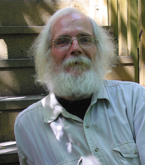
Author. Photo credit, Name
David Clewell

ABOUT THE AUTHOR
David Clewell is the author of a dozen books of poetry, including Taken Somehow by Surprise, The Low End of Higher Things, Now We’re Getting Somewhere, Jack Ruby’s America, and Blessings in Disguise. He is a former poet laureate of Missouri and also formerly a circus laborer, professional weight-guesser, and professional wrestler. He currently labors as a professor of English and director of the Creative Writing Program at Webster University in Saint Louis.

BLURB
“Clewell’s lanky, chatty, extravagant, gimlet-eyed poems would make Ulysses ask to be tied to the mast again, they’re that seductive. This collection not only provides a place to catch our breath—it administers CPR to any disheartened reader.”
     - Ron Koertge

David Clewell
Missouri poet-laureate David Clewell, Webster University professor of English, reads from his collection of poems.
Video:  Webster University


469

DISCLAIMERS

Poems cited here are assumed to be under copyright by the poet and/or publisher.  They are shown here for publicity and review purposes.  For any other kind of re-use of these poems, please contact the listed publishers for permission.

We here at TBOP are technically deficient and rely on our bashful Milo to fix everything.  We received notice from Google that we were using "cookies"
and that for our readers in Europe there had to be notification of the use of those "cookies.  Please be aware that TBOP may employ the use of some "cookies" (whatever they are) and you should take that into consideration.

Sunday, April 10, 2016

Country of Ghost - Gaylord Brewer (Red Hen Press)

Today's book of poetry:
Country of Ghost.  Gaylord Brewer.  Red Hen Press.  Pasadena, California.  2015.


"The earth is mostly just a boneyard.  But pretty in the sunlight."
     - Larry McMurtry

And so begins Gaylord Brewer's hypnotic litany Country of Ghost.  It is not  a small accident that Brewer begins with a quote from one of America's least appreciated boneyard specialists.  McMurtry has put down his own trail of ghosts in his fine body of work.  Showed some pretty fine sunlight as well.

Brewer follows suit.

Becoming Ghost

As you withdraw from the beloved ones,
first in mind, then abused beast of the body
following, you will find speech no longer
plausible. Suggestive turns of hip or shoulder

suffice. The night as long surmised
requires no further recompense. The sweat
of your face, your wetted hair nothing more
than a fevered baptism of exchange.

Fly, wraith. Your secrets mean nothing
to anyone now. Fly to a moon-washed city
of dust and stone. To the cemetery
locked to you, the church undiscovered,

shuttered houses murmuring as you pass.
Ghost breathes on for awhile, sorry nostalgia--
so breathe. If the heart still struggles,
you may share too that fading urgency.

Where were you going? Where you have
arrived of course. Recognize this place
and, perhaps, weep or smile at the knowledge
you pursued. The loneliness found instead,

its barbarism and solace. There, seeker--
crevasse, mountain, flickering shore.
Dark turn of wing. The bridge where you
pause, a last bittersweet time, as you cross.

...

Death does not come easy, not even to a Ghost.  

Ghost is like the rest of us, longing for love, wanting to be able to play jazz piano, wanting to absolve grief.  It's all in here, the aching human need to belong, the bittersweet tragedy of loss.

Brewer knocks 'em down like pins at the end of an alley where he know all the grooves.

Ghost Considers the Altered Nature
of His Sleep and a Consummation to Be Wished

But not sleep as you may recall suspended hours,
not dream as dream per se, pitiless collage
of exactly what you deserved--deserved or not.
Any bed a benign bed now, good enough for Ghost.
The clocks count, wind rises, again it's late.

Lay the burden of thy body down, close eyes
to a story of forgetting, what passed, what never was.
Inhale the night and its useless truth,
no harm now. Here, say, a red canvas, a staircase
descending. There, a piano in a library of babel once

revered as wisdom, the slight hands of a woman
raising a dead man's song from the keys,
lamentation and joy learned by rote. Too,
a bridge, thighs of brick and steel impassive
in the river's filthy, freezing current, body toll rising.

And there: Your wife in her soft coat, waiting
and anxious in the new snow that hides the road.
In other words, Ghost, same ole razzmatazz
of mortal coil, nightly nonsense. What else
distracts during the long darkness that has returned?

Look; She steps forward, the mark of her boots
a white trail announcing her closer, closer still.
Hair wild in her eyes and her face flush and cold. But
she is smiling, she is glowing, ice bows bare limbs
where she passes and the morning light dazzles.

...

Country of Ghost is every country.  It's where you live.  It's where I live.  Ghosts are everywhere.   This particular ghost is a Rahsaan Roland Kirk ghost.  Always more than one instrument at hand, although sometimes he will play two just for the hell of it, sometimes three, absolutely for the hellish joy of it.  Brewer is singing in the dark corners.  Sometimes illuminations comes from the most unlikely sources.

We here at the Today's book of poetry offices almost expected a return of the ghost of John Steinbeck,
or perhaps another ghost.  No such luck.  Gaylord Brewer had the center of the floor today for the morning read.  Milo, our head tech, did his usual excellent job.  Kathryn, our new intern, read them like she owned them, and so on.  As we worked around the room Today's book of poetry realized how sturdy Brewer had built his Ghost, all haunting and hardy.

Ghost Reconsiders the Romance
of the Piano Player

During your life, Ghost, you longed
for the skill, cool and unannounced:
at evening's end, when that moment
arrived, or as surprise life-of-the-party
to those who'd known you forever,

Ghost nonchalantly on the stool, without
preamble tickling a jazzy improv
or just pounding out three blunt-force
minutes of unbridled rock'n'roll
'til you bust the damn thing or burn it.

But now, as you've surrendered
beloved biblioteque where you passed
so many peaceful hours, reclined
on cushions beneath enormous beams
centuries old in their silence, or touching

frayed volumes, opening a cover,
turning a yellowed page to inhale
the musk of its quiet history, as you've
surrendered these pleasures to the pasty
young man arrived without request

as the Bechstein in the window, who taps on
morning and night--a tortured Chopin,
lurching Beethoven to make you glad
for the master's deafness, worst of all
the droning tinker, tinker, tinker

of the mule at the wheel, round and round--
your only recompense, Ghost, is pride
you never took a lesson, practiced only
the muted score of the earth, only,
say, an art of listening, rather than

shitting one's endless noise into every
passing ear that didn't ask for it. Sorry,
all this racket makes a ghost testy,
who just wanted to step out of the rain
without assault of genius--blank-eyed,

slack-jawed, idiot savant light on the savant.

...

Today's book of poetry has always been an admirer of the good Ghost story.  We often think of poems as short movies and with Gaylord Brewer's Country of Ghost we get the range, Ghost memoir to Ghost romance, Ghost history and Ghost comedy.  A poetic film festival.

Country of Ghost can be haunting as a bad dream in search mode, it is constantly perceptive and ultimately we discover we need a Ghost to tell us what it means to be human.

Gaylord Brewer
Gaylord Brewer

ABOUT THE AUTHOR
Gaylord Brewer, a native of Louisville, Kentucky, earned a PhD from Ohio State University. He currently teaches at Middle Tennessee State University, where he founded and for twenty-one years edited the journal Poems & Plays. His most recent publication is a cookbook/memoir, The Poet's Guide to Food, Drink, & Desire (Stephen F. Austin UP, Spring 2015). He has published 900 poems in journals and anthologies, such as Best American Poetry and The Bedford Introduction to Literature.
- See more at: http://redhen.org/gaylord-brewer/#sthash.Sby72DRX.dpuf

BLURBS
Brewer writes as if a sly old god, wounded, lost and yet to renounce his magic. Ghost is a tour de force, part Caliban, part Ariel. Revenant, bored, hungry and amazed, Ghost will be with us ever hereafter.”
     - —Robert Olmstead

In this work of haunting, the possibilities for fruitful speculation and reflection are great. Gaylord Brewer’s poems in Country of Ghost are, at once, whimsical and deeply affecting in their pathos. The many ghosts that inhabit these poems contend with the conundrum of regret, and desire. It takes precise, well-modulated poetry that is alive with metaphor, wicked puns, image, and acutely observed detail to achieve what Brewer does in Country of Ghost.”
     - —Kwame Dawes

The world of feeling that Brewer so urgently describes is complicated and dynamic.”
     - —Asheville Poetry Review

“The poems are eerie, achingly honest, conversational, and beautifully, darkly funny. Even if we are tempted to turn away from the rotting, breaking, bruised, and bleeding body, we are drawn in by the human need, the fragility, the nostalgia, the bittersweet longing of the speaker and his Ghost.”
    - —Prick of the Spindle

Brewer manages to masterfully balance the ordinary and extraordinary. The consequent contrasts and juxtapositions elevate both conditions of ‘ordinariness’ into a kind of equilibrium of the sublime. A trademark Brewer poem: craft, precision, self-analysis, humor, endurance, and a razor-sharp epiphany.”
     - —The Evansville Review


Gaylord Brewer
Meacham Conversations, 22.3.2013
Gaylord Brewer talks with Meacham director Richard Jackson about his experiences with "Ghost," how travel has influenced his writing, his work with fiction and editing, and his growth as a poet.
video: Meacham Writer's Workshop


458


DISCLAIMERS

Poems cited here are assumed to be under copyright by the poet and/or publisher.  They are shown here for publicity and review purposes.  For any other kind of re-use of these poems, please contact the listed publishers for permission.

We here at TBOP are technically deficient and rely on our bashful Milo to fix everything.  We received notice from Google that we were using "cookies"
and that for our readers in Europe there had to be notification of the use of those "cookies.  Please be aware that TBOP may employ the use of some "cookies" (whatever they are) and you should take that into consideration.

Friday, May 29, 2015

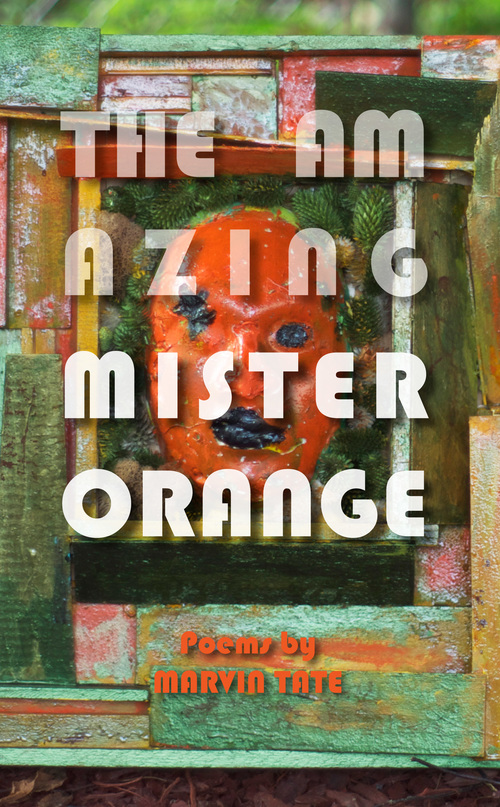
The Amazing Mister Orange - Marvin Tate (Curbside Splendor)

Today's book of poetry:
The Amazing Mister Orange.  Marvin Tate.  Curbside Splendor.  Chicago, Illinois.  2014.


Bird House

I saw a bird fall from its tree house,
into a bed of debris where it instantly died.
A passerby noticed it too and said, don't take it personal,
death can be like that, unexpected and without reason.
She then continued on with her search through all the havoc
and beauty caused by god

..

Marvin Tate is my new guru, if I can track him down.

Marvin Tate is Rahsaan Roland Kirk squealing out perfect melodic beauty laced with the shrieks, squawks and sirens of real everyday life.

Marvin Tate is a shark in shallow water thrashing his elegant discomfort.

Marvin Tate's The Amazing Mister Orange is so down to earth wise that you don't feel the earth shift beneath your feet until you try to take your next step and realize the landscape has changed.  Subtly.

Snitch

The majority of your day is spent peeking out
of your bay window at the day runners changing places
with their afternoon replacements. One of them is the son of an old
girl friend, an irregular booty call, that never amounted to anything
and so you're not surprised to see her youngest and oldest slinging
dope in the middle of a school day. You feel hypocritical in your new
role as sporadic community activist, convinced that their type of
entrepreneurialism is worse and more dangerous than yours could
ever be; you make the call, police arrive, a reality-show spectacle
ensues, and three out of the five are caught. You feel good about
your anonymity; reassured that your role as snitch, weed advocate,
and community activist is on point. Tonight you sleep with the
window open. The street you live on is moonlit. The lookouts and
stickups contemplate their losses - Pharoah's "Deaf, Dumb, and Blind,"
the soundtrack to your dreams.

...

And just so you know -- ANY poet who mentions Pharoah Sanders in a poem is going to get huge props from Today's book of poetry.  First question we ask any intern in an interview at Today's book of poetry is "what's your favourite Pharoah Sanders album?"

End of the interview for those without an answer.

When reading a book for the blog the first time I write a few notes as a reminder.  The second time through I write down the page numbers of the poems I'd like to include.  With The Amazing Mister Orange the side of my page of notes looks like a calendar listing for a month, the shape of a long ladder.

Today's book of poetry is totally convinced, Marvin Tate is a Monsterpoet.

The Amazing Mister Orange (for Ainsworth)

Mister Orange has a habit of pulling down his pants
in public places like at Bauble Land and at open mic poetry readings,
he calls these public exhibitions, "works in progress." I respect Mister
Orange; he's clairvoyant, with an original sense of humor but has
problems dealing with the present. Once he rescued a calico from
being eaten by a finch, by feeding the bird catnip, while the
frightened cat flew into his arms. Outsiders see our friendship as
superficial and exploitative, solely based on if I have any weed or my
willingness to sit through one of his philosophical tirades about
chakra and chanting the word O-YA! This, he reminds me, relaxes the
soul. From his new deck of tarot cards I've chosen the drunken court
jester. I too wish to be carefree, but first (he insists) I must rid myself
of negativity and self doubt. Music from downstairs is playing, the
singer's name I can't recall. Irked by my lack of concentration he
returns to his makeshift bed of nails and levitates. Never have I met
a brother so irreverent and uninhibited. Tomorrow we'll meet
underneath the viaduct or in the park among the dope dealers and art
fucks. I'll try to impress him with the name of the obscure soul singer
while he burns incense to keep away the many evil spirits.

...

These stories, these lovely narrative poems, read like a hit-parade of the best stories your friends have yet to tell you.  They are funny, knowing, witty, sharp, remorseless, confident.

We really couldn't ask for more.  This book kicks it.

Marvin Tate

ABOUT THE AUTHOR
Marvin Tate is a visual artist, author, educator, front man and songwriter. A notorious poet, he has performed widely, including on National Public Radio's This American Life, Def Jam Poetry, The Heartlands in San Francisco, the Chicago Blues Festival and the Eindehoefen Museum in the Netherlands. Tate has also collaborated with longtime multi-instrumentalist and former Wilco member, LeRoy Bach, and singers Tim Kinsella and Angel Olsen for for a collection of songs called Tim Kinsella sings the songs of Marvin Tate with LeRoy Bach and Angel Olsen on Joyful Noise Records (2013). 

BLURBS
“Marvin is the funky genius... Marvin is the writer for this age and his poems help us complicate the normal and ponder the obscene. Somewhere between the poem and the wisdom of Job, Tate offers us another way in, but only if you really want to go with him. Marvin made me a soul singer and a better reader and a fan of being myself and bigger than myself. Marvin’s words help us believe.”
     —Theaster Gates, Jr., renowned Chicago artist

“Walking a dog, apologizing to a lover, recognizing a kindred soul in the gesture of a stranger—these minor considerations and mundane activities open the reader to complex humorous and empathetic observations craafter with the lyricism of a songwriter and the precision of a minimalist. I was reading Marvin Tate and thinking of him in the lineage of Wanda Coleman and other poets who write their poems on the bus and leave them there for other riders in solidarity and care.”
     —Cauleen Smith, filmmaker, Drylongso

Marvin Tate
Def Poetry
"My Life 1959 to present"
video courtesy: dmetrius

345

Poems cited here are assumed to be under copyright by the poet and/or publisher.  They are shown here for publicity and review purposes.  For any other kind of re-use of these poems, please contact the listed publishers for permission.