Showing posts with label maryse holder. Show all posts

Sunday, October 27, 2019

Fresh Pack of Smokes — Cassandra Blanchard . (Nightwood Editions)

Today's book of poetry:
Fresh Pack of Smokes.  Cassandra Blanchard.  Nightwood Editions.  Gibsons, British Columbia.  2019.


Today's book of poetry's first thought, when we stepped back to catch our breath, say about 30 pages in, was that I was back with Billy Hays in a Turkish prison ala Midnight Express.  Fresh Pack of Smokes feels so vividly harrowing and morbidly exciting that you can almost smell the decay and feel the defeat.  Cassandra Blanchard's poems sound more real and honest than Charles Bukowski's sad songs.  And make no mistake, Today's book of poetry still worships Sir Charles the B.

Blanchard isn't so much down and dirty as she is candidly and explicitly blunt, with a burnt sense of humour somewhere near that darkest of blacks, the one that reflects zero light.  Other than Nigerian poets fighting in the rebellion, Today's book of poetry has rarely encountered this kind of literary slap in the face wake-up call.

XXX

I must have turned a thousand tricks over those six years, you name
it I've done it, the perfect whore, young-looking so the men buzzed
around me like bees on honey, you have no idea how many men see
working girls for a quick blow job in the car after work before going
home or taxi drivers or stockbrokers, all kinds like the author of
children's books or the man who was a politician in Native self-
government or probably your boyfriend or husband, there are the
real cold mean ones and the okay ones who were not that bad and I
mostly had middle-aged married white men and I guarantee that you
know someone who has paid for sex; once I did a blow job where he
blew his load in exactly three seconds or the vampire-looking dude
with a foot-long boner that made me almost piss myself, but it's 
always been strictly business, I've been around the block for sure.
At a Quebecois rehab centre, there was the gender rule, no breaking
gender, as in no fucking with either gender and of course I broke that
rule multiple times, at night when everyone was asleep I would slide
into bed with my woman and quietly make her cum, I couldn't not
do it and it didn't help when a chick would get a crush on me, I guess
I had to break the rules, it felt so good to be bad — I've never even
been on a date before, it has always been straight to screwing, I guess
it would be nice to go out for dinner rather than sleeping with some-
one in secret, for two years we were together, the violent psycho and
me, the pushover, but damn we clicked in the sack and everywhere
too like in a semi or on the bus or outside, the only time we got
along was when we were fucking, this bitch was a sociopath, I swear
her eyes had nothing behind them but even though I was in danger
around her, she made me feel safe and made me feel like I was losing
the hamster wheel race, seriously though, I've had enough to last me
three thousand years and that's nothing to be happy about, being for 
sale ain't nothing to be proud of.

πŸ’£πŸ’£πŸ’£

Fresh Pack of Smokes  has velocity, like it is being shot out of a gun.  Every one of these compact prose poems carries the full weight of crack exploding.  Every one of these poems sees predators and police while looking for a safe place to sleep.

Fresh Pack of Smokes assaults the reader's level of comfort in our comfortable world.  All those woman we pretend are invisible when we see them on a street corner, all those women we pretend we don't see as they fall through the crack.  Blanchard gives them a voice.  As Maryse Holder so bravely wrote "Give Sorrow Words".

Streets

It may sound very stupid but there's something about the streets that
always appealed to me, there was a type of freedom where I could do
what I wanted when I wanted whenever I wanted and never be tied
down to one place, the only rules being those of the street, never
staying in one place for long, on an endless journey for more and
more drugs until it became the most important task at hand and I
could not plan anything because I didn't know where I would be in
any foreseeable future and I had no address, however the flip side to
all this was that I was tied up — I was a prisoner and everything that
came with it, I was a coin, each side a cell with thick bars.

πŸ’£πŸ’£πŸ’£

It's a cold, grey morning here at Today's book of poetry.  It's raining "hammers and nails" as Tom Waits once suggested, it's raining as though we were waiting for an ark.  Sunday is always a quiet day in the Today's book of poetry offices.  We're pretty soft about actual attendance as all of our staff are volunteers.

One dear friend and contributor, Otis, flashed by earlier this week.  It was great to see him, he'd been living in Mexico, Belgium and Italy this past year.  No grass growing on that cat.  Today's book of poetry sent him off with an armful of chapbooks (which he paid for, bless his cotton socks), and a big Today's book of poetry hug.  We are always happy to see old friends.

Cassandra Blanchard's Fresh Pack of Smokes is gripping and frightening.  We can't help thinking that there, for the grace, luck, whatever, goes my sister, my mother, my love, and so on.  Blanchard's poems leave no room for doubt.  Any false glamour we might have imagined is sanded down to the ugly survival bone.  Spectacularly squalid stuff, it gets behind your eyes, under your fingernails, these poems make you feel dirty, used.  Blanchard has revealed a dark talent, a beautiful mind that tours hell.

Stars

Instead of calling the ambulance they dumped his body on some-
one's lawn, my father had overdosed on heroin and his so-called
friends were too afraid of the police to try and save his life and so
the cops came to our house and because we were children they
gave teddy bears to us, however I was asleep when the officers came
so I woke up to my sister crying and she said he passed away and I
thought he fell in a ditch, passing away like falling, and so I went to
my mother who was in the shower crying and she told me he was
dead and I understood; my memories are there but there are not so
many of them and some of them I would rather not remember like
the alcohol he was dependent on and the violence that came with it;
he was troubled but he loved us, I look up at the sky and to me he is
a lone star in the ever darkening cosmos.

πŸ’£πŸ’£πŸ’£

Today's book of poetry loved Cassandra Blanchard's Fresh Pack of Smokes and will be on notice for Blanchard's next book.  It's going to be a killer.  This kind of talent and honesty is going to burst the seams somewhere.  Kudo's to Nightwood for putting their ass on the line.

Blanchard burns like she came up with the expression all on her own.  Today's book of poetry is an instant fan.


Cassandra Blanchard

ABOUT THE POET
Cassandra Blanchard was born in Whitehorse, YT, but called Vancouver home for many years.  She holds a BA from the University of British Columbia with a major in gender, race, sexuality and social justice.  Her poetry has been published in a handful of literary journals.  Fresh Pack of Smokes is her first book of poetry.  She lives in Duncan, British Columbia.

BLURBS
There's tremendous pressure on underrepresented artists to diffuse complex stories so they may be made more easily understood and consumed by the mainstream. Debut author Cassandra Blanchard's unapologetic, immersive and veracious voice cannot be diffused! Her prose poems stand bold and true on the page, with barely a stanza break to mitigate their power. I am honoured to stand with her poems — I've been a big admirer of Blanchard for years.  Read Fresh Pack of Smokes and become an admirer too.
     — Amber Dawn

This is a book, ultimately, about dignity. These poems spill over like a sentence as long and relentless as a lifetime. Grasping for what feels fleetingly like a normal life, the narrator instead wrings words from blood. This is a book of a city that is everywhere, of policing, of using, of survival that is all-consuming, of fear and pleasure and hallucination that are three sides of a coin. This is a book about the wisdom of not caring and yet the pain of still doing so.
      — Ray Hsu

Truly distinctive in vision and voice, Blanchard's Fresh Pack of Smokes probes the pain and elation, the silence and clamour, the confinement and the freedom of life on the street. The power of Blanchard's poetry arises from its rare combination of raw honesty, remarkable detail and spiralling accumulation, producing a collection  that is as difficult and unrelenting as it is exceptional, necessary and wise.
     — Daniel Scott Tysdal

793


DISCLAIMER
Poems cited here are assumed to be under copyright by the poet and/or publisher.  They are shown here for publicity and review purposes.  For any other kind of re-use of these poems, please contact the listed publishers for permission.

We here at TBOP are technically deficient and rely on our bashful Milo to fix everything.  We received notice from Google that we were using "cookies"
and that for our readers in Europe there had to be notification of the use of those "cookies.  Please be aware that TBOP may employ the use of some "cookies" (whatever they are) and you should take that into consideration.

Wednesday, August 1, 2018

Pressed Against All That Nothing — Cody Deitz (Yak Press)

Today's book of poetry:
Pressed Against All That Nothing.  Cody Deitz.
Number One - Native Blossom Chapbook Series Two.  Yak Press.  Littlerock, California.  2015.

Poems by Cody Deitz

Take note, if Today's book of poetry gave out stars, today we would have to give them all to Cody Deitz.  Pressed Against All That Nothing is nothing short of extraordinary.  

Cody Deitz does a bunch of things in this marvelous book, but mostly Today's book of poetry thinks Deitz shows his brother true love and devotion.

These poems don't just "give sorrow words," as Maryse Holder would have said, they are both a vivid poetry accounting of harrowing personal losses, and a lovingly detailed account of the strength of a brother's love.  Deitz writes both about his brother's addictions and his incarceration but always from a loving and accepting terra firma.

Joshua Trees (Yucca brevifolia)

               for my brother, and R.G.

In the great expanse of sky
                                        and nothing,
we pass cigarettes back and forth:

the only holy incense we know,
timid offerings to the teenage gods of rebellion and getting lucky,

each sacramental stick carried
out into the desert—where else do sacraments belong?

Brothers, we share apathy,
exhaled through the nose,
                                 staining clothes and fingertips vanilla.

From the depths of our chests,
each streak of smoke flies off
like a pale crow.

I'm nostalgic for a past that doesn't exist
in a town that was never real,

and though it's still years to come,
                                                 and now, we're still in this together—

I can already see me getting out of this place and you standing alone
out in the Joshua trees, pressed against all that nothing.

πŸ’«πŸ’«πŸ’«

Deitz never loses hope for the reappearance of his lost brother and he understands that this battle doesn't always have a victor.  The emotionally fraught landscape of these poems is one where the family of an addict endure, suffer, wait.  

The canvas Pressed Against All That Nothing appears on is mined with dangers both unseen and predicted.  And as much as Deitz fears his brother may never return from his abyss, Deitz never loses hope or faith.

Cody Deitz is one hell of a marksman because every single poem in Pressed Against All That Nothing hits the target right in its blood-red centre.  Today's book of poetry is here to tell you that Deitz is more than a fine marksman, he consistently hits targets that only moments ago were invisible.

Hindsight In Six Parts

— 

July evening, mid-summer drought
                                      like always, and windy.

A red-tailed hawk updrafts foothills nearby,
                                                      just hunting for mice,

and you're not sober yet—the leaves wait to turn
and let gravity take them, the earth waiting—

But you haven't yet lost your sense of being alive, either,
                                                     the shudder and cringe of it,

as you wait again for a car to drive you into the night.

—

You have yet to be left in the desert

while mom and dad fly off—
the tired nest finally pulled out from under you.

Your room is still your own, a cluttered installation:
video games, tissue boxes, cheap watches that hold their breath—
                                            things not yet sold for Vicodin and rum.

The floor strewn with empty Marlboro packs,
                                                         their many tiny gaping mouths.

—

You have yet to be picked up in the night,
pulled from that red-eyed neighborhood,
                                              your freedom left on the roadside.

Your car emptied of plastic bottles, pinhead knot of resin,
glass pieces with bowls like small translucent moons:
                                         small catalog of municipal reckoning.

It will sit empty in the weeds for months,
mechanical ghost
              of your leaving.

—

You've yet to be bussed downtown
and left in Men's Central,

locked away for months in psychiatric,

        (How will you keep warm in that heat-sink,
          angry architecture?)

where you will freeze in your powerlessness,
its democratic pain.

The prison windows are tall, narrow eyes
                                             that look out into nothing.

—

You have yet to learn in rehab you've carried sickness for years,
an illegible letter, chicken-scratch diagnosis.

You haven't stood beneath the streetlight amber,
                                             watched the smoke rise

from the coffee-can ashtray, carcinogen bloom,

cigarette butts wrinkled petals wedged
into that strange bouquet nobody sent.

—

Now you stop your car on 65th street,
sleeping houses on one side,
                    tumbleweeds and dark on the other.

You load a bowl and look out, considering all that grows
                                                                  without sustenance:

Joshua trees and juniper amazingly green without a breath
of water for weeks, their heads tall and stoic in the desert chill—

you read once, of their root structures,
                         everything connected so nothing slips past.

πŸ’«πŸ’«πŸ’«

Today's book of poetry has been behind the wheel of car for six of the last seven days and still feels the wind whipping past.  As a result, we aren't moving very much, or very quickly, today.  But Today's book of poetry was so taken by Deitz's Pressed Against All That Nothing that today's office reading was a solo shot.  The entire staff sat stone silent while I whipped through Pressed Against All That Nothing as though it were something of my own creation.  I should be so lucky.

These poems felt so tight I could barely get the pages apart.  These poems were so ripped with magic Today's book of poetry didn't know whether to spit or wind my watch, they just worked.  Cody Deitz is in Master Chef territory, he's so good in the poetry kitchen you can smell his burn from every direction.

Habit Of The World

          Don't take it personal, they said;
          but I did, I took it all quite personal
                        -Tony Hoagland

The jacaranda tree at the end of my street
has been losing itself all week,

dropping its amethyst and lavender
all over the sidewalk, while spring burns off like fog
                                       and the sky looks blue and determined.

It's easy to take it personal—this undermining of permanence,
                                                                   this habit of the world.

πŸ’«πŸ’«πŸ’«


Cody Deitz gives his brother every opportunity to come home again but as Thomas the Wolfe so aptly told us, you can never do that again.  

Today's book of poetry fell in love with how far Deitz was willing to go in his brother's name.  As it turns out Deitz is willing to go as far as it takes, these poems are a full-fledged love song to his flawed and beautiful sibling.

Deitz knows that being straight is a good thing but it is not the only thing.  Some of us have other dreams.

Image result for cody deitz photo

Cody Deitz

ABOUT THE AUTHOR
Cody Deitz, a California native, now resides in North Dakota where he is pursuing his PhD. in English at the University of North Dakota. He is fascinated with poetry of place, and how geography informs individual experience, seeking in his work to explore this connection and the insights it affords.

BLURBS
Cody Deitz understands something about interiority—that ‘the subconscious is always a terrain’—and he fluidly moves between the psychic space of the shared dark and that brighter horizon where ‘the sun becomes the symbol it always wanted to be, / that slippery metaphor for god, shooting into the well’s eye.’ These are poems of addiction, recovery, fraternal love, and a Ginsberg-like faith that there is salvation in poetry. The genius of Cody Deitz is in his intimate, meditative act of witness, far-seeing yet detailed. He offers an undeniably unifying force of human spirit where we learn the pain and possibility of ‘unmaking. . .the terrible.’ Like the ‘steel refrigerator / with its cord buried in dirt,’ these poems, too, seem ‘plugged. . .into the world.’ ”
     ~ Leilani Hall, author of Swimming the Witch  

“Cody Deitz’s collection documents a brother’s disappearance into addiction, a black hole around which the family spins. After stints in prison, psych care, and rehab, he reemerges barely recognizable — a figure that, like Zeno’s paradox, the speaker can never fully reach, ‘the idea of progress // suddenly unfathomable.’ These events are embodied and presented in vivid, resonant details: Joshua trees, shoe prints in desert sand, the mouths of empty Marlboro packs, the crackle of a prison telephone. In his precise and yet discursive verse, Deitz’s poetic attention is ‘More than turning on a light—it’s becoming // the bulb and the switch and the finger. . .’ ”
     ~ Heidi Czerwiec, author of Self-Portrait as Bettie Page and A is for A-kΓ©, The Chinese Monster 

“Cody Deitz’ work is a live wire snaking over the asphalt of lyrical poetry, though the hum of his words never rises above the electric din: instead, it is the reader who reverberates with recognition in the mechanical ghost Deitz creates out of his stark architecture. The invisible cord of his words will become a nightlight in a forever-darkening sky, will conduct electricity against this fleeting urban solitude. His poetry is a voice that both reassures from the hallway and echoes back to you in a strange rhythm, as you lay safe and pressed against all that nothing.”
     ~ Gina Alexandra, MFA candidate, UCSD


Cody Deitz
reads from
Pressed Against All That Nothing
Video:  YakPress


709


DISCLAIMERS

Poems cited here are assumed to be under copyright by the poet and/or publisher.  They are shown here for publicity and review purposes.  For any other kind of re-use of these poems, please contact the listed publishers for permission.

We here at TBOP are technically deficient and rely on our bashful Milo to fix everything.  We received notice from Google that we were using "cookies"
and that for our readers in Europe there had to be notification of the use of those "cookies.  Please be aware that TBOP may employ the use of some"cookies" (whatever they are) and you should take that into consideration

Sunday, July 30, 2017

The Corpses of the Future - Lynn Crosbie (House of Anansi)

Today's book of poetry:
The Corpses of the Future.  Lynn Crosbie.  House of Anansi.  Toronto, Ontario.  2017.


Such tenderness amid so much sorrow.  Lynn Crosbie has done that most difficult of things, she has learned, as Maryse Holder insisted upon, to "give sorrow words."  The Corpses of the Future is bursting at the seams with stunning poem after exhilaratingly sad poem.  Crosbie is documenting the demise of her father as dementia drags him incrementally further away day by horrifying day.

Crosbie is singular in her pursuit of whatever dark truths lay ahead -- she is steadfast but lost in the memory of her fully functioning and much adored father.

Slainte Mhath

For David McAskill

The visits have taken on an orderliness that I imagine prison is like, odious and
conciliatory in its steadfast regimen.

What must it be like for him, his mind attacked like a painting altered
with swipes of turpentine, then left exposed.

There are fields of his childhood, alive with tiny raspberries, sharps sticks and
slowpoke turtles, bleeding into his hoodlum teens.

Did you actually rock around the whole clock, I ask him, when my sister suggests
we play his fifties record.

We rocked until the girls said they had to go, or we were too drunk, he says, and
remember vomiting at a party, spills of yellow and green.

A through line of parties with David, his partner in crimes, who visits this August
with a stack of bitter chocolate, and stories my father sits up and shares

Of a detested colleague whose plant Dave sprayed every morning with DDT until
the man wrenched the tended-to, maddening thing into the trash, spiking the
     earth with

A pencil that Dave began treating with paint remover: Nothing can grow in this!
the man despaired,

An open can of sardines left in a heating duct during another colleague's vacation;
hours billed to big steaks and tall beers:

He signs his letters with the Gaelic words for Cheers.

One day later, my father forgets that we were there, but he is desperate,
the heavy bear howls for the bars of chocolate.

He doesn't remember seeing me, but he never forgets who I am,
the most besieged of his platoon, and the most enduring: You're just like me,

He says, and my brother holds his head with infinite tenderness and shaves him,
and I lead him back to bed, in my mind I am lifting him again and he is holding on--

Like Anchises as we stagger through the burning city.

In the very centre of the painting we are untouched by ruin: we are five, furious
and suffering and madly in love.

...

It's a hell of a thing to see your father disappear in front of your eyes only to be replaced by a unfamiliar familiar inhabiting his flesh.  Today's book of poetry has seen this movie from the front seat and it was crippling.  Crosbie has made it art.

This level of honesty could be considered reportage but the uber-talented Crosbie makes it all personal and universal with one sweep of her talented pen.  We survive this painful litany only because Crosbie leads us through.  We get to observe our worst parental fears writ large on someone else's sad canvas.

Elba

My father asked for peace and quiet for his birthday and for Christmas and Father's 
Day, every year.

I want to live like Napoleon, he said. Exiled in silence on my Elba.

In their early fifties, my parents moved to Curacao, one of the ABC islands, just
north of Venezuela.

He worked for some Dutchmen there, moving money around, and my mother
volunteered at an orphanage.

They went to church every Sunday: one Christmas Eve, my father asked my
sister and me to go to the early-morning Mass.

We declined and he offered us money. I'll give you fifty, no, one hundred guilders.
Has it come to this? he said.

They stayed for many years, and on our last family visit we sat at the beach and
watched the sun go down.

Dad disappeared and I went off to find him.

He was sitting in a rowboat, also watching the sun cannonball into the water, in a
great violent splash.

The boat was called the Elba, I noticed.

He had put his shoulder to his dreams. Dad, why won't you get better?

In Curacao, there are hundred of stray dogs, all of them big yellow curs--
fireworks are set off on every holiday,

Huge repeating rockets, poppers, sparklers and shells.

This terrifies the dogs and in the morning you drive the fast streets and keep
swerving,

There are so many dead dogs on the road, who ran there, out of their
minds with fear, only to be struck,

To be battered and ground into peace, then quiet.

...

Somehow, Lynn Crosbie forgive me, it seemed the right thing to do, so this morning during our production meeting I had Milo, our head tech, play Amy Winehouse's astonishing album Frank on the office speakers.  There is absolutely no correlation of narrative between Winehouse and Crosbie, but emotionally Winehouse strives for the same sort of dark clarity that Crosbie insists upon.  

Or maybe I just wanted/needed to break a little of the tender tension in the office.  Today's book of poetry couldn't help but notice the sudden run on phone calls to parents after this morning's read. 

Crosbie writes poems like dominoes, one as solidly constructed as the next, each one solid enough to stand on its own, each one a building block.  Her poetry machine punches these, fully formed, out like clockwork.  The Corpses of the Future comes in at a hefty 140+ pages and there's nary an unnecessary poem.

Lynn Crosbie poignantly goes where we all fear to be and does it with unflinching honesty.  The Corpses of the Future  isn't just a pained tribute to her father, it's a primer for the rest of us on how love overcomes pain.

For the Person Suffering

From dementia, it is traumatic to relive certain events over and over. As such, certain
topics should be avoided--

This is how I started lying to my father.

I read an article by a Dutch doctor, which instructed me never to say, No, Dad,
your mother has died,

To watch his face crumple in confusion and pain.

This spring, when he asked me about our bets on the horse race, I made up names
for the runners, and he added Hurry up Honeybun to the list:

One hundred on the nose! he said.

Later I would try to register the name, and get into an awkward, meretricious
conversation with a horsey sort located outside Leeds.

Today, tired as ever, I listened carefully to my father's story about the football
game.

He was taking me to see the Alouettes versus the Roughriders, but could I call
about the tickets?

Of course I can, I said.

I'm on this damn boat, he said, and I told him I would send Mom the information.

They think I have some illness, he said. Expialadocious.

I repeated the word, as though writing it down.

We've never been to a game before, I said, feeling winded from the little smacks to
my heart.

I want to take you, he said.

He and I are in a fall stadium, drinking spiked coffee as he explains the rules of
football.

We are wearing Als hooded sweaters and once in a while his arm presses against
mine and I double over in pain, reliving the very thought of my father.

Wanting to take me to a game.

...

Today's book of poetry had Milo go to the stacks and he came back with the following:  Miss Pamela's Mercy (1992), VillainElle (1994), Queen Rat (1998), Missing Children (2003) and Liar (2006).  Which reminds us that we are big fans of Lynn Crosbie here at Today's book of poetry but now realize we have some catching up to do on the Crosbie canon.  

The Corpses of the Future could be the crowning achievement of any excellent poetic career but Today's book of poetry is pretty sure Crosbie is just getting warmed up.  The Corpses of the Future will reverberate in the ear of every reader with aging parents, and that is most of us.

This book will be remembered.

Image result for lynn crosbie photo
Lynn Crosbie

ABOUT THE AUTHOR
Lynn Crosbie was born in Montreal and is a cultural critic, author, and poet. A Ph.D. in English literature with a background in visual studies, she teaches at the University of Toronto and the Art Gallery of Ontario. Her books (of poetry and prose) include Queen Rat, Dorothy L’Amour, and Liar. She is also the author of the controversial book, Paul’s Case, and most recently Life Is About Losing Everything and the Trillium Book Award-nominated novel Where Did You Sleep Last Night. She is a contributing editor at Fashion and a National Magazine Award winner who has written about sports, style, art, and music.

houseofanansi.com

592

DISCLAIMERS

Poems cited here are assumed to be under copyright by the poet and/or publisher.  They are shown here for publicity and review purposes.  For any other kind of re-use of these poems, please contact the listed publishers for permission.

We here at TBOP are technically deficient and rely on our bashful Milo to fix everything.  We received notice from Google that we were using "cookies"
and that for our readers in Europe there had to be notification of the use of those "cookies.  Please be aware that TBOP may employ the use of some "cookies" (whatever they are) and you should take that into consideration.

Wednesday, November 23, 2016

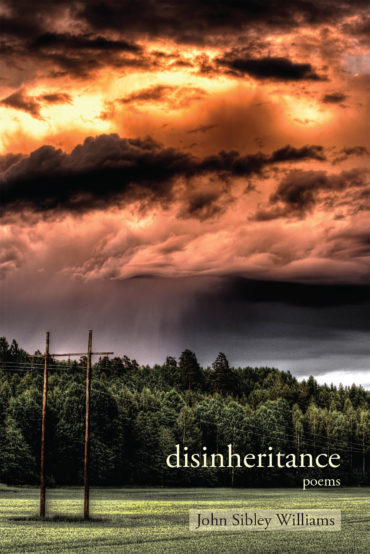
Disinheritance - John Sibley Williams (Apprentice House Press)

Today's book of poetry:
Disinheritance.  John Sibley Williams.  Apprentice House Press.  Loyola University Maryland.  Baltimore, Maryland.  2016.

9781627201315-Disinheritance-COV.indd

Disinheritance by John Sibley Williams is an epic cannonade of grief that echoes with the howls of the bereaved and the callous innocent whispers of the dead.  Williams says it right out loud in his poem Procession, Disinheritance is Williams coming to terms with "This dazzling confederacy of losses."  

Williams is deep into some desperately sad glamour but the reader connects to this urgent melancholy as though it were our own.  Williams is touching our deepest fear, the loss of one of our beloved.

A Dead Boy Speaks to His Parents

        Hush now:

you don't have to be              anymore.

Whatever script you'd written for the stars to follow, they've missed
their marks,
gone true right               instead of stage right.

Nightly, you whisper:
ever since                      perhaps because              or even before --

but you don't have to thread cause through effect

or rummage through whatever beginnings you've captured on film to
discover a fixed point of departure.

The zeotrope continues to spin                     without image.


           Mom and Dad:

you don't have to be                       contained anymore

between the lines I never had time to write
on the stars                        that don't listen anyway.

...

Banshee screams reverberate in the quiet sorrow Williams has invested in these poems.  The loss and unimaginable emotional fatigue that underscores the restrained madness of grief is writ large in all these poems yet they never weigh us down completely.  John Sibley Williams has "given sorrow words" to quote Maryse Holder - another writer who knew everything you get to know about loss.

These poems touch our hearts at the same time as they wrench our stomachs and pull at our throats. Ghosts reach out with their ghostly cold hands to offer some solace but the revenant have no skill at holding back grief.

Things Start at Their Names

Ice locks the river in place and my heart
is static for the season and traversable.

Sometimes a boy about the age
my son would be adventures

half way across me before remembering
the duty to destroy the one thing

beneath him. He writes his name
on my rib; it says Curiosity. I reply

with the name I've learned to wear:
Distance. A fluster of bluegill follows his body

downstream to where it meets the Columbia,
in time the ocean, which I cannot make freeze.

Next spring I will snare the things that still in me,
beat them against stone, and eat until empty. I have

his name written all over my body; it say Forever
be Winter. My wife calls him Gabriel; after all these years

she still calls him Gabriel, and sometimes from the shore
she calls to me: Thaw.

...

To say that this morning's reading was a somber affair would not be going quite far enough.  Tears were shed.  John Sibley Williams seems determined to unleash a quiet emotional fury on the reader and is entirely successful, everyone in the office "liked" the poems, much admiration was expressed, shared glances. muted looks.  Reading Disinheritance will wring your heart right out of your chest.

So how does Today's book of poetry say I like something so sad?  For the same reasons I like sad songs, I am touched.  Williams builds tension like he was stringing a piano, everything is tight.

A Dead Boy Fishes with His Dead
Grandfather

The fish have broken the line again, Grandpa,
and everything we've held runs silver through our hands,
and out. Across the never-ending surface: disruptions and
echoes, waves our crooked fingers cannot flatten.
Our lines travel without us. You and I and the lives we must end.

But not today.
Today we've lost the death that keeps us.

Today we reverse: you are my child and I will love you
for the childish stories I've heard.
About the dead you cannot erase,
muddied uniforms and flags marked by the smallest red suns.
About how Grandma combs the long-dried blood
from your thinning hair, with her thinning hand.
About how each kindness is a reason to remain unpardoned.

How memory writhes below skin and is its own decision:
devour or release.

I will decide to love the empty hook of your body,
like a warning, your hands--
where they've calloused and where they've healed.
Today I will pretend to understand

why you cry like a knife stroke when I throw you back.

...

Grief can be overwhelming and terrifying and Williams isn't letting anyone out the exits without a heartscorch.  Disinheritance is a pained pleasure, compelling as it is discomforting.  This is wicked good writing.

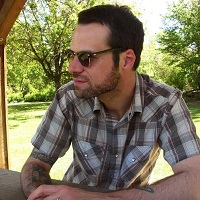
Image result for john sibley williams photo
John Sibley Williams

ABOUT THE AUTHOR

John Sibley Williams is the editor of two Northwest poetry anthologies and the author of nine collections. A five-time Pushcart nominee and winner of the Philip Booth Award, American Literary Review Poetry Contest, Nancy D. Hargrove Editors’ Prize, and Vallum Award for Poetry, John serves as editor of The Inflectionist Review and works as a literary agent. Previous publishing credits include: The Midwest Quarterly, december, Third Coast, Baltimore Review, Nimrod International Journal, Hotel Amerika, Rio Grande Review, Inkwell, Cider Press Review, Bryant Literary Review, RHINO, and various anthologies. He lives in Portland, Oregon.

BLURBS
“In John Sibley Williams’ “amalgam of real /and fabled light” one is able to believe again in the lyric poem as beautiful—if difficult—proof of private space. Disinheritance contends intimately with loss, to be sure – but it also proposes the poem as a way to remember, to persist, to be oneself, to believe. And to persist when belief may not be possible within the bounds of the shores the seas impose upon us.”
     —Joan Naviyuk Kane

“There is eternal longing in these poems of John Sibley Williams. A yearning for what cannot be understood. A song for what simply is. A distance beyond human measurement. A series of profound losses giving birth to words no different from medicine.”
    —Zubair Ahmed

“There is a hunger in these poems, one of an empty handed wise man who wants to sing. And sing he does. Let these poems sing to you too. Let them hold you in that raw place of hope, let them be ships mooring us to the wild / bottomless sea.”
     —Daniela Elza

“In John Sibley Williams’ moving, somber collection, the power of elegy, reverie, and threnody transcends the disinheritance caused by separation. These compellingly atemporal poems form the locus wherein generations of a family can gather. Here, Williams’ lyric proto-language—elemental, archetypal, primordial—subsumes barriers of time and space. His poems create their own inheritance.”
     —Paulann Petersen, Oregon Poet Laureate Emerita
Daniel Klawitter, author of A Poet Playing Doctor and An Epistemology Of Flesh, reads the poem Sanctuary from John Sibley Williams' poetry collection Disinheritance.
Video: John Sibley Williams

527

DISCLAIMERS

Poems cited here are assumed to be under copyright by the poet and/or publisher.  They are shown here for publicity and review purposes.  For any other kind of re-use of these poems, please contact the listed publishers for permission.

We here at TBOP are technically deficient and rely on our bashful Milo to fix everything.  We received notice from Google that we were using "cookies"
and that for our readers in Europe there had to be notification of the use of those "cookies.  Please be aware that TBOP may employ the use of some "cookies" (whatever they are) and you should take that into consideration.


Thursday, January 21, 2016

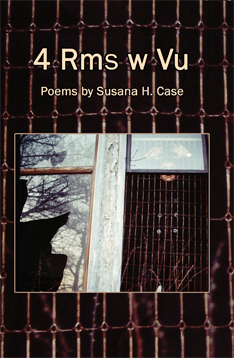
4 Rms w Vu - Susana H. Case (Mayapple Press)

Today's book of poetry:
4 Rms w Vu.   Susana H. Case.  Mayapple Press.  Woodstock, New York.  2014.

Susana Case - 4 Rms w Vu - front cover

There is nothing better than the powerful whisper-blow of Ben Webster's tenor and that is what we are listening to this morning in the Today's book of poetry office.  It's -19 C or some other ungodly temperature outside.  Every time Milo and I want to have a smoke we have to bundle up like explorers.  We both end up looking like kids going off to kindergarten, everything but mittens on a string.

But now that we are back here in our warm office and listening to Ben we can tell you why we are excited by Susana H. Case and her utterly vibrant 4 Rms w Vu, although given any sort of chance Case would handle that with aplomb.  Case writes our kind of poetry.  Her poetry is down to earth, wildly emotional but almost controlled, anarchy of the best kind.

And Now Let's Revisit Sex and Death

Getting into bed with you,
it's afternoon, my mind on play,
I'm wearing chiffon, I'm grinning
like the cows have already come home
for me when you say,
could you take a look at my lip -- I'm thinking cancer,
which of course stops the whole thing dead
while we go to the lamp
get you angled right and yes,
there's something there, could be anything,
there's a definite thing that doesn't belong,
like a dog in a tree
and you couldn't know the number of my women friends
whose men are no longer here,
how it always starts with,
could you look at this bump on my neck, this spot on my leg,
as if any of us had expertise in more than fear and rage,
rage because you just had to wrap your lips
around your smoke, didn't you, instead of around
some more compliant part of me,
always this conjunction of sex and death,
it's like the good twin hopelessly
sharing a brain with the evil twin,
the one who pops open a beer,
whispers, go ahead--light the match--mess it all up,
through nicotine-yellow teeth, the one
who makes me think that if you're ill,
I'll shoot you myself, kill you right now
for carelessly leaving me in this fucked-up place alone.

...

Case has no problem leading with her heart but be careful because she is coming for yours and she is a take-no-prisoners poet.

4 Rms w Vu takes the reader to the steppes of Kazakhstan, the Adirondacks, a car accident in Kansas and  a new apartment in New York City.  The last Inca ruler plays a part and so does Charlie Parker.   Susana H. Case is an equal opportunity poet.  But regardless of the setting she is always aiming for some new truth, a better understanding of the tumultuous relationships that make us human.

While Case is striding through all this scenery the important consideration is how engaged you become as a reader, how invested you become in the outcome.  Case is all about relationships but has no trouble at all blowing them up to get a better look at what was inside.  And we get to go along for the frenetic ride.

Girls You Could Love

girls you could fuck
and straddle-both-world girls
like me, you showed off

to your friends. Peaking early
girls. Peaking late. Prom queens.
Science girls. Nasty girls.

Straight-A girl with my intricate
knowledge of each protrusion, slit,
crevice. Don't forget the stockings,

the heels, you'd say, fetish boy
with your dual-career
parents, your empty house,

housekeeper who pretended
not to notice, the gilt phones I laughed
about to my friends. So good to be

inside you--or--you
inside me. I got so lost in it. My parents
who devoured relationship

books frowned, symbiosis
--a big word for us, fat
on the tongue--and yes,

I thought I'd crumple without
you, but also knew to direct you, slowly
run your hand up here, along the 15 denier

nylon you had so crazily fixed upon. Little
garter button indents red on my thighs
that read: the one with these legs

knows exactly how to want.
Anyone who thought the power was yours
really didn't understand.

...


Case is trying, quite diligently, to break down all impediments to the truth in these narratives.  These poems hit like a wrecking ball.  4 Rms w Vu reminds us here at Today's book of poetry of Maryse Holder's Give Sorrow Words, if only for a moment.  Case has some of the same intensity of emotional clarity and frankly, some of the same female anger that compelled Holder.

That's not a bad thing at all.  

Today's book of poetry loved Give Sorrow Words and we are quite fond of Susana H. Case at the moment, we have nothing but admiration for any poet who is willing to put it all on the table.

Incantation

The best thing to die from is living.
Let me kill myself slowly with pleasure.

Let me dance round and round in circles first.
Let me blow a lot of fuses.

Let me age like a good slab of steak, tender
with the mold trimmed. Let me be

a car going 80 miles per hour.
Let me reach 80--the exquisite

torture of those many years is compelling.
Let them not be Chaplinesque. Let them say

she never knew what hit her. Let it be like
the one James Dean got, only much later.

Let me not surrender to humiliations.
Let me end when my mind, still sharp,

is somewhere else--dreaming of perfectly
grilled lamb, the rosemary perfume so strong,

it could be sealed in my pillow, of hot sex,
and let that be not so long gone

that it burns like a bad joke. In the valley
of the shadow of death, I'd still like

my red lipstick please. Let my breasts not reach
my waist. Let there be very little

scar tissue on me at the time and
let there be a weeping willow, under it

a significantly younger man,
my own little honey cake, who is weeping,

too--thought I don't wish that on him for long,
He'll have a life to live.

...

Is a good life possible?  Today's book of poetry thinks so and so does Susana H. Case, she just makes it clear it won't come easy or without bruising.  It might leave a scar.  Just like these poems.

Susana H. Case

ABOUT THE AUTHOR
Susana H. Case is a Professor and Program Coordinator at the New York Institute of Technology. Her photos have appeared in Blue Hour Magazine, pacificREVIEW, and San Pedro River Review, among others. Author of several chapbooks, her Slapering Hol Press chapbook, The Scottish CafΓ©, was published in a dual-language version, Kawiarnia Szkocka, by Poland’s Opole University Press. Her previous books of poetry are: Salem In SΓ©ance (WordTech Editions), Elvis Presley’s Hips & Mick Jagger’s Lips (Anaphora Literary Press), and Earth and Below(Anaphora Literary Press). Please visit her online at: http://iris.nyit.edu/~shcase/.

BLURBS
The poems in 4 Rms w Vu, like most of Susana H. Case’s work, demand full participation—no watching here—that we live in their apartments, wear their clothes, down to the “denier nylon.” At the end we’re a little shaken, but a lot wiser. Susana is a daring poet, not so much for the sake of issuing challenges, but more to the cause of poetry itself; she defies one to bring the whole body and soul, and deny no part of this experience called living.
     – Mervyn Taylor, author of The Waving Gallery
4 Rms w Vu is a poetic open house in which Susana H. Case guides us through the rooms of the heart. In poems addressed to husbands, lovers and parents, Case shows how the past, the curious details of daily life and wonderings about the future all weave together endlessly, how nothing is ever really lost—not a loved one, not a hurt—if you can remember. In her moving new collection, we see how this poet’s art is an act of holding on in language that is sure-footed.
     – Matthew Thorburn, author of This Time Tomorrow

Susana H. Case’s 4 Rms w Vu superimposes an intricate map of a lover’s mind on the floorplan of a New York City apartment in poems that never shrink from the “weep and stink
of everyday brutality.” Moving from room to room and year to year, 4 Rms w Vu passes through meditations on life with dogs, the metaphysics of lipstick, and the peculiarly American primal scene of the isolating, moving, colliding car, in square footage inhabited by a woman with the brio to ask, as final prayer — “Let me blow a lot of fuses.” 
     -B. K. Fischer, author of St. Rage’s Vault

In these poems, Susana H. Case captures a vision of New York that can no longer be seen but in memory. Filled with characters frenzied by love, desire & hope, 4 Rm w Vu reminds us not only where we’re from but also who we are. 
     -Gerry LaFemina, author of

Susana H. Case
reading her poem "Copiapo" from 
the poetry anthology "Rabbit Ears"
video:  Rabbit Ears TV


428