New York, 1960. Barry Gifford. Curbside Splendor. Chicago, Illinois. 2016.
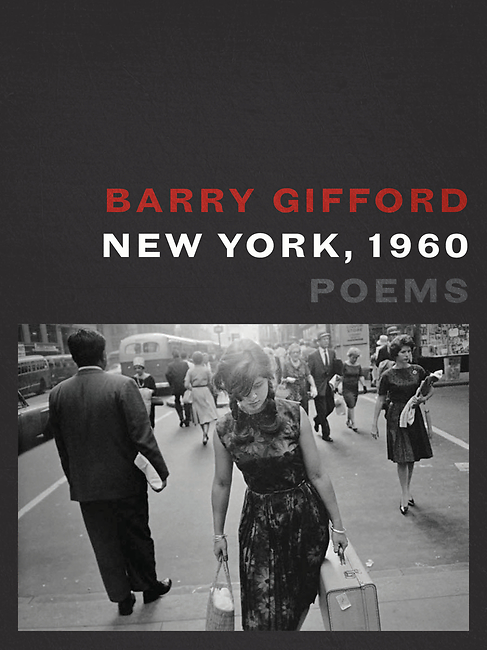
All the big themes are in here. Death and dying, romantic love and loss, Barry Gifford is all over them. New York, 1960 is part memory exercise and part dream catalogue.
Mexico, Argentina, Rome, San Diego and so on, they are all in New York, 1960, so is Sumatra along with her tigers and orangutans. Barry Gifford's New York is an all encompassing grand tour of a place and time that can only exist in poetry world.
The Unconquered Flame
Both the actress Hedy Lamarr
and the writer Clarice Lispector
outstanding beauties in their youth,
believed, as Lispector wrote,
"it was ugly to go out when one
was no longer young."
Still only in their forties
they hid themselves away, wishing
to be remembered as they had been.
My mother, also a great beauty
into middle age, felt differently.
She was relieved, she said, to not
have to bear the burden of being
looked at. "I was frightened
by the thought of others wanting
to possess and destroy me."
Nevertheless, she never stopped
asking those closest to her
how she looked.
One night,
in the Bar Chicote in Madrid,
in the company of a famous
film director and an actress
considered by many to be among
the most beautiful women
in the world, I was admiring
a photograph on a wall
of Ava Gardner at her loveliest
drinking in Chicote
with Ernest Hemingway
when the actress asked me who
I thought was more beautiful,
she or Ava Gardner.
"What an impossible question!"
said the director. "Don't answer,"
he instructed. "If you choose Ava,
this one will hate you, and if you
choose her, she'll know you're lying."
I looked at the actress.
"Please lie," she said.
...
In a brief final section of New York, 1960 titled "The Lost Graveyard Poems" Gifford visits the final resting places of Apollinaire, Proust, Balzac, Oscar Wilde, Baudelaire and Ezra Pound. Although these are cemetery odes they read less eulogic and more like a fancy tip of the hat. Gifford, like the rest of us, writes about his heroes to bring them closer.
Gifford has the sophisticated demeanour of one who has seen it all. New York, 1960 reads smart and crisp even when Gifford is playing the agent provocateur.
In his poem "Dinner Conversation" for example, he riffs between Albert Einstein and Rabindranath Tagore as though they were in New York right now, talking about current events. Gifford is persistent and persuasive and funny as hell.
Dinner Conversation
Albert Einstein, the Swiss physicist,
and Rabindranath Tagore, the Indian poet,
met at a banquet in Princeton, New Jersey, in 1931.
"Tell me, Tagore," said Einstein,
"did you get hurt much in the crash?"
"I was lucky, Albert, I got out in '28. And you?"
Einstein shook his shaggy head, grinned
like a tiger, and said, "My wife keeps the cash.
She doesn't trust the market or banks, either.
Our savings are in a suitcase in a hotel vault."
"But you're Swiss. I'd have thought you'd keep
your dough in a bank over there."
"They charge too much," said Einstein. "The hotel
fee is peanuts, and this way I can get my hands
on the case in a hurry."
"What are the odds the economy recovers this year?"
"That won't happen until the next war, Rabi."
"So what do you advise?"
Einstein patted the poet on his right knee
and said, "Tagore, get a suitcase."
...
Gifford is no easy read, he wants you to know all about Agamemnon and Achilles too, it would help if Sonny Stitt and Jackie McLean came easily to your tongue and you better be comfortable with Eric Dolphy.
Today's book of poetry has been to a few rodeos and knows most of this cast but some of my younger office staff spent the morning looking up names. We played a few Dolphy songs during our morning read. I'm certain Eric Dolphy now has several new fans and so does Barry Gifford.
The Definition of Noir
My cousin Chris blew his brains out
sitting on the sidewalk in front of
a Jack-in-the-Box in Phoenix, Arizona.
I don't like the desert, never have.
Chris ended up in Arizona because he
had no place else to go and my sister lives there.
When we were boys he and I played together
but after he was thirteen and I was nine
we didn't see each other again for six years.
His parents divorced and Chris lived
with his mother. My uncle -- my mother's brother --
remarried and moved to Florida, so Chris
didn't see his father, either, during that time.
Chris and I kept in touch over the years
but never really lived in the same place.
He blew every opportunity he had, got in trouble --
had trouble -- sometimes, became an alcoholic
and a pothead, went to military school, the army,
then got a college degree in history, after which
he drove a taxi, worked construction, taught
in a reformatory school, dealt drugs, tended bar
and shot and killed a couple of guys who
double-crossed him. He was good looking, smart,
wrote a novel that got published, married and
divorced the same girl twice, then married
another girl and divorced her because she was lazy,
he said. Toward the end Chris lost it, mailed
racist and anti-semitic screeds to friends
and relatives, saw himself as a victim with
a capital V, blamed his failed existence
on everyone other than himself. The morning
he reported for induction into the army,
I drove him to the train station. Before he
got out of the car, Chris gave me three hundred
dollars in cash, told me it was his life's savings
and that I should spend it however I wanted to.
This was during the Vietnam War and he didn't know
if he'd get back home alive. You're all I've got,
cousin, he said to me, you're the only one who cares
if I live or die. This was certainly not true
but I think he meant it. I was sixteen.
As Marlene Dietrich, playing Tanya, the gypsy madam
in Touch of Evil, said about Hank Quinlan, the bad cop
played by Orson Welles, after he was dead,
What is there to say about such a person?
...
Barry Gifford's New York, 1960 is a cocktail party you want to be at. Great conversation, the ghosts of literary giants along with a myriad cultural cornerstones in a city that never sleeps. Gifford writes to his daughter, his granddaughter, to Pound and to Wilde, and then to the rest of us. These poems have the near urgent smell of necessity to them.
Gifford is an excellent host, he'll get you that martini while character sketching the room then he'll whisper something delightful in your ear.

In his poem "Dinner Conversation" for example, he riffs between Albert Einstein and Rabindranath Tagore as though they were in New York right now, talking about current events. Gifford is persistent and persuasive and funny as hell.
Dinner Conversation
Albert Einstein, the Swiss physicist,
and Rabindranath Tagore, the Indian poet,
met at a banquet in Princeton, New Jersey, in 1931.
"Tell me, Tagore," said Einstein,
"did you get hurt much in the crash?"
"I was lucky, Albert, I got out in '28. And you?"
Einstein shook his shaggy head, grinned
like a tiger, and said, "My wife keeps the cash.
She doesn't trust the market or banks, either.
Our savings are in a suitcase in a hotel vault."
"But you're Swiss. I'd have thought you'd keep
your dough in a bank over there."
"They charge too much," said Einstein. "The hotel
fee is peanuts, and this way I can get my hands
on the case in a hurry."
"What are the odds the economy recovers this year?"
"That won't happen until the next war, Rabi."
"So what do you advise?"
Einstein patted the poet on his right knee
and said, "Tagore, get a suitcase."
...
Gifford is no easy read, he wants you to know all about Agamemnon and Achilles too, it would help if Sonny Stitt and Jackie McLean came easily to your tongue and you better be comfortable with Eric Dolphy.
Today's book of poetry has been to a few rodeos and knows most of this cast but some of my younger office staff spent the morning looking up names. We played a few Dolphy songs during our morning read. I'm certain Eric Dolphy now has several new fans and so does Barry Gifford.
The Definition of Noir
My cousin Chris blew his brains out
sitting on the sidewalk in front of
a Jack-in-the-Box in Phoenix, Arizona.
I don't like the desert, never have.
Chris ended up in Arizona because he
had no place else to go and my sister lives there.
When we were boys he and I played together
but after he was thirteen and I was nine
we didn't see each other again for six years.
His parents divorced and Chris lived
with his mother. My uncle -- my mother's brother --
remarried and moved to Florida, so Chris
didn't see his father, either, during that time.
Chris and I kept in touch over the years
but never really lived in the same place.
He blew every opportunity he had, got in trouble --
had trouble -- sometimes, became an alcoholic
and a pothead, went to military school, the army,
then got a college degree in history, after which
he drove a taxi, worked construction, taught
in a reformatory school, dealt drugs, tended bar
and shot and killed a couple of guys who
double-crossed him. He was good looking, smart,
wrote a novel that got published, married and
divorced the same girl twice, then married
another girl and divorced her because she was lazy,
he said. Toward the end Chris lost it, mailed
racist and anti-semitic screeds to friends
and relatives, saw himself as a victim with
a capital V, blamed his failed existence
on everyone other than himself. The morning
he reported for induction into the army,
I drove him to the train station. Before he
got out of the car, Chris gave me three hundred
dollars in cash, told me it was his life's savings
and that I should spend it however I wanted to.
This was during the Vietnam War and he didn't know
if he'd get back home alive. You're all I've got,
cousin, he said to me, you're the only one who cares
if I live or die. This was certainly not true
but I think he meant it. I was sixteen.
As Marlene Dietrich, playing Tanya, the gypsy madam
in Touch of Evil, said about Hank Quinlan, the bad cop
played by Orson Welles, after he was dead,
What is there to say about such a person?
...
Barry Gifford's New York, 1960 is a cocktail party you want to be at. Great conversation, the ghosts of literary giants along with a myriad cultural cornerstones in a city that never sleeps. Gifford writes to his daughter, his granddaughter, to Pound and to Wilde, and then to the rest of us. These poems have the near urgent smell of necessity to them.
Gifford is an excellent host, he'll get you that martini while character sketching the room then he'll whisper something delightful in your ear.
Barry Gifford
ABOUT THE AUTHOR
Barry Gifford is the author of more than 40 books, which have been published in twenty-eight languages. His work has been awarded by PEN, the NEA, the Los Angeles Times, and the New York Times. His film credits include Wild at Heart, Lost Highway, City of Ghosts and more.
BLURBS
"It's like this: It's late at night, or very early in the morning, and you're walking down an empty street, and everything is utterly still and silent; and then you pass by an apartment building and someone on the third floor has a window open, and you hear some music playing, very softly. The music bounces off the walls of the buildings and you can make out the tune, pure and intimate and playing just for you. And that's what you get with Barry Gifford's poetry. It's direct, tender, wry, and heartbreaking."— Rob Christopher, Chicagoist
"Like Minerva Jones, the village poet in Edgar Lee Masters’ 1916 Spoon River Anthology, all-around writer Barry Gifford croons out these poem-prose reflections in a well-distilled voice that booms and whispers with life. Consider the beauty of aging women, including his own dying mother or the Andy Warhol film-cult star Ultra Violet. Consider loss and loss and Greenwich Village, ancient China’s poet Li Po, fellow Chicagoan Nelson Algren (whose Walk on the Wild Side precedes Lou Reed’s), baseball, the making of a proper dry martini, Beat-flowered Zen, screenwriting as key to worldwide travel. Consider romance, the constant demand and craziness of love, children, grandchildren, the social over-wash of adoption, the glory of creative life lived out. Picture a table fragrant with food and drink. Across from you, some character straight out of William Saroyan’s The Time of Your Life, sits telling you stories. At comfortable, even-pitched Frank Sinatra level, he leans in to speak or chant of Sumatra’s tigers and orangutans, sighing, uttering: “Here in San Francisco techies jaywalk / talking on cellphones / women windowshop on Hayes Street / sipping gigantic takeout lattes / drivers weave through traffic / while texting / homeless people sleep on sidewalks” – and you get it. What connects New York, 1960 to post-War 1916 USA and Barry Gifford’s 21st century is the measure of his lyric, narrative breath.
— Al Young, California's former poet laureate
— Al Young, California's former poet laureate
— Andrei Codrescu
curbsidesplendor.com
523
DISCLAIMERS
Poems cited here are assumed to be under copyright by the poet and/or publisher. They are shown here for publicity and review purposes. For any other kind of re-use of these poems, please contact the listed publishers for permission.
We here at TBOP are technically deficient and rely on our bashful Milo to fix everything. We received notice from Google that we were using "cookies"
and that for our readers in Europe there had to be notification of the use of those "cookies. Please be aware that TBOP may employ the use of some "cookies" (whatever they are) and you should take that into consideration.