Showing posts with label ellen bass. Show all posts

Tuesday, January 2, 2018

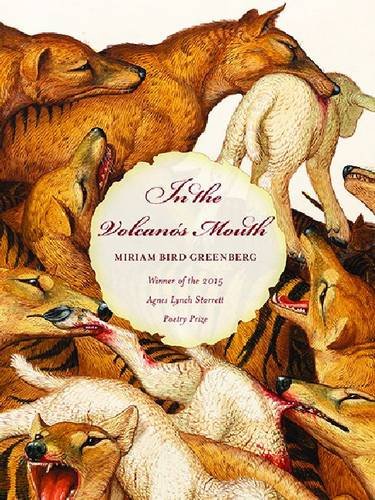
In the Volcano's Mouth - Miriam Bird Greenberg (Pitt Poetry Series/University of Pittsburgh Press

Today's book of poetry:
In The Volcano's Mouth.  Miriam Bird Greenberg.  Pitt Poetry Series.  University of Pittsburgh Press.  Pittsburgh, Pennsylvania.  2016.

Winner of the 2015 Agnes Lynch Starrett Poetry Prize
Winner of the 2017 Bob Bush Memorial Award for Best First Book of Poetry from the Texas Institute of Letters


It's two days in to the new year and Today's book of poetry finds himself outside of a medical clinic shortly after eight in the morning.  I'm in a warm car, the engine running and I have Miles, Trane and the Cannonball keeping me company.  An old friend is in the clinic doing clinic stuff.

Knowing I'd be here a while, it's -25C which is why I'm keeping the car running instead of enjoying the heated waiting room in the clinic, I brought along Miriam Bird Greenberg's In the Volcano's Mouth.  If I'd known what was about to happen I might not have bothered with turning on the heat.

This is why Today's book of poetry got into this game.  Let the banners fly and the bells ring, call out the trumpets, because Today's book of poetry is opening the year with a stunner.

Miriam Bird Greenberg is a beautiful poetry monster.  How else to describe the delicious havoc these poems leave in their tidy wake, how else to describe these powerhouse narratives that arrive at their harsh conclusions so gently?  Greenberg totally disarms the reader with one sweep of her disarming brush and then knocks them all over with the return pass.

Would You Believe

                     Three blocks from the Cyprus Freeway in Oakland,
                          which collapsed in the 1989 Loma Prieta earthquake,
                          with a line by Susan Moon

We climbed from the mouth of a volcano
all year, the year I moved west with my sweetheart

to live three blocks from where the earth had broken
open. Men in the Acorn Projects

remembered pulling strangers
trapped in their cars to safety. Brother,

one told me he'd said, we can be afraid
of each other again tomorrow. Twenty

years past, they'd made good
on their promise. By then I waited weekly in a food line

alongside Chinese immigrant women who fished
plastic bottles from the trash, eyes

roving for a coin, a lost prize, at the curb. Sometimes
I'd lift my hand to the lip--

look out over the volcano's rim, and there,
in a crevice, a scrap of paper, shining:
                                                someone's private prayer

or prophecy. Everybody held out
hope, tended their small hustle. Women knocked

on the door selling broken-heeled shoes, loquats
picked in an abandoned yard, would try the knob

if no one was home. Could I make change
for a twenty, asked someone, unfolding one

she'd manufactured from a dollar bill.
                                               Would you believe

what lengths I went to, to call myself
happy then?                  Star of blood that blooms

beneath a bruised fingernail, star
of silence left high in the heart of a room

after the door's slammed. A couple sits, watching
one another's reflections in a mirror. The two

talk like this as evening falls
around them, and neither has the heart

to get up and turn on the light. "My body's here
but no one's in it." writes a friend; for me

it's different. I'd spent my childhood
in a house made of bees; on hot days honey

dripped through cracks in the ceiling. Me, I hummed,
coiled tight. It hadn't been long since I'd slept

in a creosote field while grainers crashed
in the switchyard nearby. Actual tumbleweeds

turned like prayer wheels crossing the tracks
and the constellations coyotes called to,

streaked across the night, were more miraculous
than freckles on the face of god. Around then,

hitchhiking past Death Valley, a pair of truckers
stopped for me. I used to haul cattle

to LAX, one said. But I couldn't take looking
into their mournful eyes anymore. I guess I wear my heart

on my sleeve, he said. They were climbing
through the Sierras to pick up a load of honey, telling jokes,

they both had wild white beards. I hadn't yet come
in my life to peer over the lip of a volcano,

I wasn't yet made of cicada's coils
and tymbal. Still, I carried a bit of string, a quipu I used

for eavesdropping on the passage of time.
If someone had put a knife in my hands, even then,

I'd have taken it.                                  I can hear
two birds quarreling, tangled in midair. I'm afraid

one day I'll find myself trash picking, tearing
corners from a twenty. I'm afraid I'm no longer

lost as the runaway I met hopping a train
out of Colton that summer

who carried a small jar of her own baby teeth
with her in her pack.

...

Today's book of poetry is tickled to bring such a high-stepping collection up to bat for our first book of the year.  It's too early for any "best book" of the year comparisons but we are certain In the Volcano's Mouth will be part of that discussion.  This is superb poetry.

Greenberg writes poems that are full of new information that feel like old knowledge, these poems feel like a modern folk tale happening in real time, stories we've known all along.  It's not quite haunting but it is close to unnerving as Greenberg unleashes her formative artillery and these poems spill out in front of us like accidents that were meant to happen, prophecies we are only hearing about now.

A Thousand Wire Humming

My room is hemmed with rain; otherwise its windows
are a scrim of moths pressed
            against the light, tracing feverishly

their dizzy script, and I am made from shadows
they cast,
            passport stamps from Moldova

and Suriname. If you passed me working
at a telephone box on the corner, a thousand wires
            humming, and I

in my mechanic's jumpsuit, phone co.
logo over the breast pocket, you'd never glance back
            twice. One night I sat drinking

on someone else's porch
after a rainstorm. The light was off, it was late, and no one
            came home. The moon cast my dim shape

into the yard, and the clouds racing over it
were skittish
            as rabbits. I am getting ready

to see you--shaving
my legs, painting my fingernails
             and my toes. I put on a black lace bra

you've never seen me wear. I've held the throat
of an animal,
             and broken its neck. I'm climbing

out of my skin. One night
      a woman I knew immersed herself in a bath
             of India ink, came out

darker than the rafters
of a empty house. Her mouth
             burned red, open as instinct

makes a fledgling's mouth open, and her ankles
were more beautiful
             than a sapling bent

by wind. More beautiful than the new body
of a snake emerging
            from its winter skin in the rafters. Somewhere far off

I can hear the sound of a telephone
ringing in an empty house.
             Don't empty houses ring? Listen

how echo inhabits a place it knows
no one's home. Sometimes on the subway
             you catch sight of someone familiar--your eyes meet

but there's nothing to say that won't be swallowed
by the throng.
             Your shadows are tangled

in the legs of the crowd, are talking already, or fighting,
or fucking. Whatever you wish for
             in secret, and each one's ankles

are more beautiful than the other's. Do you remember
the morning when,
             before I'd laid the iron to my work clothes,

you pinned one arm
behind my back? Something trembled
              in the palm of your other hand--

an egg yolk--and you poured it
into my mouth. Breath
              chasing breath's dizzy script,

it was slippery in my throat
as a minnow passing through your fingers
              into shadow, as a paw print

on the loamy creek bank
tires of the rain
               that erodes it, and I became a swarm

of dust-winged moths
then that filled the air where a moment before
               my shape had stood.

...

Our first morning read of the new year had to wait until the afternoon.  More snow and slow minions meant for a later start than normal to our poetry world.  Milo, our head tech, was all Campbell McGrath happy as Santa brought him three early McGrath titles.  Kathryn, our Jr. Editor, was happy because I told her the David Lee had another book in the offing.  She likes to refer to him as Sir David of Lee, and rightly so.

The rest of the staff seemed to have made it through those damned reindeer and Fat Man in Red.  Miriam Bird Greenberg brought everything into focus real quick.  Milo was the first to say it out loud when he said "if In the Volcano's Mouth is any indication of what is ahead in 2018 we are in for one hell of a year."

Living in the End Times

We sat in the ruins
                       and made tea from the flowers.

Who among us knew
                       anything? The mourning machine

sowed furrows in the distance
                       and a little while later came the mourning machine

to reap what had grown. There
                       at the edge of the field

crouched some children, ready
                       to dash through the field stubble

to pick through the wrecked rabbits' burrows
                       the machine had uncovered, then left behind.

...

Miriam Bird Greenberg writes with such clarity that it breeds instant familiarity, gives instant access to the undercurrents, the swirl darkly at the edges of all these poems, she is almost tender about it.  Today's book of poetry is excited to start 2018 with such an outstanding books of poems.  This is Greenberg's first book but it never shows, before she is done you will want to have every word she has written.

Greenberg's In the Volcano's Mouth is a book you'll want on your poetry shelf, you'll want Greenberg in your poetry brain.

Today's book of poetry starts the year with a bang.  Miriam Bird Greenberg's In the Volcano's Mouth will cook your poetry brain from the inside out.


   ABOUT THE AUTHOR
Miriam Bird Greenberg teaches creative writing and English as a second language. She is the author of two chapbooks, All Night in the New Country and Pact-Blood, Fevergrass. Greenberg has been honored with fellowships from the National Endowment for the Arts, the Provincetown Fine Arts Work Center, and The Poetry Foundation. Her work has appeared in Poetry, the Missouri Review, and in the anthologies Best New Poets 2014 and The Queer South. A former Wallace Stegner Fellow, she lives in the San Francisco Bay area.

BLURBS
“These poems do what the best poetry sometimes does: reveal and deepen our understanding of the strangeness in the ordinary. And do so in language clear as a bell.”
     —Ed Ochester, judge

“In the Volcano’s Mouth is rich with mysterious and heartrending images. Miriam Bird Greenberg blends scraps of the harshness of life, of what would be ugly in less skillful hands, with the beautiful, even beatific. These are poems that are acutely aware of the world: The flame/of a match that flares/at the tip of his cigarette/before he draws in his breath/deepens the darkness/that falls just beyond/ his illuminated face. Paul Eluard wrote, ‘There is another world and it is in this one.’ These poems give us a glimpse into that world. They are poems I will come back to for inspiration.”
     —Ellen Bass

“Although many of the poems in this haunted book are ‘pastoral’ in a Classical sense, the natural world is not a place of peace and serenity. Rather, it’s unstable, a setting not devoid of meaning, but a realm where meaning is always on the move, like the many characters wandering through this book, and the mind of the poet who has carefully made it. These poems are harrowing and wounding, and yet retain a quiet, sustaining reserve of beauty.”
      —Maurice Manning


Miriam Bird Greenberg
@ Quiet Lightning
Video: Evan Karp


646

DISCLAIMERS

Poems cited here are assumed to be under copyright by the poet and/or publisher.  They are shown here for publicity and review purposes.  For any other kind of re-use of these poems, please contact the listed publishers for permission.

We here at TBOP are technically deficient and rely on our bashful Milo to fix everything.  We received notice from Google that we were using "cookies"
and that for our readers in Europe there had to be notification of the use of those "cookies.  Please be aware that TBOP may employ the use of some "cookies" (whatever they are) and you should take that into consideration

Monday, April 25, 2016

Tiger Heron - Robin Becker (Pitt Poetry Series/University of Pittsburgh Press)

Today's book of poetry:
Tiger Heron.  Robin Becker.  Pitt Poetry Series.  University of Pittsburgh Press.  Pittsburgh, PA.  2014.


Today's book of poetry is heartened by the moments of quiet celebrations Robin Becker finds again and again in Tiger Heron.  It is hard to deal with aging, the dead and the dying but Becker takes it head on and renders some peace out of the harrowing process.  

Tiger Heron covers some big ground in short order.  There are Yiddish lamentations to consider, unwanted dogs roaming the pages, an unwieldy horse sculpture being dismantled for transport and a Civil War re-enactment with cross-dressing scouts and friends, that is just the tip of the perverbial ice-berg.

Late June Owl

          They say it's a bad
summer for ticks, a good summer
          for day lilies

(Quality control likes
          to measure and evaluate
with continuous monitoring)

          They say my friend
has a few weeks, maybe a month
          but you never know

As the raptor people know
          how to keep the orphaned
screech owl before release

          may his keepers
open the airy nets of their patience
         when he tries them

They say the screech owl's trill
          has more than four
individual calls per second

          They say they can
barely hear his voice, more like wind
          than words

They say the owlet will leave
          the open cage when fully flighted
and capable of hunting

          They say the dying
will sometimes wait until everyone
          has left the room

...

Becker laments ecological with eloquence and subtle power in poems about mushrooms and flying squirrels and these are poems worth knowing.  Becker is laying some very deep tracks with Tiger Heron, and once you've read it you realize that the biggest strength is consistency, making you laugh or cry is easy but having these poems roll across the page as steady as cars on a train makes you take notice.  These poems are big and strong, solid like they were built of iron.  You can almost hear them rumble.

Becker is full of surprises, she is quite happy to make you smile before she drops the hammer.  She does not lack for humour.

The Weight
          for Jill Morgan

If some true measure of my mother's
          sorrow lay in each ounce of vermeil and gold,
then I could, bracelet by bracelet,
          account for years of sadness.

and so I took the box
          to the floor, to hold and smell
each piece, invoking the plate glass jeweler's
          windows and then the jolt of possession

when my father pointed to a ring or
          necklace pinned to a velvety cushion.
Sometimes, aboard a cruise ship, he'd get the urge;
          sometimes, flushed, after winning at the track.

She never went for the most expensive
          things like some girls do, he said after she died.
I sat there, cupping in my palms the stories,
         my hands sinking with the weight.

...

It's easy to get weighed down with family melancholia but Becker deftly avoids that trap by never becoming sentimental.  And besides, there are scuba diving in the Dominican Republic poems one minute and a climb towards a mountain summit poem the next, lovers get left behind or they leave.
It's all in the same fine tone as Becker sifts through our emotional dance in her search to give it words.

Today's book of poetry is convinced Becker is doing an exceptional job.  The best poems make the personal universal, speak to us all, we think Becker nails it.

Threesome Interval

That summer my cooking exceeded
          all expectations.
I excelled in tagine of chicken with olives
          and a curried Thai soup.

We biked to yoga at six a.m.,
          biked home virtuous
and clarified. Was it the Prozac? The new
          puppy glorious in red curls?

Your new man, the Scrabble champ? Even
          the wild blueberries astonished.
In Shelburne Falls, from the viewing platform
          we admired the glacial potholes

ground from granite by snowmelt and gyrating
          stone. Swirls marbled
the rock with a natural patina. We kept
          our composure,

despite hundred of millions of years
          whirlpooling abrasion.
Arriving at the Walt Whitman party, in great spirits,
          I wondered: might we try a trip to Rome?

At the tag sale, he found a first edition
          of Frost, and you snagged
a Henckels knife. We didn't deserve such
          good luck, but luck found us anyway.

...

Robin Becker knew long before the experts, long before they made it public, luck accounts for a big slice of the pie.  We are all one second, one false move away, from a new and different life.  We are riding a narrow and precarious ledge.

Tiger Heron made for a spirited read this morning here at Today's book of poetry.  Milo, our head tech laughed and then he cried.  Kathryn, our new intern, cried and then she laughed.  Robin Becker made them do that.

Robin Becker

ABOUT THE AUTHOR
Robin Becker, Liberal Arts Research Professor of English and Women’s Studies at the Pennsylvania State University, is the author of seven poetry collections, includingDomain of Perfect Affection, The Horse Fair, Giacometti’s Dog, and All-American Girl, winner of the Lambda Literary Award. In 2002 the Frick Art and Historical Center in Pittsburgh published Venetian Blue, a limited-edition chapbook of Becker’s art poems. She is the recipient of fellowships from the Bunting Institute, the Massachusetts Cultural Council, and the National Endowment for the Arts. In 2000 she received the George W. Atherton III Award for Excellence in Teaching from Penn State, and from 2010 to 2011 she served as the Penn State Laureate. For the Women’s Review of Books, Becker edits poetry and writes a column on poetry called “Field Notes.”

BLURBS“Becker's Tiger Heron, rich with animal life from the flying squirrel and prairie dog to inhabitants of the coral reefs of the Caribbean, expresses outrage and grief over the ongoing destruction of these ecosystems. A moving poem deals with homophobia, another celebrates Yiddish, ‘a mongrel, Middle High German.’ These vivid, self-confident lyrics ranging from villanelle to couplet deserve close reading.”
     —Maxine Kumin, Pulitzer Prize winner

Robin Becker looks straight at the failures of our human species, yet never loses her compassion or reduces the complexities and paradoxes to easy conclusions. Deftly, precisely, these poems express their wisdom in lines that surprise and delight. They are clear as open windows through which we see our lives.”
     —Ellen Bass, author of The Human Line

“Robin Becker’s poems have the limpid clarity of an early Flemish painting, the crisp details always fusing into a larger illumination. Complicated loss, unsparing truth, animal grace, small comforts—her deft and daring language yields them all up fresh, the paint still wet.”
     —Alison Bechdel, author of Fun Home

“The surprise of this book is that the poems are actually stories—about devotion and death and decay—but somehow they’re not sad stories. Because in all of them, Robin Becker reaches into the shadowy corners of love and pulls out feelings I didn’t even know I wanted named. I didn’t know you could sneak so much life into poems about death.”
     —Sarah Koenig, producer, This American Life
Robin Becker
"Solar," a poem by Robin Becker, 2010-11 Penn State laureate
Video: Penn State University


464


DISCLAIMERS

Poems cited here are assumed to be under copyright by the poet and/or publisher.  They are shown here for publicity and review purposes.  For any other kind of re-use of these poems, please contact the listed publishers for permission.

We here at TBOP are technically deficient and rely on our bashful Milo to fix everything.  We received notice from Google that we were using "cookies"
and that for our readers in Europe there had to be notification of the use of those "cookies.  Please be aware that TBOP may employ the use of some "cookies" (whatever they are) and you should take that into consideration.

Tuesday, October 21, 2014

Mules of Love - Ellen Bass (BOA Editions)

Today's book of poetry:
Mules of Love.  Ellen Bass.  BOA Editions.  American Poets Continuum Series, No. 73.  Rochester, New York.  2002.


Today's book of poetry bought this book by Ellen Bass at the public library in Bryn Mawr, just outside of Philadelphia.

As a rule, Today's book of poetry only writes about books that we receive in the mail. But this is my house and I get to do what I want.  So here is the rare exception.

Last year I was visiting an old friend and fine poet, Chui, in Bryn Mawr.  He and his astonishing wife Patt live in a huge stone house filled to the brim with art.  It's a monster beautiful home that is older than Canada.

As luck would have it his backyard abuts the grounds for the public library.  I checked out the "Book Sale" room and scored a mountain of poetry.  I bought as much as I could carry home on the plane.  It was about 30 books.

I've read them all now and this is the one I want to tell you about because it is monster good.

Everything on the Menu

In a poem it doesn't matter
if the house is dirty. Dust
that claims the photographs like a smothering
love. Sand spilled from a boy's sneaker,
the faceted grains scattered on the emerald rug
like the stars and planets of a tiny
solar system. Monopoly
butted up against Dostoyevsky.
El techo, a shiny sticker, labeling the ceiling
from the summer a nephew studied Spanish.

Mold on bread in the refrigerator
is as interesting as lichen on an oak--
its minuscule hairs like the fuzz
on an infant's head, its delicate
blues and spring greens, its plethora of spores,
whole continents of creatures, dazzling our palms.

In a poem, life and death are equals.
We receive the child, crushed
like gravel under the tire.
And the grandfather at the open grave
holding her small blue sweatshirt to his face.
And we welcome the baby born
at daybreak, the mother naked, squatting
and pushing in front of the picture window
just as the garbage truck roars up
and men jump out, clanking
metal cans into its maw.

In a poem, we don't care if you got hired
or fired, lost or found love,
recovered or kept drinking.
You don't have to exercise
or forgive. We're hungry.
We'll take everything on the menu.

In poems joy and sorrow are mates.
They lie down together, their hands
all over each other, fingers
swollen in mouths,
nipples chafed to flame, their sexes
fitting seamlessly as day and night.
They arch over us, glistening and bucking,
the portals through which we enter our lives.

...

When I read these poem by Ellen Bass I feel hopeful.

Mules of Love reads like a long-play record you don't want to end.  It is languorous and so flesh and bone human.  Ellen Bass has wandered wise into my sphere as a reader and boy was I waiting for this.  Here is a poet you really would want to sit down and have a glass of red with because you know her warm understanding of the world would elevate yours.

Remodeling the Bathroom

If this were the last
day of my life, I wouldn't complain
about the shower curtain rod
in the wrong place, even though
it's drilled into the tiles.
Nor would I fret
over water marks on the apricot
satin finish paint, half sick
that I should have used semigloss. No.
I'd stand in the doorway
watching sun glint
off the chrome faucet, breathing in
the silicone smell. I'd wonder
at the plumber, as he adjusted the hot
and cold water knobs. I'd stare
at the creases behind his ears and the gray
flecks in his stubble. I'd have to hold
myself back from touching him. Or maybe
I wouldn't. Maybe I'd stroke
his cheek and study
his eyes the amber of cellos, his rumpled
brow, the tiny garnet
threads of capillaries, his lips
resting together, quiet as old friends--
I'd gaze at him
as though his were the first
face I'd ever seen.

...

Clearly here at Today's book of poetry we have a bias for narrative poems.  We are also suckers for a style we like to call Romantic Realism.  Really hoping Ms. Bass doesn't object but that's where I'd throw her hat.

Think Thomas Hart Benton meeting Andrew Wyeth.

Happiness After Sorrow

No days were good, but some were worse.
I'd gotten as far as my door--reach out,
they always tell you--then had to pee.
Two steps toward the bathroom. But
what did peeing matter? I slid down
like a coat shrugged off. And slumped there,
on the edge of the frayed rug, I catalogued the worst
things that could happen to a parent. This--
my daughter stripping the medicine chest, rimming
the sink with plastic cylinders, her life
suspended in transparent amber--
was number three.

And then years pass. And you're making meatballs.
Exactly the way your family likes them.
A little bread crumbs. A little matzoh meal.
No egg. A dash of sherry.
You're browning them in a pan. Diana Krall's
singing "Peel Me a Grape." And you're happy.
The present is what you're crazy for,
each moment plump and separate as a raindrop
reflecting the world on its curved skin.

It happens. Our troubles familiar
as the peeling paint in the back
hallway, the stain on the couch
where the cat threw up.
We live with all the unbearable knowledge--
the hole in the ozone, the H-bomb,
and right now fathers are hurrying
children in their arms across barbed-wire borders.
After we weep, we fold the newspaper
and drive our kids to school.

How do we do it? How do we want
to make supper again? Squeezing
cold mush through my fingers, patting
it into pies. How does love keep
swelling in the cavities of our frail bodies,
how do these husks hold so much jagged
pleasure in their parched split skins?

I tip the pot, oily water rushes out
and steam rises. All I have lost
swirls around me. I scoop
the mist with my palms.

...

We passed Mules of Love around the office for weeks, reading it aloud, sometimes reading the same poem twice in a row, out loud.  Every single poem made us like this poetry more.


Ellen Bass

ABOUT THE AUTHOR
Ellen Bass has published several poetry collections, including Mules of Love (BOA Editions, 2002), a Lambda Literary Award winner; and The Human Line (Copper Canyon Press, 2007), a San Francisco Chronicle Notable Book. She coedited with Florence Howe one of the first anthologies to highlight feminist poetry, the groundbreaking No More Masks! Her nonfiction books include the best-selling The Courage to Heal: A Guide for Women Survivors of Child Sexual Abuse and Free Your Mind: The Book for Gay, Lesbian and Bisexual Youth. She has published poems in The New Yorker, American Poetry Review, The New Republic, The Sun,Ploughshares, and of course, Rattle. Among her many awards is a Pushcart Prize, the Pablo Neruda Prize, the Larry Levis Prize from Missouri Review, and the New Letters Prize. Bass teaches in the low-residency MFA program at Pacific University. Her new collection of poetry, Like a Beggar, is forthcoming from Copper Canyon Press in early 2014. (ellenbass.com)

BLURBS
"The sudden intimacy of these poems will hold you to the page. Ellen Bass knows an awful lot and is ready to tell it all. Her poems will quicken the pulse, and as you read you will become anxious to discover more and more. But she can only tell you so much, one good line at a time, and that is more than enough."
     --Billy Collins

"Reading Mules of Love gave me great joy. I found the poems striking, full, complete and beautifully crafted. Ellen Bass is a poet writing about quintessential beauty, and these poems are swollen with it. These radiant poems emerge from her Santa Cruz garden of life. Bass writes with a Dionysian ecstasy yet infuses it with the calm energy of a gardener's earthy-hands."
     --Diane Wakoski

"Ellen Bass's voice is direct and unambiguous. These are intimate, confessional poems, yet in almost every instance they go beyond the specific details to strike a universal chord. A highly readable and touching book."
     --Maxine Kumin

"Ellen Bass writes of ordinary life with a fierce a loving passion. Her honesty, her insights, and her mastery of language, particularly metaphor, make this book compelling to read."
     --Linda Pastan

Ellen Bass reading "Gate C22"
11-2-07
Cornelia Street Cafe


259