Showing posts with label miriam bird greenberg. Show all posts

Tuesday, January 2, 2018

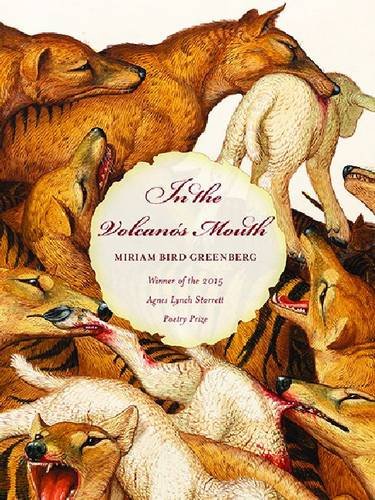
In the Volcano's Mouth - Miriam Bird Greenberg (Pitt Poetry Series/University of Pittsburgh Press

Today's book of poetry:
In The Volcano's Mouth.  Miriam Bird Greenberg.  Pitt Poetry Series.  University of Pittsburgh Press.  Pittsburgh, Pennsylvania.  2016.

Winner of the 2015 Agnes Lynch Starrett Poetry Prize
Winner of the 2017 Bob Bush Memorial Award for Best First Book of Poetry from the Texas Institute of Letters


It's two days in to the new year and Today's book of poetry finds himself outside of a medical clinic shortly after eight in the morning.  I'm in a warm car, the engine running and I have Miles, Trane and the Cannonball keeping me company.  An old friend is in the clinic doing clinic stuff.

Knowing I'd be here a while, it's -25C which is why I'm keeping the car running instead of enjoying the heated waiting room in the clinic, I brought along Miriam Bird Greenberg's In the Volcano's Mouth.  If I'd known what was about to happen I might not have bothered with turning on the heat.

This is why Today's book of poetry got into this game.  Let the banners fly and the bells ring, call out the trumpets, because Today's book of poetry is opening the year with a stunner.

Miriam Bird Greenberg is a beautiful poetry monster.  How else to describe the delicious havoc these poems leave in their tidy wake, how else to describe these powerhouse narratives that arrive at their harsh conclusions so gently?  Greenberg totally disarms the reader with one sweep of her disarming brush and then knocks them all over with the return pass.

Would You Believe

                     Three blocks from the Cyprus Freeway in Oakland,
                          which collapsed in the 1989 Loma Prieta earthquake,
                          with a line by Susan Moon

We climbed from the mouth of a volcano
all year, the year I moved west with my sweetheart

to live three blocks from where the earth had broken
open. Men in the Acorn Projects

remembered pulling strangers
trapped in their cars to safety. Brother,

one told me he'd said, we can be afraid
of each other again tomorrow. Twenty

years past, they'd made good
on their promise. By then I waited weekly in a food line

alongside Chinese immigrant women who fished
plastic bottles from the trash, eyes

roving for a coin, a lost prize, at the curb. Sometimes
I'd lift my hand to the lip--

look out over the volcano's rim, and there,
in a crevice, a scrap of paper, shining:
                                                someone's private prayer

or prophecy. Everybody held out
hope, tended their small hustle. Women knocked

on the door selling broken-heeled shoes, loquats
picked in an abandoned yard, would try the knob

if no one was home. Could I make change
for a twenty, asked someone, unfolding one

she'd manufactured from a dollar bill.
                                               Would you believe

what lengths I went to, to call myself
happy then?                  Star of blood that blooms

beneath a bruised fingernail, star
of silence left high in the heart of a room

after the door's slammed. A couple sits, watching
one another's reflections in a mirror. The two

talk like this as evening falls
around them, and neither has the heart

to get up and turn on the light. "My body's here
but no one's in it." writes a friend; for me

it's different. I'd spent my childhood
in a house made of bees; on hot days honey

dripped through cracks in the ceiling. Me, I hummed,
coiled tight. It hadn't been long since I'd slept

in a creosote field while grainers crashed
in the switchyard nearby. Actual tumbleweeds

turned like prayer wheels crossing the tracks
and the constellations coyotes called to,

streaked across the night, were more miraculous
than freckles on the face of god. Around then,

hitchhiking past Death Valley, a pair of truckers
stopped for me. I used to haul cattle

to LAX, one said. But I couldn't take looking
into their mournful eyes anymore. I guess I wear my heart

on my sleeve, he said. They were climbing
through the Sierras to pick up a load of honey, telling jokes,

they both had wild white beards. I hadn't yet come
in my life to peer over the lip of a volcano,

I wasn't yet made of cicada's coils
and tymbal. Still, I carried a bit of string, a quipu I used

for eavesdropping on the passage of time.
If someone had put a knife in my hands, even then,

I'd have taken it.                                  I can hear
two birds quarreling, tangled in midair. I'm afraid

one day I'll find myself trash picking, tearing
corners from a twenty. I'm afraid I'm no longer

lost as the runaway I met hopping a train
out of Colton that summer

who carried a small jar of her own baby teeth
with her in her pack.

...

Today's book of poetry is tickled to bring such a high-stepping collection up to bat for our first book of the year.  It's too early for any "best book" of the year comparisons but we are certain In the Volcano's Mouth will be part of that discussion.  This is superb poetry.

Greenberg writes poems that are full of new information that feel like old knowledge, these poems feel like a modern folk tale happening in real time, stories we've known all along.  It's not quite haunting but it is close to unnerving as Greenberg unleashes her formative artillery and these poems spill out in front of us like accidents that were meant to happen, prophecies we are only hearing about now.

A Thousand Wire Humming

My room is hemmed with rain; otherwise its windows
are a scrim of moths pressed
            against the light, tracing feverishly

their dizzy script, and I am made from shadows
they cast,
            passport stamps from Moldova

and Suriname. If you passed me working
at a telephone box on the corner, a thousand wires
            humming, and I

in my mechanic's jumpsuit, phone co.
logo over the breast pocket, you'd never glance back
            twice. One night I sat drinking

on someone else's porch
after a rainstorm. The light was off, it was late, and no one
            came home. The moon cast my dim shape

into the yard, and the clouds racing over it
were skittish
            as rabbits. I am getting ready

to see you--shaving
my legs, painting my fingernails
             and my toes. I put on a black lace bra

you've never seen me wear. I've held the throat
of an animal,
             and broken its neck. I'm climbing

out of my skin. One night
      a woman I knew immersed herself in a bath
             of India ink, came out

darker than the rafters
of a empty house. Her mouth
             burned red, open as instinct

makes a fledgling's mouth open, and her ankles
were more beautiful
             than a sapling bent

by wind. More beautiful than the new body
of a snake emerging
            from its winter skin in the rafters. Somewhere far off

I can hear the sound of a telephone
ringing in an empty house.
             Don't empty houses ring? Listen

how echo inhabits a place it knows
no one's home. Sometimes on the subway
             you catch sight of someone familiar--your eyes meet

but there's nothing to say that won't be swallowed
by the throng.
             Your shadows are tangled

in the legs of the crowd, are talking already, or fighting,
or fucking. Whatever you wish for
             in secret, and each one's ankles

are more beautiful than the other's. Do you remember
the morning when,
             before I'd laid the iron to my work clothes,

you pinned one arm
behind my back? Something trembled
              in the palm of your other hand--

an egg yolk--and you poured it
into my mouth. Breath
              chasing breath's dizzy script,

it was slippery in my throat
as a minnow passing through your fingers
              into shadow, as a paw print

on the loamy creek bank
tires of the rain
               that erodes it, and I became a swarm

of dust-winged moths
then that filled the air where a moment before
               my shape had stood.

...

Our first morning read of the new year had to wait until the afternoon.  More snow and slow minions meant for a later start than normal to our poetry world.  Milo, our head tech, was all Campbell McGrath happy as Santa brought him three early McGrath titles.  Kathryn, our Jr. Editor, was happy because I told her the David Lee had another book in the offing.  She likes to refer to him as Sir David of Lee, and rightly so.

The rest of the staff seemed to have made it through those damned reindeer and Fat Man in Red.  Miriam Bird Greenberg brought everything into focus real quick.  Milo was the first to say it out loud when he said "if In the Volcano's Mouth is any indication of what is ahead in 2018 we are in for one hell of a year."

Living in the End Times

We sat in the ruins
                       and made tea from the flowers.

Who among us knew
                       anything? The mourning machine

sowed furrows in the distance
                       and a little while later came the mourning machine

to reap what had grown. There
                       at the edge of the field

crouched some children, ready
                       to dash through the field stubble

to pick through the wrecked rabbits' burrows
                       the machine had uncovered, then left behind.

...

Miriam Bird Greenberg writes with such clarity that it breeds instant familiarity, gives instant access to the undercurrents, the swirl darkly at the edges of all these poems, she is almost tender about it.  Today's book of poetry is excited to start 2018 with such an outstanding books of poems.  This is Greenberg's first book but it never shows, before she is done you will want to have every word she has written.

Greenberg's In the Volcano's Mouth is a book you'll want on your poetry shelf, you'll want Greenberg in your poetry brain.

Today's book of poetry starts the year with a bang.  Miriam Bird Greenberg's In the Volcano's Mouth will cook your poetry brain from the inside out.


   ABOUT THE AUTHOR
Miriam Bird Greenberg teaches creative writing and English as a second language. She is the author of two chapbooks, All Night in the New Country and Pact-Blood, Fevergrass. Greenberg has been honored with fellowships from the National Endowment for the Arts, the Provincetown Fine Arts Work Center, and The Poetry Foundation. Her work has appeared in Poetry, the Missouri Review, and in the anthologies Best New Poets 2014 and The Queer South. A former Wallace Stegner Fellow, she lives in the San Francisco Bay area.

BLURBS
“These poems do what the best poetry sometimes does: reveal and deepen our understanding of the strangeness in the ordinary. And do so in language clear as a bell.”
     —Ed Ochester, judge

“In the Volcano’s Mouth is rich with mysterious and heartrending images. Miriam Bird Greenberg blends scraps of the harshness of life, of what would be ugly in less skillful hands, with the beautiful, even beatific. These are poems that are acutely aware of the world: The flame/of a match that flares/at the tip of his cigarette/before he draws in his breath/deepens the darkness/that falls just beyond/ his illuminated face. Paul Eluard wrote, ‘There is another world and it is in this one.’ These poems give us a glimpse into that world. They are poems I will come back to for inspiration.”
     —Ellen Bass

“Although many of the poems in this haunted book are ‘pastoral’ in a Classical sense, the natural world is not a place of peace and serenity. Rather, it’s unstable, a setting not devoid of meaning, but a realm where meaning is always on the move, like the many characters wandering through this book, and the mind of the poet who has carefully made it. These poems are harrowing and wounding, and yet retain a quiet, sustaining reserve of beauty.”
      —Maurice Manning


Miriam Bird Greenberg
@ Quiet Lightning
Video: Evan Karp


646

DISCLAIMERS

Poems cited here are assumed to be under copyright by the poet and/or publisher.  They are shown here for publicity and review purposes.  For any other kind of re-use of these poems, please contact the listed publishers for permission.

We here at TBOP are technically deficient and rely on our bashful Milo to fix everything.  We received notice from Google that we were using "cookies"
and that for our readers in Europe there had to be notification of the use of those "cookies.  Please be aware that TBOP may employ the use of some "cookies" (whatever they are) and you should take that into consideration

Friday, December 1, 2017

One - Gerald Fleming (Hanging Loose Press)

Today's book of poetry:
One.  Gerald Fleming.  Hanging Loose Press.  Brooklyn, N.Y.  2016.

One

Today's book of poetry will get to the piercing and subtle workings of Gerald Fleming very shortly - but today we are starting with a note to our readers around the world - thank you.  When Today's book of poetry opened for business this morning we were able to report readers, on line, from Canada and the United States that were in the hundreds, but there were also six from Ukraine and Brazil.  Germany was on line along with France and the United Kingdom.  We had readers from Kenya this morning, and readers from China and readers from Spain.  There are more.

It brings Today's book of poetry much joy.

And so did Gerald Fleming.  He doesn't know it but Gerald Fleming is in the movie business, he just thinks he's writing poems.  These narrative prose poems reel out so cinematic you can almost hear the whirr of the old projector.  One is a series of prose poems where each one is a fully realized scene, or often as not the whole exciting movie, intro, emotional drama, climax, denouement.  Fleming has it all happening in these little documentaries.

Clean Man

     I want a clean man, she thought -- a man who bathes, & if not each
day, then, say, four times a week. A man who shaves, but if he's got
a beard then trims that beard, clips those wild hairs from his nose &
ears, a man who won't walk through the house & belch & fart or snort
& spit into the sink like some men do, a man not too clean, of course--
not crazed with it but one who knows that his own clothes are his to
wash -- is this too much to wish for?
     Some nights in bed I think that if I had a man like that I'd oil
him -- feet, legs, back, neck -- the way a boy would wax the car he'd just
bought. Grapeseed oil, I'd use -- his thighs like oak, his back like teak,
each arm birch stripped of its bark, I'd sculpt him, my hands traced
into his skin & when he stood my prints would burn in him, stay with
him, seen by no one, but he knows they're there, I know they're there
& when he moves in the world, this clean man, he hear my lips at the
nape of his neck: Come back.

...

Well that's a movie I want to watch.  Today's book of poetry was interested to see that Fleming isn't just telling the hero's story, the usual movie arc, he's telling the not-so-successful, not necessarily happy ending narrative as well.  The important thing is that these stories feel real.  More real emotionally, more real than your average Bear.

Sometimes these vignettes are looking for joy and sometimes they're swinging low to sorrow's baleful tune but mostly Fleming is surveying the good and bad we do to one another in the service of love.

One sneaks up on the reader with a narrative style that does all of its work under the surface.  There is certain quietude behind Flemings poems but that never tarnishes the knowing timbre of the voice.  Gerald Fleming is entirely without artifice or deceit, his poems belay any gilding.

Looked at Him

     In high school he picked a fight with a kid he knew he could beat.
What had the kid done? Not a thing. Looked at him.
     They met in the back lot when school let out. Big crowd. It was
quick. This to show his friends, of course. Blood on the kid's mouth.
     Down the years he thought back to that scene, & when he did he
felt like shit. It wore on him.
     He paid a clerk in his law firm to look the man up. He'd moved to
upstate New York.
     Wrote him a note: "Not a year has gone by I've not thought of that
day. It makes me feel so bad." Sent the note off, felt a great weight lift.
     Two weeks passed, then came the man's note.
     "I see that you've not changed a bit."

...

There is an obviousness to the conclusions readers will draw from One.  Fleming is aiming for the very heart of the matter and wants to know what it means to be a good person.  These clever biopics of the opera of the everyday work because we recognize each and every character Fleming employs.  It's easy enough to do, he is writing about all of us.

Our morning read was brightened considerably by the temporary return of our dear friend Odin.  As usual, he didn't have much to say, walked around the office like he owned the place and/or he was King of the World.  After a short snack he curled up in a big chair and nodded off like he was hit by a hammer.  Had to wake him for the morning read but he faithfully did his part and then returned to his happy slumber in his big chair and his dreaming of poetry loving women.

     All Life Long I've Heard Friends Say Death's
Part of Life, But at Last I Think They're Wrong

     No: a heart valve bursts or cells go wild, there's a gun-blast or a car
comes wrong way 'round the bed & Death steps in & calls the game.
     You can say that life just shifts then--they dig you in, those cells
break down, or you're cooked, half of who you are to rise through the air,
what's left to be sent to two guys with hand-cranks in the back room,
bones ground down & mixed with ash & packed in a box then put into
the hands of your son, who stores them in his loft, thinks of them not
& then as he nears his own end, then one day pours them in some sea
or spreads them at the foot of some elm--sure, part of life, they claim--
but where, I ask, is Death in this?
     You did what you could: sought the cure, bathed in light, took your
pills, stayed, tried: weak, short of breath...
     Zen friends, say what you like--Life's life, Death's death, & here he
comes--he's out back--look at him, he's on his one-wheeled bike--it's
game-on-the-grass for him, & he wins.

...

Gerald Fleming's One is a comedian with a short story teller's sense of space and a poet's sense of timing.  He also manages to write from both sides of the fence with gentle diplomacy.

We're convinced that Gerald Fleming is a gentleman, even if he's poet.  This is solid, poetry-thirst quenching stuff.

Image result for gerald fleming poet photo

Gerald Fleming

ABOUT THE AUTHOR
Gerald Fleming's most recent books are The Choreographer (Sixteen Rivers Press, San Francisco) and Night of Pure Breathing, prose poems (Hanging Loose). From 1995-2000 he edited and published the literary magazine Barnabe Mountain Review, and is currently editing both the limited-edition vitreous magazine One (More) Glass and The Collected Prose and Poetry of Lawrence Fixel. Fleming taught in the San Francisco public schools for thirty-seven years and has written three books for teachers, including Rain, Steam, and Speed (Jossey-Bass/Wiley). He lives part of the year in Paris.

BLURBS
“Gerald Fleming is a remarkable writer, made more so by his commitment to the prose poem, a form which at its best, as here, is a delicious treat on almost every occasion. His new volume, One, takes on the monosyllable and wrestles it into dizzying and wonderful pretzel-esque works which may appear, at first glance, non-pretzel-esque. You'll probably love this book as much as I do.”
     —Frederick Barthelme

“At times wry and wickedly self-aware, these linked prose vignettes deepen into a resonant, searching meditation on that which resides hidden within us-metastatic cells, racism we've spent half our years unlearning, the slow burn of our lives. Fleming's voice is rich with a plainspoken elegance that evokes flickers of Ovid ("the years fled from her face," he writes in elegy) or the quieted mind of a Gerard Manley Hopkins who's made peace with his god and is engaged in the contemplative practice of ordinary life. In this almost-Oulipian project, poet and speaker both gently interrogate language and self, "take each shred down from the line/sew it to the next, soak it in brine/look at it/see that it means in ways we've not known-now finds us, & like us it's scarred now, but still ours-back in our mouths, on our tongues-quick birds!-flung into the air of our time." One is a powerful collection woven of grief, compassion, and the joy of a life well lived. Sidling up against fiction's narrative drive, it's told in a reinvented sprung rhythm sure and steady as a heartbeat, as the beat of one's own footsteps.”
      —Miriam Bird Greenberg


Gerald Fleming
 reads at Petaluma Poetry Walk, Jungle Vibes, Sun. 9/18
Video: Connie Madden


635

DISCLAIMERS

Poems cited here are assumed to be under copyright by the poet and/or publisher.  They are shown here for publicity and review purposes.  For any other kind of re-use of these poems, please contact the listed publishers for permission.


We here at TBOP are technically deficient and rely on our bashful Milo to fix everything.  We received notice from Google that we were using "cookies"
and that for our readers in Europe there had to be notification of the use of those "cookies.  Please be aware that TBOP may employ the use of some "cookies" (whatever they are) and you should take that into consideration