Showing posts with label harbour publishing. Show all posts

Wednesday, June 17, 2015

Song & Spectacle - Rachel Rose (Harbour Publishing)

Today's book of poetry:
Song & Spectacle.  Rachel Rose.  Harbour Publishing.  Madeira Park, British Columbia.  2012.

Winner of the Audre Lorde Award
Winner of the Pat Lowther Memorial Award


Song & Spectacle reads like a bowl of succulent and perfectly ripe fruit.  Every time you dip your hand to the bowl you are rewarded with different tastes, textures and colours.  Some of them are familiar and as welcome as old friends.  Others are entirely new experiences, grateful moments. Rachel Rose has served us up something elegant.  Which is not to say she doesn't slap the reader up the side of the head at her leisure.

These poems have deep resonance the first time you read them.  The second time you read Song & Spectacle these suckers start to sing.

What We Heard About the Heart

We heard you like red wine,
dark chocolate, prefer iambic

pentameter to free verse. Our
specialists study your ailments: we call them

cardiologists, poets. We give your aches
the names of movie stars: Angina, Arrhythmia, Tamponade.

We hear you won't go on forever,
and that gives us pause.

Each of your two and a half billion beats
shapes our hours. Our tickers stutter

like firecrackers, pressed against the breasts
of lovers. In dance clubs, we hear your be-bop

with the bass thrum in our ears. Tough muscle:
we put our hands on your to swear the whole truth

and nothing but. We give you
a day of candies and roses,

frilled boxes, pink and labial. We vow to stay true.
Don't be still, my heart. Once,

before memory, you shocked us to life,
began the mystery. No one knows how. Sweet

heart; we ask for a generous span of beats.
We pray when you stop, you stop

in our sleep.

...

Rose is as serious as a heart attack as she tries to figure out one paradox after another.  These poems don't promise any solutions - just traverse each subject and question with warm wisdom and cold scepticism.

Song & Spectacle isn't looking for any easy answers.  Rachel Rose is digging for truths.

What We Heard About the Mob

We surprise ourselves. An unknown talent
emerges. In a blink, we become collective. Smoldering

rage taproots down, ignites. Their accents revolt us.
The radio broadcasts suggestions. We are the swarm

of bodies, armpit tang, children on shoulders, cracked
teeth. Drag a body by a boot, hello, hello,

its arms flap over potholes. Don't trust
yourselves. Crush those who wear spectacles,

stack their skulls on shelves. We are peasants,
we are intellectuals, we play football.

The dog screams, pitch-forked to the wall.
The KKK burns crosses in moonlight.

We were breastfed, we were cradled,
we were kissed and beaten.

Chairs shiver through glass,
our grins reflect silver. We liberate a candelabra,

leave a footprint in blood. Three cut knuckles.
We are original, we are pure,

we discover the other use for fire.

...

What we thought here at Today's book of poetry was that Rose tackles as many big subjects as she can get to the tip of her pen, as many as are on offer; children, relationships, the nature of love, desire, abortion, murder, Buddha, cocks, drunks, suicide, death and dying, suicide and so on.

This is all good.

YOU want to hear what Rachel Rose has to say about these things.  And once you've read them you'll want to hear what she thinks about everything else.

What We Heard About the Suicide

We heard it wasn't our fault.
We heard you left a note,

scrawled when poison
stole your voice. We heard you left no reason.

You were alone. You borrowed a gun.
We heard you didn't mean to swerve.

Everywhere you went, bridges called you.
Cliffs made the soles of your feet ache.

From a hundred living rooms,
we watched your slow death on the internet.

When you left, the same rain
still blurred our windows. Pollen drifted over the freeway

near your apartment as we dragged away your blood-thick bed
before your parents came. Your smell fogged our hair.

The first time you shot into your own
supple vein, you knew your name

was an anagram of gone.
We heard the radio play what was once your song.

...

Song & Spectacle is both fast paced and carefully contemplative.  You usually only see that in jazz.

Today's book of poetry could listen to Rachel Rose riff all day long.

Rachel Rose
And any friend of the excellent writer Jane Silcott is a friend of ours.  Everyone in the office loved Jane's Everything Rustles, an excellent book of personal essays.


ABOUT THE AUTHOR
Rachel Rose’s work has appeared in various journals including Poetry, The Malahat Review and The Best American Poetry, as well as numerous anthologies. Her most recent poetry collection, Song & Spectacle (Harbour, 2012) won the Audre Lorde Award in the US and the Pat Lowther Memorial Award in Canada. She was the librettist for the opera When the Sun Comes Out, which grapples with fundamentalism and forbidden love. She is the winner of the Peterson Memorial Prize for poetry and the Bronwen Wallace award for fiction, and the recipient of a 2014 Pushcart Prize. She is the Poet Laureate of Vancouver for 2014–2017.

Vancouver Poet Laureate Rachel Rose has just won a 2016 Pushcart Prize for her poem, “White Lilies,” that will be appearing in Marry & Burn, her forthcoming collection from Harbour Publishing (2015)

BLURB
In this stunning new collection, the poems are drenched with beauty, with milky maternal love, but also the hard grey rains of winter, with guilt and envy and the sadness of what we daily lose. The heart, the unborn child, even death has a song in these pages. Her language is so dense, so daring, so rich. [...] Read this book and you'll discover "The other use for fire."
     - Lorna Crozier


harbourpublishing.com

352

Poems cited here are assumed to be under copyright by the poet and/or publisher.  They are shown here for publicity and review purposes.  For any other kind of re-use of these poems, please contact the listed publishers for permission.


Wednesday, March 18, 2015

Circa Nineteen Hundred and Grief - Tim Bowling (Gaspereau Press)

Today's book of poetry:
Circa Nineteen Hundred and Grief.  Tim Bowling.  Gaspereau Press.  Kentville, Nova Scotia.  2014.


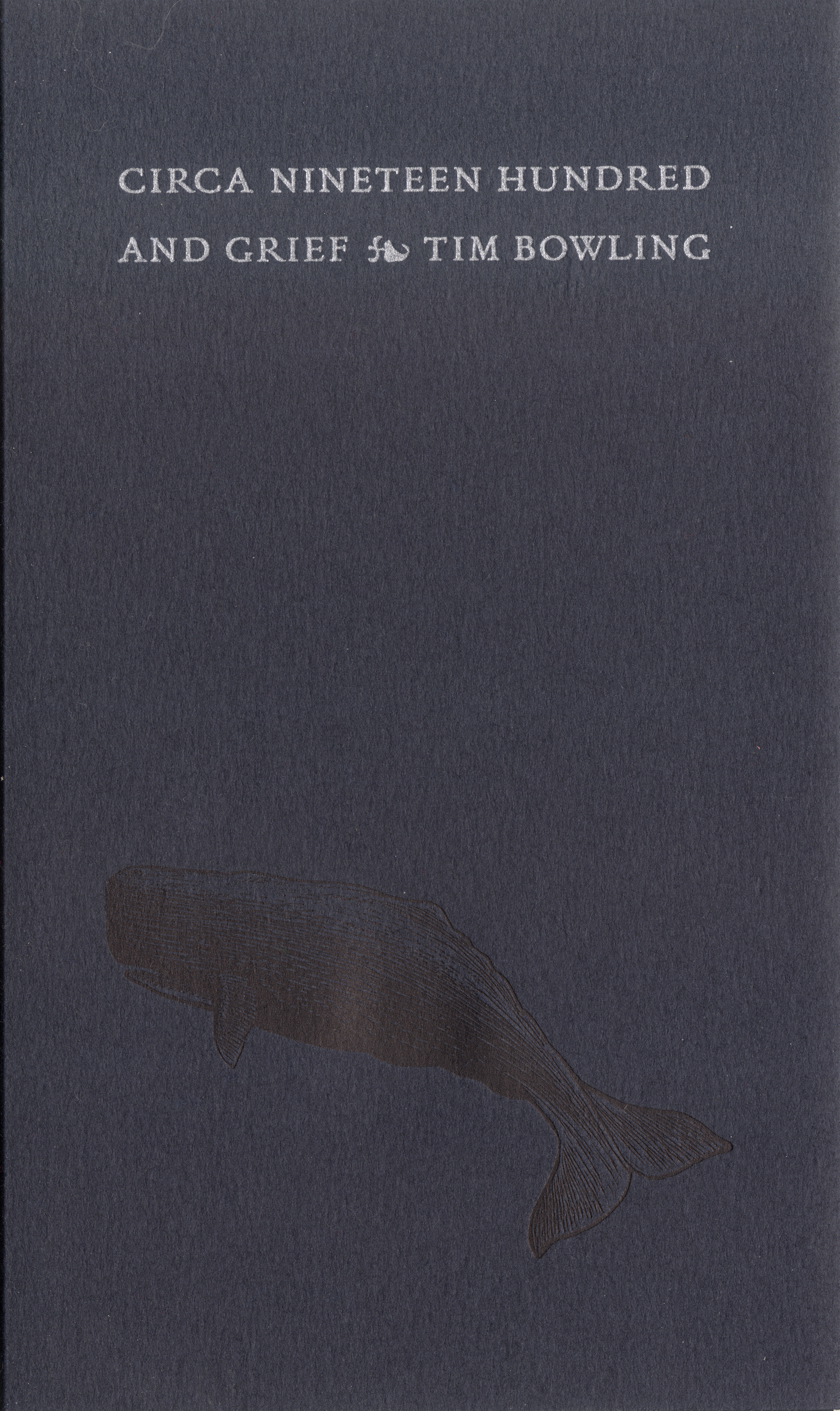
The picture I have of the cover does not do justice to the lovely Wesley Bates woodcuts that grace this beautiful book.  Gaspereau Press books are not like the others.

Today's book of poems looked at Tim Bowling's Selected Poems (Nightwood Editions, 2013) back on May 13, 2013.  We loved it.

You can see that blog here:
http://michaeldennispoet.blogspot.ca/2013/05/selected-poems-tim-bowling.html

Circa Nineteen Hundred and Grief is Bowling's twelfth book of poetry and perhaps his best to date - which is saying a hell of a lot.  Bowling has been a big favourite here at Today's book of poetry.  His book Low Water Slack (Harbour Publishing, 1995), is required reading for our interns.

Childhood

I want it back. It is unseemly
to admit so. The many who confuse
a love for the present of the past
with a love for something dead
roll their eyes. Forget them.
This is for men and women
of certain years who,
having left prints on the sand,
remember the feeling
of castles in their fingers
and turn for the fanfare
blowing silent out of the mouth
of the sun, for those who,
when the utilities are paid
another month and the children
in their intensities occupied
and the laundry transferred
once more to the light,
sit on the grass in the yard
and place one hand
on the sun-warmed gold
of the sleeping retriever's fur
to take the pulse
of that small self
they say goodbye to
a little more each day,
for those voters, tax-payers,
bearers of the ordinary burden
without end or praise who
for a few seconds
bury their faces in the old trinity
earth-sun-beast
and breathe that lost present alive
tending the last coals of a fire
in the woodcutter's woods
before the blank page of the story
turns back again
with the sound of a whale
sliding its Victorian nursery
for the last time
into the sea.

...

"Childhood" starts off this sterling collection like the whistle of a train announcing its definitive arrival with authority.  This lament to aging is Bowling at the height of his considerable powers.  It breathes the same air as The Old Man And The Sea.

Time is a lonely hunter bearing down on us all as invariably as Orion looking down on every night. Bowling knows time and the stars burns equally bright.  These poems read as though they were chiseled into stone, carved as runes of wisdom for those to come.  As though the very earth loosed them in a fit of chthonic wonder.

Two Young Men In A Duck Punt

It's still dark, they wait for something.
Light? Time? Though their lives
and ours consist of light and time
it is not for these they wait.
But see the tension in their necks
shoulder -- what else could be
the cause? Even if you say
they wait to kill, what
have you ever done to the light
and time besides?

The river around the rushes
flows black, the salmon smolts
cluster thick in separate gleams --
the knives of the knife-
throwing before the show.
Frost thaws on the gunwales
water drips off the oars
the breath of the young men
comes down-slow
and visible, there are no rings
on their raw hands. They wait
without knowing, for everything

as you have done, are doing,
there in your row at the seminar
at the breakfast table, on the knife-
scored seat of the city bus,
with the frost burning off
and the day's last windfall
rotted in your lap, waiting
for the horizon's stir
the thousand clock hands
at the centre of the present.

How fleetingly lovely
the ordinary annulment
of our skies
as the tide changes
and smoke leaves the barrel
and those young hands
like ours
gather all morning
each soft inch
of the bloody rope
whose pulling sounds only the silence
in which is heard

light and time
light and time
light and time

...

Today's book of poetry has always enjoyed the poetry of Tim Bowling and Circa Nineteen Hundred and Grief cements what we always thought.  Bowling is one of our best.

Bowling is more formal than he first appears, and fiercer.  These poems work like the inside of a fine watch, all delicately intertwined and necessary for the silent mechanism to keep track of time.  All those gears grinding away and we don't hear a sound.

The Last Days of Summer
Before the First Frost

Here at the wolf's throat at the egress of the howl
all along the avenue of deer-blink and salmon-kick
where the spider lets its microphone down
into the cave of the blackberry bush -- earth echo
absence of the human voice -- wait here
with a bee on your wrist and a fly on your cheek
the tiny sun and tiny eclipse.
It is time to be grateful for the breath
of what you could crush without thought
a moth, a child's love, your own life.
There might never be another chance.
How did you find me, the astonished mother says
to her four-year-old boy who'd disappeared
in the crowds at the music festival.
I followed my heart, he shrugs,
so matter-of-fact you might not see
behind his words
(o hover and feed, but not too long)

the bee trails turning to ice as they're flown.

...

These poems long to understand our world, put it into perspective despite the complex layers of narrative that demands.  Bowling has found the language that both connects us to and explains mysteries we have yet to unravel about ourselves.  We want to listen to everything Bowling has to say and he never disappoints.

Bowling must be an excellent listener because it appears he doesn't miss a thing.

Gary Dunfield and Andrew Steeves should be sainted by the small press world.  They are the Huckleberry Saints of Canadian publishing as far as Today's book of poetry is concerned.  No one does it better.  They can be counted on to produce books of unsurpassed physical beauty.  Circa Nineteen Hundred and Grief is but one of a long line of visually stunning and consistently gorgeous books lovingly produced by Gaspereau Press.

Tim Bowling

ABOUT THE AUTHOR
Circa Nineteen Hundred and Grief is Tim Bowling’s twelfth collection of poetry, others of which include TheAnnotated Bee & Me, Fathom, The Memory Orchard, and Selected Poems. He has also published a memoir, four novels (including The Bone Sharps and The Tinsmith) and a creative work on book collecting and poetry entitled In The Suicide’s Library. Bowling lives in Edmonton, Alberta.

gaspereaupress.com

320

Poems cited here are assumed to be under copyright by the poet and/or publisher.  They are shown here for publicity and review purposes.  For any other kind of re-use of these poems, please contact the listed publishers for permission.
Sunday, March 1, 2015

Washita - Patrick Lane (Harbour Publishing)

Today's book of poetry:
Washita.  Patrick Lane.  Harbour Publishing.  Madeira Park, British Columbia.  2014.


Most of us are familiar with the poetry of Patrick Lane - for those of you who aren't - Mr. Lane is one of Canada's most respected and admired poets.

Patrick Lane has published over 30 books of poetry, Washita is his latest.

It's masterclass stuff.  These poems are piano-string tight and sing with a particular melody.

You never have to look far in a book by Patrick Lane to get to the heart of the matter.  Lane's poems often make me think of Raymond Carver's poetry, more for the effect on the reader than technique, but for me both men have a similar density and depth.

Bokuseki

Iris blades cut through the last ice on the pond.
Emblems of endurance, they are what a man knows
who asks of the grey clouds they witness his passing.
I don't know where the water goes, remember the thin creek
I drank from when I lived in that cabin by the sea.
The doe grazed among fallen apples in my yard.
When I shot her she hung for a moment in the sky.
There were days back then I lived without regard for life.
Forgiveness comes hard.
Each year I rake the leaves and burn
the winged seeds of maples in the flames.
I kneel by the pond and ask where I am going,
what it is I must do. Bokuseki, these iris blades in ice.
When the rain dries on my palms it leaves the trace of Gobi dust.
Each night I breathe a far desert, vestiges of the fall.

...

"Bokuseki" is a type of "ink painting", like calligraphy, done by Zen monks in a meditative state.

This poem, a graceful response to death, guilt and mortality.  Lane doesn't fool around.  His poems have weight.

For physical reasons Lanes' process was altered for this book.  The resulting poems were carved out of hard wood, as a result, the sparse language that much more tempered by flame.  The reader is the winner in this dilemma, the ensuing poems are as tight as spooled wire.

For The Woman Who Danced
     With The Ashes Of Her Son

Strange how beautiful when we are diaphanous,
a bit of ripped muslin set against the sun, the wind
soft as a child's skin. Tragedy does that to us
and we are made the greater for our smallness.
A bright pebble among the discarded shells.
There are times I am a questing mole, fierce
in my love, lost as anything alive.

...

You can think of these reflective poems as meditations - but they are never sermons.  Lane continues to vigorously investigate what it is that makes us so unfailingly human, continue to uncovers what it is that might make us beautiful.

Solstice Coming

Typing with my left forefinger today. The poem is immensely slow,
one letter, one word, one line at a time. This and then this and ...
amazing how the images slow to an intimate crawl,
each word a salamander peering from beneath a stone.
The fish this winter are wraiths, the pond's perfect thoughts.
I have tried to love this quiet as the hours pass through me.
It is rare to feel anything deeply. My life is a feast if I allow it to be.
The slow rain falls without cease. It eats the ice, one drop at a time.
These days my body breaks down and I cannot lift my right arm.
My poems now are thin as I was when I lived in the mountains.
I tried to believe the lake when I came down from the high snows.
I watched the water for a long time from the safety of the trees.
It was a trout rising made me see what a day is, a ripple only.

...

Patrick Lane is not worried about spilling a little blood, he understands the cycles that life takes. That red flowing off of his hand and into both the earth and the ether where his poems become part of both.

Lane is a giant and we are lucky to have his big shadow, his beautiful poems.

Patrick Lane

ABOUT THE AUTHOR
Patrick Lane, considered by most writers and critics to be one of Canada's finest poets, was born in 1939 in Nelson, BC. He grew up in the in the Kootenay and Okanagan regions of the BC Interior, primarily in Vernon. He came to Vancouver and co-founded a small press, Very Stone House with bill bissett and Seymour Mayne. He then drifted extensively throughout North and South America. He has worked at a variety of jobs from labourer to industrial accountant, but much of his life has been spent as a poet, having produced twenty-four books of poetry to date. He is also the father of five children and grandfather of nine. He has won nearly every literary prize in Canada, from the Governor General's Award to the Canadian Authors Association Award to the Dorothy Livesay Prize. His poetry and fiction have been widely anthologized and have been translated into many languages. Lane now makes his home in Victoria, BC, with his companion, the poet Lorna Crozier.

BLURB
"like physical blows, [Lane] wields his pieces like small threats of intense beauty."
     - Globe and Mail


Patrick Lane
Calgary Spoken Word Festival, 2008
video by: ciswf


312

Poems cited here are assumed to be under copyright by the poet and/or publisher.  They are shown here for publicity and review purposes.  For any other kind of re-use of these poems, please contact the listed publishers for permission.

Monday, December 29, 2014

Albrecht Durer And Me - David Zieroth (Harbour Publishing)

Today's book of poetry:
Albrecht Durer And Me.  David Zieroth.  Harbour Publishing.  Madeira Park, British Columbia.  2014.

Poems cited here are assumed to be under copyright by the poet and/or publisher.  They are shown here for publicity and review purposes.  For any other kind of re-use of these poems, please contact the listed publishers for permission.


If this happened to all of us when we traveled, no one would ever stay home.

What a marvelous way of traveling.

David Zieroth might not be a big name in poetry where you live but his name gets a lot of traction here, in this house.  His mature and elegant poetry always breathes excellence.

You can think of this book as a travelogue.

Viennese Shoes

in Wien, even the homeless wear good shoes
or at least one bedraggled, bearded, filthy-
coated giant managed uncommonly decent leather
brogues that toe-curl a bit, an Italian smile
intimating heat and lust and care for craft

yes, any change of place forces up generalizations
rife and ready, and even knowing how quickly
scenes arise in the mind: lithe men, short hair
long strides, briefcases, or young artists debating
over Styrian beer and new wine spritzers the edge
of mathematical, abstract space - I know really

very little: glittering steel lines of the tram
on Ungargasse, straight under my feet
and along some sections, short grass snuggles
green against silver - earth and engineering
power-sharing - what could either say to the other
about times when heels of famous men

clacked these cobblestones: Freud's boots, how he
slipped into leather smoothly pleased with strength,
and Hitler's shoes, paint bespattered, then further back
and further back again until an Ottoman stands
outside the ringed wall of the city, 300 cannon strong
the story goes, Grand Vizier Pasha tapping
his magnificent Asian slippers on these stones.

...

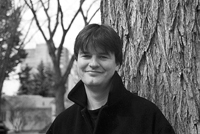
In Albrecht Durer And Me, Zieroth takes us on a trip through central Europe where he reflects on art and humanity.  The people we become when there is that change that movement brings.  When there is new soil under our feet, new language in our ears, we sometimes soar.

Albrecht Durer And Me

     at the Albertina Museum

his entire life he thought
of death approaching
it was the century syphilis arrived
1500 meant the end of time
one self-portrait an imitation
of Christ

for me, it's his rabbit
each ear bent differently, every
whisker visible
its mood pensive
another sort of portrait

and his monogram -
AD, 1502 (same year
his medieval father died) -
floats beneath the brown foot
as I float

back to rodents I snared
in a winter garden
frozen next day
and still the fur soft
(or back to fuzzy lucky
charms on key rings
among coins in pockets
of the slightly odd)

from him almost all
German art springs, begins
from me up pops this poem
when here I stand
(wanting to touch the painting
and feel the fur again)
one of many awed viewers
this young hare has seen
in five centuries
even as he draws into
the calm before trembling
to ponder his animal thought

and from my departing train
I see him once more
a tall buck alert in rows
any frame - through red dots
of waving wild poppies
defining the farmer's field
draw me eye to his readiness
for leaping

...

From his first book, Clearing: Poems From a Journey (1973), Zieroth has been a traveller and an especially keen observer.  Through How I Joined Humanity At Last (1998) up until now, with his tenth volume of poetry, Albrecht Durer And Me (2014), Zieroth has humbly created a great body of poetry.

Weeds Grew While I Was Away

I expected what?
an unchanged patch
of pure stasis, stems
unaltered, exactly as
the morning I glanced back
from the cab, my face sunny
not this yellow of greeters
trumpeting on my lawn
crowding the walk where birds
splatter white words
around the grey face
of the garden stone
that has not altered, cool
under my hand, a spot more
lichen-wrinkle persisting

- that this filigree lives
so little, unlike the rise
and fall we are made of
we hardly care, so pleased
we along measure how slow
rock crumbles, as we touch it
we rub against time and find
we triumph: listen
to our watery laughter
when sun lights up skin
we have animal pleasure
knowing and loving
even ragweeds with their vigour
and niche so like our own
in urgencies coming and going
...

Zieroth also reminds us of the sweetness of returning home, knowing where we came from, how we got there.


David Zieroth

ABOUT THE AUTHOR
David Zieroth has published several books of poetry including The Fly in Autumn, which won the Governor General's Literary Award for Poetry, and How I Joined Humanity at Last, which won the Dorothy Livesay Poetry Prize.  He taught at Douglas College in New Westminister, BC, before retiring and founding the Alfred Gustac Press.  Born in Neepawa, Manitoba, he lives in North Vancouver, BC.

BLURB
"David Zieroth has long displayed in his poetry a subtle and unique faithfulness to following invisible threads through the world -- hearing calls and offering responses, speaking spells.  In this collection, as he turns the largesse of his poetic attentiveness to the inescapably symbolic activity of travel -- to the rich roads of distance within and without his poetic individuality -- the results are evocative, enlarging, and touch often at deep mystery.  Albrecht Durer And Me is a gift to the reader -- a marvel of an addition to Zieroth's ongoing oeuvre."
     - Russell Thornton, author of Birds, Metals, Stones and Rain


285

Monday, October 6, 2014

The Collected Poems of Patrick Lane - (Harbour Publishing)

Today's book of poetry:
The Collected Poems of Patrick Lane.  Patrick Lane.  Harbour Publishing. Madeira Park, British Columbia.  2011.


Today's book of poetry has seriously floundered in attempting to write about Patrick Lane and his collected poems.

How do you write about your heroes?

This monumental collection is a pure object of beauty before you open the covers.  Harbour Publishing have done their boy proud.

Oh yes, the poetry.

The Image

Now that he was older
the artists had begun to paint him, and the photographers,
the clever ones with their miniature machines came
and arranged him in gardens and poolrooms, bars and verandas,
to capture the images of who he was, who they thought
he had been. Most of the artists were his age
but some were younger, beautiful young men,
and woman with large hands, their hair pulled back
tight, their clothes unruly. He liked them best.
He liked the way they would walk around him
after spending days and nights with his books,
his poems, the way they would stop and stare
while painting him, all his words in their minds,
all the suffering intact, precise and imaginable.

...

You can pretty much jump in anywhere to harvest the rich vein of work Lane has been pounding out since his work was first published in the sixties.  Twenty-seven books of poetry so far.

Just so you know, from Today's book of poetry perspective, Patrick Lane is the poet of the people. Horrible moniker to lay on anyone but in this case it fits.  His very approachable body of poetry is working class no-nonsense and as erudite as the golden tongued whisper of the angels.

Grief

He sat at the foot of the low bed and watched her cry.
It was not like Rome burning and it was not
like the spare fires he had built
when he was alone in the wilderness,
the ones he sat away from, the ones he put out
when he was tired of watching.
Her grief was of another kind, an event
that was merely ornament, a thing
that perishes as it is made, as a performance
in a northern town perishes line by line
with no one to remember it, something less than art
as time is less than merit. He had made her love him.

She hadn't wanted to. He had shaped her love
by shaping himself, giving himself to her
in the exactness of her integrity, becoming
her, and so, becoming less, their time
together an intimacy which was only imitation.
Sitting there he felt the same
as when he was a child and dressed
in his mother's clothes, his posturing
in front of her mirror, the inaccuracy
of that kind of dance.

He understood his gluttony, the wanting more,
his greed for her loss, the pain
she seemed to love more than him.
She did not tell him to go away, and
she did not call out to him.
What he had was what an observer has,
the man who gazes alone from a private box
protected by velvet curtains, a glass of good wine beside him,
the play going on and him with no rights, one way
or another, the man who watches with detachment
as a critic does, having no stake in the event.

...

I had the privilege of meeting Patrick Lane once.  It was back in the late 70's.  I was driving taxi in Peterborough and writing my little poems.  I got a call from my high school drama teacher, for some reason or another she was meeting Patrick Lane for drinks and was inviting me to join.  Of course I did.  Pretty sure I was able to get another young poet, Richard Harrison, to join me.

And that's the end of that story.

I've met Acorn, Purdy, Layton, Birney.  And just meeting those men took my breath away.  But Lane has always been the poet whose work paralyzed me with pleasure most.  Of all the giants, he is the giant that makes the most sense to me.

My intern disagreed.  You will not hear from that intern again.

Last Water Song

It is not the water you tried to find when you were young.
That was the water that lost you.
You climbed trees to look and the water was there.
You walked on the earth and the water was nowhere.
That was the losing water.
This water is the finding water.
It is cloud searching water.
When you are old it comes down.
It stretches out on the earth.
It says follow this water.
First water is woman water.
The belly of woman has this song.
This water was the first learning song.
This water is the last learning song.
It is the cloud under the earth.
Now you climb down roots to find this water.
Now this tongue is a root.
Open this mouth in the earth.
Now sing this water song.
Now you are the last water.

...

For many of us at the Today's book of poetry offices Patrick Lane sets the bar for the rest of Canadian poetry.  The Collected Poems of Patrick Lane should be an essential for every poetry collection in the country.

Patrick Lane

ABOUT THE AUTHOR
Patrick Lane, considered by most writers and critics to be one of Canada's finest poets, was born in 1939 in Nelson, BC. He grew up in the in the Kootenay and Okanagan regions of the BC Interior, primarily in Vernon. He came to Vancouver and co-founded a small press, Very Stone House with bill bissett and Seymour Mayne. He then drifted extensively throughout North and South America. He has worked at a variety of jobs from labourer to industrial accountant, but much of his life has been spent as a poet, having produced twenty-four books of poetry to date. He is also the father of five children and grandfather of nine. He has won nearly every literary prize in Canada, from the Governor General's Award to the Canadian Authors Association Award to the Dorothy Livesay Prize. His poetry and fiction have been widely anthologized and have been translated into many languages. Lane now makes his home in Victoria, BC, with his companion, the poet Lorna Crozier.
BLURBS

"Like the classic Buddhist, Lane finds in the recognition of life's horrors, or the terrible things men do to men and even more to other beings, the reason for an ultimate compassion, for a desire to nurture love where it survives."
     George Woodcock

"Patrick Lane is our most essential poet; tough, tender, fearless, and beautifully dangerous. For decades he has been our guide to darkness, and our provider of unexpected flashes of brilliant, almost blinding light. Now gathered together in one spot, the poetry of his life enhances and energizes us, and takes us to places we would never go on our own. Lane is a true Master."
     Jane Urquhart

"Lane's poems have a lucid, generous eye for the unsung and excluded, an abiding dignity in their rhythms of blind continuance, compromised peace."
     Ken Babstock

"...a breathtaking achievement of moral and poetic genius."
     Tim Lilburn

Patrick Lane @ 2008 Calgary Spoken Word Festival


254