Showing posts with label karen shklanka. Show all posts

Friday, September 30, 2016

Ceremony of Touching - Karen Shklanka (Coteau Books)

Today's book of poetry:
Ceremony of Touching.  Karen Shklanka.  Coteau Books.  Regina, Saskatchewan.  2016.

Image result


Today's book of poetry had the distinct pleasure of writing about Karen Shklanka's first book of poetry Sumac's Red Arms back in November of last year.  Sumac's Red Arms was one hell of a debut. You can see that here:


Ceremony of Touching picks up the torch with aplomb.  Shklanka writes with such open emotion and accessibility that she reveals the inner workings of things.  Even things we don't want to know.

In one part of this world Shklanka is a physician, in another a dancer, she is a lover and a historian, and she is constantly reporting from her post as a poet.  It must get terribly crowded in Karen Shklanka's noggin' but then aren't we all fractured pieces trying to be whole?  Shklanka is a quick study in the fabrication of the glue that holds those pieces together.

One by One

At random times, when I am
wiping the dog's muddy paws, opening a biography
of Lord Byron, or undressing
for my husband, their faces
come to me.

Evelyn, who baked two
apricot loaves at a time - 
one for me - even after I
diagnosed her diabetes.

Albert, who brought me camellias
every spring, his wife's favourites.
His blue eyes filled and he blinked
each time he passed the pink flowers
to me, their stems wrapped in wet
paper towels and foil, the way
Edith used to.

Eleanor, unpacked from the ambulance,
rattled out on a stretcher. I'd just arrived
to do morning rounds. I recognized her,
even swaddled in white blankets, strapped
down, her smile twisted, eyes wide.
In the office, her loud voice made me smile.
Down with a stroke,
the ambulance attendant told me.
A dangerous new blood thinner
available, but only in the city.
No family to decide. Time
is brain. A four-hour window of chance
to give the medication. Too late
and the stroked-out tissue
softens and bleeds. There's time, I said,
called neurologist, the helicopter,
didn't tell them right off
she was a smoker, refused to take
Coumadin for her TIA's. To get your way,
sometimes it helps to smile as you talk.
As they wheeled her out of the hospital for transfer,
I took her hand, said, I'll see you
when you get back; it will be alright.

Years ago, when a patient died,
I went down to the river at night,
my husky howling into the wind
with me. Now, sometimes I cry,
sometimes I don't.

Nobody told me I would
remember the face of
each of my patients who died.
I wish I could remember every face
in detail, every voice, and listen
to their words. So
that I could read each name,
bring them to me. Hold them
for a moment.

...

Who among us hasn't wished to hold someone long past holding?  Ceremony of Touching explores many of the ways we come together to interact, love and hurt one another, all those juicy moments that make us human.

One section of Ceremony of Touching is a series of poems called Flight Log.  These poems create a fictional logbook for the flight of the Enola Gay on that fated day over Hiroshima.  These short poems are sparse, almost code, and almost perfect.  Shklanka has just the right balance of function and gravitas.  These little bullets are impressive.

Shklanka's curiosity does not let us down, these poems have laser guided vigor, whimsy when called for.

Trying Not To Remember the Woman in the ER

White needles, hoarfrost on the Douglas fir.
I can't leave my boyfriend, she says. Women use

what their partners do. I still want
to be a social drinker, she says.

All the new science is about immortality.
When's the point of no return,

journeying from bottoms up? It's snowing
at the bottom of the mountain,

not the top. When you're walking downward
inside a cloud, at what exact moment

does the snow start to form?
We say that hearts beat, but they don't.

They open and contract, open and contract.

...

This mornings read of Today's book of poetry went surgically smooth, everyone got out with only the smallest of scars and those were all neatly stitched.

Shklanda isn't afraid of shining the light on her own imperfections, these poems have the weight of truth about them.  Every dilemma does not have an immediate solution, or a solution at all, but these are the moments we have to live through, Ceremony of Touching gives voice to keen observations of our stumble.

Antidote II

A raven drops a chestnut into the middle of the afternoon,
flies back to the lamp-post, waits for the lights to change.
I am down to the last two patients of the day.

A woman with lung cancer whose father recently died
of the same. She inherited the smoking,
or the radon in the basement.
She asks me to tell her
whether she needs more chemotherapy.

The wife of a man with Alzheimer's. He needs diapers,
runs away and is returned home by police
once a week. She should let him go
into extended care. At least I will try
to convince her of that.

Cars will crunch the raven's chestnut into a smear.
The raven will eat when the light changes.

...


That's two for two.  Two books, Sumac's Red Arms and Ceremony of Touching, two books that Today's book of poetry thinks you should read.  Karen Shklanka writes fine poems and Today's book of poetry can't wait to see what comes next.

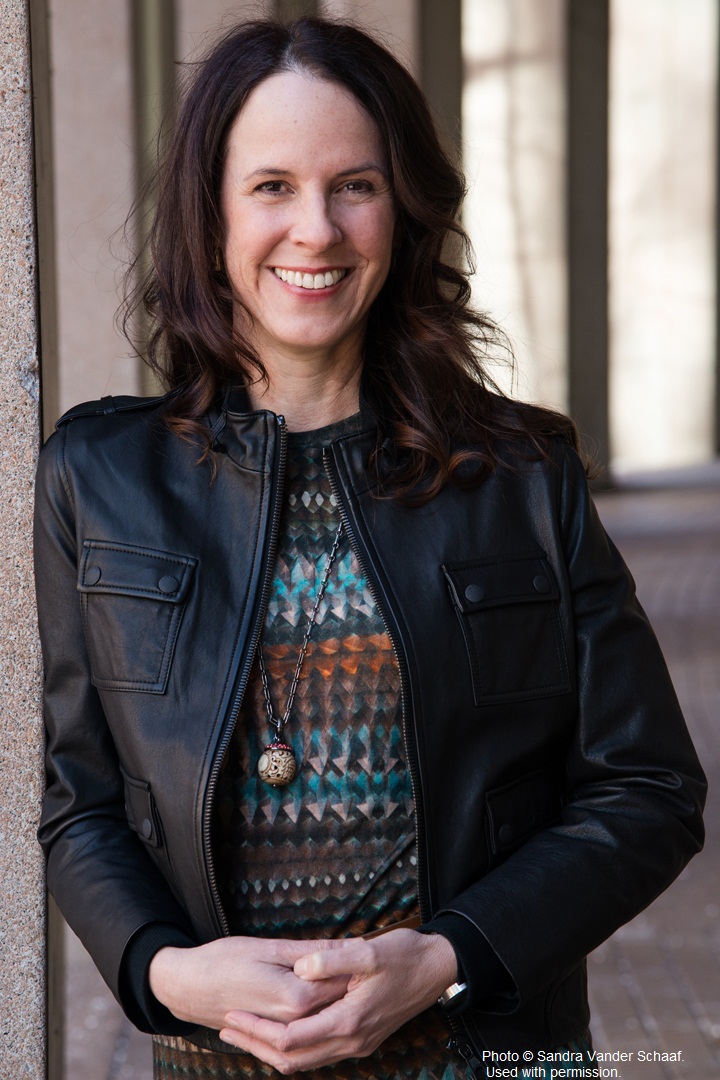
Image result for karen shklanka photo
Karen Shklanka
(photo: Tatiana Balashova)

ABOUT THE AUTHOR
Karen Shklanka is a poet, family physician and an Argentine Tango dancer. Her first book of poetry, Sumac’s Red Arms, published by Coteau Books in 2009, was nominated for aForeWord Review’s Book of the Year award. In 2012 she was long-listed for the CBC Poetry Prize (for “Flight Log” – included in this collection). Her poetry has been included in the Planet Earth Poetry Anthology and the 2004 chapbook anthology, Letters We Never Sent, edited by Patrick Lane. She was four times a finalist in ARC magazine’s international poem contest, and has been published in numerous other literary periodicals, most recently in CV2 and Room.

Born in Toronto, Karen Shklanka spent 14 years practicing rural and emergency medicine in small and medium-sized Canadian communities. She has an MFA in creative writing from UBC and currently works as a hospital-based Addiction and Pain medicine consultant in Vancouver, and as a Clinical Assistant Professor at UBC.

coteaubooks.com

508

DISCLAIMERS

Poems cited here are assumed to be under copyright by the poet and/or publisher.  They are shown here for publicity and review purposes.  For any other kind of re-use of these poems, please contact the listed publishers for permission.

We here at TBOP are technically deficient and rely on our bashful Milo to fix everything.  We received notice from Google that we were using "cookies"
and that for our readers in Europe there had to be notification of the use of those "cookies.  Please be aware that TBOP may employ the use of some "cookies" (whatever they are) and you should take that into consideration.

Thursday, November 19, 2015

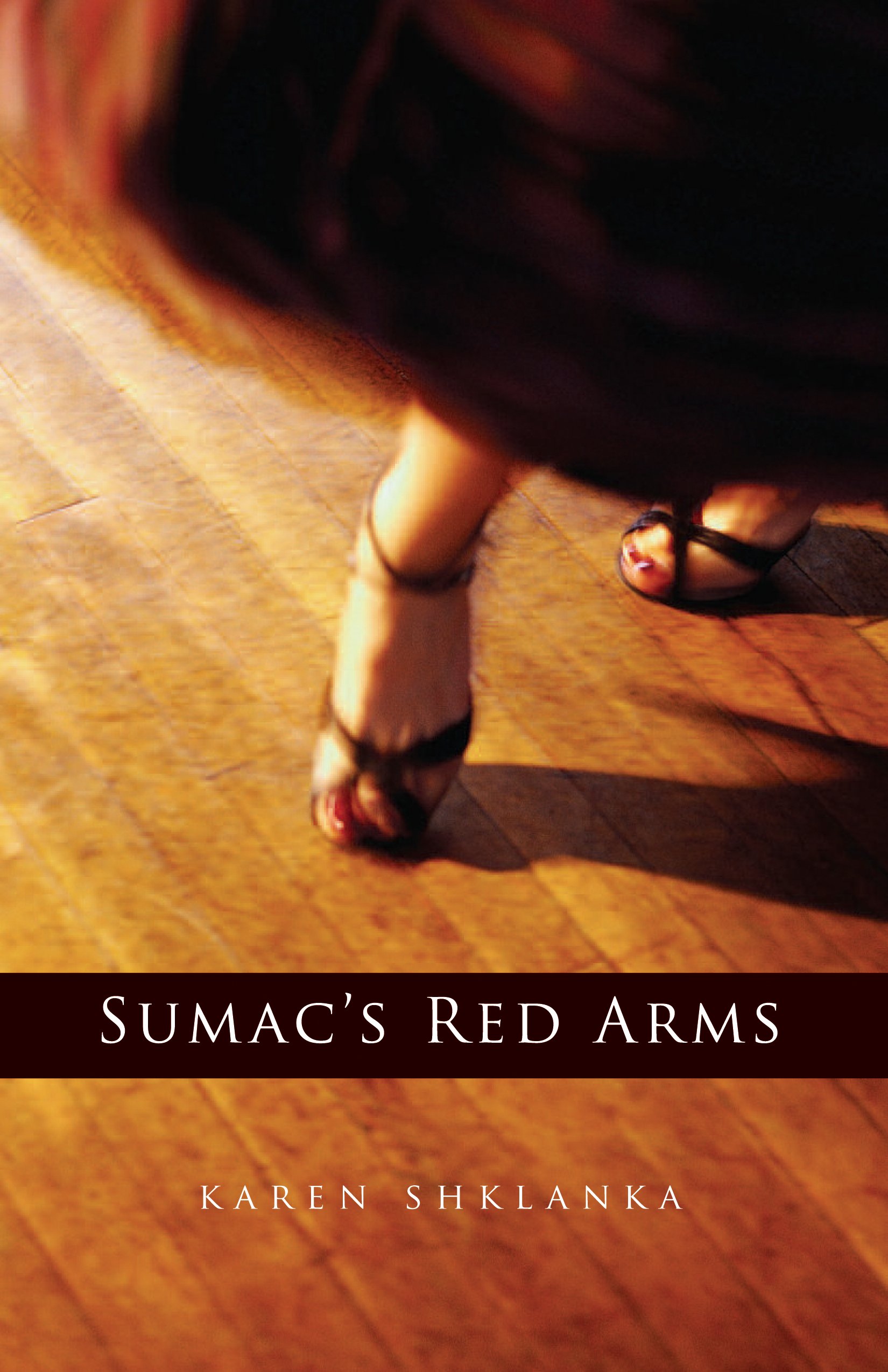
Sumac's Red Arms - Karen Shklanka (Coteau Books)

Today's book of poetry:
Sumac's Red Arms.  Karen Shklanka.  Coteau Books.  Regina, Saskatchewan.  2009.


Karen Shklanka is a poet I could listen to all day long.  Nothing is as exciting as a voice filled with vibrant intelligence and wit.  She also happens to be a practicing physician.

The poems in Sumac's Red Arms are small movies worth watching.

Whether Shklanka is in an emergency room stitching scalps or dancing the tango as though her life depended on it Sumac's Red Arms stuns the reader with precision and clarity.  These poems charm the reader, if this is dancing, Shklanka is definitely the lead.

Season

Milkweed pods empty themselves to the wind,
dry cups like grandmother's hands.
A child on the bank follows a yellow leaf underwater.
Sumac's red arms gather in the weather.
The river, larger than memory,
pours itself like clear tea through the ravine.

...

Today's book of poetry takes old school pleasure in the way Shklanka's narrative holds the reader by the scruff of the neck.  These poems are well traveled, the fruit they serve could be from anywhere.

Sumac's Red Arms  is broken up into several separately titled sections and each has some stylistic perk that make them unique but the voice never changes, Shklanka is constantly stone-cold certain. The lucky reader gets to see Shklanka's considerable skills spread out over several different palettes and she has a different gear for each other them.

In The Poem

I won't tell you
about how morning stretches
under the clouds on English Bay
like a bright skin, how
its edges blur tenderly into
the dark, how all moments
accordion into this one
where we touch a stranger's
fingers, how our steps echo
in the street, how you measure
this, the Pont Neuf, my stride,
how you read my back
with your hand, how my sidelong
thoughts slip by
the Seine, out of streets
of the Marais, sniff around you,
intercept a glance, a sudden
kiss before the inevitable
commutation, the door closing
and the gleaming train.

...

The gang in our office for the read this morning was larger than usual.  Milo and Kathryn both brought guests, they claim our morning read is better than Bugs Bunny or Oprah.  The office rule is that everyone has to read a poem and that included our guests.

One visitor read the entire "Vocabulary A Tango" section of Sumac's Red Arms.  The other guest, they both prefer to go unnamed, read two poems, "Dear God," and "Letter to Jesus."  Both were excellent reads.

From today forward, Today's book of poetry will be welcoming guests to our morning reading.  But if you show up - you HAVE to read.

The Girl From Attawapiskat

She is the fifth Friday night "Tylenol overdose" send from the
Attawapiskat nurses in six weeks. I am new to medicine, to the North,
still can't sleep night before being on-call. We chopper them down:
fifteen or sixteen years old, smooth skin, wary eyes. I never really know
what to do. There's no acetaminophen level. No proof. They get an IV
drip for the night, Mucomyst, then go shopping at the Northern store
the next day. There's not much for a teenager to do in Attawapiskat, a
reserve of a thousand people with their own Cree dialect. Once, we
made the rule, "No Shopping," and the weekend helicopter rides
stopped, for a while.

**

Another Saturday night, the girl from Attawapiskat again. An
"overdose." She refuses to stand, so I sit on the floor of the ER with her.
Her voice is quiet, not wanting to talk to me. She casts her eyes down. I
wait. Look at the scuffmarks on the floor.

She says she heard a voice in her head that gave orders. Kill yourself, the
voice says. This time, I know what to do. There is a psychiatric hospital in
North Bay. The psychiatrist can't refuse. The pilots flying patients to this
hospital insist they wear a straightjacket. We both cry as the orderlies
strap her in. She screams at the men. I stand in the stairwell by the
helicopter pad. She spits on me as they wheel her out on the stretcher.

**

Four months later the girl from Attawapiskat stops me on the road, as I
walk to the hospital. I hardly recognize her. She is pretty now. A bit
plumper. From the medication, I think. Not as quiet. Says she wants to
thank me for sending her to North Bay, that she'd been in
treatment for depression, sexual abuse. She appreciates me taking the
time. Plans to go and stay with her older sister in Fort Albany. I blush,
then release my breath; fight the tears in my eyes.

**

Six months later I get a call at 10 pm from the nurse in Fort Albany, one
community north from Moose Factory on James Bay. A thirty-five year
old woman has been in a gas explosion. From medical school, I know the
key question is, Does she have burns around her mouth? Yes? Then
check inside. Yes? Bits of Black? My mind is tight and clear.

I send the anesthetist up in the chopper in case of swelling of her airway,
then I fall asleep on the living room floor, a blanket over my shoulders,
my husband in the bedroom upstairs. The phones wakes me up at
midnight. I've been drooling. Don't know where I am. The nurse is
panicking. The chopper isn't there yet. The patient is choking.

I talk the nurse through a needle cricothyroidotomy. It doesn't work.
There's blood everywhere, she says. Get the bag and mask, oxygen,
I say, some air will get in. They hear the chopper. Hang up.

I can't sleep, call an hour later to see what's happened. She was barely
hanging in there when the doctor arrived, then she lost her IV. I'd asked
for two, but they'd only managed one, her veins were so shut down.
While they all tried to replace the IV, she stopped breathing, had a
cardiac arrest. The nurse says the woman's sister, the girl from
Attawapiskat, is waiting outside.

...

The feeling around the office was that we all wanted to see more of Karen Shklanka's very fine poetry.  Sumac's Red Arms was thoroughly entertaining when Shklanka was dancing, riveting and respectfully sublime every time there was blood on her hands.  Shklanka's prescriptions are disguised as poems.

This is great medicine.

Karen Shklanka

ABOUT THE AUTHOR
Karen Shklanka is a poet, a family physician and, with her husband, an Argentine Tango dance instructor. Her poetry was included in the 2004 chapbook anthology, Letters We Never Sent, edited by Patrick Lane. She was twice a finalist in ARC magazine's international poem contest, in 2005 and 2006, and has been published in numerous other literary periodicals. Sumac's Red Arms is her first book publication.

Born in Toronto, Karen Shklanka spent 18 years practicing rural and emergency medicine in small and medium-sized Canadian communities. She has lived in Vancouver, Australia, Regina, Houston, Los Angeles and Moose Factory, Ontario, and on Salt Spring Island. She received her M.D. in 1988, and, in 1990, received the top mark in Canada from the Canadian College of Family Physicians. She currently serves as a Clinical Instructor in the Faculty of Family Medicine at UBC.


409
DISCLAIMERS

Poems cited here are assumed to be under copyright by the poet and/or publisher.  They are shown here for publicity and review purposes.  For any other kind of re-use of these poems, please contact the listed publishers for permission.

We here at TBOP are technically deficient and rely on our bashful Milo to fix everything.  We received notice from Google that we were using "cookies"
and that for our readers in Europe there had to be notification of the use of those "cookies.  Please be aware that TBOP may employ the use of some "cookies" (whatever they are) and you should take that into consideration.