Showing posts with label kevin prufer. Show all posts

Monday, February 11, 2019

Losers Dream On - Mark Halliday (Phoenix Poets - The University of Chicago Press)

Today's book of poetry:
Losers Dream On.  Mark Halliday.  Phoenix Poets.  The University of Chicago Press.  Chicago & London.  2018.
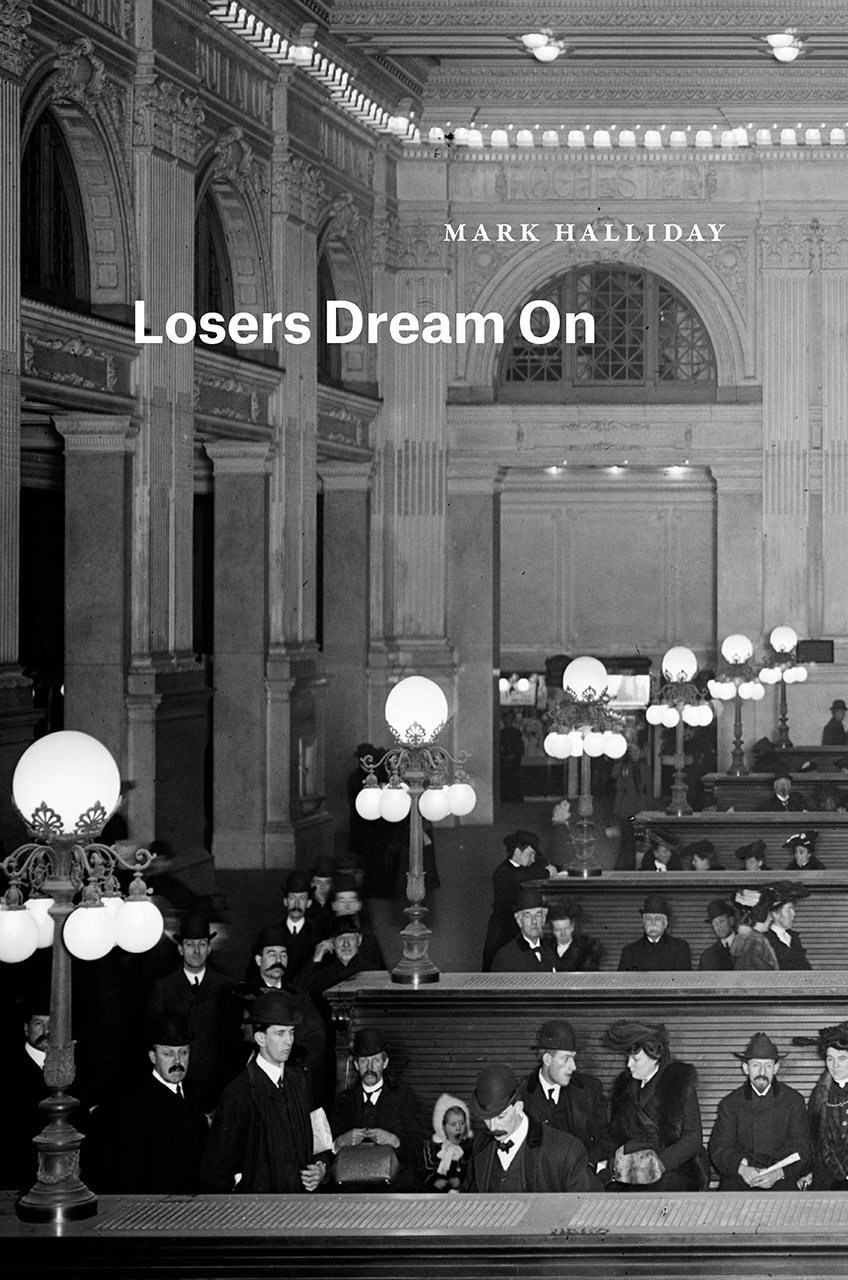

Mark Halliday's Losers Dream On is for the Hoi polloi even though they are unlikely to ever read it.  More's the pity.  Losers Dream On.

Losers Dream On was written for stand-up comedians at the end of hope and in need of a laugh.  There's plenty strange happening as Losers Dream On but somehow it all plays familiar.

Halliday is thoroughly transparent, all of his magic tricks are done right in front of you, no slight of hand.  

A Gender Theory

Women are right:
There must be meaning;
and the meaning will die.

Men are wrong:
They suppose there can be a deathless meaning;
or else that there can be joy without meaning.

Women know the double truth:
There must be meaning;
and the meaning will die.

💫💫💫

Here in Ottawa today we are trying to enjoy the sunshine and the blue, blue sky because tomorrow all hell is about to break loose.  We are expecting 30-40cm. of snow tomorrow (15 inches or so), along with the snow there will be wind gusts up to 90km. (60mphish).  Batten down the hatches.

On a snowy day when you can't leave the house Today's book of poetry says that a book of poetry might make for some fine quiet time.  Mark Halliday is your huckleberry today.  We recommend getting you hands on a copy of it and marking out some time.

Mark Halliday likes to look at time, how things work out over time, or don't.  You can feel the undertoad in Losers Dream On even when Halliday is tickling the old funny bone.

First Wife

Each of us carries secret scars in spirit always ready
to be wakened into wounds, ready as if waiting
as if to be wakened into wounds is a debt forever unpaid:
a song suddenly brings the invoice again
and finds the screen door forever unlatched—

as when I hear "Save the Last Dance for Me"
and think immediately of Annie
and how I always said I would.

💫💫💫

Mark Halliday is pretty matter of fact in his optimism regardless of the obstacles he invents and/or endures.  Losers Dream On is a totally solid poetry read.  You all know the Today's book of poetry drill; when I'm reading a book for the blog, in this case Losers Dream On, it is only during the second reading where I'll start to mark up a notepad with page numbers of essential poems.  These are the poems that Today's book of poetry wants/needs to share.

Halliday ran up some impressive Today's book of poetry numbers as we marked up our header with page after page of poems Today's book of poetry wanted to share.  Halliday's batting average is All-Star material.  Here's one more taste.

Index to Hamaday: A Questionable Life

Addicted to salted cashews,   64
Apologizes to two women in past,   55
Baffled by human acquiescence in gush of time,   49   
Complacently accepts middle-class white male privilege,   56
Considerably less funny than thinks,   66  
Doubts greatness of Philip Roth,   49 
Dozes off over important books,   38, 39, 40, 41, 42, 43, etc.
Eats more than friends deem possible,   19, 20, 22, 24, 26, 28, 31ff
Feels "smaller than his life,"   57, 62
Forgets smart things said in restaurants,   28, 33, 39, 47, 60
Forgets that everyone else's heart is beating,   38, 48, 58
Honors Paul Violi via less funny imitation,   see Index
Hopes candor can substitute for lapidary brocade,   38
Hopes mild flickering wit better than no wit,   67
Jilted by series of women insensitive to poetic virility,   23, 24, 26, 27 ff.
Keeps daily diary because is center of world,   41
Loses track of criteria for good poems,   45, 55, 67
Means more than can quite express,   passim
Melon balls, metaphorical references to,   33, 44
More talented than enemies, by long shot,   48
More talented than friends, why not admit,   58
Mutters to self, unaware of being observed,   59-65
Ogles young women in airports,   45-66
Opposes own sexist tendencies,   24, 47, 56
Plans day around caffeine,   43, 45, 46, 48, 50, 52, etc.
Rejects "reference," "impact," and "grow" as transitive verbs,   54
Salves conscience by sending small contributions to
      Amnesty International, Planned Parenthood, Doctors Without Borders
      and ACLU,   32, 40, 50, 61
Sings like George Thorogood while alone in car,   62
Still trying to impress women unimpressed forty years earlier,   61
Suddenly sees self as tiny fleck of ego amid billions of such,   70
Surprisingly clever after two gin and tonics,   56
Testosterone in odd relation to existential bafflement,   51, 55, 60
Time, mystery of, unable to stop exclaiming about,   39, 49, 59
Undeserving of luck but very glad to have it,   68
Wishes had been kinder on certain occasions,   71

💫💫💫

It's been a while since Today's book of poetry had a list poem and all of you regulars will know that Today's book of poetry is a sucker for the list poem.  Halliday's "Index to Hamaday: A Questionable Life" is an ace.

Yep, Mark Halliday can burn.

Image result for mark halliday poet photo

Mark Halliday

ABOUT THE AUTHOR
Mark Halliday has taught in the creative writing program at Ohio University since 1996. His six previous books of poems include Jab and Thresherphobe, both published by the University of Chicago Press.

BLURBS
" 'And you try to be awake,' growls Mark Halliday. These poems are fully awake, practicing vivisection on their own delusions, complacencies, and sublimities, carving into the tissue of language. Song here sounds more like invoice than voice. Yet its wit reveals the timeless: sorrow for a dying father, a lost wife, and the core recognition of our 'dustitude.' A remarkable book."
     - Rosanna Warren, author of Ghost in a Red Hat

“Reading Losers Dream On is like listening in on the constantly shifting, uncomfortable thoughts of a mind brilliantly attuned to the world of memory and to its own intricate (often hilarious) processes. These poems take place in landscapes that seem familiar at first—snow-covered parking lots, an empty Mexican restaurant, airport gates crowded with travelers—but, under Mark Halliday’s gaze, they become dazzling and strange, filled with troublesome knowledge and the possibility of mortality and transcendence. Witty, exciting, and wide-awake, Halliday is one of the best poets at work in America today.”
     - Kevin Prufer, author of In a Beautiful Country

“Mark Halliday is one of our foremost technicians of the American vernacular. In Halliday's poems, James Joyce, Leave It To Beaver, and Sir Walter Raleigh all get their turn at the microphone. I admire Halliday's dedication to coherence, self-interrogation, and endless verbal playfulness. His voice is one of the most reliable, hilarious, effervescent, and moody pleasures in the contemporary canon. His rich new collection, Losers Dream On, holds its own with the high standard of his best work.”
      - Tony Hoagland, author of Application for Release from the Dream


Mark Halliday


Poetry@Tech:  Mark Halliday
Video: Poetry@Tech


738


DISCLAIMERS

Poems cited here are assumed to be under copyright by the poet and/or publisher.  They are shown here for publicity and review purposes.  For any other kind of re-use of these poems, please contact the listed publishers for permission.
We here at TBOP are technically deficient and rely on our bashful Milo to fix everything.  We received notice from Google that we were using "cookies"
and that for our readers in Europe there had to be notification of the use of those "cookies.  Please be aware that TBOP may employ the use of some "cookies" (whatever they are) and you should take that into consideration


Sunday, January 11, 2015

Honey - Richard Carr (Gival Press)

Today's book of poetry:
Honey.  Richard Carr.  Gival Press.  Arlington, Virginia.  2008
(Winner of the Gival Press Poetry Award)


Whimsy and delight would suggest the wrong thing, but whimsy and delight are at the fore of Honey.

Richard Carr gives us a sequence of such silly joy that the reader spills with glee.  But there is enough seriousness in here to give you a heart attack, sweetly.

Intelligent and witty doesn't cut the mustard with Honey, but witty and intelligent are two of the first visceral responses to this tapestry.  This is some fine weaving.  Richard Carr is as sure footed as spider on its' own web.

IV

No amount of washing can divert the ashtray
from its purpose.
The Bearded Lady, clean shaven in the off season,
offers me a cigarette,

and we share a thin, gravelly smoke.
I want to be like her.
She is a mirror. when she stirs her coffee,
the whole restaurant stirs.

...

These poems rollick with frenzied imagination.  Richard Carr has limitless spark and endless horizon.
Each of these stunning short poems adds another colour to Carr's explosive palette.

IX

Design in the gothic city
a matter of assemblage,
I wear a massive clothing of stone monuments
and scaffolding.

The street a chaotic plaid of asphalt repairs,
I dent the pavement
where the work is still fresh,
hot.

The soles of my feet blacken my apartment--
walls, ceiling, all of it.

...

I usually require more of a narrative thread but found these tireless ditties endlessly fascinating.  It's like they came out of the barrel of a machine gun, each bullet as faultless as the other.

Carr would, I expect, be a marvelous dinner guest -- his imagination rolls out like a big sun that is constantly rising.

LXXXIII

I gather to my cheekbones
crabappled blossoms drenched in a cold drizzle.
I lick violets, kneeling obscenely,
and draw yellow dandelion heads into my mouth.

I want to taste what the bee tastes,
nectar and pollen, but more, her chemical imprint,
footprints on the petals,
to learn where she has been, what orchards and nurseries.

gardens, graves --
and if she ever blushes.

...

A blushing bee, footprints on petals.  I loved these.

Everyone here at Today's book of poetry chose three different poems for today's blog -- but I chose the three you read here.  It could just as easily been any three poems picked at random from this electric book.

Dazzling stuff, sweet like honey, and a little sticky.

Richard Carr

ABOUT THE AUTHOR
Richard Carr grew up in Blue Earth, Minnesota, and lives in Minneapolis. A former systems analyst, web designer, and tavern manager, he has taught writing and literature at several universities and community colleges. His other poetry collections are Ace (The Word Works, winner of the Washington Prize), Honey (Gival Press, winner of the Gival Press Poetry Award), and Mister Martini (University of North Texas Press, Winner of the Vassar Miller Prize). His chapbooks include Butterfly andNothingness (Mudlark) and Letters from North Prospect(Frank Cat Press, winner of the Frank Cat Press Poetry Chapbook Competition).

BLURBS
"Poet Richard Carr weaves together lovely and unlikely connections in his Gival Press Poetry Award winner, Honey (978-1-928589-45-7). Wrinkled plants, a goldfish and the poet drink water while outside, 'The clouds rain gasoline.' A Bearded Lady stirs coffee in a restaurant, birds listen to our voices on a telephone wire, and 'somewhere a dying child / wears a wig of [his] donated hair.' Lyrical, laced with longing, these 100 short poems create a world where 'The best stars slide across the sky in retrograde.'"
ForeWord Magazine, July 2009

"Honey is a tour de force. Comprised of 100 electrifying microsonnets, Richard Carr’s invention recalls Berryman’s Dreamsongs, for brilliance and wit, but is more readable. Open to any page: language and image startle and delight, like 'Einstein’s blown-fuse hairdo.' The whole sequence creates a narrative that becomes, like the Hapax Legomenon, a form that occurs only once in a literature."
—Barbara Louise Ungar, author of the award-winning collection The Origin of the Milky Way and final judge of the 2007 Gival Press Poetry Award

"This sequence of compact poems is musically subtle, visually surprising, and, at times, deeply moving. More than this, though, Honey is an ambitious, intricately unified book, part brilliant lyrical meditation and part surreal Bildungsroman. In it, Richard Carr creates a character whose search for truth and self (accompanied by the Bearded Lady, the Poet, the Boy, and the Hapax) is delightful and ambiguous. Honey is a poetry collection unlike any you’re likely to encounter. It is a wonderful, breathtaking achievement.
 —Kevin Prufer, editor of Pleiades: A Journal of New Writing


291

Poems cited here are assumed to be under copyright by the poet and/or publisher.  They are shown here for publicity and review purposes.  For any other kind of re-use of these poems, please contact the listed publishers for permission.


Thursday, November 20, 2014

Hustle - David Tomas Martinez - (Sarabande Books)

Today's book of poetry:
Hustle.  David Tomas Martinez.  Sarabande Books.  Louisville, Kentucky.  2014.


"Calaveras" is a long poem in eleven parts and I've chosen the very first poem of the sequence.  It could just as easily been any of them.

David Tomas Martinez makes it look easy.  These poems are unadorned and bursting with beauty.

Calaveras

1.

A car wants to be stolen,
as the night desires to be revved,

will leave a door unlocked,
a key in the wheel well

or designedly dropped from a visor.

A window will always wink,
to be broken by bits of spark plug
or jimmied down the glass.

This is mine.
Where is the window to break
in your life?

In a backyard off the 94, I demonstrate on the moon
how a dent pulled ignition and a toothbrush for a turned key
easily swoon the inner workings of a Ford.

Push the dent puller in,
turn the triangle, burrow the screw,
and metallic light falls in twirled shavings.

Before I snap the weight I say
nobody gets caught with this,

not because this is a felony,
we speak of prison inevitably,
as likely as sweeps and raids,

as common as falling.
Prison, for us,
taxes and deaths.

Nobody gets caught with this
because I took it from my grandfather's tools.

...

To shoot someone we needed a gun;
Albert said he could get a pistol but we needed a car.

That's how, at midnight, on a Tuesday,
we strolled down the street with a dent puller

trying to murder a man.

Not wanting to steal a car
from our neighborhood,

we take alleys we shouldn't,
until cops chase us across
eight lanes of freeway and backyards.

To get away, I ran in a canyon
and a field of cactus.

The needles ripped my clothes,
left spiked fruit behind my knee;

with a knife wet under a garden hose,
I cut away skin and spines.

With arms around my boys' shoulders
we walk home, but only I see god.

It was the Lord from his La Jollan gates,
the big white man in the sky hollered at me.

In pale distance and omniscient beard,
in sky clouded with open azure:

No murder this night for you,
nor any night for you,

only a hot bath and plate of papas fritas
from a grandmother's hands

and four hours of needles
shooting from the skin

and holding the faucet like a gun.

...

I am immediately drawn to poetry of this sort.  It is from the streets and the heart and there is no artifice.  Martinez writes intricate poetry that rattles off of the page and tongue with inspired elan, but it is never cliche or tired.

Shed

In the wood shed
I found my uncle's magazines.

Snooping out of boredom,
looking for a wrench
to loosen a question in my body,

I flipped along glossy women
in kitchens without sinks
and refrigerators without food,
where bored housewives released
frustrations by
fucking the plumber,

where gardeners were pulled into pool houses
by college freshmen, their pig tails
doing most of the raking;
I saw women and horses
and women and circles of men
and women and women.

There seemed to be no shortage of women.

Being eleven with the drain pulled
on my wondered lust, my eyes
began to see sex everywhere,

in the plunging of stopped toilets,
in gas tanks being filled, in the pool halls
where my father circled his cue.

How the world moaned and pumped,
and hope flashed fluorescently through the blinds.

I lost my virginity three years later
to a girl without a name,
a neighbor in my curiosity about the body.

Before we did it, she said,
I don't make sounds during sex
and she didn't, just waited blankly,
waited to have emotion scribbled on her.

Eventually, love marked me
with a woman who walked with tumultuous hips--
she made bathrooms and classrooms more exciting,

and proved old Walt right -- the body does
electric -- when a kiss jumps the body --

as love is the leap of moment suspended
between jumping and landing, learning
and knowing, quitting and starting again

and it hurts more than just in skin,
to walk because your walked away from,
and no hurt scatters, no love vanishes,
and no sorrow dissipates or forgives,
and no words can be eaten.
Nothing can be eaten.

And her climbing up a balcony on the second
floor to break in through the sliding glass door
to leave, on a puffed pillow, music she made for you

wont screw back together what was shed.
No one wants to leave the comfort of wood,
or finally say goodnight.  I wish the world
had left me cuddled with boxes and magazines,

with boxed wine and videos of Vegas.
Can another cigarette break keep
the shell of sleep from cracking,

stay the flashes of her bent under another man?
Wondering if she is across the country, or the street,
how can I stop her monuments, not hear her again?

...

Whoosh, good lord, Martinez is good.  These poems have weight, great substance, but they are never too heavy or overbearing.

Think of the best of old Tom Waits ballads like Romeo is Bleeding.  If you knew me you'd know that in our home and around the Today's book of poetry office that Tom Waits is a deity of the highest order.  He's always been a crazy mad priest poet of popular music.  So when I tell you Martinez is worthy of Tom Waits' praise please pay attention.

Coveralls

The orange coveralls flamed around me in one-size-fits-all,
and no matter how I stood, they slouched and bent me.

In the shipyard there were no mirrors
but in the ocean's reflection or the pools in the dry docks
I could see how the leathers covered my boney clavicle
and my arms were only as wide as my torch.

I interviewed in a flower-spattered rayon,
but was hired because my uncle was foreman.

In training, I met Lucy.

Straightening out the crooked cuts in my bulkheads
she showed me how an orange stream pours off a perfect bevel.

Once in the bilges, I asked what brought her
to the bottom of this boat, measuring and cutting walls.

Pulling off her suede glove,

wiping sweat and ash away,
on her hand shone a green 13.

Secretaries don't have tattoos,
muffled through her respirator.

And by lunch,
we were burnt by sparks,
by three we sneezed black,

but the foreman flirted with her
using the last banging mallets
to get close and whisper.

Wrenching hoses
from our torches,
on our neck, metallic dust
ignited in the sun.

The top half
of her coveralls,
unbuttoned and wrapped,
slowly melted down
as the whistles blew.

After training,
I worked on frigates,
she worked on tankers,

I walked by her worksite
and Lucy'd be cutting
a tanker's wall,

golden ashes
dropping from
a chariot
of rusted pipe
and planks.

Looking up
shaking the wind,

shaking a hole
in my coveralls,

from ankle to knee gone,
the thin blue cloth gone;

I watched Lucy rise.

...

Hustle by David Tomas Martinez announces with authority the arrival of a dynamic new voice in American poetry.

David Tomas Martinez

ABOUT THE AUTHOR
David Tomas Martinez has published in San Diego Writer's Ink, Charlotte Journal, Poetry International, and been featured in Border Voices. A Ph.D. candidate at the University of Houston, Martinez is also an editor for Gulf Coast.

BLURBS 
"David Martinez is like an algebra problem invented by America — he's polynomial, and fractioned, full of identity variables and unsolved narrative coefficients. How does it all go together? And what does it add up to? The speaker in Hustle roams the kingdoms of experience, from stealing cars to explaining post-colonialism to his Mexican grandfather, from celebrating sex to wondering about the crippling mixture of strength and weakness in the men around him. Martinez's poetic voice sings story, talks wisdom, and verbally switches between the sophistications of the academy and those of slang. Out of these trespassings and travels, he makes an original, wise, and tender poetry. Hustle is full of dashing nerve, linguistic flair, and unfakeable heart."
—Tony Hoagland

"Welcome to the world of David Tomas Martinez, where cars want to be stolen and the faucet is held like a gun, and homemade tattoos thicken with age. He breathes fresh air into American poetry by bringing it to the street—away from the Ivory Tower, away from the self-referential jokes and commentary. Martinez allows us to see Neruda's love songs again, but this time they "whoop / a motherfucker's ass." And he makes up his own vocabulary here, one in which the word "weekend" comes from word "weaken," long estranged from "wedded." Open this book on the poems like "Sabbath Fe Minus" or "California Penal Code 266," or "Coveralls," and you will see right away a tone that is restless, metaphors that thrill you, and music that is so contagious it just won't let you be. That is because David Tomas Martinez is a real poet."
—Ilya Kaminsky

"In these intricate, psychologically rich poems, David Tomas Martinez looks back on a harrowing youth in a rough part of town, at one point concluding, "as a boy, I died into silent manhood." Here, the shooting of a school acquaintance becomes an opportunity for a kaleidoscopic investigation of violence, mortality, and doomed youth. Or the ruined landscape of a concrete urban park provokes a meditation on the sadness that smolders just beneath youthful bravado. Elsewhere, the intricacies of family lore mix with the half-understood yearnings of a young man eager to make his name outside of the neighborhood. From maturity, these poems look to the past with resigned brilliance, finding in recollection not just self-knowledge, but a larger truth about the inescapable power of memory and experience to shape us. Hustle is a terrific, electric first book or poems."
—Kevin Prufer

David Tomas Martinez
Border voices 17, part 3

268