Blood Memory. Colleen J. McElroy. Pitt Poetry Series. University of Pittsburgh Press. Pittsburgh, PA. 2016.
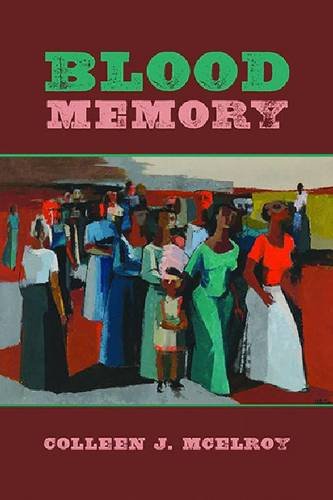
Can a joyous shout still be a protest? Blood Memory tells us that it can. Colleen J. McElroy makes it so. Poems like McElroy's "Lessons in Deportment" will teach you almost everything you need to know.
Today's book of poetry is over seven-hundred blogs/reviews into this project and we are still subject to being totally amazed. Awed.
Colleen J. McElroy has mastered voice. These tear-blinding and immaculate poems are damned near perfect. Voice and place, McElroy, like the very best film directors has mastered mise en scene. Having set flawless stages her characters simply tell their stories and we believe every word.
Sunday Best
before Aunt Jennie joined Visitation
Catholic Church I walked Mama
to Lane Tabernacle CME and settled her
in a pew next to Aunt Ethel
the two of them demure in small
pancake hats with fragile veils
among the grand feathered hats of the ladies
who hid a week's worth of bad hair earned
in hot kitchens or sweaty laundries
the ladies of Visitation were all but hidden
in stained glass windows incense and stations
of the cross, their dresses as dull as nun's habits
at Lane Methodist Mama and her sister
sat together their heads tilted toward each other
hats pinned to clouds of kinky white hair
around them ladies in gingham and worn coats
fanned away the heat that had kept them all week
in white kitchens or scrubbing office floors
all week they had been no more than
wallpaper seen and never heard
come Sunday when they sang Amen, feathers
and flowers nodded along with them
when I was older I went with Aunt Jennie
to mass at Visitation, rosary beads matching my dress
on my head a white lace handkerchief pinned
into my curls, my missal white to match
around me ladies of various hues cradled
their rosaries and echoed a prayer of redemption
come Sunday we were all of the same cloth
women who sought to be what we dreamed
💫💫💫
Reading Colleen J. McElroy taught Today's book of poetry a new way of looking at his long dead father and allowed us to see him in a kinder light. That's some trick. That's a good trick.
Good poetry will do that to you; take you places you've never been, teach you things you didn't know were missing.
Blood Memory is an astonishing collection that will resonate with Today's book of poetry for a long time. These poems are good enough to take an entitled and aging, old and cranky, sad white man, and for a moment, we got to see the world from the joyous eyes of innocent youth. There are layers and layers of white privilege weighing down on these poems yet McElroy's world is peopled with strong, strong women helping each other abide.
Today's book of poetry doesn't see many books like Blood Memory, a book dedicated to how intelligent young Black women endure and grow. In Blood Memory strength is gathered, cultivated and nurtured in the hands of an elaborate matriarchal maze. Blood Memory affirms our belief that great poetry can come from any source, whether it is the lessons learned while grooming natty hair or the pride/fear confused emotions about the first Black cop in St. Louis.
Precocious
my mother is angry with me
I am barely four just young enough
to get on the bus for free
but my mother is angry with me
when I read aloud the bright
placards curved high
above the bus windows
I read aloud the placards
asking us to buy nothing
that is free and my mother
grows angry as I read
everything I can barely see
I want to tell her letters
go all mushy melting together
before my very eyes
but my mother is angry
when the bus driver tells her
she must pay for me since
children who are truly young
can not read the ads they see
my mother yanks my collar
tells me sit be still
you'll ruin your eyes
reading everything you see
she threatens to put me
in school a year before
I'm ready and I smile
my mother frowns and asks
what will become of me
if I insist on reading
every little thing I see
💫💫💫
Our morning reading was lovely. The Today's book of poetry staff doesn't always come to a consensus with our poetry choices but Colleen J. McElroy had us all close ranks, come together, and celebrate as one. Didn't matter who was doing the reading; these poems bounced around our offices like they were purely electric and everyone got shocked.
Consensus is rare enough, enthusiastic consensus is another. Kathryn, our Jr. Editor, and Maggie, our newest intern, found Blood Memory touched them to tears.
They weren't alone.
The Answers to Why
because her daughter, Claudia, had babies while Mama
was still having babies family lines blurred
mothers and daughters waltzing just out of reach
because her daughter, Jennie, turned Catholic
Mama took me to Lane Methodist each Sunday
because a photographer penciled an outline
around Mama's cottony hair Jennie studied
tinctures and rouges and one-eyed camera could find
because she could not read Mama memorized
all the songs in the hymn book
the communion wine tasted like grape juice
because Mama fed me from a bowl that read: find the bottom
I ate my vegetables sipped pot liquor while she sang old time songs
spoon to mouth: Ol'Dan Tucker too late to git his supper
because Mama's fingers grew thick in winter
I learned to braid her hair
because Mama got too old to do fine work as she called it
I became her eyes to thread needles and pick loose hems
I made sure the white butcher didn't put his thumb on the scale
because my mother, Ruth, worked at Fort Leonard Wood
Mama taught me how to cook
what's a Leonardwood? I asked
because my mother opened mornings like a can of beans
fussing and cussing and quoting Shakespeare
between dammit-I'll-bite-you and scrambled eggs
because Mama said my mother was moody and needed help
I watched my mother paint fake stocking seams down her legs
shapely as Betty Grable high heels clicking on the linoleum
heading to the door factory head scarf tied neat as a Sunday hat
because we had afternoons alone Mama taught me
how to knead bread dough the proper way — knuckles down
because Mama singed her eyebrows when the pilot light
went out Papa bought a brand new stove
I missed the old stove and its stand-up oven
because Papa said none of his girls would do day help
I read the papers and dialed the telephone for Mama
because Papa died on the train coming home from California
Mama sat by the window all day and wouldn't talk
because Claudia had become a widow before Papa died
my mother and her sisters fought to get Mama's attention
because Mama said the four poster was too big
after Papa died I slept with her
in the same bed she'd birthed babies who lived
and those who didn't
I counted angels carved in the chifferobe door
because a spider bit me the first night I slept
in the four poster Mama propped me on pillows
so I wouldn't roll onto the blister on my back
because Mama covered the bite in goose grease
there was no trace of the spider come morning
because the chifferobe held Papa's shaving basin
and shoes I spent hours inspecting the little shelves
because Mama put plugs in the locks of Papa's
roll top desk and chifferobe I always had a way out
because Mama said there were two places
she wouldn't want to be: hell and west Texas
we lived in that railroad house on Kennerly for years
because Mama didn't trust white people after the Klan
shot the mules dead in front of the old family house
because after they moved to Missouri Mama said she saw
ghosts walking the long hallway that banked the house
because she said it so much I thought I saw them too
and my mother said don't talk about the old ways Mama
because my mother worked long days I learned Mama's stories
because Mama lived in the past when Papa was alive
and lived every day when he wasn't she couldn't stop
because my mother caught Mama telling me stories
of the time before Lincoln freed us my mother argued
but Mama said she had to tell me what was just because
💫💫💫
It has been a long, long time since Today's book of poetry posted a "list" poem but Colleen J. McElroy's is a cake stealer. McElroy is now on our radar and will be celebrated by us when Today's book of poetry talks poetry.
Today's book of poetry lives for the pleasure of sharing poetry with you readers, today it is an honour.
Colleen J. McElroy will help inspire a new generation of poets.

Colleen J. McElroy
ABOUT THE AUTHOR
Colleen J. McElroy is professor emeritus of English and creative writing at the University of Washington. She is the former editor in chief of the literary magazine Seattle Review and has published numerous poetry collections, most recently Here I Throw Down My Heart. Her latest collections of creative nonfiction include A Long Way from St. Louie and Over the Lip of the World: Among the Storytellers of Madagascar. She has received a PEN/Oakland National Literary Award, the Before Columbus American Book Award, two Fulbright Research Fellowships, two NEA Fellowships (in both fiction and poetry), a DuPont Visiting Scholar Fellowship, and a Rockefeller Fellowship.
BLURBS
"There is much to admire in Blood Memory, from the general impulse to preserve a family against the onslaught of time to the details of this particular African-American family in the twentieth-century heartland, to McElroy's style, at once spare and dense with incident and observation."—The Potomac
“She is the last woman of her line. Her new poems end and begin with A. Phillip Randolph and Pullman Porters, her enjambments are Ma Rainey and Lawdy Miz Clawdy, her leading men are the last Black men on the planet named Isom, her major planets are porches and backroads. She is still the master storyteller to the 60 million of the Passage. When I didn't know how to be a poet, I first read Colleen McElroy to slowly walk the path to how.”
—Nikky Finney
—Sonia Sanchez
An Interview with Colleen J. McElroy, author of Here I Throw Down My Heart
Video: Bill Kenower
726
Poems cited here are assumed to be under copyright by the poet and/or publisher. They are shown here for publicity and review purposes. For any other kind of re-use of these poems, please contact the listed publishers for permission.
We here at TBOP are technically deficient and rely on our bashful Milo to fix everything. We received notice from Google that we were using "cookies"
and that for our readers in Europe there had to be notification of the use of those "cookies. Please be aware that TBOP may employ the use of some "cookies" (whatever they are) and you should take that into consideration.