Tiller North. Rosa Lane. Sixteen Rivers Press. San Francisco, California. 2016.
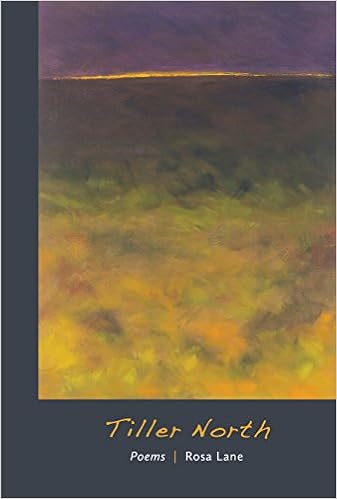
Rosa Lane's Tiller North makes Today's book of poetry think of Alistair MacLeod's short stories in marvels such as The Lost Salt Gift of Blood and As Birds Bring Forth the Sun and Other Stories if they were written by a woman of equal power and persuasive gifts. Or Michael Crummey's stunning novel Sweetland. These poems feel like they are familiar, like they take place on or near the same water.
Today's book of poetry says this because these poems are big, they feel like stories, fill up the space and imagination just like a big novel. These poems situate you in a rural/remote fishing community surrounded by sea and brush. You are in the kerosene lit kitchen, you are in that death-watch bedroom.
But most certainly, you are there.
The natural path Rosa Lane pushes you down in these poems is strewn with hard work and calloused hands, hard living and some hard luck. Yet there doesn't seem to be much complaint, this is reportage using memory rendered poetic. Lane isn't asking for any empathy, her heart is full to bursting with memory.
June Bugs
Electricity buzzes the yellow bulb
in Maine's humid heat. June bugs bomb
the porch light with spiny legs -- date-colored
and oversized.
Spring peepers pin the night,
pitch a universe in my mother's kitchen, except
I have not yet occurred to her. She is sixteen,
and I will be hers in less than a year.
Supper's on the table for the boy who will be
my father, his nineteen-year-old body big
and husky. He rinses dried splashes
of work from the day's ocean into a small
blue basin, enameled and filled
with hand-pumped water drawn from the well.
Fireflies light the field aflame. Conceived in the heat
of summer, I appear a small spark of night
planted in the deep crevice between them.
...
Lane takes the reader to a time and a specific place in these poems. We'll never truly understand the life of a small and remote fishing village but we certainly understand more now. We can't smell the kerosene or the fish but Lane gets us there, we are on the coast of Maine gazing west towards civilization.
Today's book of poetry was terribly enamoured reading Tiller North, Rose Lane has that steady Andrew Wyeth gaze and hand, and it would appear some of his same ideas about story, narrative and how to make the heart arc. Many of Wyeth's paintings seem stark but in fact they never are, Rosa Lane has that trick finessed. There are some hard moments in Tiller North but a warm and tempered heart is leading the way. Tiller North is coming of age poetry writ large over the working class background of a young woman in a remote place.
Tiller North
Take Route 130 nine miles
where it dead-ends at the coastal tip,
keep your eye on the spire,
how it peaks above ragged pines
torn from a small length of ocean:
shingled shacks drunk with fog,
the mouth of John's River, a bar
of khaki sand, a stand of piers rusted
in salty air, Dora's cow pasture blurred
with brutes down meadow. How the fog
dampens fisher boats wedged at the wharf,
arched glass stained with light on the hill.
~
Households begin at the Point,
where fisher boys drive
their cars fast to the cliff,
test their brakes, scare
their girls, who squeal and dive
for safety into dangerous
arms. Tongues of the bell buoy
bang a rhythm of ocean in backseats,
when sixteen-year-old bodies grow
pregnant, birth armloads that suck
tiny breasts, unready. The young stumble
along a path of church bells calling them
to kneel Protestant pews and swallow
white wafers of a single mind.
~
Fisher boats named women wait in the cove,
anchor lines tied at the nose, nets piled
in the hold. Our father stands there waving
across the salt air, our mother at the shore
squinting the sun, seaweed floating
her black hair across the surface ahead
of winter already moving in. The three of us
run to the school bus each morning.
Our father's fingers, cracked with cold, count
singles laid on the kitchen table at night,
our porch lights lit proof of survival at the edge
of the harbor we are damned to leave.
...
No guests for this morning's read as Ottawa was covered in snow this morning. A number of our staff didn't make it to our digs on Dagmar. I was out shovelling snow for over an hour earlier this morning and will go back out when it stops snowing altogether. Milo, our head tech, and Kathryn, our Jr. Editor, both made it through the snow, they live close by and walked. The three of us batted these poems around until we reached shore.
Today's book of poetry really liked the tone Lane establishes from the start, she has such confidence and is so self-assured that you feel like some of it might rub off, a little osmosis through hard living.
Bingo
Lucy's shack sat on cinder blocks
pressed into peat near the bog,
a piece of real estate
no one wanted. Saturday night
down at the hall,
she laid navy beans
on numbers, played six cards,
won a few coins
on the left straight.
She drives
headlights up the throat of driveway
pounded hard by the last rain. Trees
crawl across the face
of the house. Her porch light
burns a small hole at the door.
Her boyfriend can't wait up,
he said -- her daughter's silhouette
in the upper window riding horseback
on a horse she never sees.
...
Rosa Lane's Tiller North is the 37th title from San Francisco's Sixteen Rivers Press. Lane joins a fraternity that includes Nina Lindsay, Stella Beratlis, Ito Naga and Beverly Burch, very fine company.
Today's book of poetry thinks you should join Rosa Lane on her journey back to the Maine of her youth. Lane's Tiller North imparts a portrait of family and community, loss and found, in one elegant nostalgic yawp.

Rosa Lane
ABOUT THE AUTHOR
ROSA LANE is a native of coastal Maine, with familial and ancestral roots steeped in lobster fishing. She earned her MFA from Sarah Lawrence College and is the author of the poetry chapbook Roots and Reckonings(Granite Press, East, 1980). Her work has appeared in numerous journals, including The Briar Cliff Review, Crab Orchard Review, New South, and Ploughshares. After earning her second master’s and a Ph.D. in sustainable architecture from UC Berkeley, Lane works as an architect and divides her time between coastal Maine and the San Francisco Bay Area, where she lives with her partner.BLURBS
“Tiller North ends with the word sing, a final act in a volume of poems that narrates sorrows and pays tribute to the Maine people Rosa Lane comes from. She offers scenes looked over carefully, as everyone takes their place at the table. She tells of making it through a sense of unbelonging, imprinted by rejection based on class and cut-off dreams mitigated by fierce love, hard work, and constant relation to family, place, and the rules of the season.”
—Beatrix Gates, author of Dos and In the Open
Rosa Lane’s poems in this remarkable volume are reminiscent of Elizabeth Bishop’s in the author’s fierce dedication to craft….Lane’s poems build through the architecture of the image; the texture of physical detail; and a sparse, understated language that resonates a profound love of humanity, an embrace of the people around her, and a deep, inward movement of the poet’s imagination.”
—Stephen Haven, author of The Last Sacred Place in North America and Dust and Bread
“In Tiller North, Rosa Lane gives us a world—not just one compass point, but all of them. In poems as lyrical as they are narrative, she presents a family and a landscape with precision and compassion. Her writing is as sharp as her heart is full. Tiller North is a moving and accomplished book.”
—John Skoyles, author of A Little Faith and Permanent Change
Rosa Lane’s poetry reminds us why, at a certain time in our lives, we’ve had enough of innocence. Here is a compendium of those so crucial, chronology-defying self-revelations that we only know through our skin….Each poem is a skiff sculling through sounds almost Hopkinsesque, each measure of music anchored by the ground base we feel more than hear.”
—Jeffrey Levine, author of Rumor of Cortez and Mortal, Everlasting
532
DISCLAIMERS
Poems cited here are assumed to be under copyright by the poet and/or publisher. They are shown here for publicity and review purposes. For any other kind of re-use of these poems, please contact the listed publishers for permission.
We here at TBOP are technically deficient and rely on our bashful Milo to fix everything. We received notice from Google that we were using "cookies"
and that for our readers in Europe there had to be notification of the use of those "cookies. Please be aware that TBOP may employ the use of some "cookies" (whatever they are) and you should take that into consideration.


