Showing posts with label punchy poetry. Show all posts

Tuesday, May 8, 2018

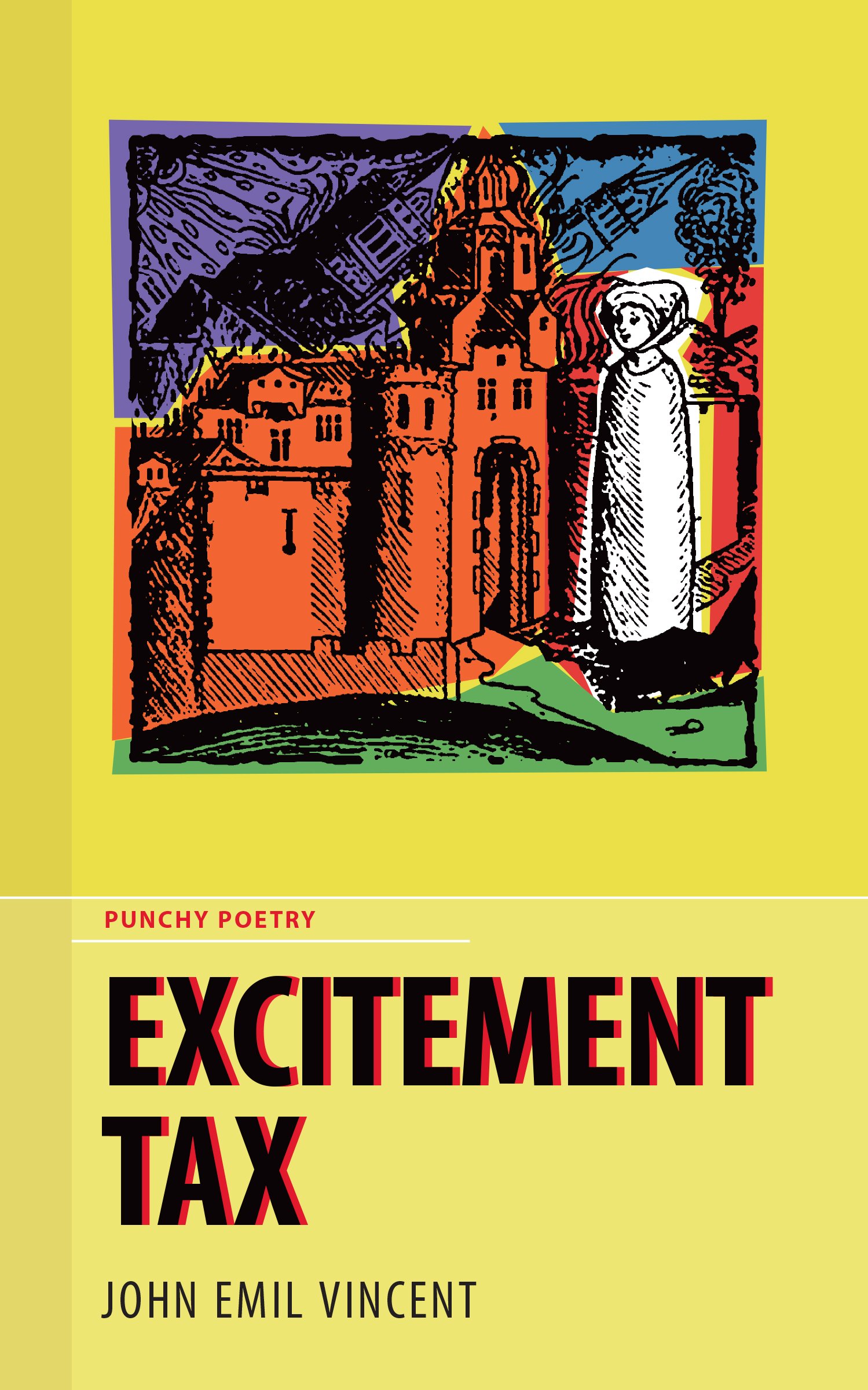
Excitement Tax — John Emil Vincent (Punchy Poetry/DC Books)

Today's book of poetry:
Excitement Tax.  John Emil Vincent.  Punchy Poetry/DC Books.  Montreal, Quebec.  2017.

Today's book of poetry was only eight or nine poems into John Emil Vincent's Excitement Tax and we knew that Vincent should drop his other misadventures and write poetry full time.  Of course it won't feed the cat, but.  But, Vincent can seriously burn.

Excitement Tax starts off sprinting and never pauses for breath.  We get introduced to "Weaselbird" who seems both a symbol and a foil, but mostly a tool for the spontaneous glee that comes bounding out of every line in these poems.  Weaselbird is quite the character.  So was Gulley Jimson.

“Nothing like poetry when you lie awake at night. It keeps the old brain limber. It washes away the mud and sand that keeps on blocking up the bends.
Like waves to make the pebbles dance on my old floors. And turn them into rubies and jacinths; or at any rate, good imitations.”
― Joyce Cary, The Horse's Mouth 

John Emil isn't showing all of his cards all of the time, no good gambler would.  Today's book of poetry isn't suggesting Vincent is borrowing anything from Mr. Cary but rather his Weaselbird is a bird cut from the same cloth as Mr. Gimson.

At Breughel Elementary

Here everyone does their part to maintain the punctuated
equilibrium: The kid facing the wall, thinking: how
innocent whoever invented hell. Then that kid: a knot
attracting other knots. The kid hung italic on her shoulders.
The girl who will build a toy empire. The boy who will
rule it badly. Two friends whose peculiar brand of grace
is to be wholly forgotten. Two, who, coy, hunker in the
gutter of the gathering. They will be sculpted in butter.
One who points like a duke trying to point like a proverb.
One whose very face says: my pappy gave it me. One who
smiles wisply to forestall the ink lines of the meat chart.
One fogged with breath.

A good two feet below eye level, they wield their glossy
shields against self-esteem. Young the way eloquence
outlasts insight. Each so easily imitated as to be one of
a kind.

The mystery: which will have sweetness beat out of him,


and which in.

...

Erudite is a word that Today's book of poetry has to look up in the dictionary every time we use it.  John Emil Vincent is the Vincent Black Shadow of gloriously glib glottis glee — Mr. Vincent is Erudite.  This poetry compels you to turn the page just so you get to hear more of John Emil Vincent's engine running.  Today's book of poetry thinks Vincent jazzes it up like a 60s French cellar full of Chet Baker, Anita Baker and a rumbling Studebaker Avanti.

Today's book of poetry had some special guests stop by our office yesterday.  Larry R. Cowan of Monk Press fame came and sat on our porch and drank cold beer along with his much better looking partner.  Mr. Cowan wanted to see how our operation ran, even threatened to copy some of our office organizational hardware.  Today's book of poetry was tickled that they wanted to come by, delighted that they brought beer, and everyone here in the office thoroughly enjoyed their stay.

Vincent isn't shy about graphic exploration of sex, sexuality, sex acts.  As Elizabeth Bachinsky said of John Emil's poems:  "like a box of candy," "sweet surprises."  Of course some of these sweet surprises are bittersweet, some of them might even sting.  Vincent is talking about gender straight up and with a clear voice, a matter-of-fact resonance to it all.  Vincent knows that pandering always reads fake and there is not a false moment in Excitement Tax.

Marlon Brando's Thermos

I love it when movies give tips. 25 yrs ago, Betty Blue: an
incidental friend of the tortured couple enters to describe
how one must wet the filter before ! adding coffee; like
watching one very small uncoordinated boy teach a smaller,
less coordinated boy to shoot baskets. As if an elderly
relative sidled up, said: something I'd like to give you.

All about the soft focus foxing of the Polaroid. I see, starts
Weaselbird. Don't forget to mention the way an echo gets
gentler and gentler til it comes back for one last turn as a child
in the 50s trying to quietly nudge a sibling awake in a bunk
bed for a detective caper with a giant silver flashlight, a stub of
golf pencil, and a pocketful of kibble.

You see, indeed! I titled this for you, sweet critic of my
choosing. You can stay skinny for a while on reds but blues
will find you eventually and you prolly oughtn't mix them in
whiskey, but do: and call it the "Abraham and Isaac." And
it seems glam, a trailer at the shoot, but really it is just
an RV with a plastic toilet seat and wrapped utensils and
blocks of squeaky cheese. Deliver line, throw on blanket.

sit 'pon fold-down steps of shitbox and never will you
recall this day without demonstrative pronouns til some
gothic, letter-boxed edition of it blows across the land and
you're as surprised as anyone else, which is how you've
avoided vanity, and possessive pronouns, because you never
really did that in the first place. Or rather, like Calvinism:
your feigned ignorance is a sure sign that you really did
do that and o boy Isn't It Good. The ultimate lesson of
all things:


better to own, but richer to rent.


...

Regular readers of Today's book of poetry will know how much we admire smart.  The first thing I said out loud to K when reading some of Vincent's Excitement Tax was that this cat can seriously burn, he's a freaking Julia Child.

Today's book of poetry recently read Julia Child's My Life In France.  The result was a huge crush on the brilliant cook, the beautiful chef, and more admiration than we can express for Dame Julia. 

John Emil Vincent throws Marlon Brando and Sylvia Plath into the pan, stirs in some vibrato with Mr. H. the Bosch, and Bob is your uncle.  Vincent likes to keep his oil hot.

Our mourning read was splendid and made all the more so by a prank from our most excellent mail carrier, Jean-Marie.  In the end Today's book of poetry did get two poetry packages containing five books, but not before Ms. Canada Post made us dance a little.

Existential Tips From Our Studio Chef

Within the closed circuit, there's always risk of erotic
target location error and it's best to wipe down surfaces
completely, almost ecstatically, before we begin. Remember,
you're effacing, not polishing!

If your narcissism whinges too much, try counterclockwise.
Reality's resilience is a bonus, just don't come to count on
it. Think of it as habit, not reflex. If necessary to buck your
tic toward collapsing sequence to category, close your eyes.
Press the lids. The little supernova light blob will come,
then go. You may notice some elegant branch-shaped
veins. Come to suspect everything is a lesson. Be, however,
Always Skeptical of Absolutes.

Anticipate the double bind but don't try to outsmart it
by underthinking! Remember that most wrongs later in
need of redress will be racked up in your profitless research.
Success, then, second order: by comeuppance once
removed. Resign yourself a little. Guilt's a great healer!
Then feel proud of your resignation and make yet another
gigantic categorical error that will set you back years. That's
okay. Really, it's the fire you need under your ass and in
your 50s will be just the thing. One trick I like is the bad
people are their own punishment defense. Use that liberally.

it really is like aspirin, an oldie and a goody. Analgesics
from another better simpler time still working their magic.
And of course, your worst enemy, and your best friend, is
Mister I told you so.


But I'm getting ahead of myself.

...

John Emil Vincent's Excitement Tax comes in at a tight and tidy eighty pages or so.  Today's book of poetry wants more.  Vincent is that gentleman at the other end of the table at a dinner party.  Everyone is leaning in hard, straining to hear, because experience tells us that is is going to be wicked good and perfectly bad.  Vincent is a poet who is comfortable under the full gaze of the most diligent reader, his bad engine purring.

JohnEmilVincentAuthor

John Emil Vincent

ABOUT THE AUTHOR
John Emil Vincent is a Montreal-based poet, editor, and archivist. He’s taught literature, queer theory, and poetry writing at Concordia and Queen’s in Canada and at Wesleyan, Haverford, and University of Miami in the US. He and his partner, Luis Loya Garcia, emigrated to Montreal in 2010 to get married and escape anti-immigrant laws and sentiment in the US.

Vincent earned his BA in Religion and Literary Studies (French) from Williams College where he worked with Louise Glück. We went on to earn an MFA from Warren Wilson College (in North Carolina) where he worked with Heather McHugh and Larry Levis among others. Toward the end of his MFA he started his PhD in English across the state at Duke University where he studied under Eve Kosofsky Sedgwick and Michael Moon. He was among the earliest cohort to graduate specializing in Queer Theory. While at Duke he published an essay on Swinburne and whipping in Eve’s collection Novel Gazing and co-authored an article on Latinamericanism and “My Own Private Idaho” with José Estaban Muñoz.

He recently earned his Masters Degree in Library Science (Archives) from Simmons College (in Boston). He has worked doing preservation work for John Ashbery in his home in Hudson, New York, and has worked helping organize James Tate’s papers and books after his recent death.

He served as Editor-at-Large for the Massachusetts Review, where he edited a double “especially queer issue” packed with queer literary luminaries and a special issue celebrating the 50th anniversary of the UMass-Amherst Program for Poets and Writers. He’s served as poetry editor for the now-defunct Swink magazine and issue editor for tinywords (a web-based haiku journal).

He has published poems in jubilat, Denver Quarterly, BlazeVOX, Slope, Spork, failbetter, Drunkenboat, and many other journals. A number of his poems appeared in an anthology of new gay poets, entitled This New Breed, edited by Rudy Kikel (Windstorm Creative 2003).

With Factory Hollow Press he recently published a chapbook Cheshirization containing 9 poems from Excitement Tax.

dcbooks.ca

684
DISCLAIMERS

Poems cited here are assumed to be under copyright by the poet and/or publisher.  They are shown here for publicity and review purposes.  For any other kind of re-use of these poems, please contact the listed publishers for permission.
We here at TBOP are technically deficient and rely on our bashful Milo to fix everything.  We received notice from Google that we were using "cookies"
and that for our readers in Europe there had to be notification of the use of those "cookies.  Please be aware that TBOP may employ the use of some "cookies" (whatever they are) and you should take that into consideration

Saturday, April 7, 2018

This Real - concetta principe (Pedlar Press)

Today's book of poetry:
This Real.  concetta principe.  Pedlar Press.  St. John's, Newfoundland and Labrador.  2017.


Today's book of poetry has been down the concetta principe poetry highway before.  Back in February of 2016 Today's book of poetry looked at principe's Walking (Punchy Poetry/DC Books, 2013) and admired it very much.  You can see that here:


Since then, Today's book of poetry has had the pleasure of reading principe's 2016 Hiroshima: A Love War Story (Pedlar Press) and now we have This Real in our grubby little maw.  principe flies at a higher altitude than Today's book of poetry can usually manage.  Her poems take some work, they demand a particular level of participation from the reader.  

This Real is another principe title of erudite poems that read like today's history from an informed inside source.  principe is in no way concerned with the status quo, instead This Real quotes liberally from Sefer Yetzirah's The Book of Formation or Creation (as translated by Aryeh Kaplan) and her text reads like another sort of secret manuscript.

from Storm Advancing From Paradise

assuming that the end of times was her, coinciding with the Tarot reading of
death, followed by the end of her marriage: la vie morte; assuming that her heart,
ruined by divorce, was miraculously remade with immortal substance one night;
assuming this to be a vision, not a dream, because this new organ burned inside
her with such force that she was sure it would burst into flames, 6  there on the 
bus, in front of all these strangers; she gained a new perspective on death and
the human race... it was inevitability of these end times that gripped her. 7  the
pressure for ending is tremendous, carried by the force (majeure) of the first cause.

the end of the world was--measure it--nigh.

--------------------------------------------------------------------------------------------------------------------------
6 "if your heart runs, return to the place" (SY 1:8)
7 "a flame in burning coal" (SY 1:7)

...

John Lennon and Mary Magdalene debate the possibility of "fireballs from heaven" while "manic harlots" and other psychiatric patients paint in windowless rooms.  There isn't much cheer in principe's prose poems, not an abundance of optimism in this world view but the poems themselves compel the reader further and deeper.

Sefer Yetzirah's The Books of Creation inform the text of principe's poetry for most of the duration of This Real but that isn't enough drama, no, principe changes gears just long enough to crawl into a bear-cave with Werner Herzog and his mad view of optimism.  Walter Benjamin provides some geo-sensitive time clock for this human experiment.

In truth, Today's book of poetry could barely keep up with some of the concepts concetta principe throws around like a genius frisbee lofted with counterspin and precision.  I called in some of the troops for help, Today's book of poetry does not care who teaches him new things.  We always appreciate some help getting through the gate.

from Confessions of a Barren Mother Contemplating Creation

the machines of progress that crank and whine; the whistles that sound, the
pulleys that whir, have a baby and enter the wheel 69 of generations: of Toro and
Tutonia and Peg Perego, cutting the summer drone and grind and thumping of
bureaucratic interventions on the sidewalks of the air filled with 9/11 anxiety
you are sure will wake the peace of innocent slumber.

hijackers and jihadi.

silence of the wheels of history, as if the calm messianic entrance. the wheel
of human reticence is not peace but, by judging things, the capital of procreation.
keep this piece of negligence (you gave me nothing) under wraps. here, take this
law (of love) and shove it. down the street they've birthed the axis of evil, sleep
deprivation so bad that you miss how this paranoid web spreads out into the
future to trip your child.

sleep-deprived hallucinations. in that vast, limitless reproduction of time's quiet
spinning, you barely recognize that love is the science of mitosis: love for child,
cat because she has eyes, too, and nation because we are one. hate is elsewhere.
love because there is always elsewhere. and creates terror.70

------------------------------------------------------------------------------------------------------------------------
69 "oscillates... back and forth" (SY 2:4).
70 crowning

...

concetta principe briefly conjures a fleeting Marion Engel "Bear" vibe in the final section of This Real but this comment probably stems from Today's book of poetry's serious fear of bears more than any actual literary description.  principe is writing poems that challenge the reader and then reward their diligence.  

The end of times happens every single day and concetta principe leaves little fat and no excess for the lazy reader to hang to.  The poems in This Real are deliberate and unrelenting in their examinations.

from Theses on the Philosophy of Waiting
               after Werner Herzog's Cave of Forgotten Dreams

XIV

maybe there was only ever waiting; the waiting of the bear who dreams through
winter; the waiting of a modern woman who lights another cigarette waiting for
the messiah's foot-

fall, sitting in cold damp clothes waiting for the hot coffee to spread through the
body, waiting for the morning light; waiting for the wind outside to stop howling
against the glass, or the rain to stop beating at the dirt; waiting for the smell of
the wet grass to enter, after the rain has stopped; for the smell of burning wood;
for the foot-

fall, waiting for the cigarette to end; waiting for the wood to turn charcoal or the
marshmellow to ignite; for the chapter in the book to get interesting; waiting for
feet to be warmed by the fire; waiting for the fish to be cooked; for hair to dry;
for the foot-

fall, waiting for the wind to change, waiting for dreams to become real; waiting for
tomorrow; waiting for what will never come; waiting for the rain to stop; waiting for
him to arrive, as he had promised, waiting for the sun to rise; waiting for the night
to end; for the foot-

fall. waiting for the dream to end; waiting to be found; waiting for the wait to stop.
in all that waiting, there was someone arriving, a miracle that would repeat deep
into the future, full of light, cascading through solid rock as if matter were immaterial;
as if human life were a cave; as if everything beyond these walls were waiting for
someone to find it; as if waiting, in its passive way, were willing someone to come.

...

The long-john and thermostat battles continue here at Today's book of poetry as the windchill was a brisk -21 C yesterday morning. And for our morning read This Real being read by those just coming in from the cold was freakishly apt.  Still cold enough to be angry, our staff gave This Real a fierce reading and it warmed them up something proper.  concetta principe is marking her place in Canadian poetry with another necessary volume.

Image result for concetta principe photo

concetta principe

ABOUT THE AUTHOR
concetta principe writes prose poems, creative non-fiction and academic articles. This Real is her fourth book of poetry, and, in being a project on love, is a sequel to Hiroshima: A Love War Story. She is Assistant Professor of English at Trent University.

BLURBS
This Real is concetta principe's take on the end-times in which we live. Here the poem is prophecy, meditation, urge, and inquiry; a space of thinking on fecundity and the mother, on the tree of life and on catastrophe, on the war on terror, wary of honte's erreur. The splendid pacing of principe's prose-poems lets their reader probe and wander. The tone is not one of bright hope but of persistent dwelling, moored in the dark aura of messianic thought and the radiance of things, in which child and wo/man, mothered and unmothered, walk shadowed by history's perilous and precarious wing.
      - Erin Moure

Packed with pain and psychoanalysis, mothers, messiahs, and milk, starvation, sacrifice, shock, and son, concetta principe's This Real presents a maelstrom of dense poetic lines and dark prophetic love. It will haunt you till the end of days.
     - Jonathan Ball


675

DISCLAIMERS

Poems cited here are assumed to be under copyright by the poet and/or publisher.  They are shown here for publicity and review purposes.  For any other kind of re-use of these poems, please contact the listed publishers for permission.
We here at TBOP are technically deficient and rely on our bashful Milo to fix everything.  We received notice from Google that we were using "cookies"
and that for our readers in Europe there had to be notification of the use of those "cookies.  Please be aware that TBOP may employ the use of some "cookies" (whatever they are) and you should take that into consideration

Thursday, October 20, 2016

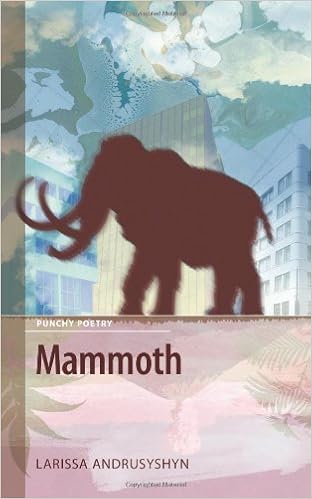
Mammoth - Larissa Andrusyshyn (Punchy Poetry/DC Books)

Today's book of poetry:
Mammoth.  Larissa Andrusyshyn.  Punchy Poetry.  DC Books.  Montreal, Quebec.  2010.


Back in October of last year Today's book of poetry looked at Larissa Andrusyshyn's second book of poetry, Proof (Punchy Poetry/DC Books, 2014) and you can see that here:


The first thing Today's book of poetry said in that review/blog was that we wanted to get our meaty little hands Andrusyshyn's first book, Mammoth.  We did.

It is startlingly good which comes as no surprise here.  Andrusyshyn's one-two punch of Mammoth and Proof is a noteworthy accomplishment and one hell of an entrance to Canadian letters.

Mammoth could be seen, in part, as a scientific report on genetics and the moody behaviour of those under a variety of microscopes.  Andrusyshyn has the intricate eye of procedure that she apparently stole from some now blind scientist, she also has a streak of Darwinian glee in her anthropomorphous and delightfully necessary beasts repleat with human language and understanding.

What she does more than anything else is to write poems of such self evident truthfulness and perception that the reader willingly accepts the reason of mammoths, the contemplative nature of polar bears, the tell-tale beating of a petri-dish laboratory heart.

The Grizzly Man

Timothy is supposed to leave at the end of the season,
pack the bear-proof bins, the tent and video camera,
board a Cessna for the airport.

But he doesn't return
to the shrugging of airline employees,
the seat numbers, the exhausting trajectories
of airports and luggage that spins like cake slices
for the bored customer of windowless diners.

He stays in the grizzly maze,
the dense bramble on the nature reserve
where he hides his camp from the parks department.

The view from here is something
and the grizzly bear knows this place.
But the bear does not wish to be Timothy
and he does not think of humans
or hold up lenses to watch them with.

Days later, when the parks department finds the campsite,
they bag the evidence, shoot the bear
and collect the remains.

Someone recovers the video camera
and there are hours and hours of footage: Timothy
touching the wet muzzle of a sow, talking to the bears,
calling them by their names.

...

Today's book of poetry knows we shouldn't laugh at that story, so turn away for a moment because it makes us howl.

Larissa Andrusyshyn happily employs the scientific worlds of biology, anthropology and numerous other ologys, Andrusyshyn renders them clever tools as she navigates those belief systems for us, translates so that the terrain makes our poetry hearts race.  If Mammoth weren't so damned spot on emotionally you'd almost think someone as clever as Andrusyshyn was toying with us.

Polar Bear Caught on Ice Floe Updates Status

There's a spray of water and your skin seems to detach from
your skull in temperatures like that. The wind just drives
the vapor up your nose and it's all burning and salt. In the
photograph the glacier looks like a coral reef up close, real
close so you think you see the calcium hydroxyapatite
depositing itself there in microbial stacks. On top there's me,
so you might realize this could be the last piece of ice on
earth and they you'll wonder why it's all carved out like that,
with holes and a ledge that looks like it could just hold the
weight of a cartoon coyote for a split second before dropping
off the field of view. Below me there's the water so clear I can
see fifty feet down. Have you heard the sound of breaking
ice? It's like a giant door opening, a huge ungreased hinge
or the crack of trees before they fall and you feel like you are
about to step out into an important moment like a moon
landing or something.

...

Milo, our head tech, was tickled pink this morning when I foisted Mammoth on the staff for the morning read.

"This is that Proof poet!  Right!?"

Milo could hardly contain his enthusiasm and it was infectious.  This morning's reading was quick paced in a room full of smiles.

Mammoth reads smart and clean, the poems give themselves to the reader with such self-evident precision and common sense that Today's book of poetry had to look behind the covers to see if it was a trick.  Andrusyshyn impressed Today's book of poetry with Proof, Mammoth confirms it, this is a poet full of golden promise.

Waiting Room

The waiting room is teeming with news
and updates, white blood cell levels
and the flight details for your friends from Winnipeg.
We visit you in shifts, in manageable numbers.

What I want to do is write something completely
giddy. Something about sea horses. Polygons,
cappuccino scum. The elbows of mediocrity.

You pull the oxygen mask away to talk
and your father frowns.
Lungs filling with blood, you are trying to remember
a recipe for bread. You stop and take breaths.
You keep repeating "three cups of flaxseed flour."
Behind the mask that fogs and clears,
your voice is a blizzard, an operatic storm.
We lean against each other motionless, someone
is writing the recipe down, because we want
to bake the bread again, because it was the bread you brought
to the last party we remember. You start again from the 
   beginning
and we hang like the troubled hands of murderers.

...

Mammoth isn't all sunshine and blue sky.  Andrusyshyn gives us a fair share of the certainty of death at the end of the ride -  but her entertaining poems make it a more worthwhile journey.

Two books in and Larissa Andrusyshyn has made a big fan out of Today's book of poetry.

Larissa Andrusyshyn
Larissa Andrusyshyn

ABOUT THE AUTHOR
Larissa Andrusyshyn’s first book Mammoth (DC Books 2010) was shortlisted for the QWF First Book Prize and the Kobzar Literary Award. Her poems have been shortlisted for Arc Magazine’s Poem of the Year and the Malahat Review’s Open Season Award. She works with a local non-profit to offer creative writing workshops to at-risk youth. She lives, writes and is planning her zombie apocalypse survival strategy in Montreal


516


DISCLAIMERS

Poems cited here are assumed to be under copyright by the poet and/or publisher.  They are shown here for publicity and review purposes.  For any other kind of re-use of these poems, please contact the listed publishers for permission.

We here at TBOP are technically deficient and rely on our bashful Milo to fix everything.  We received notice from Google that we were using "cookies"
and that for our readers in Europe there had to be notification of the use of those "cookies.  Please be aware that TBOP may employ the use of some "cookies" (whatever they are) and you should take that into consideration.

Thursday, February 4, 2016

Walking: Not a Nun's Diary - Concetta Principe (DC Books)


Today's book of poetry:
Walking: Not a Nun's Diary.  Concetta Principe.  DC Books.  Montreal, Quebec.  2013.


Compelling.  Heart wrenching.  Concetta Principe's Walking: Not a Nun's Diary grabbed me and would not let me go.  Today's book of poetry would tell you that grace under pressure is where the hardest gems are formed.

Principe is a flaneur in the Michael Herr fashion and these poems are like punches to the stomach, little bombs that you can't avoid, arrows straight to the heart.

Hands 19

Carlos' best friend is a Jewish woman who sneaks from her
home to visit him. He hates all Jews who are not his best
friend, and waits for the final Judgement when the evil that
they have done will smite them down. Moshe has a theory
that the Arabs all age too fast: it is genetic. He smiles at
them, but that's all I've seen him do. The woman who lives
in Berlin refuses to look into the kitchen of the cheapest
kosher hotel in town. And there are Born Agains who
claim their Jewish roots in order to have the right to sit and
wait for the Second Coming. He is due soon. They identify
with the Orthodox Jews who keep to themselves.

and where is God?

ah, yes
those maps are precious

even if you do get one
by accident or manipulation

you must acquire the art
of reading what is not there

...

Got to the end of my first read of Walking: Not a Nun's Diary and was reading Concetta Principe's "Notes" and "Thanks" and lo and behold -- the first person she thanks is Luba Szkambara.  Luba is a lady, a lawyer, a legend.  Luba and I have been dearest friends for over thirty years.  She is one of TBOP's biggest fans and supporters, Luba reposts almost every TBOP blog/review, bless her cotton socks.

Today's book of poetry is not surprised to hear that Luba had an eye on this poetry.  Luba knows her stuff and likes it strong.

Concetta Principe isn't timid about walking into the mix, most of Luba's friends aren't.  This book is a pilgrimage that unglues the politic of a centuries old struggle, Principe renders this titan conflict human, she cuts it down to scale.

Frontier of Construction - Gaza

For Rachel Corrie, aged 23. killed 5:20 p.m., Rafah,
      Palestine, March 16, 2003 by an IDF bulldozer

If I were a soldier driving a bulldozer,
a peace activist would be a fly
on the wall of the house
I am here to destroy.

If I were a peace activist
I would look into the eye of the blind
and make hurricanes with the wind of my moving arms.

If I were a soldier
I would lie rather than admit
to murder.

If I were a peace activist
I would hate with all my heart the fact
that I am privileged enough to have a home
while theirs are broken in their faces.

If I were a soldier
I would hate peace activists even more than Arabs
because they grew up in happy parks
while our playground here is war.

I am a peace activist
wishing I could move my arms to make heaven fall
and crush the soldier with the weight of its light.

I am a soldier
trained to detect and wipe out danger
and ignore what can't be changed.

I am a peace activist
thanking God he is not my brother.

I am a soldier
Unable to sleep at night due to nightmares that haunted
     my mother until her death.

My name is Rachel
and I would do it again and again and again
until he does what's right and kills the engine.

I am an Israeli soldier,
prepared to wait until my next life
to cry for the things that happen here.

...

Principe has a hard, firm hand and these poems show it, there is no slack in this rope.

This morning's reading was a relatively quiet affair.  These poems marched into the room and shut everyone up.  Very steady readings and intent listening.  Now Milo and Kathryn are in the corner pulling down names of Israeli poets, Palestinian poets, Jewish poets, Lebanese poets, Syrian poets, and so on.  Once those two go into the corner, that's the day.  They have become a universe of two.

Kathryn picked the first two poems for today's blog, Milo choose this one:

My German 8

My father is an 8 year old in the dusty little town in the
rocky hills of southern Italy, Calabria, where they grow
olives and figs at their door. The smell of jasmine is a mist
dispersed by the towering puppet of the Madonna paraded
through the streets of her feast day in August.

I think it is a fall day when father runs through the dust
of inner streets to arrive home panting at his papa who, in
World War I, lost two unimportant fingers from his right
hand, and the lower half of his left arm.

They live on his war pension in one room with a stove.

My father says, "Papa, you must buy me a black shirt, now."

"For what?" replies papa.

"Because tomorrow we are having a concert. Everyone
in the school is in the concert and we must each wear a
black shirt."

"Give me your shirt," orders his father, and then puts the
good white cotton in the over, still hot from baking.

In minutes the shirt is done, covered in good soot. Papa
gives it to my father, still warm saying, "Tell them that is as
black as we can afford," and laughs.

...

Principe's sense of humour is sooty and we like that here at Today's book of poetry.  "My German 8" reminds TBOP of that one time we were in a small barbershop in Barga, Italy.  The elderly gentleman who had so kindly translated my hair-cutting needs, upon leaving the barbershop and entering the street, paused in the doorway, raised his one arm in a dramatic gesture, gave the fascist salute and then yelled "Il Duce!" at the top of his lungs.  Then he turned, smiled, nodded and walked out into the Italian sun and the Italian afternoon.

Most of the time we don't know a damned thing.  If we are are lucky, someone like Concetta Principe comes along with a book like Walking: Not a Nun's Diary and shines a little light.


Concetta Principe

ABOUT THE AUTHOR

Concetta Principe is the author of two previous books-Stained Glass (1997) and Interference (1999)-and has written and directed for TV, including the Vision TV series on Biblical archaeology, The Naked Archaeologist. She is currently completing her PhD at York University, where her work considers representations of the messiah and the Muselmann in twentieth century cultural and intellectual works, arguing that these figures are evidence of a trauma of secularism dating to first century Judea. She has managed to find coherence in her unconscious compulsion to think politics and revelation together.


433

DISCLAIMERS

Poems cited here are assumed to be under copyright by the poet and/or publisher.  They are shown here for publicity and review purposes.  For any other kind of re-use of these poems, please contact the listed publishers for permission.

We here at TBOP are technically deficient and rely on our bashful Milo to fix everything.  We received notice from Google that we were using "cookies"
and that for our readers in Europe there had to be notification of the use of those "cookies.  Please be aware that TBOP may employ the use of some "cookies" (whatever they are) and you should take that into consideration.


Tuesday, October 6, 2015

Proof - Larissa Andrusyshyn (Punchy Poetry/DC Books)

Today's book of poetry:
Proof.  Larissa Andrusyshyn.  Punchy Poetry/DC Books.  Montreal, Quebec.  2014.


Today's book of poetry hasn't seen Larissa Andrusyshyn's first book, Mammoth (DC Books, 2010), but we are sure going to be looking for it now.

Proof caused all sorts of havoc around the office this morning.  Milo actually read two of Andrusyshyn's poems out loud for the rest of us to hear, a real first, but even more surprising was that Milo followed the reading with a smile.  Another first.  Sad makes Milo happy, go figure.

These poems tend to be quick as a first kiss, sudden as a hornet's mad hello.  Andrusyshyn gets full marks for making the reader feel that candy-coated warmth from a rosy first kiss and then she does the other -- the sting.

Self Portrait

I'm tired of the book shelves,
the stacks I never get to.
The typewriter, with the dry ribbon
I didn't replace.

I get my bearings in detritus.
There was no catastrophe,
just slow erosion.

When I've unwound it all, stretched the skin
of my life out, it'll shrink back to a small strip,
dry out and blow like dust.

I keep looking back, twenty, ten, two,
years ago.

If give the choice,
what if I were there?

Back as the shore
of a previous me, drifting close.

...

Milo has taken the line "Back at the shore of a previous me, drifting close" as his new motto, theme song and potential tattoo.

Andrusyshyn would have us believe that the world can be explained through entomology and mathematics and then she proceeds to provide engaging and convincing examples of her theory, all working towards Proof.  These are sweet and enchanting poems with the right amount of venom and malice.

Proof is one of those books of poems that you roll through while reading quickly, constantly muttering to yourself "yes", "of course", "perfect".

Supernova

We are made of star stuff
--Carl Sagan

The iron in your blood
once burned at the core
of a distant star.

You and I are three explosions--
calcium, carbon, magnesium,
expelled at the speed of light.

We are built
and we separate
in turbulence.

We are elemental--
peering through telescopes
at all that we don't know--
Plasma held together by its own gravity, a star
is creation and death.

Granny sweaters and haircuts replace
the old you. Pixilated remnants
of a changing world.

One burst and the foundations
of planets and bodies and sand are laid.

bone and blood--
what we call
              living things.
And dust, does it remind you of me?

...

These poems are sad and tender like the end of summer and sneaky like that last hidden spider who has moved to an indoor universe.  Larissa Andrusyshyn is a less-is-more poet and has clearly found her stride.  These poems are solid and ring strong with her confident voice.

These poems are that spider you step on as it walks across your autumn kitchen floor, the spider you step on that breaks open like a spent blister, breaks open like a pinata and sends hundreds of bright red spiderlings cartwheeling to every nook and cranny of the room like a crimson spinning wheel.

You won't get it out of your system any time soon.

Earworm

In a cluttered room you call me by the wrong name.
You are most endangered, a dainty bone in the jaw of
a yellow bird. I had wanted to catch your eye. It's open mic
night and the comedians are talking over each other. The
man with his hand in my hair whispers "you're as cold as
the tundra."  I take whiskey and write my name on all the
coasters like a chorus i can sing to myself over and over.

...

Today's book of poetry liked the pace of Proof, loved the poems.  We liked how it walked right to the middle of the room and made Milo smile.  No small feat.


Larissa Andrusyshyn

ABOUT THE AUTHOR
Larissa Andrusyshyn’s first book Mammoth (DC Books 2010) was shortlisted for the QWF First Book Prize and the Kobzar Literary Award. Her poems have been shortlisted for Arc Magazine’s Poem of the Year and the Malahat Review’s Open Season Award. She works withsys a local non-profit to offer creative writing workshops to at-risk youth. She lives, writes and is planning her zombie apocalypse survival strategy in Montreal.


Larissa Andrusyshyn
Poetry from Pain
video: Montreal Gazette Videos

dcbooks.ca

389
DISCLAIMERS

Poems cited here are assumed to be under copyright by the poet and/or publisher.  They are shown here for publicity and review purposes.  For any other kind of re-use of these poems, please contact the listed publishers for permission.

We here at TBOP are technically deficient and rely on our bashful Milo to fix everything.  We received notice from Google that we were using "cookies"
and that for our readers in Europe there had to be notification of the use of those "cookies.  Please be aware that TBOP may employ the use of some "cookies" (whatever they are) and you should take that into consideration.


Saturday, May 2, 2015

Rabbit Punch - Greg Santos (Punchy Poetry/DC Books)

Today's book of poetry:
Rabbit Punch.  Greg Santos.  Punchy Poetry/DC Books.  Montreal, Quebec.  2014.


Greg Santos is one skilled cat.  You might think he is a sprinter at first, these poems race by so fast with their jet-speed alacrity.

You could also make a good argument that Santos could be a stand-up comic of a particular type of brilliance -- throwing out poems so quick, so deft, so off-the-cuff, that they could easily be mistaken for one-liners but in fact, this a feast of punch lines.

Punches coming at you so fast and furious you'll be punch-drunk in no time.

The Prodigal Son

That feeling the executioner has
when he hangs up his mask at the end of the work day,
I have that right now.
Like a rabbit punch out of the blue.
I feel on kilter and that worries me.
But I'm not complaining.
I'm just singing a requiem for all decent centaurs
    everywhere.
The digital photo frames of the present
do not compare to the daguerreotypes of the past.
Take a bayonet to the face
and you regret it for the rest of your life.
It's best not to dwell.
I say it's better to pack one's bindle
and hobo it down to the freight yard.
That way you won't feel like a permanent intern
and that elephant you've had on your back all your life
will be off scratching its back on a tree in some open field.
Skulking back into the village
long after they've forgotten they tarred and feathered you,
the prodigal son will be welcomed home with loving arms.

...

A rabbit punch is a dangerous punch to the back of the head or neck that can lead to serious injury and it is heavily penalized.  The term comes from the short, sharp punch gamekeepers use to kill rabbits - quick short shot to the back of the head - so as to not spoil the pelt.

Greg Santos is unlikely to kill anyone with Rabbit Punch but the title is apt.  These poems hit a bit like a well timed punch.  You don't necessarily go down - but the boxer/poet certainly wins your undivided attention.

Tree Frogs

In the summer we caught
frogs while they burped
at the edge of ponds,
their spawn bubbling,
shimmering in the sun.

We were fast,
grabbed them
with bare hands,
squeezed until
they stopped squirming.

Tied string around their bodies
hung them on pine trees,
left them dangling
all through summer and fall,
waiting for winter to come.

In December
wearing boots, heavy jackets,
we trudged through
clean snow
till we reached the pines

where we proudly
showed off our
homemade christmas ornaments:
tiny skeletons,
bones tinkling in the wind.

...

Today's book of poetry could not give a higher/better recommendation for a book of poetry. Seriously.  Almost every page is gold of the purest kind.

I hope Santos had half as much fun writing Rabbit Punch as the reader gets mining this delicious ore.

Everything Santos writes is true-sounding, his left jab winnows out any chaff, his crisp right cross - always on the button.

It occurs to us here at Today's book of poetry that "This Poem Wants You to Trust it" might in fact be a manifesto.  It certainly is a treat.

This Poem Wants You to Trust it

Not right away but gradually over time.
It wants to hold hands for a while before getting serious.
It is very patient and understanding that way.
It enjoys making mixtapes to help you get through the
   work day.
It likes Renaissance fairs, prancing, and enchantment.
It wants to be a guest speaker in your high school gym.
It will come dressed completely covered in glitter.
It will shake itself like a dog and sprinkle its wonderment
   all over the audience.
It will charm the pants off the crowd.
Some of them will even consider becoming poems
   themselves when they grow up.
That's just how this poem rolls.
It encourages you to follow the rainbow.
It is the leprechaun of poems.
No, actually it is more like the unicorn of poems.
This poem can only be read
By the pure of heart,
by you.

...

Truer words never hissed out from between a boxer's bruised lips.

You, the reader, better be in good shape, Greg Santos' Rabbit Punch is not fooling around.

Stunningly good poetry.

Greg Santos

ABOUT THE AUTHOR
Greg Santos is the author of The Emperor's Sofa (DC Books). He holds an MFA in Creative Writing from The New School in Manhattan. Greg is a poetry editor for carte blanche and teaches the art of verse to at-risk youth. He lives in Montreal with his wife and two children.

BLURBS
“Rabbit Punch! breaks the neck of poetry and stuffs it in a bag and trudges with it through the forest and spills it out onto the kitchen table, where Tara Reid and John Ashbery dig in. This is a funny, creepy, reverent, irreverent and insolent collection. And likely the only one in the history of literature to mention Tara Reid on the back cover.”
 – Stuart Ross

"Greg Santos' poems are so quick on their feet, and fly by so fast, and are so pleasurable, I almost forgot that they are poems. Of course they are, and are as literary as they are entertaining:  New York School by way of Paul Violi. But even tradition deserves a jab or two. Santos packs a whole lot of enchantment in each of his rabbit punches. Getting knocked out has never been such fun.
 -David Trinidad

Greg Santos
Reads poems for harold and kumar 2 USTREAM
August 25, 2011 - hosted by Johnny Vulpine
Video by Greg Santos


334

Poems cited here are assumed to be under copyright by the poet and/or publisher.  They are shown here for publicity and review purposes.  For any other kind of re-use of these poems, please contact the listed publishers for permission.