Showing posts with label vehicule press. Show all posts

Monday, June 25, 2018

Table Manners — Catriona Wright (Signal Editions)

Today's book of poetry:
Table Manners.  Catriona Wright.  Signal Editions/Vehicule Press.  Montreal, Quebec.  2017.


Today's book of poetry is breaking a couple of our own rules with this post about Catriona Wright's Table Manners.  Today's book of poetry only posts blogs/reviews of books we receive directly from the publisher or directly from the poet.  In this case, there was third party activity.  I inherited this book from another poet, who I have tons of respect for, who was thinning out her collection.  Just so you know — Today's book of poetry encourages all of you to do the same, thin out your poetry collections and send the overstock here to Today's book of poetry.  In exchange, we'll be happy to send two Crying Charlies to each of you.

So Today's book of poetry was reading Table Manners without an agenda.  I didn't have to think or worry about whether or not I should write about it.  Then Today's book of poetry started reading.

Now, Today's book of poetry longs to be a "marzipanimaniac."  Today's book of poetry wants to be at a dinner party with Catriona Wright.  This is poetry Anthony Bourdain would have loved, he would have read it in his kitchen and then posted it on the wall.  [Today's book of poetry greatly laments the passing of Mr. Bourdain.  We always admired his passion and his humane and open heart.]  Wright not only burns but she cooks as well.

Table Manners is a movable feast.  Wright is not only an excellent poet but clearly a gastronome as well.  This banquet doesn't stop with one pleasure, this feast is for all the senses.  Catriona Wright's ribald sense of humour is a properly oiled cornucopia.

Think Julia Child cooking with a willing Erica Jong, or Martha Stewart supplying her level of expertise to a baking dominatrix.  Yes, this poetry is as fun as it sounds.

Dietary Restriction

At night I dream of performing polygraph tests
on pomegranates. By day I watch Tampopo and think slurp, slurp.

Poco a poco I even begin to feel the miso-loaded mist on my face,
to taste the universe distilled to a rococo so-and-so of noodles and beef.

I can't even seek the brief, shamed-inflected relief
of bragging. The whole point of this penitence is to be humble, humble.

When I visit my ancestor's shrine I find it closed
and encased in a giant yellow dome. No note. Nothing to explain.

why my past has been replaced with a Cyclops's lemon drop.
My strength is diminishing fast. I ask a four-year-old girl to eat

a blueberry muffin in front of me and describe the sensation.
When she says yummy and sweet, I slap her,

then fall to my knees and beg forgiveness, kissing
her feet and relishing the coconut sunscreen sting

on my lips. Bit by bit the hunger lessens. Water's subtleties
reveal themselves and I stop picturing gods

wearing aprons. Of course I slip up from time to time, pursue
the latest reviews of it-joints, read the menus,

all those menacingly homespun promises: Drones deliver
skewers of pork honk and yolo yam slammers to your table.

Meals come with sides of triple-fried panopticorn fritters and grits.
After a self-flagellation quickie, the drool dries

and I can return to prayer. As my bones rise to the surface
I receive compliments, envy, concern, then threats

to shove a feeding tube down my throat,
just like they did to my Aunt Gertrude

or was that Eleanor? I don't, can't remember
anymore. Boredom and doubt and history, invasive beetles,

have bored out my family tree, and now the only thing tethering me
to this life is self-discipline, this devotion to hunger, I am still impure

but improving my ability to discern the saints who deserve songs
from those who deserve slaps. I must admit that

if butterscotch rained from the skies, I would join the riots
and streak down the street, syrup,

hot and thick and fawn-coloured, speckling my shoulders.
I would roll in the gutters

until every inch of skin
was covered in stiffening sugar.

...

Getting your hands all greasy reading Catriona Wright's menu, Table Manners is one splendid culinar-literary delight after another.  Wright's intellect is as voracious as her appetite as she romps gastro-atomic.

Today's book of poetry just read the back cover of Table Manners only to discover that we'd mentioned some of the same glorious and famous knife wielders.  Well, Today's book of poetry is not surprised, Wright makes a clear impression and it's not hard to see where she is going.

Table Manners offers pure insightful delight, wittier than whipped cream on a Tijuana Brass album cover.

What a Girl Wants, or, Pledging Allegiance

I escape fig slingers, brie gropers
and dulse munchers only to be brought low
             by marzipanimaniacs, their dainty creations,

miniature cabbages cherubic with grubs,
blind songbirds with silver beaks, skunks
             stinking only of soft almond.

All the loveable scamps of the woodland
and garden, the campy gnomes
             and blushing squash blossoms.

Quail huggers and kale apologists
warn me not to fall for candy's goofy
             charisma, not to confuse gimmicks

for genuine artisanship. I listen and nod
and lift a thimble to reveal the Sydney Opera House,
             a chaser for the Sphinx and Taj Mahal.

...

Our morning read was like a family reunion.  Today's book of poetry has been taking a quiet break as our resources were being stretched in other non-literary directions.  Kathryn and Milo and Maggie and Tomas were all bright-eyed and bushy-tailed, Max was bushy-eyed and suspects he's being tailed, and Today's book of poetry was just glad to be back in the saddle, where we are loved and appreciated.  I wish you all were so lucky.

Far too many reminders of what is wrong in the world permeating the news — Catriona Wright's Table Manners is heavily weighted ammunition in the good fight.

Think of Wright's poetry as a menu of delights and you'll be converted.  Saucy, dark, tangy, sweet, tart, every damned one of them served up just right.

Hitler's Taste Testers

Me and fourteen other girls. After months, years, of sawdust
and ground acorn coffee, rancid margarine and biscuits
that required a chisel, it almost seemed a gift.

I am disgusted now to admit I was one of his yellow-feathered things,
but there it is. On that first day I shoved fresh vegetables into my mouth.
Asparagus sceptres ennobled with hollandaise, sweet roasted peppers, lettuce,

rice, rich clear broths. No meat or fish. He was a vegetarian
or pretended to be. It's difficult to describe the solemnity of seeing each meal
as your last. We cried with relief when our bowels moved bloodlessly.

But I was hardly a medieval court taster. I never even met him.
We were kept in a separate room, a forced sorority. Forbidden
from seeing our families, we slept on hard beds in a concrete bunker.

At night Anna and Irene analyzed lovers and brothers and other tyrants.
Marlene and Ruth debated belladonna versus arsenic versus hemlock.
Our cycles began to align. We laughed from time to time.

Ingrid did her best Lola-Lola, a blue angel falling
in love again while Ilse giggled, embarrassed, cheeks hot.
Ursula swept our hair into aristocratic knots and swirls.

I can't explain why all fifteen of us had to test his meals.
Or why we were all women. Helga thought him handsome, deferential
to our fragile bodies. Gertrud punched the wall until her bones went limp.

Equally important was that we be of upstanding German stock
as though we weren't just tasting his food, but digesting it too,
his outsourced intestines.

We were lab rabbits twitching in our cages. Karin wondered if our shared diet
made us more like him or he more like us. Hydrangeas with the same blue hue
dictated by acidic soil. I still can't eat Eintopf or GriefskloBchensuppe.

Frieda concocted bold escapes. Eleonore recited verses
from the Book of Job. Lotte found her faith. Sonja lost hers.
We wrote each other's obituaries, full of lewd jokes and accolades.

It went on that way until one night when a soldier who was sweet
on me dragged me from bed and pushed me through an open mouth
in the fence. The Soviets got there soon after

and shot the other fourteen
while the newlyweds dined
on cyanide.

...

Today's book of poetry loves good food, good poetry and is lucky to have the love of a very good woman.  Catriona Wright's Table Manners is a guarantee that you'll always have great poetry on hand to read before, during, or after dinner.

Bon appetit.

Image result for catriona wright photo

Catriona Wright

ABOUT THE AUTHOR

Catriona Wright is a writer, editor, and teacher. Her poems have appeared in Prism International, Prairie Fire, Rusty Toque, Lemon Hound, The Best Canadian Poetry 2015, and elsewhere. She has been a finalist for The Walrus's Poetry Prize, Arc's Poem of the Year Contest, and a National Magazine Award. In 2014, she won Matrix Magazine's LitPop Award. She is the co-founder of Desert Pets Press, a chapbook press. She lives in Toronto.

BLURBS
“Tightly woven and elaborate in its conceit, the poems in Table Manners linger both on the mind and palate.”
      – Gillian Sze, Montreal Review of Books

“…a baroque feast of juicy diction and inventive wordplay that explores food as social ritual and slippery signifier of desire.” 
     – Barb Carey, The Toronto Star

“Deft, dark, and unflinching, Catriona Wright’s work is stand-up comedy for the mind.” 
     – Emily Schultz, author of The Blondes.

“Catriona Wright’s shining debut, Table Manners, is the decadent feast of a sharp mind at play. The poems offer unerring precision of thought and a kaleidoscopic view of a stratum of human desire, performance and need that far eclipses that of mere survival.”
      – Dani Couture, author of Yaw


Catriona Wright

Tree Reading Series Featured Reader 8 May 18 - 

Video: Tree Reading Series


699

DISCLAIMERS

Poems cited here are assumed to be under copyright by the poet and/or publisher.  They are shown here for publicity and review purposes.  For any other kind of re-use of these poems, please contact the listed publishers for permission.
We here at TBOP are technically deficient and rely on our bashful Milo to fix everything.  We received notice from Google that we were using "cookies"
and that for our readers in Europe there had to be notification of the use of those "cookies.  Please be aware that TBOP may employ the use of some "cookies" (whatever they are) and you should take that into consideration

Friday, February 9, 2018

Siren - Kateri Lanthier (Vehicule Press)

Today's book of poetry:
Siren.  Kateri Lanthier.  Signal Editions.  Vehicule Press.  Montreal, Quebec.  2017.


Kateri Lanthier isn't going to give up anything easily in Siren.  Lanthier's tight inner monologues, confessionals and testimonials are so laden with images and metaphors that take up instant residence in your brain you feel you've been poetry hammered.

Kateri is a full speed poet, no meandering allowed.  One minute you're a grand piano and the next a Formula One engine.  Lanthier finds a way so that "coral has osteoporosis" and "The satellite dish and the satellite must weep for their decay."  Lanthier ties these disparate threads together into an information overload, poems ripe with jaw drop.

Siren

I was the waif in the snowbank of the banquet hall parking lot.
A voluptuous stray. A bravura drunk. My thoughts encrypted in sugar.

Chiming through my rain-streaked gaze, the hues of this week's cocktail:
CuraƧao blues, maraschino rage, olive, lime cordial, not bitter.

Unplugged from the folk circuit, unhinged by your grin.
When the heat deigns to return, the extremities sing pain.

The perimeter keeps expanding. Shots ricochet round the arch.
Catch me, catch me, if you must! Back me into the Earth's crust.

I clawed you from the rock and now you glisten on my finger.
In the marble at your temples, I can trace the throb of doubt.

All night the blind truck-river-road courses past my house.
Sirens swim the butterfly to comfort each shipwreck.

...

Today's book of poetry had Milo, our head tech, fetch Lanthier's first book, Reporting From Night (Iguana Books, 2011), out of the stacks for our morning reading.  Witty and sensual, it says so on the cover.  What Today's book of poetry remembers is that Lanthier's first book had a warm tenderness.

Try this one:

March Hatter

I am afflicted by tulipomania,
ailurophilia
and an attention headache.

I am at least as confused
as the raccoon drinking
ice water on our deck
in the mid-day sun.

...

Imperfect moments perfectly caught in time.  That's a slick skill.  But Lanthier is after bigger game with Siren, she's stretching bigger muscles.  Today's book of poetry thoroughly enjoyed Reporting From Night but Siren is a whole new ball game.

Lanthier has been doing some serious reading since the last time out and it shows.  Today's book of poetry has nothing but time for poets who love and respect other poets and Lanthier pays constant tribute with her own particular inventive instrument.

Playmates

The ice in the field has its game face on. That wind will toy with your feelings.
May I recommend revenge, served chilled in silence and slow time?

The toy lies upturned in the bin, wheels stilled or legs askew.
As soon as one kid palms it, the others whine in chorus.

So it is with the redhead at the bar, the blonde on your roommate's bed.
I've jammed your signal with sticky fingers: remote control's over and out.

I thought I was writing love poems. Turns out, I was writing to Mars.
"Dear distant red-faced planet! How highly ironic you are."

How artless, all that sweet talk while you twisted the pocket knife.
Meretricious. A miniature elephant carved in poachers' ivory.

As soon as a child is handed a toy, he tears off the wrapper and feasts.
But then, from the corner of the room, the empty box works its magic.

Cold and perfect, the toys in the window; the smears on the glass are where art lies.
When your abacus is missing a bead, you learn so much more about math.

...

Our morning read was held in considerably more comfort as we have added another reading chair to the office furniture courtesy of our friends Jeff and Tina at Vanier Moderns.  Kathryn, our Jr. Editor, appears to have claimed it as her own, already has a stack of books beside the chair, marking her territory.  Kathryn led the charge this morning for the readings and then put both of Lanthier's titles, Siren and Reporting From Night on her new pile, labelled ever so carefully in Kathryn's beautiful hand with red and yellow marker and it says: "TOUCH + DIE!!" 

Today's book of poetry thinks Lanthier would appreciate Kathryn's strong independent attitude and charm.  Kathryn pointed out Lanthier's use of the Ghazal and it's good that she did.  Today's book of poetry wouldn't know a ghazal from a gazelle but we know when we like a poem.  For Today's book of poetry Kateri Lanthier's Siren worked its own particular spell on this reader.  There's a kind of "compelling melancholy" in Lanthier's poetry.

What Washes Off, What Sticks

The grey-clothed day unsheathes to pink. Tickles the horizon.
Nightfall on site. I rub the jaw of the daffodil-dinosaur digger.

Light makes its last, weak argument. Excuses itself for the night.
No more hearsing and rehearsing. One false note: colony collapse.

Your lack of inflection troubles me. You must seize a ghost by the wrist.
Is this obsession, addiction, habit or an unscratchable itch?

We need new earth, dirt bags! They're sandbagged up at the mall.
Sweet soil arrived from the countryside. Got trashed in the parkette.

The ransom note in tenor clef of nosebleed on the pavement.
The cursive curse of a love note pissed in pale ale on the snow.

Strike the set. The dream mill's strapped to a dead-pan flatbed trailer.
The coldest day in decades and the sky is newborn blue.

You scrub at the stain while marvelling at what washes off, what sticks.
A missed miscarriage. The heartbeat that skipped town but never left.

...

With Siren Kateri Lanthier firmly stakes her ground as a poet to be dealt with.  This is confident, smart poetry that surprises the reader with a "seductive power."

Image result for kateri lanthier photo

Kateri Lanthier

ABOUT THE AUTHOR

Kateri Lanthier's work has appeared in numerous journals, including Green Mountains Review, Hazlitt and Best Canadian Poetry 2014. She was awarded the 2013 Walrus Poetry Prize. Her first book of poems is Reporting from Night (Iguana, 2011). She lives in Toronto with her family.

BLURBS
"In Siren, Kateri Lanthier puts contemporary culture on blast. Playful, kaleidoscopic, and full of unexpected connections, her ghazals "think at the top of their lungs"-- boldly exploiting the Persian form's compressed energy. Plug-in and prepare to be "pistil-whipped."
     - Jim Johnstone, author of Dog Ear

"Every one of these dazzling poems is crammed with wildly memorable images and expressions. With her whip-smart couplets and snappy lines, Lanthier offers a highly original and witty perspective on the world."
      - Jane Yeh, author of The Ninjas


Kateri Lanthier
Reading at the Tree Reading Series, September 12, 2017
Video:  Tree Reading Series


655
DISCLAIMERS

Poems cited here are assumed to be under copyright by the poet and/or publisher.  They are shown here for publicity and review purposes.  For any other kind of re-use of these poems, please contact the listed publishers for permission.
We here at TBOP are technically deficient and rely on our bashful Milo to fix everything.  We received notice from Google that we were using "cookies"
and that for our readers in Europe there had to be notification of the use of those "cookies.  Please be aware that TBOP may employ the use of some "cookies" (whatever they are) and you should take that into consideration


Sunday, November 1, 2015

The Golden Book of Bovinities - Robert Moore (Signal Editions/Vehicule Press)

Today's book of poetry:
The Golden Book of Bovinities.  Robert Moore.  With illustrations by Chris Lloyd.  Signal Editions/Vehicule Press.  Montreal, Quebec.  2012.


Drink up.  Because a glass of milk is never going to go down your throat in quite the same way again.
The Golden Book of Bovinities takes allegorical poetry to the stockyards, barns, cattle pens and meat trays, the domain of cows, and explains everything.

Not since Art Spiegelman's Maus has an animal acquired such a voice.

The Golden Book of Bovinities is several things at once.  The first thing you absorb is the rational voice of bovines, then you get caught up in cow world something fierce.

There is much seriousness afoot and ahoof.  Rarely do we find so much plain reason acquiring such gravitas and big belly laughs at the same time.

...

     After you've been branded,
     had the living horn sawn from your skull
     and seen your little ones sold into confinement
     and certain death, you start to think it couldn't get any worse.
     But then, life comes along and hits you right between the eyes
     with a bolt pistol.

...

Somehow Robert Moore has transcribed the unspeakable horrors we humans inflict on bovines and made poetry out of it.  That is one hell of a good trick.

Today's book of poetry guarantees that after you read The Golden Book of Bovinities the next hamburger or steak you encounter will talk back to you.

Bovinities is illustrated by Chris Lloyd.  Today's book of poetry is not a big fan of illustrations in poetry books.  But Chris Lloyd has rendered a mysterious parallel world that entirely makes sense in this cow context.  Another very good trick. These simple drawings are the perfect jewelry for this bovine extravagance.

...

     The inventions for which cows are responsible
     but for which they receive absolutely no credit include
     the following: the fork, selective memory, human error,
     the fuel gauge on a time machine, the ironically named
     hearty breakfast, and Tuesday afternoons. And, oh yes:
     the eye rolled back in abject terror.

...

Robert Moore has one hell of a dark sense of humour and we like that here.  He has also opened up an entirely new world of bovine history that illuminates all the questions cows want answered.

At our morning read everyone was on board, everyone wanted a turn and was delighted to read aloud. Even Milo cracked a smile.  Egads!  The Golden Book of Bovinities is a tidy little marvel.  From this day forward cattle have their Little Red Book, their Gideon's Bible.  Wit and bovine wisdom abound in herds, our misconceptions about cows foul the ground we trod upon.

...

     Proof of reincarnation visits daily
     in the form of scores of biting insects
     who blithely assume your blood is theirs to take.

     Being human must be a difficult habit to break.

     .

     They call where we're kept in barns a stall.
     Good word. Pretty much says it all.

     .

     If a man ever approaches you from an oblique angle
     carrying a sledgehammer, prepare to be absolutely
     astounded.

...

Today's book of poetry will be MOOning about The Golden Book of Bovinities all day.

Robert Moore

ABOUT THE AUTHOR
Robert Moore's previous books are So Rarely in Our Skins [2002], Museum Absconditum [2006] and Figuring Ground [Wolsak & Wynn,2009]. He has been a finalist for the Atlantic Poetry Prize and the ReLit Award. He lives in Saint John, New Brunswick.

ABOUT THE ILLUSTRATOR
The former director of Halifax's Khyber Centre for the Arts, Chris Lloyd has had solo exhibitions at the Art Gallery of Nova Scotia and the Art Gallery of Calgary and participates in group exhibitions across Canada. He lives in Montreal.

Robert Moore
Poets Rule The World - Ignite Saint John
video - Ignite Saint John


401

DISCLAIMERS

Poems cited here are assumed to be under copyright by the poet and/or publisher.  They are shown here for publicity and review purposes.  For any other kind of re-use of these poems, please contact the listed publishers for permission.

We here at TBOP are technically deficient and rely on our bashful Milo to fix everything.  We received notice from Google that we were using "cookies"
and that for our readers in Europe there had to be notification of the use of those "cookies.  Please be aware that TBOP may employ the use of some "cookies" (whatever they are) and you should take that into consideration.


Friday, June 5, 2015

Dante's House - Richard Greene (Signal Editions/Vehicule Press)

Today's book of poetry:
Dante's House.  Richard Greene.  Signal Editions/Vehicule Press.  Montreal, Quebec.  2013.


The title poem of Richard Greene's fourth book of poetry, Dante's House, does take Today's book of poetry back to Sienna and the Il Palio.  And that is a great place to visit.

There is no feeling quite like the feeling one gets in Sienna.  It is where the old world, the really old world, meets the new world.  No city glows quite like Sienna when that sun sets all orangeyred over the roof tiles and the Tuscan hills.

The other eleven poems in Dante's House gave me jitterbug feet.  I had to get up and walk about my house after reading each of these poems.

These narratives fully, completely, inhabit the reader.  You are in prison.  You are at Yankee Stadium.  You are in Haiti.

Corrections

1.

My friend works medium security and says
of his mad charges, 'You can't be angry.
They're sick -- shouldn't be here.' To the near-sane,
he doles punishments when 'Fuck you, screw'
is prelude to a shank -- some soup spoon snatched
and ground against the whetstone of the bars,
a razor blade bound into a pencil's
eraser tip, or merely the handle
of a toothbrush made murder-one sharp.
And strange things: back in stir after
his biopsy a man threatened to force a pen
through the incision and crush his liver
unless given Tylenol Three. He settled for
Extra Strength and the promise of a doctor:
'I was just joking,' he added meekly,
knowing threats of self-harm bring sanctions too --
days apart in an observation cell,
diaper-clad and deprived of any thing
imagination could turn into a noose.
Others would cut themselves or even rip
open the skin and muscle with their hands;
one inmate slashed deeper than his scrotum,
poured blood and half his entrails on the floor;
luckless, he missed the artery and lived.
Some lifers, almost done, can no longer mount
the stairs to the range or have left their
wits at the scene -- time's muddled fugitives
who could not pick themselves from a line-up.
Beyond correction, a man with one leg
weighs 500 pounds and may no longer lift
himself. Torpid, he pisses and shits among
the blankets, cannot wash or move,
cuffed to a history of offences,
manslaughter (released) and then child rape.
His heart and kidneys wind down -- my friend,
tall as a linebacker, joins a staggering
scrimmage of guards and paramedics,
as they hoist the stretcher down stairwells
and across a lighted courtyard to the gate
where an ambulance waits to parole him.

...

Green so thoroughly inhabits  each world he explores that the poems become visceral experience for the reader.

These poems are visits to strange places, odes to friendship, musings on a "winter's God who mingles grace and grief."  This is one of those cases where Today's book of poetry just liked listening to Richard Greene talk.

Crooked Eclipses

     In Memory of James Gray Watson
     (1939-2010)


     Nativity, once in the main of light,
     Crawls to maturity, wherewith being crowned,
     Crooked eclipses 'gainst his glory fight,
     And Time that gave doth now his gift confound.

                                        - Shakespeare, Sonnet 60

New on the ground in Tulsa, you fought off
the boyishness of the newly hired prof
with a bow tie: you said, 'I want to look
different from the students,' and some old book
worm said, 'It makes you look different from
anyone', and so it did, added to the sum
of the things that made you -- the things clung to
by friends as now the sun-shadow takes you.

Once you showed me your surehanded father
surgeoning in photographs. A brother
and a son of yours took up scalpel and clamp
while your work lay under a table lamp,
five books mapping Yoknapatawpha,
the slippery Snopes and what Sartoris saw,
and, in the time I knew you, Matthiessen --
always gags on Killing Mr. Watson.

Austin was our place; din makers
over manuscripts, our jokes and whispers,
shenanigans through bookish afternoons
drawing reproachful looks over half-moons.
In the evenings, there was Johnny Walker Red
and things men say as they leave them unsaid.
Yet, clear spirit, you counselled me by poem,
recommended Frost for troubles back home:
you sent me to 'An Old Man's Winter Night',
while, to me, friendship was your gift outright.

Yesterday, your son checked your email,
read you my silly note, conveyed a hail
from your sickbed, sent your love, spoke plainly:
'In short, his condition worsens daily.'
Just pain and sleep: chemo becomes morphine
and seventy years of being have been:
I substitute have seen you for will see.
Tenses shift and I prepare for memory.

...

There is a tender elegance in the way Richard Greene looks at the world through his poet's gaze.  
There is a little bit of everything, awe and anger, beauty and brass.  The one thing you won't see in a Richard Greene poem is naivete.  He is never that.

Greene is worldly without being pompous, these erudite and articulate poems and never showy, they're knowledgeable.

Oils

Black and white and nationally portable,
a TV occupies half the kitchen table,
serves up The Edge of Night or Coronation Street,
as my mother, among copies of Vogue
and Chatelaine and The Daily News,
lays oils on the rough side of Masonite.
The brushes seem never to need replacing,
and the tubes of Winsor and Newton go
from year to year, the same ones never empty:
manganese blue hue, phthalo turquoise,
cobalt chromite, viridian, and terre verte,
purple lake, raw umber light, and Payne's grey.
Her gardens are decorative and terrible
as vined or beasted letters of a manuscript,
and undersea, whales and plankton and octopi
of equal proportion, as when sleeping
shortens the gap between dead and living.
Mind always elsewhere - on Adam Trask
and Mike Karr in mobbed up Monticello,
on Ena Sharples and Elsie Tanner,
the Barlows, all that marriage and murder
at Rover's Return - her automatic
touch making intricacies on the board,
shapes of memory from which she can
never turn away - a tiny brother
throttled by whooping cough, her father
weeping in the pantry, all the dailiness
of death in 1941. Thirteen then and never
right afterwards, except perhaps in oils.

...

Today's book of poetry liked visiting Dante's House and felt right at home.  Mr. Greene makes it all look so easy even when he knows life can be so sad.

Richard Greene

ABOUT THE AUTHOR
Richard Greene teaches Creative Writing and British Literature at the University of Toronto. His most recent biography Edith Sitwell: Avant-garde Poet, English Genius [2011] was widely acclaimed, and he has published three collections of poetry, including Boxing the Compass [2010], which won the Governer General's Award for Poetry. He lives in Cobourg, Ontario.

 
Richard Greene
Mississauga's National Poetry Month Event, 2012
Video:  Anna Yin


348

Poems cited here are assumed to be under copyright by the poet and/or publisher.  They are shown here for publicity and review purposes.  For any other kind of re-use of these poems, please contact the listed publishers for permission.

Friday, February 27, 2015

The Grey Tote - Deena Kara Shaffer (Signal Editions/Vehicule Press)

Today's book of poetry:
The Grey Tote.  Deena Kara Shaffer.  Signal Editions.  Vehicule Press.  Montreal, Quebec.  2013.


Deena Kara Shaffer sure makes a sad but excellent debut.  The Grey Tote is a season of illness, death and mourning as the poet comes to terms with her parents dying, first her father, followed shortly by her mother.

Shaffer elegantly calls these poems a "lesson in goodbye".

These poems work very well in their grim territory, they work with considerable and fierce tenderness.  But the poems are never coy, never a whine, there are no exposed tears, you feel rather than see the seismic shifts and internal thunder that drives Shaffer in these poems.

On Longevity

The heavy fret
of how long.
Living now
with view only
to life later.
Wishing daily
for more days
to wish for.
(More with which
to wish for more.)
Now has always
an eye on later--
keeping watch
over what never
isn't on its way.

...

Grief is a terrible ocean to swim in.  How do we get past death and how do we endure as we mourn? How do we get out of mourning?

Shaffer's The Grey Tote is a no-holds barred look straight down that double-barreled shotgun that is aiming at us all.

These poems have no 'fuss' to them at all, they are as direct as a black suit and tie and with purpose.

Comeabout

She needed the endline,
the terminal verdict.
Hopelessness renewed her
hope, made her funny.

In knowing it wouldn't be
long, she sought harder to thrive.
Held both the soon of ending
and faith in remiss.

Scans injected
momentum. Paralysis made her
hungry. Her cancer wasn't catchable,
but boy, her belief in wellness was.

...

These are poems for "the left-over people" so that perhaps they won't feel so alone.

Eventually we all make some of the same journeys Shaffer treks in The Grey Tote, now we have her book to remind us that we are not alone.  This book is an attempt to make the unbearable bearable even if it is just by making it a familiar.

Words

Are they dormant,
choked by the drips,
handed over
with the death
certificates?

Can language
resurrect,
even though
they won't?

Morbidity trumps
diction woes.
Avoiding silence
idles copy--
pantheism could
be claimed,
but it's more
like gloom.

The only ones
I hear are
the early condolences
from the once
heroic surgeon.

...

Deena Kara Shaffer


ABOUT THE AUTHOR
Deena Kara Shaffer's poetry has appeared in many magazines including The Dalhousie Review, FreeFall, Canadian Voices: Volume 2. The Grey Tote was short-listed for the Marina Nemat Award. Currently a Learning Specialist at Ryerson University, Shaffer lives in Toronto.

BLURBS
"The Grey Tote is impressive for its attitude and language–its direct expression of fear, its realization of mortality in the technological labyrinth. The style is direct, spare, hard, clear, but with elegance and significant whimsy."
      –A.F. Moritz

"Addressed to the dead and the living, the elegiac yet urgent poems in Deena Shaffer's debut collection use wordplay to better understate grief and longing. They keep asking: how do we transcend death? How can we live in this radiant world and not be diminished? The answer: celebrate as you mourn."
     -Jan Conn


311

Poems cited here are assumed to be under copyright by the poet and/or publisher.  They are shown here for publicity and review purposes.  For any other kind of re-use of these poems, please contact the listed publishers for permission.

Saturday, December 27, 2014

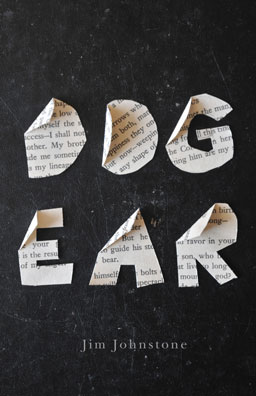
Dog Ear - Jim Johnstone (Signal Editions/Vehicule Press)

Today's book of poetry:
Dog Ear.  Jim Johnstone.  Signal Editions/Vehicule Press.  Montreal, Quebec.  2014.


"I never met a man
with one
black eye
who wanted two"
                                                                                         from - "First Principles"
                                                                                                     Jim Johnstone

I get the distinct feeling from Jim Johnstone's Dog Ear that in his world vision  --  someone has to pay.

This is the dark end of a world out of balance, basic goodness is deeply suspect.

These poems are the loose tooth your tongue can neither solve or salve.  You feel them like a bruise. They are part of your flesh and bone, but a tender, sore part.

These poems are Michael Corleone sentencing Freddo to perdition while the Corleone matriarch still breathes.

Temps Mort

     Hell is empty.  All the devils are here.
                           -William Shakespeare, The Tempest

Look for a vanishing
point in tooth

and claw, the arrow
that predicts

equal and opposite
circles of hell.

Hell is of this world,
the wind blown

level with rooftops
on New Arthur,

cells re-circulating
as if symmetry

justified existence--
beauty where

nothing beautiful
had been.

Behind my back the
hemisphere

begins again and I 
question

whether I'm needed
to complete

this scene: an open-
ending plain,

body dissolving
where a dog-

fox circles its tail
until all that

has passed slows.
When time's

arrow repeats, its bow
empties

and the Devil walks
through.

...

These tight, taut poems are a bit like a nightmare you can't wake from.  A grimace that could turn to a smile, if only you could wake.

So, why would I recommend it?

Just ask our crying intern at Today's book of poetry.  Ask her why she loves the sad torture of Yukio Mishima, the painful kiss of Jean Genet.  Not all beauty wears a smile.

Louis Dudek, in Love

Umbrella held aloft like paper pulled
from a pinata, we trace the limits
of Marie-Reine-du-Monde and bull
inside. Bad luck: the basilica chaste
save for the confetti of our entrance,
the incline of a room within a room
inked-in in happenstance. By chance,
we've stumbled on our Waterloo:
elderly parishioners lulled to sleep,
pews like broken fingers on a working
hand. I take yours now, know your grip,
the clots that bulge like latticework,
confine the prize of blood's ascent.
See here? Your skin grows lean. Exeunt.

...

Where we might expect, even want, a love poem for passion, or even passive release we get:
"elderly parishioners lulled to sleep,
pews like broken fingers on a working
hand,"

Johnstone is relentless with his dark lament, his "raw self-examinations" that encompass us all.

Drive

No one will find us in this city -- not your valentine,
not the line of dogs he's chained by the throat. My collar
blooms chin-high, is perfumed with lilac where you
finger buttons, parse leaves and hook a flush of green

to my breast. Tell me you're good. Tell me we'll
lend our touch to the nearest MG, drive south on a
sucker bet until we run dry in the desert. There are
others who've come uninvited, who've come to free

themselves from their skin, lose their grip
and trace in a mess of coins. Here's my loss -- fist
lodged in the maw of the first guest to speak, our
honour run aground. To stay we'll need to slap down

the pin that adorns your jacket, bet against a snail being
able to survive the edge of a straight razor. I've been
told that nothing can live to know such a lean blade.
When we drive land rises and we rise with it.

...

Jim Johnstone's breathless and forcefully consistent Dog Ear should be read early in the morning. Hopefully on a day that promises sunshine.

This dark beacon reminds us of our better nature, the dire abyss promised with its loss.

Not all poetry give us hope, the shape of reason is not always pretty.  Johnstone paints like Brueghel The Elder, beautiful pandemonium when the harsh light of the human heart is fully revealed.

What a riveting read.  What an ominous outlook.

Jim Johnstone


ABOUT THE AUTHOR
Jim Johnstone is the author of three previous books of poetry: The Velocity of Escape (2008),Patternicity (2010) and Sunday, the locusts (2011). He is the recipient of a CBC Literary Award, The Fiddlehead’s Ralph Gustafson Poetry Prize, and Matrix Magazine’s LitPop Award. Currently he’s the Poetry Editor at Palimpsest Press, and an Associate Editor at Representative Poetry Online. He lives in Toronto.

BLURBS
"There is a lot to admire in Patternicity: musicality, intelligence, toughness, tensile juxtapositions of rational enquiry and lyrical tenderness."
     -Arc Poetry Magazine

"Johnstone's poems are entertaining, erotic, and dangerous, and at times brute in their clean, heart-wrenching details."
     -Mansfield Review

"Johnstone simply does not miss opportunities to drive home his music, to exploit each vowel's potential to ring and electrify its neighbours."
     -Maple Tree Literary Supplement

vehiculepress.com

284                                        

Friday, December 5, 2014

Radio Weather - Shoshanna Wingate (Signal Editions/Vehicule Press)

Today's book of poetry:
Radio Weather.  Shoshanna Wingate.  Signal Editions.  Vehicule Press.  Montreal, Quebec.  2014.


Radio Weather by Shoshanna Wingate is no stroll through the park.  Her clear thinking and plain speaking heart take us through some dark territory.

The poem "Radio Weather" is a fine introduction to Wingate's verse.  In it she tells us that "Our stories, though, tell us who we are."

Radio Weather

When there should be snow there is rain, rain, rain,
then ice, then rain. The radio hosts asks

call-in listeners if they think this a sign
of climate change. Old timers hit speed dial,

side-step the point, eager to talk storms,
lives marked by weather, recall jumping out

of windows when the doors were blocked with snow,
the hospitals filled up with broken backs--

What does it mean? The questions gather. Oh,

I have another story, a good one.
This storm flooded the town then froze it in

its shell; each home a snow globe of its own.
That one felled trees older than most houses;

rain pummeled us for days until the roads
gave way, just buckled, the ground beneath us

heaved and upended, water everywhere
devouring the road as if it were a sandcastle;

took bridges too, whole town unglued, adrift,
now islands of their own. Weather serves up

memory better than any book.
Who likes to think about means and ends,

how things change so slowly until they snap?
We fear our maps outdated, pencil sketches

on onion skin. Our stories, though,
tell us who we are.

...

Wingate introduces us to a narrative that includes draft-dodgers, Vietnam veterans, and a father who is a counsellor for these men.

The concerns of these soldiers  is addressed in the section of the book titled "Letter From Vietnam" which is assembled from actual letters sent to her father.  The sparse haunting reality of the poems reminds us fully of the huge costs of war.  The terrible umbrella of emotional destruction it pounds out on families, the personal fear and anguish of so many young men forced to arms.

Wingate strikes exactly the right chords of understanding and disbelief.

The Poet's Devil

We all have romantic ideas of our lives, you know.
That's how we get dressed in the mornings and leave
the house. Otherwise we'd never shave or bother
with silverware. Have you forgotten the art
of seduction, miss? I'm only a figment, yet look
at how I've handled my lot.
I brought down Kings. I had mothers burned
in front of their children.
You hear what I'm saying, don't you.
Implication. Suggestion. Don't be a dolt.
Words are power. You're thinking too hard
on all this, my ducky. You're still
going to die. And since you don't believe in an
afterlife, you'd better write your goddamn heart out.

...

I like clarity in poetry, I like to know where the poet is going and why.  Shoshanna Wingate is aces.

She tells you, poetically, everything you need to know.

Thankfully Radio Weather is not all grim memory and lost causes.  Wingate celebrates life's small moments of joy, as should we all.

New Year's Day

Others speak. They call for time
to come meet them. We do not

speak. We rest. We look
for nothing and do not stretch

to find ourselves different
in the new year. We lie together

under wool blankets, the baby kicks
my back, pads my shoulder

with her fingers, roots for what is hidden
until she cries herself awake.

I lift my shirt, eyes closed, and offer her
my breast as she squirms into me.

Me leg moves sidesways to find
his warm leg. We three know ourselves

together in sleep, content in
knowing what we'll find when we awake.

...

 Shoshanna Wingate

ABOUT THE AUTHOR
Shoshanna Wingate’s poetry and fiction have been published in The New Quarterly, The Fiddlehead, and Arc Poetry Magazine. A poetry chapbook, Homing Instinct, appeared from Frog Hollow Press in 2012. Founding editor of the arts & culture journal, Riddle Fence, she lives in St. John’s, Newfoundland.

BLURB
“Clear-eyed, musical, deeply-considered and deeply-felt, Radio Weather contends with the inhospitable. Bringing both child and adult perspectives to bear, it calls to account both the living and the dead. Brilliantly-crafted and wise, occupying a provisional space that is both wary and compassionate, somewhere ‘between what we didn’t want and what we could afford,’ these are poems of great psychological tension, poems for grown ups.”
      —Patrick Warner, author of Perfection


275

Friday, October 3, 2014

Satisfying Clicking Sound - Jason Guriel (Signal Editions/Vehicule Press)

Today's book of poetry:
Satisfying Clicking Sound.  Jason Guriel.  Signal Editions/Vehicule Press.  Montreal, Quebec.  2014.


Jason Guriel's Satisfying Clicking Sound is a Jekyll & Hyde compendium of razor sharp commentaries on the state of the world.

There is vitriol in his humour and a smirk in his snark.  Guriel really is a take no prisoners poet.

Claustrophobia

     "...the claustrophobia induced by this precision; it's difficult for the reader to find a point of entry."
                         -Mitchell Parry, reviewing Pure Product

Imagine your silhouette
cut into a wall
and call it a doorway
as done in the do-
it-yourself world
of Looney Tunes,
where the children
of Chuck Jones charge
at the surfaces
they would prefer
were passages--
willing their way through
as if brick were batter
and the body in motion
the cookie-cutter.

Now imagine the room
this man-stencilled
doorway opens onto
holds no more
than your dimensions.
You step into the plaster
cast of yourself,
the door closes behind,
and everything's snug:
your penis finds
its sheathe, your lips
their depression,
each ear plugged
to the drum with drywall.
This room of your own
is your eclipse.
It woolfs you down.

The coat of paint
coats you, too,
a second skin
flush with the first
like a blush.
The wall's pebbled
microtexture maps
onto your pores
and mates with them;
the slightest lift
of one of your
moles is matched
with its shallow,
corresponding hole.
The ceiling fits
you for a skullcap,
the chandelier
your tiara.

(Each rap of a hand
at the door is a blow
to the heart.)

Imagine this room
which, if you try
to open your mouth,
stuffs it to the ends
of your intestines--
a room with nary
a mail slot
for coughing
out of. A bespoke
joke, it gloves
your fingertips
and accounts for
the crescents of dirt
beneath the nails.

You say it feels
like a tailor-
made coffin,
the rain outside
the drumming
of handfuls of dirt.
You say it feels
to the touch
like a tomb.

I say it again
and say it still has way too much
in the way
of wiggle room.

...

Some of these poems read like snapshots and others are fully formed panoramas, but everything is always in HD, very clear, High Definition.

Satisfying Clicking Sound may refer to the noise in Guriel's head as he rollicks through the roughshod boxes of his imagination, scattering cultural references and glee with equal abandon.

These poems are machine-gun steady, all coming out of the barrel at the same velocity, just don't get in the way.

Women in the Arts

     "So I resented Stanley [Kubrick] at times because he pushed me.
     And it hurt. And I resented him for it. I thought, 'Why do you want
     to do this to me? How can you do this to me?"
                      -Shelley Duvall, on filming The Shining

That gargoyle of a little girl
who dwells downstool
of the pianist--her heels
adangle--and turns
his mind a page at a time
as he runs out of score,
returning her hands
to her lap where they stiffen
like stonework. The maid
withdrawing from master
at his desk, and doing her best
to minimize the click
of the door that always
puts a kink in his line
of thought and for which
he's given her bottom
what for. The wife stooping
to retrieve the pages
some ass of a Wyndham
Lewis--working longhand
in the darkness--flings
to the floor, a few lines
on each, the Lewis
taking for granted the wife
would take them
to the typewriter and unknot
his snarled cursive.
The Vera saving Lolita
from the furnace
that's always burning
in anecdotes that just eat
you up. The Tabitha
who hauls the first
few pages of a novel
called Carrie up
from the bottomless well
of a writer's trashcan
and commands her King
reverse the sentence
of exile. The wife
of the novelist who's been
blocked awhile and--
he being a hack
haunted by failure
and equipped with an ax
to grind--chases the wife
around the grounds
of a hotel as if she was
firewood with feet.
The muse who gives
birth to ideas which
is to say the enabler
with the berth of eggs.
The nearest warm
bodice that's available
when Byrons and
other such shits
find themselves between
poems or--"sleepwalking"
in the servants' wing--
all of sudden between
a pair of some body's
legs and raping
the benefits.

...

Guriel is a witty guy but that's not his only ammo.  These shoot-from-the-hip missives are tracer bullet true.  Some aim.

Guriel builds poems that riff towards his inevitable conclusions with the astuteness of Charlie Parker tipping at the scales.

Reviewing a Unicorn

     for Michael Lista

     "Reviewing Chinese Democracy [by Guns N' Roses] is not like reviewing music. It's more like
     reviewing a unicorn. Should I primarily be blown away that it exists at all? Am I supposed to 
     compare it to conventional horses?"
                                                          -Chuck Klosterman

The mob that likes to think
it likes such things
as unicorns will judge
your work a hatchet job
and you, a hack, a heart-
less Viking tucking in
at his trestle table--
hacking loose a hoof
or breaking off a haunch
of a horse laid out
among apples on a platter.
Never mind your skill
with a cleaver, your wielding
it the way a surgeon does
a scalpel; the mob won't see,
being up in the balcony
of the operating theatre,
what lies before you: a horse
with a tacky, tacked-
on prosthesis, the sort
of cost-effective solution
an extra wears when playing
it alien on some show.
(Test the prosthesis
with a tug and the mob
will cup its collective
hands around the bassoon
of a boo.) Your critics,
smelling a critic
with an attitude,
won't see the papier-mache
cone for the horn,
so when you saw
it off (the horse craning
to lick your wrist
in gratitude) the mob will swear it hears
the sound of snark-
toothed steel biting
into living bone.

...

Jason Guriel's third book Satisfying Clicking Sound, is a rewarding adventure.  Guriel whips the readers head around so fast you'll think you've been Linda Blaired.

Jason Guriel

ABOUT THE AUTHOR
Jason Guriel’s books include The Pigheaded Soul: Essays and Reviews on Poetry and Culture(2013) and Pure Product (2009). His work has been anthologized in The Best Canadian Poetry in English. In 2007, he became the first Canadian to be awarded Poetry’s Frederick Bock Prize. Poetry gave him their Editors Prize for Book Reviewing in 2009. He lives in Toronto.

BLURBS (praise for PURE PRODUCT)
"[Pure Product] may well be that rare thing; a collection to be lived with."
     -The Globe and Mail

"These poems, often about disposable parts of our culture, are frenetically alive. They infuse the products they exemplify with a life, a valency, an irrepressible energy."
     -Arc Poetry Magazine

"What We Talk About When We Talk About Poetry"
Jason Guriel - "The Pighead Soul"
Ben McNally Books, Toronto, Ontario, March 20, 2014
VIDEO: therotarydial


253