Showing posts with label len gasparini. Show all posts

Thursday, February 15, 2018

Send - Domenico Capilongo (Guernica Editions)

Today's book of poetry:
Send.  Domenico Capilongo.  Essential Poets Series 244.  Guernica Editions.  Toronto - Buffalo - Lancaster (U.K.).  2017.


Today's book of poetry knew we'd heard the name Domenico Capilongo before so we sent Milo into the stacks.  As soon as Milo sat Capilongo's first two books down on my desk I remembered.

Domenico Capilongo does plenty in his first book but Today's book of poetry remembered how Capilongo nailed that whole furtive first kiss with his poem "Shera-Lee" from I Thought Elvis Was Italian (Wolsak & Wynn, 2008).  Today's book of poetry remembered thinking that maybe Capilongo was another Len Gasparini character but he soon wrote us out of that illusion.  I Thought Elvis Was Italian was all James Brown hip and e.e. cummings poetic, quoting John Lennon and tipping the old hat to Saint Michael of Ondaatje.  We loved it.

Hold That Note (Quattro Books, 2010) had Louis Armstrong, Theolonious Monk, Billie Holiday, John Coltrane and Tom Waits as angels in the wings.  You just know that Today's book of poetry is going to have a lot of time for that, all the time in the world.

Send is a whole new ball game.  A clean slate.  But Today's book of poetry doesn't own a phone, of any kind.  There is a land-line phone in our office, plugged into the wall.  Today's book of poetry has never sent or received a text.  Domenico Capilongo's Send bursts at the seams with messages that you need to receive.

Contrary to the constantly public display of "texting" by the current POTUS there are texts worth reading, messages worth hearing.  Send is full of them.

Capilongo gives us instant access in his efforts to capture the languages and means we use to communicate. Capilongo catalogues it all from Morse Code to "whistled languages."

after

all the selfies. all the shame. after all the tex-
ting. all the comments. all the sexting. after
all the nakedness. all the pain. after all the
instagram. all the secret tattoos. after all the
tweeting. all the play-by-play. after all the
facetime. all the snapchat. the skype. after
all the auto-correct email. all the googling
after all.

...

Marconi and Alexander Graham Bell both put in cameos in Capilongo's efforts to search out every step forward in our haste to communicate faster.  Today's book of poetry suspects that some of these communiques are "found poems" and we can only celebrate Capilongo's keen sense of every methodology.  Domenico Capilongo is an all-in type poet if his first two books are any indication and in Send he invests it all in how we communicate.

Capilongo's sense of humour is abundant in these compellingly readable poems.  Today's book of poetry fears I am out of my depths because I can only think I know what it means when Capilongo titles a poem "Christopher Marlow Pocket Calls William Shakespeare."  The poem itself is hilarious.

kiss me like houdini's wife

straightjacketed and ready to take the plunge
in the dark. his mind racing through steps.
through the math of the weight of water. the
pressure of oxygen in his lungs. the sound
of the eyes of the crowd all around him. the
kiss from his wife. his tongue meets hers.
she slips a key into his mouth. he pushes it
into the corner of his cheek for later. the
crowd takes a breath. kiss me.

...

Our morning read started a little later than usual today.  It's not snowing in Ottawa for the first time in weeks but there is a misty rain that is falling and coating everything it touches in a lovely coat of ice.  Milo insisted we use all three Capilongo titles for the morning read but agreed we would hammer through Send first. 

Much to Capilongo's credit he happily jumps into concrete poems when he feels the need.  Here Today's book of poetry feels terribly unqualified to comment except to say that in most cases these poems surprised us with the clarity of a particular message, for us they were dead on.  And that is first time Today's book of poetry has ever said that!

During the reading we passed those poems around for everyone to see and then kept on with the rest.

In Capilongo's exhaustive and almost encyclopedic search for examples of how we choose to communicate he never loses sight of the reader, always makes certain they are engaged, Capilongo is communicating in a direct line with us.  The poems in Send got Today's book of poetry on Capilongo's side early.  After that the intriguing entertainment/exploration never let up.

carretto siciliano

in argentina or brazil there are ex-nazi soldiers in their
eighties who still hide in the shadows of trees. who still
wear large hats with sun glasses. they try to speak spanish
or portuguese. they try to walk slowly with knees bent but
you can still see the stiffness in their backs. the harsh ac
cent hanging at the ends of words. these men, in the early
morning, still wonder how the allies managed to take sicily.
     it was one man, a lowly carretto driver, some salvatore
or giuseppe, who came up with the idea. the germans were
everywhere with their checkpoints. no one was safe. they
even looked under hats. it came to him in a dream. the sky
was purple. his carretto flying over palermo like some sicil-
ian santa. his horse turned head back and spoke to him.
     we can send the messages with the horses, he thought
to himself over morning coffee, but how? the germans
even check under the horses' balls. later when he fed his
horse he saw it shove some food in its cheek only to share
it with another horse in the plazza.
     messages were sent in little walnut-sized capsules
from horse-to-horse piazza-to-piazza all across sicily. the
german soldiers often commented about the strange sicil-
ian horses, seltsame kussende pferde. strange kissing horses.
     this sicilian secret is know only to a chosen few. if
you want to know the truth about how this really hap-
pened you will have to go to sicily and ask one of the
horses yourself.

...

Domenico Capilongo writes solid poetry that you can depend on, every time out.  These are sweet, smart, clever, witty, funny, incisive poems that will re-wire your future communication.  All Today's book of poetry can say to Mr. Capilongo is thank you.

It's usually three strikes and you are out in almost every league.  What does it mean when you hit a homer out of the park your first three times up to the plate?

Capilongo's Send is a book of poetry you can hang your hat on.  This cat can seriously burn.
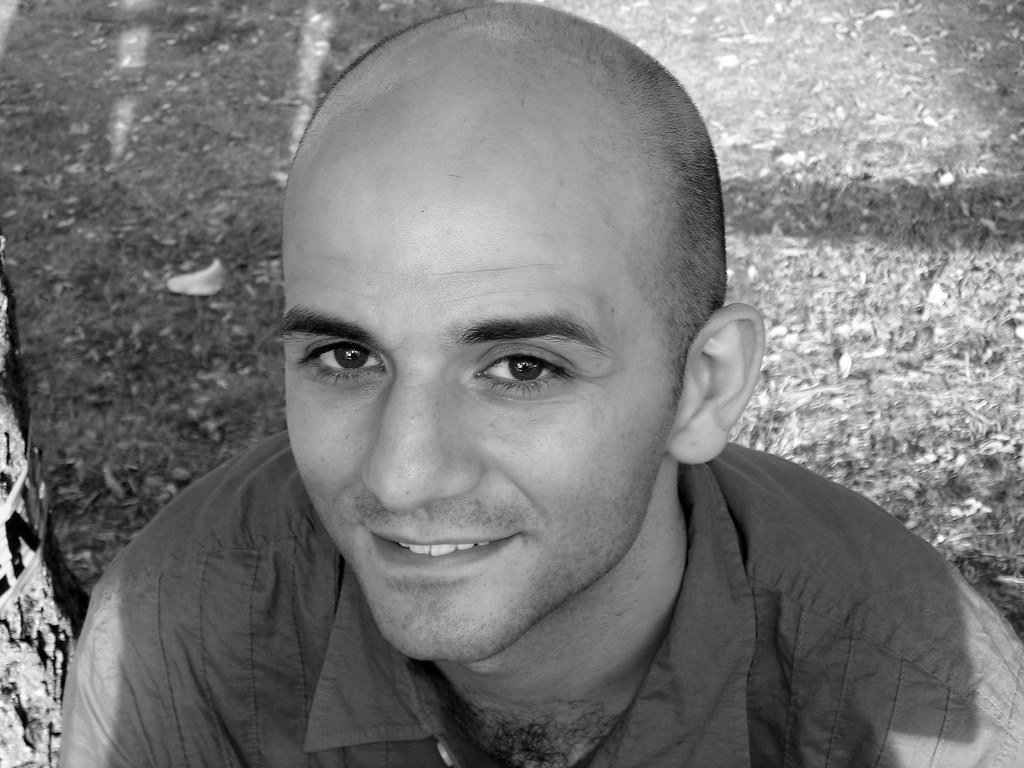
Image result for Domenico capilongo photo

Domenico Capilongo

ABOUT THE AUTHOR
Born when rotary telephones came in multiple colours, Domenico Capilongo began writing with pencil and paper, passing poetry notes from the back of the class. He still writes in notebooks, used a typewriter in high school, and his earliest published poems were printed on a dot-matrix printer. His first books of poetry, I thought elvis was Italian (2008) and hold the note (2010), as well as his first book of short fiction, Subtitles (Guernica, 2012), came very close to winning awards and were all mailed in the post. A high school creative writing teacher and karate instructor, he lives with his wife and children in Toronto. Find out more on the information superhighway at domcapilongo.wixsite.com/home.

BLURB
In his latest book, Dom Quixote mounts a new smartphone and tilts away at our digital windmills. His chivalry is analogue: what is lost in our twittering is the seed-bed of his musings. Messages between and underneath communications—tender, sensuous, comically misaligned and/or brutal by turn—are gathered up and offered back to us as rebus: an oracular operating system where what we mean is not always how we speak.
     - Chris D’Iorio, author of Without Blue


Book teaser for
Domenico Capilongo's Send
Video: Capilongo Poetry


657


DISCLAIMERS

Poems cited here are assumed to be under copyright by the poet and/or publisher.  They are shown here for publicity and review purposes.  For any other kind of re-use of these poems, please contact the listed publishers for permission.
We here at TBOP are technically deficient and rely on our bashful Milo to fix everything.  We received notice from Google that we were using "cookies"
and that for our readers in Europe there had to be notification of the use of those "cookies.  Please be aware that TBOP may employ the use of some "cookies" (whatever they are) and you should take that into consideration

Thursday, June 29, 2017

After Hours - Darrell Epp (Mosaic Press)

Today's book of poetry:
After Hours.  Darrell Epp.  Mosaic Press.  Oakville, Ontario.  2016.

Hamilton Ontario Poet Darrell Epp

The best poems in Darrell Epp's After Hours remind you of the first time you got stoned.  The first time you felt dangerous.

You know how you felt the first time the veil came down.  The first time you saw behind the wizard's screen.  Welcome to a new Oz.

Epp has just the right amount of disgruntled dissatisfaction to fill these poems with the proper vigour. Hope doesn't come easily but it is buried in the seams of After Hours.  Maybe under an old car with a mad dog chained to the bumper, the hard-packed soil oil stained.

The Mongol Invasions

i have as of late acquired the ability to
turn myself into fictional characters,
it's an old man in a rent-controlled
basement today--no one suspects
he's really an eccentric billionaire
with a thousand years of memories.
i prowl the malls, laugh at the
baffled cluelessness of the
bargain-hunting taxpayers.
i seem to recall having
magic powers, a dozen
wives and x-ray eyes;
watching atoms knit
themselves into pairs,
then clans, then faces.
maybe a face will say
hi to me today, maybe
i'll make a new friend
who truly understands:
we'll trade war stories
about missing dorothee
and rampaging across
asia with genghis khan.

...

Today's book of poetry positively romped through Darrell Epp world.  I want to tell you that Epp made me think of Bukowski but in truth Epp is not a Bukowski cat.  So then I'm thinking somewhere between Johnny Rivers melancholy and Len Gasparini rant and maybe with a modernized Milton Acorn thrown in there for a touch of righteous rage.

How silly to be looking for comparisons when Epp can so clearly stand on his own.  These quick and sharp narratives cut clean as a razor.  Epp has found a voice just below the bellow of flat out rage and is comfortable roaming that dangerous territory.  It certainly makes for kick-ass poems.

Our morning read was like watching young kids with their first fireworks, setting them off one at a time.

Contraindications

an unpolluted pacific

a garden of eden sky

the man in the moon

a star's molten heart

a volcano's teardrop

put one of the above under your
tongue every 4 hours or as needed.

do not mix with food, do not answer
the phone, and if anybody asks, tell

them you haven't seen me, tell them
you haven't seen me for months.

...

After Hours is Darrell Epp's second book of poetry.  Today's book of poetry didn't have to go far to find his first book, Imaginary Maps (Signature Editions, 2009), we have a copy on shelf of "coming attractions."  Today's book of poetry will be looking at Imaginary Maps in the not too distant future.

When Milo, our head tech, put Imaginary Maps down on my desk I had an immediate flashback to the first time I read it.  Cue big smile.  Epp is a quick study because he allows the reader immediate entrance to his chaotic world, seasons it with kindness.

The Robert Crumb type front cover of After Hours has a Bukowski type "Hank" character with angel's wings sitting with other barflies as eternity sneaks up on them.  Rarely are covers so apropos.

Telephone Game

the message ran around the world; by the
time it came back to me i had a wooden
leg and lived in a castle made of bone.

my pet unicorn could sing like a bird.
i was a wanted man, one step ahead
of irs, kgb and other sinister acronyms.

i beat superman at arm-wrestling and
punished all who loved me. love's a
word poets use as a crutch, like 'very'

and 'and.' funny how love brought out
my inner martyr: a lesser man would
have broke both your arms. what was

it, that thing you thought you wanted?
sorry. but don't look at me, look at the
universe, downright peacock-y in its

nightly burlesque: supernovae like
popped corks; the milky way,
waving her spiral arms like shiva

herself; the gravity that pulled me
to you, indiscriminate, affirmative, it
felt like heaven, or the next best thing.

...

Maybe After Hours is an entirely coincidental title pick but Today's book of poetry is convinced Epp is giving a big nod to ol' Martin Scorsese's flick of the same name, After Hours (1985).  In the episodic flick, think of individual poems, the hero/loser is entirely over his head from one late night misadventure to another.  The character presents as though he were on top of things, as though he were in control whereas the movie is one continuous lesson in how he controls nothing at all.

Darrell Epp's After Hours discombobulates the reader in much the same way.  It is a great ride. Buckle up.

Image result for darrell epp photo
Darrell Epp

ABOUT THE AUTHOR
Darrell Epp’s poetry has appeared in dozens of magazines around the world including Maisonneuve, Poetry Ireland, Sub-Terrain, and The Saranac Review. His previous poetry collection was entitled Imaginary Maps (2009). He lives in Hamilton, Ontario.

BLURBS
“In Epp’s second collection of poems, he explores diverse themes and imagery firmly rooted against a gritty postmodern backdrop.” 
     – The Hamilton Spectator

“A fun, sly jumble of poems that often tackle weighty issues”
     – Jonathan Ball, Winnipeg Free Press

“In After Hours, Darrell Epp proves himself as adept at bricolage as he is at ventriloquism. That he manages to not only interpolate discrete, oblique, and temporally disconnected texts and cultural signifiers into his poems, but does so while remaining consistently tethered to the visceral reality of his native Hamilton, a city he describes in “No Sweat” as “awesome and oblivious/and no help at all,” is no mean feat.”

     – Phillip Crymble, Hamilton Arts & Letters


“I enjoyed these poems immensely.”

     – William Peter Blatty, author of The Exorcist


“Lucid, raw and honest poems, refrains that slide with grace and wit from the particular to the general, from past to present and back again, authentic and absorbing.”
     – novelist and screenwriter Rudy Wurlitzer (Pat Garrett and Billy the Kid and Little Buddha)


“If you ever get caught in the subway between stations, try to sit beside a guy like the guy who wrote these poems.”
     – novelist David Gilmour (The Film Club, Back On Tuesday)


“Funny and fun to read, playful but also deadly serious…a depth of experience got at only in the best poetry.”

     – novelist Samuel Thomas Martin (This Ramshackle Tabernacle, A Blessed Snarl)

mosaic-press.com

588

DISCLAIMERS

Poems cited here are assumed to be under copyright by the poet and/or publisher.  They are shown here for publicity and review purposes.  For any other kind of re-use of these poems, please contact the listed publishers for permission.

We here at TBOP are technically deficient and rely on our bashful Milo to fix everything.  We received notice from Google that we were using "cookies"
and that for our readers in Europe there had to be notification of the use of those "cookies.  Please be aware that TBOP may employ the use of some "cookies" (whatever they are) and you should take that into consideration.

Sunday, October 23, 2016

Mirror Image - Len Gasparini (Guernica Editions)

Today's book of poetry:
Mirror Image. Len Gasparini.  Essential Poet Series 209.  Guernica Editions. Toronto - Buffalo - Lancaster(U.K.).  2014.

Mirror Image

I first discovered Len Gasparini in 1976 when rummaging through stack of used books in a ramshackle barbershop near the Ford plant I worked at in Windsor.  I was writing poems and had published in a few small magazines and journals but I was still a couple of years away from my first book. 

Gasparini was a liberating and inspirational find.  Here was a poet whose straight ahead no bullshit persona came jumping off of the page and grabbed me by the collar.  I liked Gasparini right out of the gate and have been a big fan ever since.

Early this morning I sent Milo, our head tech, into the stacks to see what he could find by Gasparini, this is what he came back with:

21 X 3 - with Dorothy Farmiloe/Eugene McNamara, The Gryphon Press, 1967
Cutty Sark - The Quarry Press, 1970
Tunnel Bus to Detroit - Fiddlehead Poetry, 1971
Pelee Island - Thistle Printing, 1972
The Somniloquist - Fiddlehead Poetry, 1972
One Bullet Left - Alive Press, 1974
If You Love - Borealis Press, 1975
Moon Without Light - York Publishing, 1978
Breaking and Entering, New and Selected Poems - Mosaic Press/Valley Editions, 1980
Ink from an Octopus - Hounslow Press, 1989
I Once Had a Pet Praying Mantis - Mosaic Press,1995
A Canadian In Dixie - Lyrical Myrical, 2003
Leftover Love to Kill - Lyrical Myrical, 2004

Turns out this is only a portion of his output.

Today's book of poetry cannot begin to tell you how thrilled we were to see Gasparini's Mirror Image come through the door.  Len Gasparini has been a big hero of ours for almost forty years. Today's book of poetry was reading poems by Gasparini before Bukowski, before Purdy, Carver, Ross, any of it.  I thought Len Gasparini was the original gangster poet.

This first poem comes from a longer sequence of poems, "Memories of the Rockin' Fifties" and encapsulates the feeling I had back in the Windsor of my youth when I first picked up a copy of One Bullet Left.

from Memories of the Rockin' Fifties

8

       for Jim Christy

How summer day in the city.
On my way to a beach party
I stopped for cigarettes at a corner store.
A 35 cent Avon paperback, The Subterraneans,
by Jack Kerouac, caught my eye.
(The title sounded like sci-fi.)
I bought the book ... read passages
to my sunbathing pals drinking contraband beer.
When the party ended, it came
as no little surprise to see the beach
hadn't moved, the lake was still there;
but this cat wasn't.
Kerouac had turned me around.
I was never altogether the same after that.

...

The poetry of Len Gasparini is often clipped so short that you don't realize you've been rabbit punched.  No wasted movement.  Gasparini is a romantic of an old school of take no prisoners, that might include the ghosts of Raymond Chandler and Jim Harrison, maybe even Charles the B.

Mirror Image is two books in one.  The first thirty pages are poetry and the remainder is prose.  Odin, our newest staff member is working over the prose right now and I don't have the heart to tell him that prose is above our pay grade.  Our mandate stops with the poetry.  But what fine, crisp, clean poems these are.

Endangered Species

     for Patrick Lane

In a country that was founded
on the backs of fur-bearing animals
I once saw a stuffed adult cougar
at a trade show in Vancouver's BC Place.
It there is reincarnation,
metempsychosis, transmutation, or whatever,
I hope that I come back
as a cougar, Felis concolor,
solitary and nocturnal in the wilds
of northern British Columbia.
I will stalk, ambush, and stab
my sharp canines into the neck
of any motherfucking nimrod
who tries to hunt me down.
I'll eat my fill: feed my kittens:
and leave the rest for the ravens.

...

Gasparini has been publishing his honest and unfettered poetry with resolute consistency for the best part of fifty years.  Today's book of poetry feels honoured to have him come through the door, for an opportunity to share his work.

Many of Gasparini's poems can be read as reportage sans resolution, these poems often raise more questions than answers.  Today's book of poetry thinks Gasparini's modus operandi has always been the pulling back of the curtain to show the real world at work.  That old over the rainbow trick from the Wizard of Oz.

Runaway

Alone, with nowhere to go,
she stands on the corner
of some deserted intersection
late at night, waiting
for a traffic light.

...

Today's book of poetry has admired the poetry of Len Gasparini my entire adult life and is pleased to share his work with you.  You're not going to like every poem in Gasparini's vast catalogue, no poet can pass that test, but all these years on Gasparini has never let me down.

Len Gasparini
Len Gasparini

ABOUT THE AUTHOR
Born in Windsor, Ontario, Len Gasparini is the author of numerous books and chapbooks of poetry, five short-story collections, including The Snows of Yesteryear (2011), The Undertaker's Wife (,2007), and A Demon in My View (2003), which was translated into French as Nouvelle noirceur. He has also written two children’s books, a work of non-fiction, and a one-act play. In 1990, he was awarded the F.G. Bressani Literary Prize for poetry. In 2010, he won the NOW Open Poetry Stage event. Having lived in Montreal, Vancouver, New Orleans, and Washington State, he now divides his time between Toronto and his hometown. Mirror Image, his latest collection, combines poetry and prose.


517
DISCLAIMERS

Poems cited here are assumed to be under copyright by the poet and/or publisher.  They are shown here for publicity and review purposes.  For any other kind of re-use of these poems, please contact the listed publishers for permission.

We here at TBOP are technically deficient and rely on our bashful Milo to fix everything.  We received notice from Google that we were using "cookies"
and that for our readers in Europe there had to be notification of the use of those "cookies.  Please be aware that TBOP may employ the use of some "cookies" (whatever they are) and you should take that into consideration.