Showing posts with label michael ondaatje. Show all posts

Thursday, March 14, 2019

Building On River - Jean Van Loon (Cormorant Books)

Today's book of poetry:
Building On River.  Jean Van Loon.  Cormorant Books.  Toronto, Ontario.  2018.


Building On River is a little unlike any other book of poetry Today's book of poetry has seen in quite a while.  Jean Van Loon has reinterpreted, rendered if you like, biography, extensive research, heresay and conjecture, all of it into a timeless tapestry.  This brocade plays out, almost seamlessly, in the mind's eye, as though the reader were watching a movie.

Van Loon is cinematic.

This is history that you can taste, smell and feel.

Sir Michael Ondaatje (in Today's book of poetry world we knight and honour as we see fit) pave the way for this sort of adventure with his ground breaking The Collected Works of Billy the Kid.  If you haven't read Ondaatje's Billy the Kid and you love poetry.  The very next thing you should do is to put on your coat and go to the bookstore/library and get a copy of The Collected Billy....

John Rudolphous Booth is the subject of Van Loon's expansive narrative about a self-made man on the edge of the Canadian wilderness.  Booth understood what was about to happen and took advantage of it.  His astute sense of what was needed and how to supply it made him a very rich man.  Jean Van Loon witnessed none of it but somehow brings Booth to flesh and bone you care about.

J.R., Age Nine, Builds a Bridge

Runoff bulges the creek
a muscled river
if I look at it right, churning
alongside the field
icing my feet.

Yesterday's turtle
drags again onto its rock
head and legs outstretched
shell scarred. Midday sun
warms my shoulders.

I've cleared the brush
with the hatchet Father
made me. Now I can
spade the bank, anchor
a buttress shaped from

a fireplace log Father
must not notice missing
and the stump I dug out last week.
A dab hand with an axe, Mother said
now two years dead,

who told me Blue Flag
was the flower that looked like an iris
beside the summertime creek
who sweetened my sickbed
with a mug of wild roses.

💫💫💫

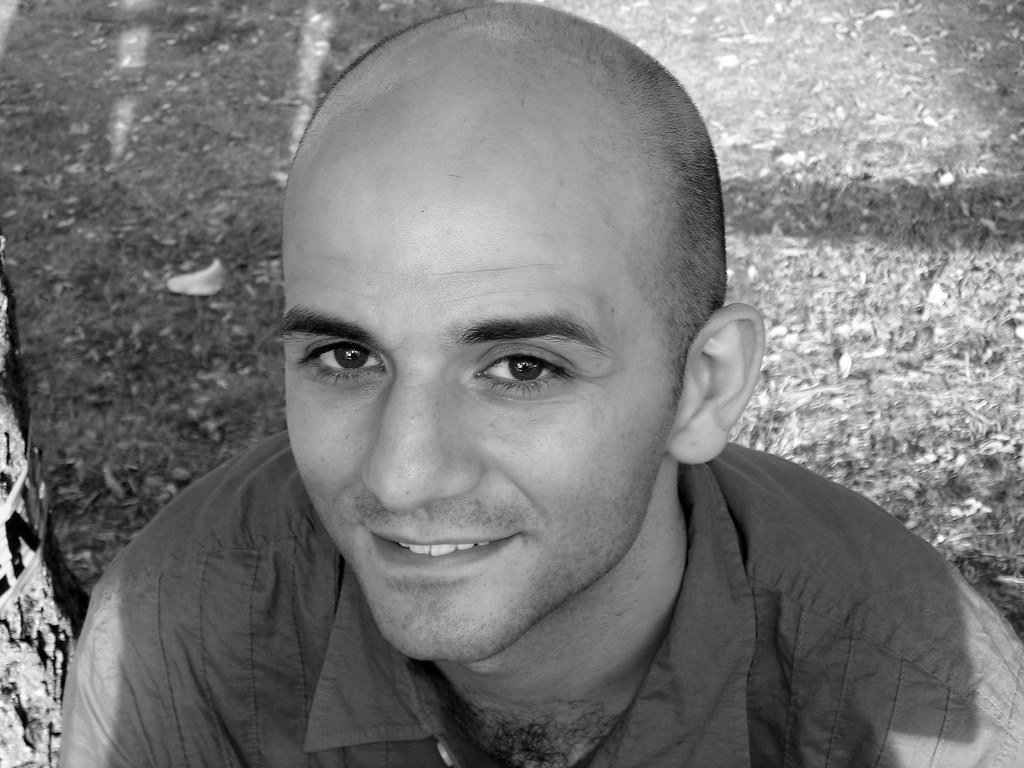
As it happens Jean Van Loon and I will be doing a reading in a private home here in Ottawa a couple of weeks from now.  Ms. Van Loon and I have yet to meet.  You're just going to have to take my word for it on the coincidence of timing for Building On River.  

Jean Van Loon researched Building On River by reading tracts from the Historical Society of Gatineau, lumber baron biographies, Donald McKay and David Lee too.  Susanna Moodie and Catherine Parr Traill.  And that isn't scratching the surface.

The result is poems that sound and feel true in all respects.  These poems do bring J.R. Booth to flesh and blood, we see his diligence and imagination make an empire from wood.  

Tale from the Feed Mill

This was before he was rich.
Starting out in Hull with a small plant
for shingles. He'd hitch up and carry a load,
sell it in Ottawa, then make the rounds for supplies.

So he comes to my mill for a quantity of fodder
finds he doesn't have the cash to pay for it all.
I tell him, Go ahead, take what you need
—lord knows, he'd be good for the money.

Well sir. But a few minutes later, didn't he
wheel the horses back and return the part unpaid.
Couldn't unload fast enough. As if it would
burn through his wagon.

💫💫💫

Jean Van Loon isn't going to knock you over the head with fireworks, there is a far subtler game afoot, these poems accumulate, gather momentum, details build, until the story of J.R. Booth carries you, becomes important to you, the reader.  This is a good trick.

This morning's read was held with one sore crew.  Yesterday's deadline was not met because each and every one of us was outside shovelling snow, again, like we have almost every day since the beginning of November.  Today's book of poetry loves Ottawa and is happy to live here, but this winter was truly a kick right in the old tender parts.  Milo, our head tech, did something to his back lifting wet snow.  Kathryn, our Jr. Editor, did something to her back trying to look after Milo.  And so on.

Today's book of poetry thought Jean Van Loon found the right tension between tough and tender.  Booth was clearly a man of purpose.  And we get the sense that he did care about family and community.  He was a man dedicated to his work.  Van Loon has found the man under all that wealth, behind all that work.

The Weaver's Tale

—found poem

The saw on his left
sets the pace. If the singing blade
rips 50 rough shingles
off the block every minute
the sawyer must reach over
to its teeth
50 times in 60 seconds;
if the automatic carriage
feeds the odorous wood 60 times
into hungry teeth, 60 times
he must reach over, turn the shingle, trim its edge
on the gleaming saw in front of him
cut the narrow strip containing
the knot hole with two quick movements
and toss the completed
board down the chute
to the packers,
                          meanwhile
keeping eyes and ears open
for the sound that asks him
to feed a new block into untiring teeth.
Hour after hour the shingle weaver's
hands and arms, plain, unarmored
flesh and blood, staked against
the screeching steel that cares not
what it severs. Hour after hour the steel
sings its crescendo as it bites
into the wood, the sawdust cloud
thickens with fine particles.

Sooner or later he reaches
a little too far, the whirling blade
tosses drops of deep red
into the air, and a finger, a hand
or part of an arm comes sliding
down the slick chute.

💫💫💫

Building On River is quiet determination realized.  Jean Van Loon has done that rare feat, found the real poetry in history.


Jean Van Loon

ABOUT THE AUTHOR
Jean Van Loon lives with her husband in a home that is an easy walk to the Ottawa River. Since retiring from a career as a public servant and head of the steel industry's national trade association, she has published poems and stories in literary magazines across Canada. When not at her desk, she often walks through the Experimental Farm, comprised in large part of farmland bought from J.R. Booth, or along the river where he got his start. Building on River is her first book-length publication.

BLURBS
"Building on River is full of lyrical moments and metaphor."
     — Patrick Langston, Artsfile

​"Van Loon’s musical ear drew me into the narrative fast..."
     — Catherine Owen, Marrow Reviews


Jean Van Loon
reads
Video: Arc Poetry


743


DISCLAIMERS

Poems cited here are assumed to be under copyright by the poet and/or publisher.  They are shown here for publicity and review purposes.  For any other kind of re-use of these poems, please contact the listed publishers for permission.
We here at TBOP are technically deficient and rely on our bashful Milo to fix everything.  We received notice from Google that we were using "cookies"
and that for our readers in Europe there had to be notification of the use of those "cookies.  Please be aware that TBOP may employ the use of some "cookies" (whatever they are) and you should take that into consideration
"Building on River is full of lyrical moments and metaphor."
— Patrick Langston, Artsfile
"Van Loon’s musical ear drew me into the narrative fast..."
— Catherine Owen, Marrow Reviews

"Building on River is full of lyrical moments and metaphor."
— Patrick Langston, Artsfile
"Van Loon’s musical ear drew me into the narrative fast..."
— Catherine Owen, Marrow Reviews

Thursday, February 15, 2018

Send - Domenico Capilongo (Guernica Editions)

Today's book of poetry:
Send.  Domenico Capilongo.  Essential Poets Series 244.  Guernica Editions.  Toronto - Buffalo - Lancaster (U.K.).  2017.


Today's book of poetry knew we'd heard the name Domenico Capilongo before so we sent Milo into the stacks.  As soon as Milo sat Capilongo's first two books down on my desk I remembered.

Domenico Capilongo does plenty in his first book but Today's book of poetry remembered how Capilongo nailed that whole furtive first kiss with his poem "Shera-Lee" from I Thought Elvis Was Italian (Wolsak & Wynn, 2008).  Today's book of poetry remembered thinking that maybe Capilongo was another Len Gasparini character but he soon wrote us out of that illusion.  I Thought Elvis Was Italian was all James Brown hip and e.e. cummings poetic, quoting John Lennon and tipping the old hat to Saint Michael of Ondaatje.  We loved it.

Hold That Note (Quattro Books, 2010) had Louis Armstrong, Theolonious Monk, Billie Holiday, John Coltrane and Tom Waits as angels in the wings.  You just know that Today's book of poetry is going to have a lot of time for that, all the time in the world.

Send is a whole new ball game.  A clean slate.  But Today's book of poetry doesn't own a phone, of any kind.  There is a land-line phone in our office, plugged into the wall.  Today's book of poetry has never sent or received a text.  Domenico Capilongo's Send bursts at the seams with messages that you need to receive.

Contrary to the constantly public display of "texting" by the current POTUS there are texts worth reading, messages worth hearing.  Send is full of them.

Capilongo gives us instant access in his efforts to capture the languages and means we use to communicate. Capilongo catalogues it all from Morse Code to "whistled languages."

after

all the selfies. all the shame. after all the tex-
ting. all the comments. all the sexting. after
all the nakedness. all the pain. after all the
instagram. all the secret tattoos. after all the
tweeting. all the play-by-play. after all the
facetime. all the snapchat. the skype. after
all the auto-correct email. all the googling
after all.

...

Marconi and Alexander Graham Bell both put in cameos in Capilongo's efforts to search out every step forward in our haste to communicate faster.  Today's book of poetry suspects that some of these communiques are "found poems" and we can only celebrate Capilongo's keen sense of every methodology.  Domenico Capilongo is an all-in type poet if his first two books are any indication and in Send he invests it all in how we communicate.

Capilongo's sense of humour is abundant in these compellingly readable poems.  Today's book of poetry fears I am out of my depths because I can only think I know what it means when Capilongo titles a poem "Christopher Marlow Pocket Calls William Shakespeare."  The poem itself is hilarious.

kiss me like houdini's wife

straightjacketed and ready to take the plunge
in the dark. his mind racing through steps.
through the math of the weight of water. the
pressure of oxygen in his lungs. the sound
of the eyes of the crowd all around him. the
kiss from his wife. his tongue meets hers.
she slips a key into his mouth. he pushes it
into the corner of his cheek for later. the
crowd takes a breath. kiss me.

...

Our morning read started a little later than usual today.  It's not snowing in Ottawa for the first time in weeks but there is a misty rain that is falling and coating everything it touches in a lovely coat of ice.  Milo insisted we use all three Capilongo titles for the morning read but agreed we would hammer through Send first. 

Much to Capilongo's credit he happily jumps into concrete poems when he feels the need.  Here Today's book of poetry feels terribly unqualified to comment except to say that in most cases these poems surprised us with the clarity of a particular message, for us they were dead on.  And that is first time Today's book of poetry has ever said that!

During the reading we passed those poems around for everyone to see and then kept on with the rest.

In Capilongo's exhaustive and almost encyclopedic search for examples of how we choose to communicate he never loses sight of the reader, always makes certain they are engaged, Capilongo is communicating in a direct line with us.  The poems in Send got Today's book of poetry on Capilongo's side early.  After that the intriguing entertainment/exploration never let up.

carretto siciliano

in argentina or brazil there are ex-nazi soldiers in their
eighties who still hide in the shadows of trees. who still
wear large hats with sun glasses. they try to speak spanish
or portuguese. they try to walk slowly with knees bent but
you can still see the stiffness in their backs. the harsh ac
cent hanging at the ends of words. these men, in the early
morning, still wonder how the allies managed to take sicily.
     it was one man, a lowly carretto driver, some salvatore
or giuseppe, who came up with the idea. the germans were
everywhere with their checkpoints. no one was safe. they
even looked under hats. it came to him in a dream. the sky
was purple. his carretto flying over palermo like some sicil-
ian santa. his horse turned head back and spoke to him.
     we can send the messages with the horses, he thought
to himself over morning coffee, but how? the germans
even check under the horses' balls. later when he fed his
horse he saw it shove some food in its cheek only to share
it with another horse in the plazza.
     messages were sent in little walnut-sized capsules
from horse-to-horse piazza-to-piazza all across sicily. the
german soldiers often commented about the strange sicil-
ian horses, seltsame kussende pferde. strange kissing horses.
     this sicilian secret is know only to a chosen few. if
you want to know the truth about how this really hap-
pened you will have to go to sicily and ask one of the
horses yourself.

...

Domenico Capilongo writes solid poetry that you can depend on, every time out.  These are sweet, smart, clever, witty, funny, incisive poems that will re-wire your future communication.  All Today's book of poetry can say to Mr. Capilongo is thank you.

It's usually three strikes and you are out in almost every league.  What does it mean when you hit a homer out of the park your first three times up to the plate?

Capilongo's Send is a book of poetry you can hang your hat on.  This cat can seriously burn.

Image result for Domenico capilongo photo

Domenico Capilongo

ABOUT THE AUTHOR
Born when rotary telephones came in multiple colours, Domenico Capilongo began writing with pencil and paper, passing poetry notes from the back of the class. He still writes in notebooks, used a typewriter in high school, and his earliest published poems were printed on a dot-matrix printer. His first books of poetry, I thought elvis was Italian (2008) and hold the note (2010), as well as his first book of short fiction, Subtitles (Guernica, 2012), came very close to winning awards and were all mailed in the post. A high school creative writing teacher and karate instructor, he lives with his wife and children in Toronto. Find out more on the information superhighway at domcapilongo.wixsite.com/home.

BLURB
In his latest book, Dom Quixote mounts a new smartphone and tilts away at our digital windmills. His chivalry is analogue: what is lost in our twittering is the seed-bed of his musings. Messages between and underneath communications—tender, sensuous, comically misaligned and/or brutal by turn—are gathered up and offered back to us as rebus: an oracular operating system where what we mean is not always how we speak.
     - Chris D’Iorio, author of Without Blue


Book teaser for
Domenico Capilongo's Send
Video: Capilongo Poetry


657


DISCLAIMERS

Poems cited here are assumed to be under copyright by the poet and/or publisher.  They are shown here for publicity and review purposes.  For any other kind of re-use of these poems, please contact the listed publishers for permission.
We here at TBOP are technically deficient and rely on our bashful Milo to fix everything.  We received notice from Google that we were using "cookies"
and that for our readers in Europe there had to be notification of the use of those "cookies.  Please be aware that TBOP may employ the use of some "cookies" (whatever they are) and you should take that into consideration

Wednesday, July 22, 2015

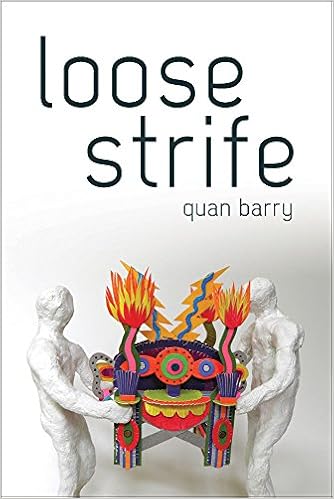
Loose Strife - Quan Barry (University of Pittsburgh Press)

Today's book of poetry:
Loose Strife.  Quan Barry.  University of Pittsburgh Press.  Pittsburgh, Pa.  2015.


Quan Barry is utterly magic. 

Not that smarmy bright light "and for my next trick..." magic.  Barry is magical because she instantly transports the reader to a new reality.  We recognize where we are at all times when reading Barry but also realize it has never looked quite so real in quite this way.

Whether she is writing about the killing fields of Cambodia or the tunnels of Cu Chi, and we have all heard the horrors, the reader is whisked to a reality previously invisible and unavailable.

Barry pulls off the remarkable feat of being clear like crystal but hard as diamond, hard as nails, and at the same time so gently and lovingly human, it is almost impossible to reconcile the two.  Barry does it.

Loose Strife is in this case -  the endless battle we all endure in trying to become humane.  Quan Barry is quite simply masterful.

Loose Strife

Listen  closely  as  I  sing  this.   The man  standing  at  the  gate
tottering on his remaining limb is a kind of metronome,  his one
leg planted firmly on the earth. Yes, I have made him beautiful

because I aim to lay all my cards on the table. In the book review
the  critic  writes,  "Barry  seeks  not  to judge but to understand."
Did she want us to let her be, or does she want

to be there  walking  the  grounds  of  the  old  prison  on  the hill
of the poison  tree where comparatively a paltry twenty thousand
died? In the first room with the blown up

black-and-white  of  a  human  body  gone  abstract  someone has
to  turn   and   face   the   wall   not  because  of  the  human  pain
represented in the photo but because of her calmness.

the   tranquility   with   which    she    tells    us    that   her   father
and  her sister  and  her  brother  were  killed.   In graduate school
a whole workshop devoted to an image of a woman with bleach

thrown   in   the   face   and   the   question    of   whether   or   not
the   author   could   write,   "The   full  moon  sat  in  the  window
like a calcified eye, the woman's face aglow with a knowingness."

I  felt  it  come  over  me  and I couldn't stop. I tried to pull myself
together  and  I  couldn't.   They  were  children.  An army of child
soldiers.  In the room papered with photos of the Khmer Rouge

picture   after    picture   of   teenagers,    children   whose   parents
were   killed   so   that   they   would   be  left  alone  in  the  world
to do the grisly work that precedes paradise.

And  the  photos  of   the victims,  the woman holding her newborn
in   her  arms  as  her   head  is  positioned  in  a  vise,  in  this  case
the vise an instrument not of torture

but  of  documentation,  the  head  held  still as the camera captures
the   image,   the   thing   linking   all    their  faces,  the  abject  fear
and total hopelessness as exists

in  only  a   handful  of  places  in  the  history  of  the visible world.
For  three  $US  per  person  she  will  guide  you through what was
Tuol Sleng prison, hill of the strychnine tree.

Without   any   affectation   she   will   tell   you   the  story  of  how
her    father   and    her    sister    and    her    brother    went   among
the two million dead.  There are seventy-four forms

of poetry in this country and each one is still meant to be sung.

...

PLEASE NOTE, TBOP was unable to reproduce Quan Barry's poems exactly as they appear in her book.  We apologize profusely to both Ms. Barry and to the University of Pittsburgh Press.  We here at TBOP will continue to try to improve our technical proficiencies.  A thousand monkeys, a thousand typewriters.

...

Perhaps a word about style.  Today's book of poetry has no clue why Barry has chosen a variety of formal constructs for her poems.  These deliberate forms are consistent blocks, columns of text with perfect margins down both sides.  I'm sure it means something and I assure you there isn't a comma out of place in these panoramic puzzles.  But I don't know what it means and don't really care.  Why would I?  Loose Strife is a solid as it gets, Quan Barry is a stone cold heavyweight.  Period.

How is it possible that one person knows what Quan Barry knows?  Who can know this?  How is it possible that Quan Barry riffs across the water as though she were the Siren of Time.

Do you get the idea that TBOP likes this absolutely stunning book?  Loose Strife compels you to turn the page.

Noli Me Tangere

&  I  cried  out  in  Aramaic,  the
tongue  of  the  only  god, Rabbi,
it's me!
Noli  me  tangere,  he whispered,
&     the     world    went     black.
Don't cleave to me.

Comfort   me   with   apples  is  a
mistranslation.    What    the     J-
writer meant:
Sustain    me   with   raisins.   Put
down    a   bedding   of   apricots.
Sleep with me.

The  last  time  we  spoke  on  the
phone     one   final   moment   of
connection.
Take  care,  he  said,  but  I  knew
what     he    was    really   saying.
Don't need me.

In   the  Semitic   light  I  mistook
him        for        the        gardener,
something in the look
of  his  hands. Give  me  the body,
I    cried.    I   am   of    his   flock.
Believe me.

The  email  claims  I   am   a  lady
who  is  very much  at  the  top of
her game.
Now     if     only      I    lived    in
Milwaukee,     city     of       hops.
A reprieve for me.

That   a   woman's   touch   would
soil him. The  white  robe forever
marred.  So
much   of   what   he   preached  I
still             don't          understand
Sister, how it grieves me.

In   my   fantasies   I   imagine   a
dark   man  in   a  three  thousand
dollar suit,
the  man  a  heart  surgeon  with a
love   of    poetry.   Yeah      yeah.
It's beneath me.

When   the   world   ends   I   will
remember   bits  &  pieces  of  my
wicked ways. The seven demons
of  the   head.  The   sound  of our
moans     when    one     of    them
pleased me.

&   tell   the   others  I  am   risen
Then    he    points    away    from
himself & out into the
stony  world,  I imagine  his heart
beating  stay   but   his   face  says
leave me.

In   that    movie   with   the   teen
prostitute,    how    no   one   ever
touched her yet
the   maniac  took  up   a  gun.  So
many   ways   to  touch   someone.
Naive me.

& what of  it?  A  man  nailed like
a  bloody  flag   to  two  pieces  of
wood.
the  duality  of   the  word  cleave.
I  get   it  now.     He   was   trying
to free me.

I don't  know  it   yet  but it's  good
advice.   I   should   write  it   down
somewhere.
Star of  the sea  &  the  sea a sea of
bitterness.          Lord               God,
don't deceive me.

...

Barry does not hesitate to dance into the darkness where others fear to tread.  With chops like these she can do whatever she likes and thank you, thank you, thank you.

Reading Quan Barry for the first time makes me think of my younger self, makes me remember the first time I read Michael Ondaatje, Charles Bukowski, Kurt Vonnegut.  I remember those books, where I was at the time, and I know I am going to remember reading Barry forever.

These poems have heart and are heartlessly blunt.  These blunt poems have beauty in spite of the bloody wounds they sever open.

Loose Strife

Everyone dreams of being harmed.  It's easy.  If I were to restructure the narrative,

I   would   start   with   the   serial   killer   taking   his   wife's   face   in   his  hands

and  nodding  sagely   toward   the raggedy  young   woman   by   the   diner   door,

a  baby slung  on  her  hip.  "They're   the  invisible  ones,"  the   killer tells his wife


who  thirty years  later  tells  the  journalist who  once  lived as  a  teenage  runaway

hopping   from   rig  to  rig.   I  have   never   had   to   force  myself  to   stay  awake

as    the    journalist    did    as    she    hitched    cross-country.   I   have   never   had

to   adopt   extreme  behaviors  in   order  to  stay   alive.   But   once  I   needed help


and   every   single    person   who   drove   by   pretended   they   couldn't   see   me,

ostensibly       me      a     dirty      black        woman       in       an    oversized      coat

standing      by     the     ATM.       In       the      article       the      journalist      details

the     night     a      trucker     pulled    a    knife    on   her    then   told    her   to    run


then    a    different     night     when     a    woman's     mangled    body    was    found

in     a    truck-stop     dumpster     as     the     cab     the     journalist   was   riding   in

sat    filling      up,    all    over    the     landscape    the    young     runaways   tortured

and      killed,      pierced      with       metal,       their      bodies    completely    shaved.


So     many     ways     to     be    invisible,      so     many     ways       to     be     erased.

On   the  traffic  island   by  the   westside   Target   a   man  with   his  cardboard  sign

saying    any   little    thing    will    help.    Everyone     dreams    of    being     harmed.

Much       tougher        to       recover        from       the         dream        of       harming...


The   other   time   I   went   invisible   I   went    invisible    for    six    whole    weeks.

It   was  November.  I stood as my hands slowly froze, the whole world passing me by

even   as    I    started    crying.     After   9/11   a    friend    joked   that  a   black   man

in    a    UPS    uniform    and    a    truck    could    still    go    anywhere    he   pleased.


Tonight     if   I    could     go    anywhere     I    would   go    back   to   that    afternoon

when   the   last   photo   of   her    was   taken.  She's   so   young,   her  body a sapling

her   smile  goofy  and  adolescent,   self-conscious.   She  is  sitting   in   the   backseat

of  a  car,  this  murdered  girl,  the  one  he  tortured for weeks in the back of his trailer,


stringing  her  up  by  a  series  of  hooks  before  finally garroting her with bailing wire.

In    the    photo,   I    imagine    she   is   on    her    way    toward   a    body    of   water.

Something  that  will bear  her  up.  In  ancient  Greek  there  is  a  noun  for the blessing

of children.   EUTEKVIA.    Lord,    have    mercy    on    us.    She   is   fourteen   years   old.

...

These poems have power, magic and grace.  Hard to beat those three.

Quan Barry is spectacular, seriously.  These poems move us all one step closer to a better understanding of what it is to be human beans.

Reading these poems makes you feel smarter.


***


ABOUT THE AUTHOR
Quan Barry is the author of three previous poetry collections: Asylum, winner of the Agnes Lynch Starrett Poetry Prize; Controvertibles; and Water Puppets, winner of the Donald Hall Prize in Poetry. She is also the author of the novel She Weeps Each Time You’re Born. Barry has received two fellowships from the National Endowment for the Arts in both poetry and fiction. She is professor of English at the University of Wisconsin-Madison.

BLURBS

“Violence across history, from Greek myth to modern American serial killers and the Cambodian genocide, animates this disturbing and graphically original fourth effort from Barry (Asylum). She utilizes dual-justified and unusually arrayed text to fit stark scenes where we find someone ‘hiding in a space meant/ for buckets and rags as// next door the soldiers/ drag away a young boy,’ or, in a modified ghazal, a witness at Golgotha watching ‘a man nailed like/ a bloody flag to two pieces of/ wood.’ Taking in ecological as well as human horror, falling gingko pods remind Barry of failing satellites, ‘all of which some day will come tumbling back.’ In a series of poems that belong together despite their diverse scenes, she tries ‘to describe the unimaginable/ in a time and a place when sadly everything is imaginable.’ Those vivid pictures, and their self-consciousness about what it means to narrate extremities, perhaps benefit from the book's origin in a collaboration between Barry and visual artist Michael Velliquette. And yet the book stands up, and stands out, on its own. Barry risks the lurid, and the knowing, but comes out more like a prophet, overwhelmed-sometimes sublimely so-by the first- and second-hand truths she must convey.”
      --Publishers Weekly (starred review)

"Born in Saigon and raised in Boston, Barry is the author of three previous collections of poetry and a novel, She Weeps Each Time You're Born. In a review of Water Puppets (2011), one critic says, 'violence is a shocking misfortune that remains foreign, beyond [Barry's] personal borders.' And yet, in this book, Barry's poems take jarring, strange arrangements on the page: scrambled and center-spaced with black bars across lines like censored transcripts. The unusual use of space enacts a subtle violence on the reader, frustrating expectations of how poetry should appear. Likewise, 'loose strife' refers to the sowing of chaos in the tragic plays of the Oresteia, and an undercurrent of deconstructed Greek pervades the work ('Pandora's Box, from the Greek word / pithos, what in actuality was a jar, an urn'). In one poem, Barry quotes the aforementioned review and responds with a story of being 'robbed at gunpoint on a deserted road.' Barry offers a difficult, sophisticated look at violence in personal, historical, and textual forms."—ALA Booklist


365

Poems cited here are assumed to be under copyright by the poet and/or publisher.  They are shown here for publicity and review purposes.  For any other kind of re-use of these poems, please contact the listed publishers for permission.

Monday, February 2, 2015

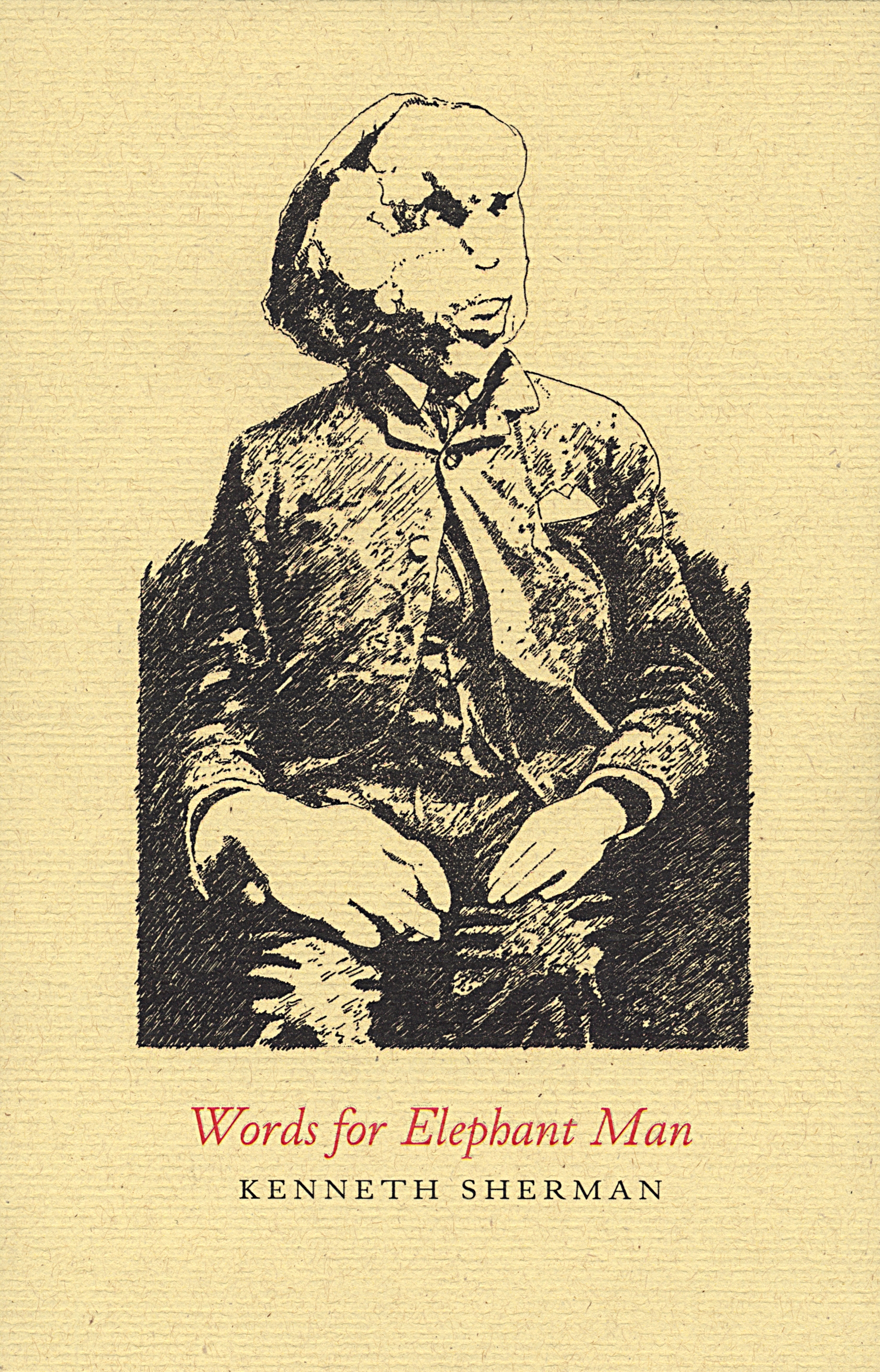
Words for Elephant Man - Kenneth Sherman (The Porcupine's Quill)

Today's book of poetry:
Words for Elephant Man.  Kenneth Sherman.  The. Porcupine's Quill.  Erin, Ontario.  2012.  (Second Edition)

Words for Elephant Man was originally published by Mosaic Press, Oakville, Ontario, 1983.


Today is a special day for Today's book of poetry, so, a special book.  This is the 300th blog/review for Today's book of poetry.

I was lucky enough to see some of Kenneth Sherman's poetry before Words for Elephant Man was published in 1983.  I was already a big fan.  Words for Elephant Man was a game changer.  It is great to see this lovingly rendered second edition.  George Raab did some seriously fine etching to illustrate Words for Elephant Man but they never get in the way.  Raab's etchings work like the rhythm section of a good band, they hold it all together, make it all sound better.

I've always thought that Words for Elephant Man belonged on that same short list as The Collected Works of Billy the Kid by Michael Ondaatje, Sid Stephens' Beothuck Poems and anything that went through Milton Acorn's hands - as sacred material in the Canadian canon.

Sherman's take on Joseph Merrick's voice is so human, humane and tender it is sometimes hard to bare his kindness  -  knowing what he knows.

The Only Electric Lady

As a young man, Tom Norman paid a penny
to see the 'Only Electric Lady':
                                                sparks
flew like inchworms of light
                                             from her body.
When he touched her hand
                                            the shock of it
bolted him back.

Later, he discovered she was connected
(as was the metal plate under the damp
carpet on which the customer stood)

to an electric coil,
                              It was,
Tom said,
               like seeing the soiled underpants of God.

For his first show, 'Savage Zulus', he
hired unemployed seamen
It was not the show,
                               he used to say,
it was the tale you told,

though with me he never had to say a word.

I was beyond metaphor,
                                      my stench
cutting through the intricacies of fiction.

That is why when Treves came to see me
they had to fetch Tom in a pub,

                                                  he
was drinking,

                       he was dreaming

the Only Electric Lady.

...

These poems bare witness to a stunningly sad tale, moderated only by Merrick's gratitude and gentle wisdom in the face of such eternal horror.  There is no anger in Sherman's Merrick, and the melancholy is usually on delicate restraint.

These poems give splendid voice to a misunderstood and misshapen man sadly afflicted with burdens beyond our imagining - and for many more a myth than a man.

None of us are capable of imagining the true horrors Merrick endured.  But these poems give Merrick a voice of reason, Merrick has a great lesson of humility to teach us all.  These poems are deeply moving and the well researched Sherman makes them vibrate with the resonance of truth.

Nurses

The first one who saw me
dropped her tray and fled.
After that, I am sure it became a challenge -
compassion's final chalice.

                                           The faces
of the younger ones are nondescript
like puffed-up pillows. They mostly
hold their breath
and turn the other way.

                                         The older ones,
gaunt-faced, owl-eyed
from having seen
all there is to see
(so they thought)
                            turn
when I catch them staring.

                                           Lately
I have been wondering
what stories they tell
when they return to their homes

whether they have become famous
on their respective streets
for having touched my sacred flesh.

...

I chose Words for Elephant Man by Kenneth Sherman as our 300th post for Today's book of poetry because this elegant edition by Porcupine's Quill is lovely and absolutely necessary for today's generation of readers.  Sherman/Merrick's beautiful reason is the sort of kindness we should all embrace.

Nowhere

It is evening.
The eyes of animals peer out
from the forest,
shiny and wet.

Too exotic for even their world
I sit on a black rock
which took wind and earth
aeons to create.

I am closer to the moss, to the
fungus
            or perhaps to that flower
blown colourless
by today's storm

its stem bent,
it seems to be held up
by its crutches of thick leaves.

On the road back to the cottage
my moonlit shadow
                               limps ahead.

I will never catch
up with it,

it looks
like the figure
of another man.

...

I loved this stunning book when it was first published more than thirty years ago - it hasn't aged a day.  This is poetry that will fill your socks and then some.  Kenneth Sherman's Words for Elephant Man is a classic at Today's book of poetry.

Kenneth Sherman

ABOUT THE AUTHOR
Kenneth Sherman was born in Toronto in 1950. He has a BA from York University, where he studied with Eli Mandel and Irving Layton, and an MA in English Literature from the University of Toronto. While a student at York, Sherman co-founded and edited the literary journal Waves. From 1974--1975 he travelled extensively through Asia. He is a full-time faculty member at Sheridan College where he teaches Communications; he also teaches a course in creative writing at the University of Toronto.

In 1982, Sherman was writer-in-residence at Trent University. In 1986 he was invited by the Chinese government to lecture on contemporary Canadian literature at universities and government institutions in Beijing. In 1988, he received a Canada Council grant to travel through Poland and Russia. This experience inspired several of the essays in his book Void and Voice(1998). Sherman, author of the acclaimed Words for Elephant Man, and The Well: New and Selected Poems, lives in Toronto with his wife, Marie, an artist.

BLURBS
‘While the story of the Elephant Man may be familiar to many, Sherman’s poems take readers to the heart of understanding the intelligent, tender-hearted man who lived within his “bales of skin.’ Containing etchings by George Raab, Words for Elephant Man moves beyond the reach of poetry readers, making it an essential book for anyone interested in Merrick’s life and times.’
—Jennifer Fandel, ForeWord Reviews

‘Better than either the movie or the play, Words for Elephant Man delves under the pitted skin of John Merrick before emerging with a masterfully articulate portrait.’
—Poetry Toronto

‘Sherman’s subject has produced from him poetry as bare and original as Beckett’s best. Merrick is, by deft and and incisive association, a crucified Christ, a creator full of irony and power, victim and victimizer, ‘the age’s Doppelganger/its underside/its Hyde.’
—Canadian Forum


300


Poems cited here are assumed to be under copyright by the poet and/or publisher.  They are shown here for publicity and review purposes.  For any other kind of re-use of these poems, please contact the listed publishers for permission.

Wednesday, October 8, 2014

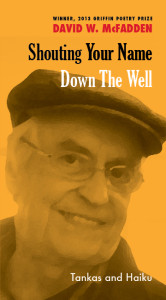
Shouting Your Name Down The Well - David W. McFadden (A Stuart Ross Book/Mansfield Press)

Today's book of poetry:
Shouting Your Name Down The Well - Tankas and Haiku.  David W. McFadden.  A Stuart Ross Book.  Mansfield Press.  Toronto.  2014.


David W. McFadden's last book of poetry, What's the Score?, won the Griffin Prize for Poetry.

Shouting Your Name Down The Well is a completely delightful encore.  This time out he is exploring the Japanese forms of tanka and haiku.  McFadden would seem to be a bottomless well of excellent poetry.

I've met the man a few times and am always surprised.  I keep expecting to see a giant lumber gracefully into the room rubbing his knowledgeable noggin on the ceiling.  Instead, this gentle, humble man, carefully disguised genius.

Today's book of poetry is going to let other Canadian poets tell you what they think:

"David McFadden is such an essential writer for us. His wonderful poems before and after Gypsy Guitar, his great Trip Around the Lakes series, feel to me the central unofficial voice of our time. He has always kept us close to the earth with his humour and his wandering off the beaten path of literature."
MICHAEL ONDAATJE

...

          I was on one of
Those happy drugs for three months
          And liked it okay.
But soon I got nostalgic
For a little misery.

...

"David McFadden's poems come across as passages in a long, thoughtful, roaming conversation about matters no less deeply serious for sometimes being utterly frivolous. As the title of one of his books, There'll Be Another, suggests, it all seems easy--this stroll from one poem to the next, this leap between stanzas--but that's part of McFadden's art. There won't be another like him.  Let's treasure the one we've got; the conversation of his poems includes us."
STEPHANIE BOLSTER    

...
          Tanka is to me
As bicycles to Curnoe.
          His friends kept thinking
This was the end of the line
But it was merely the start.

...

"Dave McFadden's attention to writing has always been top-notch, right from when he published Mountain magazine in the early '60s through many years of a wide range of poetry, prose, teaching, editing, and just being open to the beauty of language. In my generation he's a master."
FRED WAH

...

          Give me those who aren't
Afraid to say "I don't know."
          You can have the rest.

...

"His words would rip a hole in the night."        
LILLIAN NECAKOV

...

          When you're ninety, say
Grandma, people you haven't
          Seen in fifty years
Appear so real in your dreams
You can reach out and touch them.

...

"David McFadden has won every book prize ever lodged in a secret corner of everyone's heart, his acceptance speech echoing in our heads."
GEORGE BOWERING

...

          Turns out the love in
Love songs is true. Everything
          Will last forever.
The wind blows a gust of rain
All over my desk and me.

...

"Part rascal, part rogue, David McFadden is one of Canada's chief mischief makers. He condenses essential wisdom and offers it generously. I'm made more human by reading his work."
SANDRA RIDLEY

...

          When I was a kid
I could walk so quietly
          Through the woods that once
Without any warning I
Saw a dozen dozing deer.

...

"The world is full of wonder, but this can be easily forgotten. The poetry of David W. McFadden is a manual for restoring that sense of wonder. I'm quite certain reading it has improved my life tremendously."
PAUL VERMEERSCH

...

          I'm eight years old and
I've read Peter Pan eight times.
          Now for my ice cream.

...

"David McFadden is one of the purest and most radiant poetic souls of our time."
STEVE VENRIGHT

...

          The poems we write
After the Holocaust must
          Be the type Hitler
Would have despised, that would have
Had us put in cattle cars.

...

"I feel like writing the most wild / and humble poems in the world / but David had already written them."
SUSAN MUSGRAVE

...

          I'm a subjective
Man. I never ask questions.
          I just work it out.

...

Today's book of poetry could go on forever with both David McFadden poems and the gushing voices of so many other Canadian poets,  But you get the idea.  McFadden is a poet that other poets love.

Stuart Ross continues to champion some of our best poetry with his imprint for Mansfield Press.


David W. McFadden

ABOUT THE AUTHOR
David W. McFadden has been publishing poetry since the early 1960s. He is the author of about thirty books of poetry, fiction, and travel writing. Why Are You So Sad? Selected Poems of David W. McFadden (Insomniac Press) was shortlisted for the 2008 Griffin Prize for Poetry, and Be Calm, Honey (Mansfield Press) was short-listed for the 2009 Governor General's Award for Poetry (his third such nomination). In 2013, What's the Score? (Mansfield Press) won the Griffin Prize for Poetry. David lives in Toronto.

BLURB
"David McFadden's poetry is probably the poetry most often read aloud at my house...His broad talent, a unique voice and real vision."
     Elizabeth Bachinsky

The Griffin Poetry Prize - 2013
David W. McFadden
reading "It's Not Funny Anymore"
from What's the Score?


255