Tuesday, November 18, 2014

Blind Items - Dina Del Bucchia (Insomniac Press)

Today's book of poetry:
Blind Items.  Dina Del Bucchia.  Insomniac Press.  London, Ontario.  2014


These wildly funny poems will alter the way you look at celebrity for ever.  Dina Del Bucchia is a carnival freak amalgam of Anias Nin, Erica Jong and Dorothy Parker.

These poems are witty, highly sexualized and just a little bit bitchy.  I could listen to Bucchia talk all day long.

Lindsay Lohan

I am fucking Lindsay Lohan in the back of a pickup
truck, on an old sleeping bag printed with bass jumping
out of the water, hooks in their mouths. She is so
Hollywood she doesn’t even understand how real this
is, wants me to use my wrong hand, keeps telling me to
move my arm into the light, wants the shot to be perfect
on the first take. But it’s 2 a.m. behind the Walmart,
and I don’t know where my bra is. All we’ve managed
to do today is make out, shed our clothes, and split a
microwave burrito. She keeps giving me advice on how
to best show off her crotch in the scene, that a movie
crotch shot is so very different from a paparazzi up-skirt.
Both are choreographed but have different techniques.
She moves like a new kitten, brushes against my breasts.
I can’t ignore her. She whispers in my ear that cocaine
is almost always free, that mustard brings out her
freckles, that touching another person is like stepping
on a scale, that if you smell cinnamon, there is probably
a baby being born. I’m taken in. Between the folds of a
sleeping bag older than she is, she’s chosen me. When I
go to put my mouth around her nipple, she stops me;
my shoulder will be in the way of the shot. We glow in
the heavy lights of the parking lot

...

Imagination is a wonderful thing.  From now on I'm going to imagine that the wickedly hilarious and darkly comic Del Bucchia is my buddy.  Why?  This woman got game.

I passed this book around the office and everyone laughed, snickered, bickered, and now they are taking turns reading them, the poems, out loud.

Jack Nicholson

Jack Nicholson isolates stakes, produces, is adept
at turning words into phrases that turn women
into moulds of other women.

I don't want to become anyone else. Well, maybe
Anjelica Houston, just for a few months in the '70s.
To wear my hair like a shield

against regret, the quiet torture of never being
on top. To hear his secrets before he became
a voice to imitate. A woman's sadness makes him run.

When we meet, we kiss, share a few hours of afternoon
sun on our skin. I keep my hair up, keep him up
with small licks and slaps,

crease my body into his, so I feel
small, supermodel tiny. Afterwards, I weep, spray tears,
use his Lakers jacket as a tissue. A good fake cry.

Flustered and pink with stress, he flees.
If I kept a scorecard,
I'd check a box beside"Legend".

...

Dina Del Bucchia makes her dreams read like photo-op poems, sparkling, witty and immediate.

But let us not forget that these are all smart "hypermodern" confessional poems of the first flight.

Reading these poems there is so much amusement in play you don't realize how heavy fame can be. How dark those corners of the mind can get.  Good thing we have Bucchia for illumination.

Kate Moss

Kate Moss wants me to understand her. Some call her
reptilian. The description misses the point of her sharp-
ness, edge of nose, creases that spank her eyes. She isn't
glossy, likes to be rubbed raw. Together, lounging in the
sway of the sea, perched on sailboat corners, we are
lizards, we are flamingos, we are Bengals. Our hands
touch and slip away, mouths form silent words only
when they meet. We read lips through lips. We lay each
other to waste in our sunlight flashbulb lust. Makeup
smeared against our navels, thighs, under sides of arms, our
bodies mutated in colour. Breasts greet and swing away.
Below our bodies, the wooden deck is streaked with
pinks, blues, greens, pools of colour made of cosmetics
and ocean spray. I want to shrink to the size of the bright
mole near her nipple. She wants me to pull love out of
her, for us to wear each other, skin for skin.

...

Everyone in our office is now in love with Dina Del Bucchia.  Literary lust at least.

These poems are just like Rice Krispies, they snap, crackle and pop.


Dina Del Bucchia
(photo:  Ruth Skinner)

ABOUT THE AUTHOR
Dina Del Bucchia writes, and does many other things, in Vancouver. Her short story “Under the ‘I’” was a finalist for the 2012 RBC Bronwen Wallace Award for Emerging Writers. She holds an MFA in Creative Writing from the University of British Columbia. Her previous poetry collection is Coping with Emotions and Otters (Talonbooks, 2013). 

BLURBS
"In Blind Items, Dina Del Bucchia reverse-engineers the public persona of celebrities to reveal the mouth like ‘hospital Jell-O, perfect in a place full of despair.’ [...] These poems will pick you up on Page Six and leave you gasping at the side of the highway, filthy, sweaty, and breathless."
     — Nikki Reimer, author of DOWNVERSE and [sic]
     
"Del Bucchia deftly dodges revealing her sources and leaves the reader in the morning groping after whatever it is that poems should do in the wake of such humorous, intimate, and intelligent company. Blind Items is a must-read for understanding the impact of celebrity culture on how we relate to each of our others (or otters)."
     — Jason Christie, author of Unknown Actor and i-ROBOT


267

Wednesday, November 12, 2014

Otherwise, My Life Is Ordinary - Bobby Byrd (Cinco Puntos Press)

Today's book of poetry:
Otherwise, My Life Is Ordinary.  Bobby Byrd.  Cinco Puntos Press.  El Paso, Texas.  2014.


Bobby Byrd's Otherwise, My Life Is Ordinary is a big book and it is packed.  Byrd starts us off with a very amusing and informative personal essay outlining his life and practice of poetics.

It sounds a lot like he is a mischief making Buddhist with a taste for wine, a good pot of beans and always a good story to tell.

Back Roads To Far Towns

I wish old Basho would come to my house.
Especially when it's winter, a paltry desert winter,
Warm enough this evening to sit outside in the city night
Huddled up in a warm jacket and a good hat
The trees bare-boned,
Old men, Basho and me--
We will drink some red wine
A bottle of the $7.49 merlot from the 7/11
The one with the yellow kangaroo
And we'll swap stories.
Like that one about the frog jumping into the pond.
Splash!
What's the story behind that, huh?
Or maybe he'll want to know,
What's it like to be pissing in the backyard with my two sons
The full moon like a Chinese coin.
Ha!
We'll sit there on our sorry asses
Open-mouthed
At the beauty of a dying cockroach
We'll write a few poems
Three-liner thingamabobs
Old-man fingers
Useless 3x5 index cards
I'll lose somewhere
Why not?
The gate swings open and shut
Open and shut
The cockroach is the gatekeeper
Basho and me
We will empty that bottle of wine

     "Enough," he says, "is always exactly enough."

"That's a good one," I say, and we giggle
And the big bright moon
Dodges back and forth behind the clouds.

...

Otherwise, My Life Is Ordinary is anything but ordinary.  It is not ordinary to write this close to the surface of the earth, to be this grounded.  These poems lack all guile or artifice, instead they overflow with a vitality to be envied.

A Sonnet For Love

Flossie put her plums in the icebox.
Bill ate a plum and wrote a famous poem.
I tried the same trick on my wife.
Turns out she doesn't like cold fruit.
That's what she said.
She turned over and went to sleep.
That was afterwards.
I got up twice in the night to pee.
At 5am she let the cat in and fed him.
When she climbed back into bed she farted.
We giggled and went back to sleep.
After a while she let the cat back out and made coffee.
Sometimes I do all that stuff but it's so nice when she does it.
This poem, like all of my poems, is for sale.

...

In Byrd's "ordinary life" there are short sledgehammer poems and long rambling John Steinbeck Tortilla Flats monologues.  Byrd is political, practical and never, ever precious.

Not sure I've ever read a book of poems where I felt a clearer portrait of the poet emerge.  This is a poet I want to share wine and stories with.  These poems reflect a rich life well lived, full of music and family.  Byrd states his priorities so clearly I think I could pick him out of a crowd.

These are fine poems on a very human scale.

Imperialism In The 21st Century: The Bush Years

George Bush flew to Pakistan.
They hated George Bush in Pakistan.
With good reason.
George carries his bible like an AK-47.
The Muslims carry the Koran the same way.
It was them against us, us against them.
But Mohammed
He paid George no never-mind.
The prophet fed the president bitter pomegranates.
The president refused.
He didn't want his lips purple with the juices.
Lee changed the channel.
Kathryn Hepburn was pulling leeches off poor Humphrey Bogart.
The African Queen was lost in the swamps and the reeds.
Life always happens like this. There is no story without trouble.
Kathryn Hepburn was undaunted.
Humphrey Bogart was in love.
The Germans, like the American Empire, didn't stand a chance.

...

Today's book of poetry loved the weight of these poems because they hold the right amount of humour, the sufficient stroke of gravitas -- but Byrd never takes anything too seriously, it is all serious mirth.

Growing Up In Memphis, #3

In 1952 Dewey Phillips invented Elvis.
It happened on the radio.
Rock n' Roll saved my life.
In 1960 the bad guys sold Elvis into slavery.
Don't let anybody tell you different.

...

Bobby Byrd

ABOUT THE AUTHOR
Bobby Byrd—poet, essayist and publisher—grew up in Memphis, Tennessee during the golden age of that city’s music. In 1963 he went to Tucson where he attended the University of Arizona. Since then he has lived in the American Southwest. In 1978 he and his wife—novelist Lee Merrill Byrd—moved to El Paso, Texas with their three children. The city and the border region has become their home.

Bobby Byrd, the recipient of a poetry fellowship from the NEA, a D.H. Lawrence fellowship, and an international fellowship to study in Mexico, is one of the most accessible poets writing today. His work is compassionate, tender & joyful. He is the author of numerous books of poetry including Pomegranates, Get Some Fuses for the House, On the Transmigration of Souls in El Paso, The Price of Doing Business in Mexico, White Panties, Dead Friends & Other Bits & Pieces of Love and his most recent, Otherwise My Life is Ordinary.

BLURBS
"Byrd writes poems like a novelist.  Epic ones.  His lines are full of fiction, bullshit and beauty."
      Eileen Myles - poet, performer, novelist and essayist

"Bobby Byrd has wrought a singular music over the years made of memory, love, place and a kind of bluesy Zen.  I love this book.  It's a hymnal to life."
     Luis Alberto Urrea - author of The Hummingbird's Daughter"

"Bobby Byrd's poems have that rare ability to make profound the ordinary rituals and events of everyday life.  His hand-carved stories twist our hearts and make us remember ourselves."
     Tom Russell - singer/songwriter

Bobby Byrd, poet, publisher.


266

Monday, November 10, 2014

The Seasons - Bruce Meyer (The Porcupine's Quill)

Today's book of poetry:
The Seasons.  Bruce Meyer.  The Porcupine's Quill.  Erin, Ontario.  2014.


Respect.

Deep, deep respect.

The Seasons is a one hundred sonnet love song.  Really, really not my cup of tea.

So why did I LOVE it?

I'd ask my new intern, but since she read it she has been softly weeping in the corner, sipping tea, and glaring at me.  I know what she is thinking.  She is thinking that if I don't rave about this book she will have to kill me.  She looks very serious about it.
.
She needn't worry,  No problem.  I would've raved without her menacing, unspoken threats.

I loved this book because it reminded me how powerful love is, how precious.  Meyer's gentle voice hits exactly the right note, again and again.  Honest and clear.

Assurance

Just as I am woken by a passing plough
in the middle of the night, I open my eyes

in time to catch its flashing blue light
reflected on the bedroom wall, the engine

grunting, the scoop grating the street bed,
and my dreams are paved like the road

in destinations where I want to see the way ahead,
cleared for us, but that is not the world's way.

If I am lucky enough, the snows will clog
your route to work and we shall spend

the day together, housebound, your voice
filling the silence as if summer returned,

and to assure myself you are still near,
I shuffle my toe to touch your leg until you sigh.

...

Bruce Meyer is an accomplished and well published old pro.  These beautiful sonnets seem effortless but the discipline to sustain such a high, sweet note is remarkable.

Tenderness is too overlooked in our society and often mocked in poetry.  Bruce Meyer's The Seasons is a living, loving testament to tenderness.  One long whisper into a lover's ear.

Flannel

Flannel leaves more to the imagination
than silks or satins against smooth skin.

It tells me that just as in all great art
the mind must be engaged in discovery,

that the curves of your body are uncharted
and my hands will trace my thoughts--

that when I close my eyes I see a goddess
hidden beneath your warm-skinned smile.

It is cold outside. The wind is howling.
It claws at the house and whines to come in.

It merely wants to be warm at last--
to slip its hand inside your button front

and dream of paradise and tropical light
as a navigator kisses land on his arrival.

...

It took me a while to read The Seasons because every time I teared up my glasses steamed.

Damn Bruce Meyer.

Tree

We are one soul built from a solemn vow,
a tree whose branches reach beyond us,

a place that maps cannot contain, existing
in both shadows and sunlight, the music

of wind that makes our lives speak the love
of life together growing brighter as we grow.

To be one is to offer shade to others on days
when sun bakes the earth and air lingers

waiting for a passing breath to give it voice.
To be one is to fill the air with life magnified

as a beacon standing tall across a harvest field
where the farmer has drawn out the soil's life

so others might be fed: and we shelter love
the way a tree guards a nest until hatchlings fly.

...

Where I expected formality these poems sounded warmly sage, Meyer never wavers.  These one hundred sonnets of love, in the tradition of Pablo Neruda's Cien sonetos de amor, sing of boundless love.

What a pleasure.

Bruce Meyer

ABOUT THE AUTHOR
Bruce Meyer is author of numerous books of poetry, short fiction, non-fiction, pedagogy, and literary journalism. His broadcasts on The Great Books became the CBC’s bestselling spoken-word audio series, and evolved into the national bestseller, The Golden Thread: A Reader’s Journey Through the Great Books. He is professor of English at Georgian College, and teaches for Laurentian University, Victoria College in the University of Toronto, and St. Michael’s College Continuing Education Program. He is the inaugural Poet Laureate of the City of Barrie, and lives in Barrie, Ontario with his wife and daughter.

BLURB
"Bruce Meyer's latest collection, The Seasons, is an unabashed paean to human love and the invisible cords that bind a man and woman together. In a brave and passionate hundred sonnet sequence the poet's moving tribute to his wife navigates the vagaries of intimacy through the passage of the seasons. A work reminiscent of Neruda's hundred love poems, Meyers's words shine with sincerity and originality."
     James Clarke, author of The Kid from Simcoe Street

Bruce Meyer - Best Lecture  2010
Bruce Meyer discusses his poetry.


265

Wednesday, November 5, 2014

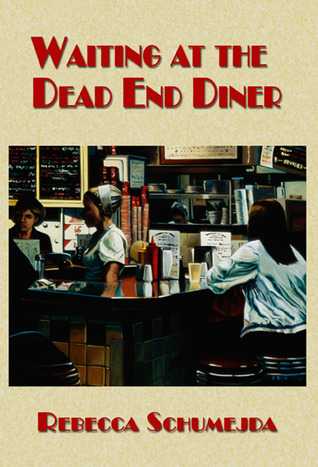
Waiting at the Dead End Diner - Rebecca Schumejda (Bottom Dog Press)

Today's book of poetry:
Waiting at the Dead End Diner.  Rebecca Schumejda.  Working Lives Series.  Bottom Dog Press.  Huron, Ohio.  2014.


I really don't know how to break this to Rebecca Schumejda, someone I do not know, but I am about to put the kiss of death on this book.  I like these poems more than oxygen.

These poems hit my heart and head at the same time, with a sledgehammer.

Rebecca Schumejda's Waiting at the Dead End Diner works for me as though John Steinbeck had set Grapes of Wrath in a diner and had Charles Bukowski help him write it.  Of course, for this scenario, they'd both have to be women.

No One Cares

No one cares what you think,  Rick screams
after I tell him that the coleslaw is spoiled.

He doesn't care it is tinted yellow and stinks;
he still scoops heaping piles onto plates.

Rick's been a fixture here for over a decade,
as permanent as grease accumulating

on kitchen walls.  Finally after two years,
he calls me by my real name instead of

Hey legs or Yo, college girl.  When I refuse to take
out the plate, he calls to Jolene, who he says

is Used to serving rotten merchandise, but
even she refuses--No way, Rick, you're gonna

kill someone.  Rick shrugs and says something
about population control before screaming

86 the coleslaw, thanks to these two twats
from the health department, and even though

he yells this, no one seems to have heard.

...


Every single one of you has been to a diner, some of us more than once.  My mother worked in places like this when I was a young boy.  I did dishes in a similar kitchen.  This all rings so true it could be a series on HBO - and I'd watch it.

Schumejda is not someone who pulls any punches and as a result Waiting at the Dead End Diner rollicks over the pages.  These poems sing and you can hear the grill sizzling and the grease popping, but more importantly you see that this canvas is the world writ large, reduced to human scale.  An opera with cooks, waitresses, customers and the ching of the cash register keeping time.

Degrees of Intelligence

Rochelle's Master's degree
in Art History landed her a
part-time job as a tour guide
at the state museum over
an hour and a half from
her house, $50,000 in debt,
and here at our counter
where she is trying to
figure out why the coffeemaker
won't stop even though
the pot underneath is full.

She panics, tries to
turn if off, looks around
for help.  Maggie swoops
in, pushes Rochelle aside,
grabs the half-empty pot
on the top burner,
pulls the full one out
and switches them.
Rochelle lets out a long
sight of relief, leans back
against the counter,
knocking over Eddie's
glass of water.

...

So the setting is a diner but of course it is a microcosm to illuminate the macrocosm, and can I get fries with that.

These poems are honest, pared down, clean.

Rebecca Schumejda sings a tune we will all recognize, these poems touch a familiar.

All in the Same Day

The day I can finally afford
a one-way plane ticket to Alaska,
Jolene tells me how she had
a threesome with her boyfriend Charlie
and the only waitress George
ever threatened to fire.
You know you can always join us,
she offers with a wink.

The same day, when a young boy
with Down's Syndrome comes in,
Maggie goes to the back and starts
crying.  She begs me to take
her tables.  She needs to leave
right now, but she'll be back.

After seeing Maggie break down,
Tommy tells me that he will
pay the bill for the boy's table.
Just tell them it's on the house,
he says.  When the little boy
orders pancakes, Sammy makes
a happy face with chocolate chips,
gives it a cherry nose,
and whip cream hair.

The same day, George's wife
wins fifty dollars on a scratch-off
lottery ticket; Kitty orders
the meatloaf special instead of
her usual, and Asif stops in to
tell me he just had to see me.

Toward the end of
her shift, Jolene passes
by me and says, I spilled
hot chocolate on my shoulder,
and tomato soup on my boob.
I can't wait to see what
gets splattered on my cooter.

...

Boy, I just flat out enjoyed these poems.  I loved the clarity and humour that seem to be Schumejda's natural fit.  These poems were touching and energetic, there aren't any forced moments but there is certainly tension.  Within the walls of this diner there are morality tales being played out on the small stage that speak to the humanity within us all.

Leave a big tip.

Rebecca Schumejda

ABOUT THE AUTHOR
"When I was in seventh grade, my English teacher asked the class to write poems and I eagerly complied. A few days later, my parents were called into a meeting at the school where my teacher, the principal, the vice-principal, and the social worker discussed how my assignment was unacceptable and how they were worried about my mental state. After reading the poem, my father sat there for what seemed like forever before he looked right at me and said, 'This is a great poem, Rebecca!' Then he looked at the teacher and said, 'Don't ask your students to write poetry if you don't want to hear their truths.' My father, a hard working roofer, has always been my inspiration."-Rebecca Schumejda

Rebecca Schumejda is the author of Cadillac Men (NYQ Books, 2012), Falling Forward, a full-length collections of poems (sunnyoutside, 2009); The Map of Our Garden (verve bath, 2009); Dream Big Work Harder (sunnyoutside press 2006); The Tear Duct of the Storm (Green Bean Press, 2001); and the poem "Logic" on a postcard (sunnyoutside). She received her MA in Poetics and Creative Writing from San Francisco State University and her BA in English and Creative Writing from SUNY New Paltz.

BLURB
"With a spot-on ear for dialogue and a solid feel for gestural nuance, Rebecca Schumejda sweeps us swiftly into the late-night chatter and dish clanking of the Dead End Diner.  In this collection, we meet a memorable cast of prickly though resilient characters who simultaneously shrink and expand under the high-pressure cooker of life.  Cinematic in its conception, I can't help but think of Robert Altman's Short Cuts, or some of Raymond Carver's best for that matter.  Waiting at the Dead End Diner is a deft exploration of the complicated forces embodied in gender, unreciprocated love, ethnic and religious stereotype and economic class, where participants dream big and live hard in the face of unflinching obstacles.  If I could purchase one meal at any hour, it would undoubtedly be Rebecca Schumejda's latest."
     Manuel Paul Lopez, author of The Yearning Feed

Rebecca Schumejda reads at the Howland Centre, N.Y.
Calling All Poets (CAP)
4.4.14


264

Monday, November 3, 2014

All Movies Love the Moon - Prose Poems on Silent Film - Gregory Robinson (Rose Metal Press)

Today's book of poetry:
All Movies Love the Moon - Prose Poems on Silent Film.  Gregory Robinson.  Rose Metal Press.  Brookline, MA.  2014.


Reading All Movies Love the Moon is a bombastic pleasure.  Gregory Robinson is here to translate the light between the projector and the screen.  No small trick.

Silent movies provide a launching board for his beautiful madness but I suspect Robinson could add glee to any subject he wanted to play with.

There are forgotten stills from movies, the text cards from silent films, all sorts of amusing distractions and associations to play havoc.  It works so well.

These loosely connected prose poems are about film and they're not.  What they definitely are - is riotously entertaining, engaging and even sometimes illuminating.

The Birth of a Nation (1915)

This is for you. The ushers in Civil War garb, for you. The rows of red velvet cushions,
crafted for girdled backs and porcelain bottoms, for you. The Birth--a new history formed
because you did not like the first one--for you.

A plea. We do not fear censorship, and we demand, as a right, the liberty to show the dark
side of wrong, so we might illuminate the bright side of virtue.

We demand it with our hands.

In the quarters of the Majestic, the best boy first saw light under his sheets and found it
was his own:  thin beams streaming from his palms like light shooting through a pinhole.
All over the studio lot, workers woke to the same stigmata, the gaffers, the cutters, the key
scenics, and the set designers, waking, wondering, keeping their arms outstretched as if
they held fire and wiggling their glowing fingertips as though ready to ascend.

The beams grew stronger by salary and status.  The cinematographer:  a policeman's
flashlight.  The director of photography:  the light on a freighter's mast.

Just off the lot, still under the storm of luminance, D.W. left a dream to find his palms gone
supernova.  He reached for his wife in the adjacent bed and cut her in half, along with the
wall behind her and the foundation of a neighboring house.

This is the product of those hands, all for you.  This palace built for no other purpose, this birth,
a world rewritten with lightning, the bright side of virtue slashing the old world to streamers.

...

Robinson is one of those freaky jugglers who can get comedy, drama, the history of cinema and the history of the world, all into the air at once.  Although it is also abundantly clear he might be a bit of a liar as well.  A magnificent and eloquent liar.  Often times the truth is far less interesting and Robinson seems to take comfort in that.

Today's book of poetry did a straw-poll in the office this morning.  Hands down, this is the book that has made us laugh most in recent memory.

The Mystery of the Leaping Fish (1916)

The mystery is what they see wide-eyed in the post-dart instant when their world is
overshot, when the prospect of a nymph is replaced by searing yellow light and a clamping
of lungs.

In those blurred snapshots, almost unrecognizable:  Fairbanks in a fish floatie, pretending
he's Sherlock Holmes.  Splash!  Browning undressing a flapper with his eyes.  Plunk!  Griffith
sunning himself.  Pop!  In some ridiculous outfit, absurd even to a fish.  Swish!  Then the cold,
the blue, the slick slide of water and scale.

The mystery is if we would realize if we did the same;  broke through, experienced some
other world in shards.  The mystery is where the fish go that we cannot.

...

I have loved movies since I was a kid.  Really loved them.  Worked as an usher in both of my home town movie theaters.  Worked as a projectionist when I was first in university studying English and Cultural Studies.  When I finally went back to university a few years ago I did a degree in English and Film.  I love movies.

Anyone who has ever loved a movie will love this book.

The real kicker is that an argument could be made that most of the poems have nothing to do with film but instead use celluloid to launch the fevered reason of Gregory Robinson.  Either way, win/win.

Secrets of a Soul (1926)

Nine out of 10 men do not want to get jacked up on coke then sleep with their moms.  One
out of 10 does, and that is why there are movies.

Psychoanalysis has nothing to do with coke or mom-banging.  Sorry,  It might be more fun if
it did.  Forgotten to most is the all-out wonder of a boy who sees a path and believes it never-
before discovered.  Imagine Sigmund saying Come with me, I have unlocked the secret of dreams.

What you want you cannot have and that makes you want it more.  And what you want is not
what you think.  Dreams, Sigmund said, are not stories at all, even the ones where you talk to chipmunks who tell you to kill.  Not stories at all, but hieroglyphs, some ancient self communicating to you in modernist verse.  You do not have to understand it.  You just have to say it.  Again and
again you say it because that is what your wants want, for you to acknowledge that you are
one giant factory of the absurd.

The secret of your soul is that you are a mess trying to pull it all together, boxing multitudes
into a single home.  Sigmund dreamed himself an explorer of this Borgesian structure,
where he could follow winding halls and spiral steps leading nowhere, and claim the last
undiscovered territory as his own.
...

"for you to acknowledge that you are one giant factory of the absurd"

Ya, we here at Today's book of poetry couldn't get enough of Gregory Robinson or his excellent All Movies Love the Moon.


Gregory Robinson

ABOUT THE AUTHOR
Gregory Robinson lives in Boulder City, Nevada with his wife Joan and his dog BinBin. He is currently Chair of the Humanities Department at Nevada State College. When he is not writing, he is hiking around the desert, doing iaido, or (of course) watching movies. Visit his website here.

BLURBS
“What an intriguing amalgam of genres Gregory Robinson has created in his All Movies Love the Moon. Part silent film history, part poetic romp, this fine collection recalls the work of the great Uruguayan poet/historian Eduardo Galeano, author of Memory of Fire. Rich rewards await as you step into the dark rooms of these poems that flicker by ever so beautifully at 16 frames per second.”
—David Shumate, author of Kimonos in the Closet

“All Movies Love the Moon, with its salute to Georges Méliès, is somewhat like the visionary himself: mischievous, innovative, enigmatic, witty, and captivating. Robinson’s book is a beautiful hybridization of film history and poetic journey. Roaming through the celluloid cemetery of silent films, Robinson becomes a Dr. Frankenstein as he reconstitutes pre-existing material into new forms: he is both alchemist and ‘cinematic recycler.’ This book has the noteworthy skill of persuading the reader to revisit it immediately, while concurrently enticing the reader to (re)see the films it so lovingly pays tribute to. Pour a glass of wine, settle in, and be transported.”
—Simone Muench, author of Wolf Centos

“In the eighteenth century Laurence Sterne broke all the rules of novel-writing that hadn’t yet been written with Tristram Shandy. In 2013 Gregory Robinson’s All Movies Love the Moon travels back in time to the dawn of cinema, when silent movies were as surreal, playful, dislocating, and dumbfounding as the twentieth century itself. In deadpan prose poems Robinson tracks the gradual emergence of narrative out of the dream logic of pure images, and the more sudden birth of pop culture as we know it, until we see Theda Bara and Sylvester Stallone silently side by side at last. The poetry in film, the film in poetry: the book is a delirious romp through the grammar of their entanglement. Or as Robinson puts it, ‘Any great detective will tell you the trick is not walking into movies but finding the way out again.’”
—Joshua Corey, author of Beautiful Soul: An American Elegy

“Gregory Robinson’s All Movies Love the Moon brings silent film, that drowned and nearly forgotten continent, back to life and into our time. From the hand-colored fantasy of Méliès’ A Trip to the Moon to Hitchcock’s chilling thrillerThe Lodger, each of these prose poems is a movie—one filled with the sheer joy we take in watching as the projector’s light illuminates the darkness.”
—Jesse Lee Kercheval, author of Cinema Muto and My Life as a Silent Movie

“All Movies Love the Moon is as much the autobiography of a cinéaste as a history of silent film and the linguistic windows through which it makes meaning. Interspersed with real and invented intertitles to guide us through his poetic underworld, Gregory Robinson's prose poems conduct a cinematic séance in which an array of personal and celluloid spirits parade before the reader. Inquiry gives way to elegy both historical and personal, and the book's great trick is ‘to bend trust without breaking it, to lead by the hand rather than by the wrist’ as Robinson guides us gradually into the imaginative space between words on a screen. Robinson sees the irony in nostalgia for those days before film was given voice, but if we are not tempted by his ‘Vertov Kino app, which makes the iPhone weigh 40 pounds and replaces the battery with a wooden crank,’ then, reader, we are the cranks.”
—Amaranth Borsuk, author of Handiwork

All Movies Love the Moon - trailer


263