Showing posts with label alan feldman. Show all posts

Thursday, February 9, 2017

On Not Losing My Father's Ashes in the Flood - Richard Harrison (Buckrider Books/Wolsak & Wynn)

Today's book of poetry:
On Not Losing My Father's Ashes in the Flood.  Richard Harrison.  Buckrider Books.  Wolsak & Wynn.  Hamilton, Ontario.  2016.


Micheline Maylor recently referred to Richard Harrison as the best narrative poet in Canada.  Those could be fighting words in some circles because it is a pretty big declaration.  Today's book of poetry certainly thinks that Richard Harrison's On Not Losing My Father's Ashes in the Flood certainly bolsters his case.

Richard Harrison is a masterful story teller and as a result you could be forgiven for assuming these are spontaneous histories, lovingly improvised stories for the fire or late at night in bed, but Harrison's work is anything other than off the cuff.  These gentle and compassionate poems are made of interlocking puzzle pieces so meticulously set into place and rendered that the seams become invisible.  The puzzle becomes a painting and the painting is the poem.

Now is the Winter

With the last ounces of his grace, my father
stands up from his wheelchair, turns toward
the bed as though the floor is ice;
he tilts his spine, knees bent, and waits to shift
his weight to mine; I lay him on the blanket
and kiss his lips. We talk of Shakespeare
who carried him line by line through tropic wars
to the final surgery on his failing hips.
Now is the winter of our discontent,
he recites from those pages of his brain
no disease has yet erased,
the words the prayer of one
who has no god to hear his cries, his powers spent.
When he asks, I promise to be with him when he dies,
and winter stirs in the broken fingers
of my hand that long ago healed winter cold
into mended bone. My father sleeps as the land sleeps --
and I am taught that nothing is immortal
and awake forever. Outside, the heroes, green,
and knowing only what they see,
take their sticks and pucks and
lean into their shots
while the mid-winter's night
dreams water turned to stone beneath their feet.

...


Today's book of poetry first met Richard Harrison in Peterborough back in 1978 or 1979.  Our impression then was that he was a true gentleman with manners beyond his years and we all know how hard they are to find.  Almost as hard to find as a poet who has stayed the course all these years. Richard Harrison had a brilliant mind when I first met him thirty-eight years ago and he has spent the intervening years honing his considerable craft.  Practice and experience.

You see it in every poem in On Not Losing My Father's Ashes in the Flood, practice and experience. Today's book of poetry recently looked at the Alan Feldman's Immortality and feels Harrison can claim some of that same rarefied air.  Bless the cotton socks of the poets who tell stories with experienced wisdom, razor honed craft and hearts as big as locomotives.

Maybe I forgot to mention that Harrison usually leads with his heart.  Most men wouldn't dare and Harrison makes it look easy.

Found Poem

On a line from Margaret Laurence's The Diviners 

At my feet, at a bus stop, a bumblebee and a honeybee
are stinging each other to death. At first I think it's two bees mating,
something I had seen only once: not every bee
has a queen surrounded by a hundred thousand female eunuchs
in the monarchy of a hive; the Bombini, bumblebees,
never gave up motherhood to that degree, and plenty of them pair up
to breed like you and I have done in a selfishness so great
it created more of our own.

Once, in the hot first days of autumn,
out on the soccer pitch, I heard two Bombi fucking in the grass,
buzzing as they did it, and I was afraid for them,
being out on the field where he had come to trample and kick.
So I tried to pick them up as one rich flooding coil
singing the mellifluous bumbling aria of nature and sex.

But they broke away from each other, the one flew off,
while the other let me take it out of bounds and play --
                                                                      and that was it --
                                                                      a coitus interrupted, yes.
but a gene code preserved that would otherwise be lost beneath a pair of cleats.

And isn't it odd that it is not odd to talk of living things this way? These days
                      every object is a kind of page,
                                                                      every life a kind of writing.
I feel comforted, thinking of the unfathomable mystery at the heart of the bee
as piece of paper in a bottle, and on that paper, nothing more than one
                                                                      among an infinite arrangement
                                                                      of words.

The bee is a sentence, a line from a song.

But I know my kind.

Someone arriving after me to wait for the bus
would step on these two insects at war. So I pick them up,
and put them on the lawn away from human feet
so they can settle it in the grass undisturbed.

And I recall the fossil I saw as a child of
two dinosaurs that died together, struggling in the mud,
the carnivore with its arm down the other's throat all the way to its stomach,
the plant eater with its teeth sunk in the predator's shoulder all the way to 
the bone,

a poem composed in flesh,
               preserved in stone
                                       that waited 200 million years for its readers.

...

Our morning read was a little different this morning.  I'm hoping Richard doesn't mind but Today's book of poetry called in some old favours, made a few bribes and called on some old Peterborough friends.  Richard and I used to be loosely connected in a coven of misspent youth and poetry so I called in some old Peterborough Poets.  Of course we already had our Sr. Editor Max, I let him out of his strongbox this morning and made him put on pants and we decided to put on a show for the youngins. 

I met Max in Peterborough almost forty years ago and he was terror.  I was also able to round up Riley Tench and Ian David Arlett and get them into the office this morning -- please don't ask what sort of voodoo was required to accomplish this.

We each took our enthusiastic turns with pleasure, we were all proud of our old friend and the morning wine didn't hurt either.  Happy to do Richard's bidding, we bounced these poems off of the walls.  My old tricks no longer have much affect on the Today's book of poetry staff but when Max, Arlett and Tench were through the effect was jaw-dropped silence.  You'd have thought Marcel Marceau was on stage.  I think GOB STRUCK is the word.

Confessional Poem

Yesterday I wrote a confessional poem,
          but my wife, who always reads me first, said it was just a journal entry.

It's been years since I was that far from a poem and thought I was that close,
                                                                                                     but I trust her.

Today, before class, a student was zipping through a Rubik's Cube,
                        knuckling the box into panels of many colours, then a couplet,
                                                                       then one            then many again.

Within two minutes, without looking, he was done.
         I asked him to do it over so we could all watch, and, having watched,
                       have something with which to begin the writing of the day.

I wrote that the planes of the cube going in and out of order
                       as the student twisted the game were like the drafts of a poem,

sometimes deliberately torquing towards the opposite of the desired end
                       because the poem is a way we give in to a logic that lives within us
                                                                                                    but is not our own.

I was thinking of that poem I couldn't write,
          an apology I wish I'd made years ago,
                                           and carry with me even though two things are true:

          the person I would have apologized to is dead now,
                       and what I want to apologize for is speaking badly of them
                                   thought it was only to my wife and so they never knew.

The poem was like having an argument with someone in a dream,
                        then going up to them in daylight wanting to make amends.

Last time I did that,
          the other person reminded me
                       that I had done nothing.

But I apologized anyway
         because they had done nothing
                       to deserve what I did not do.

...

It's an honour to tell you how much Today's book of poetry enjoyed our old friend's book.  Today's book of poetry still can't tell you whether Micheline Maylor was wrong or right and we see quite a bit of poetry here in the Today's book of poetry offices.   We've admired Richard Harrison's poetry since before most of you were born and On Not Losing My Father's Ashes in the Flood confirms what we already knew, Richard Harrison writes beautiful poetry.

Image result for richard harrison poet photo
Richard Harrison
Photo:  Keeghan Rouleau

ABOUT THE AUTHOR
Richard Harrison’s first comic book was a Marvel Tales collection of Spider-Man’s first battle with the Hulk, Thor vs. Sandu, the Human Torch vs. the Sub-Mariner and a scary cautionary tale told by the Wasp to a kid in the hospital, “Somewhere Waits a Wobbo.” Four fantasies for a quarter: it was a steal. He’s been reading ever since. Richard is a nationally recognized poet (Hero of the Play, Big Breath of a Wish), editor and essayist on topics ranging from philosophy to prayer, literary criticism to mathematics, and poetry to hockey – as well as his work on superheroes. A professor at Calgary’s Mount Royal University, he teaches English, Creative Writing, and courses in comics (with Lee Easton) and the graphic novel.

Richard Harrison
School of Thought - 2016
Video: ciswf


550
DISCLAIMERS

Poems cited here are assumed to be under copyright by the poet and/or publisher.  They are shown here for publicity and review purposes.  For any other kind of re-use of these poems, please contact the listed publishers for permission.

We here at TBOP are technically deficient and rely on our bashful Milo to fix everything.  We received notice from Google that we were using "cookies"
and that for our readers in Europe there had to be notification of the use of those "cookies.  Please be aware that TBOP may employ the use of some "cookies" (whatever they are) and you should take that into consideration.



Wednesday, January 25, 2017

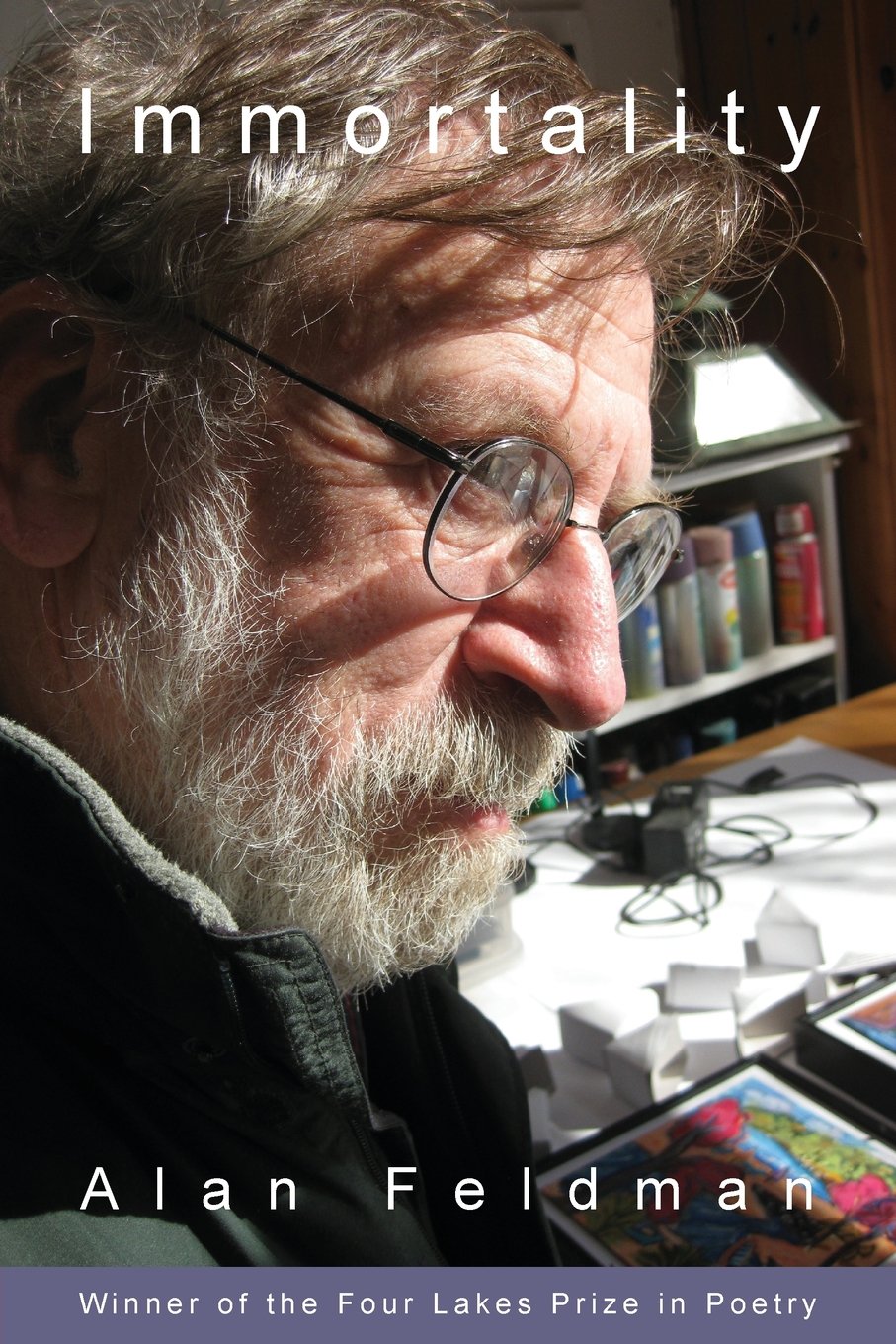
Immortality - Alan Feldman (University of Wisconsin Press)

Today's book of poetry:
Immortality.  Alan Feldman.  University of Wisconsin Press.  Madison, Wisconsin.  2015.
Winner of the Four Lakes Prize in Poetry


Alan Feldman reads like the gentlest of men but that doesn't stop him from taking you to the deep end of the pool.  Immortality is an emotional assault without aggression or violence.

Alan Feldman reads like the wisest of men.  These poems have that uncanny warmth you feel around a stranger whom you know is going to become a friend.

Alan Feldman reads like a poet bursting at the seams with loving reason and even seasoned hope.

The Afterlife

There's a lot of light in her apartment,
falling on the rented hospital bed.
I've been told the dying like to be held,
so, though we're just friends, I make myself
hold her hand, as if the conversation is final,
matters more than others, though most have mattered.

She's seen a couple of rabbis, who were helpful.
It seems there are Jewish angels. (Why argue?)
And she likes the story I brought her,
"The Death of Ivan Ilych," how before the end
he learns so much nobody knows about,
except the reader.

"So many faces," she says of the people who came
for the songfest yesterday evening, over a hundred
crowded into this little place. "Each face a flower.
Each face..." and here she pauses
(the medicines are affecting her word retrieval?)
"so full of memories."

It all makes a strange image in my head:
faces that aren't faces, but wide open,
as if she's discovering that she's lived
everything they have -- centuries
more than she thought.

"Our life in others," I remind her,
citing Pasternak, "that is our immortality."
But she knows that doesn't go far enough.

I'm glad she's thinking of her own afterlife,
since not being alive is, apparently, unthinkable
on the brink of it happening, a kind of shallowness
to imagine it's merely like going to sleep,
though lately her dreams have been so vivid:
an all-night argument with her sister about a dog,
over what color it should be, white or black.

Outside the weather appears to be changeable,
I'm dying to go out there, on the small terrace.

"Go out on the terrace," she says, "before you leave.
The view is wonderful."

...

Reading Immortality reminds Today's book of poetry of what it is we truly love about poetry.  We like to be moved by words.  We like our heart to pound in our chest when we read something we have just discovered but know to be true. 

These smart, smart poems avoid any melodrama or fuss, emotional or otherwise, with intelligent humour and a sensitive dash of pathos.  Whatever the emotional temperature called for, Feldman knows how to dial it in.

Feldman starts his conversation with the reader with his rejection of a suggested mantra, a plea from a friend to "drop the personal."  Today's book of poetry is familiar with that strident battle cry and is pleased to report that Feldman went the other way.

These are deeply personal poems full of universal good intent, maybe even a moral imperative. Today's book of poetry is never sure of anything but we're pretty certain about Feldman's Immortality.

Watch Battery

Who knows if my father ever thought
what Montaigne's father did: That every city
should have a place where people in need
could go to meet. How somewhere
a man is starving, and another with a surplus
would grieve if he only knew, and offer the man
a modest but reasonable living. That giving man
could have been my father. Not grieving, perhaps,
but regretful he couldn't be of more help --
a man you could trust to fix things.

Like the man who helped the watchmaker
fix my watch. How, when he couldn't decide
how to loosen the clasp that holds in the battery,
itself no bigger than a small coin,
without breaking it, he turned to someone
more experienced -- a Dutchman, actually,
who seemed happy to demonstrate this very skill,
and upload it to YouTube. Demonstrate it
with a camera in his lap, so we could see his two hands
familiarly, competently, and rapidly
opening the watch to replace the battery,
the way a father would automatically retie his son's shoes.

And there was also his calm voice with its accent,
like the woodcarver's in Pinnocchio,
telling the confused and despairing who were ready
to lose patience and snap the band holding the battery
and ruin the watch -- the watch that could keep running --
how to prolong its life by exercising patience,
the very quality my dad had in abundance,
that quality I always loved him for, of solving the problem
without getting exasperated. Though it's unfair
he didn't have parents like that himself.
Or that -- when the amount of pain rose to be greater
than any pleasure he'd be able to feel --
the little watch-sized defibrillator near his heart
wouldn't simply stop, and let him go.

...

Feldman's Immortality has travel poems for those that need to go somewhere and political poems for people who need to politicize.  There's a great kick at Walter Cronkite's can in a sailboat poem tart as the lemon and gin in a sunset cocktail.  

This morning's reading was attended by our bon ami Alexandre whose enthusiasm and energy gave us all a lift.  Immortality read like the best parts of a story you've been waiting to hear.  Odin, our quiet right hand man, made it clear he liked these poems and then he gave the room a solid once over, looked everyone in the eye.  Kathryn and Milo both read with warmth and grace, just like the poems asked for.

In November

When my daughter calls
and I can hear her baby
crying in the back seat
and she asks, "Dad, would you mind if I stop by
for a quick diaper change and feeding?" --

I'm so glad I picked up the phone,
glad I hadn't set off on my walk,
and quite soon I see her car rolling into the driveway,
and the baby is stretching open her little mouth
and wailing, as babies do --
so enraged not to be able to speak,
not even to be able to think this or that is wrong
except that the whole universe is wrong.

And when they're settled in the little bedroom off the kitchen,
and the baby is suckling noisily,
and then, contented once more,
rolling both eyes, not always in the same direction --
mother and baby in the bedroom
where my daughter herself was once diapered and fed --

I feel so thankful for never having strayed very far
into the wide world, never having served
in the foreign wars of my time, and grief for fathers
who do, the ones swaddled in flags --
maybe because yesterday was Veterans Day,
and though she says she's never done this before,
my daughter tells me she called up a soldier's family she knew
just to say she'd been thinking of them, just hoping
the war we have now will end soon.

And the thin November light is straining through the window curtains
we've never changed,
and I feel thankful for my years right here in this house
the way I imagine a tree might feel thankful
if it were given an opportunity to roam around the world--

how it might say, "So good of you, but no thank you,
where would the birds be without me here? --
the ones that fly back unpredictably
to perch in my thinning hair,
this and every November."

...

Ronald Wallace and the University of Wisconsin Press consistently send Today's book of poetry crackerjack fare.  Alan Feldman is a new discovery for Today's book of poetry and already we are a devoted admirer.

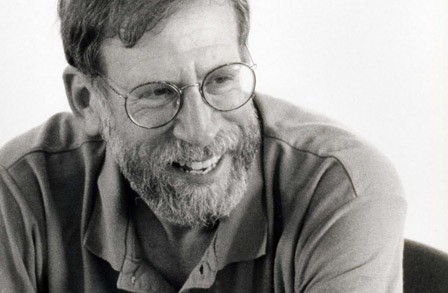
Alan Feldman

ABOUT THE AUTHOR
Alan Feldman is the author of several collections of poetry, including Immortality (2015), winner of the Four Lakes Prize; A Sail to Great Island (2004), winner of Pollak Prize for Poetry; and The Happy Genius (1978), winner of the annual George Elliston Book Award for the best collection published by a small, U.S. non-profit press. His work has appeared in the Atlantic Monthly, the New Yorker, and Kenyon Review, among many other magazines, and included in The Best American Poetry anthology in 2001 and 2011. Feldman's recent work appears in Hanging Loose, Cimarron Review, upstreet, Southern Review, Yale Review, Salamander, Southwest Review, Cincinnati Review, Catamaran, Worcester Review, and online in Boston Poetry Magazine and Cortland Review. His poem "A Man and A Woman" was featured in Tony Hoagland's 2013 article for Harper's, "Twenty Little Poems That Could Save America."

Feldman was a professor and chair of English at Framingham State University, and for 22 years taught the advanced creative writing class at Harvard University's Radcliffe Seminars. He offers free, drop-in poetry workshops at the Framingham (MA) public library near his home, and in the summer at the Wellfleet library.


BLURBS
“Alan Feldman is our greatest American poet of the household and family, as a loving, growing, struggling, and essential institution. He manifests the kind of love we rarely see in our poetry, and this familial love pours into the world around him. I am personally thankful every time I read an Alan Feldman poem, and Immortality, the book you are holding in your hands right now, makes us understand that immortality lies all about us, in everything we experience as a human being.”
     — Bill Zavatsky, author of Where X Marks the Spot

“A richly engaged, near flawless collection. Like those magic mineral waters pumped from deep in the earth, Feldman’s poems can cure emotional arthritis and ventilate the soul. Better poems than these cannot be written in this confiding, intelligent humanist mode.”
     — Tony Hoagland, author of Twenty Poems That Could Save America and Sweet Ruin

“These poems enact with grace and intelligence the process by which one comes to possess the life one is actually living. This is an enlarging journey that no reader of poetry will want to miss, offering the pleasures of discovery every step of the way.”
     — Carl Dennis, Pulitzer Prize–winning author of Practical Gods

“Alan Feldman’s poems offer the companionship of a witty, thoughtful, sometimes bewildered friend testing his life in language; telling it all. This is a heartening, deeply satisfying collection from a seasoned poet at the top of his game.”
     — Linda V. Bamber, author of Taking What I Like

Alan Feldman
reading In November
Video: Nan Hass Feldman


uwpress.wisc.edu

545
DISCLAIMERS

Poems cited here are assumed to be under copyright by the poet and/or publisher.  They are shown here for publicity and review purposes.  For any other kind of re-use of these poems, please contact the listed publishers for permission.

We here at TBOP are technically deficient and rely on our bashful Milo to fix everything.  We received notice from Google that we were using "cookies"
and that for our readers in Europe there had to be notification of the use of those "cookies.  Please be aware that TBOP may employ the use of some "cookies" (whatever they are) and you should take that into consideration.